The Chinese House, Good Fortune and Harmony with Nature
The ancient Chinese strongly
believed in the need to seek the assistance of gods and
spirits to bring good fortune in the form of wealth and sons,
and to provide protection from demons. For this reason,
the Chinese used the charms
and amulets which are discussed in great detail
throughout this website.
 Similarly, they desired for their houses,
temples and other buildings to be sited and oriented in a way
that would put them in harmony with the yin yang and qi forces of the heavens
and the earth. To meet this end, they developed a system
known as feng shui (fengshui 风水) or geomancy.
Similarly, they desired for their houses,
temples and other buildings to be sited and oriented in a way
that would put them in harmony with the yin yang and qi forces of the heavens
and the earth. To meet this end, they developed a system
known as feng shui (fengshui 风水) or geomancy.
"Feng" (风) means wind and "shui" (水) means water. Together they express the power of the flowing elements of nature. Through the proper understanding and application of feng shui principles, one can enjoy peace, good fortune, fertility and longevity.
While the principles of feng shui are vitally important prior to the construction of a structure, it is equally important that the appropriate charm and amulet accoutrements be placed during and after construction in order to promote good fortune and avoid disasters.
This article will briefly introduce the essential elements of feng shui to ensure harmony with nature and will also discuss the charms, amulets and other protective and "good luck" objects which have been used for hundreds of years in traditional Chinese houses to promote good fortune and avoid misfortune.
For an interesting and in-depth discussion on the use of old Chinese coins for feng shui purposes, please see Feng Shui Coins.
To cure the body, an acupuncturist will correct the flow of qi through the use of needles applied to acupuncture meridians.
Similarly, qi flows through the earth like underground streams which can constantly change their channels based on a number of factors. If the flow of qi is disrupted by changes to the surface of the earth by man or nature, bad things can happen.
As is the case with the acupuncturist, the proper practice of feng shui can help the earth's qi flow freely along its hidden veins and dragon lines with minimal obstruction by manipulating the location and orientation of houses, temples, pagodas, tombs, etc.
 The feng
shui practitioner frequently relies on a geomancer's compass
called a luo pan
(罗盘) or luojing
(罗经).
The feng
shui practitioner frequently relies on a geomancer's compass
called a luo pan
(罗盘) or luojing
(罗经).
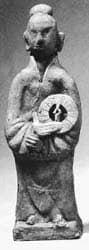
Shown here is a small earthenware figure of a man holding a luo pan. This figurine was excavated in 1985 from a tomb in Linchuan Prefecture (临川县) in Jiangxi (江西) Province. Chinese archeologists have dated the tomb to the year 1198 AD of the Southern Song Dynasty which means Chinese practitioners were using the luopan at least as early as this time period.
Written in black ink on the base of this tomb figure is 张仙人 which means "Zhang the Immortal".
A luo pan has a number of concentric rings with a south-pointing needle set within a yin-yang symbol in the center. The concentric rings represent the various relationships of heaven and earth as expressed through the symbols of the taiji (yin and yang), four seasons, Five Elements, Eight Trigrams (bagua), nine constellations, ten "Heavenly Stems", twelve "Earthly Branches", twenty-eight constellations or mansions, and sixty-year cycle. A proper understanding of these relationships will determine the merits of a prospective building site.
For example, a very good site would be one with a south-facing slope having a lake or river in front and a mountain range at the rear.
 Since the
breaking of the ground means disturbing the soil, appropriate
offerings must be made to the local deities.
Since the
breaking of the ground means disturbing the soil, appropriate
offerings must be made to the local deities.
To appease the "Earth God" (tudi gong 土地公 or fu de zheng shen 福德正神) and to repel evil spirits, there are offerings of fruit and incense.
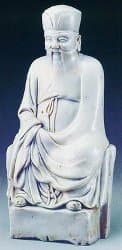
At the left is a porcelain sculpture of the "Earth God" which dates from the Ming Dynasty and is in the collection of the Xiamen Museum located in Xiamen (厦门), also known as Amoy, in Fujian Province (福建).
Peachwood slips written with Chinese characters and Daoist (Taoist) magic characters are also placed in the soil.
Finally, chicken blood is sprinkled over the site to repel evil spirits.
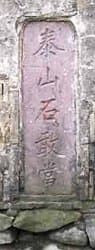 Sometimes
there is a "foundation stone" or "resisting stone" (shigandang 石敢当) placed
with the inscription "the stone of Taishan dares to resist" (taishanshi gandang 泰
山石敢当), or simply "Taishan is here" (taishan zai ci 泰山在
此).
Sometimes
there is a "foundation stone" or "resisting stone" (shigandang 石敢当) placed
with the inscription "the stone of Taishan dares to resist" (taishanshi gandang 泰
山石敢当), or simply "Taishan is here" (taishan zai ci 泰山在
此).
Tai Shan (taishan 泰山), located in Shandong Province, is one of the Five Sacred Mountains of China and its stones are believed to ward off evil, catastrophe and other unlucky influences.
An example of a Tai Shan "resisting stone" is shown at the left.
This "resisting stone" is embedded in a wall and the inscription reads "the stone of Taishan dares to resist" (taishanshi gandang 泰 山石敢当).
Proper positioning of the main gate is critical because this determines the ultimate placement of the ridgepole.
The ridgepole is the main cross beam located at the top of the house which provides major support for the roof. It is one of the most critical components of a house and its installation requires a special ceremony.
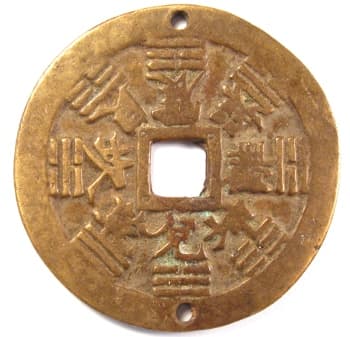 The ridgepole is
usually painted an auspicious red
color and a charm with the "Eight Trigrams" or bagua (八卦), sometimes
including the taiji (太
极) symbol, is commonly attached.
The ridgepole is
usually painted an auspicious red
color and a charm with the "Eight Trigrams" or bagua (八卦), sometimes
including the taiji (太
极) symbol, is commonly attached.
An example of an Eight Trigrams charm is shown at the left.
A "trigram" is a three-lined symbol. Each of the three lines can either be continuous or broken. A straight line represents yang (阳) and a broken line represents yin (阴). Yin Yang (阴阳) is the Chinese term for the basic polarities of the universe, such as male/female, light/dark, strong/weak, etc. There are eight possible combinations of these trigrams and they are known collectively as the Eight Trigrams or bagua (八卦).
The two holes on this particular charm indicate that it may have been attached to a ridgepole sometime in its past.
The charm has a diameter of 39 mm and a weight of 11.5 grams.
(For a detailed discussion of this type of charm, please see The Book of Changes and Bagua Charms.)
Red paper and cloth banners are hung from the ridgepole during its hoisting. These banners have such auspicious sayings as:
In addition to the banners, other objects symbolizing fertility and prosperity are frequently attached to the ridgepole such as:
There may be times when carpenters and masons feel they have not been treated properly. If workers feel they have been mistreated in any way, they might seek revenge by secretly hiding objects within the framework of the building which would bring misfortune to the familiy.
Some of these objects are made simply of paper or straw. For example, a paper drawing, or a figurine made of straw, hidden in the infrastructure could become a ghost which would haunt the house. Or, a small straw man together with a match could in the future cause a fire which would destroy the structure.
Other objects which can be secretly hidden and can bring misfortune include a broken rice bowl with a pair of chopsticks, or the tail of a pig, or a cart with cash coins headed away from the house. All of these would portend poverty and hardship for the family.
On the other hand, if the builders feel they were well treated they might hide objects believed to bring good luck. For example, it is believed that copper cash coins with their inscription (obverse) side facing downward and placed on one of the main beams of the ceiling will bring wealth to a family.
Promoting Good Fortune and
Averting Misfortune After Construction
To counter any possible vengeance by the carpenters and
masons, as well as shortcomings regarding the feng shui of the
location, a family might install a variety of objects as a
means of defense.
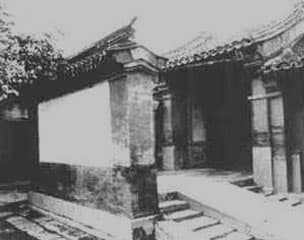 "Screen walls" (yingbi 影 壁) or
"spirit walls" are placed in courtyards in front of doors.
"Screen walls" (yingbi 影 壁) or
"spirit walls" are placed in courtyards in front of doors.
The image at the left is an old photograph of a traditional Chinese house in Beijing (Peking), known as a siheyuan (四合院) or "Chinese quadrangle", where the buildings surround an internal courtyard.
A "screen wall" can be seen in front of the entrance to one of the buildings.
The Chinese believe that there exist spirits intent on causing harm. There are also ghosts who do not have anyone who will offer sacrifices for them and, as a consequence, will try to create calamities and disasters for a family.
Ghosts like to travel in straight lines and a "screen wall" requires them to go around to gain entrance to an interior room.
It is also believed that a ghost approaching a "screen wall" will see its own image or shadow on the wall and be scared away.
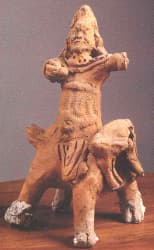 An earthenware statue of the
"Roof-Tile General" (wajiangjun
瓦将军) might be placed on the roof to neutralize any negative
influences from nearby roofs or walls.
An earthenware statue of the
"Roof-Tile General" (wajiangjun
瓦将军) might be placed on the roof to neutralize any negative
influences from nearby roofs or walls.
The image at the left is an example of a Roof-Tile General, approximately 25 cm (9.8 inches) in height, dating from the Qing (Ch'ing) Dynasty (1644-1911) and displayed at an exhibition of ancient artifacts from Jinmen (金门).
A cloth bearing a government official's seal (yin fu zi 印幅子) is sometimes hung in the house. Because a government official's orders and proclamations convey great authority among the living, it is believed to also carry such authority among evil spirits.
A mirror, and especially a concave or "inverting" mirror, is often hung above a doorway. It is believed that a ghost will flee if it sees its own reflection. Since a concave mirror will invert the image of the ghost, it is believed that it will also "overturn" any evil influences.
Another very popular form of protection is to place images of famous generals, immortals and gods throughout the house.
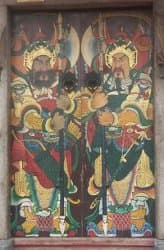
It is quite common for traditional Chinese houses to display images of the "door gods".
The "door gods" or "gate gods" (menshen 门神) are fiercesome-looking Chinese usually seen brandishing weapons such as swords or, as shown here, halberds.
The "door gods" are based on a story originating from the 3rd Century BC of Shen Tu (神荼) and Yu Lei (郁 垒) who were ordered by the Emperor of Heaven (Tiandi 天帝) to protect humans from evil spirits.
As seen in the picture at the left, their images are frequently hung on both sides of a door or gate.
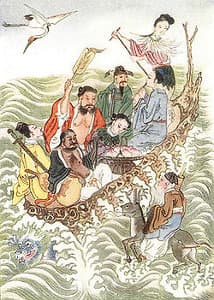 Images of the Daoist Eight
Immortals, or baxian (八仙),
are also very popular and often seen in old Chinese houses.
Images of the Daoist Eight
Immortals, or baxian (八仙),
are also very popular and often seen in old Chinese houses.
They are considered symbols of longevity, happiness and prosperity.
At the left is an illustration of the famous story "The Eight Immortals Cross the Sea" (ba xian guo hai 八仙过海).
Each member of the group is seen as a folk hero with special magical skills able to live an eternally carefree and fun-loving life.
Some members of the group are only legends while others were actual historical figures.
For example, the immortal in the red robe holding a feather fan above his head is the historical Han Zhongli. Another historical figure is Zhang Guolao who is the immortal riding the donkey or mule to the right of the boat.
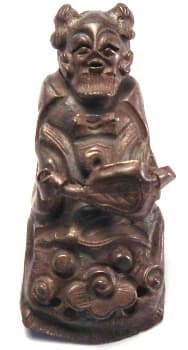
Han Zhongli (汉锺离), also known as Zhongli Quan (锺离权), is one of the Daoist Eight Immortals shown in the above illustration.
He is believed to have been an army general during the Han Dynasty (206 BC - 220 AD).
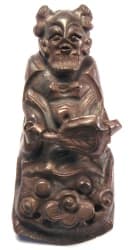
As represented by the small bronze statue at the left, he is usually depicted as a bearded old man, with tufts of hair coiled on each side of his head, who enjoyed drinking wine.
Han Zhongli is usually shown carrying a feather fan, as can be seen here, which he used to revive the dead.
This statue, which dates from the Qing (Ch'ing) Dynasty (1644-1911), is 42 mm in height and 18 mm in width.
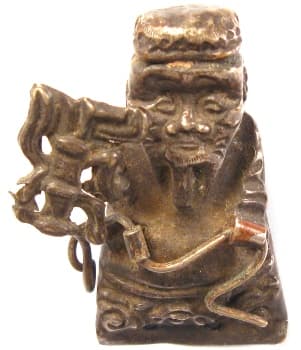 The small bronze
statue at the left is Zhang Guolao (张果老), also
known as the "Elder Zhang Guo", who is another of the Eight
Immortals illustrated above in "The Eight Immortals
Cross the Sea".
The small bronze
statue at the left is Zhang Guolao (张果老), also
known as the "Elder Zhang Guo", who is another of the Eight
Immortals illustrated above in "The Eight Immortals
Cross the Sea".
Zhang Guolao was a Daoist hermit who lived during the Tang Dynasty (618-907).
He is frequently shown riding a donkey or mule, sometimes backwards, and carrying an ancient Chinese musical instrument known as a yugu (鱼鼓).
Zhang Guolao is shown here holding his yugu or "fish drum" which was a tube-shaped bamboo musical instrument that was beaten with two rods.
Zhang Guolao had the ability to make himself invisible. He also could take his mule, fold it and place it in his bamboo wallet. When he needed the mule, he would take it out of his wallet, spray water on it from his mouth, and the mule would regain its original form.
This house statue is also from the Qing (Ch'ing) Dynasty. It has a height of 39 mm and a width of 27 mm.
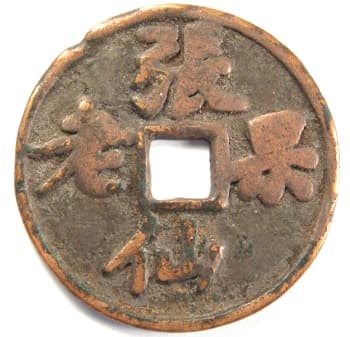
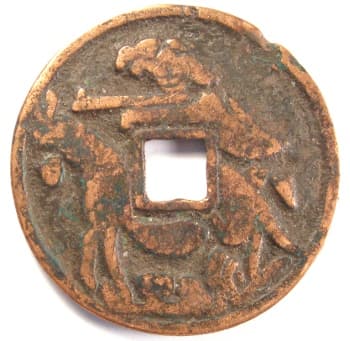
This is another representation of Zhang Guolao (张果 老) but in the form of a charm.
The obverse side (far left) of this old Chinese charm has the inscription zhang guo lao xian (张果老仙) which translates as "the immortal Zhang Guolao).
The reverse side (near left) depicts Zhang Guolao riding his donkey or mule and carrying his musical instrument the yugu (鱼鼓).
This charm has a diameter of 34 mm and a weight of 12 grams.
An image of the God of War (guandi 关 帝), also known as Guan Yu (关 羽) or Guan Gong (关公) (Emperor Guan), is also commonly seen in Chinese houses. The God of War fights evil with a large broadsword.
Pictures of another fearsome slayer of evil spirits wielding his sword and seen in Chinese houses is Zhong Kui (钟馗), the "Demon Slayer".
Zhang Daoling (张 道陵), the "Celestial Master" who established the first organized Daoist religious sect known as the "Five Bushels of Rice" ("Five Pecks of Rice" or Wudou Mi Dao 五斗米道), is believed to have the power to expel demons and his image is, therefore, commonly seen hanging on walls of Chinese homes.
 As
mentioned earlier, the "Eight Trigrams" or bagua is considered to be
a powerful symbol that is detested by evil spirits.
Besides being attached to the
ridgepole during construction of a house, an Eight
Trigram amulet is frequently placed on a main gate or door.
As
mentioned earlier, the "Eight Trigrams" or bagua is considered to be
a powerful symbol that is detested by evil spirits.
Besides being attached to the
ridgepole during construction of a house, an Eight
Trigram amulet is frequently placed on a main gate or door.
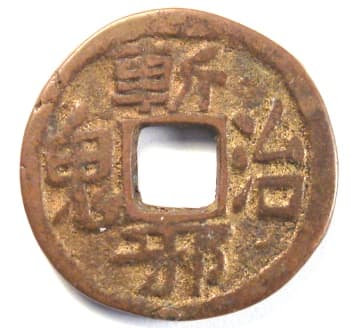
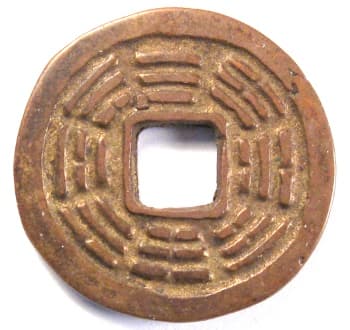
An example of such an amulet displaying the Eight Trigrams is shown here.
The inscription (far left) reads zhan zhi xie gui (斩治邪鬼) which means "behead and punish the demons".
This amulet has a diameter of 21 mm and a weight of 4.4 grams.
The image of a tiger is sometimes hung over a door. Cleverly forming the wrinkles on the tiger's forehead is the Chinese character wang (王) which means "king". This is another authority figure which further enhances the power of the tiger to drive away evil spirits.
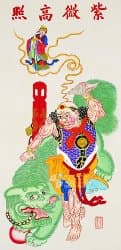
An image of a human figure is sometimes shown either riding or standing next to a tiger.
This is the "Polar Diety" who is also known as the "Purple Polar Star" and the "Purple Planet".
The Polar Diety is usually shown with a banner stating "the purple polar star shines directly" (zi wei gao zhao 紫微高照) to scare away demons.
An example of such a paper print is shown here from the collection of the National Museum of History in Taipei, Taiwan.
Besides seeking protection from the supernatural, a family will also incorporate measures against natural enemies. Summertime, for example, brings a host of dangerous pests such as snakes, scorpions, spiders, etc. These poisonous animals are collectively known as "The Five Poisons".
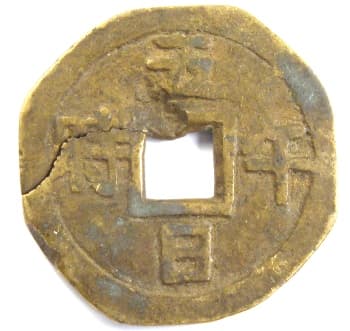
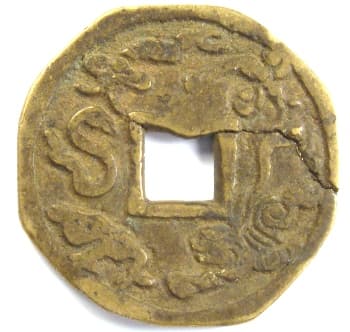 According
to
the traditional Chinese calendar, the fifth day of the fifth
month is the most dangerous time for these pests.
According
to
the traditional Chinese calendar, the fifth day of the fifth
month is the most dangerous time for these pests.
Families will nail a "Five Poison" amulet, such as the one at the left, on a door or gate as a form of protection.
If you look closely at the inscription side of this amulet (far left), you can see the depression left by a nail at the upper left corner of the square hole.
For a detailed discussion of this amulet please see Five Poison Charms.
Families also like to hang sweet flag (calamus) on doors and gates during the summer because its leaves resemble "swords".
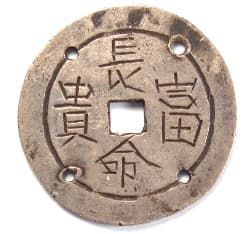 The Chinese will take
every measure possible to promote "good fortune" for the
family and may nail a good luck charm, such as the one on the
left, on a gate or wall.
The Chinese will take
every measure possible to promote "good fortune" for the
family and may nail a good luck charm, such as the one on the
left, on a gate or wall.
The inscription reads chang ming fu gui (长命富贵) which means "longevity, wealth and honor".
The reverse side of the charm states that it is made of "fine silver" (纹银) and was made in Hong Kong (香港) by He Bao Xiang (河宝样).
This charm was probably made during the 1890's.
The charm has a diameter of 18.5 mm and a weight of 1.5 grams.
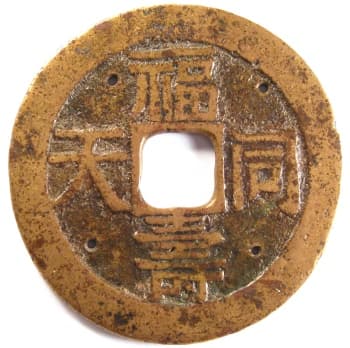 This is another "good fortune" charm.
The four small holes indicate that it, too, was probably mounted to a wall or gate at sometime in the past.
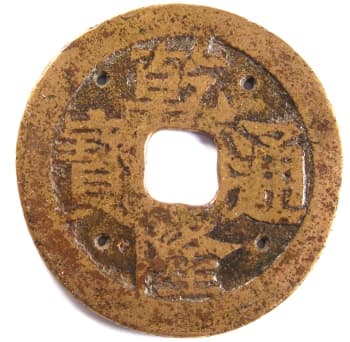
This particular charm was made during the Qing (Ch'ing) Dynasty at the mint in Jiangsu Province.
The obverse side (far left) has the inscription qian long tong bao (乾 隆通宝) which is the same inscription found on the cash coins cast during the reign of Emperor Gao Zong (1736-1795).
The reverse side has the auspicious inscription fu shou tong tian (福寿同天) which translates as "good fortune and longevity on the same day".
While this charm very closely resembles a Qing Dynasty cash coin, it is actually much larger. The charm has a diameter of 38 mm and a weight of 10.6 grams.
 One of the most popular
"good luck" motifs found in old Chinese houses consists of
five bats (fu
蝠) surrounding the Chinese character shou (壽) which means
"longevity".
One of the most popular
"good luck" motifs found in old Chinese houses consists of
five bats (fu
蝠) surrounding the Chinese character shou (壽) which means
"longevity".
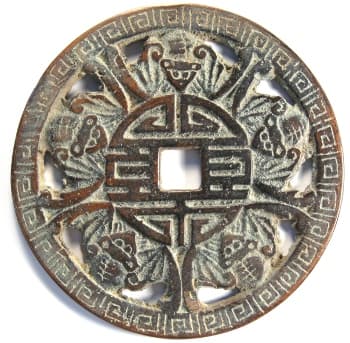
At the left is an example of an old Chinese "open work" charm with this design and which is known to the Chinese as wu fu peng shou (五 福捧寿) or "five fortunes surround longevity".
At the very center is a large and very stylized shou (壽) character which translates as "longevity".
Surrounding this character are five bats. A bat (fu 蝠) is a visual pun or rebus for "good fortune" or happiness (fu 福) because both characters have exactly the same pronunciation.
The "five bats" represent the "Five Blessings", also known as the "Five Happinesses" or "Five Good Fortunes". The "five blessings" are longevity (寿), wealth (富), health and composure (康宁), virtue (修好德), and the desire to die a natural death in old age (考 终命).
This old bronze charm has a diameter of 71 mm.
The bat and longevity symbols are sometimes incorporated directly into the design of a house. An outstanding example of a Qing Dynasty carved wooden window with the theme "Four Happinesses surround longevity" (si fu peng shou 四福捧寿) is discussed in detail at "Four Happinesses Window".
Woodblock prints, paper cutouts and "couplets" are also very commonly found hanging on walls and doors of traditional Chinese homes.
Perhaps the most frequently seen print is that of Zaojun (灶君), also known as Zaowang (灶王), who is the "Kitchen God" or "Stove God".
Despite the name, Zaojun is not concerned with cooking but, rather, is the god in charge of the household.
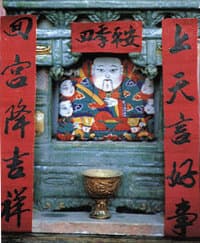 As can be seen at the left, his
image is frequently placed in an altar where offerings of
incense, candles, and food are made in his honor.
As can be seen at the left, his
image is frequently placed in an altar where offerings of
incense, candles, and food are made in his honor.
The parallel couplets written on red paper to the right and left of Zaojun read shang tian yan hao shi (上天言好事) and hui gong jiang ji xiang (回宫降吉祥) which translates as "ascend to heaven and speak of good deeds" and "return to your palace and bring good fortune".
The inscription above Zaojun reads si ji ping an (四季平安) which means "peace for the four seasons".
Zaojun observes all activities of the family members. Just before the lunar new year ("Chinese New Year" nongli xinnian 农历新年 or "Spring Festival" chunjie 春节) on the twenty-third day of the twelfth lunar month, the family will burn the print allowing Zaojun to ascend to heaven on the smoke in order to report on the family's good and bad deeds of the past year to the Jade Emperor of Heaven (yuhuang 玉皇, yudi 玉帝). Good or bad fortune for the new year is dependent on Zaojun's report. So, to maximize prospects for a good report, the head of the household will smear sugar paste over Zaojun's mouth, or place a glass of wine in front of Zaojun, before burning the print.
Then, at the start of the New Year, a new print of Zaojun is pasted on the wall so that he can continue his work of observing and reporting and thereby ensuring "good fortune" for the family.
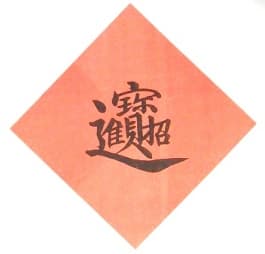 Also for
the New Year, Chinese families will hang nianhua (年画) or "New
Year's pictures" inside the house. Most of these are
pictures associated with good fortune.
Also for
the New Year, Chinese families will hang nianhua (年画) or "New
Year's pictures" inside the house. Most of these are
pictures associated with good fortune.
At the left is an example of a New Year's picture with an auspicious inscription on a diamond-shaped red paper.
The inscription is zhao cai jin bao (招财进宝) which roughly translates as "money and treasures will be plentiful" or "attracts wealth and treasure".
The inscription is written in a unique linked character style (lian zi gua pai 连字挂牌) which is discussed at Ancient Chinese Pendant Charms.
On the outside gate or door are hung duilian (对联) or "New Year's couplets". These are Chinese phrases written on red strips of paper and pasted vertically on each side of the front gate. These are also known as "spring couplets" (chunlian 春联) and "door couplets" (menlian 门联) and are derived from the peachwood charms (taofu 桃 符) that originated during the Han Dynasty.
Return to Ancient Chinese Charms and Coins
Similarly, they desired for their houses,
temples and other buildings to be sited and oriented in a way
that would put them in harmony with the yin yang and qi forces of the heavens
and the earth. To meet this end, they developed a system
known as feng shui (fengshui 风水) or geomancy."Feng" (风) means wind and "shui" (水) means water. Together they express the power of the flowing elements of nature. Through the proper understanding and application of feng shui principles, one can enjoy peace, good fortune, fertility and longevity.
While the principles of feng shui are vitally important prior to the construction of a structure, it is equally important that the appropriate charm and amulet accoutrements be placed during and after construction in order to promote good fortune and avoid disasters.
This article will briefly introduce the essential elements of feng shui to ensure harmony with nature and will also discuss the charms, amulets and other protective and "good luck" objects which have been used for hundreds of years in traditional Chinese houses to promote good fortune and avoid misfortune.
For an interesting and in-depth discussion on the use of old Chinese coins for feng shui purposes, please see Feng Shui Coins.
Feng Shui
The Chinese have long believed in the primal life force known as qi (ch'i 气 ). When qi flows naturally in a person, there is good health. When there are obstacles to the flow and the qi becomes stagnant, there is disease.To cure the body, an acupuncturist will correct the flow of qi through the use of needles applied to acupuncture meridians.
Similarly, qi flows through the earth like underground streams which can constantly change their channels based on a number of factors. If the flow of qi is disrupted by changes to the surface of the earth by man or nature, bad things can happen.
As is the case with the acupuncturist, the proper practice of feng shui can help the earth's qi flow freely along its hidden veins and dragon lines with minimal obstruction by manipulating the location and orientation of houses, temples, pagodas, tombs, etc.
The feng
shui practitioner frequently relies on a geomancer's compass
called a luo pan
(罗盘) or luojing
(罗经).Shown here is a small earthenware figure of a man holding a luo pan. This figurine was excavated in 1985 from a tomb in Linchuan Prefecture (临川县) in Jiangxi (江西) Province. Chinese archeologists have dated the tomb to the year 1198 AD of the Southern Song Dynasty which means Chinese practitioners were using the luopan at least as early as this time period.
Written in black ink on the base of this tomb figure is 张仙人 which means "Zhang the Immortal".
A luo pan has a number of concentric rings with a south-pointing needle set within a yin-yang symbol in the center. The concentric rings represent the various relationships of heaven and earth as expressed through the symbols of the taiji (yin and yang), four seasons, Five Elements, Eight Trigrams (bagua), nine constellations, ten "Heavenly Stems", twelve "Earthly Branches", twenty-eight constellations or mansions, and sixty-year cycle. A proper understanding of these relationships will determine the merits of a prospective building site.
For example, a very good site would be one with a south-facing slope having a lake or river in front and a mountain range at the rear.
Charms and Amulets Placed during Construction
Once a house is properly
sited according to feng shui principles, house construction
can begin. During the building process, "charm"
objects are usually installed to ensure that the structure
is conducive to summoning good fortune. Similarly,
certain "amulet" objects are placed to provide protection
from adversity.
The construction process also involves making offerings, burning incense, and affixing inscriptions in order to secure good luck and prosperity.
The construction process also involves making offerings, burning incense, and affixing inscriptions in order to secure good luck and prosperity.
Since the
breaking of the ground means disturbing the soil, appropriate
offerings must be made to the local deities.To appease the "Earth God" (tudi gong 土地公 or fu de zheng shen 福德正神) and to repel evil spirits, there are offerings of fruit and incense.
At the left is a porcelain sculpture of the "Earth God" which dates from the Ming Dynasty and is in the collection of the Xiamen Museum located in Xiamen (厦门), also known as Amoy, in Fujian Province (福建).
Peachwood slips written with Chinese characters and Daoist (Taoist) magic characters are also placed in the soil.
Finally, chicken blood is sprinkled over the site to repel evil spirits.
Sometimes
there is a "foundation stone" or "resisting stone" (shigandang 石敢当) placed
with the inscription "the stone of Taishan dares to resist" (taishanshi gandang 泰
山石敢当), or simply "Taishan is here" (taishan zai ci 泰山在
此).Tai Shan (taishan 泰山), located in Shandong Province, is one of the Five Sacred Mountains of China and its stones are believed to ward off evil, catastrophe and other unlucky influences.
An example of a Tai Shan "resisting stone" is shown at the left.
This "resisting stone" is embedded in a wall and the inscription reads "the stone of Taishan dares to resist" (taishanshi gandang 泰 山石敢当).
Proper positioning of the main gate is critical because this determines the ultimate placement of the ridgepole.
The ridgepole is the main cross beam located at the top of the house which provides major support for the roof. It is one of the most critical components of a house and its installation requires a special ceremony.
The ridgepole is
usually painted an auspicious red
color and a charm with the "Eight Trigrams" or bagua (八卦), sometimes
including the taiji (太
极) symbol, is commonly attached.An example of an Eight Trigrams charm is shown at the left.
A "trigram" is a three-lined symbol. Each of the three lines can either be continuous or broken. A straight line represents yang (阳) and a broken line represents yin (阴). Yin Yang (阴阳) is the Chinese term for the basic polarities of the universe, such as male/female, light/dark, strong/weak, etc. There are eight possible combinations of these trigrams and they are known collectively as the Eight Trigrams or bagua (八卦).
The two holes on this particular charm indicate that it may have been attached to a ridgepole sometime in its past.
The charm has a diameter of 39 mm and a weight of 11.5 grams.
(For a detailed discussion of this type of charm, please see The Book of Changes and Bagua Charms.)
Red paper and cloth banners are hung from the ridgepole during its hoisting. These banners have such auspicious sayings as:
The Protector Jiang Taigong
is here (jiang
tai gong zai ci 姜太公在此) (Jiang Taigong was a
great Zhou Dynasty military advisor)
In addition to the banners, other objects symbolizing fertility and prosperity are frequently attached to the ridgepole such as:
A bamboo sieve because
its many square holes are the same shape (口) as the Chinese
character for "mouths" (kou
口).The Chinese sometimes refer to people as
"mouths". A large number of "mouths", as illustrated
by the many holes of a sieve, expresses the wish for a large
family. Some also believe that the holes resemble
"eyes" which will scare evil spirits away.
Red chopsticks are
sometimes attached to the ridgepole. The color red is
considered very auspicious and the chopsticks symbolize the hope for
having many children quickly. This is because the
pronunciation of "chopsticks" (kuai zi 筷子) sounds
the same as saying "fast"(kuai 快) "sons" (zi 子).
There may be times when carpenters and masons feel they have not been treated properly. If workers feel they have been mistreated in any way, they might seek revenge by secretly hiding objects within the framework of the building which would bring misfortune to the familiy.
Some of these objects are made simply of paper or straw. For example, a paper drawing, or a figurine made of straw, hidden in the infrastructure could become a ghost which would haunt the house. Or, a small straw man together with a match could in the future cause a fire which would destroy the structure.
Other objects which can be secretly hidden and can bring misfortune include a broken rice bowl with a pair of chopsticks, or the tail of a pig, or a cart with cash coins headed away from the house. All of these would portend poverty and hardship for the family.
On the other hand, if the builders feel they were well treated they might hide objects believed to bring good luck. For example, it is believed that copper cash coins with their inscription (obverse) side facing downward and placed on one of the main beams of the ceiling will bring wealth to a family.
Promoting Good Fortune and
Averting Misfortune After Construction
To counter any possible vengeance by the carpenters and
masons, as well as shortcomings regarding the feng shui of the
location, a family might install a variety of objects as a
means of defense."Screen walls" (yingbi 影 壁) or
"spirit walls" are placed in courtyards in front of doors.The image at the left is an old photograph of a traditional Chinese house in Beijing (Peking), known as a siheyuan (四合院) or "Chinese quadrangle", where the buildings surround an internal courtyard.
A "screen wall" can be seen in front of the entrance to one of the buildings.
The Chinese believe that there exist spirits intent on causing harm. There are also ghosts who do not have anyone who will offer sacrifices for them and, as a consequence, will try to create calamities and disasters for a family.
Ghosts like to travel in straight lines and a "screen wall" requires them to go around to gain entrance to an interior room.
It is also believed that a ghost approaching a "screen wall" will see its own image or shadow on the wall and be scared away.
An earthenware statue of the
"Roof-Tile General" (wajiangjun
瓦将军) might be placed on the roof to neutralize any negative
influences from nearby roofs or walls.The image at the left is an example of a Roof-Tile General, approximately 25 cm (9.8 inches) in height, dating from the Qing (Ch'ing) Dynasty (1644-1911) and displayed at an exhibition of ancient artifacts from Jinmen (金门).
A cloth bearing a government official's seal (yin fu zi 印幅子) is sometimes hung in the house. Because a government official's orders and proclamations convey great authority among the living, it is believed to also carry such authority among evil spirits.
A mirror, and especially a concave or "inverting" mirror, is often hung above a doorway. It is believed that a ghost will flee if it sees its own reflection. Since a concave mirror will invert the image of the ghost, it is believed that it will also "overturn" any evil influences.
Another very popular form of protection is to place images of famous generals, immortals and gods throughout the house.
It is quite common for traditional Chinese houses to display images of the "door gods".
The "door gods" or "gate gods" (menshen 门神) are fiercesome-looking Chinese usually seen brandishing weapons such as swords or, as shown here, halberds.
The "door gods" are based on a story originating from the 3rd Century BC of Shen Tu (神荼) and Yu Lei (郁 垒) who were ordered by the Emperor of Heaven (Tiandi 天帝) to protect humans from evil spirits.
As seen in the picture at the left, their images are frequently hung on both sides of a door or gate.
Images of the Daoist Eight
Immortals, or baxian (八仙),
are also very popular and often seen in old Chinese houses.They are considered symbols of longevity, happiness and prosperity.
At the left is an illustration of the famous story "The Eight Immortals Cross the Sea" (ba xian guo hai 八仙过海).
Each member of the group is seen as a folk hero with special magical skills able to live an eternally carefree and fun-loving life.
Some members of the group are only legends while others were actual historical figures.
For example, the immortal in the red robe holding a feather fan above his head is the historical Han Zhongli. Another historical figure is Zhang Guolao who is the immortal riding the donkey or mule to the right of the boat.
Han Zhongli (汉锺离), also known as Zhongli Quan (锺离权), is one of the Daoist Eight Immortals shown in the above illustration.
He is believed to have been an army general during the Han Dynasty (206 BC - 220 AD).
As represented by the small bronze statue at the left, he is usually depicted as a bearded old man, with tufts of hair coiled on each side of his head, who enjoyed drinking wine.
Han Zhongli is usually shown carrying a feather fan, as can be seen here, which he used to revive the dead.
This statue, which dates from the Qing (Ch'ing) Dynasty (1644-1911), is 42 mm in height and 18 mm in width.
The small bronze
statue at the left is Zhang Guolao (张果老), also
known as the "Elder Zhang Guo", who is another of the Eight
Immortals illustrated above in "The Eight Immortals
Cross the Sea".Zhang Guolao was a Daoist hermit who lived during the Tang Dynasty (618-907).
He is frequently shown riding a donkey or mule, sometimes backwards, and carrying an ancient Chinese musical instrument known as a yugu (鱼鼓).
Zhang Guolao is shown here holding his yugu or "fish drum" which was a tube-shaped bamboo musical instrument that was beaten with two rods.
Zhang Guolao had the ability to make himself invisible. He also could take his mule, fold it and place it in his bamboo wallet. When he needed the mule, he would take it out of his wallet, spray water on it from his mouth, and the mule would regain its original form.
This house statue is also from the Qing (Ch'ing) Dynasty. It has a height of 39 mm and a width of 27 mm.
This is another representation of Zhang Guolao (张果 老) but in the form of a charm.
The obverse side (far left) of this old Chinese charm has the inscription zhang guo lao xian (张果老仙) which translates as "the immortal Zhang Guolao).
The reverse side (near left) depicts Zhang Guolao riding his donkey or mule and carrying his musical instrument the yugu (鱼鼓).
This charm has a diameter of 34 mm and a weight of 12 grams.
An image of the God of War (guandi 关 帝), also known as Guan Yu (关 羽) or Guan Gong (关公) (Emperor Guan), is also commonly seen in Chinese houses. The God of War fights evil with a large broadsword.
Pictures of another fearsome slayer of evil spirits wielding his sword and seen in Chinese houses is Zhong Kui (钟馗), the "Demon Slayer".
Zhang Daoling (张 道陵), the "Celestial Master" who established the first organized Daoist religious sect known as the "Five Bushels of Rice" ("Five Pecks of Rice" or Wudou Mi Dao 五斗米道), is believed to have the power to expel demons and his image is, therefore, commonly seen hanging on walls of Chinese homes.
As
mentioned earlier, the "Eight Trigrams" or bagua is considered to be
a powerful symbol that is detested by evil spirits.
Besides being attached to the
ridgepole during construction of a house, an Eight
Trigram amulet is frequently placed on a main gate or door.An example of such an amulet displaying the Eight Trigrams is shown here.
The inscription (far left) reads zhan zhi xie gui (斩治邪鬼) which means "behead and punish the demons".
This amulet has a diameter of 21 mm and a weight of 4.4 grams.
The image of a tiger is sometimes hung over a door. Cleverly forming the wrinkles on the tiger's forehead is the Chinese character wang (王) which means "king". This is another authority figure which further enhances the power of the tiger to drive away evil spirits.
An image of a human figure is sometimes shown either riding or standing next to a tiger.
This is the "Polar Diety" who is also known as the "Purple Polar Star" and the "Purple Planet".
The Polar Diety is usually shown with a banner stating "the purple polar star shines directly" (zi wei gao zhao 紫微高照) to scare away demons.
An example of such a paper print is shown here from the collection of the National Museum of History in Taipei, Taiwan.
Besides seeking protection from the supernatural, a family will also incorporate measures against natural enemies. Summertime, for example, brings a host of dangerous pests such as snakes, scorpions, spiders, etc. These poisonous animals are collectively known as "The Five Poisons".
According
to
the traditional Chinese calendar, the fifth day of the fifth
month is the most dangerous time for these pests.Families will nail a "Five Poison" amulet, such as the one at the left, on a door or gate as a form of protection.
If you look closely at the inscription side of this amulet (far left), you can see the depression left by a nail at the upper left corner of the square hole.
For a detailed discussion of this amulet please see Five Poison Charms.
Families also like to hang sweet flag (calamus) on doors and gates during the summer because its leaves resemble "swords".
The Chinese will take
every measure possible to promote "good fortune" for the
family and may nail a good luck charm, such as the one on the
left, on a gate or wall.The inscription reads chang ming fu gui (长命富贵) which means "longevity, wealth and honor".
The reverse side of the charm states that it is made of "fine silver" (纹银) and was made in Hong Kong (香港) by He Bao Xiang (河宝样).
This charm was probably made during the 1890's.
The charm has a diameter of 18.5 mm and a weight of 1.5 grams.
This is another "good fortune" charm.The four small holes indicate that it, too, was probably mounted to a wall or gate at sometime in the past.
This particular charm was made during the Qing (Ch'ing) Dynasty at the mint in Jiangsu Province.
The obverse side (far left) has the inscription qian long tong bao (乾 隆通宝) which is the same inscription found on the cash coins cast during the reign of Emperor Gao Zong (1736-1795).
The reverse side has the auspicious inscription fu shou tong tian (福寿同天) which translates as "good fortune and longevity on the same day".
While this charm very closely resembles a Qing Dynasty cash coin, it is actually much larger. The charm has a diameter of 38 mm and a weight of 10.6 grams.
One of the most popular
"good luck" motifs found in old Chinese houses consists of
five bats (fu
蝠) surrounding the Chinese character shou (壽) which means
"longevity".At the left is an example of an old Chinese "open work" charm with this design and which is known to the Chinese as wu fu peng shou (五 福捧寿) or "five fortunes surround longevity".
At the very center is a large and very stylized shou (壽) character which translates as "longevity".
Surrounding this character are five bats. A bat (fu 蝠) is a visual pun or rebus for "good fortune" or happiness (fu 福) because both characters have exactly the same pronunciation.
The "five bats" represent the "Five Blessings", also known as the "Five Happinesses" or "Five Good Fortunes". The "five blessings" are longevity (寿), wealth (富), health and composure (康宁), virtue (修好德), and the desire to die a natural death in old age (考 终命).
This old bronze charm has a diameter of 71 mm.
The bat and longevity symbols are sometimes incorporated directly into the design of a house. An outstanding example of a Qing Dynasty carved wooden window with the theme "Four Happinesses surround longevity" (si fu peng shou 四福捧寿) is discussed in detail at "Four Happinesses Window".
Woodblock prints, paper cutouts and "couplets" are also very commonly found hanging on walls and doors of traditional Chinese homes.
Perhaps the most frequently seen print is that of Zaojun (灶君), also known as Zaowang (灶王), who is the "Kitchen God" or "Stove God".
Despite the name, Zaojun is not concerned with cooking but, rather, is the god in charge of the household.
As can be seen at the left, his
image is frequently placed in an altar where offerings of
incense, candles, and food are made in his honor.The parallel couplets written on red paper to the right and left of Zaojun read shang tian yan hao shi (上天言好事) and hui gong jiang ji xiang (回宫降吉祥) which translates as "ascend to heaven and speak of good deeds" and "return to your palace and bring good fortune".
The inscription above Zaojun reads si ji ping an (四季平安) which means "peace for the four seasons".
Zaojun observes all activities of the family members. Just before the lunar new year ("Chinese New Year" nongli xinnian 农历新年 or "Spring Festival" chunjie 春节) on the twenty-third day of the twelfth lunar month, the family will burn the print allowing Zaojun to ascend to heaven on the smoke in order to report on the family's good and bad deeds of the past year to the Jade Emperor of Heaven (yuhuang 玉皇, yudi 玉帝). Good or bad fortune for the new year is dependent on Zaojun's report. So, to maximize prospects for a good report, the head of the household will smear sugar paste over Zaojun's mouth, or place a glass of wine in front of Zaojun, before burning the print.
Then, at the start of the New Year, a new print of Zaojun is pasted on the wall so that he can continue his work of observing and reporting and thereby ensuring "good fortune" for the family.
Also for
the New Year, Chinese families will hang nianhua (年画) or "New
Year's pictures" inside the house. Most of these are
pictures associated with good fortune.At the left is an example of a New Year's picture with an auspicious inscription on a diamond-shaped red paper.
The inscription is zhao cai jin bao (招财进宝) which roughly translates as "money and treasures will be plentiful" or "attracts wealth and treasure".
The inscription is written in a unique linked character style (lian zi gua pai 连字挂牌) which is discussed at Ancient Chinese Pendant Charms.
On the outside gate or door are hung duilian (对联) or "New Year's couplets". These are Chinese phrases written on red strips of paper and pasted vertically on each side of the front gate. These are also known as "spring couplets" (chunlian 春联) and "door couplets" (menlian 门联) and are derived from the peachwood charms (taofu 桃 符) that originated during the Han Dynasty.
Return to Ancient Chinese Charms and Coins