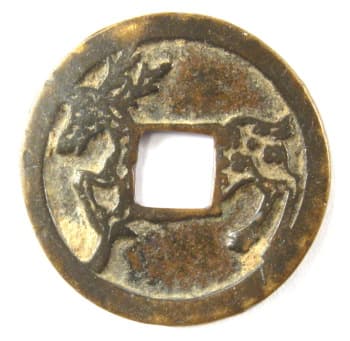
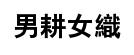
Men Plow, Women Weave
Charms related to Rice and Silkworm Production
As in the case of most ancient
civilizations, China has depended on agriculture, and in
particular the production of rice, as a basic foundation of
its society.
 Along
with food production, however, China is unique in that it
created an agricultural industry known as sericulture which
included raising silkworms, growing the mulberry leaves needed
as feed, processing the cocoons and weaving the silk cloth.
Along
with food production, however, China is unique in that it
created an agricultural industry known as sericulture which
included raising silkworms, growing the mulberry leaves needed
as feed, processing the cocoons and weaving the silk cloth.
Sericulture probably began in China during Neolithic times. A cocoon was discovered at an archaeological site in Shanxi Province dating to 2600 - 2300 BCE. The earliest silk remnant discovered dates to the Shang Dynasty (circa 16th ~ 11th century BCE).
Silk was originally restricted to use only by the emperor and his consort. Silk later because more widespread and besides being used in textiles also became a form of currency during the Han (206 BCE - 220 AD) and Tang (618 - 907 AD) Dynasties, and a staple of international trade (Silk Road).
Silk played such an important role in Chinese life and history that it came to symbolize "industry" itself.
Along
with food production, however, China is unique in that it
created an agricultural industry known as sericulture which
included raising silkworms, growing the mulberry leaves needed
as feed, processing the cocoons and weaving the silk cloth.Sericulture probably began in China during Neolithic times. A cocoon was discovered at an archaeological site in Shanxi Province dating to 2600 - 2300 BCE. The earliest silk remnant discovered dates to the Shang Dynasty (circa 16th ~ 11th century BCE).
Silk was originally restricted to use only by the emperor and his consort. Silk later because more widespread and besides being used in textiles also became a form of currency during the Han (206 BCE - 220 AD) and Tang (618 - 907 AD) Dynasties, and a staple of international trade (Silk Road).
Silk played such an important role in Chinese life and history that it came to symbolize "industry" itself.
Silk in Chinese Myth and History
The invention of silk has
been traditionally attributed to Lady Xiling (Lady Xi Ling
Shi), the wife of the legendary Yellow
Emperor (Huangdi
黃帝), who purportedly lived from 2698 to 2598
BCE. According to Confucius,
while she was drinking a cup of tea under a mulberry tree
in 2640 BCE a silk cocoon fell into her teacup. She
observed the silk threads begin to unravel in the hot
tea. She unwound the silk threads and then used them
to weave cloth.
For many centuries, China was the only place where silkworms were cultivated and silk produced. There are inscriptions on Shang Dynasty (circa 16th ~ 11th century BCE) oracle bones with references to a silk spirit.
The legend regarding the Silkworm Horse Maiden (matouniang 马头娘) emerged during the Tang Dynasty. According to a very ancient myth, there was a father who spent his days traveling far away and left his daughter and a white stallion at home. The girl, who took care of the horse by feeding him mulberry leaves, lived in dismal poverty and longed for her father's return. She told the horse that she would marry him if he would bring her father home. The horse immediately galloped off and eventually was able to find the father who rode the horse back home. The daughter reluctantly admitted to her father the promise she had made. Fearing disgrace to the family, the father killed the horse with his bow and arrow and set the horse skin out to dry. One day while the father was again off on his travels, the girl was playing with the horse skin and mockingly said "you're just an animal and you wanted a human for a wife?" The horse skin suddenly engulfed her and whisked her away. When the father returned, he searched for his daughter and finally found that she and the horse had changed into a big white silkworm (with a horse-shaped head) that was spinning silk thread in a large tree. Because the silk was much stronger and more abundant that that of an ordinary silkworm, this silkworm became the stock for all future silkworm raising. To honor the girl's plight, the tree was named "mulberry" (sang 桑) because sang (丧) also means "mourning".
(This myth also includes sexual symbolism because the word "silk" (si 丝) is a pun for "sexual desire" (si 私).)
For many centuries, China was the only place where silkworms were cultivated and silk produced. There are inscriptions on Shang Dynasty (circa 16th ~ 11th century BCE) oracle bones with references to a silk spirit.
The legend regarding the Silkworm Horse Maiden (matouniang 马头娘) emerged during the Tang Dynasty. According to a very ancient myth, there was a father who spent his days traveling far away and left his daughter and a white stallion at home. The girl, who took care of the horse by feeding him mulberry leaves, lived in dismal poverty and longed for her father's return. She told the horse that she would marry him if he would bring her father home. The horse immediately galloped off and eventually was able to find the father who rode the horse back home. The daughter reluctantly admitted to her father the promise she had made. Fearing disgrace to the family, the father killed the horse with his bow and arrow and set the horse skin out to dry. One day while the father was again off on his travels, the girl was playing with the horse skin and mockingly said "you're just an animal and you wanted a human for a wife?" The horse skin suddenly engulfed her and whisked her away. When the father returned, he searched for his daughter and finally found that she and the horse had changed into a big white silkworm (with a horse-shaped head) that was spinning silk thread in a large tree. Because the silk was much stronger and more abundant that that of an ordinary silkworm, this silkworm became the stock for all future silkworm raising. To honor the girl's plight, the tree was named "mulberry" (sang 桑) because sang (丧) also means "mourning".
(This myth also includes sexual symbolism because the word "silk" (si 丝) is a pun for "sexual desire" (si 私).)
Illustrations and Poems of Rice and Silk Cultivation
There is an ancient
artistic tradition in China pairing rice farming and
silkworm production together.
During the Southern Song Dynasty (1127 - 1279 AD), the imperial court in 1145 AD published a series of illustrations depicting the cultivation of rice and the rearing of silkworms. This series is known as "Poems of Plowing and Weaving" (Gengzhi Shi 耕织诗). The original set consisted of twenty-one poems with illustrations of rice production and twenty-four poems with illustrations of raising silkworms.
In 1696, Emperor Kang Xi of the Qing (Ch'ing) Dynasty (1644 - 1911 AD) commissioned the publication of a revised version entitled "Illustrations of Plowing and Weaving" (Gengzhi Tu 耕 织图). The set consisted of twenty-three illustrations of rice cultivation and twenty-three illustrations of silkworm raising. Each illustration was accompanied by a poem written by Emperor Kang Xi himself.
(To see an interesting "charm" coin cast during the reign of Emperor Kang Xi, please see An Old Chinese Coin with the Powers of a Charm. Please also visit Chinese Poem Coins for charms displaying a "poem" composed of the names of twenty (20) coin mints from the time of Emperor Kang Xi.)
These woodblock-printed books circulated widely and emphasized the traditional division of labor of "men plow, women weave" where men were responsible for rice production, and women were responsible for raising the silkworms on mulberry leaves, harvesting the cocoons, spinning the silk thread, and weaving the silk cloth.
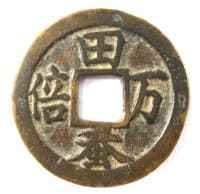
This is an example of an old Chinese charm pairing rice and silkworm production together.
The inscription is read top to bottom and right to left as tian can wan bei (田蚕万倍) which means "may your (rice) fields and silkworms increase 10,000 times".
During the Southern Song Dynasty (1127 - 1279 AD), the imperial court in 1145 AD published a series of illustrations depicting the cultivation of rice and the rearing of silkworms. This series is known as "Poems of Plowing and Weaving" (Gengzhi Shi 耕织诗). The original set consisted of twenty-one poems with illustrations of rice production and twenty-four poems with illustrations of raising silkworms.
In 1696, Emperor Kang Xi of the Qing (Ch'ing) Dynasty (1644 - 1911 AD) commissioned the publication of a revised version entitled "Illustrations of Plowing and Weaving" (Gengzhi Tu 耕 织图). The set consisted of twenty-three illustrations of rice cultivation and twenty-three illustrations of silkworm raising. Each illustration was accompanied by a poem written by Emperor Kang Xi himself.
(To see an interesting "charm" coin cast during the reign of Emperor Kang Xi, please see An Old Chinese Coin with the Powers of a Charm. Please also visit Chinese Poem Coins for charms displaying a "poem" composed of the names of twenty (20) coin mints from the time of Emperor Kang Xi.)
These woodblock-printed books circulated widely and emphasized the traditional division of labor of "men plow, women weave" where men were responsible for rice production, and women were responsible for raising the silkworms on mulberry leaves, harvesting the cocoons, spinning the silk thread, and weaving the silk cloth.
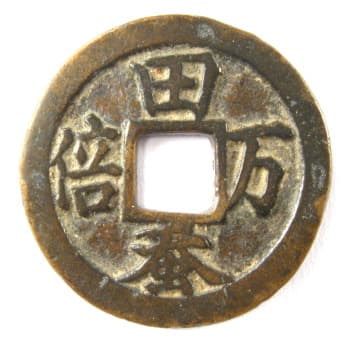
This is an example of an old Chinese charm pairing rice and silkworm production together.
The inscription is read top to bottom and right to left as tian can wan bei (田蚕万倍) which means "may your (rice) fields and silkworms increase 10,000 times".