An embarrassed government education department in Taiwan had to issue an apology in regard to piggy banks it had given some children.
According to a report in The China Post, the mayor of New Taipei City held a “summit” for elementary school students on April 29th “to promote financial responsibility and planning for their future”.
To emphasize and help promote these goals, each student was given a new piggy bank.
These were high-tech electronic piggy banks which were calibrated to automatically identify and calculate the total amount of money being deposited.
A problem arose, however, when some of the parents attending the event noticed that the boxes in which the piggy banks were packaged had instructions written in “simplified” Chinese, which is used in mainland China, as opposed to the traditional Chinese characters still used in Taiwan.
But even more embarrassing was that the instructions stated the piggy banks were “for depositing coins that circulate in mainland China”!
This surely was not the “planning for the future” the Taiwan mayor had intended.
As it turned out, the piggy banks were built at a factory in mainland China that is owned by a Taiwanese business. In the rush to ship the piggy banks in time for the meeting, the wrong packaging was used.
Zhong Kui lived during the reign (712-756 AD) of Emperor Xuanzong of the Tang Dynasty.
However, just at the moment he achieved the pinnacle of success which would guarantee him fame and fortune, he suffered such misfortune that he took his own life.
Over the centuries, a mythical Zhong Kui evolved who, now immortal, protects others from evil and brings happiness and good fortune.
Zhong Kui has also become one of Peking Opera’s most popular and beloved character roles.
On April 20th, China released a second series of gold and silver coins commemorating famous characters of the Peking Opera. This set of coins, officially known as the Peking Opera Facial Makeup Series, includes a gold coin with a denomination of 100 yuan honoring Bao Zheng who was an official during the Northern Song Dynasty and a symbol of justice and integrity. Two silver coins denominated at 10 yuan were also released. One silver coin honors Dian Wei who was a military general under Cao Cao during the Han Dynasty.
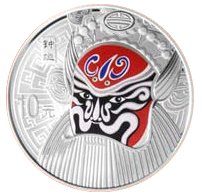
The other silver coin, shown at the left, honors Zhong Kui who is a character in the ever popular Peking Opera “Zhong Kui Marries Off His Sister”.
Zhong Kui was a gifted scholar who succeeded in passing the highest examination of the imperial examination system making him eligible for an important office which would ensure a life of wealth and honor.
However, Zhong Kui was denied these rewards because he happened to be physically disfigured and was considered too ugly.
Zhong Kui was so despondent that he committed suicide by bashing his head against a pillar.
In China, history and myth frequently merge and this was the case with Zhong Kui. The immortal Jade Emperor took pity on him and appointed him to be the protector of mortals and to be both judge and executioner in the fight against demons and evil spirits.
Pictures of Zhong Kui, in his mythical role as the “Demon Slayer” or “Demon Chaser”, have traditionally been hung on the walls of Chinese houses as a form of protection.
A robust and heavily-bearded Zhong Kui is seen here wielding his famous “Demon Slaying” sword.
The projections extending from each side of his hat are actually “demon-seeking” devices which point at unseen and lurking dangers.
Also, just above and to the left of his head is a bat. The bat is often seen together with Zhong Kui as a symbol of “good fortune” and “happiness”.
This is because the Chinese language facilitates the creation of puns and rebuses.
In Chinese, the word for “bat” (fu) and the word for “happiness” (fu) have the same pronunciation.
Also, if you observe closely, you will notice that the bat is actually flying upside-down. The Chinese word for “upside-down” (dao) and the expression “have arrived” (dao) have the same pronunciation.
Therefore, to say “the bat is upside-down” sounds exactly like saying “happiness has arrived”!
Some of the same characteristics that identify this “mythical” Zhong Kui can also be found in his Peking Opera character.
For example, the makeup of Zhong Kui on the Peking Opera coin includes a heavy beard.
Moreover, the beard helps set off the face which, along with the ears that look like wings, gives the face the appearance of a bat.
As already mentioned, the “bat” symbolizes the “happiness” he can bring to mortals.
To further emphasize the “bat” and “happiness” rebus, an image of a bat flying downwards is actually painted on the forehead.
As part of the makeup, Zhong Kui is given red cheeks to symbolize dignity. The painted black and white lines on the face express uprightness and the mouth is shown smiling to express Zhong Kui’s amiability.
The top of the head is painted red as a reminder that he died by beating his head against a pillar.
However, at the very top of his head is an oval-shaped design which in reality is a very stylized version of the Chinese character shou meaning “longevity”. In spite of his suicide, Zhong Kui became immortal.
The Zhong Kui of the Tang Dynasty was denied the honor, wealth and happiness he had earned and he died in sorrow by his own hand.
But the mythical Zhong Kui has become immortalized as a popular character in traditional Peking Opera.
And, for many centuries, images of Zhong Kui have been hung in countless Chinese homes and carried as charms and amulets to provide protection from evil spirits and to bring “happiness” and “good fortune”.
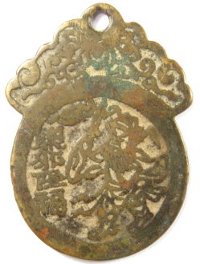
“I have been trying to decipher, without total success, a chinese cast bronze charm – my very tentative guess would be Ming Dynasty – and wondered if I could send along a digital image of the two sides?
On the front side two of the characters are (I believe) for longevity, but the other two I do not know.
The reverse has a male figure (left) and female figure (right), with what looks like a folded big dipper above and a design in a cartouche below.
Please let me know if I can send scans.
Thanks!”
My reply was as follows:
King Mu Seeking Drug of Immortality from Queen Mother of the West
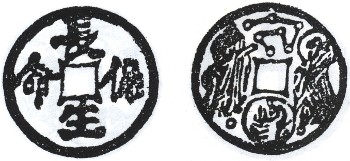
The inscription reads chang sheng bao ming. The chang sheng would translate as “long life” and bao ming translates as “protect life”.
The symbols on the reverse side are as follows:
1. At the top are seven dots connected by a zigzag line which is meant to represent the “Big Dipper“.
2. The figure at the left is “Dong Wang Gong”, the Royal Lord of the East, who was actually King Mu of the Zhou (Zhou Mu Wang).
3. The figure at the right is the Queen Mother of the West (Xi Wang Mu).
4. At the bottom is a circle (which represents the moon). Inside the circle is a rabbit using a pestle and mortar.
The scene describes King Mu asking the Queen Mother of the West to give him the drug of immortality. The drug of immortality was made by the rabbit that lived on the moon.
Because of the wear on the charm, it is difficult to see the rabbit. If you look closely at the circle, the rabbits ears are at the 12 o’clock position, the tail is at 3 o’clock, and the legs are at 5 o’clock. The rabbit is facing left and slightly bent over. The rabbit is making the drug of immortality using the pestle and mortar. The top of the pestle is pointing to the 11 o’clock position.
It is very difficult to date charms but charms like this first appeared in the Jin (1115-1234) or Yuan (1271-1368) dynasties.
I frequently receive correspondence from people who have a coin or charm they would like identified.
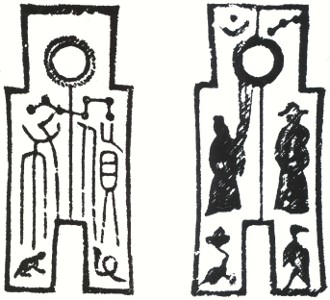
The following is my reply to such an inquiry and I have attached a rubbing of the charm for reference.
It is a charm.
However, it is based on an ancient form of spade money called a “Huo Bu”. If you visit my Chinese Spade Charms web page you will see a real “Huo Bu” cast in the year 14 AD during the reign of Wang Mang.
As best I can tell from reference books, your charm is actually fairly modern. Apparently, it first appeared during the early years of the Republic of China sometime after 1911. From your photos, I would say that your particular charm is a very recent copy of this older charm.
One of my reference books says that this charm may actually be Japanese and not Chinese.
The charm has some interesting features. It has the same Chinese inscription “Huo Bu” as the original Wang Mang spade coin upon which it is based. It is much much bigger in size. Just above the Chinese characters is the seven star “Big Dipper”constellation. There is a snake on the lower right foot and a “three -legged toad” on the left foot.
The reverse side has the sun (the dot) and moon (crescent) at the upper left. At the upper right are three stars connected by a line. This refers to the three “Star Gods”. The two “human figures” are unknown. On the right foot may be a heron or egret. I am not certain what symbol is on the left foot but I believe it is a tortoise exhaling an “auspicious cloud“.
To learn more about these symbols, please look under the appropriate entry at my Hidden Meaning web page.