Archaeologists have unearthed more than 3,000 coins dating from the Tang Dynasty in the ancient Silk Road city of Kucha (库车县) located in China’s far western region of Xinjiang (新疆维吾尔自治区).*
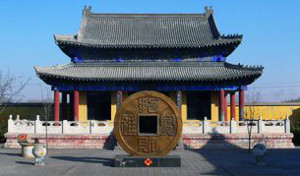
“Kai yuan tong bao” coin unearthed in ancient “Silk Road” city of Kucha
The China News (中新网), in an article published on April 25, 2013, reports that the Kucha Bureau of Cultural Relics (库车县文物局) was informed of the discovery at a construction site on April 23rd.
A team of archaeologists was dispatched and more than 3,000 coins were recovered.
At the time the report was filed on April 24th, the site was being managed by staff of the Kucha Bureau of Cultural Relics and the Qiuci Bureau of Public Security (龟兹公安分局) and coins were continuing to be dug up.
More than 3,000 Tang Dynasty coins were recovered
Ms. Yin Qiuling (尹秋玲), a cadre with the Kucha Bureau of Cultural Relics, informed the reporter that all the coins have the inscription kai yuan tong bao (开元通宝) and were cast during the Tang Dynasty (618-907) more than 1,300 years ago.
She added that although the coins had been buried for more than a thousand years and had acquired a patina, the inscriptions could still be clearly read.
The coins were found scattered in an area 10 meters long by 5 meters wide.
Ms. Yin stated that Qiuci (Kucha) was an ancient Buddhist kingdom on the ancient Silk Road and that this discovery of such a large number of Tang Dynasty coins is important to the research of the economic, political and historical relationship between Qiuci and Tang Dynasty China.
*Update as of May 2, 2013: News agencies are now reporting that the number of ‘kai yuan tong bao’ coins unearthed is nearly 10,000!
Buried “mountain” of Song Dynasty iron coins seen in field near Cangzhou
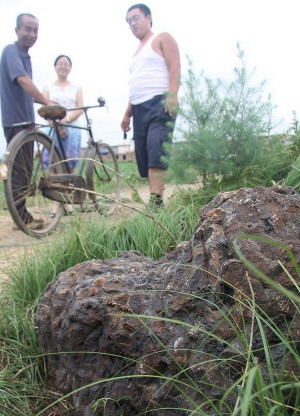
The People’s Daily (人民日报) on May 20, 2000 announced that Chinese archaeologists had unearthed a “mountain” of ancient Chinese coins in a field near the city of Cangzhou (沧州) in China’s northern province of Hebei (河北省).
The initial discovery of the buried coins actually dates to 1997.
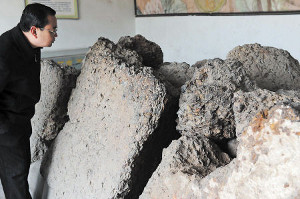
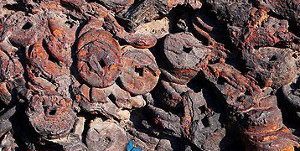
The coins were made of iron and were stuck together in very large and heavy pieces. Closer examination revealed that the coins were cast during the Song Dynasty (宋朝 960-1279).
But what startled the archaeologists most was the huge number. They initially dug up about 48 tons of the coins.
Tieqian Ku in Cangzhou where the Song Dynasty iron coins are on display
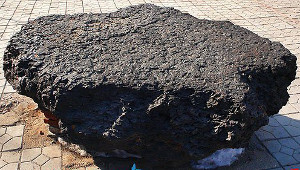
The largest single chunk of coins weighs about 7 tons.
Moreover, it is estimated that an additional 50 tons of the coins are still buried in the ground.
The total find is thus estimated to be about 100 tons.
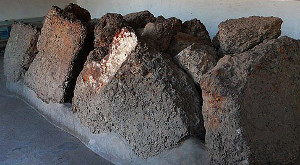
The archaeologists also discovered that the iron coins had not simply rusted together but showed clear signs of having been melted together.
Why such a large quantity of Song Dynasty iron coins were buried in the area and why they had apparently been melted together in large chunks is a mystery which to this day remains unsolved.
Large chunks of the unearthed iron coins on display
An article in the April 4, 2013 edition of the China Culture Journal (中国文化报) has renewed attention to this discovery and provides some insight into current theories to explain the mystery.
The coins are now displayed at the Tieqian Ku (“Iron Coin Treasury” 铁钱库) in Cangzhou.
According to Ms. Wang Yufang (王玉芳), the Director of the Cangzhou City Bureau of Cultural Relics (沧州市文物局), no historical documents mention the existence of this unusual coin cache.
Larger pieces of fused iron coins on display at the Tieqian Ku in Cangzhou
Ms. Wang says that experts have proposed three possible theories to explain the mystery.
One theory is that the field where the coins were discovered was the site of a Song Dynasty mint.
However, other experts refute this theory because this area of China was a frontier region during the Song Dynasty and the authorities would not have built a mint in such a remote border area.
Ms. Wang proposes a second possible explanation for the find.
In ancient times, Chinese cash coins were typically carried by threading the coins together on a cord or string. A standard unit of 1,000 coins on a string was called a guan (贯).
Some of the Song Dynasty iron coins that were melted together
Close examination of the massive iron coin chunks reveal that the coins were first neatly stacked in rows of guan. There is also clear evidence that the coins were then exposed to fire and melted together.
According to this theory, the coins were transported from other locations to this site in order to be melted down and destroyed.
This very large mass of iron coins was too heavy to be placed in the exhibition hall
Other experts, however, reject this proposition. They say there would not have been any necessity to move such a large quantity of coins to this single location to be destroyed. Also, the effort and expense to do so would not have been worthwhile.
Ms. Wang says that there is a third theory to explain the existence of the huge iron pieces composed of Song Dynasty coins. This theory takes into account the historical background of the times.
The area now known as Hebei was considered the northern border of China during the Tang Dynasty. With the collapse of the Tang Dynasty in 907 AD, the area became divided among several regimes during the Five Dynasties and Ten Kingdoms (五代十国 907-960). The area was not reunited until the reign (923-926) of Emperor Zhuangzong (庄宗) of the Later Tang Dynasty (后唐).
Map showing the Sixteen Prefectures in yellow.The Liao Dynasty is to the north (dark grey) and the Northern Song is to the south (light grey).
What is pertinent to this discussion is that during the Song Dynasty there was much contention for this sixteen prefecture area between Song China and the Liao Dynasty. During the Southern Song, all of this northern region of present day Hebei was abandoned and fell under the rule of the Jin Dynasty (金朝 1115-1234) ruled by the Jurchen (女真).
The third theory takes into consideration the historical reality of the time to explain the existence of the massive chunks of Song Dynasty coins. The iron coins were sent to the area in order to pay for the expenses of the Song army contending for control of the Sixteen Prefectures of Yanyun.
The forces of the Song were eventually defeated. Forced to withdraw from the area, the Song army was faced with having to transport a huge quantity of iron coins. Since transport would have been difficult, and given the necessity for a hasty retreat, the decision was made to abandon the money.
To prevent the money from falling into the hands of the enemy, however, the coins were partially melted down.
According to Ms. Wang, all three theories seem reasonable although many experts are now leaning towards the third theory. She says additional research and discoveries will need to take place before the mystery of the 100 tons of melted Song Dynasty iron coins is fully explained.
It should be noted that the quantity of coins may actually exceed 100 tons. The newspaper articles referenced above do not mention that, since the initial discovery, even more chunks of partially melted Song Dynasty iron coins have been unearthed in the area. Please see “Tons of Song Dynasty Iron Coins Discovered” for coverage of this more recent find.
The ancient town of Ciqikou (磁器口) is part of the municipality of Chongqing (重庆) located in Southwest China.
Ciqikou actually translates as “Porcelain Port” and the town gained prominence during the Ming Dynasty as a prosperous commercial port located on the Jialing River.
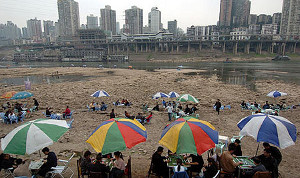
Chongqing residents playing mahjong on the Jialing River
The Jialing River (嘉陵江) is a popular spot for the residents of Ciqikou and Chongqing to relax in the outdoors.
There are open-air tea houses located on the banks of the river. People like to sit under umbrellas and play mahjong (麻将). Young couples can be seen strolling along the river banks.
Chinese coin kite
Children enjoy flying kites in the large open spaces.
Due to recent drought conditions, however, the water level of the Jialing River has dropped to such an extent that large portions of the riverbed are now dry and fully exposed.
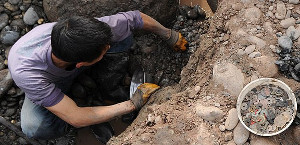
The bare riverbed has provided the rare opportunity for residents to partake in a new outdoor activity — digging for “treasure” (淘宝).
In this case, the “treasure” refers to old Chinese coins.
Over the centuries, a number of river boats suffered misfortune and sank to the bottom. Some of their treasures, including coins which had been hidden underwater, can now be found scattered among the rocks and mud of the riverbed.
Digging for Chinese coins in the dry Jialing River
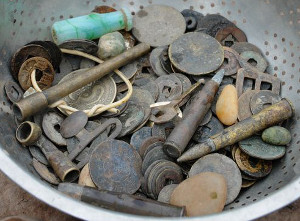
Most of the coins being found date from the late Qing Dynasty (1644-1911) to the early years of the Republic.
Old coins and ammunition dug up from the riverbed
As can be seen in the photos, treasure diggers have been able to recover some of the heretofore buried treasure.
While searching for old Chinese coins in a dry riverbed would seem to be a fairly safe activity, the activity in this case is fraught with danger.
This area of the river not only has old Chinese coins but also a large quantity of buried munitions including rifle rounds, grenades, artillery shells and bombs.
During the Second Sino-Japanese War (1937-1945), Chongqing served as the provisional capital of the Republic of China under the leadership of Generalissimo Chiang Kai-shek.
During this time, Chongqing suffered extensively from aerial attacks by Japanese forces. A very large number of bombs dropped by Japanese planes, but which did not explode, are now being exposed after lying under the waters of the Jialing River for so many years.
This same area also saw fighting between the Communist and Nationalist forces during the Chinese Civil War (1927-1950) and large quantities of grenades, artillery shells and other unexploded ordnance (UXO) are buried in the river.
Unfortunately, many people seem to be unaware of the hidden danger in digging for coins in the river.
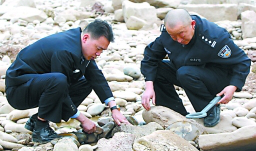
Local police using a handheld metal detector easily found buried ordnance
According to a recent report, the local police decided to give a demonstration on just how dangerous digging for treasure in the river can be.
As can be seen in the picture at the left, the police officers using a small handheld metal detector were quickly able to locate some hidden explosive materials.
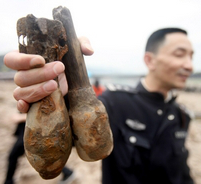
Old hand grenade and mortar round dug up from the riverbed
In just 30 minutes they found a hand grenade and a mortar round.
The police also reported that on the same day a “treasure digger” discovered an unexploded 80 kg bomb buried in the riverbed.
According to the police, these munitions still have the ability to explode and cause massive injury and destruction.
In an attempt to convince the treasure hunters not to dig in the river, the local police explained that it would be very difficult to find any large quantity of old Chinese coins at this time. With the passage of time, the treasures of the ancient shipwrecks have either been washed away or are buried deep underground.
The police also posted a sign urging people not to dig for coins because of the potential danger from the undetonated ordnance and also because any found “treasure” would rightfully belong to the state according to law.
But despite the demonstration and the warning about the hidden explosives, people continue to dig in the river searching for old Chinese coins.