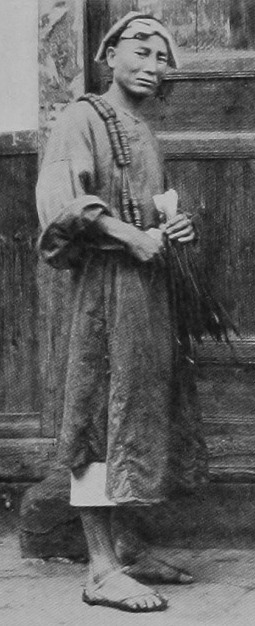
My recent post entitled “Carrying Cash in Imperial China” illustrated the inconvenience of carrying “cash” coins at the end of the Qing Dynasty.
Surprisingly, carrying cash in the 40 to 50 years that followed continued to be inconvenient even though paper money replaced coins as the primary form of money.
Due to the severe inflation and the falling value of the official paper currency (fabi 法币) during the war years, carrying any amount of “cash” in the latter years of the Republic meant having to deal with a large and heavy pile of paper money.
The photographs below clearly illustrate this fact. This undated series of photos documents the story of a business needing to obtain cash from a local bank in order to pay wages to its employees. While we do not have specific details as to the name of the business, bank, or city, the situation was probably typical throughout China during the 1940’s.
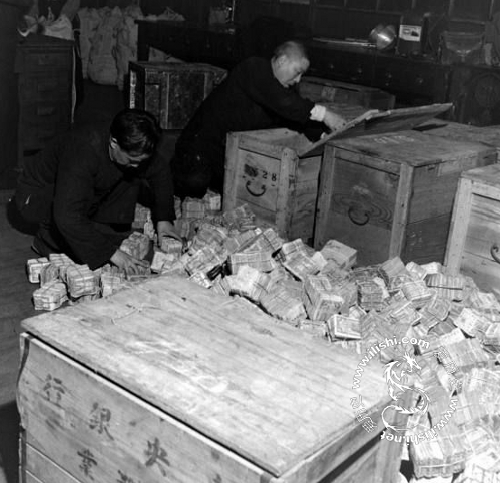
As can be seen in the photo above, money was shipped to local banks in wooden boxes. The local bank employees are busily unpacking the boxes. While we cannot see the entire name of the bank printed on the wooden box in the foreground, it is probably the Central Bank of China (中央银行).
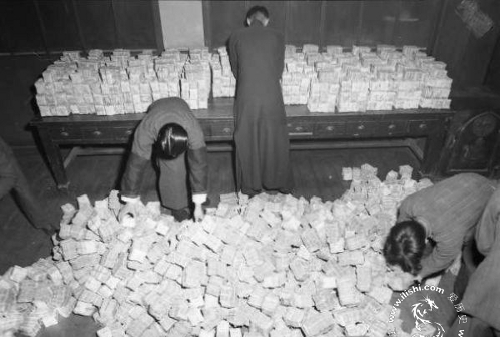
Because a local business needs money to pay its employees, the bank employees are seen in the above photo preparing for the withdrawal.
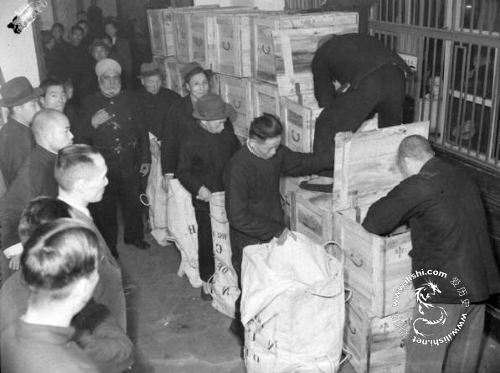
To transfer the needed funds to the customer requires packing many large money bags as shown above.
The bank appears to have a Sikh as a bank guard.
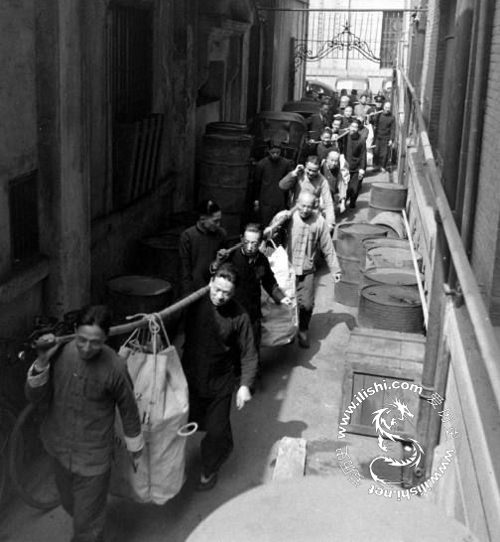
The large number of heavy bags of money are then carried from the bank to a truck which will deliver the funds to the customer. Because of the weight, each bag needs to be hung on a wooden shoulder pole and carried by two people.
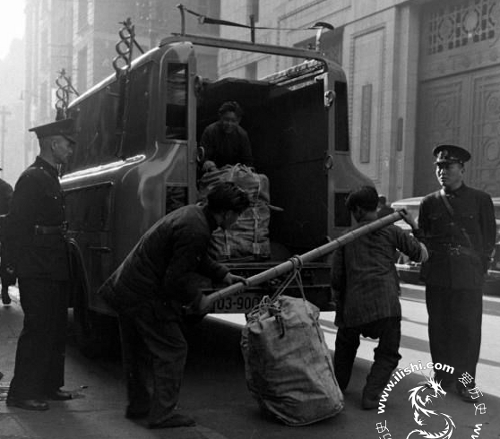
The bags of money are seen here being loaded into a truck for delivery to the customer.
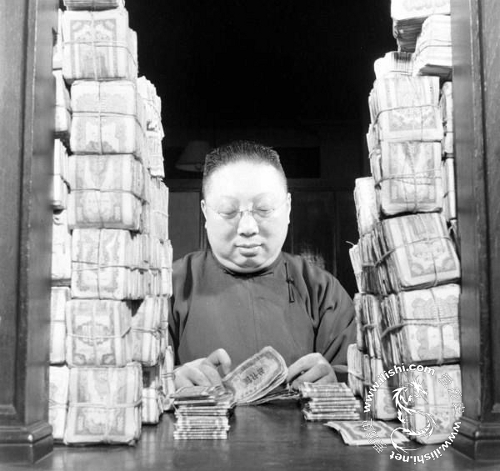
Once the funds arrive at the company, the bags are unpacked and preparations are made to distribute the wages.
(I was unsuccessful in trying to identify the banknote in the employee’s hand until I realized that the negative must have been flipped horizontally when the original photograph was printed. If you flip the above image right to left, the denomination can be seen as 5000 yuan (伍仟圓). I think this is a Central Bank of China 5000 yuan note. Notes of this large denomination were issued in 1945 and 1947. If this is correct, then this series of photos would roughly date to that time period.)
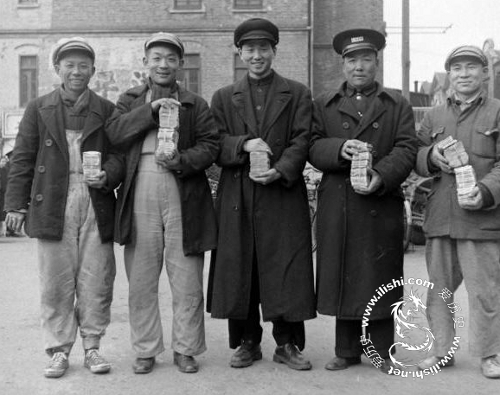
This photograph shows the smiling faces of employees having just been paid.
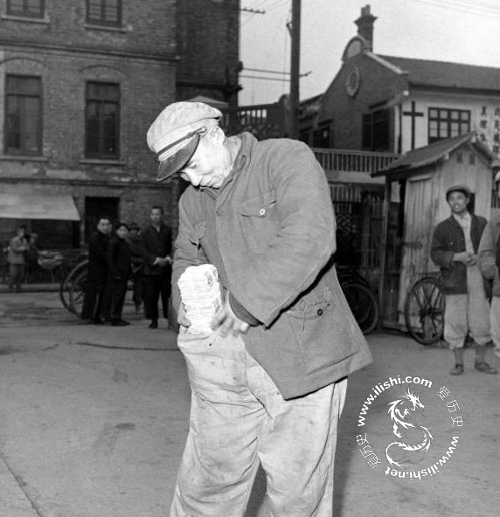
However, carrying such a large quantity of paper money could be quite a challenge. This employee is having a problem trying to stuff a large stack of paper money into his very large trouser pocket.
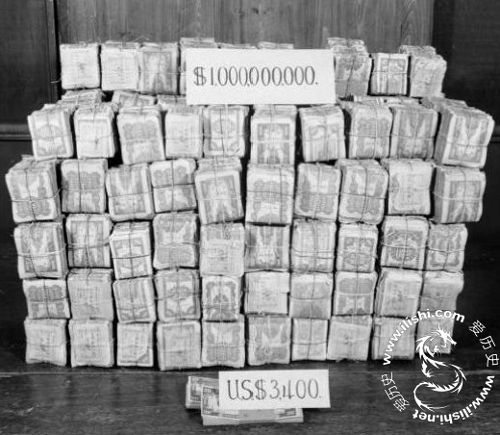
The photograph above clearly demonstrates the extent of inflation and the devaluation of the currency during the late 1940’s.
This large pile of paper money has a face value of one billion “dollars” (1,000,000,000 yuan)!
The equivalent in US currency is shown as the small stack of bills in the foreground worth $3,400.
While my intention was to show the inconvenience of carrying cash, this series of old photographs graphically reminds us of the deteriorating economic situation the Chinese people endured during those last years of the Republic.