Month: October 2013

  • Byzantine Gold Coin Found in Tomb of Emperor Jiemin of Northern Wei

    Chinese archaeologists recently completed their work excavating an ancient tomb located near Luoyang (洛阳), Henan Province (河南省), according to recent reports in the Chinese press.
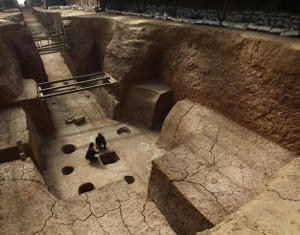
    Archaeologists believe the tomb belongs to Emperor Jiemin of Northern Wei
    Archaeologists believe the tomb belongs to Emperor Jiemin of Northern Wei

    The archaeologists from the Luoyang Municipal Institute of Cultural Relics and Artifacts (洛阳市文物考古研究院) can be seen working in the tomb in the image at the left.

    The archaeologists believe that the tomb belongs to Emperor Jiemin (节闵帝) of the Northern Wei (北魏).  Emperor Jiemin is sometimes referred to by his personal name Yuan Gong (元恭).

    The Northern Wei was a Mongolian dynasty and Emperor Jiemin ruled during the years 498-532 AD.

    Historical sources reveal that after the capital was moved to Luoyang, six Northern Wei emperors died and were buried in the area.  Documents specifically mention the tombs of Emperor Xiaowen (孝文帝长陵), Emperor Xuanwu (宣武帝景陵), Emperor Xiaoming (孝明帝定陵) and Emperor Xiaozhuang (孝庄帝静陵).

    The historical records are not clear in regard to the tombs of Yuan Ye (Prince of Changguang 长广王元晔) and Emperor Jiemin.

    Because Yuan Ye reigned for only a few months (530-531), the archaeologist do not believe that a tomb of this magnitude could not have been built during his reign.

    Given the scale of the tomb, its location and configuration, as well as the length of time it would have taken to build, the archaeologists have preliminarily concluded that the tomb must therefore belong to Jiemin.

    This would be the fifth Northern Wei emperor tomb discovered in Luoyang.

    The path leading down to the grave is 39.7 meters in length and 2.9 meters in width.  The tomb chamber is 19.2 meters in length and 12 meters in width.

    While a number of artifacts were recovered, many had suffered damage.

    Gold coin found in the tomb of Emperor Jiemin of Northern Wei and minted during the reign of Anastasius I of the Byzantine Empire.
    Gold coin found in the tomb of Emperor Jiemin of Northern Wei and minted during the reign of Anastasius I of the Byzantine Empire.

    However, the most important artifact discovered in the tomb was a gold coin (solidus) in excellent condition.

    The coin, shown at the left, was minted during the reign of Anastasius I (阿纳斯塔修斯一世) who was the Byzantine Emperor during the period 491-518 AD.

    The coin is 2.1-2.2 cm in diameter and is one of only a few Byzantine gold coins ever unearthed by archaeologists in China.

    According to the archaeologists, the discovery of this Byzantine gold coin in a Chinese emperor’s tomb provides further evidence that Luoyang was the eastern terminus of the ancient Silk Road (丝绸之路).
  • Knife Money from State of Qi Unearthed in Shandong

    A farmer working in a field in Shandong Province recently unearthed an ancient knife-shaped form of money from the Warring States period (475 BC – 221 BC), according to a Chinese newspaper article published today.

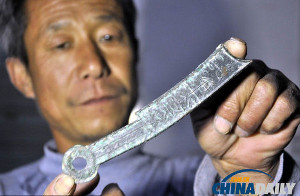
    A farmer from Shandong displays the knife money he discovered from the ancient State of Qi
    A farmer from Shandong displays the knife money he discovered from the ancient State of Qi

    Mr. Jia Qingguang (贾清广) was sifting sand at his farm in Liaocheng (聊城市) in China’s eastern province of Shandong when he discovered this knife-shaped money known in Chinese as dao bi (刀币).

    The image at the left shows Mr. Jia holding the knife money.

    The newspaper report provides little information regarding the the knife other than it is believed to have been cast during the Warring States period.  The knife is 15 cm in length and has Chinese characters on one side only.

    The newspaper article does not specify the type of knife money but “hopes that the relevant departments will help identify it”.

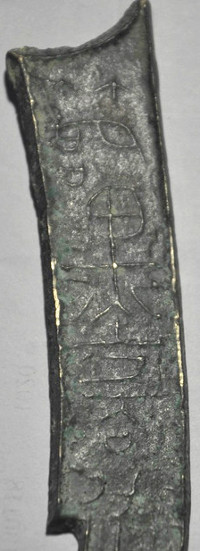
    Inscription on the State of Qi knife translates as "Jimo Legal Money"
    Inscription on the State of Qi knife translates as “Jimo Legal Money”

    However, if you look carefully at the close-up image of the knife shown here, you can see that it is a “four character” (四字)  large knife from the State of Qi (齐国).  The inscription is ji mo fa hua (即墨法化) which translates as “Jimo legal money”.

    The State of Qi existed from 1046 BC to 221 BC and occupied the area of what is now Shandong Province where the knife was discovered.

    Jimo (即墨) was a city in the State of Qi and was the site of a very famous battle in 283 BC which I describe in detail in an article entitled “Battle of Jimo Horse Coin”.

    It is believed that Qi produced knife money during approximately 400-220 BC.  Besides “four character” (四字刀) knives, Qi also issued knife money with three (三字刀), five (五字刀) and six characters (六字刀).

    (For more about the Four Character knives (四字刀) and Five Character knives (五字刀), please see Ancient Chinese Coin Exhibit at the Qi Heritage Museum.)

    (Six Character knives (六字刀) are discussed in detail at State of Qi Six Character Knife Money.)

    Some knives have Chinese characters on the reverse side and some do not, as is the case with this specimen.

    Specimens of this type of knife money are typically 15-16 cm in length and weigh 23-45 grams.

    The State of Qi was the last state to be conquered by the armies of Qin Shi Huang (秦始皇) who then unified China in 221 BC.

    All State of Qi large knives are considered to be rare.