Month: January 2015

  • ‘Kai Yuan Tong Bao’ Clay Mould

    The world’s only known specimen of a Tang Dynasty clay mould used to cast kai yuan tong bao (开元通宝) coins is now on public display according to Chinese news reports dated January 6, 2015.
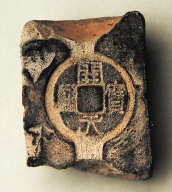
    'Kai yuan tong bao' clay mould
    ‘Kai yuan tong bao’ clay mould

    This very rare clay mould (钱陶范), which is classified as a “national treasure” (国宝级), was unearthed in Shutang on August 17, 1992 by Mr. Ceng Jingyi (曾敬仪), a retired teacher and coin collector.

    Shutang is located in the Wangcheng District (望城区) which is about 20 km from Changsha (长沙) in Hunan Province (湖南).

    The clay mould is on display at the “Exhibition of Chinese Ancient Coins” (中国历代钱币展) being held at the Ouyang Xun Cultural Park (欧阳询文化园) located in Shutang (书堂).
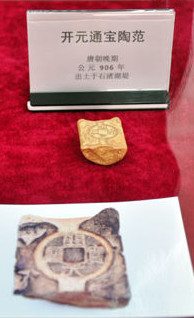
    Rare 'kai yuan tong bao' clay mould on display at the ancient coin exhibition
    Rare ‘kai yuan tong bao’ clay mould on display at the ancient coin exhibition

    Kai yuan tong bao coins were cast beginning in the year 621 during the reign of Emperor Gaozu (高祖) of the Tang Dynasty (618-907).

    The kai yuan tong bao, which translates as the “Inaugural Currency”, marked a watershed in Chinese history.

    Up until this time, Chinese coins had been named after their weight.  Beginning with the casting of the kai yuan tong bao, coins were now designated as tong bao (“circulating currency” 通宝) or zhong bao (“heavy currency” 重宝).

    This new coin replaced the wu zhu (五铢) coins which had been produced for more than 700 years.

    Ouyang Xun (557-641) was born in Shutang and is recognized as one of the most famous calligraphers of the Tang Dynasty.
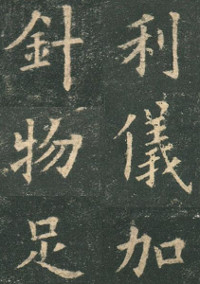
    Detail from stone rubbing of "Jiucheng Palace Sweet Wine Spring Inscription" by Ouyang Xun
    Detail from stone rubbing of “Jiucheng Palace Sweet Wine Spring Inscription” by Ouyang Xun

    Ouyang Xun was selected by Emperor Gaozu to write the inscription for the kai yuan tong bao coin.

    The inscription is written in a combination of Han Dynasty lishu (“Clerical” 隶书) and bafen (八分) scripts.

    This was also the first time in history that a famous calligrapher wrote the characters for a Chinese coin.

    Ouyang Xun is considered the finest calligrapher of the Tang of a style known as “regular script” (kai shu 楷书), also referred to as “standard script”.

    His calligraphy was immortalized on a stone stele located at Emperor Taizong‘s palace on Tiantai Mountain (天台山).

    The work is known as the “Jiucheng Palace Sweet Wine Spring Inscription” (九成宫醴泉铭) and is considered the model for “regular script” even today.
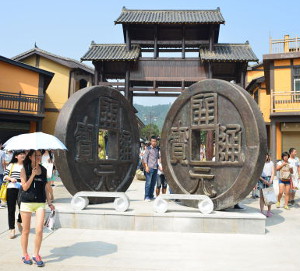
    Large sculptures of 'Kai Yuan Tong Bao' coins at entrance to the exhibition
    Large sculptures of ‘Kai Yuan Tong Bao’ coins at entrance to the exhibition

    In addition to the rare clay mould, the exhibition also includes more that 1,000 ancient Chinese coins donated by Mr. Ceng.

    The opening of the Chinese coin exhibition featuring the clay mould also received television coverage.  Please click here to view one of the television broadcasts covering the event.

    In the 2-minute video, Mr. Ceng Jingyi is interviewed (0:49 mark) and the kai yuan tong bao clay mould is shown (1:28 mark).

    Up until the unearthing of this clay mould, no moulds were known to exist for the casting of the Tang Dynasty kai yuan tong bao coins.

    For this reason, it was unclear as to what process was actually used to cast these coins.  While the coins could have been cast in the traditional manner from moulds made of clay, stone or bronze, it was believed that the coins were now being cast in sand using “mother” coins to make the impressions.

    With the discovery of this clay mould, however, it is now confirmed that clay moulds were still being used to cast coins during the Tang Dynasty.
  • Not Being Greedy Is a Treasure

    An unusual Chinese charm was recently posted to a popular Chinese coin forum in China.

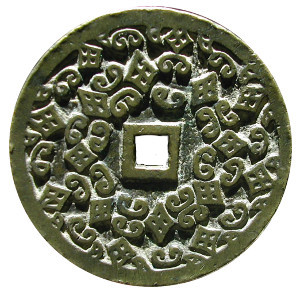
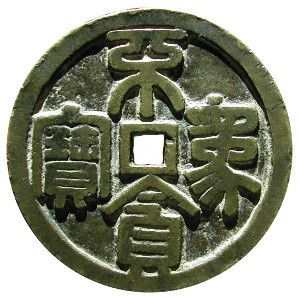
    Chinese charm with inscription "Not being greedy is a treasure"
    Chinese charm with inscription “Not being greedy is a treasure”

    The charm is shown at the left.

    The inscription bu tan wei bao (不貪為寶) is written in seal script and translates as “not being greedy is a treasure”.

    The phrase is a reference to a story in the Zuo Zuan (左传), also known as the “Commentary of Zuo”, which is a very ancient text describing historical events during the period 722 BC – 478 BC of the Spring and Autumn Period.

    The story appears in the book’s “Fifteenth Year of Duke Xiang” 《左传·襄公十五年》as follows:

    宋人或得玉,献诸子罕。子罕弗受。献玉者曰:“以示玉人,玉人以为宝也,故敢献之。”子罕曰:“我以不贪为宝,尔以玉为宝,若以与我,皆丧宝也。不若人有其宝。

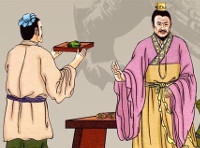
    Zi Han refuses to accept the jade
    Zi Han refuses to accept the jade

    The story is about Zi Han (子罕), a high government official of the state of Song, who was known to be virtuous and wise.

    One day, a peasant came to see him.  The peasant had found a stone which an expert had confirmed was a valuable piece of jade.  The peasant wanted to present this treasure to Zi Han.

    Zi Han, however, refused to accept the jade.

    Zi Han said to the peasant, “You consider the jade to be a treasure while I consider ‘not being greedy’ to be a treasure.  If I receive the jade, you will have lost your treasure and I, too, will have lost my treasure.  It would be better if both of us keep our own personal treasures.”

    Reverse side of charm displaying sycee and land as traditional symbols of wealth
    Reverse side of charm displaying sycee and land as traditional symbols of wealth

    At the left is the reverse side of the charm.

    The objects with the curled ends are meant to represent sycee or silver ingots (yuan bao 元宝) which were a form of money in ancient China.

    The square objects that resemble windows are actually the Chinese character tian (田) which means “field” as in farm land.  Land was also a symbol of wealth in ancient China.

    Liu Xiang (刘向), a government official and scholar during the Han Dynasty, wrote a commentary on the story.

    Liu Xiang explained that it was not that Zi Han did not have treasures but that “treasure” meant something different to him.

    Liu Xiang illustrated his point as follows.

    If one were to offer a small child a cake or gold, the child would pick the cake.  If one were to offer a “lower-class” man the legendary “Jade of He” (和氏璧) or gold, the man would definitely take the gold.

    However, if one were to offer a wise man the valuable “Jade of He” or a moral principle, the wise man would choose the moral principle.

    According to Liu Xiang, the better one understands the true nature of things, the better choice one will make.

    It is noteworthy that the members of the Chinese coin forum had not seen a charm like this before and its appearance resulted in a flurry of more than 200 comments.

    The forum members universally praised the meaning behind the charm and felt that its posting had been very timely.  This is because a well-publicized campaign is currently underway to rid the party and government of corrupt officials.

    Please also see “Legacy of an Untarnished Reputation” for a discussion of a charm written in “tadpole script” with a similar theme.