Month: October 2016

  • Southern Song Coin for Jin Army Defectors

    Portrait of General Liu Guangshi (刘光世) from a painting by Southern Song artist Liu Songnian (刘松年)
    Portrait of General Liu Guangshi (刘光世) from a painting by Southern Song artist Liu Songnian (刘松年)

    In the summer of 1131 AD, the armies of the Southern Song (南宋) and the Jin (金朝) were encamped on opposite sides of the Yangtze River (Changjiang 长江) and engaged in a pitched battle.  General Liu Guangshi (刘光世) commanded the Southern Song army while General Wan Yanchang (完颜昌) led the forces of the Jin.

    The two armies were of equal strength and neither side was able to advance on the other.

    General Liu decided to try to break the stalemate through the use of an unusual instrument of propaganda.

    He minted coins.

    The coins were not meant to circulate as currency, however, because they were created to achieve the specific military goal of inciting defections among the enemy ranks.

    The coins were made of bronze (copper), just like the common Chinese cash coins, but a few were made of silver and some of gold.
    Southern Song
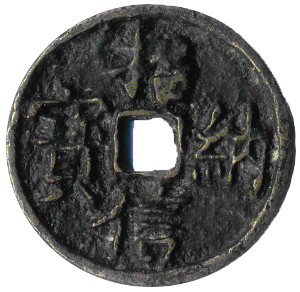
    Southern Song “zhao na xin bao” (招纳信宝) coin cast to encourage defection of Jin army conscripts and to ensure their safe passage to the Song army encampment

    At the left is the image of one of the bronze coins.  The inscription, written in regular script (kai shu 楷书), is read in a clockwise rotation as zhao na xin bao (招纳信宝).

    The coin inscription zhao na xin bao (招纳信宝) is explained as follows.  Zhao (招) means “to beckon” or “recruit”.  Na (纳) translates as “to admit” or “to accept”.  Xin (信) is a “letter”.  Bao (宝) is a “treasure” which is the term that was used on Chinese cash coins (coins with a square hole in the middle) for two thousand years.

    This rare coin is in the collection of the Hangzhou Museum (杭州博物馆).  The coin was donated to the museum in 2006 by the family of Mr. Ma Dingxiang (马定祥) who was one of the most respected Chinese numismatists of the 20th century.

    The coin has a diameter of 2.6 cm and a weight of 5 grams.  One of the easily observed characteristics of these coins is that the bao (宝) character, at the left of the square hole, is unusually “tall”.

    According to this article, the National Museum of China (中国国家博物馆) also has a bronze zhao na xin bao coin in its collection.

    General Liu knew that many of the soldiers in the Jin army were ethnic Han Chinese  (汉族), and not Jurchen (女真族), and that they had been forced to serve in the Jin military.  He felt that many of these men were probably homesick and would like to escape and return to their homes.

    General Liu implemented a new policy with the casting of the coins.  When Jin soldiers were captured, instead of being killed, they were treated very well.  The captured Jin soldiers were shown the newly minted coins and told that anyone carrying one of these special coins could return safely to their home. The captured Jin soldiers were then given the coins and told to return to the Jin army and give the coins to any of their compatriots who wished to desert and return home.

    The soldiers returned to the Jin encampment and secretly distributed the coins to the other soldiers who wanted to leave.

    The inscription zhao na xin bao (招纳信宝) therefore means it is a “treasure” or coin (bao 宝) that is “recruiting” (zhao 招) soldiers of the Jin who want to return home.  They will be warmly “accepted” (na 纳) into the Song army encampment and the coin would serve as their “letter (xin 信) of introduction”.

    Mr. Ding Fubao (丁福保) points out in his authoritative “Dictionary of Ancient [Chinese] Coins” (古钱大辞典) that zhao na (招纳) has the meaning of “submitting to the authority of another” (gui fu 归附).  The inscription could therefore be interpreted to mean that the bearer of the coin can trust that he will be able to safely return to the authority of the Song.

    Noted Chinese numismatists have proposed English translations of the coin inscription as  “Trust Token for Recruits” and “Pass Coins“.
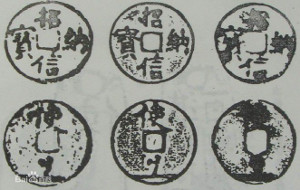
    Rubbings of "zhao na xin bao" (招纳信宝) coins
    Rubbings of “zhao na xin bao” (招纳信宝) coins

    The reverse side of the coin, seen in the rubbings at the left, show the Chinese character shi (使) above the square hole. “Shi” (使) means “a messenger” or “envoy” which implies that the coin and bearer are on an official mission.

    Below the square hole is a symbol that resembles the Chinese character shang (上) although it is reversed left to right and thus facing the wrong direction.  The consensus of Chinese numismatists is that this is actually a “signature”, and possibly that of Liu (刘), although the exact translation has yet to be determined.

    As mentioned above, some of these coins were also cast in silver and gold.  Several Chinese coin references mention that in the past a few specimens of these coins were in the hands of private collectors.  Unfortunately, the current location of these coins is unknown.

    However, a Chinese reference (中华珍泉追踪录) provides some information regarding the silver version of the coin.  During the Republican period (1912-1949), Mr. Fang Dishan (方地山) had a silver specimen in his collection.  Mr. Yuan Hanyun (袁寒云) described this coin as being slightly larger than the bronze version.  The shi (使) character above the square hole on the reverse side was slightly smaller.  Most noteworthy, however, was that the character below the hole was not a “reverse” shang (上) like that on the bronze coin.  The character resembled a 凵 (kan) with a 禾 (he) in the middle.  This apparently was a signature but, again, the meaning is unclear.

    Mr. Fang Dishan passed away in 1936 and it is not known what happened to his silver coin.

    Regarding the gold version of the coin, the Baidu Encyclopedia reports that Mr. Chen Rentao (陈仁涛) owned a specimen.  Mr. Chen passed away in 1968 and I have not been able to determine the whereabouts of this coin which is considered “priceless” and a “first-class cultural relic” (一级文物).

    According to historical records, the coins achieved their goal as an instrument of psychological warfare.  These coins guaranteeing freedom persuaded tens of thousands of Jin conscripts to defect to the Song.  Some of the men decided not to return home but instead to join the fight on the side of the Song.  The recruits were organized into two new armies, namely the “Red Hearts” (chi xin 赤心) and the “Army Appearing from Nowhere” (qi bing 奇兵).  The flood of deserters, which included not only Han Chinese but also Jurchen and Khitan (契丹), was so great that General Wan and the Jin army were forced to retreat.

    Because the coins were issued over a very short period of time and circulated in a very limited area, very few authentic specimens have survived.

    These coins are quite rare and valuable.  An authentic bronze zhao na xin bao coin would sell today for about 100,000 RMB ($14,500).  As mentioned earlier, the silver and gold coins are so rare that they are essentially priceless.

    Unfortunately, most of the zhao na xin bao coins seen today are fakes or reproductions.

  • Unique Western Xia Coin Written in Seal Script Unearthed in Ningxia

    Map showing the the location of Western Xia, Song and Liao
    Map showing the location of Western Xia, Song and Liao

    The Western Xia (Xi Xia 西夏  1038-1227) was an empire situated between the Song (宋朝) and the Liao (辽朝).

    Until very recently, Chinese numismatists were aware that the coins of the Western Xia had inscriptions written in the native Tangut script (xi xia wen 西夏文) or one of the calligraphic styles of Chinese with the notable exception of Seal script.

    It was therefore considered a major discovery in 1984 when a cache of coins was unearthed in Ningxia (宁夏) that included a Western Xia coin written in Seal script (纂书).  The coin was a guang ding yuan bao (光定元宝) cast during the reign (1211-1223) of Emperor Shenzong (李遵頊).

    This coin has a diameter of 25.3 mm, a thickness of 1.4 mm and a weight of 4.3 grams.

    A second specimen was unearthed in 2002 in Shaanxi (陕西省), and then a third specimen was dug up in Inner Mongolia (内蒙古自治区).  With additional excavations in the area of Tongxin County (同心县) in Ningxia, there are now more than 10 authentic specimens of guang ding yuan bao written in Seal script known to exist.

    It was believed that these guang ding yuan bao coins cast towards the very end of the dynasty were the only Western Xia coins produced with a Seal script inscription.

    In 2012, however, a farmer digging in a field in Tongxin County, Ningxia uncovered a  cache of Western Xia coins that included a different coin written in Seal script.  The inscription was qian you yuan bao (乾祐元宝) which indicates that the coin was cast during the reign (1170 – 1193) of Emperor Renzong (李仁孝).

    Coin catalogues through the centuries had documented this coin being cast in Regular or Running scripts but not in Seal script.

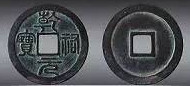
    Very rare and unique qian you yuan bao coin (乾祐元宝) from the Western Xia written in Seal script and unearthed in Ningxia in 2012
    Very rare and unique qian you yuan bao (乾祐元宝) coin from the Western Xia written in Seal script and unearthed in Ningxia in 2012

    This newly discovered coin, shown at the left, is the only qian you yuan bao written in Seal script known to exist according to an article written by  Dr. Zhu Hu (朱浒) of the Art Research Institute of East China Normal University (华东师范大学艺术研究所) published earlier this year in “China Numismatics” (2016年1期).

    The inscription (乾祐元宝) written in Seal script is read in a clockwise rotation starting at the top.

    The coin has a diameter of 25.4 mm, a thickness of 1.5 mm and a weight of 3.3 grams.

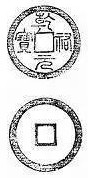
    Rubbing of the Western Xia "qian you yuan bao" (乾祐元宝) coin written in Seal script
    Rubbing of the Western Xia “qian you yuan bao” (乾祐元宝) coin written in Seal script

    The inscription can be seen in greater detail in the rubbing of the coin shown at the left.

    The Seal script you (祐) character, at the right of the square hole, is in the same style as the you found on inscriptions from coins cast during the Northern Song dynasty (北宋 960-1126) such as jing you yuan bao (景祐元宝 1034-1038), jia you yuan bao (嘉祐元宝 1056-1063), and yuan you tong bao (元祐通宝 1086-1093).

    The Seal script yuan (元) character, located below the square hole, is very similar to the yuan found on the Northern Song xuan he yuan bao (宣和元宝 1119-1125) coins.

    The Seal script bao (宝) character, to the left of the square hole, mimics the bao found on the Northern Song zheng he tong bao (政和通宝 1111-1117) and xuan he yuan bao (宣和元宝 1119-1125) coins.

    It is clear that the Seal script inscription on the newly discovered qian you yuan bao was greatly influenced by the style of the Northern Song coins.

    As mentioned above, the qian you yuan bao was the second type of Western Xia coinage found to have been cast in Seal script in addition to the more common Regular and Running script varieties.

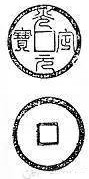
    Rubbing of a Western Xia "guang ding yuan bao" (光定元宝) coin written in Seal script
    Rubbing of a Western Xia “guang ding yuan bao” (光定元宝) coin written in Seal script

    A few differences can be seen in comparing these two Seal script coins.

    An image of an authentic guang ding yuan bao in Seal script may be seen at this Chinese website, but for our purposes we can look at the rubbing at the left.

    The yuan (元) character of the guang ding yuan bao has more “twists and turns” while that of the qian you yuan bao is more “dignified”.  Also, the last stroke of the yuan character of the guang ding yuan bao touches the rim which is not the case with the yuan on the qian you yuan bao.

    The “crown” of the bao (宝) character of the guang ding yuan bao is more “square” while that of the qian you yuan bao is more “round”.

    These characteristics are also found on the Seal script coins of the Song.

    Dr. Zhu advances a theory as to why Seal script inscriptions only appeared on Western Xia coins toward the end of the dynasty.  When the dynasty was established in 1038, the Tangut people (党项族) discarded the Chinese written language and rejected Chinese clothing in an effort to restore their original national character.  They created their own writing system known as Tangut and the first coins had inscriptions written only in Tangut.

    By the time of Emperor Ren Zong’s Qian You reign (1139 – 1193), however, there was political stability, economic prosperity, and less warfare.  The Emperor attached importance to education and the establishment of schools including an Imperial Academy.  He established an imperial examination system similar to that of the Chinese.  There was also greater respect for Confucianism and the culture of the Song.  This period was considered to be the heyday of Western Xia rule.

    The first Western Xia coinage had inscriptions only in Tangut but the Song dynasty custom of casting “Matched Coins” (dui qian 对钱), where two or more different calligraphy styles were used on coins of the same period title, continued during the Western Xia.  These styles included Official script (Li Shu 隶书),  Regular script (Zhen Shu 真书), Running script (Xing Shu 行书), and Grass script (Cao Shu 草书).

    With the recent discoveries of the qian you yuan bao and guang ding yuan bao coins, the Seal script (Zhuan Shu 纂书) has now been added to the calligraphic styles used to form the “Matched Coins” of the Western Xia.

    Discovery of a new Chinese coin variety is a rare occurrence nowadays so the Seal script qian you yuan bao caused great excitement among collectors.  The discovery also means that the qian you yuan bao is the only Western Xia coin known to exist in three calligraphic varieties, namely Regular, Running and Seal scripts.

    The fact that this coin is very well-made and, to date, is one of a kind, lends credence to the belief that the coin may be a trial piece and that very few were actually cast for circulation.