Author: Gary Ashkenazy

  • Royal Lord of the East and the Queen Mother of the West

    I received the following inquiry:

    “I have been trying to decipher, without total success, a chinese cast bronze charm – my very tentative guess would be Ming Dynasty – and wondered if I could send along a digital image of the two sides?

    On the front side two of the characters are (I believe) for longevity, but the other two I do not know.

    The reverse has a male figure (left) and female figure (right), with what looks like a folded big dipper above and a design in a cartouche below.

    Please let me know if I can send scans.

    Thanks!”

    My reply was as follows:
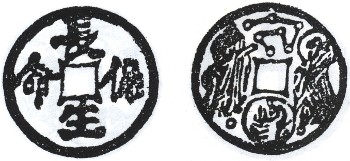
    "Chang Sheng Bao Ming" Charm
    King Mu Seeking Drug of Immortality from Queen Mother of the West

    The inscription reads chang sheng bao ming.  The chang sheng would translate as “long life” and bao ming translates as “protect life”.

    The symbols on the reverse side are as follows:
    1.  At the top are seven dots connected by a zigzag line which is meant to represent the “Big Dipper“.
    2.  The figure at the left is “Dong Wang Gong”, the Royal Lord of the East, who was actually King Mu of the Zhou (Zhou Mu Wang).
    3.  The figure at the right is the Queen Mother of the West (Xi Wang Mu).
    4.  At the bottom is a circle (which represents the moon).  Inside the circle is a rabbit using a pestle and mortar.

    The scene describes King Mu asking the Queen Mother of the West to give him the drug of immortality.  The drug of immortality was made by the rabbit that lived on the moon.

    Because of the wear on the charm, it is difficult to see the rabbit.  If you look closely at the circle, the rabbits ears are at the 12 o’clock position, the tail is at 3 o’clock, and the legs are at 5 o’clock.  The rabbit is facing left and slightly bent over.  The rabbit is making the drug of immortality using the pestle and mortar.  The top of the pestle is pointing to the 11 o’clock position.

    It is very difficult to date charms but charms like this first appeared in the Jin (1115-1234) or Yuan (1271-1368) dynasties.

    A size of 58 mm is about right for this charm.

    Hope you find the above information helpful.

    Thanks for writing,
    Gary
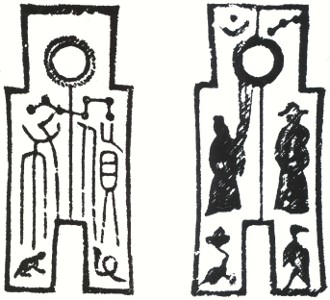
  • Huo Bu Charm

    I frequently receive correspondence from people who have a coin or charm they would like identified.

    The following is my reply to such an inquiry and I have attached a rubbing of the charm for reference.

    Chinese huobu charm

    It is a charm.

    However, it is based on an ancient form of spade money called a “Huo Bu”.  If you visit my Chinese Spade Charms web page you will see a real “Huo Bu” cast in the year 14 AD during the reign of Wang Mang.

    As best I can tell from reference books, your charm is actually fairly modern.  Apparently, it first appeared during the early years of the Republic of China sometime after 1911.  From your photos, I would say that your particular charm is a very recent copy of this older charm.

    One of my reference books says that this charm may actually be Japanese and not Chinese.

    The charm has some interesting features.  It has the same Chinese inscription “Huo Bu” as the original Wang Mang spade coin upon which it is based.  It is much much bigger in size.  Just above the Chinese characters is the seven star “Big Dipper”constellation.  There is a snake on the lower right foot and a “three -legged toad” on the left foot.

    The reverse side has the sun (the dot) and moon (crescent) at the upper left.  At the upper right are three stars connected by a line.  This refers to the three “Star Gods”.  The two “human figures” are unknown.  On the right foot may be a heron or egret.  I am not certain what symbol is on the left foot but I believe it is a tortoise exhaling an “auspicious cloud“.

    To learn more about these symbols, please look under the appropriate entry at my Hidden Meaning web page.

    I hope the above is helpful to you.

    Thank you for writing,
    Gary