Category: Chinese chess (xiangqi)

  • “Ministers of Fire” Chinese Chess Piece

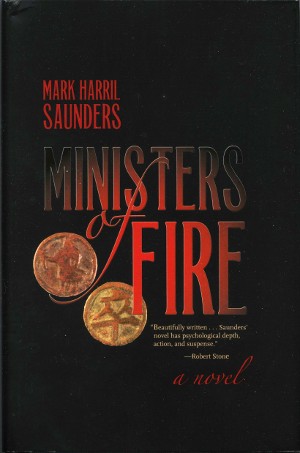
    Old Chinese chess piece on cover of "Ministers of Fire"
    Old Chinese chess piece on cover of “Ministers of Fire”

    Ministers of Fire” is a newly-published critically-acclaimed novel by Mark Harril Saunders which displays an ancient Chinese soldier on its dust jacket.

    The soldier is not a creation of a graphics designer but is actually an ancient Chinese chess piece dating back about 1000 years.

    The author contacted me late last year after seeing the old Chinese chess piece on my website.  He asked for permission to use the image on the cover of his new novel to be published by Swallow Press (Ohio University Press) in early 2012.

    I was happy to grant permission and provided the high resolution images.

    The book is a fast-moving spy thriller which has received outstanding reviews from such notable authors as Robert Stone and John Casey, both of whom are National Book Award winners.

    The book has also earned a “starred review” from Publishers Weekly.

    It is quite exciting to see a piece from your own collection on the book jacket of a major novel.
  • Chinese Chess Mooncakes

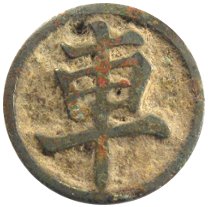
    Ancient Chinese Chess Piece
    Ancient Chinese Chess Piece

    Chinese chess or xiangqi (象棋) is one of the most ancient forms of chess.

    Old Chinese chess pieces, similar to the “chariot” (車) piece displayed here, were made of bronze and can date back to the Song Dynasty (960-1279 AD).

    A complete set of these old Chinese chess pieces would be extremely difficult to collect.

    A modern set of red and black Chinese chess pieces, on the other hand, is usually made of plastic or wood and can be easily purchased.

    Mooncakes in the shape of Chinese Chess Pieces
    Mooncakes in the shape of Chinese Chess Pieces

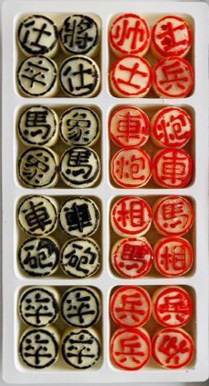
    At the left is what a modern set of Chinese chess pieces looks like.

    This particular set, however, is very special.

    The “pieces” are actually “mooncakes” (yue bing 月饼) made to resemble Chinese chess pieces.

    Mooncakes are the traditional pastry eaten during the Mid-Autumn Festival (zhong qiu jie 中秋节) which occurs on the 15th day of the 8th month according to the traditional Chinese calendar.

    The festival coincides with the autumnal equinox when the moon is at its fullest.  This year the festival falls on September 12th.

    Mooncakes are round and usually have an auspicious Chinese character such as “longevity” (shou 壽) imprinted on top.  They have a thin crust with a lotus seed paste filling and, sometimes, have a salted duck’s egg yolk in the center.

    The mooncake not only symbolizes the full moon but also evokes the story of Chang’e (嫦娥), the beautiful wife of Houyi (后羿), who ate the pill of immortality and as punishment must now live on the moon with only the Jade Rabbit (yu tu 玉兔) as a companion.

    It is a happy coincidence that this traditional festival food can be made to look exactly like the pieces from the ancient game of Chinese chess.  Now during game play, the pieces can be eaten once they are captured by the opposing player.

  • Chinese Chess Pieces Found in Old Tomb

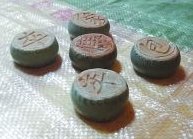
    Chinese Chess Pieces from Song Dynasty
    Chinese Chess Pieces from Song Dynasty

    According to a report in the Yangzi Evening News, archaeologists recently unearthed five ancient Chinese chess (xiangqi 象棋) pieces from a tomb located at Tiger Hill in Suzhou, Jiangsu Province.

    The tomb dates from the Song Dynasty (960-1279).

    Archaeologist Mr. Zhang Tiejun (张铁军) emphasized that, among the burial objects, only five Chinese chess pieces were discovered. Each piece is made of porcelain and is green in color.

    He noted that they are actually very similar to the Chinese chess pieces used today except for being slightly heavier.

    The pieces include two “soldiers” (zu 卒), one “cannon” (pao 炮), one “horse” (ma 马), and one “elephant” (xiang 象).

    According to Mr. Zhang, the person buried in the tomb was most likely a “chess fanatic”.

    Chinese chess has a very long history with official records dating from the Warring States Period (475 BC – 221 BC).

    By the time of the Song Dynasty (960-1279), the game had become a popular pastime and the major game characteristics had already evolved into essentially the same game as played today.  The game then, as now, was played with 32 chess pieces on a board having two “palaces” and divided in the middle by a “river”.

    During the Song, there were already craftsmen who specialized in making the chess boards and pieces.

    Books on game theory and play written by Hong Mai (洪迈), Ye Maoqing (叶茂卿) and Chen Yuanliang (陈元靓) were also popular.

    Not surprisingly, a number of famous Chinese from the Song Dynasty were known to be Chinese chess aficionados including such famous poets as Li Qingzhao (李清照) and Liu Kezhuang (刘克庄).  Other notable players included Hong Zun (洪遵), author of one of China’s first books on numismatics, and Wen Tianxiang (文天祥), the scholar-general who is recognized as one of China’s great heroes and patriots.