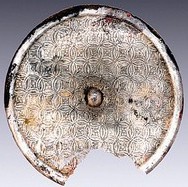
An ancient bronze mirror with a Chinese coin design was recently unearthed from a Song Dynasty (960-1279) tomb according to a report from Qianjiang City (潜江), Hubei Province.
The Qianjiang Cultural Relics Bureau (潜江文物局) announced that the mirror, which has some damage, was among the precious items found in a tomb located in Longwan Zhen (龙湾镇). Also discovered in the tomb were three silver bracelets and a bronze wash basin.
Song Dynasty bronze mirror with Chinese coin design
The mirror design incorporates multiple images of the classic Chinese cash coin, which is round with a square hole in the center, that was used for more than 2,000 years in China.
In addition to the mirror with the coin motif, 42 ancient Chinese cash coins were excavated from the tomb.
The coins included Han Dynasty (206 BC – 220 AD) wu zhu (五铢) coins and Tang Dynasty (618-907) kai yuan tong bao (开元通宝) coins. There were also coins from the Song Dynasty such as tai ping tong bao (太平通宝 976 – 989), jing de yuan bao (景德元宝 998-1022), and xi ning tong bao (熙宁通宝 1068-1085).
This is the first time coins from more than ten Emperor reigns have been discovered in a single tomb in Qianjiang.
The report concluded by stating that the discovery of the tomb will contribute greatly to the understanding of local burial customs and the historical changes that occurred during the Song Dynasty.
An outstanding private collection of ancient Chinese bronze mirrors owned by Lloyd Cotsen is being donated to the Shanghai Museum according to press releases issued in China and by The Huntington in San Marino, California.
Lloyd Cotsen, a successful American entrepreneur and noted philanthropist, began collecting ancient Chinese mirrors in the 1950’s after being exposed to Chinese art as an undergraduate at Princeton University. His collection of 95 pieces includes mirrors from the “Qijia Culture” (齐家文化 2100-1700 BC) as well as specimens produced during the Warring States Period, the Tang and later dynasties.
The collection will be exhibited at The Huntington from November 2011 to May 2012, and then will be transferred to the Shanghai Museum in China for permanent display.
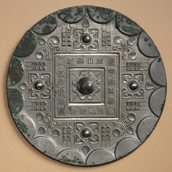
Western Han Dynasty Inscribed Mirror
At the left is a mirror from the Cotsen collection which is one of the earliest to include an inscription. The inscription on this Western Han Dynasty (206 BC-24 AD) mirror reads:
長貴福樂無事日有熹宜酒食常得君喜
“May you enjoy noble status and blessings for a long time. May you have pleasure without incident. May you have brightness every day. May you have plentiful wine and food. And may you regularly obtain lordly delights.”
The museum describes the piece as “quatrefoil, grass motifs, stars, and linked arc” incorporating cosmic symbols of space, time, earth and the heavens.
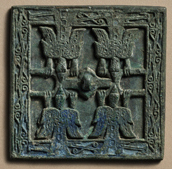
Mirror from Warring States Period
This mirror was produced even earlier during the Warring States Period (475-221 BC).
It is unusual in being layered or “tiered” and, unlike most mirrors, is square instead of round.
In ancient Chinese cosmology, the earth was believed to be “square” while “the heavens” were seen to be “round”.
The museum describes this as a “square double tier mirror with four opposed birds”.
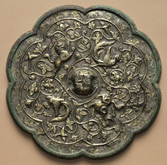
Tang Dynasty Mirror
The mirror at the left dates from the Tang Dynasty (618-907).
According to the museum, it is an “eight-lobed mirror with vines, birds, and mythical animals”.
The surface is covered with “hammerings” which are small pieces of soft metal placed over a carved form, tapped into shape with a hammer, and then attached to the mirror.
The vines, birds and mythical animals on this mirror were all created in this manner.
The mirror also exhibits “chasing” which is a technique for making intricate detail and texture on the surface of a mirror by using a hard stylus tapped with a hammer.
Mr. Cotsen explained at the press conference in California that he decided to donate his collection of ancient Chinese mirrors to the Shanghai Museum because of its reputation and commitment to public education.
Mr. Chen Kelun (陈克伦), the Deputy Director of the Shanghai Museum (上海博物馆副馆长), commented that the mirrors were exquisite. He said that no data existed for some of them which means that they will be very valuable for research.
Mr. Cotsen began his collecting in the 1950’s and acquired his first set of Chinese bronze mirrors at an auction in Hong Kong. He did not know it at the time but the other key bidder was the Swedish government bidding on behalf of the King of Sweden.
Chinese bronze mirrors are usually circular with one side highly polished to provide a reflective surface and the other side decorated with an inscription and symbols.
Simple undecorated bronze mirrors first appeared during neolithic times while the earliest decorated mirror, which was discovered in a tomb in Qinghai Province, dates to the Xia Dynasty (2100-1600 BC).
In terms of quality and production, the period from the Warring States (475-221 BC) through the Tang Dynasty (618-907 AD) was the heyday of Chinese bronze mirrors. By the middle of the Qing (Ch’ing) Dynasty (1644-1911 AD), bronze mirrors began to be replaced by glass mirrors and the 4,000 year history of bronze mirror use was nearing its end.
Chinese bronze mirrors were primarily used for vanity purposes but were also used to start fires by concentrating sunlight.
However, mirrors were also used for ritual and spiritual purposes.
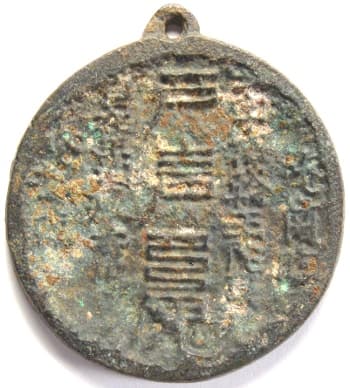
This is an example of an old Chinese Daoist (Taoist) mirror.
The inscription is written in Daoist “magic writing” (fuwen 符文) and its meaning can only be understood by a Daoist priest.
Mirrors were believed to have strong amuletic powers that could ward off evil spirits. An invisible demon would flee when it saw its reflection in a mirror.
For this reason, Daoists often wore these mirrors hanging down the back to protect against being blind-sided by a ghost.
So even though the exact meaning of the inscription on the mirror is unknown, we can reasonably believe that it is meant to provide protection from demons.
Reflective side of Daoist mirror
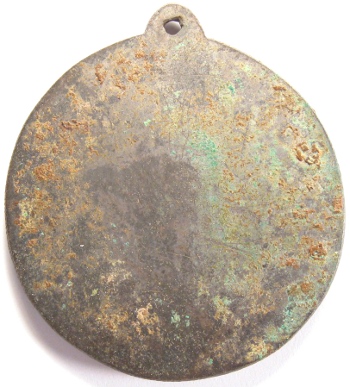
This is the “reflective” side of the mirror.
Since it is believed that this mirror was used to provide protection, the mirror was probably hung with the inscription side facing outwards.
Mirrors used for this purpose frequently had concave surfaces. This mirror is actually concave on its inscription side. A concave mirror “inverts” the image of a ghost, and thus “overturns” any evil influences.
Daoist priests also used the concave bronze mirrors to collect dew which, because of its “purity”, was used in rituals.
This talisman mirror with Daoist magic script characters was probably cast during the Qing Dynasty and is actually quite small. It has a width of 5.3 cm and a weight of 37.6 grams.