Month: October 2011

  • Laozi and Zhang Daoling Charm

    The Chinese have been producing coin-shaped charms and amulets in a variety of themes for more than 2,000 years.  One of the most visually appealing types of charms involves scenes of people.

    Unfortunately, it is often difficult to interpret what historic or legendary scene is being presented.
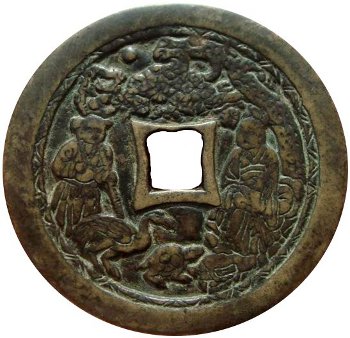
    Laozi and Zhang Daoling Charm
    Laozi and Zhang Daoling Charm

    The charm at the left is frequently referred to by Chinese collectors as a “boy under a pine tree” (松下童子) or a “boy worships an immortal” (童子拜仙人).

    More serious collectors, however, feel that the scene must be an event of special importance.

    The charm is believed to depict a meeting between Laozi (老子) and Zhang Daoling (张道陵).

    Laozi, the mystic founder of Daoism (Taoism) and the author of the Dao De Jing (道德经), is shown seated under a pine tree on the right.

    The “youth” on the left is Zhang Daoling who is clearly carrying a cane or staff.  The Chinese word for “cane” (zhang 杖) has the same pronunciation as the “Zhang” in Zhang Daoling’s name and, therefore, helps confirm his identify.

    Zhang Daoling spent a good part of his life seeking the secret of immortality and there are several symbols which help to reinforce the longevity theme of this charm.  Below the square hole are a crane and a tortoise facing Laozi.  Both are traditional symbols of longevity as is the pine tree.

    In the gap above the pine tree can be seen a full moon where the “Jade Rabbit” lives and makes the “elixir of immortality”.

    According to Daoist accounts, Laozi appeared before Zhang Daoling on “Crane Cry Mountain” (hemingshan 鹤鸣山), in what is now Sichuan Province, in the year 142 AD and proclaimed him the “Celestial Master” who would deliver the people from the evils of the Han Dynasty.

    Zhang Daoling would subsequently establish the first organized Daoist religious sect known as the “Five Bushels of Rice” (wudou mi dao 五斗米道).
    Chinese Zodiac side of charm
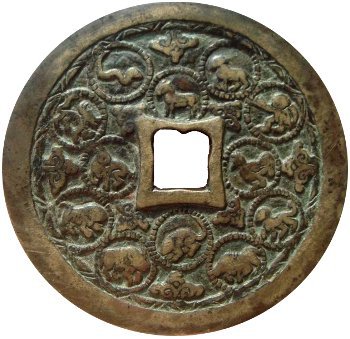
    Chinese Zodiac side of charm

    The reverse side of the charm displays the twelve animals of the Chinese Zodiac (十二生肖) with each animal in its own circle.

    Interspersed among the animal circles are eight “auspicious clouds“.  “Eight” is considered a lucky number because in certain Chinese dialects it shares the same pronunciation as the word for “wealth”.

    The auspicious clouds at the top, bottom, right and left sides of the rim indicate the four directions.  The other four clouds are at the protruding corners of the square hole.

    This charm is particularly well-made and probably dates from the Jin (金 1115-1234) or Yuan (元 1271-1368) dynasties.

    Another old charm portraying the meeting of Laozi and Zhang Daoling on “Crane Cry Mountain”, but with a different set of symbols, may be seen at Daoist Charms.


  • Coins Discovered at Rufu Stone Pagoda

    Rufu Stone Pagoda
    Rufu Stone Pagoda

    Chinese archaeologists working at an ancient stone pagoda in Hainan Province (海南省) recently made a discovery which will help to establish the date when the pagoda was originally built.

    An article in the October 27, 2011 edition of the Haikou Evening News (海口晚报) describes the restoration work being done at the Rufu Stone Pagoda (儒符石塔) near Haikou.  The pagoda is distinctive because it is built from volcanic rock but has fallen into disrepair over the centuries.

    Hidden vault where tortoise box was found
    Hidden vault where tortoise box was found

    Few records exist concerning the history of the pagoda with the oldest references dating to the Ming Dynasty.

    The pagoda is believed to have been built during the late Song Dynasty but no historical evidence exists to prove this.

    The Buddhist pagoda is one of the oldest structures in the province and its design reflects Indian influences.

    While working at the base of the pagoda a worker discovered a hidden vault.

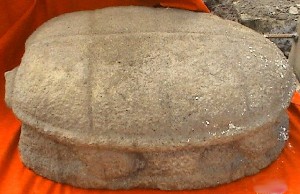
    Inside the vault was a stone tortoise-shaped box.

    Tortoise-shaped box
    Tortoise-shaped box

    According to Mr. Wang Daxin (王大新), the Director of the Haikou City Bureau of Cultural Relics (海口市文物局), the tortoise box contained a number of items.

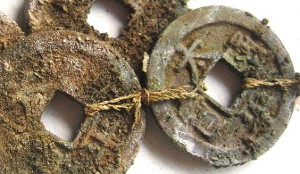
    In the box were more that seventy Chinese bronze coins.  Remarkably, the coins still retain remnants of the cord with which they had been bound together.

    "Tai Ping Tong Bao" Song Dynasty coins

    The majority of the coins have the inscription tai ping tong bao (太平通宝) which means they were cast during the years 976-989 of the reign of Emperor Tai Zong of the Song Dynasty.

    Coins are always considered an important find because they can be accurately dated.  Since the majority of the coins are tai ping tong bao, it is most likely that the pagoda was built during this same time period.

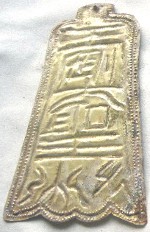
    Silver tablet with unknown meaning
    Silver tablet with unknown meaning

    Among the most puzzling artifacts found in the box, however, were six metal tablets.  Originally thought to be made of tin, after cleaning they were found to be made of silver.  Unfortunately, three of the tablets were too fragile to be cleaned so they are being kept in their original state.  This also means that their inscriptions cannot be read.

    Of the other three silver tablets, two have auspicious connotations.  One has the inscription fu de chang shou (福德长寿) which translates as “good fortune, virtue and a long life”.  Another has the inscription qian yuan heng li zhen (乾元亨利贞) which is a cryptic phrase from the ancient Chinese “Book of Changes” (I Ching 易经).

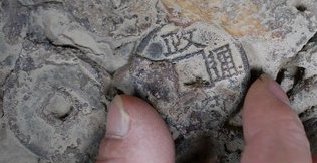
    The last silver tablet, displayed above, has the inscription wang gang da sheng (王刚大圣).  The experts are still trying to understand the meaning of this inscription.

    Mr. Wang made clear that while the archaeologists continue to study the cultural relics found at the site, the work to restore the pagoda to its original state is continuing with completion of the project expected by the end of this year.

  • Lu Xun and Chinese Coins

    Lu Xun (鲁迅 1881-1936) is recognized as one of the greatest Chinese writers of the 20th Century and the founder of modern Chinese literature.

    Few people, however, are aware of Lu Xun’s contributions to Chinese numismatics.  He was not only a collector of ancient Chinese coins but he also wrote a manuscript annotating Chinese coins from the 7th to the 17th Century.

    According to a Xinhua news dispatch, this treatise on Chinese coins written by Lu Xun is now being published for the first time in commemoration of the 62nd anniversary of the founding of the People’s Republic of China.

    The manuscript was written in 1913 while Lu Xun was working for the Ministry of Education in Peking (Beijing).  During that time, he began to study ancient books on Chinese coins and he frequently went to Liulichang (琉璃厂) to buy old Chinese coins for his own collection.

    Lu Xun was familiar with the famous work on Chinese coins known as Quan Zhi (泉志) written by Hong Zun (洪遵) in 1149 during the Song Dynasty.  The Quan Zhi has the honor of being recognized as the world’s oldest extant coin book.

    The Quan Zhi annotated the various forms of Chinese money from the very earliest times to the Song Dynasty.  Lu Xun wanted to supplement this great work.  In his manuscript, he wrote about Chinese coins beginning with those of the Tang and Five Dynasties and ending with the coins of the Ming Dynasty.  He cataloged 1,311 different coins from this time period thus adding an additional 700 years to the field of numismatic research.

    But Lu Xun’s involvement in Chinese numismatics went even further for he was actually involved in the design of one of the coins of the time.

    According to an entry in Lu Xun’s diary dated August 28, 1912, he along with two colleagues, Xu Shouchang (许寿裳) and Qian Taoxun (钱韬逊), designed a twelve symbol emblem.

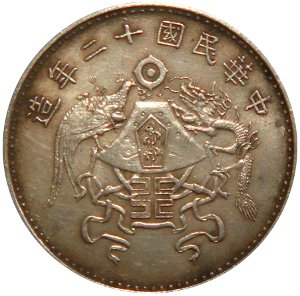
    Dragon and Phoenix Silver Dollar
    Dragon and Phoenix Silver Dollar

    This emblem, seen on the coin at the left, was designed by Lu Xun to be the national emblem for the newly established Republic of China.

    Lu Xun incorporated into the design the auspicious elements known as the Twelve Symbols (十二章), which date from the Spring  and Autumn Period (770 BC – 476 BC), that had traditionally been used on the clothing of Chinese emperors.

    These ancient symbols include the dragon and pheasant.  However,  the Chinese have traditionally mistaken the pheasant (雉) as being a phoenix (凤) and so the design is usually referred to as the “dragon and phoenix”.

    Besides the dragon and pheasant (“phoenix”), the Twelve Symbols include the axe head (斧 located between the dragon and pheasant),  rice (粉米 small circles on the axe), the sun (日 above the axe), the moon (月 the dragon’s horn), fire (火 on dragon’s body), the fu (黻 under the axe), stars (星辰 the three dots above the pheasant’s crest), the mountain (山 bottom of axe), the grail (宗彝 in claws of dragon and pheasant), and seaweed (藻 in pheasant’s beak).

    At the top of the coin is written “Made in the 12th Year of the Republic of China” (中華民國十二年造) which would be the year 1923.

    Reverse side of Dragon and Phoenix Silver Dollar
    Reverse side of Dragon and Phoenix Silver Dollar

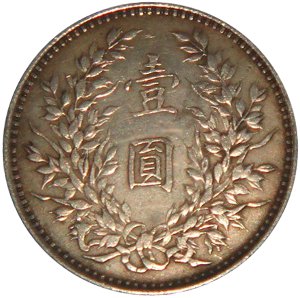
    The other side of the coin has the denomination “One Yuan” (“One Dollar” 壹圓) written within a wreath of grain (嘉禾).  There are two versions of the coin depending on if the two Chinese characters are written “large” (大字) or “small” (小字).

    This “dragon and phoenix silver dollar” was produced as a pattern or trial piece at the mint in Tianjin.  Only a small number were produced and the coins were not put into circulation because the design was considered by some to retain too much symbolism from China’s imperial past.

    The lead mold used by the Tianjin Mint to produce these pattern coins can be seen at the Lu Xun Museum in Beijing (北京鲁迅博物馆).

  • “Cassia and Orchid” Charm

    An article in “The Oriental Collection” (dongfang shoucang 东方收藏) introduced a rarely seen Chinese charm from the Qing Dynasty (1644-1911).

    Honorable sons and noble grandsons
    Honorable sons and noble grandsons

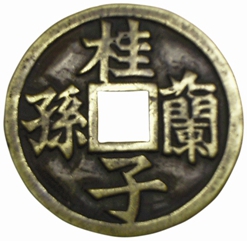
    One side of the charm has the inscription gui zi lan sun (桂子蘭孫).

    Gui (桂) refers to a plant known as the “cassia” and zi  (子) refers to “seeds”.  Lan (蘭) is the “orchid” and sun (孫) means “grandson”.

    So, what does “cassia seeds and orchid grandsons” mean?

    The Chinese love puns and the Chinese language has many homonyms which facilitates the making of puns.

    The word for cassia (gui 桂) shares the same pronunciation as “honorable” (gui 贵).  And,  “seeds” (zi 子) can also mean “sons” (zi 子).

    Therefore, “cassia seeds” sounds the same as “honorable sons”.

    The cassia also symbolizes success in the imperial examination system.

    “Orchid grandsons” is also a play on words.  The orchid (lan 蘭) is a  reference to zhilan (芝蘭) which literally means “irises and orchids” but to the Chinese has the implied meaning of “noble character”.

    “Orchid grandsons” thus means “noble grandsons”.

    The entire inscription gui zi lan sun therefore means “honorable sons and noble grandsons”.

    High position and great wealth
    High position and great wealth

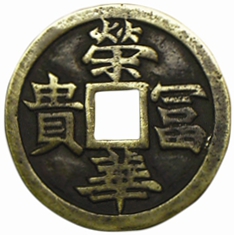
    The inscription on the reverse side of the charm reads rong hua fu gui (榮華富貴).

    Rong (榮) means “grow luxuriantly” and “flourish” but also has the meaning of “honor” and “glory”.  Hua (華) means “flowers” but is also used for “glory”.  Ronghu (榮華) can thus refer to flowers, such as the cassia and orchids, growing luxuriantly but it also has the meaning of “honor and glory”.

    Fu (富) means “wealth” and gui (貴) means “honor”.  So fugui (富貴) translates as “riches and honor”.

    The entire inscription rong hua fu gui is commonly used to express “glory, wealth and rank” or “high position and great wealth”.

    This charm was made when emperors still ruled China.  A traditional Chinese family’s greatest wish was to have sons who would be successful in passing the imperial examinations.  In so doing, they would be assigned an important position in the government bringing honor and prosperity to the entire family.

    Another charm with a related content may be seen at “A Talented and Noble Young Man“.

  • Tons of Song Dynasty Iron Coins Discovered

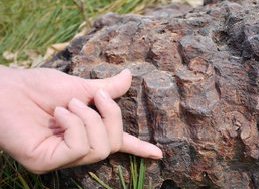
    A Chinese newspaper reported today that several tons of iron coins dating from the Song Dynasty were recently discovered in a field near the city of Cangzhou (沧州), Hebei Province in northeast China.  Although the coins protruding through the soil have rusted together, they can still be seen just the way they were arranged in stacks almost a 1,000 years ago.

    Stacks of iron coins from the Song Dynasty
    Stacks of iron coins from the Song Dynasty

    An outcropping of the pile of neatly stacked iron coins can be seen in the photo at the left.

    This was not the first time a large quantity of coins had been discovered in the area.  In July 1997, at a location just 500 meters from the newly discovered pile of coins, more than 48 tons of Song Dynasty iron coins were unearthed.

    The actual quantity of coins discovered in the new “pile” is not known at this time.  Based on preliminary calculations, the coins fill an area approximately 25 meters by 16 meters.  The top of the pile is about 0.4-0.5 meters below the surface.  Since it is not known how deep the pile is, the experts can only estimate that there are several tons of coins.

    Chinese iron coin from 1101-1125 AD
    Chinese iron coin from 1101-1125 AD

    The photo at the left displays one of the iron coins from the pile of coins discovered in 1997.

    This round cash coin with a square hole in the center has the inscription zheng he tong bao (正和通寶) which was used on coins cast during the reign (1101-1125 AD) of Emperor Hui Zong of the Northern Song Dynasty.

    Mr. Yang Fengling (杨凤岭), the Director of the Cang Prefecture Cultural Relics Institute, said it is not yet known if there is any connection between the newly discovered pile of coins and the coins discovered nearby in 1997.

    As to why such a large quantity of Song Dynasty coins might exist, Mr. Yang could only conjecture at this time.

    Mr. Yang said that during the Song Dynasty, Cangzhou was one of the places where prisoners were sent.  During ancient times, prison labor was sometimes used to produce coins.  It is possible that this had been the site of a coin foundry or mint.

    Mr. Yang also pointed out that the coins seem to have been arranged in a very orderly manner and that the site may have been a large-scale treasury where money was stored.

    Mr. Yang mentioned one other interesting possibility.  It is said that after Emperor Taizu (960-976) established the Song Dynasty, he wanted to redeem parts of present day Hebei Province, known then as the “Sixteen States of You Yun” (幽云十六州), which were occupied by the Khitan (契丹) of the Liao Dynasty (辽朝).  Cangzhou happened to be situated right at the border of the Song and Liao territories and the cache of coins may have been intended for this purpose.

    Mr. Yang further stated that this new discovery of iron coins might rewrite history.  According to historical sources, iron coins during the Song Dynasty were made and circulated in the southern part of the country.  The discovery of such a large quantity of iron coins in the north means that iron coins must have circulated here as well.  They may also have been produced here.

    Mr. Yang hopes that the mysteries surrounding this new discovery may be better explained once excavation of the site begins next month.