Chinese charms very often resemble Chinese coins. A number of old Chinese charms are modeled after a coin issued during the reign of Emperor Taizong (太宗 939-997 AD) of the Northern Song Dynasty. The inscription on the coin was taiping tongbao (太平通宝) which translates as “Currency of the Great Peace”.
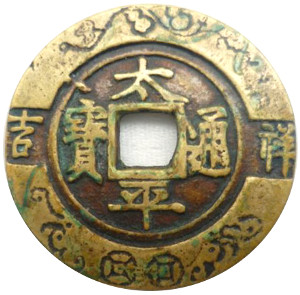
At the left is a very interesting example of a Chinese charm cast during the Qing Dynasty (清朝 1644-1911 AD) which has the same inscription taiping tongbao.
There is also a second inscription on this charm. The two Chinese characters at the left and right rim are jixiang (吉祥) which means “good fortune”. On the reverse side of the charm are the two Chinese characters ruyi (如意), located at the top and bottom rim, which translate as “as you wish”.
These four characters thus comprise the popular expression jixiang ruyi meaning “good fortune according to your wishes”.
If you look closely, you will notice that this charm has a “double rim” (重轮) because in addition to the broad outer rim there is also a thin circular rim surrounding the four character inscription. This is very unusual for a charm.
It is even more unusual for a charm to have an inscription in a recessed area of the rim, as this one does.
It is even rare for a Chinese coin to display an inscription in a recessed area of the rim.
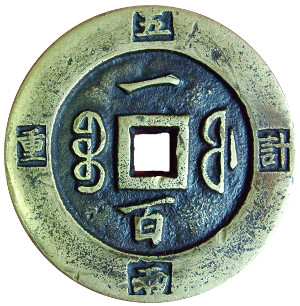
An example is the large coin displayed at the left.
This is a very rare denomination “One Hundred Cash” (一百) coin cast at the mint in Fuzhou (福州), Fujian Province (福建省) during the reign of the Xianfeng Emperor (1851-1861) of the Qing Dynasty. In recessed areas of the rim on the reverse side of this xianfeng zhongbao (咸豐重寶) coin are the Chinese characters wu liang ji zhong (五兩計重) which translates as “5 liang calculated weight”.
The taiping tongbao charm displays several auspicious symbols on its obverse side.
If you look at the top rim you will see symbols which resemble the number “8” and represent gourds. The gourd is believed to ward off evil spirits and disease.
At the bottom rim are two Chinese cash coins (circles with a square hole in the middle) which symbolize wealth and prosperity.
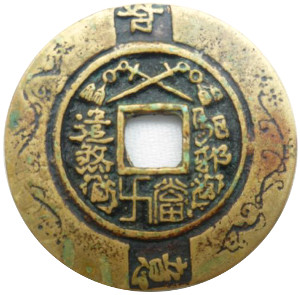
The reverse side of the charm, shown here at the left, includes additional inscriptions and a number of auspicious symbols.
Written vertically at the right of the square hole are the Chinese characters quxie (驱邪). At the left of the square hole are the characters qiansha (遣煞). The inscription quxie qiansha (驱邪遣煞) translates as “expel and strike dead evil influences”.
Just above the hole are two crossed swords with tassels which symbolizes “victory over evil”.
At the lower right and lower left corners of the square hole are two “bats”. The bat (fu 蝠)is a visual pun or rebus for “good fortune” or “happiness”.
Below the hole are two Chinese characters. At the right is the character dang (當) and to its left is a swastika (卍).
The Chinese “swastika” (卍) is an ancient religious and charm symbol that over the course of two millinnea has variously been interpreted to represent the sun, fire, the light emanating from the Buddha, etc.
The 卍 symbol also represents the number “ten thousand” (wan 萬). The two character inscription (dang wan 當卍) thus translates as “Value Ten Thousand” which means the denomination of this charm “coin” is equivalent to ten thousand cash coins. Quite a fortune, indeed!
Finally, along the right and left rims are very stylized dragons.
This is an extraordinary charm from the late imperial period that displays a variety of good luck symbols and inscriptions while incorporating features rarely found even on officially cast coins.


Leave a Reply