A large quantity of Tang Dynasty kaiyuan tongbao (开元通宝) coins were recently unearthed at an 1,100-year-old temple in Quanzhou (泉州), Fujian Province (福建省), according to a local newspaper report.
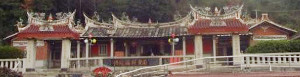
Fuhaiyuan Temple in Quanzhou where Tang Dynasty coins were unearthed
Construction of the Fuhaiyuan (福海院) Temple in Anxi Prefecture (安溪县) began in the year 900 AD.
The temple still has such ancient cultural artifacts as a horse-trough, a medicinal vat, and a stone bathing tank.
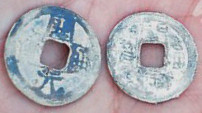
But during a recent renovation of one of the rear halls, a buried jar containing 27.5 kilograms of ancient Chinese coins was discovered.
Kaiyuan Tongbao coins totaling 27.5 kg discovered at Fuhaiyuan Temple
All the coins have the inscription kai yuan tong bao (开元通宝) which were first cast during the Tang Dynasty (618-907 AD).
Experts are not sure as to why the coins were buried.
Ms. Lin Meilian (林美莲), a local official, speculates that although Fuhaiyuan would have been considered one of the larger temples during the Tang Dynasty, the coins may have been buried “to provide for a rainy day”.
Although it is not included in most Chinese coin catalogs, this coin is known as the “King of Qing Dynasty Coins” (清钱之王).
Chinese coin collectors refer to it as the “daqing one hundred” (daqing yibai 大清壹百).
It is a denomination “100 cash” (壹百) coin cast at the Fuzhou (福州) mint during the reign (1850-1861) of the Xianfeng Emperor (咸丰帝) of the Qing Dynasty (大清).
It is an extremely rare pattern coin and is the only specimen in existence.
The coin was owned by Mr. Ma Dingxiang (马定祥), who was regarded as one of the most famous Chinese numismatists of the 20th Century, and when it was auctioned in 2009 it became the most expensive ancient Chinese coin ever sold up to that time.
Xianfeng had to contend with a number of challenges during his reign. The country’s economy was crumbling and he faced serious military challenges with the Taiping Rebellion (太平天国运动) and the Nien Rebellion (捻军起义).
He also suffered a humiliating defeat by the British and French forces in the Second Opium War (第二次鸦片战争).
To pay the huge military expenditures, Xianfeng issued a large quantity of paper money (Hu Bu Guan Piao 户部官票, Da Qing Bao Chao 大清宝钞) although the empire’s silver reserves were woefully inadequate to back the new currency. He also reduced the size and weight of the common “one cash” coins, and even issued iron coins, in order to save copper which was in short supply due to the supply lines from Yunnan Province being disrupted by the wars.
Finally, he began to issue large denomination coins (大钱) although the copper metal content did not reflect their increased value. These large coins included denominations of 4 cash, 5 cash, 10 cash, 20 cash, 30 cash, 40 cash, 50 cash, 80 cash, 100 cash, 200 cash, 500 cash and 1000 cash.
Among the various mints, the Fuzhou mint was noted for casting many varieties of these larger denomination coins with local characteristics.
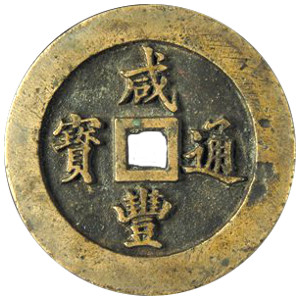
For example, the obverse inscription on this coin is xian feng tong bao (咸丰通宝).
The mints, however, were supposed to use the term tong bao only for the small “one cash” coins. Coins with denominations “5 cash” to “50 cash” were to use the term zhong bao (重宝). Coins valued at “100 cash” to “1000 cash” were to be called yuan bao (元宝).
If the Fuzhou mint had followed the directives from the central authorities, the inscription on this “100 cash” pattern coin would have been xian feng yuan bao (咸丰元宝)
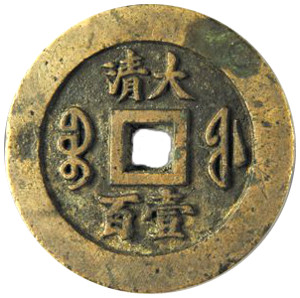
Reverse side of rare Qing Dynasty 100 cash pattern coin
Other special characteristics may be seen on the reverse side.
The inscription at the top reads da qing (大清) meaning Qing Dynasty or the “Great Qing”. At the bottom is the denomination yi bai (壹百) which translates as “one hundred” or the equivalent of 100 cash coins. To the right and left of the square hole are the Manchu characters pronounced boo fu identifying the mint in Fuzhou.
This coin is unusual in that the inscriptions state not only the reign title (xian feng), the denomination (100 cash) and the mint name (Fuzhou), but also the dynasty name (da qing).
The calligraphy is outstanding and is in a style used by the Fuzhou mint known as “mountains and valleys” (shanguti 山谷体).
This very rare pattern coin, which was never put into circulation, is large, heavy and very well cast. The diameter is 7.25 cm and the weight is 197 grams.
This coin, which was one of the prominent pieces in the collection of Ma Dingxiang, sold at the Guardian Auction on November 11, 2009 for about US$314,000 (RMB 1.96 million). At the time, this was the highest price ever paid for an ancient Chinese coin.
Many reproductions and fakes exist of this beautiful one-of-a-kind coin but the only authentic specimen now resides in the collection of the Jin Quan Coin Museum (金泉钱币博物馆).
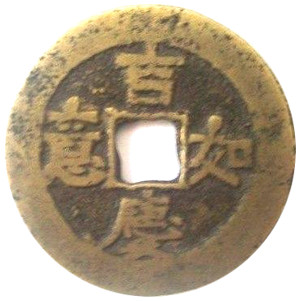
Old Chinese charm with inscription “May your happiness be according to your wishes”
The Chinese love visual puns.
The old charm displayed at the left recently appeared in a Chinese coin forum.
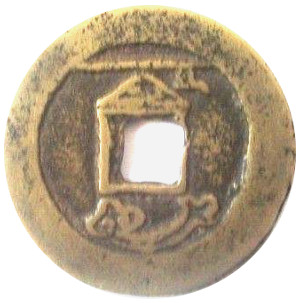
Although the quality of the images may not be the best, the symbols on the reverse side of the charm are a good example of a visual pun also known as a rebus.
The inscription on the obverse side is ji qing ru yi (吉慶如意) which translates as “may your happiness be according to your wishes” or, alternatively, “may you achieve a rank according to your wishes”.
Reverse side of charm displaying a halberd, stone chime and sceptre
The reverse side of the charm presents a visual puzzle consisting of three objects.
The stone pieces were of different sizes and produced different pitched sounds when struck with a mallet.
These chime stones were frequently made of jade and therefore also symbolize wealth and riches.
Below the square hole is a sceptre which in ancient times represented power and authority. In Chinese, this sceptre is known as a ruyi (如意).
The visual pun is thus complete because the three objects displayed on the reverse side of the charm read ji qing ruyi (戟磬如意). This sounds exactly the same as the ji qing ruyi (吉慶如意) inscription on the obverse side even though the Chinese characters are different.
This charm dates from the Qing Dynasty (1644-1911) and cleverly illustrates the Chinese fondness for auspicious visual puns.
Additional information on charms with this theme may be found here.
Chinese archaeologists recently excavated approximately 3,500 kilograms of coins, as well as more than 100 clay coin casting moulds, from the ruins of an ancient Chinese mint dating from the 1st Century AD according to several newspaper reports.
The coins were found at a site in the town of Huoluochaideng (霍洛柴登) in Ordos City (鄂尔多斯) which is located in north China’s Inner Mongolia Autonomous Region (内蒙古自治区).
The discovery was made after local police cracked three theft cases in August, 2012. Information obtained from the tomb robbers identified the location of three underground vaults, according to Lian Jilin, a researcher with the regional Institute of Cultural Relics and Archaeology.
According to archaeologists, the ruins of the coin mint dates to the period from the reign of Emperor Wu (武帝 156-87 BC) of the Western Han Dynasty (西汉) to the reign of Wang Mang (王莽 9-23 AD) of the short-lived Xin Dynasty (新朝).
The newspaper article states that the discovery of such a large quantity of coins in one hoard is a rare event.
Unfortunately, none of the newspaper articles include photos of the discovery.
The digging is taking place at three pits. One site has revealed a fairly well-preserved kiln which was used to produce the clay moulds needed to cast the bronze coins. A kiln used to cast the coins was also discovered but it apparently is not as well-preserved.
In the “kiln room” and surrounding area were found more than 100 clay moulds used to cast coins. The moulds date from the period of Wang Mang. Seven of the moulds have the Chinese inscription shi jian guo yuan nian san yue (始建国元年三月). Shi jian guo (始建国) refers to the first era of Wang Mang’s reign. The inscription thus dates the coin moulds to the third month of the first year of Wang Mang’s reign which would be the year 9 AD.
The clay moulds include those used to cast the most common coins of the reign of Wang Mang, namely da quan wu shi (大泉五十 “large coin fifty”), xiao quan zhi yi (小泉直一 “small coin value one”), and huo quan (货泉 “wealth/money coin”).
The archaeologists point out that the discovery of such a large coin producing operation confirms that Wang Mang had lifted the order issued by Emperor Wu which prohibited the commanderies (prefectures) from minting coins.
Because the discovery was made so late in the year and with the winter conditions, it is unclear at this time what may ultimately be discovered at the two other sites.
Based on the size of the mint site and the coin hoard, Huoluochaideng must have been one of the important northern cities during the Western Han and Xin Dynasties. From the inscription found on a bronze seal discovered in a nearby grave, the area was known as the “West River Agriculture Commandery” (西河农令) during this period.