The Qixiang coins were cast for the shortest period of time and in the smallest quantity of any reign of the Qing Dynasty.
Upon the death of the Xianfeng Emperor (咸丰帝) in 1861, his young son Zaichun (载淳) became the new emperor of China adopting the regnal name of Qixiang (祺祥).
The new emperor was only five years old at the time. His mother, the Empress Dowager Cixi (慈禧太后), arranged a coup (祺祥政变) and became the real power behind the throne.
After just a couple of months, the Empress Dowager Cixi changed the emperor’s regnal name from Qixiang (祺祥) to Tongzhi (同治).
Because the reign title Qixiang existed for only 69 days, very few coins with the inscription qi xiang (祺祥) were produced. It is quite possible that none of the coins ever went into general circulation.
When preparing to cast coins for a new emperor, a mint would first engrave a coin out of fine brass. This “engraved mother coin” (diao mu 雕母), also known as an “ancestor coin” (zu qian 祖钱), was then used to make impressions in a sand mold to produce several “mother coins” (mu qian 母钱). These “mother coins” were then used to make the impressions to cast the coins which would go into circulation.
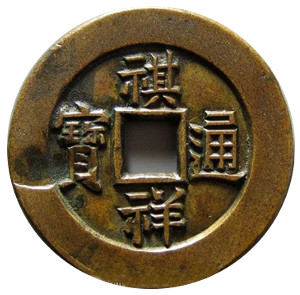
Qi Xiang Tong Bao Engraved Mother Coin
The image at the left is the obverse side of the engraved mother coin.
The coin is made of high quality brass and has a beautiful patina.
The Chinese characters are finely and deeply inscribed.
However, the left rim is clearly damaged.
This was done intentionally at the mint in order to ensure that no additional coins were cast after the regnal name Qixiang was dropped in favor of Tongzhi.
This damage provides further proof that the coin is authentic.
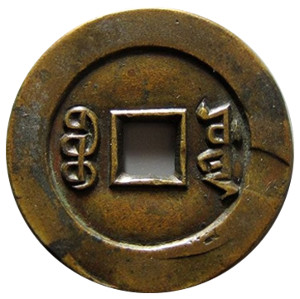
Reverse side of Qi Xiang Tong Bao Engraved Mother Coin
The reverse side of the coin is seen in the image at the left.
The Manchu script at the right of the square hole indicates that the coin was made at the Board of Works (宝源) mint in Beijing.
The mint intentionally damaged the right rim to prevent any further use of this mother coin.
The coin has a diameter of 29.14~29.52 mm and a thickness of 1.82~2.03 mm. The weight is not mentioned in the description.
A qi xiang zhong bao (祺祥重宝) “engraved mother coin” produced at the Board of Works (宝源) may be seen here.
A qi xiang zhong bao (祺祥重宝) “mother coin” from the Board of Works (宝源) may be seen here.
Because qi xiang coins were cast for such a short time, only a few of the mints produced coins. These included the Board of Works (宝源), the Board of Revenue (宝泉), the Yunnan mint (宝云), the Gansu mint (宝巩) and the Suzhou mint (宝苏).
When the regnal name changed to Tongzhi, the mints withdrew or destroyed the qi xiang mother coins and then engraved new mother coins to produce coins with the inscription tong zhi tong bao (同治通宝) and tong zhi zhong bao (同治重宝).
All authentic qi xiang coins are rare, and qi xiang engraved mother coins are extremely rare.
Only one other specimen is known to exist. It is in the collection of Mr. Sun Zhonghui (孙仲汇), a famous Chinese numismatist and author.
On November 30, 2014, the qi xiang tong bao engraved mother coin discussed here was sold at an auction in Beijing for US$129,843 (RMB 808,500).
The shape of these “coins” evolved from an ancient bronze scraper knife, known as a xue (削刀), which had a ring at the end.
Shown at the left is an example of an ancient xue knife.
Qi money knives can be categorized by the number of Chinese characters on their obverse side. There are Three Character Knives (san zi dao 三字刀), Four Character Knives (si zi dao 四字刀, Five Character Knives (wu zi dao 五字刀) and Six Character Knives (liu zi dao 六字刀).
The Four Character Knives are believed to have been minted in the early Spring and Autumn Period (春秋时代 771 BC – 476 BC) making them the first version of Qi knife money to appear. The Five Character Knives began to be produced in the late Spring and Autumn Period. The Three Character Knives began to circulate during the early to middle Warring States Period.
All Qi knives are rare.
The Qi Heritage Museum, which has the world’s largest collection of Qi knife money, is located in Linzi in Shandong Province.
The museum is situated at the site of the ancient capital of the State of Qi. The outstanding collection of Qi money and other cultural artefacts was obtained from archaeological excavations.
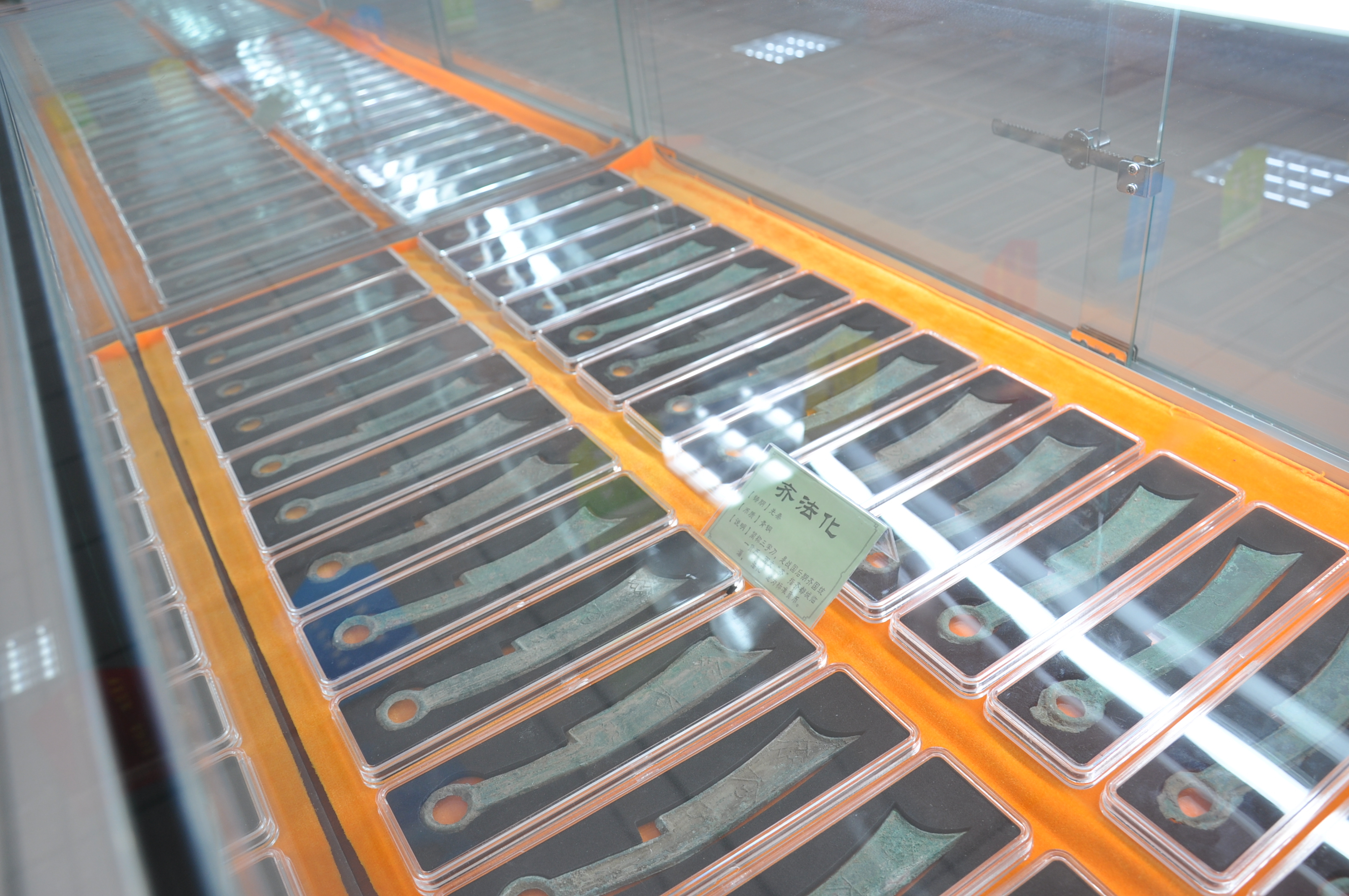
The Three Character Knives (san zi dao 三字刀) exist in the greatest number and specimens from the museum’s collection may be seen here.
There are much fewer surviving specimens of the Four and Five Character knives.
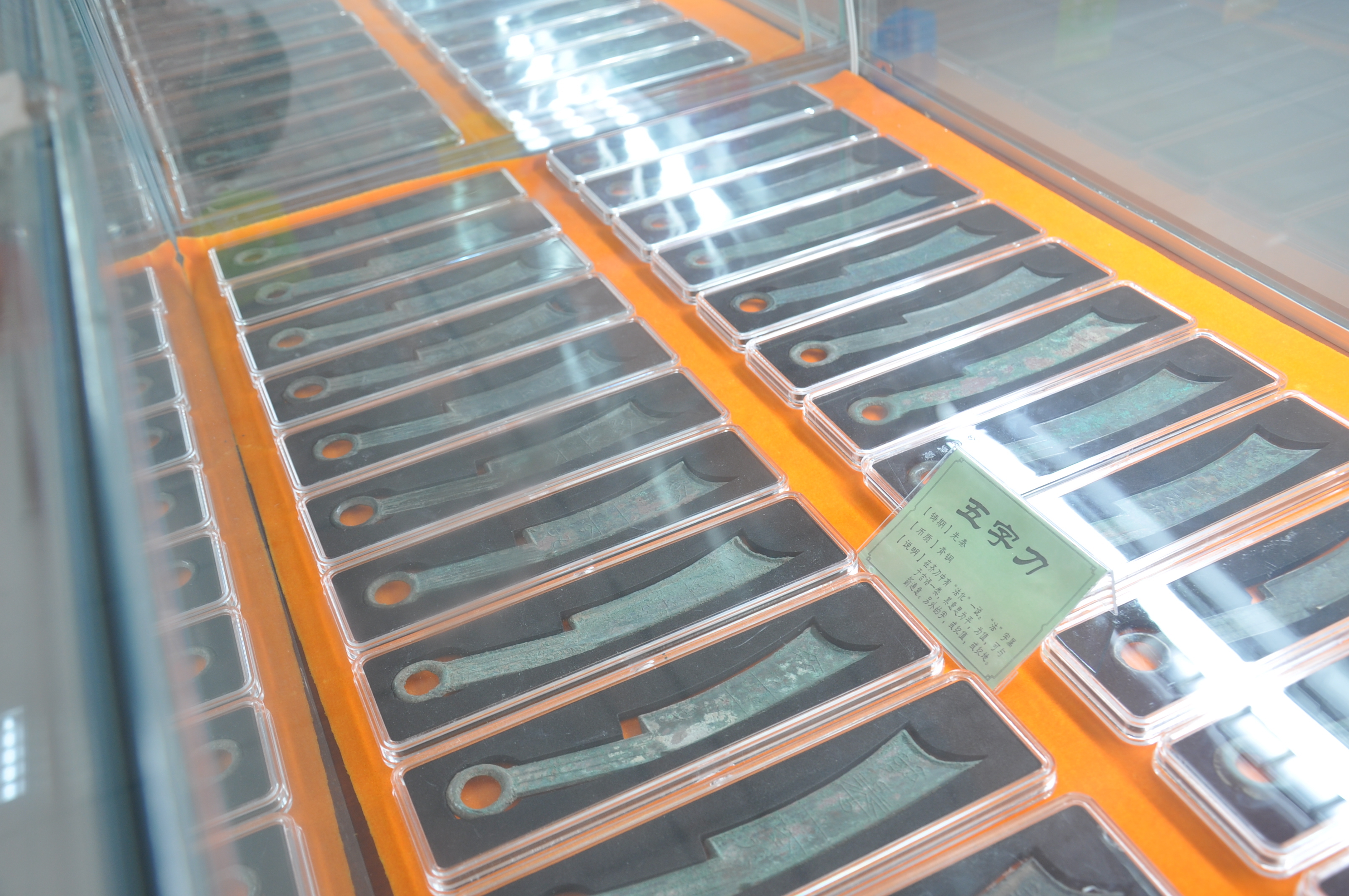
Specimens from the museum’s collection of Five Character Knives (wu zi dao 五字刀) may be seen here.
If you look carefully, you will notice that there are actually two versions of the Five Character Knife.
The Five Character Knives with the inscription ji mo zhi fa hua (即墨之法化), translating as “Ji Mo Legal Money”, were cast in Jimo which was located in what is now Pingdu in Shandong Province.
The Five Character Knives with the inscription an yang zhi fa hua (安阳之法化), translating as “An Yang Legal Money”, were minted in Anyang which was situated just east of what is now Caoxian County in Shandong Province.
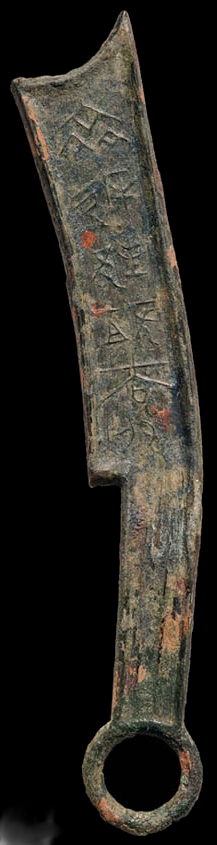
State of Qi Six Character Knife
The rarest of the Qi knives is the Six Character Knife (liu zi dao 六字刀).
Six Character Knives were cast in the ancient capital of Linzi in Shandong Province.
The Six Character Knife was actually issued as a “commemorative coin” (开国纪念币).
In 1046 BC, King Wu of Zhou (周武王) enfeoffed Jiang Ziya (姜子牙), also known as Lü Shang (吕尚) and Duke Tai of Qi (齐太公), who then proceeded to establish Qi as a vassal state.
The Jiang family continued hereditary rule of Qi for 600 years.
By the year 404 BC, however, Tian He (田和), who was the head of the Tian clan and was serving under the last ruler of the House of Jiang, had become the de facto ruler of Qi.
King An of Zhou (周安王) formally recognized Tian He, also known as Duke Tai of Qi (齐太公), as the ruler of Qi in 386 BC.
With the rise to power by Tian He, the six century rule by the the House of Jiang ended and the House of Tian became the new ruling family of Qi.
Even though Qi had existed for many centuries, Tian He decided to issue knife money with an inscription commemorating the new dynastic rule of the Tian family.
The Six Character Knife thus became China’s first “commemorative coin” marking the establishment of a new ruling family or dynasty.
The characters are written in an ancient Chinese script which is difficult to decipher. The inscription is believed to be qi zao bang chang fa huo (齐造邦长法化) which translates as “Qi, establish state long, legal money”.
Some experts believe that the second character in the inscription should not be interpreted as zao (造), meaning “establish”, but rather fu (复) or fan (返) meaning “return”.
The State of Yan invaded and occupied most of Qi in 284 BC. General Tian Dan (田单) of Qi executed a very clever plan and, despite being greatly outnumbered, was able to defeat the Yan army at Jimo. Tian Dan then freed the other occupied parts of the country which permitted him to bring King Xiang (襄王) of Qi from the small State of Ju (莒), where he had been residing, back to the royal capital of Linzi (临淄).
Those who accept this interpretation of the inscription believe that the knife was cast by King Xiang to commemorate his triumphant “return” to the capital of Linzi in the year 279 BC.
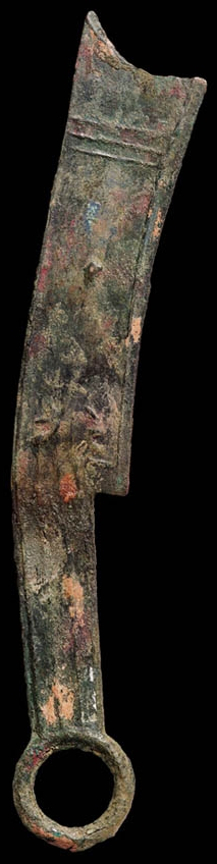
Reverse side of the State of Qi Six Character Knife
The reverse sides of Six Character Knives frequently have a single character.
A shi (十), meaning ten, may indicate the knife’s denomination.
Other characters that have been found on these knives include si (司), gong (工), and ri (日). These characters may represent the names of newly established mints.
The knives were cast in stone moulds and other characters on the reverse probably indicate in which mould the knife was cast.
At the left is an image of the reverse side of this knife.
Just above the handle is a character believed to be hua (化). Of the characters found on the reverse side of Six Character Knives, hua (化) and shang (上) seem to be the rarest.
Six Character Knives are large and thick, finely cast of good quality bronze, and display exquisite calligraphy. They are typically 18.2 – 18.5 cm in length and 2.8 – 2.9 cm in width. Their weight is 45.5 – 50.9 grams.
As mentioned above, the Six Character Knife was the first Chinese form of money to commemorate the founding of a new ruling family or dynasty.
During the more than 2,000 years that would follow, other rulers would also issue commemorative coins marking the establishment of their new reign.
For example, in the year 621 Emperor Gaozu (高祖) issued the kai yuan tong bao (开元通宝) coin. Kai yuan tong bao translates as the “Inaugural Currency” and refers to the establishment of the Tang Dynasty (618-907).
A different Emperor Gaozu (后汉高祖) issued the han yuan tong bao (汉元通宝) coin beginning in 948. The inscription translates as the “Han First Currency” which marked the beginning of the Later Han Dynasty (948-951).
Emperor Shizong (世宗) had coins cast with the inscription zhou yuan tong bao (周元通宝) beginning in 955. The inscription means “Zhou First Currency” signifying the establishment of the Later Zhou Dynasty (951-960).
Emperor Taizu (太祖) issued coins with the inscription song yuan tong bao (宋元通宝) beginning in 960. The inscription means “Song First Currency” or “Inauguration of Song” which proclaimed the establishment of the Song Dynasty (960-1279).
Modern times has seen China issue a large number of commemorative coins.
In an academic paper entitled “A History of China’s Ancient Money” (中国古代货币史), Professor Song Jie (宋杰) writes about the purchasing power of a Qi knife.
During the late Warring States Period, one dou (斗) of rice, equivalent to about 10 litres, could be bought with three ban liang (半两) coins. According to Professor Song, a Qi knife would have been the equivalent of 7 or 8 ban liang coins. Therefore, one Qi knife would have been able to buy more than two dou or 23 – 26 litres of rice.
Six Character Knives are the rarest of the Qi knives and among the rarest of all ancient Chinese coins. The specimen displayed here sold at an auction in 2014 for the equivalent of US$140,239 (862,500 RMB).
Linzi was the capital city of the ancient State of Qi (1046 BC – 221 BC).
In celebration of the Qi Culture Festival, there is a new exhibition of ancient Chinese money at the museum. According to a newspaper article, the exhibit includes unearthed specimens which have never been shown to the public before including hollow handled spade money from the Spring and Autumn Period, perfectly preserved “money trees“, coin moulds, and “Peace under heaven” palace coins.
Unfortunately, the newspaper article does not include any photographs. The museum’s website provides some images but no close-ups of the coins.
The vast majority of Chinese coin collectors outside of China have no choice but to rely on black and white rubbings in coin catalogs to determine the authenticity of rare coins. Many collectors put faith into images they see at internet auction sites which are well known to include many fake coins. Images from coin dealers, coin forums and personal websites can also include coins of questionable authenticity.
While searching the web, however, I came across a blog article from a Chinese visitor at a previous coin exhibit at the museum.
The blogger admits that he is not a coin collector but, fortunately, he took some photographs which document part of the extensive collection of ancient Chinese coins at the museum.
Clicking on the images below will bring up a larger image. By clicking the image again, an even larger and more detailed image will appear. Use your scroll bars to move around the display case.
In this way, you will have the opportunity to clearly see the color of the patina, calligraphy, metal type, size, etc. of many rare Chinese coins.
The museum has a vast and extensive collection of ancient Chinese money from the late Zhou and Warring States Period, perhaps the best in the world. This is due to the museum being located in the area where many of the ancient Chinese states were situated. Most of the collection of ancient coins came directly from archaeological digs in the area.
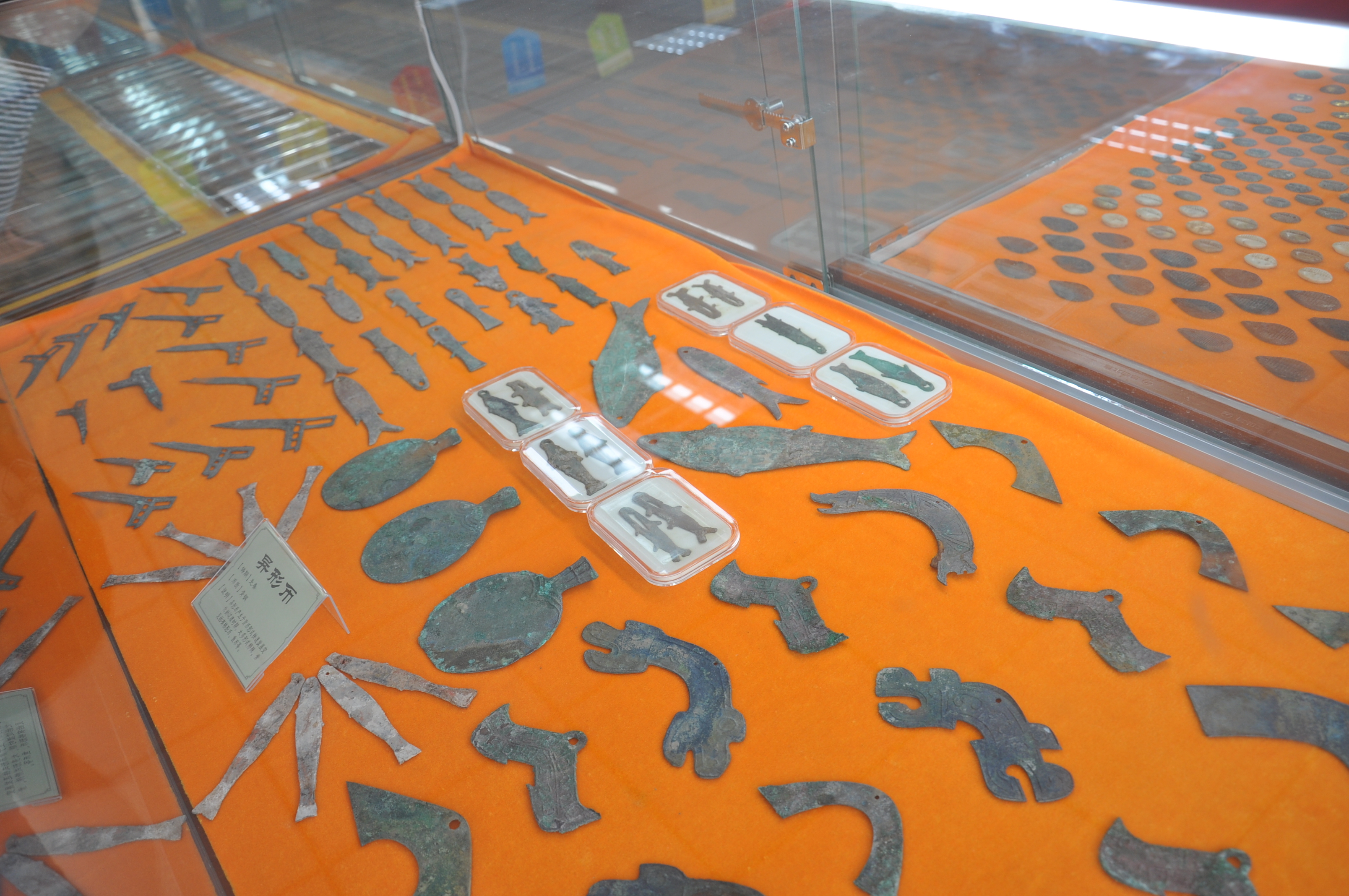
Early forms of Chinese money
This exhibition case includes specimens of what may be very early forms of money from the Zhou Dynasty (1046 BC – 256 BC).
No historical sources from this time period mention these objects so there is some question as to whether they are, in fact, ancient Chinese money forms.
They are usually referred to as “pseudo money” or “odd shaped money” (异形币).
Based on their shape, they are “fish money” (yu bi 鱼币), “halberd money” (ji bi 戟币) and “bridge money” (qiao bi 桥币). Some specimens of “bridge money” are referred to as “tiger head bridge money” or “dragon head bridge money”.
For a much larger and more detailed view, please click the image.
Three Character Knife money from the State of Qi
The museum is located near the capital of the ancient State of Qi (齐国) which existed from 400 BC to 220 BC during the Warring States Period (战国时代 475 BC – 221 BC).
Qi was one of the states that used a form of money made of bronze and in the shape of a knife (dao bi 刀币).
The Qi Knife Money evolved from an ancient bronze implement with a ring at the end. This knife was known as a xue (削).
The image at the left shows some of the extensive collection of Five Character Knife (五字刀) money.
Please click the image for an expanded view.
Five Character Knives have been found with two different inscriptions.
One inscription is ji mo zhi fa hua (即墨之法化) which translates as “Ji Mo Legal Money”. Jimo (即墨) was situated in what is now Pingdu in Shandong Province.
(A very interesting battle took place in Jimo which is the theme of an ancient Chinese horse coin. Please see “Battle of Jimo” Horse Coin for details.)
The other inscription is an yang zhi fa hua (安阳之法化) which translates as “An Yang Legal Money”. Anyang (安阳) was situated east of what is now Caoxian County in Shandong Province.
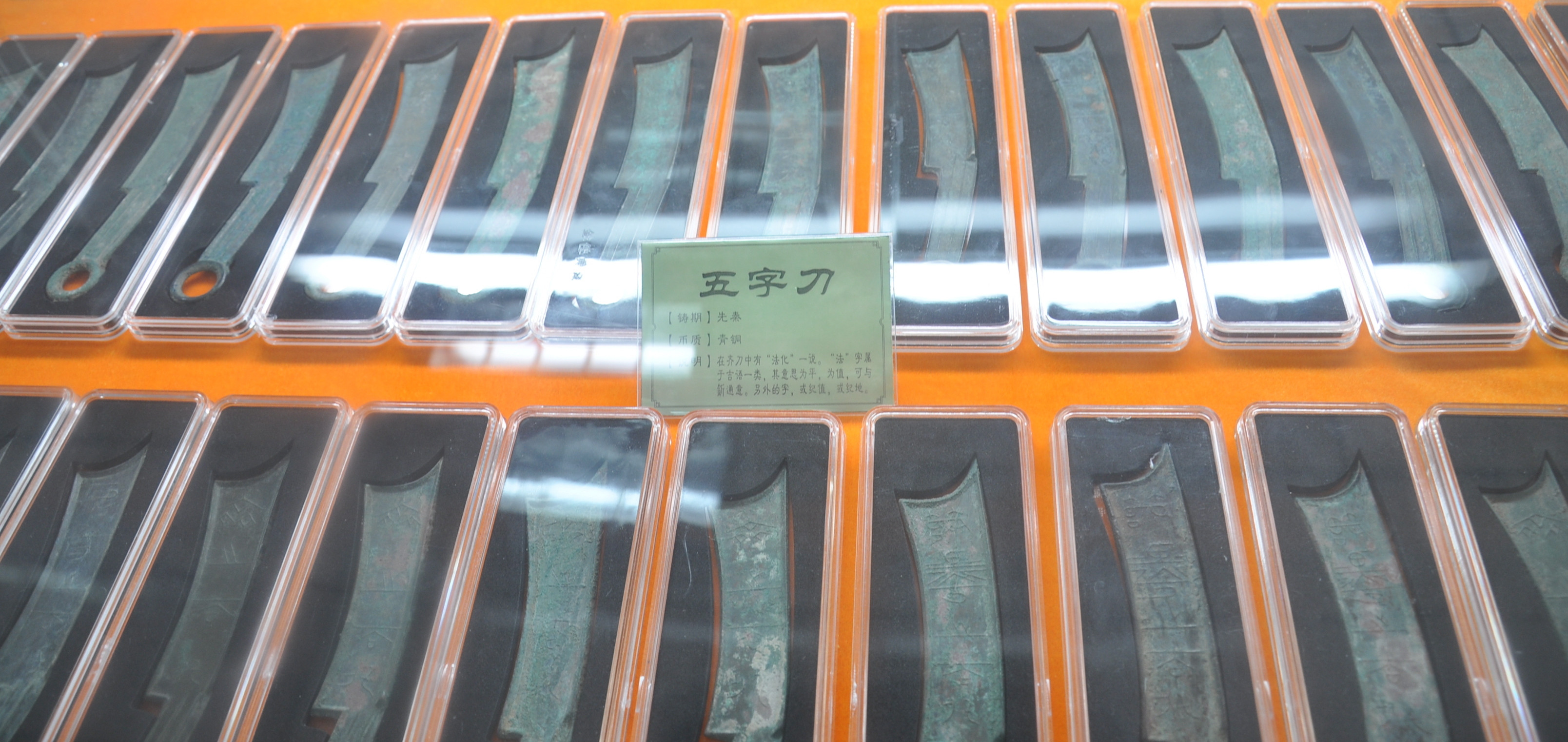
Another view of the Five Character Knives
At the left is another view of the Five Character Knife showcase.
Clicking the image will bring up a larger view.
Both the An Yang (安阳) and Ji Mo (即墨) varieties of the Five Character Knife can be seen in this image.
Unfortunately, the blogger did not publish images of the museum’s collection of Six Character Knives (六字刀). The Six Character Knives were minted in what is now Linzi in Shandong Province.
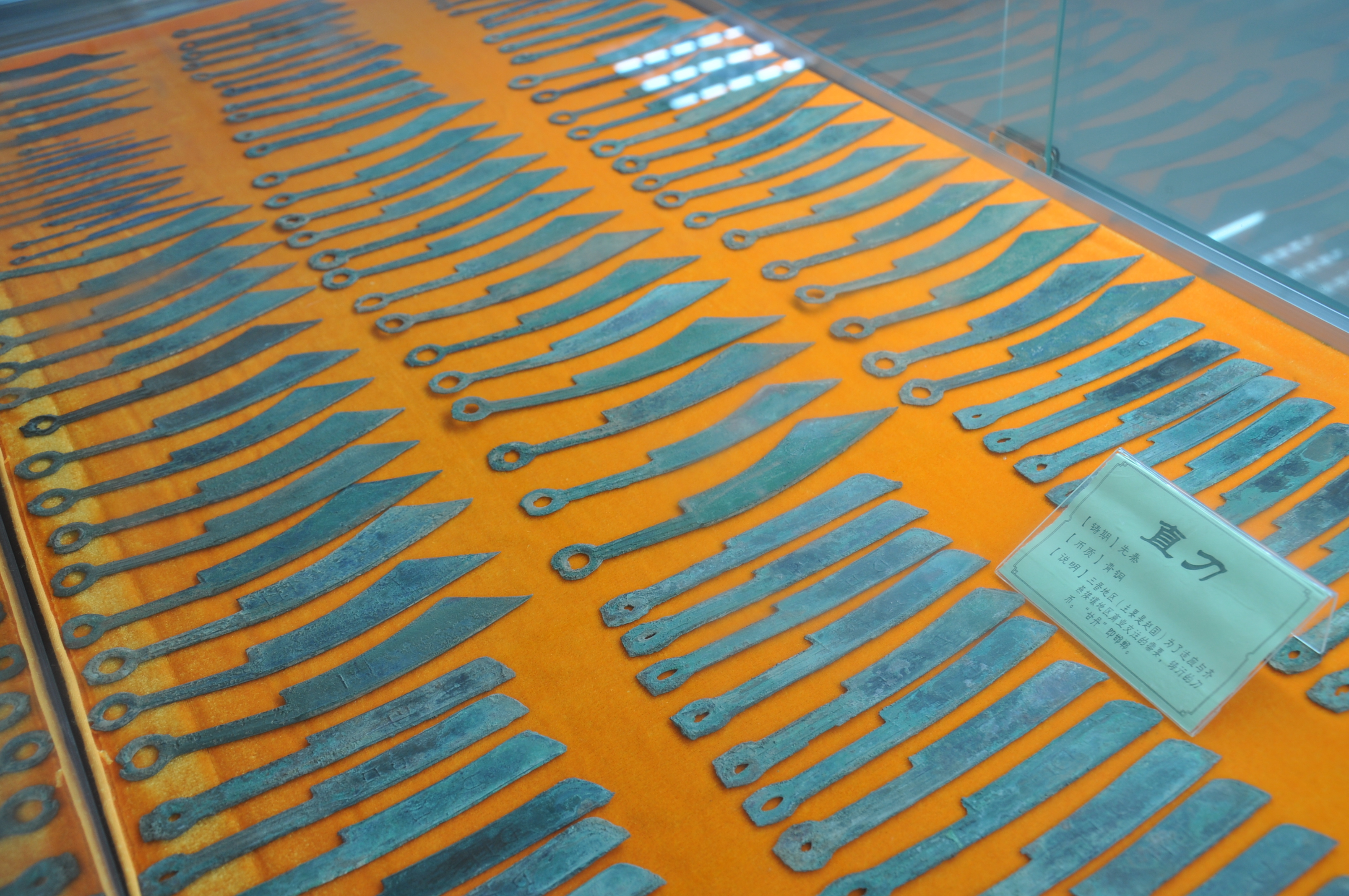
Pointed Tip Knives (jian shou dao 尖首刀) from the State of Yan, as well as Straight Knives (zhi dao 直刀) from the State of Zhao (赵国), are displayed in this case.
Clicking on the image will provide a better view.
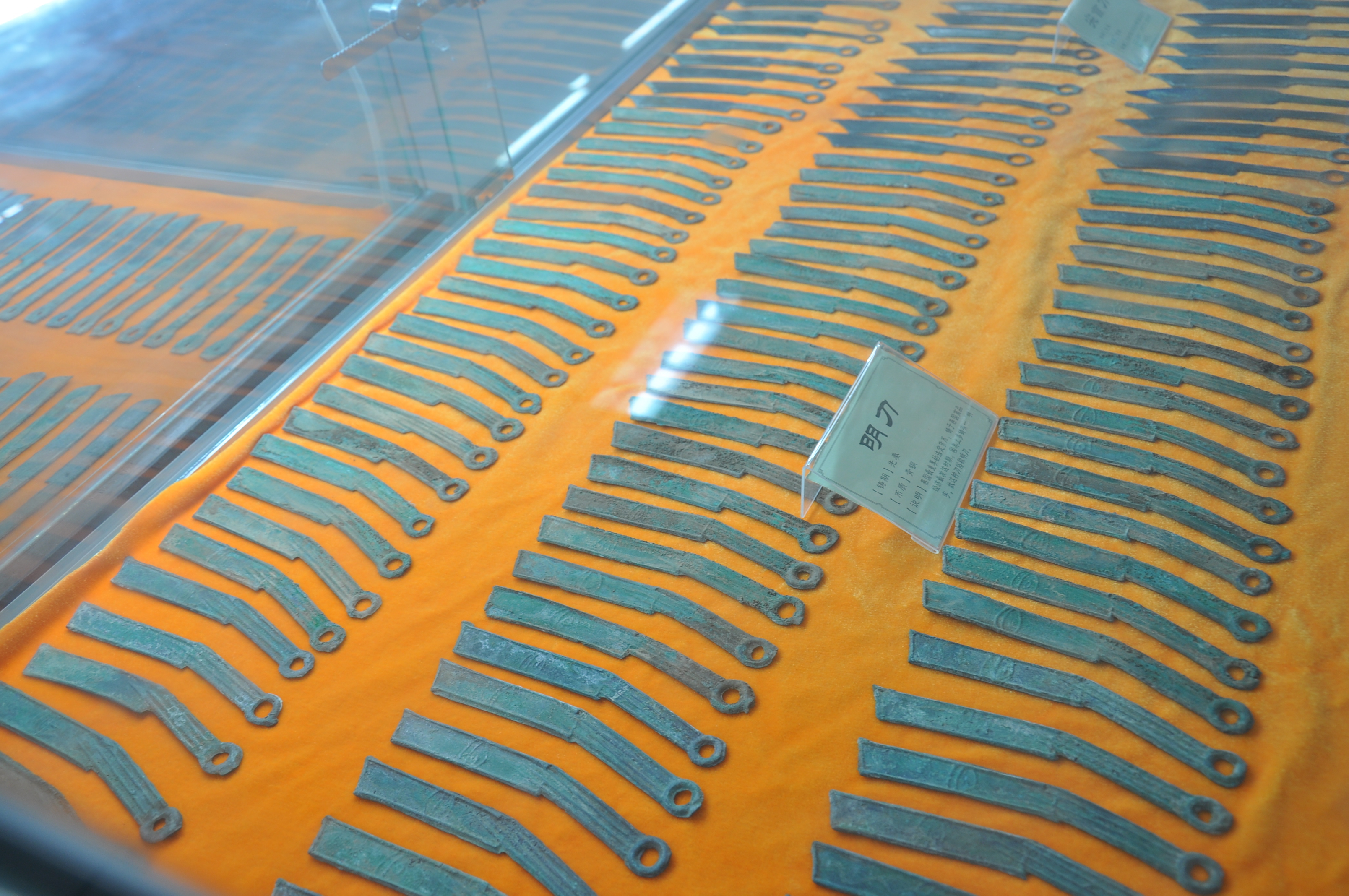
Ming Knife money from the State of Yan
The museum has a large collection of Ming Knives (ming dao 明刀) from the State of Yan (燕).
This type of knife money is known as “Ming Knives” because the character on the obverse side is believed to the the Chinese character ming (明).
For some reason, the museum decided to display all the Ming Knives with the obverse side (明) showing which is the same for all the knives.
Showing the reverse sides would have been preferable since the reverse sides display a great variety of inscriptions.
Please click the image for a closer view.
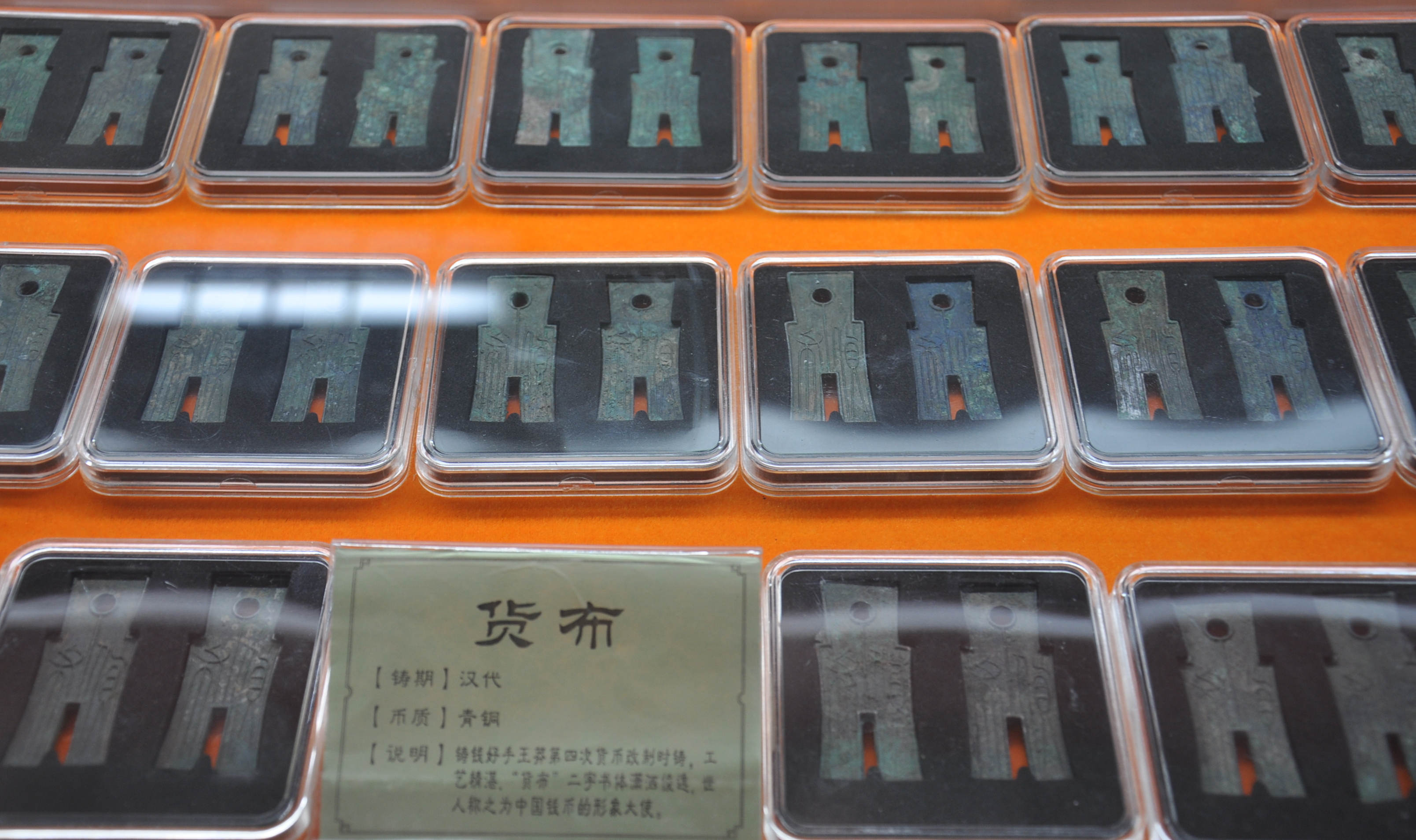
Huo Bu coins cast during the reign of Wang Mang
The Chinese blogger provides images from several other exhibition cases.
The showcase at the left displays huo bu (货布) cast 14 AD – 23 AD during the reign of Wang Mang (王莽) of the Xin Dynasty (新朝).
Wang Mang carried out four major reforms of the monetary system which included a total of 37 kinds of money. This created unprecedented chaos and misery.
To his credit, many of these money forms attained very high artistic merit.
A close-up of the museum’s collection of huo bu may be seen by clicking the image.
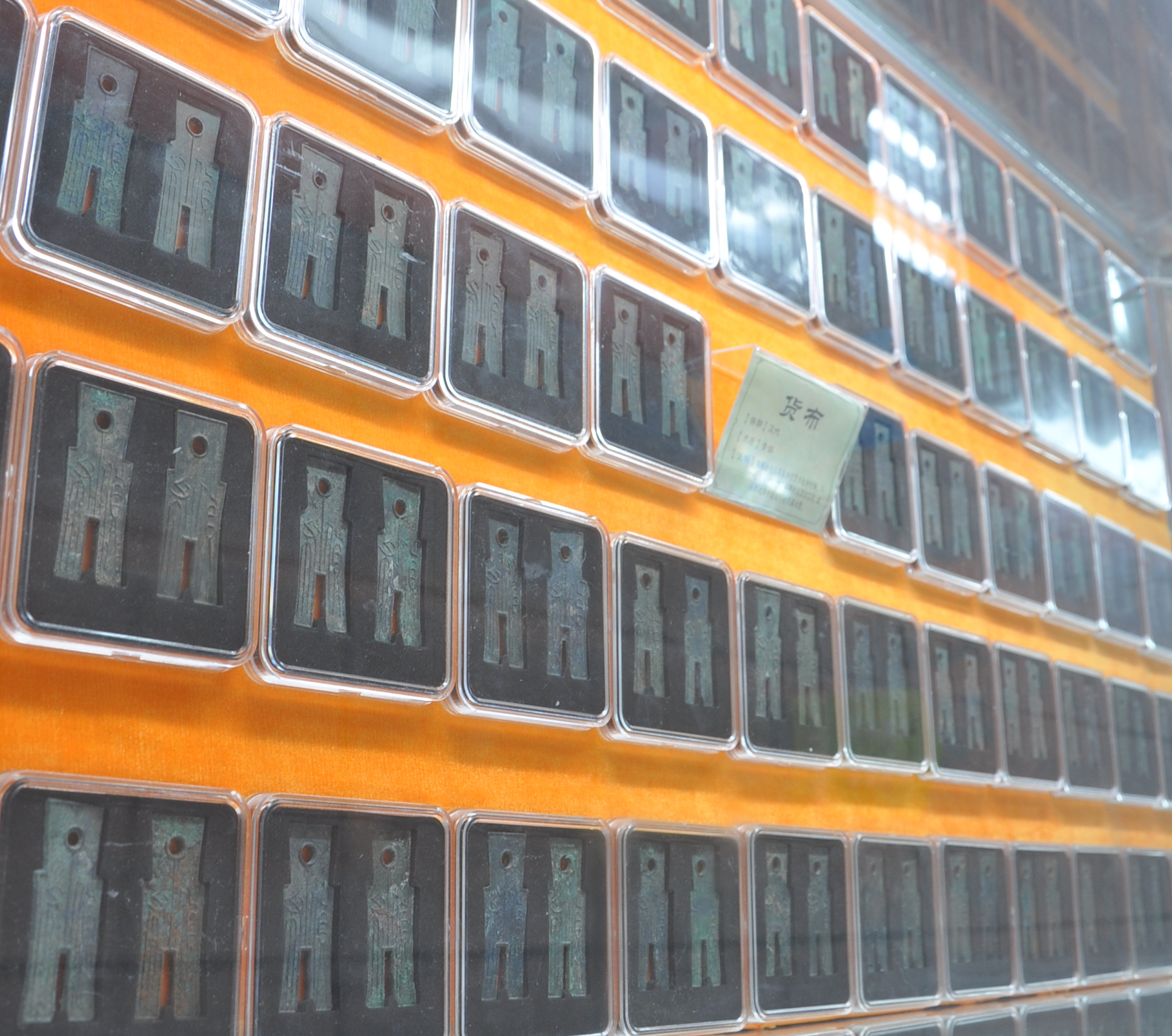
Another view of the large collection of Huo Bu coins
This is another view of the museum’s extensive collection of huo bu coins.
Please click the image for a close-up view.
The huo bu is derived from an even more ancient form of money in the shape of a spade. For more information concerning spade money (bubi 布币) and huo bu please see Chinese Spade Charms. A charm based on the huo bu is discussed in the article Huo Bu Charm.
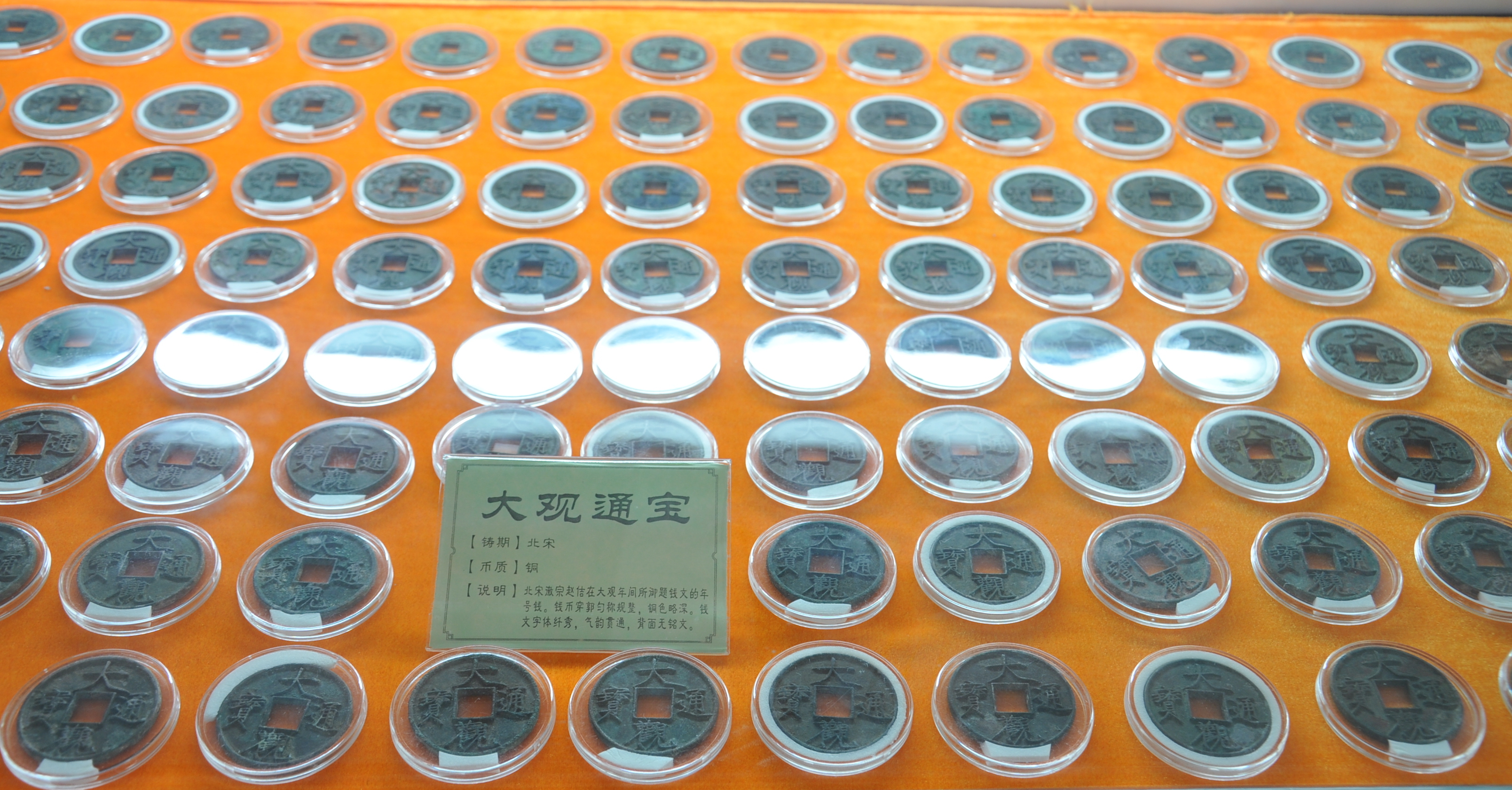
“Da Guan Tong Bao” coins cast during the reign of Emperor Hui Zong of the Northern Song Dynasty
The Song Dynasty (960-1279) is noted for casting cash coins with beautiful calligraphy.
One of the most famous coins is the da guan tong bao (大观通宝) cast during the years 1107-1110 of the reign of Emperor Huizong of the Northern Song.
The calligraphy on the coin was done by Emperor Huizong himself in a style known as “Slender Gold” script (shou ji ti 瘦金体 or tie xian shu 铁线书).
The museum has a large collection of these da guan tong bao coins as can be seen in the display above.
An enlarged view may be seen by clicking the image.
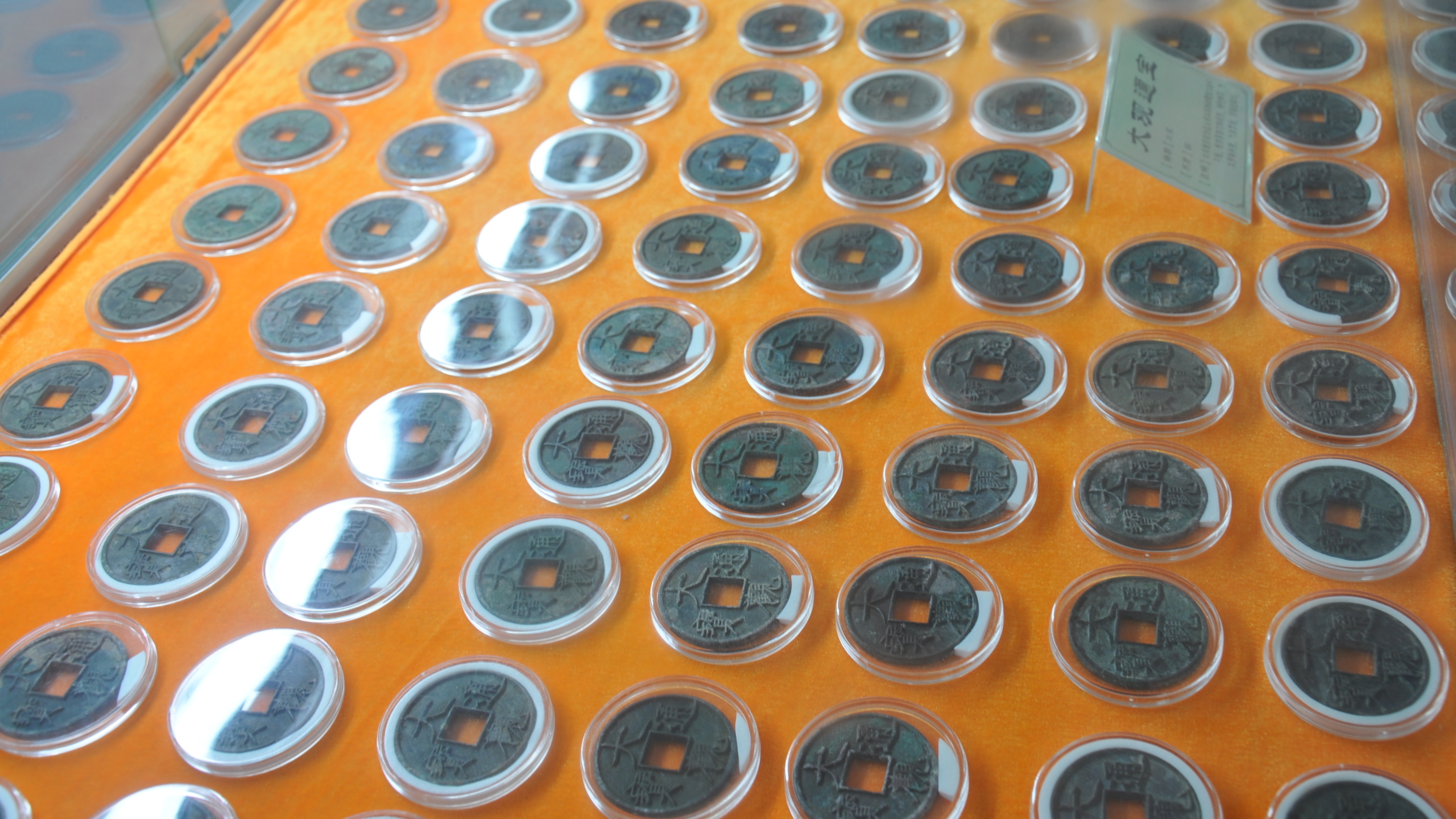
A different view of the Da Guan Tong Bao coins
At the left is a different view of the da guan tong bao coins.
Please click the image for a better view.
The museum has a large collection of Chinese sycee (xi si 细丝) which are also referred to as yuan bao (元宝).
Sycee were usually made by silversmiths instead of official mints.
Their value was determined by their weight. Moneyhandlers known as shroffs would determine the purity and weight in taels (liang 两).
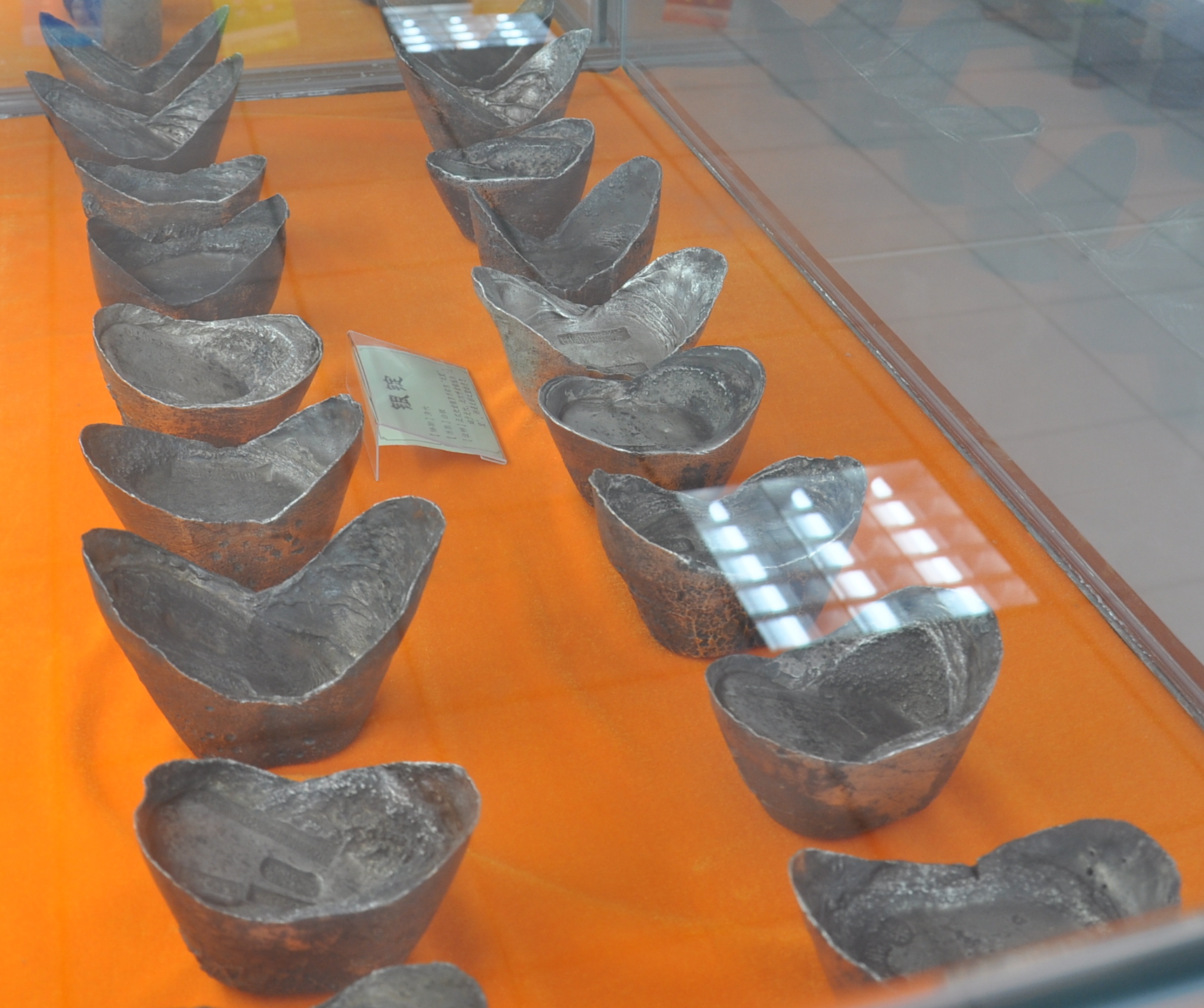
Chinese Boat Sycee
The image at the left shows one of the sycee display cases.
Sycee are often categorized by their shape. The specimens in this case are known as boat sycee (ma di yin 马蹄银).
For a very detailed view, please click the image.
(More specimens of boat sycee with detailed descriptions may be seen at this excellent website.)
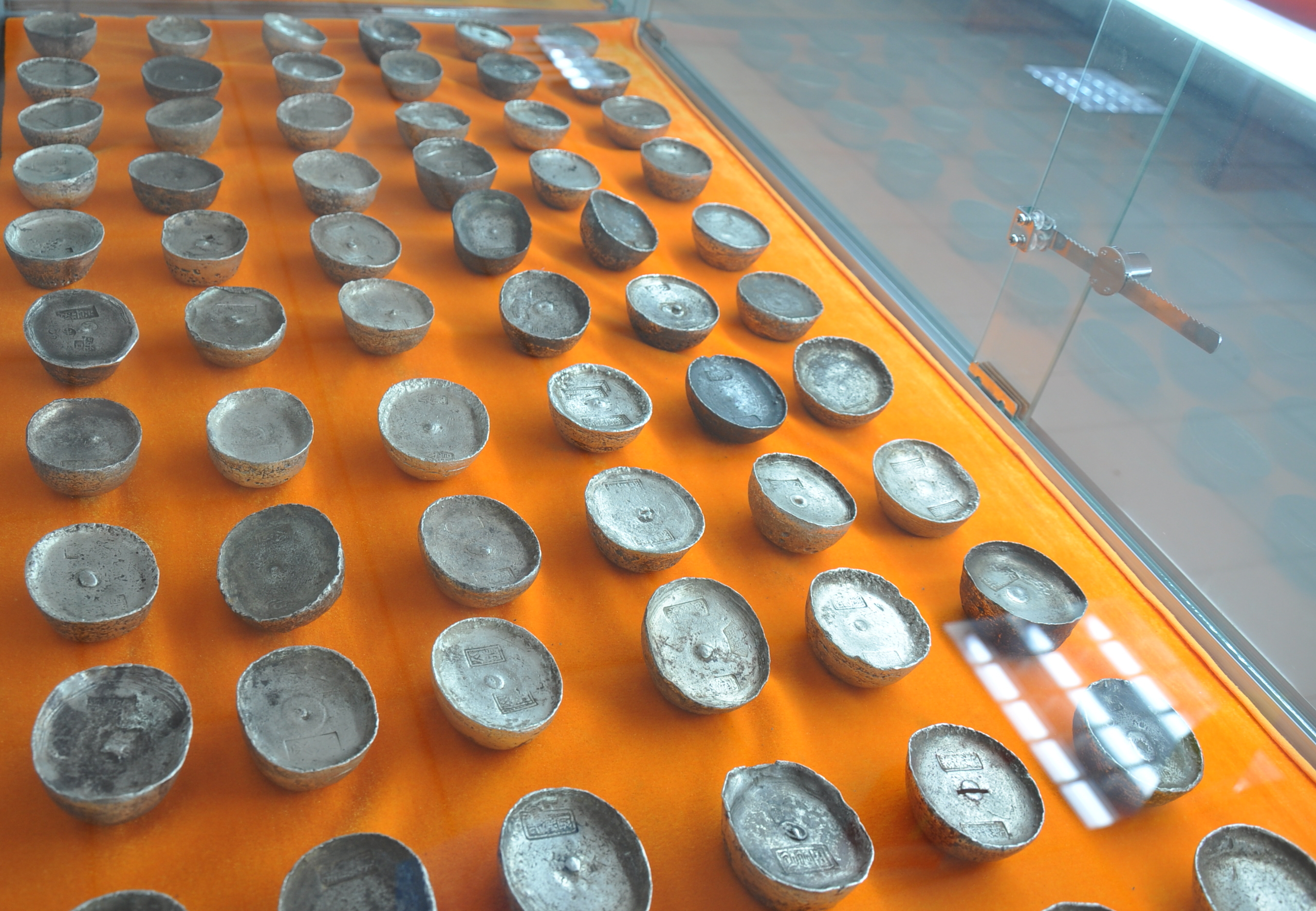
Chinese Round Sycee
At the left is another display case exhibiting a collection of round sycee (yuan ding 圆锭).
Please click the image for a close-up view of the display.
(More information and specimens of round sycee may be seen here.)
Trade Silver Bars
This case displays a different type of sycee.
The sign in the showcase states that these are “trade silver bars” (mao yi yin tiao 贸易银条).
An enlarged view may be seen by clicking the image.
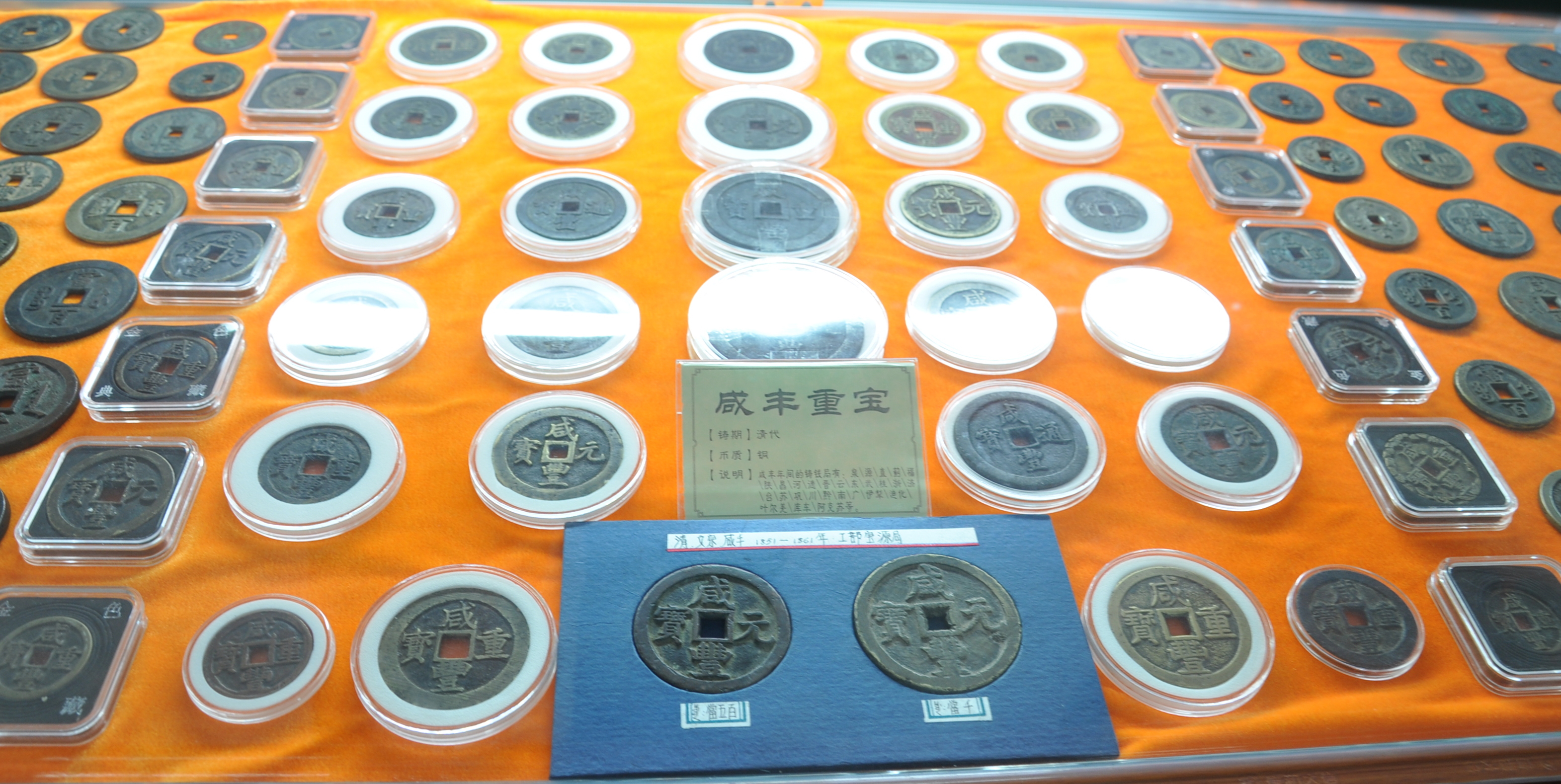
Coins cast during the reign of the Xianfeng Emperor of the Qing Dynasty
The final images show a display of coins cast during the reign (1851-1861) of the Xianfeng Emperor of the Qing Dynasty (1644-1911).
Because of huge military expenses needed to suppress the Taiping Rebellion, a great variety of large denomination cash coins were cast during the reign of the Xianfeng Emperor.
The small cash coins cast by Xianfeng are called tong bao (通宝). Coins with a value of four to fifty cash are called zhong bao (重宝). Coins with a value of one hundred to one thousand cash are called yuan bao (元宝).
The display sign states that the coins in the case are zhong bao. However, if you click the image and view the coins close up you will see that the case also includes yuan bao coins.
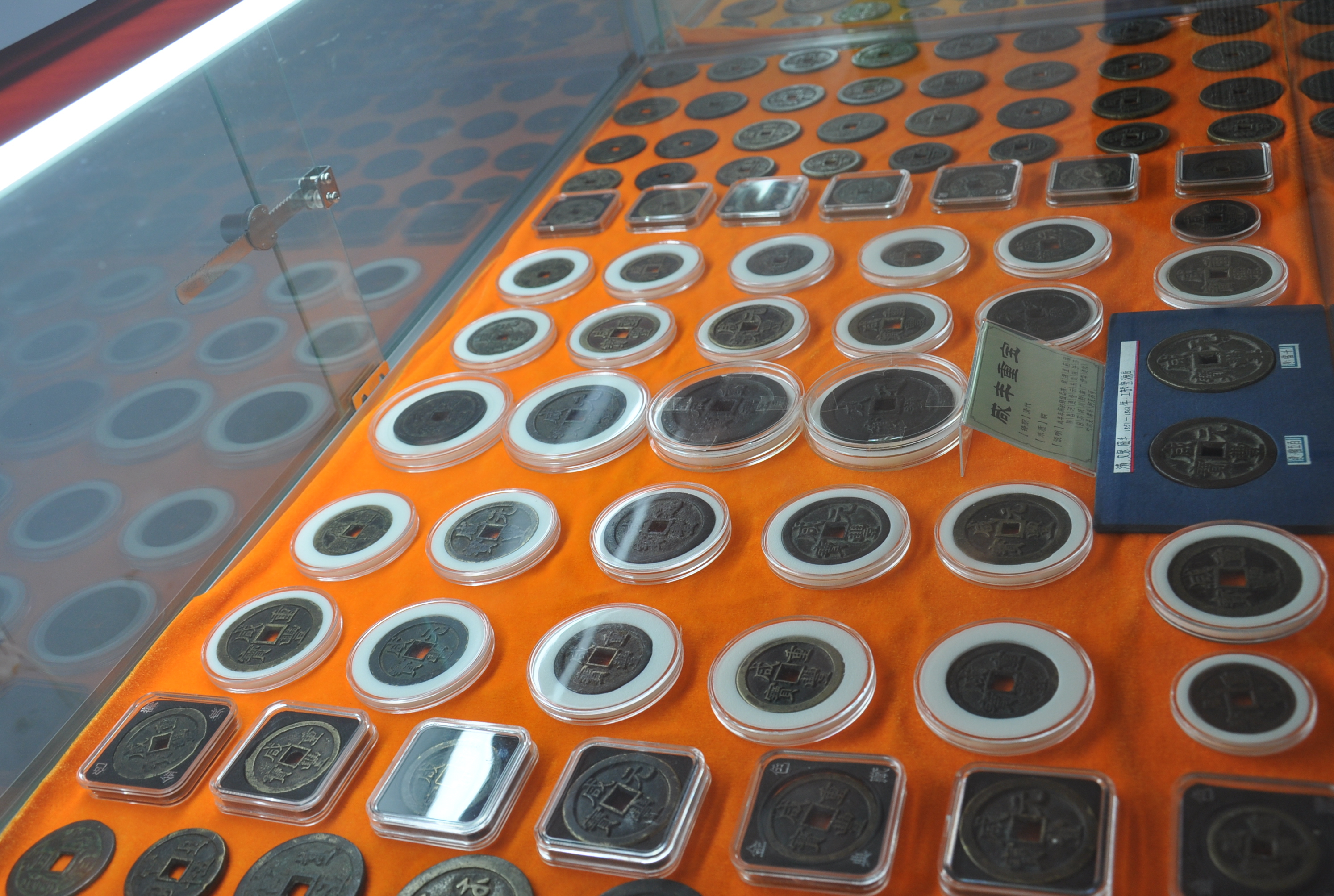
Another view of the coins cast during the reign of the Xianfeng Emperor
This is another view of the coins cast during the reign of the Xianfeng Emperor.
An enlarged view may be seen by clicking the image.
It is fortunate that the Chinese blogger decided to publish his personal photographs of some of the collection at the Qi Heritage Museum.
In so doing, he has provided collectors around the world the opportunity to clearly see authentic specimens of some of China’s rarest ancient coins.