Thirty years after the founding of the Song dynasty (宋朝 960-1279), the government was still struggling to consolidate rule. Economic hardship in the country was so great that peasants formed rebel armies to resist Song authority and kill corrupt officials.
The largest uprising took place in Sichuan (四川). Tea farmers rose up against the government monopoly on tea purchases (博買務) which was preventing them from making a reasonable income. The tea farmers were joined by landless tenant farmers (旁戶) who were being exploited by rich landowners.
By 993 AD, this insurrection had grown to include several hundred thousand peasants. Under the leadership of Wang Xiaobo (王小波), and adopting the slogan “equalize the income of the rich and poor” (均贫富), the rebel army was able to defeat regular Song armies in Sichuan. The rebels raided government granaries and redistributed grain.
When Wang Xiaobo died in battle, his brother-in-law Li Shun (李顺) assumed leadership of the uprising. Military strength grew under his command and in 994 AD he attacked and successfully occupied Chengdu (成都) which was Sichuan’s largest city.
Li Shun then proclaimed himself King of Da Shu (大蜀王) and adopted the period title “Ying Yun” (应运).
In 994, Li Shun began to cast bronze (铜钱) and iron (铁钱) coins with the inscriptions ying yun yuan bao (应运元宝) and ying yun tong bao (应运通宝).
The coins are traditional cash coins with inscriptions written in clerical script (隶书) and read in a clockwise (旋读) manner. They are similar in style to the coins of the Five Dynasties and Ten Kingdoms (五代十国) and, in particular, the coins of the Former Shu (前蜀 907-925) and the Later Shu (后蜀 926-965). These were kingdoms situated in Sichuan with the capital at Chengdu. The Later Shu was conquered by the Song in 965.
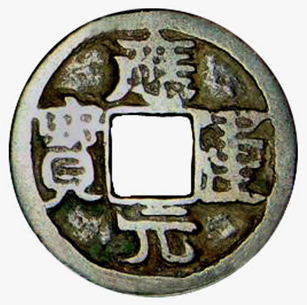
At the left is an example of a bronze ying yun yuan bao (应运元宝) coin in the collection of the Shanghai Museum (上海博物馆). The coin weighs 2.9 grams.
According to one reference (中華珍泉追踪錄 p.184), this coin was donated to the Shanghai Museum by Mr. Sun Ding (孙鼎) who was a famous Chinese coin collector of the 20th century.
The National Museum of China (中国国家博物馆) also has a bronze ying yun yuan bao which can be seen here.
This coin has a diameter of 23 mm and a weight of 3.9 grams.
In addition to the bronze ying yun yuan bao coin, the National Museum of China also also has an iron ying yun tong bao (应运通宝) coin which can be seen here.
This iron coin has a diameter of 23 mm and a weight of 3.7 grams.
After a very short time, Li Shun changed his reign title to Ying Gan (应感). According to the Baidu Encyclopedia, after Li Shun died in battle, his subordinates began to cast bronze and iron coins with the inscription ying gan tong bao (应感通宝).
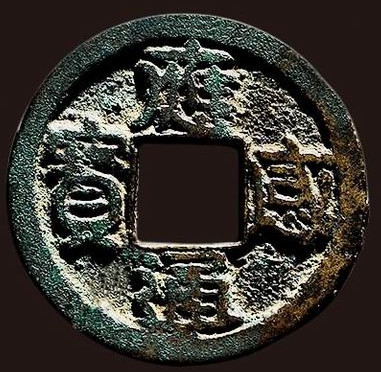
Shown at the left is an outstanding example of a bronze ying gan tong bao coin.
The diameter is 23.7 mm.
In 2015, this coin sold at auction for about $54,000 (RMB 368,000).
Another bronze ying gan tong bao coin is in the collection of the National Museum of China and can be seen here.
This specimen has a diameter of 23 mm and a weight of 3.2 grams.
An example of an iron ying gan tong bao coin can be seen here at the Sichuan Museum (四川博物馆).
This iron coin has a diameter of 23 mm.
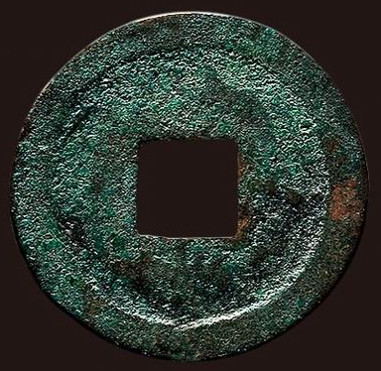
The reverse sides of all the coins are blank with the exception of the ying yun yuan bao (应运元宝) bronze coin at the National Museum of China.
According to the museum’s website, there is a “star” (星) and a “moon” (月) on the reverse side.
Unfortunately, the image on the website is too dark to discern the star and moon.
However, a January 29, 2016 article in the “China Shoucang Journal” (收藏) displays the image of a bronze ying yun tong bao (应运通宝) coin that was recently excavated in Hubei (湖北). As can be clearly seen, this coin has both a “star” and a “moon” (月孕星版) on the reverse side.
With a diameter of 26 mm, the coin is slightly larger than the other coins mentioned above. The article explains that this coin may be a “pattern” or “trial” piece (试样) or possibly a “mother” coin (铁母) used to make impressions in the moulds to cast iron coins.
Li Shun ruled his Da Shu kingdom for only about five months before he was killed by the superior forces of the Song. Even without their leader, the Da Shu Rebellion continued for about another year before it was fully suppressed by the Song army in 995 AD.
The ying yun yuan bao (应运元宝), ying yun tong bao (应运通宝) and ying gan tong bao (应感通宝) coins produced during the time of the Sichuan rebellion are recognized as the first coins in Chinese history to have been issued by a peasant uprising.
Because the Da Shu kingdom existed just a few months, only a very small number of coins were minted.
Even fewer of these coins have survived to the present time. The bronze coins are among “China’s 50 Rarest Ancient Coins” (历代古钱五十珍) which makes them, as the Chinese like to say, as rare and precious as “phoenix feathers and unicorn horns” (凤毛麟角).