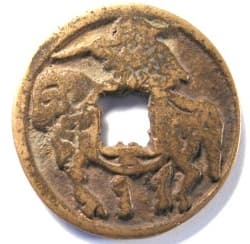
Category: Horse coins

  • “Sweating Blood Horse” Coin

    “Horse coins” have been mentioned in Chinese literature for centuries but it is still unclear exactly how they were used. It is believed, however, that beginning in the Song dynasty (960-1279 AD) they were used as either game (打马格钱) or gambling (打马博戏) pieces.

    Most pieces commemorate a famous horse from ancient Chinese history. Some of these I have already discussed in an article entitled “Horse Coins“.

    I recently came across a particularly interesting piece which does not depict a specific historical horse but rather a breed of horses which first appeared in records dating back to Emperor Wu (汉武帝 157-87 BC) of the Han dynasty.
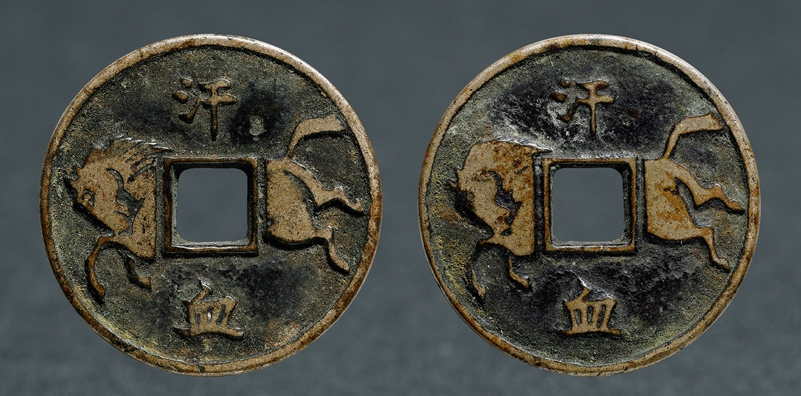
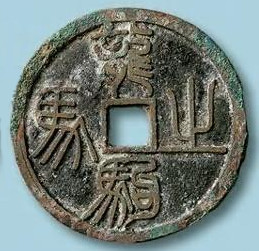
    Sweating Blood Horse Coin cast during the Song Dynasty

    The sweating blood horse coin shown above was cast during the Song dynasty and is unique in that it is the only known specimen of its kind to be the same on both the obverse and reverse sides. The coin was previously in the collection of Mr. Wei Yutian (卫玉田 1854-1937) and was sold at auction in 2017.

    The coin displays the image of a horse with two Chinese characters (han xie 汗血) meaning “sweats blood”. “Sweating blood” refers to a horse breed (han xie bao ma 汗血宝马) found in central Asia . These horses, also known as Akhal-Teke or Ferghana, are famous for their speed and endurance. They also have one unusual characteristic in that their skin can bleed when ridden hard.
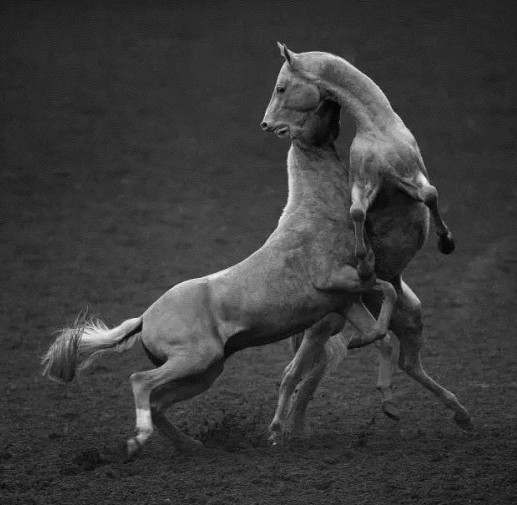
    Blood Sweating Horses Fighting
    Sweating Blood Horses

    Shown at the left is a photo from a Chinese website showing two of these blood-sweating horses in a fight. The caption reads:

    战斗中的汗血宝马在互相撕咬,大声咆哮,充斥着浓烈的雄性荷尔蒙的味道。

    This translates as:

    In the midst of battle, the sweating-blood horses bite each other, roaring loudly, and having the strong smell of male hormones.

    According to legend, these horses were a hybrid of a horse and a dragon. If they stepped on a stone, the stone would be crushed into powder.

    Ancient literary works describe these horses as able to travel 1,000 li (里) during the day and 800 li at night while ordinary horses were only able to travel 150-200 li a day. (During the Han dynasty, a li was equal to about 0.25 mile (416 meters) so a distance of 1,000 li was equivalent to about 250 miles.)

    As mentioned above, Emperor Wu of the Han dynasty had heard stories of these horses, which he referred to as tian ma (天马) or “heavenly horses”, and wanted them for his cavalry to be used in battles with the Xiongnu (匈奴), a nomadic people who occupied what is now Mongolia from the 3rd century BC to the late 1st century AD .
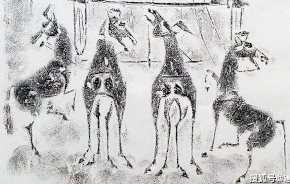
    Rubbing from Han Dynasty Tomb Brick Showing Sweating Blood Horses

    Emperor Wu tried to obtain the horses through diplomatic means from the Dayuan (大宛) who lived in the Fergana valley (present day Uzbekistan) in Central Asia. Unable to obtain the number of heavenly horses desired, he sent an army (War of the Heavenly Horses 天马之战; Han-Dayuan War 汉宛战争), defeating the Dayuan in 100 BC and obtaining 3,000 of the prized horses.

    Emperor Wu’s mausoleum contains 80 skeletons of what may be these blood-sweating “heavenly horses”.

    The ancients did not have a good explanation as to why the skin of these horses bleed. Today, scientists can offer two explanations.

    One reason may be due to these horses having blood vessels clearly defined through their thin, almost transparent, skin. Small subcutaneous blood vessels may burst during a long and hard gallop.

    These horses also have strong sweat glands in their shoulders and neck. Heavy sweating can make their coat look darker and give the illusion of bleeding.

    The second explanation is that the horses were likely infested with skin parasites. Parafilaria multipapillosa is a parasitic nematode widely distributed across the Russian steppes. This parasite burrows into the subcutaneous tissues of horses resulting in skin nodules which often bleed copiously. Veterinarians call this “summer bleeding”.

    While there are many varieties of horse coins, they can be categorized into three basic types. The first type has the picture of the horse on one side of the coin and the inscription identifying the horse on the other side. The second type has both the picture and the inscription on one side and the reverse side is blank. The third, and rarest, type has the identical picture with inscription on both sides (合背钱).

    As already mentioned, this horse coin is of the rare third type and is also the only specimen know to exist.

    This horse coin is 31mm (1.2 inches) in diameter and was sold at the Xiling Yinshe Auction Co., Ltd. (西泠印社拍卖有限公司) 2017 Spring Auction for $1,580 (10,350 RMB).

    For those interested in additional information on horse coins, please see Horse Coins, “Battle of Jimo” Horse Coin, and Horse in Armour Horse Coins.
  • Horse in Armour Horse Coins

    Horse coins (ma qian 马钱) originated in China during the Song Dynasty (宋朝 960 – 1279).  They were not used as money, however, but as game pieces.

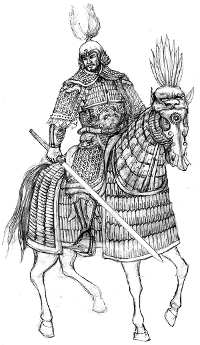
    Illustration of horse armour from the Song Dynasty
    Illustration of horse armour from the Song Dynasty

    There are a great variety of horse coins.  Some display only a horse while others show both a horse and rider.

    Some horse coins have inscriptions which identify the horse or rider.

    The horses were famous for their speed and endurance.

    Some are referred to as a “thousand-li horse” (qian li ma 千里马) which means the horse could travel 1,000 li (里), or about 400 km, in a single day.

    Even though the Chinese began using armour for their war horses as early as the end of the Han Dynasty (汉朝 206 BC – 220 AD), very few horse coins depict a horse wearing armour.

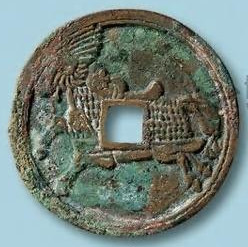
    Horse coin displaying horse armour used by the Chinese during the Song Dynasty
    Horse coin displaying horse armour used by the Chinese during the Song Dynasty

    At the left is a rare example of a horse coin with the horse wearing the type of armour (铠甲马) used by the Chinese during the Song Dynasty.

    The horse is shown in a full gallop.

    Another distinctive feature of this Song Dynasty horse coin is that it shows the saddle.  Very few horse coins display the saddle due to the placement of the square hole in the middle.

    "Dragon's Colt" horse coin from the Song Dynasty
    “Dragon’s Colt” horse coin from the Song Dynasty

    The obverse side of this horse coin is particularly attractive because the inscription is written in seal script (zhuan shu 篆书).

    The inscription reads long ju zhi ma (龙驹之马) which translates as “Dragon’s Colt”.

    Dragon’s Colt was one of the famous horses owned by Emperor Wen (202 – 172 BC) of the Han Dynasty.

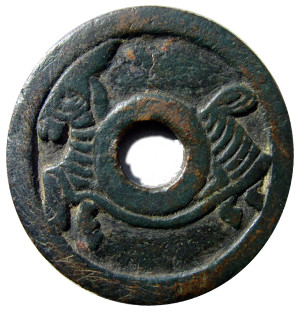
    Horse coin depicting horse armour used by the Mongols during the Yuan Dynasty
    Horse coin depicting horse armour used by the Mongols during the Yuan Dynasty

    At the left is a very rare horse coin that recently appeared in a Chinese coin forum.

    The horse coin is identified as being from the Yuan Dynasty (元朝 1271 – 1368).  The Yuan Dynasty followed the Song Dynasty.

    The Yuan Dynasty was ruled by the Mongols and was founded by Kublai Khan (元世祖).

    The Mongols rode horses wearing battle armour during military campaigns which helped them to create the largest contiguous land empire in history.  The Mongol Empire (1206 – 1368), under the leadership of Genghis Khan (成吉思汗), stretched from central Europe to China.

    This horse coin displays a horse in full gallop wearing the armour typically used by the Mongols.

    Unlike the Song Dynasty horse coin shown above, this coin’s hole is round instead of square.  The hole, unfortunately, prevents us from viewing the saddle.

    As best as can be determined, this Yuan Dynasty horse coin does not appear in any Chinese numismatic reference book.

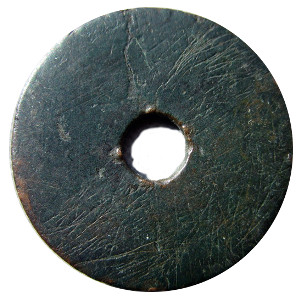
    Reverse side of armored horse coin from the Yuan Dynasty
    Reverse side of armoured horse coin from the Yuan Dynasty

    The reverse side of the horse coin is shown at the left.  It is flat with no inscription.

    This is in contrast to Song Dynasty horse coins which almost always have an inscription or design on the reverse side.

    As already mentioned, these two horse coins are most unusual.

    Very few Song Dynasty horse coins display a horse wearing battle armour and it is rare to find any horse coin from that period which also shows the saddle.

    Horse coins dating from the Yuan Dynasty, particularly ones displaying horse armour, are even rarer and have yet to be properly researched.

  • “Battle of Jimo” Horse Coin

    Most ancient Chinese horse coins display only a horse with no rider.

    Horse coins displaying a horse with a rider are much scarcer and those originating from the Song Dynasty (960-1279 AD) are particularly rare.

    Old Chinese horse coin commemorating the "Battle of Jimo"
    “Battle of Jimo” Horse Coin

    The specimen at the left is a later version of one of these Song Dynasty horse coins with a rider.

    Instead of honoring the horse, though, these horse coins commemorate the famous generals and battles of ancient Chinese history.

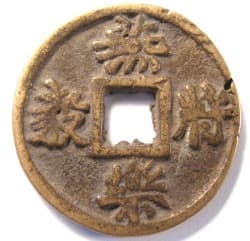
    The inscription on the horse coin at the left is read in a clockwise order, beginning with the character at the top, as yan jiang yue yi (燕將樂毅).

    The inscription translates as “General Yue Yi of the State of Yan”.  (The name is sometimes translated as “General Le Yi of the State of Yan”.)

    Chinese horse coin depicting General Yue Yi of the State of Yan on horseback
    General Yue Yi with weapon on horseback

    As can be seen here, the reverse side of the horse coin shows a man holding a spear-like weapon and riding a horse.

    The rider is intended to be General Yue Yi who participated in the battle of Jimo which is one of the most famous battles of ancient China.

    Sima Qian (司马迁) (145 BC – 86 BC), the great historian of the Han Dynasty, wrote about the battle of Jimo in his monumental work “Records of the Grand Historian” (史记).

    Annotations by Tang Dynasty poet Du Mu (803-852 AD) to the famous Chinese military treatise “The Art of War” by Sun Tzu (Sunzi 孙子), written in the 6th Century BC during the Spring and Autumn Period (722 BC – 481 BC), included the Battle of Ji Mo to illustrate the successful application of the strategies by Sun Tzu.

    A brief narrative of the Battle of Jimo is as follows.

    In the year 284 BC, the state of Yan commenced a campaign to conquer the state of Qi.  General Yue Yi led the Yan army and within the short span of only six months had conquered seventy of Qi’s cities.

    In 283 BC, General Yue Yi attacked the city of Jimo.  The commanding officer of Jimo died in the battle and was replaced by General Tian Dan who would become a major figure in the Battle of Jimo.

    Having only 7,000 soldiers, General Tian Dan had to rely on superior tactics to inspire both his troops and the citizens to defend the city against the Yan army which was at least ten times as large.

    Failing to take the city by force, General Yue Yi soon realized that the only way to victory was to somehow win the hearts of the people of Jimo and convince them that to surrender would be better than to continue to resist.

    General Yue Yi therefore began a “benevolent” siege of the city which ended up lasting three years.  His army, for example, provided food and water to the residents of the city and even allowed them to till their fields outside the city walls.

    During this three year period, the king of Yan died and his son ascended to the throne.  The son, unlike his father, was not pleased that General Yue Yi was unable to conquer Jimo.

    Also, the new king harbored fears that General Yue Yi was interested in replacing him as king.

    General Tian Dan of Jimo was keenly aware of this situation and, to foment discontent, secretly sent spies to the capital of Yan to spread rumors that General Yue Yi did indeed want to be king.

    The rumors spread quickly and upon reaching the king’s ears only “confirmed” his suspicions.  The king immediately replaced General Yue Yi as head of the army and installed a new general who would prove to be much less competent.

    General Yue Yi, having lost his position, felt that the king would now try to eliminate any perceived threat to his power.  Fearing the king would try to assassinate him, General Yue Yi sought refuge in the state of Zhao.

    The new Yan army general abandoned the long siege and immediately commenced attacking the city.  But again, due to the competent leadership of General Tian Di, the troops and citizens defended themselves successfully despite being greatly outnumbered.

    To further strengthen his people’s resolve, General Tian Di sent spies into the camp of the Yan army to spread rumors that the people of the city would definitely surrender in fear if only the Yan soldiers were to “cut off the noses” of any captured Qi soldiers and also “dig up the graves of buried Qi ancestors”.

    The new Yan army general fell for these lies and ordered his soldiers to do these exact things.  As General Tian Di anticipated, these actions of savagery and desecration of the tombs so infuriated his troops and the residents of the city that they resolved to fight on at all costs.

    With the unconditional backing of his people, General Tian Di knew that this was the opportune time to take the offensive.  Knowing he did not have the number of troops to fight the enemy head on, he devised a very clever plan.

    He had his soldiers gather a thousand oxen.  He then had his men make the oxen look like “dragons” by tying daggers to their horns and lashing dried wood to their backs.

    At midnight, General Tian Di opened the city gates and had his men set fire to the wood on the backs of the oxen which then stampeded directly towards the Yan army camp.   In the darkness, the flaming oxen looked just like fiery dragons.  The enraged “dragons” killed many of the sleeping enemy troops and simultaneously set fire to the camp.  General Tian Di then ordered his five thousand soldiers to attack the much larger Yan army.

    His tactics not only succeeded in defeating the Yan army at the city of Jimo, but the tide was now turned, and General Tian Di was eventually able to free from Yan rule all seventy cities.

    Both General Tian Di, as well as the former Yan General Yue Yi, knew that the key to victory at Jimo depended on winning the hearts of the people.  Whichever side succeeded in this endeavor would win the battle.

    General Tian Di cleverly turned the enemy’s king against the competent leader of his own army.  And by devising a plan which enticed the Yan army into adopting tactics so despicable that the residents of Jimo vowed to defend the city to the very end, General Tian Di was able to turn an almost certain defeat into one of the great victories in Chinese history.