During renovation of the Famen Temple (Famensi 法门寺) in 1987, an underground “palace” was discovered under the foundation of the pagoda. This secret vault was found intact and had never been looted by grave robbers.
Upon opening the vault, the archaeologists discovered remarkable treasures including the relic of a finger bone of the Buddha (释迦牟尼).
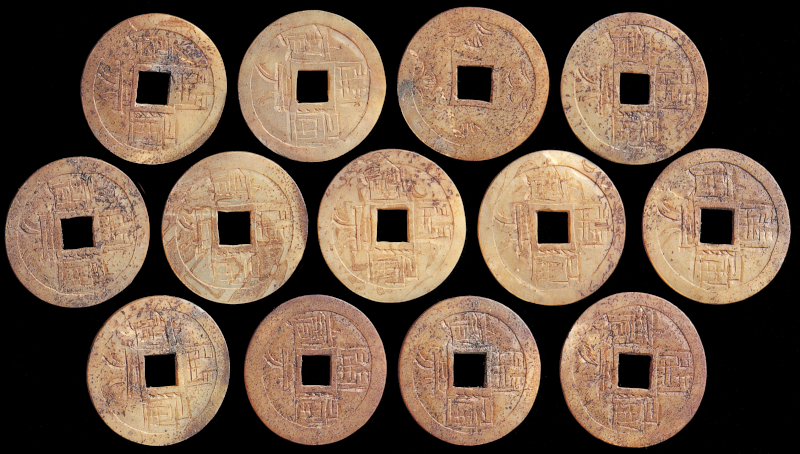
Almost overlooked among the many priceless treasures was a set of thirteen coins.
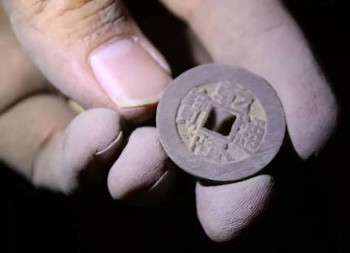
Shown in the image below are the 13 coins made of turtle shell (玳瑁币) which are the first in Chinese history to have been discovered made from this material.
China’s first coins made of turtle shell were discovered during renovation of Famen Temple
Famen Temple is situated about 75 miles (120 km) west of Xian (西安) in Shaanxi Province (陕西省). It is unclear as to when it was founded but historical records show that the temple had achieved consider size by the time of the Northern Wei dynasty (北魏 386-534 AD). The best historical evidence points to its founding during the middle to late Han dynasty.
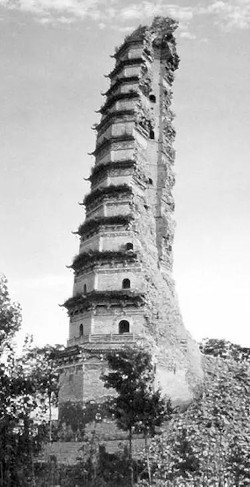
Pagoda at Famen Temple collapsed after heavy rains in 1981
In 1981, the thirteen-story octagonal brick pagoda at Famen Temple, which was built in 1609, partially collapsed due to heavy rains.
During renovations in 1987, the foundation of the previous Tang dynasty (唐朝 618-907 AD) wooden pagoda was discovered underneath the foundation of the brick pagoda.
Steps were discovered which led to a lower level.
The archaeology team entered an underground palace by going down this 19-step staircase where they found a door.
The archaeologists opened the door and proceeded along a long narrow path which was paved with a thick layer of coins. There were more than 27,000 coins.
This tantra states that there are seven “treasures” or precious things: (1) gold, (2) silver, (3) pearl, (4) coral, (5) turtle shell, (6) crystal, (7) colored glaze.
Coins of a precious material like turtle shell would have only been made to commemorate a very special occasion. In this case, they would have been made by order of an emperor to honor a sacred relic of the Buddha.
There is no mention of coins made of turtle shell in any ancient Chinese historical text so this discovery came as a complete surprise to Chinese archaeologists and numismatists.
As to why there are 13 coins, experts say that the number “13” is considered auspicious in Buddhism. This may be related to there being 13 sects in Chinese Mahayana. The number 13 is also reflected in Buddhist architecture as evidenced by the 13-story Famen Pagoda as well as the 13-floor Potala Palace (布达拉宫) in Tibet.
These coins are the first turtle shell coins discovered in China and may also be the earliest coins made of turtle shell ever found in the world. The inscription on the coins date them to the Tang dynasty. Because there is no mention of turtle shell coins in Tang dynasty historical texts, little else is known of their origin.
Turtle-shaped coin made of silver from the Han dynasty
Although the turtle shell coins were a significant find, the major discovery in the underground vault was the relic of the middle finger bone of the Buddha’s left hand. This did not come as a complete surprise, however, because historical documents clearly recorded that this “true relic” (灵骨) was kept at the Famen Temple.
This sarira is the only finger bone of the Buddha known to exist.
Many of the other treasures in the underground palace date to 874 AD which was when the chamber door was last closed. The underground palace remained hidden to the world for another 1,113 years.
The underground palace contains a total of 2,499 treasures from the Tang dynasty including gems, jewelry, art pieces, gold and silver utensils, and numerous silk fabrics woven with gold thread. There is an embroidered dress of Wu Zetian (武則天) who reigned during the years 690-705 AD of the Tang dynasty and who was the only official female monarch in Chinese history.
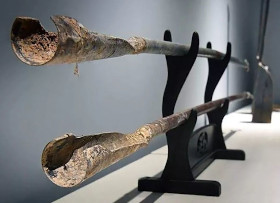
Also found was a 1.96 meter long “stick” made of gold and silver. This “stick”, and a number of the finest celadon ceramics, are believed to have been gifts from Emperor Yizong (唐懿宗) who reigned during the years 859-873 AD of the Tang dynasty.
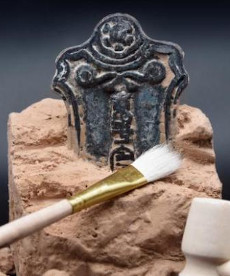
Staff member at the Henan Museum using a ‘Luoyang shovel’ to dig for treasure in a blind box
For several years, Chinese museums have been offering archaeological blind boxes (考古盲盒) in an effort to promote and popularize archaeology to the general public. These boxes are sold in museum gift shops and are especially popular with the younger generation.
A blind box is a box in which a replica of an ancient cultural artifact is buried. The object is encased in soil or clay. To discover the artifact, one needs to carefully remove the clay in a manner similar to that of an archaeologist unearthing objects in the field.
The outside of the box does not indicate what cultural artifact is “buried” inside. Much of the fun and excitement of these boxes is the surprise of discovery similar to what an archaeologist would experience.
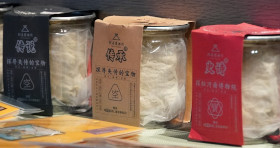
Blind boxes for sale at the Henan Museum
To enhance the reality of the experience, the clay/soil in the box is sometimes the same as that in which the original artifact was found. Also, many blind boxes include a small brush and a digging tool.
A very interesting video shows a Henan Museum staff member “excavating” treasure from a blind box.
The blind boxes from the Henan Museum (河南博物院) in Zhengzhou (郑州) include a small chopstick-sized version of a digging tool known as a “Luoyang shovel” (洛阳铲) which is the traditional tool used in actual archaeological excavations.
Mr. Song Hua (宋华), the Director of the Cultural and Creative office (河南博物院文创办主任) of the museum, says that the blind boxes have been offered since 2019 and a brochure introducing items which may be “excavated” is included in each box.
Mr. Song also says that the soil in the Henan Museum blind boxes is mixed with clay from the Mangshan Mountains (阳北邙山) in Luoyang which is where royal mausoleums from many dynasties have been unearthed.
Other boxes may include replicas of a tiger-shaped tally (虎符) issued to army generals in ancient times, a silver medal (银牌), a bronze mirror (铜鉴), jade ware (玉器) or a small bronze Buddha statue (铜佛).
Mr. Song mentions that 600 blind boxes were offered for sale online on December 8, 2020. Even though there was a limit of 3 boxes to a customer, the boxes sold out in 35 seconds. A total of 14,000 boxes were sold in that month alone.
Other Chinese museums also offer blind boxes for sale.
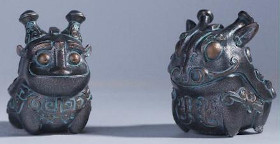
The Sanxingdui Museum (三星堆博物馆), where the ruins of an ancient Bronze Age culture are located, has blind boxes with replica dolls based on its collection of bronze face masks and figurines.
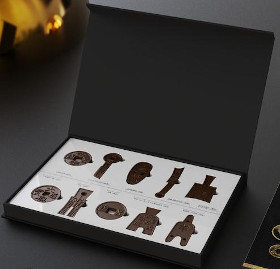
Blind box with chocolate coins modeled after ancient coins in the collection of the Henan Museum
For the Spring Festival (Chinese New Year 春节) in 2021, the Henan Museum offered a special archaeological blind box with replica ancient Chinese coins.
Upon lifting the cover of this blind box, however, one realizes that the replica coins are not encased in clay or require any digging. The coins are already visible.
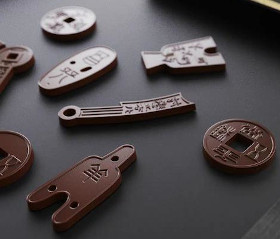
These ancient coins are made of chocolate (古钱币巧克力) as can be seen in the photo.
Chocolate coins from Henan Museum blind box
Although made of chocolate, these are replicas of actual coins unearthed by archaeologists and now on display at the museum.
Bodhidharma (菩提达摩) was a Buddhist monk who came to China from Central Asia or the Indian subcontinent during the 5th or 6th centuries. Little is known about him but he is regarded as the founder of Chan Buddhism (禅) in China. Chan Buddhism eventually migrated to Japan where it further evolved into what is known as Zen.
Bodhidarma is highly recognized and respected in Japan where he is referred to as Daruma. As part of this adoration, the Japanese created a very popular doll in his honor.
These dolls are known as a daruma dolls. Daruma dolls are seen as symbols of perseverance, good luck and prosperity by the Japanese.
Daruma dolls are ubiquitous in Japan. Some are even used as “coin banks” (“piggy banks“) in which to save coins.
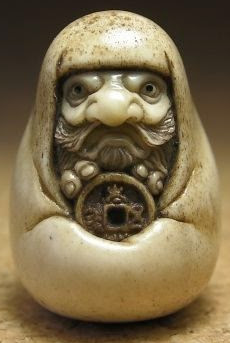
Daruma doll showing Bodhidharma holding a tai he wu zhu (太和五铢) coin
The daruma doll at the left is a most interesting and unusual example because Bodhidharma is shown holding a Chinese coin in his hands.
Bodhidharma has a striking appearance. He was not of Chinese ancestry and is described in ancient texts as being wide-eyed, heavy bearded and ill-tempered. Some texts even refer to him as the “Blue-eyed Barbarian”.
The Chinese coin he is holding is round with a square hole in the middle and is popularly known as a “cash coin”. Cash coins were used for more than 2,000 years in China and also became the model for the standard coinage of both Japan and Korea.
What is remarkable is that the daruma doll’s coin is so accurately detailed that it can be readily identified.
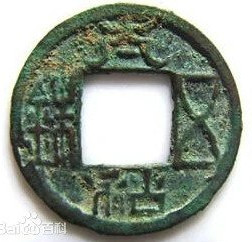
Tai He Wu Zhu coin issued in 495 AD by Emperor Xiaowen of the Northern Wei dynasty
Tai he wu zhu coins tend to be fairly crudely made and vary in size and weight. Larger specimens are about 2.5 cm in diameter and weigh about 3 grams. Smaller specimens are about 2 cm and 2.3 grams.
It is important to note that Bodhidharma lived in the Luoyang area during the time that this coin circulated. Placing this specific coin in his hands is, therefore, historically accurate.
As mentioned above, Bodhidharma is usually portrayed as being “wide-eyed”. This alludes to a story concerning his nine years of staring at a cave wall while meditating. The legend goes that one day he fell asleep. In order to prevent this from ever happening again, he cut off his eyelids.
A Japanese legend states that after sitting and meditating in the cave for nine years his limbs atrophied. For this reason, daruma dolls do not have arms or legs. This particular daruma doll is a very rare exception. While it does not have arms or legs, it does have “hands” or, more accurately, a few fingers.
The Chinese have the expression jian qian yan kai (见钱眼开) which translates as “one’s eyes grow round with delight at the sight of money”. The expression first appeared in the famous Ming dynasty (明朝 1368-1644) novel Jin Ping Mei(金瓶梅) which is translated into English as The Golden Lotus or The Plum in the Golden Vase.
By a remarkable coincidence, there is a story dating from the Southern Song dynasty (南宋 1127-1279) that precisely illustrates this expression of a person going wide-eyed over the sight of a tai he wu zhu coin which is the same coin as in Bodhidharma’s hands.
The story takes place in the city of Suzhou (苏州) and concerns an elderly businessman with the surname Chai (柴) who literally loved money above everything else. He was extremely wealthy and was also extremely greedy and stingy.
One day he was out walking when he saw a group of children playing with some coins in the street. Because he loved money so much, he fixed his eyes on the coins. His eyes lit up when he noticed that some of the coins were tai he wu zhu. Tai he wu zhu coins were very valuable at this time and were much loved by the people.
Suddenly, one of the tai he wu zhu coins rolled under his feet. He quickly stepped on it to hide it from the children.
The children walked over and asked for the coin but the old man said, “I didn’t take your money.” One of the children replied, “It’s under your foot.”
The man quickly turned around and while his back was facing the children he picked up the coin. He then turned back around to face the children and said, “Look for yourselves, I don’t have any money under my foot.”
A child then pointed to the man’s hands and said, “It’s in your hand!”
The man spun around again and while his back was facing the children he put the coin in his mouth. He turned back to face the children and stretched out his hands to show there was no coin.
A child said, “It’s in your mouth!”
Knowing he had to hide the coin, he quickly swallowed it. He then opened his mouth wide so that the children could see there was no coin.
The man returned home with the coin stuck in his throat. He kept trying to cough it out but it would not budge. In less than a day, his throat became swollen and he had difficulty breathing.
His four sons wanted to call a doctor but the old man glared angrily at them and gestured with his hand to bring him a brush and ink. He then wrote, “For the sake of money, what would be the reason to spend money?”
By the third day, the man was close to death. His four sons came to his bed to discuss the funeral. The eldest son said, “You have worked hard all you life and should therefore have a coffin made of cypress.” The father just glared at his eldest son and shook his head indicating disapproval.
The Number 2 Son then said, “You have saved all your life and should have a coffin made of willow in order to save a lot of money.” The father again shook his head in disagreement.
The Number 3 Son then said, “After your death, we could wrap your body in the old reed mat on your bed and bury you. Would this satisfy you?” The father again shook his head.
The Number 4 Son was only 14 or 15 years of age but said, “After you die, we could chop your body into little pieces and fed the meat to your big yellow dog.”
The man smiled and vigorously nodded his head approvingly. He picked up his brush and breathlessly wrote the last words of his life:
After I die, chop me into pieces of meat and feed me to the dog.
But, don’t let him eat the tai he wu zhu coin!
The story serves as an example of a person being extremely wide-eyed in love with hoarding money and refusing to spend any of it even at the end of his life.
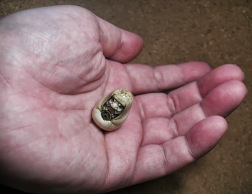
This daruma doll is carved from bone and has exquisite detail.
It is quite small as can be seen in the photo at the left.
Finally, we should not forget that Bodhidharma was a Buddhist monk who renounced the world, lived a very austere life in a cave, and spent a lifetime seeking true reality.
Over the centuries, Daruma’s legacy in Japan has evolved to the point where dolls are made in his image to serve as good luck charms and coin banks.
While the Japanese daruma dolls are very cute and symbolize perseverance, good luck and prosperity, the idea of associating the founder of Chan (Zen) Buddhism with something as secular and mundane as money is not consistent with his teachings.
During the Eastern Jin dynasty (东晋 317-420), map-like charts began to be used as a guide in understanding the ultimate reality, i.e. the “true form” of things according to the Dao (Tao 道), during pilgrimages to China’s Five Great Mountains (五岳).
The “true form” is the original, formless, inner shape of the mountain, as part of the Dao, as opposed to its physical, visible, outer shape. Daoists (Taoists) believed that if one understood the true form (zhenxing 真形) of a thing or spirit, one could have control over it.
Daoists discovered sacred sites in the highest of places and, in particular, mountains and caves. They believed that caves were the very heart of a mountain and were a fountain of the vital life force known as qi (气). These mountainous areas had forests and streams where one could find medicinal plants and the ingredients for elixirs of life and pills of immortality.
Ge Hong1 (葛洪 283-343), a scholar and alchemist who lived during the Eastern Jin, warned: “Most of those who are ignorant of the proper method for entering mountains will meet with misfortune and mishap”.
Those accustomed to living in the plains and valleys were unfamiliar with mountainous topography, weather, and geology. They feared the tigers and other strange beasts as well as the local spirits and demons.
One of the most famous of these charts was the “True Forms Chart of the Five Sacred Peaks” (五岳真形图), also known as “True Forms of the Five Marchmounts“, which was a book illustrating the “true form” of the Five Great Mountains (五岳) of China.
Ge Hong stated: “Having the Album of the True Forms of the Five Marchmounts in your home enables you to deflect violent assault and repulse those who wish to do you harm; they themselves will suffer the calamity they seek to visit upon you.”
Daoists later created talismans (charms) which displayed these charts. A talisman was more easily carried on the person and provided protection for seekers of the Dao as they journeyed into these mountainous areas.
Ge Hong wrote: “Others do not understand how to wear the divine talismans at their belt. Some do not obtain the methods to enter the mountains and let the mountain deities bring calamities to them. Goblins and demons will put them to the test, wild animals will wound them, poisons from pools will hit them, and snakes will bite them. There will be not one but many prospects of death.”
Fortunately, the talismans still exist because they continued to be cast and carried during the centuries that followed. The specimen discussed below dates to the Qing dynasty (清朝 1644-1912).
Daoist plaque charm displaying the True Forms of the Five Marchmounts (Five Sacred Mountains)
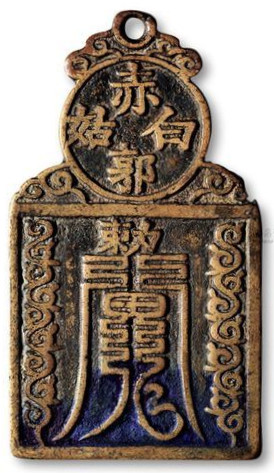
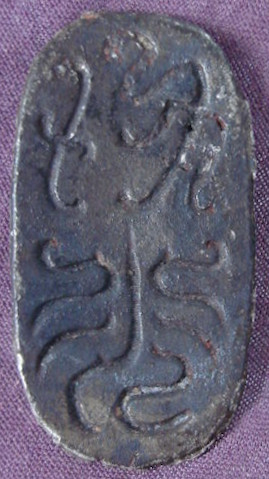
Shown at the left is the obverse side of a Daoist plaque (pendant) charm which is an example of a Daoist talisman (道教符箓).
A talisman is a charm that includes Daoist magic writing (fulu符箓) which are special written characters that give orders to deities, spirits, demons, etc.
At the top of the charm is a medallion with the four-character Chinese inscription chi guo bai gu (赤郭白姑).
“Chi Guo” (赤郭) and “Bai Gu” were two mythical beings who provided protection from demons and were described as “ghost-eaters”.
Francois Thierry, an expert in East Asian currency, describes Chi Guo (“Lord Red”) as a supernatural giant, originally from southeastern China, who wore a red garment and had a red serpent wrapped around his neck. Lord Red was capable of swallowing 800 demons in the morning and 300 or 500 at night.2
Bai Gu was a mythical maiden also known for devouring evil spirits.
Any charm carrying the names of these two ghost-eaters would provide protection to those seeking the Dao in sacred summit areas.
The bottom portion of the charm is square with two small characters and one large character.
The two small Chinese characters at the top are 勅令 (chi ling) which translates as “edict”. The edict is expressed by the large character directly below.
The large character is not a Chinese character but rather Daoist magic writing, known as fulu(符箓) or lingfu (灵符). This character with its secret “edict” is what makes the charm a Daoist talisman.
Only Daoist priests know the exact meaning of magic writing but this character is believed to protect against disasters and to bring blessings.
To the left and right of the magic writing can be seen a curly grass pattern (唐草纹) which became popular during the Tang dynasty (唐朝 618-907).
Reverse side of Daoist plaque charm displaying the Five Sacred Mountains
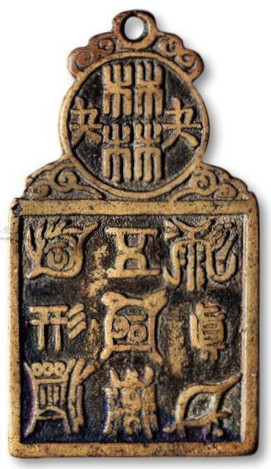
Shown at the left is the reverse side of the charm.
The four-character inscription at the top reads lin lin guai guai (林林夬夬). Lin translates as “forest” and guai refers to the 43rd of the 64 hexagrams (六十四卦) in the Book of Changes (Yi Jing易经).
The 43rd hexagram guai (夬) has the meaning “to respond strongly against opposing forces”.
This charm protects a Daoist from demons and savage beasts encountered in mountainous forests.
The lower square portion of the charm contains nine symbols. Some of these are Chinese characters and others are the “true form” maps of the five great mountains.
At the 12, 3, 6 and 9 o’clock positions are Chinese seal script (篆书) characters. Reading (top, bottom, right, left), they are wu yue zhen xing (五岳真形) which translates as the “true form of the five peaks”.
The other five special-shaped symbols are the “charts” (‘true form’ maps) of each of the five sacred mountains.
According to legend, Taishang Daojun (“Supreme Lord Tai Shang”, “Grand Lord of the Dao” 太上道君) passed these charts to the people to be used to prevent disasters and bring good fortune.
The primal concept of the number five may have had its roots in a mathematical system based on five (one hand of five fingers) as opposed to a base ten (two hands with ten fingers).
Much of the Daoist worldview could be ordered into fives.
For example, there are the five great mountains and each is associated with one of the five directions (五方 north, south, east, west, center), five mythical animals (Four Auspicious Beasts (四象) and the Yellow Dragon), five colors (五色 yellow, red, green, black, white), and five emperors (Five Yue Emperors) (五岳大帝).
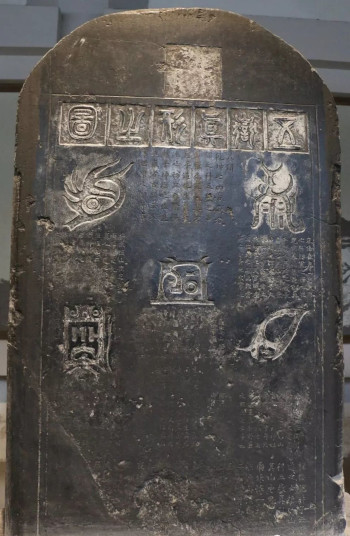
Mount Tai (Taishan 泰山) in East China’s Shandong (山东) province has been the “abode of the immortals” (xian仙) since ancient times and is the “East Peak” (东岳) of the Five Sacred Peaks. It is the holiest mountain in Daoism. For more than 3,000 years, Daoist pilgrims have journeyed to its Jade Emperor Peak (玉皇顶). The stone stele (碑), shown at the beginning of this article, is located at the Dai Temple (岱庙) on Mount Taishan.
Mount Tai is identified with the Wood (木) Element and the Azure Dragon (青龙). Azure is green-blue which is the color of the eastern fertile plains and the ocean.
Mount Heng is associated with the Fire (火) Element and the Vermilion Bird (朱雀). Vermilion is a reddish color which describes the red soils of the Sichuan (四川) and Yunnan (云南) provinces.
Mount Song is associated with the the Earth (土) Element and the Yellow Dragon (黄龙). The loess soils of the Yellow River are yellow.
The emperor of this peak is the “Holy Emperor Zhong Tianchong of Mount Songshan in Zhongyue” (中岳嵩山中天崇圣大帝).
This Daoist charm, displaying ‘true form’ symbols, was created to guide and protect pilgrims traveling to the Five Great Mountains in their quest to discover the true reality known as the Dao.
If one were to ignore the advice to carry such a talisman, Ge Hong warned: “If someone enters the mountains possessing no magical arts, he will suffer harm”.
This charm is 86.6 mm long, 49 mm wide, and 3 mm thick. The weight is 67.1 grams. The charm sold at auction in 2018 for $3,900 (RMB 25,300).
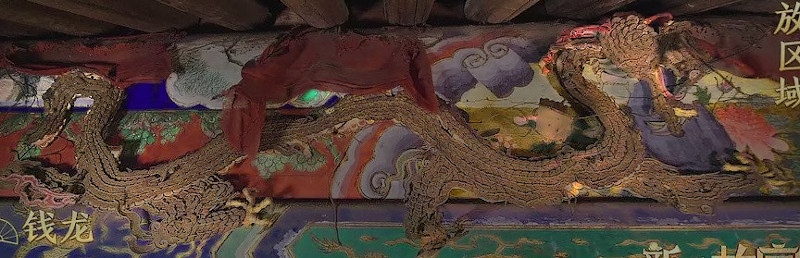
Attached to the side of the ridge beam supporting the roof is a dragon. While painted dragons can be found throughout the palace, this dragon is not a painting. It is a “coin dragon”, seen in the image below, which is a dragon sculpture made entirely of old Chinese coins.
Coin Dragon discovered in the Hall of Mental Cultivation in the Forbidden City
Since ancient times, a grand ceremony (上梁) always takes place when the main roof beam of a palace building is raised and installed. Hanging above the coin dragon can still be seen the remnants of the red silk satin from this topping-out ceremony which occurred several centuries ago.
Good luck charms, frequently including coins, would traditionally be attached to a roof beam to provide protection from evil spirits, fire and other disasters. There would also be charms expressing the wish for peace and good fortune. In the case of the Hall of Mental Cultivation, this tradition takes the unique form of a dragon made of coins.
There are no historical documents that mention the existence of this coin-dragon so, apparently, it was meant to stay hidden and kept a secret.
The above photograph is actually a still image of the ‘coin dragon’ (‘money dragon’ 钱龙) taken from a video broadcast by Beijing TV on March 2, 2020. (The coin dragon can be seen beginning at around 1:41 in this video.)
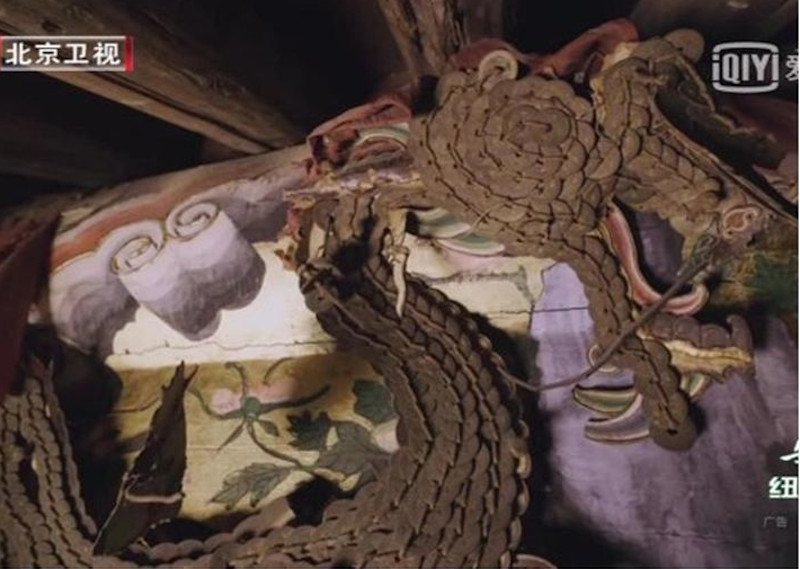
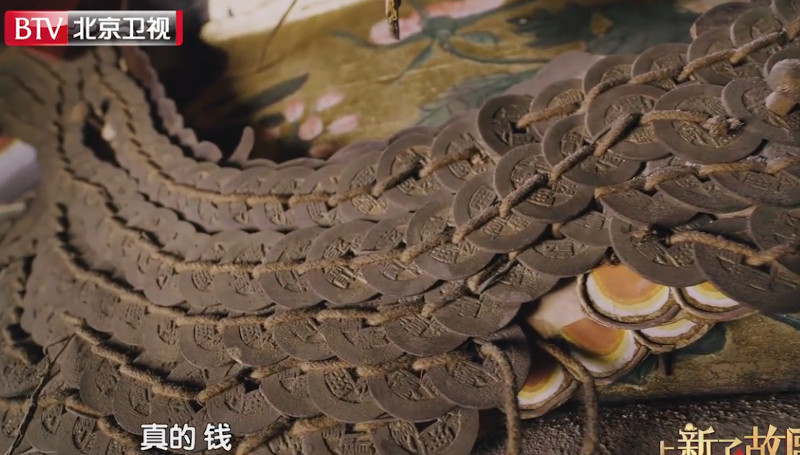
The “coin dragon” is composed of Chinese cash coins linked together on strings. The dragon is 182 cm (5.97 ft) long and 47 cm (1.5 ft) high. The backboard is made of paperboard on which is painted a colorful dragon. The strings of coins create the shape of the dragon and are attached to the backboard and beam by “gold-plated round-head copper nails”.
The construction of the coin-dragon can be better seen in the above close-up of the head.
In defining a ‘coin dragon’, the Baidu Encyclopedia (百度百科) specifically refers to this specimen in the Hall of Mental Cultivation. No other examples are mentioned so it is likely that this particular work of imperial sculptural art is unique.
Coin Dragon constructed from strings of ‘Qian Long Tong Bao’ coins
The above image gives a closer view of the dragon’s body and how the coins are connected to each other by strings or cords made of hemp. The coins are traditional Chinese cash coins which are round with a square hole in the middle. Many believe that the shape of the cash coin reflects the ancient Chinese philosophy that the ‘sky isround and the earth is square’ (天圆地方).
Although Chinese cash coins were used for more than 2,000 years, the coin dragon is composed entirely of one specific coin.
The Qianlong Emperor (乾隆帝) reigned from 1735 to 1796 during the Qing dynasty (清朝). He resided and also held audiences with high government officials in the Hall of Mental Cultivation where the coin dragon “lives”.
‘Qian Long Tong Bao’ coin
As can be seen at the left, all the coins have the inscription qian long tong bao (乾隆通宝). Qianlong (乾隆) represents the era name (年号) of this emperor and translates as “Lasting Eminence”. Tongbao (通宝) translates as “circulating treasure” and refers to money.
The coins are about 2.8 cm in diameter and are identical in every way to those that were minted for normal circulation during this emperor’s reign. However, none of these coins show any wear so they were all newly cast for this dragon sculpture and were not taken from circulation.
Dragons have been a totemic symbol of Chinese emperors since the very earliest times. In traditional Chinese culture, the dragon represents the ultimate power and authority in the sky. The emperor, being the ultimate power and authority on earth, is the thus the counterpart to the dragon. (See paper money showing the Qianlong Emperor with dragon symbols.)
Using coins to construct the dragon is consistent with this sky (round) and earth (“square” hole) relationship.
The coin dragon thus serves as the supreme representation of the Chinese belief in charms as objects with supernatural powers able to defeat ghosts and demons, deter disasters, and bring forth peace and good fortune.
Given the close association of a Chinese emperor with a dragon, why is it that a coin dragon did not make an appearance prior to the time of the Qianlong Emperor?
The explanation is actually quite straightforward. By coincidence, this emperor’s name is qian long and the Chinese expression for ‘coin dragon’ is also qian long. The emperor’s name is pronounced exactly the same as ‘coin dragon’!
Because no previous Chinese emperor had a name that sounded like ‘coin dragon’, there had never before been a reason to create a dragon sculpture made of coins to honor a reigning monarch.
While the pronunciation is identical, the qian long Chinese characters are different and have different meanings. ‘Coin dragon’ is written 钱龙 while the emperor’s name is written 乾隆.
What could be a more fitting tribute to the supreme authority of the empire than creating a dragon, literally in his name, made of symbols of wealth to represent the power and prosperity of the country?
There is, however, an intriguing and as yet unsolved mystery concerning the coin dragon.
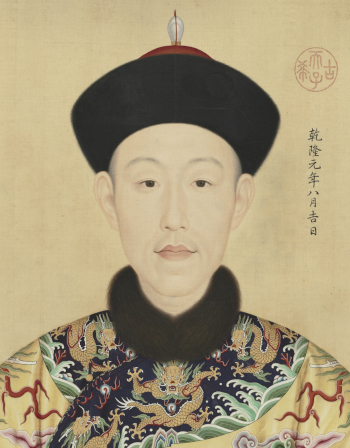
Detail from a portrait of the Qianlong Emperor at the Cleveland Museum of Art
At the left is a detail from an official portrait of the Qianlong Emperor painted in 1736 which was the year he ascended the throne. The painting is by the Jesuit missionary-artist Giussepe Castiglione (郎世宁) and is in the collection of the Cleveland Museum of Art.
As can be clearly seen, the emperor’s robe displays dragons with five claws.
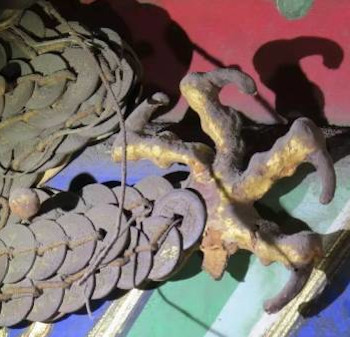
However, the Beijing TV video reveals that the coin dragon has only four claws instead of five.
Coin Dragon missing one of its five claws
At the left is a still image from the video showing the four claws. On closer examination, however, there are four claws and also a stub at the very bottom.
The coin dragon must have had five claws originally but, according to the Baidu Encyclopedia (百度百科), “for some reason, all of its legs now have only four claws and one broken claw”.
The reason for the missing “fifth claw” remains an intriguing and unsolved mystery.
Finally, the discovery of the coin dragon was not the only surprise that occurred during the renovation of the building.
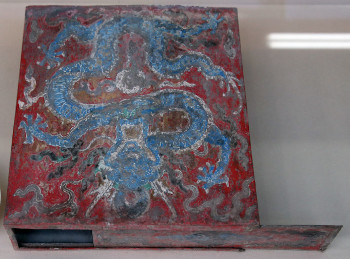
Treasure Box discovered under the roof of the Hall of Mental Cultivation
Discovered under the roof was a sealed “treasure box” (宝匣) made of tin and decorated with an azure dragon (青龙) having five claws.
The inscription on the treasure box reads “the sixth year of Emperor Jiaqing” (嘉庆六年) which would be the year 1801.
The Jiaqing Emperor (嘉慶帝) was the son of the Qianlong Emperor and ascended the throne in 1795.
The azure dragon is one of the dragon gods of the Five Deities (五帝) which is associated with the five colors (五色), five phases (wuxing五行), etc. The box contained various “treasures” including Buddhist sutras, gems in five colors (五色宝石), satins in five colors (五色缎), silk threads in five colors (五色丝线), five spices (五香), five herbal medicines (五药), and five cereal seeds (五谷).
Unfortunately, the scroll, satins, and silk threads had deteriorated to such an extent that they were barely visible. The spices, medicines and grains were also in poor condition and difficult to identify.
Sycee (yuanbao) discovered in the Hall of Mental Cultivation “Treasure Box”
The treasure box also contained five “sycee” (细丝) which are shown in the image at the left.
Sycee, also known as yuanbao (元宝), were a form of currency used during the Qing dynasty. These ingots were usually made of either gold or silver and their value was determined by their weight.
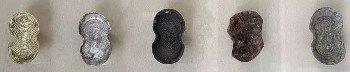
The five sycee found in the treasure box are made of five different metals including one each of gold, silver, copper, iron and tin (seen in the image above from left to right).
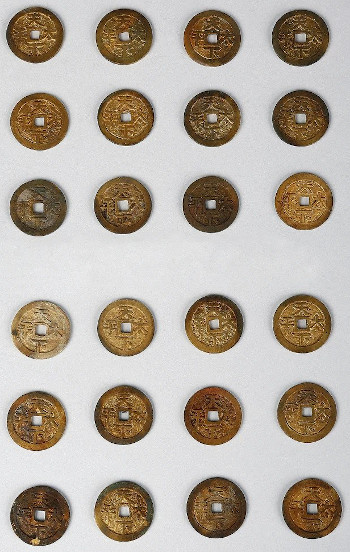
Twenty-four gold coins with the inscription (Chinese and Manchu) meaning “May the world be at peace” found in a Treasure Box under the roof of the Hall of Mental Cultivation
But, what is perhaps the most interesting treasure found in the box were the 24 gold coins shown at the left.
The 24 coins equal the number of gold coins found in the Hall of Supreme Harmony (太和殿) where the grandest rituals took place. These are the most gold coins found among the 50 treasure boxes discovered in the Forbidden City.
These 16k gold coins were not minted to be used as money. They are actually charms and have a traditional ‘good luck’ inscription as opposed to a “coin” inscription such as found on the coins of the coin dragon.
The gold charms are 25.4 to 28.4 mm in diameter, 1.7 to 2.1 mm thick, and weigh 10.7 to 11.36 grams.
The meaning of the inscription is the same on both the obverse and reverse sides. One side is written in Chinese and the other side is written in the Manchu script (满文). Manchu was the native language of the emperors of the Qing dynasty.
The characters read tian xia tai ping (天下太平) which, after all, is a fitting inscription for an imperial treasure. This inscription translates as “May the world be at peace”.
(It should be noted that besides the coin dragon, Chinese coins have also been used to create charms in the shape of a sword. The British Museum has a coin-sword made from qianlong tongbao coins which are the same coins used for the coin dragon. For additional information on sword charms, please see Swords and Amulets.)
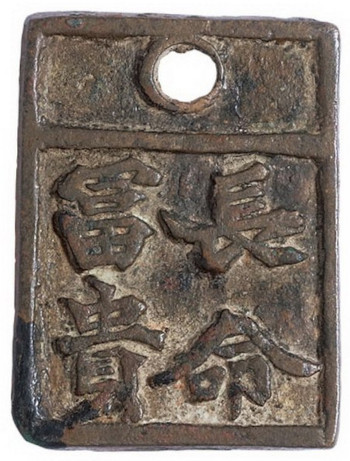
One of the most popular ‘good luck’ inscriptions found on old Chinese charms is chang ming fu gui(長命富貴) which is the wish for “long life, riches and honor”.
The inscription reads as follows: top right (chang長), bottom right (ming命), top left (fu富), bottom left (gui貴).
An easily overlooked feature of this charm is that the character fu (富), meaning “riches” or “wealth”, is written in an unusual manner.
The character fu is normally written as 富. On this charm, however, the character fu is written as 冨.
Do you see the subtle difference?
The top of the character is written as “冖” (mi “cover”) instead of “宀” (mian “roof”), i.e. the small dot or vertical line at the very top is missing.
Writing the fu character in this manner is known as fu zi wu tou (富字无头) which translates as “fu character without a top or limit”. This implies “riches without an end”. “Endless riches” are, after all, better than mere “riches”!
In Daoist (Taoist 道教) thought, each person is protected by the star god associated with the zodiacal year in which that person was born. (See Daoist Charms.)
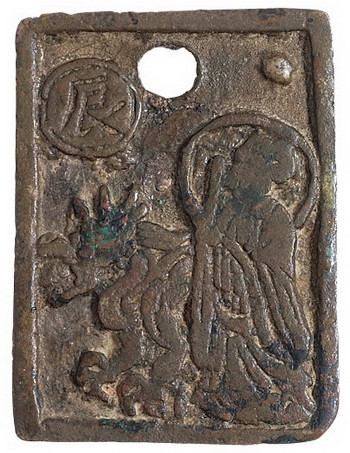
The star god is shown with a halo around the head and wearing a long robe.
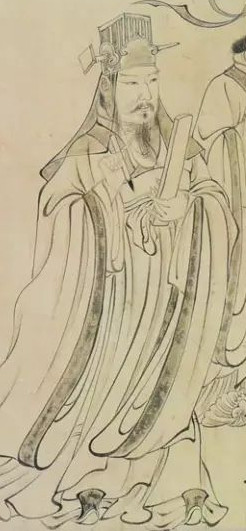
Detail from a painting by Wu Daozi showing official holding a hu (ritual tablet or flat scepter)
A hu is a plaque or tablet that is held in front of the chest by officials. It serves as a badge when being received in audience by the emperor. Depending on the rank of the official, the hu can be made of jade, ivory or bamboo.
A drawing of an official holding a hu is shown at the left. This is a detail from a painting by Wu Daozi (吴道子) who was one of the most famous painters of the Tang dynasty (唐朝 618-907 AD).
It is appropriate that a painting by Wu Daozi is used in the discussion of this charm. Some numismatists believe that the depiction of the star god on this charm is in the charming style of Wu Daozi as seen in his “The Eighty-seven Immortals” (八十七神仙圖) painting at the Xu Beihong Memorial Museum (徐悲鴻紀念館) in Beijing.
Continuing with a description of the reverse side of the charm, there is a ferocious dragon on the left side. Only the front half of the dragon is seen because it is standing behind the star god. The dragon is the 5th of the 12 animals of the Chinese zodiac (生肖). Its presence confirms that this star god is the one in charge of those born in the year of the dragon.
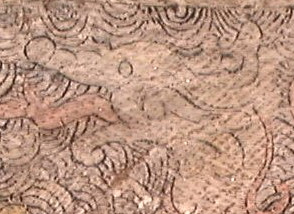
Detail of a dragon from a bow discovered in a tomb from the Wei Jin dynasties
The charm’s dragon is similar in style to dragons depicted during the Wei Jin dynasties (220-420 AD).
This similarity in style can be seen in the image at left of a dragon found on a wooden bow discovered in a tomb from the Wei Jin (魏晋) dynasties.
It should be pointed out that in the mouth of dragon on the charm is a large pearl. The pearl is a symbol of riches.
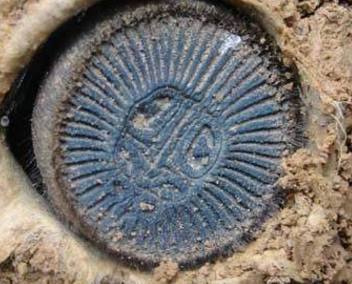
Above the dragon is a round object representing the sun. The Chinese character displayed in the sun is chen (辰) which is the fifth of the Earthly Branches (地支) and refers to the dragon of the Chinese zodiac.
Above the head of the star god is a raised dot representing the moon.
Both the inscription and images confirm that this is a ‘good luck’ charm. In ancient times, this type of charm would have been given to a newborn child or an infant having reached one-month of age (man yue满月). The charm would have been especially appropriate for a child born in the year of the dragon.
The charm is 31 mm in length and 24.5 mm in width. It sold at the Chengxuan auction in 2009 for $380 (RMB 2464).
‘Ancient Chinese coin’ discovered by villager while digging at ancestral burial site
A recent newspaper article tells the story of a Chinese villager who decided to move his family’s ancestral graves to a place with better feng shui (风水).
While digging, he accidentally uncovered an ancient coin.
He had heard stories of people becoming rich by digging up ancient Chinese coins and selling them. Now this was happening to him. He was thrilled with his good luck and anticipated that he would reap a large fortune.
He calmed down and began to dig more slowly and carefully. Just as he was about to dig the coin out, the coin moved and frightened him.
Once the coin was uncovered, he could “see its true face”. He did not know whether to laugh or cry.
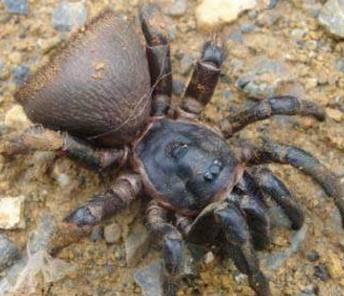
Rare Chinese ‘Money Trapdoor Spider’ (Chinese Hourglass Spider) discovered by villager
He was stunned that the object was not a coin at all but rather a living thing. He described it as a “scary and extremely ugly-looking spider”.
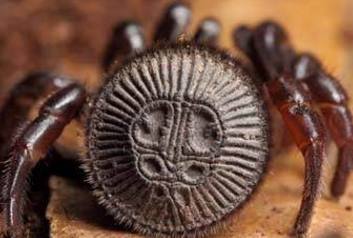
Searching the internet, he discovered that this was an extremely rare trapdoor spider known as a Chinese Hourglass Spider (Cyclocosmia ricketti里氏盤腹蛛).
In China, however, it is better known as a “Money Trapdoor Spider” (金钱活板门蛛) or “Money Living-Door Spider” (金钱活门蛛). Another common name is the “Severed Abdomen Spider” (截腹蛛).
Nevertheless, the villager was saddened that he would not be making a fortune from his “coin”.
Money Trapdoor Spider
As can be seen in the image at the left from Baidu Baike (百度百科), the spider has a very distinctive plate or disk on its abdomen which resembles an ancient coin, seal or grinding disc.
These money trapdoor spiders are found in Fujian (福建), Zhejiang (浙江), Sichuan (四川) and Yunnan (云南) provinces in China as well as the tropical rain forests of Southeast Asia.
Sichuan is the farthest north this species has been recorded. There is still much to learn about these spiders since it was previously believed that the species could not survive in areas where temperatures could drop below 13 degrees Celsius. Winters in Sichuan can get even colder.
The males are about 2.5 cm in length and the females are slightly larger at about 2.7 cm. The largest can exceed 3 cm. The disk has a radius of about 1.6 cm.
Mr. Zhao Li (赵力), the Director and Senior Biological Engineer at the Insect Museum of West China (华希昆虫博物馆) located in Chengdu (成都), says in another article that the money trapdoor spider fits the description of a type of arachnid mentioned in an ancient Chinese text known as the Erya 《尔雅》. The Erya is believed to be the oldest extant Chinese dictionary and dates to the fifth century BC.
References to what is likely the trapdoor spider can also be found in ancient texts on Chinese medicine. For example, the “Supplement to the Materia Medica” (Bencao Shiyi 《本草拾遗》) by Tang dynasty pharmacologist Chen Cangqi (陈藏器) written in 739 AD states that “the diedang (螲蟷 a species of spider living in underground burrows) is found everywhere……it resembles a spider….a hole in the ground is the nest and on top of the hole is a cover.” The diedang can be used to treat “boils, gangrene and other sores, sarcoma (malignant tumor), …”.
Mr. Zhao says money trapdoor spiders are very rare and there have been only eight sightings in China since the year 2000.
Because of their rarity, these spiders bring a high price as pets. Most of the “money trapdoor spiders”, as they are called in the pet market, are artificially bred in Thailand. One spider can sell for as much as $3,860 (RMB 25,000).
Mr. Zhao explained that the spider rests during the day and comes out at night.
Money Trapdoor Spider Burrow
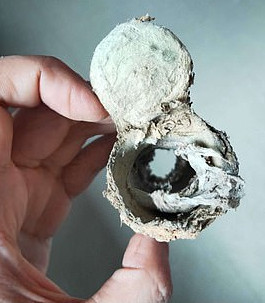
Money trapdoor spiders do not build webs. They dig burrows in the ground and line it with silk threads and mud.
Mr. Zhao is seen holding such a silk-lined burrow in the image at left.
The spider can protect itself by blocking the entrance to the burrow using its hard “coin” as a shield.
Another article explains that “the money trapdoor spider is not good at spinning silk and weaving webs in the air so it uses its weird butt to plug the opening of the burrow. Because its ‘copper coin’ is relatively hard, it can protect itself well. When a small insect steps on its ‘copper coin’, the spider will shrink its abdomen allowing the small insect to fall into the burrow and be eaten. The ‘coin’ makes it difficult for the insect to escape. When faced with a non-threatening insect, the spider can just get out of the hole and grab it”.
Even though the villager was frightened and disappointed that he was not lucky enough to find buried treasure, the spider is nevertheless considered an auspicious symbol in China.
The reason is that one of the Chinese words for “spider” is chongxizi (虫喜子). The chong (虫) means “insect”, the xi (喜) means “happy” and the zi (子) means “son”. The Chinese like puns. If you say “spider” (chong xizi) you are at the same time saying the word “happy” (xi) as well as “happy son” (xizi).
According to Chinese law, the government owns everything of value in the ground, in the rivers and within the country’s territorial waters. This means that even if the villager had discovered an ancient coin or other buried treasure, all could have been legally confiscated by the state.
However, these laws would not apply to an insect and the villager could probably have sold the spider for more money than many rare Chinese coins.
The newspaper article, unfortunately, does not say what the villager decided to do with his “scary and extremely ugly-looking spider”.
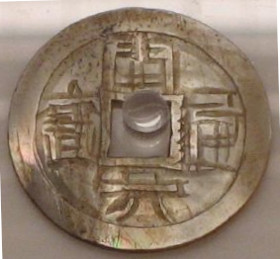
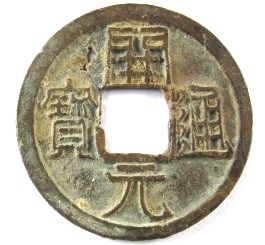
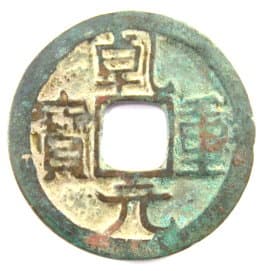
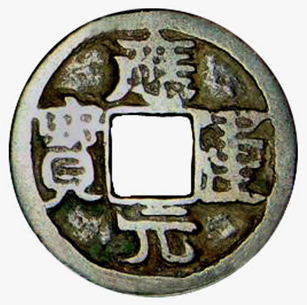
The kai yuan tong bao, shown at left, became the model for most of the coins cast during the dynasties that followed up until the very end of the imperial era in 1911.
“Kai yuan” (開元) translates as “opening a new era” and “tong bao” (通寶) means “circulating treasure”.
There are some interesting variations of this coin and a few of the more unusual ones are discussed below.
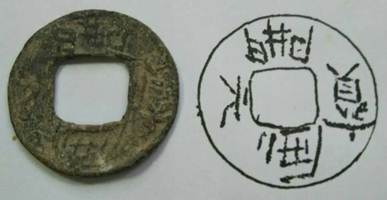
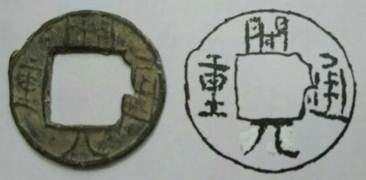
Kai Yuan Tong Bao lead coin minted by the State of Chu (Kingdom of Chu) or Southern Han Kingdom
The image above shows a most unusual kai yuan tong bao coin on the left. On the right is a rubbing of the same coin making it is easier to read the inscription.
This coin is believed to have been minted by either Chu (楚 907-951 AD) or the Southern Han Kingdom (南汉 905-971 AD). While Tang dynasty coins are well-cast copper coins with uniform-sized Chinese characters written in clerical script (隶书), this lead coin is poorly-cast with very irregular and poorly written characters.
Not only is the coin made of lead, which has a much less intrinsic value than copper, it is also smaller, thinner, and lighter than the Tang dynasty coin. It also has a larger square hole which means it contains even less metal.
This coin has the same kai yuan tong bao inscription. However, the inscription is not read in the same order (top, bottom, right, left). Instead, the characters are read starting at the top and going counterclockwise (top, left, bottom, right).
The first character kai (開) is upside down. (For illustrative purposes, I am using the Chinese characters from the copper coin.)
The next character, yuan (元), is rotated to the right so that its top is facing the square hole.
The third character, tong (通), is rotated to the left with its right side facing the square hole.
Finally, the fourth character, bao (寶), is upside down.
This is certainly a most unusual kai yuan tong bao coin.
Coins that were declared by the emperor to be worth more than the standard cash coin would sometimes have the inscription “zhong bao” (重寶) instead of “tong bao” (寶). The zhong (重) means “heavy” to imply that it has greater value.
Qian Yuan Zhong Bao was the first “zhong bao” coin
This “zhong bao” coin was declared to be worth the equivalent of 10 regular cash coins such as the kai yuan tong bao.
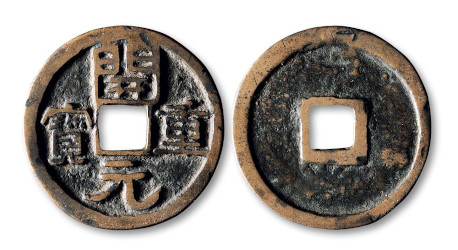
While there are no historical records stating that a “kai yuan zhong bao” (開元重寶) was ever officially minted, shown below is such a coin.
Kai Yuan Zhong Bao (開元重寶) coin made of copper and sold by China Guardian Auctions in 2011
The inscription is read in the traditional order (top, bottom, right, left). The coin is made of copper and is well-made. The characters are uniform but appear to be of slightly different sizes. The coin is 33 mm in diameter which makes it larger than a Tang dynasty coin which is about 24 mm.
This coin would not have been minted during the Tang dynasty but rather sometime later. At this time, it is not clear when or where the coin originated. The coin may be of Japanese origin, or even a charm, but it was not presented at the auction as either of these. This kai yuan zhong bao copper coin was sold at China Guardian Auctions in 2011 for about $925.
The kai (開) at top, the yuan (元) at bottom and the zhong (重) at right can be clearly identified.
The bao (寶) at left is, however, very strange until you realize that it is not the Chinese character bao (寶).
Remember that the Chinese character bao (寶) translates as “treasure”.
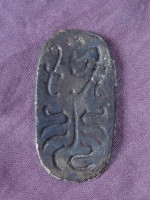
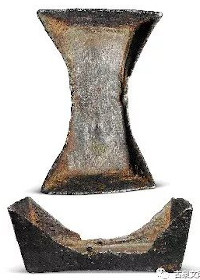
Silver Ingot (top and side views)
The “character” to the left of the square hole in this lead kai yuan zhong bao coin is, in fact, not a Chinese character at all but rather a picture of an ingot.
Shown at the left is another form of ancient Chinese money known as an ingot (sycee 细丝). Sycee were made of either silver or gold and could be cast in a number of different shapes. The silver ingot (银锭) at the left is the most common and its shape would be easily recognizable by the Chinese people.
The ingot, being a very high denomination form of money, would therefore represent a “treasure” and easily substitutes for the Chinese character bao, meaning “treasure”, on this coin.
So, the inscription on the coin is indeed kai yuan zhong bao.
While it is not clear when or where the copper kai yuan zhong bao described above originated, it is much clearer where the lead coin came from since it was found in the same area as the State of Chu and Southern Han Kingdom lead coins discussed earlier.
Finally, I would like to introduce the most unusual variation of the “kai yuan” coin theme. It is another lead coin. It was also found in the same area as the other lead coins discussed above and, therefore, is also attributed to the State of Chu or the Southern Han Kingdom.
“Kai Yuan Tong Zhong” lead coin
Looking at the coin above, you can clearly see from the rubbing that it has the kai (開) at the top, the yuan (元) at the bottom, and the tong (通) at the right.
But, you can also clearly see that the character at the left is zhong (重). This is the position where you would always expect to see the Chinese character bao (寶) meaning “treasure”.
This means that the inscription reads kai yuan tong zhong (開元通重) which makes no sense at all! Remember the tong (通) character signifies a one cash coin while coins with the zhong (重) character represent a higher denomination such as, for example, being worth 10 cash coins.
How could a coin be worth both 1 cash and 10 cash at the same time?
The owner of this coin believes that whoever made the coin mould was just careless and mistakenly wrote zhong (重) instead of bao (寶). We know that scribes can sometimes make mistakes in manuscripts so it is certainly possible that the same can happen to those writing the inscriptions in coin moulds.
It appears that after making the mould, no one noticed or cared about the error and coins were cast. It is likely that very few coins were produced from this one mould and, as far as is known, this is the only specimen to have survived to the present time.
The owner of the coin even speculates that this may be the earliest specimen of any Chinese coin having such a clerical error to have been discovered.
The coins described above are just a few of the more interesting and unusual examples of coins based on the Tang dynasty kai yuan tong bao to have been discovered.
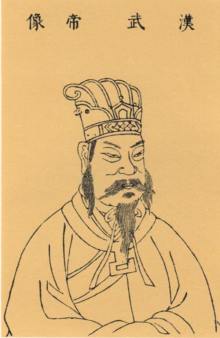
Because of expenses incurred in fighting the Xiongnu (匈奴) and opening up new territories, Emperor Wu (武帝 156 BC – 87 BC) of the Han dynasty (汉朝 202 BC – 220 AD) was in desperate need to raise revenues and in 119 BC decided to issue a new type of coinage.
Unlike the bronze ban liang coin which was the coin of the realm, this was a new form of money made of “white metal” (白金) which, according to the Records of the Grand Historian 《史记·平淮书》, was a mixture of silver and tin.
These new coins were known as the Bai Jin San Pin (白金三品) which literally translates as “white metal three kinds”.
The Bai Jin San Pin came in three denominations which differ in shape and surface pattern. In addition, they were not thin like common coins but were unusually thick and heavy and are sometimes described as “cake” or “biscuit” coins.
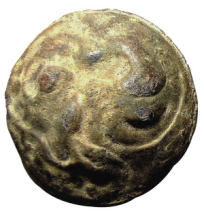
Dragon Coin of the Bai Jin San Pin
The first coin in the three coin set, shown at the left, was round and weighed 8 tael (liang 两). Incredibly, the government proclaimed that this silver coin would be worth the equivalent of 3,000 “cash” coins which at the time were the 4 zhu ban liang coin and, beginning in 118 BC, the wu zhu coin (五铢钱).
The round shape was meant to represent the sky or heavens and, consequently, the coin had the pattern design of a dragon described by one source as having a “long mouth, long neck, one horn, and flying through the clouds”.
As already mentioned, the historical texts of the Han dynasty stated that the Bai Jin San Pin coins were minted from a silver-tin alloy. To date, however, the only dragon coins unearthed have been made of lead. No authentic (i.e. silver) dragon coins are known to exist as of this writing.
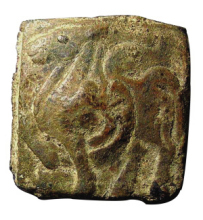
Horse Coin of the Bai Jin San Pin
The second coin in the set was square, weighed 6 tael, and was worth 500 cash coins. It had the image of a horse which represented the square earth.
The horse is described as having its “head upright, chest high, with three legs on the ground and one hoof raised, full of vigor and and imposing momentum.”
These two coins, the “round” dragon coin and the “square” horse coin, reflect the ancient Chinese theory of the “circle and square” where heaven is represented by a circle and the earth by a square.
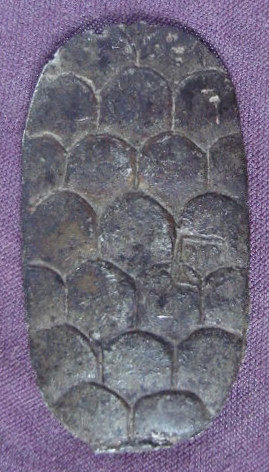
The third coin of the Bai Jin San Pin was oval-shaped, weighed 4 tael, and was worth 300 cash coins. It had the image of a turtle (wu gui 乌龟).
The turtle’s domed shell represents the sky above and its flat bottom represents the earth below. The turtle, therefore, represented the Chinese people who also live beneath the vaulted sky and stand on the flat earth. The turtle is also a symbol of longevity and immortality.
Turtle Coin (silver) of the Bai Jin San Pin, obverse side, unearthed in Xian in 2013
The coin was discovered by sand dredgers excavating in the dried up bed of the Weihe River (渭河) in the northern suburbs of the city.
The obverse is dome-shaped with the middle thick and the edges thin.
The coin is 1.6 inches (40 mm) long, 0.8 inch (21 mm) wide, and 0.12 inch (3.1 mm) thick. It weighs 10 grams. The obverse side has a scaly armor design imitating that of a turtle.
If you look closely, you will see a small square seal stamped on the surface at the middle right of the coin. This counterstamp is believed to be the Chinese character shao (少). The character shao refers to the shaofu (少府).
The shaofu (少府) was one of the Nine Ministers of the Han dynasty. Various English translations of shaofu include Privy Treasurer, Minister Steward, Chamberlain of the Palace Revenues, and Superintendent of the Lesser Treasury. The shaofu managed the palace treasury, i.e., the private finances of the imperial clan. The Records of the Grand Historian《史记·平准书》and the Book of Han《汉书·食货志》state that the shaofu was responsible for the minting of the silver Bai Jin San Pin coins.
Turtle Coin (silver), reverse side, with seal script characters 垂光
The reverse side, shown at the left, is flat. There are two seal script (篆书) characters, one above the other.
According to Mr. Huang, the meaning of chui guang is “glory illuminates, bounties bestowed to the world” (光辉普照,恩泽人间之意) which would refer to the achievements of Emperor Wu.
During the 1980’s, a number of these dragon, horse and turtle coins were unearthed at various archaeological digs. These coins were consistent with the description in the Records of the Grand Historianexcept that they were all made of lead.
As a result, these lead coins raised serious questions as to their authenticity since historical texts state that the “white metal”, from which the official coins were minted, was an alloy of silver and tin.
However, in 2007 and again in 2011, silver coins with the horse pattern were finally unearthed in Shaanxi (陕西).
And in 2013, the first silverturtle coin was unearthed. This is the turtle coin described above.
With these discoveries came the confirmation that the silver coins, and not the lead coins, were the authentic legal coins described in the ancient texts. Lead coins are either counterfeit or burial money.
Please again note that to date, there has not been any confirmed archaeological excavations of a silver round coin with the dragon motif. There exits a number of examples of lead round coins with a dragon motif, such as the one pictured above, but a coin which historical texts describe as being worth the equivalent of 3,000 bronze ban liang or wu zhucoins would not be made of the base metal lead when the lower denomination horse and turtle coins are now confirmed to have been made of silver.
Besides, the laws of the Han dynasty specified that it was illegal for the government to issue coins made of a base metal such as lead.
Nevertheless, during the Han dynasty many individuals found counterfeiting Bai Jin San Pin coins using lead instead of silver to be easy and very profitable.
However, only the emperor had the right to mint coins at the time and minting by individuals was strictly forbidden. Thousands of counterfeiters were executed for their acts.
The Bai Jin San Pin coins are generally recognized to be the first official silver coins produced in China. However, it is probably more accurate to say that the Bai Jin San Pin, although not pure silver and not in the traditional shape of a coin, were the first legal silver coins minted by the government for general circulation and recorded in official documents.
In the end, the Bai Jin San Pin coins were short-lived. They were considered to be “empty coins” (虛幣) and inflationary because they were not worth their stated value. Also, people could easily counterfeit them using the base metal lead instead of the precious metal silver. In 115 BC, only five years after their introduction, the government abolished the circulation of the Bai Jin San Pin coins.
“Horse coins” have been mentioned in Chinese literature for centuries but it is still unclear exactly how they were used. It is believed, however, that beginning in the Song dynasty (960-1279 AD) they were used as either game (打马格钱) or gambling (打马博戏) pieces.
Most pieces commemorate a famous horse from ancient Chinese history. Some of these I have already discussed in an article entitled “Horse Coins“.
I recently came across a particularly interesting piece which does not depict a specific historical horse but rather a breed of horses which first appeared in records dating back to Emperor Wu (汉武帝 157-87 BC) of the Han dynasty.
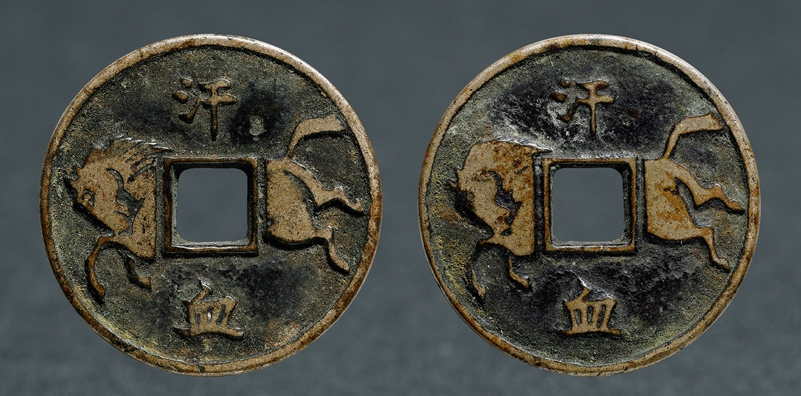
Sweating Blood Horse Coin cast during the Song Dynasty
The sweating blood horse coin shown above was cast during the Song dynasty and is unique in that it is the only known specimen of its kind to be the same on both the obverse and reverse sides. The coin was previously in the collection of Mr. Wei Yutian (卫玉田 1854-1937) and was sold at auction in 2017.
The coin displays the image of a horse with two Chinese characters (han xie 汗血) meaning “sweats blood”. “Sweating blood” refers to a horse breed (han xie bao ma 汗血宝马) found in central Asia . These horses, also known as Akhal-Teke or Ferghana, are famous for their speed and endurance. They also have one unusual characteristic in that their skin can bleed when ridden hard.
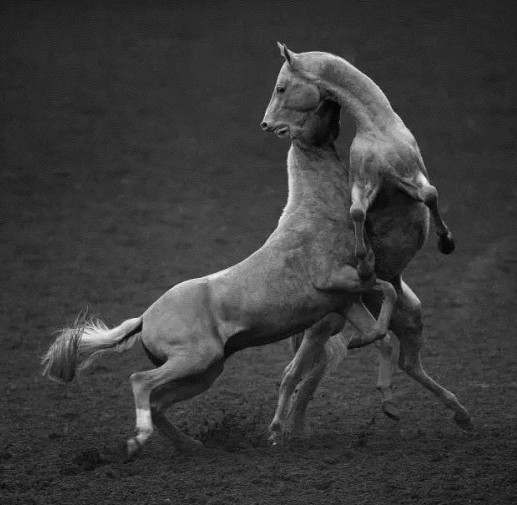
Sweating Blood Horses
Shown at the left is a photo from a Chinese website showing two of these blood-sweating horses in a fight. The caption reads:
战斗中的汗血宝马在互相撕咬,大声咆哮,充斥着浓烈的雄性荷尔蒙的味道。
This translates as:
“In the midst of battle, the sweating-blood horses bite each other, roaring loudly, and having the strong smell of male hormones.“
According to legend, these horses were a hybrid of a horse and a dragon. If they stepped on a stone, the stone would be crushed into powder.
Ancient literary works describe these horses as able to travel 1,000 li (里) during the day and 800 li at night while ordinary horses were only able to travel 150-200 li a day. (During the Han dynasty, a li was equal to about 0.25 mile (416 meters) so a distance of 1,000 li was equivalent to about 250 miles.)
As mentioned above, Emperor Wu of the Han dynasty had heard stories of these horses, which he referred to as tian ma (天马) or “heavenly horses”, and wanted them for his cavalry to be used in battles with the Xiongnu (匈奴), a nomadic people who occupied what is now Mongolia from the 3rd century BC to the late 1st century AD .
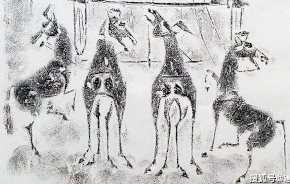
Rubbing from Han Dynasty Tomb Brick Showing Sweating Blood Horses
Emperor Wu tried to obtain the horses through diplomatic means from the Dayuan (大宛) who lived in the Fergana valley (present day Uzbekistan) in Central Asia. Unable to obtain the number of heavenly horses desired, he sent an army (War of the Heavenly Horses 天马之战; Han-Dayuan War 汉宛战争), defeating the Dayuan in 100 BC and obtaining 3,000 of the prized horses.
Emperor Wu’s mausoleum contains 80 skeletons of what may be these blood-sweating “heavenly horses”.
The ancients did not have a good explanation as to why the skin of these horses bleed. Today, scientists can offer two explanations.
These horses also have strong sweat glands in their shoulders and neck. Heavy sweating can make their coat look darker and give the illusion of bleeding.
The second explanation is that the horses were likely infested with skin parasites. Parafilaria multipapillosa is a parasitic nematode widely distributed across the Russian steppes. This parasite burrows into the subcutaneous tissues of horses resulting in skin nodules which often bleed copiously. Veterinarians call this “summer bleeding”.
While there are many varieties of horse coins, they can be categorized into three basic types. The first type has the picture of the horse on one side of the coin and the inscription identifying the horse on the other side. The second type has both the picture and the inscription on one side and the reverse side is blank. The third, and rarest, type has the identical picture with inscription on both sides (合背钱).
As already mentioned, this horse coin is of the rare third type and is also the only specimen know to exist.
This horse coin is 31mm (1.2 inches) in diameter and was sold at the Xiling Yinshe Auction Co., Ltd. (西泠印社拍卖有限公司) 2017 Spring Auction for $1,580 (10,350 RMB).
Thirty years after the founding of the Song dynasty (宋朝 960-1279), the government was still struggling to consolidate rule. Economic hardship in the country was so great that peasants formed rebel armies to resist Song authority and kill corrupt officials.
By 993 AD, this insurrection had grown to include several hundred thousand peasants. Under the leadership of Wang Xiaobo (王小波), and adopting the slogan “equalize the income of the rich and poor” (均贫富), the rebel army was able to defeat regular Song armies in Sichuan. The rebels raided government granaries and redistributed grain.
When Wang Xiaobo died in battle, his brother-in-law Li Shun (李顺) assumed leadership of the uprising. Military strength grew under his command and in 994 AD he attacked and successfully occupied Chengdu (成都) which was Sichuan’s largest city.
Li Shun then proclaimed himself King of Da Shu (大蜀王) and adopted the period title “Ying Yun” (应运).
In 994, Li Shun began to cast bronze (铜钱) and iron (铁钱) coins with the inscriptions ying yun yuan bao (应运元宝) and ying yun tong bao (应运通宝).
The coins are traditional cash coins with inscriptions written in clerical script (隶书) and read in a clockwise (旋读) manner. They are similar in style to the coins of the Five Dynasties and Ten Kingdoms (五代十国) and, in particular, the coins of the Former Shu (前蜀 907-925) and the Later Shu (后蜀 926-965). These were kingdoms situated in Sichuan with the capital at Chengdu. The Later Shu was conquered by the Song in 965.
Bronze “Ying Yun yuan bao” (应运元宝) coin in the collection of the Shanghai Museum
At the left is an example of a bronze ying yun yuan bao (应运元宝) coin in the collection of the Shanghai Museum (上海博物馆). The coin weighs 2.9 grams.
According to one reference (中華珍泉追踪錄 p.184), this coin was donated to the Shanghai Museum by Mr. Sun Ding (孙鼎) who was a famous Chinese coin collector of the 20th century.
This coin has a diameter of 23 mm and a weight of 3.9 grams.
In addition to the bronze ying yun yuan bao coin, the National Museum of China also also has an ironying yun tong bao (应运通宝) coin which can be seen here.
This iron coin has a diameter of 23 mm and a weight of 3.7 grams.
After a very short time, Li Shun changed his reign title to Ying Gan (应感). According to the Baidu Encyclopedia, after Li Shun died in battle, his subordinates began to cast bronze and iron coins with the inscription ying gan tong bao (应感通宝).
“Ying Gan tong bao” (應感通寶) bronze coin cast during the peasant uprising led by Li Shun (李顺)
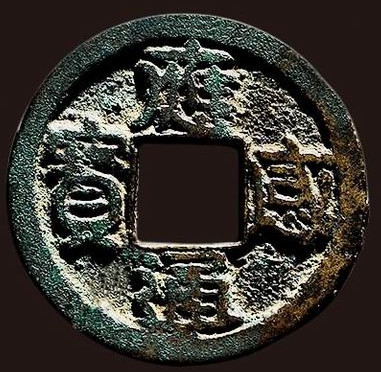
Shown at the left is an outstanding example of a bronze ying gan tong bao coin.
The diameter is 23.7 mm.
In 2015, this coin sold at auction for about $54,000 (RMB 368,000).
Another bronze ying gan tong bao coin is in the collection of the National Museum of China and can be seen here.
This specimen has a diameter of 23 mm and a weight of 3.2 grams.
An example of an ironying gan tong bao coin can be seen here at the Sichuan Museum (四川博物馆).
This iron coin has a diameter of 23 mm.
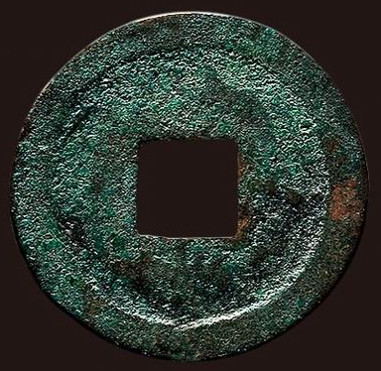
Reverse side of the “Ying Gan tong bao” (應感通寶) coin
The reverse sides of all the coins are blank with the exception of the ying yun yuan bao (应运元宝) bronze coin at the National Museum of China.
According to the museum’s website, there is a “star” (星) and a “moon” (月) on the reverse side.
Unfortunately, the image on the website is too dark to discern the star and moon.
However, a January 29, 2016 article in the “China Shoucang Journal” (收藏) displays the image of a bronze ying yun tong bao (应运通宝) coin that was recently excavated in Hubei (湖北). As can be clearly seen, this coin has both a “star” and a “moon” (月孕星版) on the reverse side.
With a diameter of 26 mm, the coin is slightly larger than the other coins mentioned above. The article explains that this coin may be a “pattern” or “trial” piece (试样) or possibly a “mother” coin (铁母) used to make impressions in the moulds to cast iron coins.
Li Shun ruled his Da Shu kingdom for only about five months before he was killed by the superior forces of the Song. Even without their leader, the Da Shu Rebellion continued for about another year before it was fully suppressed by the Song army in 995 AD.
The ying yun yuan bao (应运元宝), ying yun tong bao (应运通宝) and ying gan tong bao (应感通宝) coins produced during the time of the Sichuan rebellion are recognized as the first coins in Chinese history to have been issued by a peasant uprising.
Because the Da Shu kingdom existed just a few months, only a very small number of coins were minted.
Even fewer of these coins have survived to the present time. The bronze coins are among “China’s 50 Rarest Ancient Coins” (历代古钱五十珍) which makes them, as the Chinese like to say, as rare and precious as “phoenix feathers and unicorn horns” (凤毛麟角).
When emperors ruled China, the dream of Chinese parents was to have a son successfully pass the imperial examinations and be appointed to an important government position bringing honor and prosperity to the family.
The charm displayed below is representative of the Chinese charms expressing such a wish.
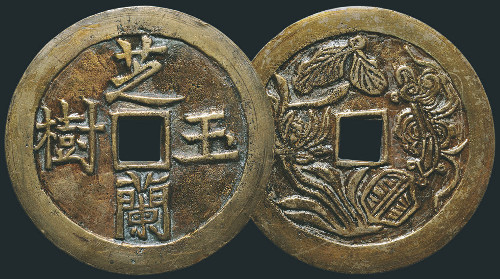
“Zhi Lan Yu Shu” (芝蘭玉樹) charm cast during the Qing Dynasty
This bronze charm has finely sculptured characters and a broad rim. Both the obverse and reverse sides are displayed together in the single image.
The Chinese inscription reads zhi lan yu shu (芝蘭玉樹). Zhi lan (芝蘭) translates as “irises and orchids” but has the implied meaning of “noble character”.
Yu shu (玉樹) translates as a “tree made of jade” but the expression is used to describe a handsome or talented young man. “Jade tree” also has the meaning of a “scholar tree” and is a laudatory title for sons.
The charm’s inscription therefore translates as a talented young man of noble character or a child with outstanding future prospects. Such an individual would be expected to do well in the imperial examinations.
The reverse side of the charm has what appears to be a random collection of objects.
Below the square hole at about the five o’clock position is a round box (he 盒) also known as a “treasure box” (bao he 宝盒).
A round box is the symbol for Han Shan (寒山), a Tang dynasty “laughing immortal” poet, who along with Shi De (拾得) are popularly known as the Immortals of Peace and Harmony (和合二仙). (A Chinese charm showing Han Shan holding his signature round “treasure box” may be seen here. Shi De is standing next to him holding a lotus which is his signature symbol.)
To understand the hidden meaning of this specific assembly of objects, one must understand that the Chinese love a visual pun also known as a rebus.
The “lotus” (he 荷) has the same pronunciation as “harmony” (he 和). The Chinese word for “box” (he 盒) has the same pronunciation as “union” (he 合). The “ruyi sceptre” (如意) has the same pronunciation as “as you wish” (ru yi 如意).
The visual pun is thus he he ru yi (荷盒如意) which has the meaning of “may you have a harmonious union with all your wishes fulfilled”.
This wish is commonly used in reference to marriages. In fact, the Immortals of Peace and Harmony mentioned above are believed to bestow blessings on marriages.