
Liu Hai and the Three-Legged Toad
 Liu Hai was a Minister of State during
the 10th century in China. He was also a Taoist practitioner.
One version of the story says that he became good
friends with
a three-legged toad who had the fabulous ability to whisk its
owner to any destination.¹ This particular toad had a
love not only for water but also for gold. If the toad
happened to escape down a well, Liu Hai could make him come
out by means of a line baited with gold coins.
Liu Hai was a Minister of State during
the 10th century in China. He was also a Taoist practitioner.
One version of the story says that he became good
friends with
a three-legged toad who had the fabulous ability to whisk its
owner to any destination.¹ This particular toad had a
love not only for water but also for gold. If the toad
happened to escape down a well, Liu Hai could make him come
out by means of a line baited with gold coins.The second version of the story is that the toad actually lived in a deep pool and exuded a poisonous vapor which harmed the people. Liu Hai is said to have hooked this ugly and venous creature with gold coins and then destroyed it.
The story of Liu Hai is frequently told as "Liu Hai playing with the Golden Toad". There is a hidden meaning here. The Chinese word for "toad" is chanchu (蟾蜍). Sometimes, Chinese will only say the first character chan (蟾). In some Chinese dialects, the character chan has a pronunciation very similar to qian (钱) which means "coin". Therefore, a storyteller reciting "Liu Hai playing with the Golden Toad" could be heard by listeners as "Liu Hai playing with the gold coins".
(For other examples of hidden meanings concerning ancient Chinese charms please see the hidden meaning of Chinese charm symbols.)
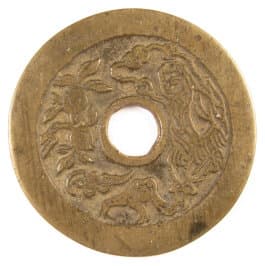 In this specimen, the obverse of the charm
depicts Liu Hai on the right waving a string of coins above
his head. The Three-Legged Toad is shown at the
bottom. Other lucky symbols include a pair of peaches to the left of
the hole and a bat to
the left of the Three-Legged Toad.
In this specimen, the obverse of the charm
depicts Liu Hai on the right waving a string of coins above
his head. The Three-Legged Toad is shown at the
bottom. Other lucky symbols include a pair of peaches to the left of
the hole and a bat to
the left of the Three-Legged Toad.In Chinese mythology, the Three-Legged Toad is said to only exist in the moon which it swallows during the lunar eclipse. Since this Three-Legged Toad is located so remote, it symbolizes the "unattainable".
In the first version of the story, the depiction of Liu Hai and the Three-Legged Toad on charms is regarded as most auspicious and conducive to good fortune. The second version of the story, however, hints at the moral that money is the fatal attraction which can lure a person to his ruin.
In either case, Liu Hai and the Three-Legged Toad has become a popular and powerful symbol of prosperity depicted on Chinese charms.
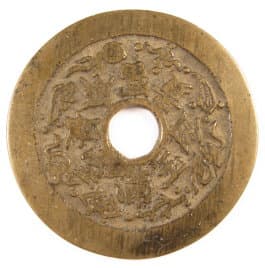 The inscription surrounding the circular hole
reads jin yu man tang,
chang ming fu gui (金玉满堂长命富贵) which translates as "may
gold and jade fill your halls" and "longevity, wealth and
honor".
The inscription surrounding the circular hole
reads jin yu man tang,
chang ming fu gui (金玉满堂长命富贵) which translates as "may
gold and jade fill your halls" and "longevity, wealth and
honor".The reverse side of this charm, shown here, displays Eight Treasures. Starting at the one o'clock position and moving clockwise are the swastika (meaning 10,000), rhinoceros horn, writing brush with silver ingot, coral, lozenge, yinyang mirror, ruyi sceptre, and pearl.
The diameter of this charm is 44 mm and the weight is 19.8 grams.
For further details on the symbolism of the Eight Treasures, please see my discussion on eight treasures charms.
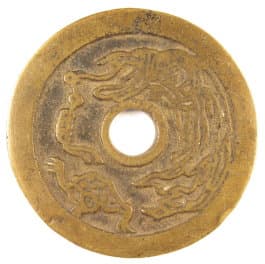
This is another charm depicting Liu Hai and the Three-Legged Toad.
Liu Hai is again shown on the right waving a string of coins at the Three-Legged Toad which is located on the bottom of the charm.
There are no other symbols on the obverse side of this example.
The diameter of this charm is about 45 mm and the weight is 21.3 grams.
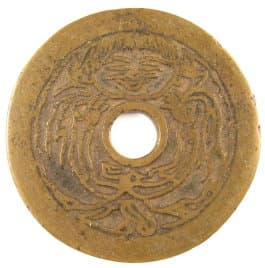
The reverse side of this charm appears to show a portrait of Liu Hai.
However, it is possible that this is actually a portrait of the "Laughing Buddha" known as budai (布袋) in Chinese and Hotei in Japanese. Budai was a Zen Buddhist monk who lived in China during the Liang Dynasty (502-557 AD) and is always shown smiling and laughing with a large pot belly symbolizing happiness, good luck and abundance.
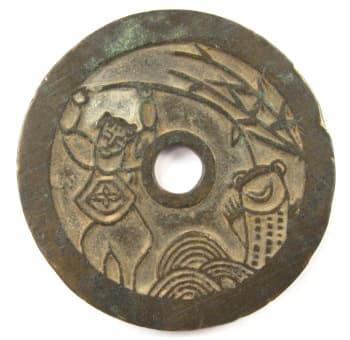
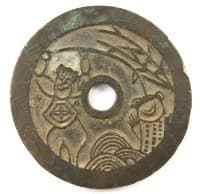
This is the reverse side of an old and large Chinese charm.
The scene shows a young Liu Hai playing with the Three-Legged Toad.
The concentric half-circles at the very bottom represent waves in the water. You will also note the bamboo branches at the right.
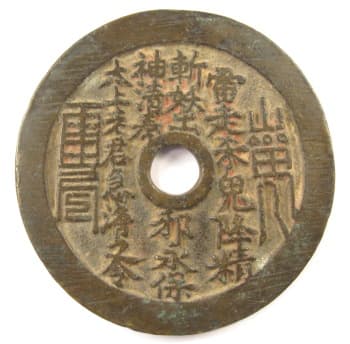
The obverse side of the charm displays Daoist magic writing (the characters at the extreme right and left) and a Chinese character inscription seeking assistance from the God of Thunder.
For more information, please see Daoist (Taoist) Charms.
This charm is 61 mm in diameter and 3.8 mm in thickness.
Note: ¹The bufotoxins found in some toads are capable of producing hallucinations but please do not allow this fact to interfere with your enjoyment of the story.
Return to Ancient Chinese Charms and Coins