
Chinese Coins
Introduction and History
China was among the first
countries in the world to use money as documented by
historical records and actual artifacts dating back 4,000
years. By the time of the Shang Dynasty (16th ~ 11th
century BC), sea shells (cowrie) were already circulating as a
major form of currency.
 China achieved the ability to cast very refined works of
bronze early on as evidenced by its extraordinary
Shang and Zhou Dynasty ritual bronzes. Based
on this technology, the first metallic coins, which even
included "bronze" sea shells, appeared in various forms in
different regions of the country during the Western Zhou
Dynasty (11th century ~ 771 BC), the Spring and Autumn Period
(770-476 BC) and the Warring States Period (475-221 BC).
China achieved the ability to cast very refined works of
bronze early on as evidenced by its extraordinary
Shang and Zhou Dynasty ritual bronzes. Based
on this technology, the first metallic coins, which even
included "bronze" sea shells, appeared in various forms in
different regions of the country during the Western Zhou
Dynasty (11th century ~ 771 BC), the Spring and Autumn Period
(770-476 BC) and the Warring States Period (475-221 BC).
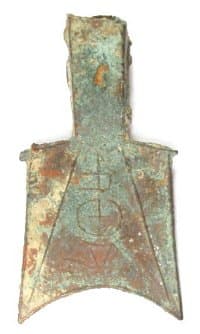
Some of these first forms of money were cast in shapes which resembled tools of the time such as spades or shovels (bubi 布币). An early example of spade-shaped money from the Kingdom of Zhou is shown at the left.
Another type of money was based on an ancient bronze implement known as a xue (削). This implement was in the shape of a knife and this knife-shaped money (dao bi 刀币) circulated in the states of Qi, Yan and Zhao.
Still another type of money that appeared during the Warring States Period was ring-shaped (huan qian 环 钱). Because this form of money was circular with a round hole in the center, such coins are also known as "round" money (yuan qian 圆钱). These coins are believed to have been patterned after jade rings or, perhaps, a spinning wheel.
One additional type of bronze money from this time period consisted of small oval pieces cast in the State of Chu. This form of money is known as "ant nose" (yi bi qian 蚁鼻钱), and "devil" or "ghost" faced money (gui lian qian 鬼脸钱) because the characters inscribed on them resemble a human face.
 When Qin Shi Huang unified the
country in 221 BC and established the Qin Dynasty, he
abolished the above-mentioned forms of money that had been
circulating in the other Warring States and stipulated that
the legal coinage would be a round coin with a square hole in
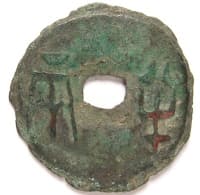
the center weighing a half tael or ban liang. This type of coin, known as a ban liang (半两),
continued to be cast through the end of the Qin Dynasty and
into the Western Han Dynasty.
When Qin Shi Huang unified the
country in 221 BC and established the Qin Dynasty, he
abolished the above-mentioned forms of money that had been
circulating in the other Warring States and stipulated that
the legal coinage would be a round coin with a square hole in
the center weighing a half tael or ban liang. This type of coin, known as a ban liang (半两),
continued to be cast through the end of the Qin Dynasty and
into the Western Han Dynasty.
A ban liang from the Qin Dynasty is displayed at the left.
In 118 BC, Emperor Wu of the Western Han Dynasty (206 BC - 24 AD) replaced the ban liang with a different type of round coin with a square hole in the center. This coin was also named according to its weight and is known as the wu zhu or wu shu (五 铢). This basic coin shape was adopted by subsequent dynasties and continued to be cast in various forms for more than 700 years.
In 621 AD, Emperor Gao Zu of the Tang Dynasty (618-907) cast a new coin known as the kai yuan tong bao (开元通宝). From this time on, Chinese cash coins were no longer named according to their weight. Instead, they were named tong bao (通宝), zhong bao (重 宝) or yuan bao (元 宝). This practice continued through the subsequent dynasties down to the end of the last dynasty, the Qing Dynasty (1644-1911).
Chinese "charms", as a form independent of coins, did not really appear until the Han Dynasty. But, even some of the earliest forms of metal money such as spades and knives had charm-like qualities in that they had "auspicious" or "good luck" characters and inscriptions.
This website primarily explores facets of Chinese culture through an examination of Chinese charms. While Chinese charms evolved into a number of different shapes and forms over a period of 2,000 years, the most common shape continued to resemble the familiar shape of ancient Chinese coins which were round with a square hole in the center.
Because of the close relationship between Chinese coins and charms, a variety of old Chinese coins from the various dynasties are discussed in different topics and on different pages of this website to provide a clearer picture of the background and historical context from which Chinese charms emerged.
Many visitors to this website, however, have a specific interest in these ancient Chinese coins themselves. In order to facilitate their research, I am providing links on this page to the Chinese coins scattered throughout the website.
Additionally, I have included on this page the images and a short introduction to other old Chinese coins in my collection which have not been discussed on other pages but which visitors may also find of interest.
 Cowrie
shells
were
the
earliest
form
of
money
to
appear
during
the
Shang
Dynasty
(16th
Century
BC
-
11th
Century
BC)
in
China.
Cowrie
shells
had
certain
qualities
which
made
them
desirable
as
objects
of
value. They were white and glossy, were fairly
uniform in size and weight, and, if ground flat on one
side to form an opening, large numbers of cowrie shells
could be easily strung together to make carrying
convenient.
Cowrie
shells
were
the
earliest
form
of
money
to
appear
during
the
Shang
Dynasty
(16th
Century
BC
-
11th
Century
BC)
in
China.
Cowrie
shells
had
certain
qualities
which
made
them
desirable
as
objects
of
value. They were white and glossy, were fairly
uniform in size and weight, and, if ground flat on one
side to form an opening, large numbers of cowrie shells
could be easily strung together to make carrying
convenient.
Because conditions for transportation and trade were very primitive at the time, cowrie shells became more and more valuable the further inland they were carried.
During Shang times, it was considered an honor for officials to be bestowed cowrie shells by their superiors. In fact the Chinese word for "bestow" (ci 赐) even has the Chinese character for shell (bei 贝) as the left component of the character. Other Chinese words relating to "money" still retain the "shell" character (bei 贝) component, such as "wealth" (cai 财), "trade" (mao 贸), "money" or "goods" (huo 货), etc.
By the time of the Eastern Zhou Dynasty (770 BC - 256 BC), however, cowrie shells were being replaced by imitation shells made of bone or metal. Even so, there are records indicating that real cowrie shells continued to be used as money even as late as the Yuan (1271-1368 AD) and Ming Dynasties (1368-1644 AD) in parts of Yunnan Province.
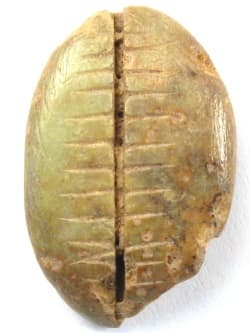
The earliest man-made forms of money were actually "imitation" cowrie shells made of bone such as the example here.
This example of bone shell money has a length of 23 mm, a width of 15 mm and a weight of 2.3 grams.
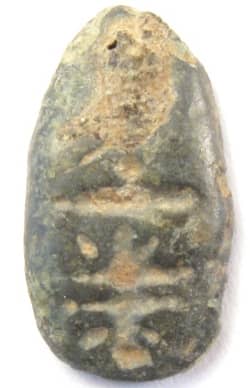
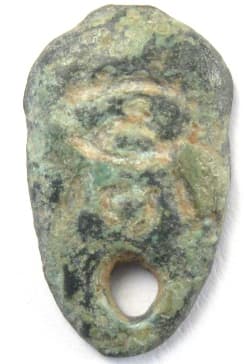
During the Warring States period of the Zhou Dynasty (475 BC - 221 BC), the State of Chu used a form of bronze money called Ant Nose Money (yi bi qian 蚁鼻钱) or Ghost Face Money (gui lian qian 鬼脸钱).
The Ant Nose Money specimen at the left has an inscription, read from top to bottom, which is currently believed to be "each six zhu" (ge liu zhu 各六朱). The zhu was an ancient measure of weight and each of these early forms of money would have been the equivalent of six zhu.
This particular example has a length of 17.8 mm, a width of 10 mm and a weight of 1.8 grams.
This is another example of Ant Nose Money.
It has a single character which is believed to be jun (君).
The Chinese character jun (君) means a "chief","sovereign" or "ruler" but it is unclear what this character may have signified during the period in history when this form of money circulated.
This specimen has a length of 18 mm, a width of 10.5 mm and a weight of 1.7 grams.
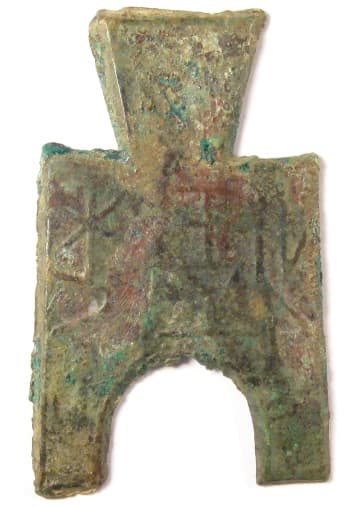
This type of spade money is characterized by an arched or rounded crotch between the two legs.
This spade money was cast approximately 400-300 BC during the Warring States period of the Zhou Dynasty.
The spade coin at the left has an inscription which is believed to be liang yi jin (梁一 釿).
Liang was one of the ancient states of China.
The "yi jin" means "one" jin with a jin being a unit of weight.
This spade money has a length of 56 mm and a width of 35 mm. The weight is 15.2 grams.
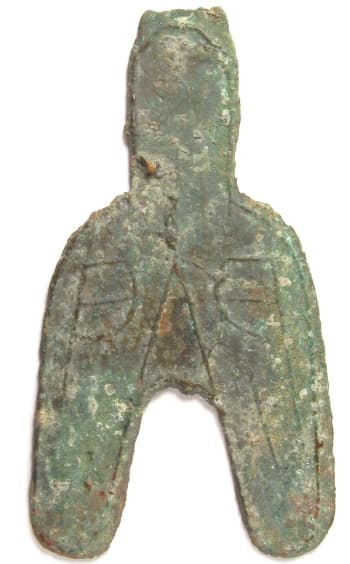
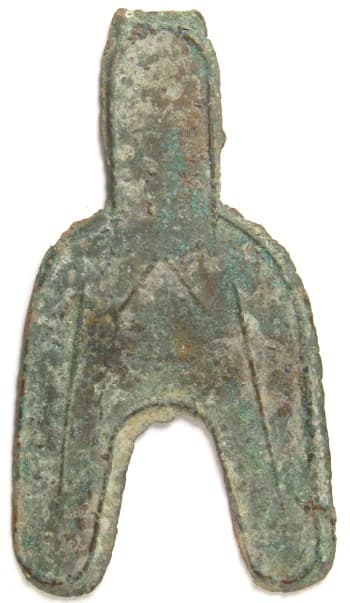 This
is an example of a flat handled spade money from the Zhou
Dynasty.
This
is an example of a flat handled spade money from the Zhou
Dynasty.
The characteristic of this type of spade money is that it has a round handle, round shoulders and round feet.
This type of spade money may have been cast during the late Warring States period in the States of Qin and Zhao.
It is also possible that these coins were cast in the 4th century BC in the State of Zhong Shan.
The obverse side at the far left has the archaic Chinese character lin (蔺).
The reverse side of the spade coin is shown at the near left and appears to be inscribed with a number(s). The inverted "v" in the center may represent the number "six". The horizontal line below the "six" may represent the number "one".
It is unclear what the number "61" may signify.
This spade money has a length of 67.5 mm and a maximum width of 37 mm. The weight is 9.3 grams.
A very distinctive and rare type of spade money is the "three hole spade" (san kong bu 三孔布). Please see "Three Hole Spades" and "Rare 'Three Hole Spade' Sold at Auction" for a detailed discussion of "the king of ancient coins".
Displayed below is an example of knife money from the Spring and Autumn Period (770-476 BC) of the Zhou Dynasty.
This form of money circulated during the years 600-400 BC in the State of Yan in northeast China.
This specific form of ancient Chinese money is known as a "pointed tip" knife (jian shou dao 尖首刀) because the end of the blade extends to a point.
If you examine the knife closely you will see a single character inscription near the bottom edge of the blade. This character is believed to be the Chinese character bu (卜) which means "to divine" or "to foretell". However, the characters on these ancient forms of money are not well understood and it is not clear as to their exact meaning or reference.
This specimen of Pointed Tip knife money has a length of 16 cm and a weight of 15.9 grams.
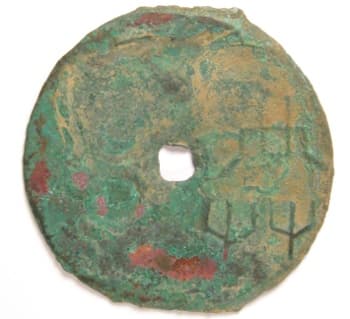 This is one of the first round coins
cast in ancient China.
This is one of the first round coins
cast in ancient China.
Ring-shaped coins, known as huan qian (环钱), first appeared during the Warring States period (475-221 BC).
The simple round shape, which would eventually evolve into the universally recognized Chinese "cash coin", made the coins more convenient to carry than the knife and spade money that had been circulating.
The origin for the round shape with a round hole is believed to have been from either the spinning wheel or the ancient Chinese jade ring known as a bi (璧). The exact purpose of the bi is unknown but it may have originally been a symbol for the sky. It also seemed to have symbolized morality and official rank.
The inscription is one character only and is believed to be gong (共). Gong was a city in the ancient State of Liang.
The coin has a diameter of 44.5 mm and a weight of 9.8 grams.
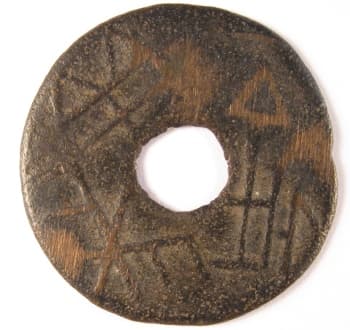
This is another Zhou Dynasty round coin.
The inscription is currently believed to be qi yuan yi jin (漆垣一钅斤) which translates as "Qiyuan one jin".
Older texts had interpreted the inscription as chang yuan yi jin (长垣 一钅 斤).
This coin was cast in the State of Liang during the period 350-220 BC.
The diameter of the coin is 37 mm and the weight is 9.4 grams.
To see other examples of Zhou Dynasty spade money and round coins please click on the desired link below:
Emperor Qin Shi Huang conquered the other "warring states" in 221 BC and in so doing unified China for the first time in its history. He proceeded to standardize the various scripts, weights and measures that were in use.
In order to standardize the monetary system, he abolished the other forms of money. This meant that the cowrie, spade money, knife money, and round coins of the other states could no longer circulate. Instead, there would be a two tier system with a "higher" form of currency (shang bi 上币) made of gold and a "lower" form of currency (xia bi 下币) made of bronze.
The
"lower" form of currency, shown at the left, was
established as a round bronze coin having a square hole in
the middle and with a value of a half "tael" or half liang (两).
A "liang" consisted of 24 zhu (铢) so the
coin pictured here was worth half (ban 半)
a "liang", or 12 zhu (铢),
and is known as a ban liang (banliang 半 两) coin.
The Qin Dynasty ban liang was a coin that was named after its weight. It was rimless in that it did not have a rim on either the outside edge of the coin or around the central square hole. It also had a flat reverse side with no inscription.
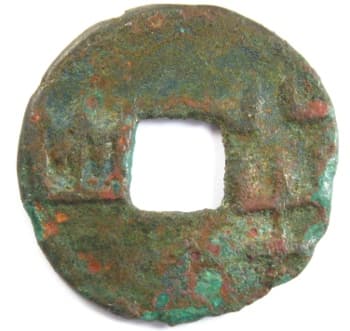 This is a fairly rare
Qin Dynasty ban liang
variety which was cast during the period 300-200 BC.
This is a fairly rare
Qin Dynasty ban liang
variety which was cast during the period 300-200 BC.
As you can see, the ban (半) character to the right of the square hole is similar to that of other Qin banliangs, such as the specimen illustrated above.
However, the liang (两) character to the left of the hole is upside-down (inverted).
If you rotate or "circumgyrate" the coin clockwise 180 degrees, the liang (两) character will be right-side up on the right side of the coin and the ban (半) character will then be upside-down on the left.
The Chinese refer to this as xuan du (旋读).
It is unknown why a very small number of ban liang coins were cast in this way.
This coin has a diameter of about 31.7 mm and a weight of 6 grams.
This form of currency proved to be very practical. Coins could be easily strung together and conveniently carried. The ban liang, with its round shape and square hole, established the shape of Chinese coins for the centuries to come. This tradition of Chinese coins being round with square holes, known as "Chinese cash", continued for about 2,100 years until China's imperial history finally ended at the beginning of the 20th Century.
A very rare ban liang coin made of silver is discussed at State of Qin Silver Banliang Coin.
The Han Dynasty continued the use of the ban liang (半 两) bronze coin, established during the Qin Dynasty, up until the year 118 BC when it was replaced by the wu zhu (五 铢) coin.
However, the Han did change the unit of weight for the gold or "higher" form of currency (shang bi 上币). The gold currency continued to be named according to its weight but, instead of being denominated in tael or liang (两) as it was under the Qin, was now denominated in jin (斤). A jin during Han times equaled about 250-300 grams.
This meant that one jin of the Han gold currency was equal to about 10,000 of the bronze ban liang coins.
Because the Qin ban liang was considered too heavy and inconvenient to use, the Han government beginning around the year 200 BC permitted the people to cast ban liang coins. Unfortunately, these coins tended to be very small and light and, because of their resemblance, became known as "elm seed" (yu jia 榆荚) ban liang coins.
It is important to note that these elm seed coins were still denominated by their presumed weight of "ban liang". While a ban liang from the Qin Dynasty averaged about 8 grams, the average weight of an elm seed ban liang was only slightly more than 1 gram. The heaviest weighed less than 2 grams. The lightest weighed only about 0.25 gram!
In response to the extreme disruption to the economy these very small coins were creating, Empress Lu in 186 BC stipulated that the official ban liang be cast at a weight of 8 zhu (铢). These new coins were thin but still had a diameter of about 26-30 mm and a weight of approximately 4.8-5.3 grams. An additional characteristic was that the ban liang inscription was now written in the "official script" (li shu 隶书) of the Han Dynasty.
In the sixth year (182 BC) of her reign, Empress Lu ordered the government to cast ban liang with a weight of 2.4 zhu (铢). These coins were thus smaller, only about 20 mm in diameter, and also had a large square hole. They typically weigh only about 1.5 grams. Since they were in reality only one-fifth of a ban liang, they are commonly referred to as "5 parts" (wu fen 五分) ban liang coins.
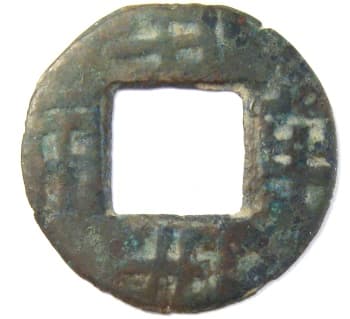
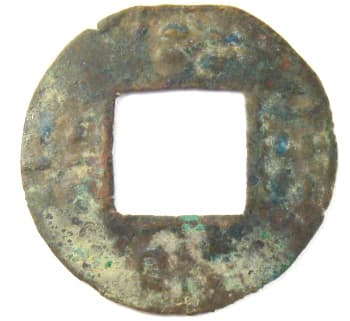
This coin is considered to be one of the rarer varieties of Han Dynasty 2.4 zhu (铢) ban liang, also known as a "5 parts" (wu fen 五分) ban liang, cast during the reign of Empress Lu Hou.
The inscription ban liang (半 两) is in its normal position to the right and left of the square hole.
What makes this coin special, however, is that this inscription is repeated with a liang (两) character above the square hole and a ban (半) character below.
If you rotate the coin 90 degrees counter-clockwise, you can still read the inscription from right to left as ban liang (半 两).
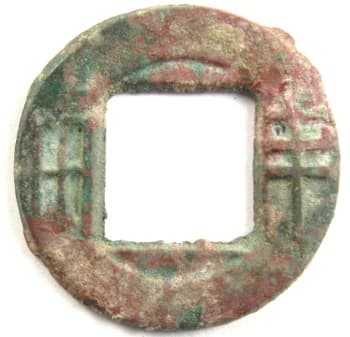
 The
reverse side of this coin is also interesting because it
displays a phenomenon occasionally seen on ban liang coins.
The
reverse side of this coin is also interesting because it
displays a phenomenon occasionally seen on ban liang coins.
What appears to be an incused four character inscription actually is not.
During the casting of the coin, the bronze contracted as it was cooling in the mold. Areas that were high spots on the obverse side, such as the raised parts of the Chinese characters, caused the corresponding areas on the reverse side to be depressed.
For example, if you look at the area above the square hole on the reverse side, you will see what appears to be four "dots". These correspond to the "spaces" between the strokes of the liang (两) character located at the top of the coin on the obverse side.
So, these are not actually "raised" dots. It just appears that way. The area surrounding these "dots" is actually depressed to correspond with the raised area of the liang (两) character on the obverse side.
This phenomenon is easily seen on this particular coin because it is a typical "5 parts" (wu fen 五分) ban liang coin which means the metal is thin.
The coin has a diameter of 23.4 mm and a weight of 1.1 grams.
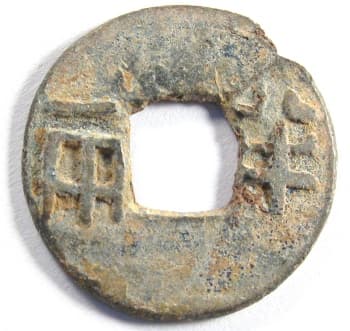
Shown at the left is another less frequently seen variety of the Han Dynasty 2.4 zhu (铢) ban liang cast during the reign of Empress Lu Hou.
This coin has a large square hole typical of "5 parts" ban liangs.
However, the coin has a very broad outside rim, which includes the Chinese inscription (ban liang 半 两), and which protrudes well above the surface of the hole.
To the Chinese, these characteristics make the coin look like the eye of a snake and this variety of ban liang is, therefore, famously known as the "snake eye" ban liang (she mu ban liang 蛇目半 两).
The coin has a diameter of 23.4 mm and a weight of 2.7 grams.
Emperor Wen changed the size of the ban liang again in the fifth year (175 BC) of his reign by ordering that the coin be cast at a value of 4 zhu (铢). The 4 zhu ban liangs typically have a diameter of about 23-25 mm and a weight of 3 grams or less.
Emperor Wu, at the beginning of his reign, made the final change to the ban liang by adding a rim.
 A very few 4 zhu ban liangs are
distinguished by displaying special symbols such as
"stars" (dots), "moons" (crescents), lines and
numbers. A number of these ban liang coins with special symbols may
be seen at Emergence
of Chinese Charms.
A very few 4 zhu ban liangs are
distinguished by displaying special symbols such as
"stars" (dots), "moons" (crescents), lines and
numbers. A number of these ban liang coins with special symbols may
be seen at Emergence
of Chinese Charms.
The 4 zhu ban liang shown here is another fairly rare type because it is made of lead.
It has a diameter of 23.5 mm and a weight of 3.5 grams.
The 4 zhu ban liangs were cast for a little more than 50 years until Emperor Wu, in the winter of the fourth year (119 BC) of the Yuan Shou reign, ordered that it be replaced with a new coin called the Three Zhu (san zhu 三 铢) which weighed about 2 grams.
The san zhu coin was only cast for a few months, however, and so very few exist.
Emperor Wu desperately needed to raise funds to fight the xiongnu (匈 奴) and to open up the new territories. In 119 BC, he issued a new type of coinage called bai jin san pin (白 金三品) which literally translates as "white metal three kinds".
 These coins
were made of a silver-tin alloy. Bai jin san
pin coins made of lead are either counterfeit or
burial items.
These coins
were made of a silver-tin alloy. Bai jin san
pin coins made of lead are either counterfeit or
burial items.
The three types included a round coin with a dragon motif, a square coin with a horse motif, and an oval coin with a turtle motif.
An authentic silver turtle-shaped coin, unearthed by archaeologists, is shown at the left.
The coins were not worth their stated values of being equivalent to 3,000, 500 and 300 copper coins, respectively. As a result, the coins were discontinued in 115 BC. For detailed information on these interesting coins, please see Turtle-Shaped Coin of the Han Dynasty.
In the spring of the fifth year (118 BC) of the Yuan Shou reign, Emperor Wu ordered that casting of the san zhu cease and that it be replaced with a new Five Zhu coin (wu zhu or wu shu 五 铢).
Large quantities of wu zhu coins were cast during the Han Dynasty and wu zhu coins continued to be cast throughout the dynasties that followed until they were finally replaced by the kai yuan tong bao coin in 621 AD at the beginning of the Tang Dynasty. The wu zhu was, therefore, used for over 700 years which makes it the longest used coin in Chinese history.
A more detailed history of the wu zhu, accompanied by images of a number of specimens displaying special symbols, may be seen at Emergence of Chinese Coins.
Many varieties of Han Dynasty ban liang and wu zhu (wu shu) coins can be viewed at the links below:
Eastern Han Dynasty (25-220) and
Later Wu Zhu Coins
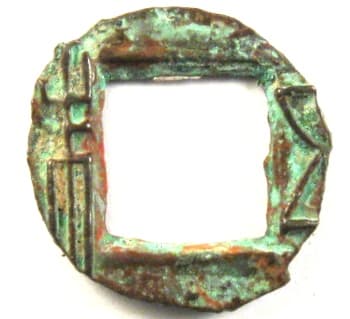 Dong
Zhuo (董卓) was a cruel and tyrannical warlord that lived
(138-192 AD) near the end of the Eastern Han and whose
infamy was forever immortalized in the famous 14th
Century historical novel Romance of the Three Kingdoms (san guo yan yi 三国演义)
written by Luo Guanzhong (罗贯中).
Dong
Zhuo (董卓) was a cruel and tyrannical warlord that lived
(138-192 AD) near the end of the Eastern Han and whose
infamy was forever immortalized in the famous 14th
Century historical novel Romance of the Three Kingdoms (san guo yan yi 三国演义)
written by Luo Guanzhong (罗贯中).
He moved the capital from Luoyang to Chang'an (Xian) in 190 AD and while there melted down large bronze statues dating from the time of Emperor Qin Shi Huang of the Qin Dynasty (221-207 BC) to cast small coins.
Many of these coins were so small that they were popularly referred to as "goose eye" (e yan 鹅眼) or "chicken eye" (ji mu 鸡目) coins.
Some of these small coins, however, were also cast with the wu zhu (五 铢) inscription but because of their diminutive size only the left half of the wu (五) character and the right half of the zhu (铢) character fit on the coin.
Displayed here is an example of such a wu zhu coin attributed to Dong Zhuo. Despite its crude appearance, the characters are actually very well cast in high relief. The zhu character to the left of the square hole is particularly distinctive in that it extends from the top of the rim to the bottom.
It is also important to note that this coin is not what is referred to as a "chiselled rim" (zao bian 凿边) coin where a normal size wu zhu coin had the inside cut out so as to form two coins. This wu zhu coin was actually cast like this as evidenced by the remnant of the metal sprue (stub) from the casting process located at the rim's five o'clock position.
This small coin has a diameter of 17 mm and a weight of 1.1 grams.
Wu zhu coins were cast for more than 700 years. It is very difficult to attribute these coins to a specific reign but examples of various types of wu zhu coins can be seen at the following links.
The "Three Kingdoms" period (san guo shi dai 三国时代) consisted of the Kingdom of Shu (蜀, "Shu Han" (蜀汉) 221-265), the Kingdom of Wu (吴, "Eastern Wu" (东吴), "Sun Wu" (孙吴) 222-280) and the Kingdom of Wei (魏, "Cao Wei" (曹魏) 220-255).
The "Three Kingdoms" period will forever be remembered as China's "Age of Chivalry" due to the popularity of the famous historical novel "Romance of the Three Kingdoms" (san guo yan yi 三国演义) written by Luo Guanzhong (罗贯中).
In reality, however, the Three Kingdoms period was a time of constant warfare, stagnant economies, and decreasing populations.
Shu Han (221-263)
After Liu Bei (刘备) took control of Chengdu and
founded the Kingdom of Shu (蜀, "Shu
Han" 蜀汉 221-263), he discovered that the treasury was
empty and that he lacked the funds to pay military
expenses.
A severe shortage of copper directly affected the production of coins during this period. In fact, the copper shortage was so severe that it is said that even the hooks used to hang bed curtains were melted down to make coins.
To raise funds, Liu Bei proceeded to cast zhi bai wu zhu ("Value One Hundred Wu Zhu" 直百五铢) coins with a value equivalent to 100 cash coins.
By so doing, however, he was implementing the same policy as Wang Mang by producing a large denomination coin which was not worth its stated value. The results, however, were not quite as disastrous as in Wang Mang's case because many of the coins in circulation were cast by Dong Zhuo and these small coins weighed only about one gram each.
An even smaller version of the coin, with only the two-characters zhi bai (直百) meaning "Value One Hundred", was also cast.
Other coins cast by the Kingdom of Shu include the tai ping bai qian ("Taiping One Hundred Cash" 太平百钱), zhi yi ("Value One" 直一), and ding ping yi bai ("Ding Ping One Hundred" 定平一百).
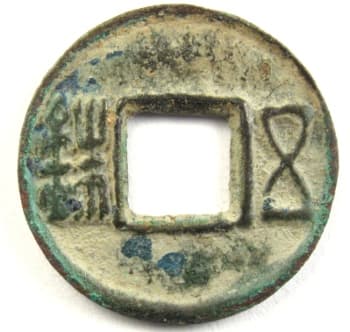
At the left is a distinctive variety of the wu zhu (五 铢) coins.
Unlike most wu zhu, there is a rim around the square hole on the obverse side.
Old Chinese coin catalogs have traditionally attributed this coin to Liu Bei and the Kingdom of Shu (221-263) and it has consequently become known as a "Shu" wu zhu (蜀五铢).
Recent archaeological discoveries, however, now cast some doubt as to these coins being from the Kingdom of Shu.
The diameter of this coin is 21.7 mm and the weight is 2.3 grams.
Wu (222-280)
Western Jin Dynasty (265-316)
China was reunified for a brief period of time
beginning in 265 AD by Sima Yan (司马炎), also known as
Emperor Wu (晋武帝), who established the Western Jin
Dynasty (xi jin chao
西晋朝 265-316) with its capital at
Luoyang (洛阳).
During the short-lived Western Jin, the government storehouses were full and the country was powerful and prosperous.
No historical texts mention the casting of coins during the Western Jin. Since the economy was recovering, however, there must have been a sharp increase in the need for cash coins.
The quantity of old wu zhu coins from the Han Dynasty that were still circulating would been insufficient. Coins, most probably wu zhu, must have been produced but their characteristics are still unknown. Future archaeological discoveries may be able to provide the answer.
Eastern Jin Dynasty (317-420)
The "War of the Eight Princes" (ba wang zhi luan
八王之乱 291-306), followed by the revolt in the north by
the Wu Hu tribes ("Wu Hu Uprising" 五胡乱华 304-316), forced
a large number of refugees to flee south where in 317
the Eastern Jin Dynasty (dong jin chao 东晋朝 317-420) was
established with its capital at Jiankang (建康城) near
present-day Nanjing (南京).
The "War of the Eight Princes" was a civil war involving eight members of the Sima (司马) family who assassinated one another with the intent of seizing political power in northern China.
The rebellion caused extreme hardship and unrest among the people.
The Jin Dynasty (晋朝) was so weakened that various ethnic minorities in the north, known collectively as the Wu Hu (五胡), were able to break away and establish sovereignty in their own areas.
These short-lived independent states are referred to as the "Sixteen Kingdoms" (shi liu guo 十六国 304-439).
Cheng Han (304-347)
Li Te (李特 303) and Li Liu (李流 303), who were leaders
of the Ba (巴) people, established and ruled the Cheng
Han Kingdom (成汉 304-347) which was the
earliest of the Sixteen Kingdoms.
Li Shou (李寿 338-343) of the Cheng Han Kingdom ruled under the reign title "Han Xing" and in the year 338 began to cast small and thin coins with the inscription Han Xing (汉兴).
The Han Xing coin is famous for being the first coin in Chinese history to use a period title in its inscription.
There are two varieties of the Han Xing coin. One variety has the inscription written horizontally (hengdu 横读) while the second variety has the inscription written vertically (zhidu 直读). The horizontally written version is the rarer of the two.
Shi Le (石勒 319-333) was a member of a small tribe situated in northern China known as the Jie (羯). He established another of the Sixteen Kingdoms known as the Later Zhao Kingdom (后赵 319-351) and installed himself as king.
King Shi Le cast coins with the inscription feng huo (丰货 "Coin of Abundance").
There exist two varieties of the feng huo coin. The "small character" (xiaozi 小字) variety has a rim around the square hole on the reverse side while the "large character" (dazi 大字) version does not.
Shi Hu (石虎 334-349) succeeded Shi Le as king. King Shi Hu's rule was exceedingly brutal and the people lived in extreme poverty. It is ironic that the coins of the realm carried the inscription "Coin of Abundance".
Former Liang (301-376)
The Former Liang Kingdom (前谅 301-376) reverted to
the use of wu zhu
coins. The small wu zhu coins with a border around the
square hole on the obverse side, traditionally referred
to as "Shu wu zhu" coins, have
in recent years been unearthed in the "Gansu Corridor" (hexi zoulang
诃西走廊). It is possible that these wu zhu coins may
actually have been cast during the reign of Zhang Gui
(张轨), the Duke of Xiping (313-314), of the Former Liang
Kingdom.
Zhang Gui was succeeded by his eldest son Zhang Shi (张实 314-320), Duke Ming of Xiping, who cast small and thin coins with the inscription liang zao xin quan (谅造新泉 "Liang Made New Coin"). In recent years, these coins have been unearthed in the areas of Chang'an (长安, Xi'an西安 ) in Shaanxi Province and in Wuwei (武威) of Gansu Province.
Xia (407-431)
The Xia Kingdom (夏 407-431) was another of the
Sixteen Kingdoms. It was established by the
chieftain Liu Bobo (he
lian bo bo 赫连勃勃) of the Xiongnu (匈奴) tribe in
what is now Inner Mongolia.
Emperor Helian Bobo cast coins with the inscription tai xia zhen xing (太夏真兴 "Great Xia Zhenxing") during his Zhenxing reign (真 兴 419-424).
These tai xia zhen xing coins are very rare.
A coin from the Later Zhou Kingdom may be seen at the link below.
This particular specimen is very unusual in that it has a nail mark or crescent moon above the square hole. The coin has a diameter of 23 mm and a weight of 2.9 grams.
Emperor Wen later permitted princes to
also mint the Sui wu
zhu coins in their fiefdoms.
Sui wu zhu coins can be can be found in large and small sizes. The smaller coins with their reduced weights were cast at a later period.
There is one variety of Sui wu zhu made of "white copper" (bai tong 白铜) which is particularly well-made. The wu character is slightly more curved where the lines cross. The coin is termed the bai qian wu zhu (白钱五铢) and is believed to have been produced in the Jiangnan area (江南).
The Sui was another short-lived dynasty that finally collapsed due to its ruthlessness, failed military campaigns and the heavy burden placed on its people.
As it was nearing its end, the economic situation became so bad that even scraps of iron, paper and leather were being used as money.
The situation did not improve until the beginning of the Tang Dynasty.
 The ancient Buddhist
kingdom of "Qiuci" (Qiuzi, Kucha, Kuche guici 龟兹) was
centered around present-day Kucha City (库车) in Xinjiang
(新疆).
The ancient Buddhist
kingdom of "Qiuci" (Qiuzi, Kucha, Kuche guici 龟兹) was
centered around present-day Kucha City (库车) in Xinjiang
(新疆).
Qiuci was one of the important kingdoms on the Silk Road (si chou zhi lu 丝绸之路) during the period between the Western Han and the Tang dynasties.
Qiuci cast several types of small bronze coins including some with no inscription at all.
As early as the 3rd or 4th century AD, Qiuci began to cast coins based on the small, devalued and degenerate wu zhu coins of post-Han Dynasty China.
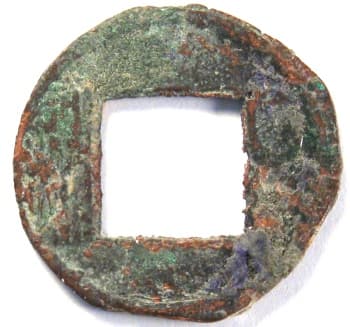
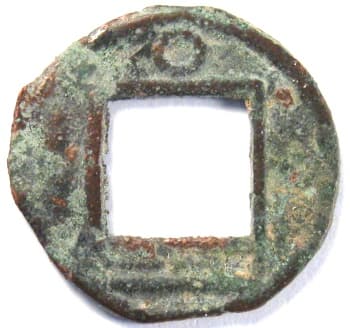
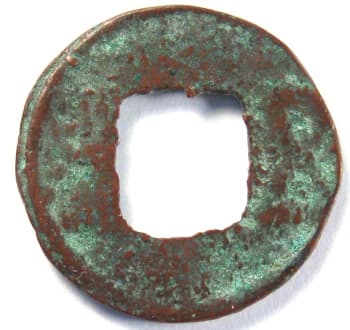
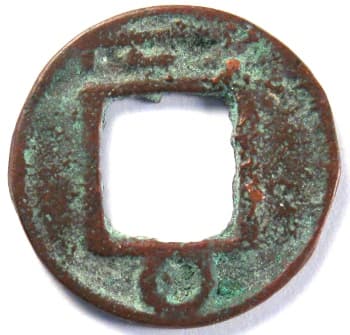
At the left are two examples of the Qiuci wu zhu which Chinese coin collectors refer to as the "Han Gui bilingual wu zhu coin" (han gui er ti wu zhu qian 汉龟二体五铢钱).
The specimens are representative of the Qiuci coins in that they are small, thin and irregular with weak inscriptions.
The obverse side (left image) is very similar to other wuzhu coins of the time with the Chinese character wu (五) on the right and the character zhu (铢) on the left.
What distinguishes these coins are the reverse sides which have the inscription written in the Qiuci script. You will notice that the Qiuci characters above and below the square hole are transposed on the second specimen.
The ancient Qiuci language is not well understood and there is no consensus as to the meaning.
Some believe that the Qiuci inscription is a translation of the "five zhu" written in Chinese on the obverse.
Others believe that the inscription translates as the name of the kingdom.
These coins are fairly scarce.
The first coin has a diameter of about 21.5 mm and a weight of 2.2 grams. The second coin's diameter is approximately 21 mm and its weight is only 1.3 grams.
The Tang Dynasty Buddhist monk Xuanzang (玄奘; tangseng 唐僧 602-664) made a seventeen-year journey along the Silk Road to India to study and bring back sacred Buddhist texts. He wrote about the pilgrimage in his "Great Tang Records on the Western Regions" (da tang xi yu ji 大唐西域记) where he described his visit to Guici in the year 630.
In the book, Xuanzang mentions the "small bronze coins" of Guici. He was almost certainly referring to these Han Gui bilingual wu zhu coins.
Xuanzang's journey to India and his return to China, along with his subsequent research and translation work, are considered monumental achievements in Chinese Buddhism.
The very famous 16th century Chinese epic novel "Journey to the West" (xiyouji 西游记; "Monkey") is a fictional account of his adventures.
As mentioned above, Qiuci cast not only the bilingual cash coins but also small bronze coins with no inscription at all. These coins are believed to have been cast during the period of about 265-589 AD.
These small coins without inscriptions can be divided into four types.
One type is round with a rim around the square hole on one side. The other side is flat. The coins are thicker in the middle and thinner at the outside edge. These coins have diameters ranging from 9 mm to 18 mm and weights of 0.4 grams to 1.7 grams.
The second type is similar to the first except that the coins do not have a rim around the square hole. The coins are 8 to 13 mm in diameter and weigh 0.2 to 0.4 grams.
The third type of inscriptionless coin is square, not round, with a large rimless square hole in the center. The coins are very thin with diameters of 8 to 11 mm and weights of 0.2 to 0.5 grams.
The fourth type of Qiuci coin with no inscription is very irregular in shape. These coins are small, thin and poorly cast. Some are only 5 mm in diameter and weigh just 0.2 grams.
At the beginning of the Tang Dynasty, the wu zhu (五 铢) coins of the Sui Dynasty (581-618) were still in common use.
However, in the 4th year (621) of the Wu De (武德) reign of Emperor Gaozu (高 祖) use of the wu zhu was abolished. A new coin began to be cast with the inscription kai yuan tong bao (开元通宝) under the strict standard that ten of the new coins would be equal in weight to one liang (两).
This marked a monumental change in the history of Chinese coinage. Chinese coins would no longer be named after their weight, such as "half tael" (ban liang 半两) or "five zhu" (wu zhu 五铢). Instead, cash coins would have inscriptions with tong bao (通寶), yuan bao (元 寶) and zhong bao (重 寶).
Another important change was that the coin inscription would no longer be written in the ancient zhuan shu (篆书) or "seal" script. The coin inscription would now be written in li shu (隶书) or "official" script which is a square and plain style of Chinese calligraphy.
Emperor Gaozu had one of the Tang Dynasty's most famous calligraphers, Ouyang Xun (欧阳询), wrote the inscription for the new coin.
These changes meant that the more that 700 year "reign" of the wu zhu (五铢) coin had finally come to an end. The new kai yuan tong bao, with an inscription stipulating tong bao ("universal" or "circulating" currency) instead of its weight, and written in "official" script instead of "seal" script, would become the model for most of the coins cast in the dynasties that followed.
The kai yuan tong bao would continue to be cast for 200 years. So great was the influence of the new Tang Dynasty coin that it also became the model for the coinage of Japan, Korea and Annam (Vietnam).
Because the kai yuan tong bao was cast for such a long period of time from mints located throughout the country, there are slight differences in the coins resulting in several hundred varieties.
The kai yuan tong bao coins cast at the beginning and the height of the Tang Dynasty tend to be very well made. Early versions of the coins that can be accurately dated by being found in early Tang Dynasty tombs confirm that the first horizontal stroke (yi 一) of the character yuan (元) was short. This variety, appropriately enough, is known as a "short one yuan" (duan yi yuan 短一元).
A small number of these early "short one yuan" coins were cast in white bronze (white copper). These white bronze (bai tong 白铜) kai yuan tong bao coins have deep rims and are unusually well made. During Tang times they were referred to as "pure coins" (qing qian 青钱). The term "qing" took on an extended meaning. The writings of Emperor Gaozong (649-683) were described as being like "pure coins" (青钱) and his "nickname" (wai hao 外号) was "pure coin scholar" (qing qian xue shi 青钱学士).
The second horizontal stroke in the yuan (元) character has four different styles according to whether or not the end of the stroke, referred to as a "shoulder", slants upwards or not: left shoulder (zuo tiao 左挑), right shoulder (you tiao 右挑), two shoulders (shuang tiao 双挑), no shoulders (不挑). The last three varieties are fairly scarce.
Excavations at a Buddhist pagoda on Niushou Hill (牛首山) in Jiangning (江宁) prefecture in Jiangsu Province (江苏省) during the 1950's provided some evidence that the kai yuan tong bao coins with the yuan (元) having "right shoulders" and "two shoulders" were probably cast in the Nanjing (南京) area.
The reverse sides of kai yuan tong bao coins frequently have crescent moons (yue wen 月纹) or other symbols. Several stories have passed down through history as to the origin of this "moon" symbol. Some say that Empress Wende (wen de huang hou 文德皇后), who was the wife of Emperor Taizong and mother of Emperor Gaozong, pressed her fingernail into the wax specimen. Others identify the person as Empress Taimu (tai mu huang hou 太穆皇后), who was the mother of Emperor Taizong. Still other stories say that it was Yang Guifei (杨贵妃), one of the four beauties of ancient China, who was the imperial consort of Emperor Xuanzong. There are also sources that say the symbol may have been influenced by foreign coins.
It is generally believed, however, that the symbols are actually marks of quality from the various mints.
The placement of the crescent moon on the reverse side is not standardized. Also, besides crescents, other symbols are found including crescents paired closely together with a dot ("star") known as "pregnant stars" (yun xing 孕星). There are also "double moons" (shuang yue 双月). There are dots and crescents separated from each other known as "star and moon" (xing yue 星月). Other symbols seen on these coins are "clouds" or "auspicious clouds" (yun wen 云纹), waves (bo wen 波纹), three moons (san yue 三月), four moons (si yue 四月), and four stars (si xing 四星). The last several varieties are fairly scarce.
Another characteristic of the early period kai yuan tong bao coins is that the Chinese characters are deeply cut and do not touch the rim. The Chinese term for this characteristic is ge lun (隔轮) which, appropriately enough, translates as "separate from the rim". Additionally, the rim on the reverse side of these coins tends to be clear and uniform.
This is in contrast to later varieties of the coins where many specimens have excess metal between the strokes of the characters. On the obverse side, the later varieties also tend to have longer strokes which touch the rim. The rims on the reverse sides of these coins are usually fairly flat and irregular.
In 1987 during renovations at Famen Temple, thirteen kai yuan tong bao coins made from sea turtle shell were discovered in an underground palace. Also discovered was a sacred relic of the Buddha. These turtle shell coins were the first ever discovered in China and may the the earliest coins made of turtle shell in world history. These turtle shell coins are discussed in detail at Coins Made of Turtle Shell Discovered at Famen Temple.
In the first year (666 AD) of the Qian Feng reign of Emperor Gaozong, coins were cast with the inscription qian feng quan bao (乾封泉宝). Chinese coin inscriptions are traditionally written with the characters read in the following order: top, bottom, right, left. On this coin, however, the inscription is read in a clockwise manner beginning with the character at the top. These coins weigh about 5 grams.
Because military expenses were very high at this time, these coins were stipulated to be worth 10 of the older cash coins as a means for the government to raise funds. To avoid loses with this unfair exchange rate, the merchants and common people simply refused to make purchases and began to hoard the older cash coins. As a result, the price of goods soared and after only one year the government stopped casting the qian feng quan bao coins. Because the casting period was so short, these coins are now fairly scarce.
Unfortunately, qian feng quan bao coins have been reproduced in fairly large numbers in recent years. Compared to a "real" coin, the reproductions tend to be slightly smaller. Also, the first stroke of the bao (宝) character is shorter.
Shi Siming (史思明) (703-761), one of the leaders of the devastating Anshi Rebellion (an shi zhi luan 安史之乱) which lasted from 755-763, cast the de yi yuan bao (得壹元宝) and shun tian yuan bao (顺天元宝) coins during the period 758-761. These coins were valued as equal to 100 each of the kai yuan tong bao coins. After the An Shi Rebellion, these large denomination coins no longer circulated and were melted down. For this reason, very few of these coins still exist.
Because of their scarcity, there exist a large number of fake de yi yuan bao coins. Many of these fakes were cast from molds created with a real de yi yuan bao coin so it can be difficult to differentiate an authentic coin from a fake by just looking at rubbings in coin reference books.
The reverse sides of De Yi yuan bao coins sometimes have a "moon". Some have four moons or auspicious clouds. All these varieties are considered to be fairly rare.
Shun tian yuan bao coins can also have moons, or moons and stars, on the reverse. Interestingly enough, it is the coins with none of these symbols on the reverse that tend to be scarce.
There is, allegedly, one shun tian yuan bao coin with a tian (天) character on the reverse above the square hole which is rumored to be in Japan.
There are also shun tian yuan bao coins with waves, auspicious clouds, and even a phoenix on the reverse. It is speculated that these coins were cast to dedicate the opening of a new furnace or mint. (See Shun Tian Yuan Bao Charm for a gilt and engraved coin with bat, fish and lotus symbols.)
The Anshi Rebellion, referred to above, had a very serious affect on the economy. To support the large military expenditures, Emperor Suzong (711-762) cast the qian yuan zhong bao (乾元重宝) coin during the first year (758 AD) of his Qian Yuan reign. Each of these coins was equivalent to ten of the older cash coins.
The qian yuan zhong bao was the first coin in Chinese history to carry the designation zhong bao (重 宝). These value ten coins were approximately 28 mm in diameter and weighed about 7 grams.
In the second year (759 AD) of the Qian Yuan reign, qian yuan zhong bao coins were cast with a double rim (chong lun 重轮) on the reverse side. These coins weighed about 22 grams and were valued at fifty of the older cash coins.
Issuing large denomination coins not worth their stated value was very profitable for the government. However, this caused very serious inflation. A "dou" (斗) of rice, which was about a ladle full of rice during Tang times, went from a price of 10 cash coins to a price of 7,000 cash coins! It was simply impossible for these large denomination coins to maintain their stated value.
When Emperor Daizong assumed the throne in 762 AD, he attempted to restore some sanity to the economy by reevaluating the coins in circulation. The old kai yuan tong bao coin was to be valued as one cash coin, the qian yuan zhong bao was declared to be equivalent to two cash coins, and the double-rim qian yuan zhong bao was valued as three cash coins.
But after only 10 days, the government rescinded this order and proclaimed that all qian yuan zhong bao coins were now to be valued as one cash coins, the same as the kai yuan tong bao. The government finally acknowledged the fact that so many qian yuan zhong bao coins had been counterfeited over the years that many weighed as little as 4 grams, which was about the same weight as the kai yuan tong bao.
As a result of this decision, large and heavy coins no longer circulated in the market. Many of these coins were melted down to be used to make metal utensils and, as a result, few of these coins exist today.
There is one variety of qian yuan zhong bao which is quite rare. This coin has the character "ten" (shi 十) on the reverse side. It is believed to have been among the very first coins cast and had the character "ten" to indicate the value of the new coinage.
Qian yuan zhong bao coins continued to be cast even after the reign of Emperor Daizong. Since these coins were valued as one cash coins, they circulated together with kai yuan tong bao coins no matter if they were large, small, heavy or light. However, varieties with stars, moons, or both stars and moons on the reverse side are scarce.
There also exist a very small number of qian yuan zhong bao coins with the Chinese character hong (洪) on the reverse. It is believed that these coins were cast in Jiangxi (江西) sometime after the fifth year (845 AD) of the Hui Chang reign of Emperor Wuzong (840-846 AD). Even though very few of these coins have been found, their existence proves that the small qian yuan zhong bao coin continued to be cast even to the end of the Tang Dynasty.
There are other scarce varieties of qian yuan zhong bao coins which have "clouds" or "auspicious clouds" (yun 云) and "sparrows" (que 雀) on the reverse. Most of these coins have been discovered in Sichuan. In contrast to charms and amulets, coins with "pictures" on the reverse side were not frequently cast in ancient China. However, there are varieties of tai ping bai qian (太 平百钱) with waves on the reverse. There are also a few kai yuan tong bao (开元 通宝) and qian yuan zhong bao (乾 元重宝) coins which have clouds on the reverse.
Auspicious clouds and sparrows frequently appear on bronze mirrors from the Tang Dynasty. During the Sui and Tang dynasties, the study of divination was in vogue and clouds and sparrows were seen as auspicious objects.
During the Da Li reign of Emperor Daizong (766-779), coins were cast in the Kucha area of Xinjiang with the inscription da li yuan bao (大历元宝). The Jian Zhong reign of Emperor Dezong (780-783) saw the casting of jian zhong tong bao (建中通宝) coins. The majority of these coins were not particularly well cast and both are scarce. Some versions of the coins only have the single character yuan (元) or zhong (中) which was an abbreviated way to write the inscriptions da li yuan bao (大 历元宝) and jian zhong tong bao (建中通宝), respectively.
A few of the da li yuan bao coins are large and well cast but almost all of the jian zhong tong bao coins are small and thin.
There is also a coin with the single Chinese character "da" (大) as the inscription. Based on the color of the bronze and the similarity in casting, the coin is believed to be an abbreviated inscription of da li yuan bao (大历元宝).
In order to obtain funds for his military and also to try to purge China of foreign influences, Emperor Wuzong (840-846 AD), a devoted Daoist (Taoist), in the fifth year (845) of his Hui Chang (会昌) reign began to cast coins with the inscription "kai yuan tong bao", the same inscription as used on the coins of Emperor Gaozu at the beginning of the Tang Dynasty. The coins were made from the bronze obtained from statues, bells and other copper possessions of the Buddhist temples that he ordered confiscated and melted down. These coins differed from those cast earlier in the dynasty by Emperor Gaozu in that they had the character chang (昌) on the reverse side. Other mints soon followed with each producing a coin with a character on their reverse side indicating the mint of production.
A total of 23 different mints cast these so-called "hui chang" kai yuan tong bao (会昌开元 通宝) coins including mints at the following locations:
昌 chang for hui chang
京 jing for Jingzhao (Xian)
洛 luo for Luoyang (Henan)
益 yi for Yi Prefecture (Chengdu)
荆 jing for Jing Prefecture (Hubei)
襄 xiang for Xiang Prefecture (Hubei)
蓝 lan for Lantian (Shanxi)
越 yue for Yue Prefecture (Zhejiang)
宣 xuan for Xuan Prefecture (Anhui)
洪 hong for Hong Prefecture (Jiangxi)
潭 tan for Changsha (Hunan)
兖 yan for Yan Prefecture (Shandong)
润 run in Jiangsu
鄂 e for E Prefecture (Wuchang)
平 ping for Ping Prefecture (Zhili)
兴 xing for Xingyuan (Shaanxi)
梁 liang for Liang Prefecture (Shaanxi)
广 guang for Guangzhou (Guangdong)
梓 zi for Dongchuan (Sichuan)
福 fu for Fuzhou (Fujian)
桂 gui for Guiyang (Hunan) or Guizhou (Guangxi)
丹 dan for Dan Prefecture (Shaanxi)
永 yong for Yong Prefecture (Hunan)
Coins with the "yong" (永) for Yong Prefecture are considered the rarest. Next rarest include those cast at the "fu" (福) for Fuzhou (Fujian), "dan" (丹) for Dan Prefecture (Shaanxi), "gui" (桂) for Guiyang (Hunan) or Guizhou (Guangxi), and "ping" (平) for Ping Prefecture (Zhili) mints.
For coins cast at the Fuzhou (Fujian) mint, the "fu" (福) character is usually located above the square hole. Coins with the "fu" character below or to the right of the hole are even scarcer. There is only one known example of a coin with the "fu" character on the reverse but no inscription at all on the obverse side. This coin is considered to be authentic and apparently was the result of a casting error.
There is a rare version of the "hui chang" kai yuan tong bao with the "jing" (京) character reversed right to left (fan shu 反书) meaning the character appears as its mirror image.
There exists a lead version of the "hui chang" kai yuan tong bao that has the "tan" (潭) for Changsha (Hunan) character on the reverse.
A rare version of kai yuan tong bao from the lan (蓝) for Lantian (Shanxi) mint has three clouds on the reverse. Another rare variety from this mint has the four character inscription "tai ping da wang" (太平大王).
There are no known authentic kai yuan tong bao coins with the mintmarks yang (扬), shu (蜀) or xi (西).
On the other hand, there allegedly exists a coin believed to be authentic with a "qing" (清) character on the reverse side.
Emperor Yizong (859-873 AD) during the 11th year (870 AD) of his Xian Tong reign cast coins with the inscription "xian tong xuan bao" (咸通玄宝). There coins are very rare.
Chinese coin collectors will sometimes encounter very large kai yuan tong bao coins weighing about 20 grams. Most of these were probably cast to commemorate the opening of a mint and are referred to in Chinese as kai lu (开炉) coins. Since later dynasties also cast such coins, it can be difficult trying to date specific coins but a few guidelines are presented here to try to assist in the endeavor.
In general, if the Chinese characters are deeply cut and the ends of the strokes are clearly defined, the coin was probably cast during the Tang Dynasty (618-907). If the outside rim is fairly broad and similar to that of the rare yong tong quan huo (永通泉货) coin cast during the reign of Emperor Yuanzu (Li Jing) of the Southern Tang Kingdom then it was most probably cast during the Southern Tang (937-975). If the strokes are rounded and simple, and the color of the bronze indicates that it is fairly new, the coin was most likely cast during a later period.
If the tong (通) and bao (宝) characters are written in the Slender Gold style (shou jin shu 瘦金书) then the coin cannot be earlier than the Northern Song (960-1127). If the bao (宝) character is written in the seal script then the coin cannot be earlier than the Jin Dynasty (1115-1234). If the tong (通) and bao (宝) characters are similar to that of the da zhong tong bao ((大中通宝)) and hong wu tong bao (洪武通 宝) coins then the coin cannot be earlier than the Ming Dynasty (1368-1644).
Following the Huang Chao Rebellion (黄巢起义) (874-884), the authority of the Tang emperor declined drastically and the casting of Tang coins finally ceased.
In 907, Zhu Wen (Emperor Taizu) deposed Emperor Ai (904-907), the last of the Tang emperors, and in so doing established the Later Liang Dynasty (852-912) and the beginning of the Five Dynasties and Ten Kingdoms Period (907-960).
 The vast
majority of kai yuan
tong bao (开元 通宝) coins
were made of bronze.
The vast
majority of kai yuan
tong bao (开元 通宝) coins
were made of bronze.
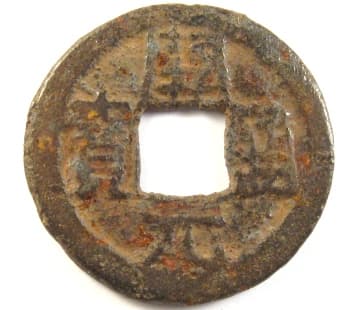
Among the many kai yuan tong bao varieties, however, are also ones made of gold, silver, lead, "white copper" ("white bronze"), and iron.
The kai yuan tong bao at the left dates from the Tang Dynasty and is made of iron. Many of these coins were produced in Sichuan where there was a lack of copper. Casting coins made of iron was thus more practical and less expensive.
There is also some evidence that during the Tang Dynasty iron kai yuan tong bao coins circulated in Hebei as well.
This coin has a diameter of 24 mm and a weight of 2.3 grams.
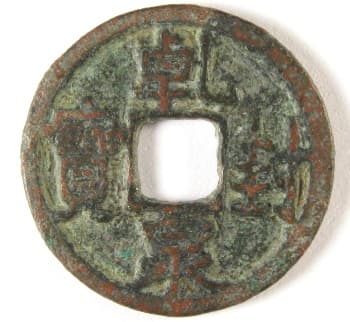
This coin was cast in the year 666 of the reign of Emperor Gao Zong (649-683) of the Tang Dynasty.
The inscription is written clockwise as qian feng quan bao (乾封泉宝).
The coin was originally valued as the equivalent to ten cash coins.
However, this valuation prompted extensive forgery and the coin was withdrawn from circulation after only one year.
The diameter is 25 mm and the weight is 3.8 grams.
Additional Tang Dynasty coins displayed on this website can be viewed by clicking on the appropriate link below:
The Song Dynasty produced a vast variety of coins of very high esthetic value and with a large number of names and titles. Each new emperor minted coins not only after enthronement but many times with each change of the nian hao (年号) which was the "imperial title", also known as "reign title" or "period title".
Coins were also cast in a number of major calligraphic styles including seal script (zhuan shu 篆书), regular script (kai shu 楷书 or zhen shu 真书), clerk or official script (li shu 隶书), running script (xing shu 行书), and grass script (cao shu 草书).
The variety of coins from the Song is so vast that many collectors and researchers specialize in just the coins of this dynasty.
Emperor Tai Zu (960-976) was the first emperor of the Song Dynasty and established its capital at Kaifeng in Henan. Coins were cast in very large quantities with the inscription song yuan tong bao (宋元通宝). The inscription song yuan, meaning "inauguration of the Song", was modeled on the kai yuan tong bao (开元通宝) which was the inaugural coin of the Tang Dynasty. Similar to the Tang coin, many of the song yuan tong bao coins have dots (stars) and crescents (moons) in various positions on their reverse sides.
After "pacifying" Sichuan, the Song ruler had the bronze coins circulating in the area sent back to the capital. The bronze coins were replaced with those cast of iron which caused the price of goods to soar resulting in great hardship to the local populace.
Emperor Tai Zong (976-997) began the tradition of casting new coins with each change of reign title. Coins with the reign titles of Tai Ping (太平 975-989), Chun Hua (淳化 990-994) and Zhi Dao (至道 995-997) were produced. The tai ping tong bao coins resembled the song yuan tong bao (宋元通宝) coins. The coins with the inscriptions (legends) chun hua yuan bao (淳化元宝) and zhi dao yuan bao (至 道元宝) are noteworthy because the calligraphy was done by Emperor Tai Zong himself in regular script, running script and grass script.
One can make an interesting observation concerning these first four coins of the Song dynasty. As already mentioned, the first coin, the song yuan tong bao, is similar to the first coin of the Tang Dynasty, the kai yuan tong bao, in that there are many varieties with dots (stars) and crescents (moons) in various positions on the reverse side. But the appearance of such symbols on the reverse side of the coins gradually decreased with the introduction of each successive reign title. For example, these symbols are found much less often on the tai ping tong bao and chun hua yuan bao coins, and are fairly rare by the time the zhi dao yuan bao (至 道元 宝) coins were issued.
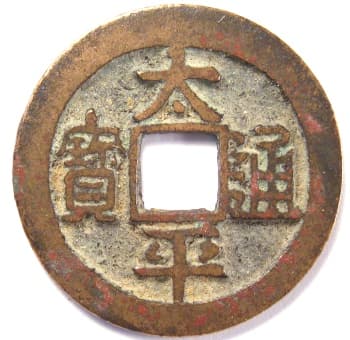
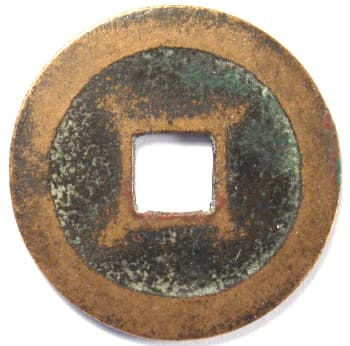 The tai ping tong bao
(太平通宝) coin shown at the left is an example of a
slightly later Northern Song Dynasty coin that still has
a symbol on the reverse side. (diameter: 25.5 mm,
weight: 3.9 grams)
The tai ping tong bao
(太平通宝) coin shown at the left is an example of a
slightly later Northern Song Dynasty coin that still has
a symbol on the reverse side. (diameter: 25.5 mm,
weight: 3.9 grams)
In this case, however, the symbol is not a "star" or "crescent".
The reverse side displays lines radiating outward from the four corners of the square hole which do not extend entirely to the rim. In Chinese, this is called si jue (四诀).
This symbol dates from ancient times but is rarely seen on a Song Dynasty coin.
One other characteristic of Song Dynasty coins was established with these first issues and can be seen on this coin. The coins have an obverse side with strong, deeply impressed characters and rims. The reverse sides, on the other hand, exhibit weak and shallow features.
During the reign of Emperor Zhen Zong (998-1022) coins were cast with the period titles Xian Ping (咸平 998-1003), Jing De (景德 1004-1007), Xiang Fu (祥符 1008-1016), and Tian Xi (天禧 1017-1022). All these coins have inscriptions written in regular script. Also, all the coins have blank reverses with the exception of an extremely few xiang fu tong bao coins which have dots and crescents.
A small number of xian ping yuan bao (咸 平元宝) and xiang fu yuan bao (祥符元宝) coins which are unusually distinctive were cast during the reign of Emperor Zhen Zong. These large coins are similar to the thick and heavy bing qian (饼 钱) coins known as "cake money" or "biscuit money" cast during the reign of Wang Mang of the Xin Dynasty. The Song dynasty "biscuit" coins, however, are not only large, thick and heavy but also have very broad rims. For a detailed discussion of these "biscuit" or "cake" coins, please see Song Dynasty Biscuit Coins.
Emperor Ren Zong (1023-1063) had coins with eight period titles cast during his reign. These include Tian Sheng (天圣1023-1031), Ming Dao (明道 1032-1033), Jing You (景佑 1034-1038), Huang Song (皇 宋 1039-1054?), Kang Ding (康定 1040), Qing Li (庆历 1041-1048), Zhi He (至和 1054-1055) and Jia You (嘉佑 1056-1063).
One interesting and very rare variety of the huang song tong bao (皇宋通宝) coin has the inscription written in "ninefold" script (jiu die zhuan 九叠篆) which was a style of calligraphy usually reserved for use only on official Song Dynasty seals.
Huang You (皇佑 1049-1053) was another period title used during Emperor Ren Zong's reign but no authentic coins with this inscription have ever been found and, most probably, none were ever cast.
Emperor Ying Zong (1064-1067) reigned for a very short time and only zhi ping yuan bao (治平元 宝) and zhi ping tong bao (治平通宝) coins were cast. There exists one extremely rare set of zhi ping "matched coins" (dui qian 对 钱) consisting of a zhi ping yuan bao and a zhi ping tong bao with four oblique lines (si chu 四出) extending outward from each corner of the hole to the rim on the reverse sides.
Emperor Shen Zong (1068-1085) only had two reign titles, Xi Ning (熙宁 1068-1077) and Yuan Feng (元丰 1078-1085), for which coins were cast but these coins were produced in enormous quantities. In one year alone, more than 5 million strings of coins were produced. A "string" consisted of 1,000 coins so 5 million strings means that 5 billion cash coins were cast in just one year! Not surprisingly, xi ning and yuan feng coins are among the most common Song Dynasty coins found today and exist in many, many varieties.
Emperor Zhe Zong (1086-1100) cast coins with the period titles Yuan You (元祐 1086-1093), Shao Sheng (绍圣 1086-1100) and Yuan Fu (元符 1098-1100). For some unknown reason, quite a number of shao sheng yuan bao (绍 圣元宝) coins have dots (stars) and crescents (moons) on their reverse sides.
Also, as a result of government corruption, a large number of iron coins were cast near the end of Emperor Zhe Zong's reign.
Emperor Hui Zong (1101-1125) was a man of culture and the arts but one whose decisions regarding administration of the state resulted in the fall of the Northern Song through defeat by the Jin. Nevertheless, the coins cast during his reign are considered among the very best produced during the Song Dynasty in terms of their quality, artistic essence and calligraphy.
Coins were cast for the following reign titles: Jian Guo (建国 1101), Sheng Song (圣宋 1101-1106?), Chong Ning (崇宁 1102-1106), Da Guan (大观 1107-1110), Zheng He (政和 1111-1117), Chong He (重和 1118) and Xuan He (宣和 1119-1125).
One variety of jian guo tong bao (建国通宝) cast in white bronze is so rare that the only known specimen is at the National Museum of China (formerly the Museum of Chinese History) in Beijing.
The sheng song yuan bao (圣 宋元宝) coins produced as a matched pair in seal and running script are particularly exquisite and exist in a number of varieties. The sheng song tong bao (圣宋通 宝) coins, on the other hand, were cast in far fewer numbers.
Emperor Hui Zong did the calligraphy for the inscription on the chong ning tong bao coins. His calligraphy is quite distinctive and is known as "slender gold" script (shou jin shu 瘦金书) because the characters resemble twisted gold filaments. While the smaller 1 cash chong ning tong bao (崇 宁通 宝) coins are fairly scarce, the larger 10 cash chong ning tong bao (崇宁通宝) and 10 cash chong ning zhong bao (崇宁元宝) coins are plentiful and exist in many varieties.
Unfortunately, these "10 cash" coins were not worth their stated value but served instead as a means for the government to confiscate wealth.
There is a humorous story dating from this time period which illustrates the hardship caused by the lack of 1 cash coins. The story relates that a patron bought a bowl of soup and paid for it with a "10 cash" coin. The soup seller did not have any small change and so encouraged the customer to eat more and more soup. The customer continued to eat but finally sighed and said, "it is fortunate that my coin is only a "10 cash". If it had been a "100 cash" it would have killed me!"
These 10 cash coins were so overvalued that they were eventually devalued until they were worth the equivalent of 3 cash coins.
While coins of Emperor Hui Zong's Chong Ning years were produced as chong ning tong bao (崇宁通宝), chong ning yuan bao (崇 宁元 宝) and chong ning zhong bao (崇宁重 宝), all the coins cast during the Da Guan years were da guan tong bao (大观通 宝). Many of the 1 cash and 10 cash da guan tong bao coins display the Emperor's "slender gold" calligraphy.
During the Zheng He reign of Emperor Hui Zong, coins were cast as zheng he tong bao (政和通宝) and zheng he zhong bao (政和重宝).
Emperor Hui Zong's Chong He reign only lasted three months and only coins with the inscription chong he tong bao (重 和通宝) were cast.
The Xuan He reign produced a large number of xuan he tong bao (宣和通 宝) coins but only a small number of xuan he yuan bao (宣和元宝) coins.
Emperor Qin Zong (1126-1127) reigned for only a very short time because of the invasion by the Jin. As a result, only a small number of jing kang tong bao (靖康通宝) and jing kang yuan bao (靖康元宝) coins were cast and they are all considered to be rare. The inscription on these coins is believed to be the calligraphy of Emperor Qin Zong.
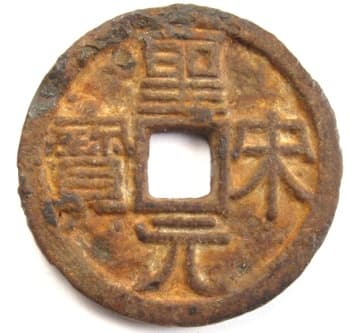
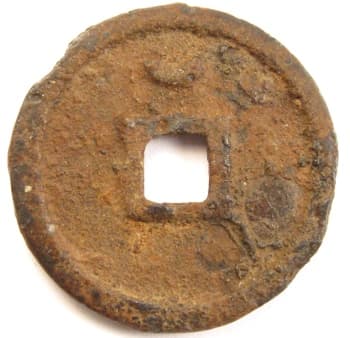
This is an iron coin cast during the reign of Emperor Hui Zong (1101-1125) of the Northern Song Dynasty.
The inscription is written in Li script and reads clockwise as sheng song yuan bao (圣宋元宝).
These coins were cast during the period 1101-1106).
The reverse side displays a crescent moon above the square hole.
The diameter is 32.5 mm and the weight is 8.2 grams.
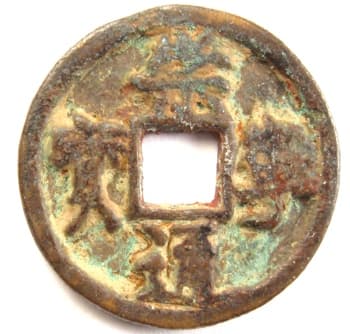
Emperor Hui Zong was known for his calligraphy and is credited with creating a personal style known as "slender gold script".
The inscription on the 1 cash coin at the left is written in slender gold script and reads clockwise as chong ning tong bao (崇宁通宝).
The diameter is 24.2 mm and the weight is 4.6 grams.
Other Northern Song Dynasty coins, including many with flower or rosette holes, can be viewed at the following links:
Southern Song
Dynasty (1127-1279)
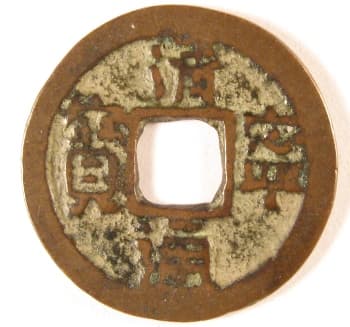
The coin at the left was cast during the reign of Emperor Dao Zong (道宗帝 1055-1101) of the Liao Dynasty.
The inscription is read clockwise as qing ning tong bao (清宁通宝).
These coins were cast during the years 1055-1064.
There are a number of varieties of qing ning tong bao. For example, underneath the "宀" at the top of the ning (寧) character can be a "一", "心" or "必". The tong (通) character can be written in "official" style (隶书) or "regular" style (楷书). There is also a variety that has a "dot" or "star" (星) beneath the square hole on the reverse side.
This coin has a diameter 24.3 mm and a weight of 3 grams.
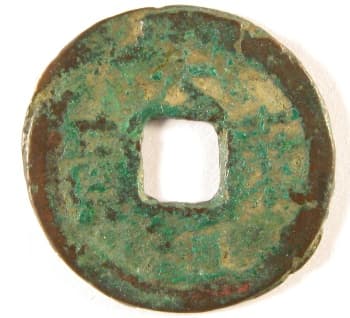
This cash coin was also cast during the reign of Emperor Dao Zong (道宗帝).
The inscription is also written clockwise and reads da kang tong bao (大康通宝).
Da kang tong bao coins were cast during the years 1075-1084.
There are three known varieties of the da kang tong bao coin. There is the "regular style" (楷 书) tong (通) variety. There is an "official style" (隶 书) tong (通) variety which is fairly scarce. Finally, there is a mu zhu ban (牡助版) variety which is even rarer.
This coin has a diameter of 23.2 mm and a weight of 3.2 grams.
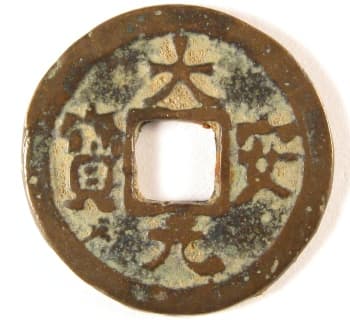 This is another cash coin
cast during the reign of Emperor Dao Zong (道宗帝)
of the Liao Dynasty.
This is another cash coin
cast during the reign of Emperor Dao Zong (道宗帝)
of the Liao Dynasty.
The inscription is read clockwise as da an yuan bao (大安元宝) and the coins were cast during the years 1085-1094.
There are several varieties of the da an yuan bao including the "long an (安)" (长安) and "short (small) an (安)" (短安) varieties. The yuan (元) character on some of the "long an" coins have "two shoulders" (双挑). The yuan (元) on some "short an" coins have a "right shoulder" (右挑).
There are also mu zhu ban (牡助版) and die zi ban (叠字版) varieties of the coin.
Some coins have a "star" (星) or "moon" (月) on the reverse side.
The diameter of this specimen is 24.2 mm and the weight is 4 grams.
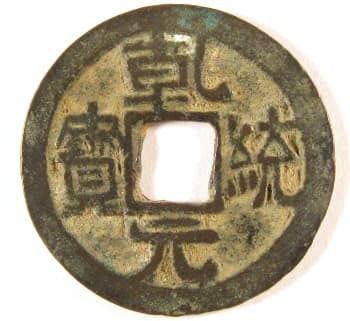
This Liao Dynasty cash coin was cast during the reign of Emperor Tian Zuo (天祚帝 1101-1125).
The inscription reads clockwise as qian tong yuan bao (乾统元宝) and these coins were cast during the years 1101-1110.
There are a number of varieties of the qian tong yuan bao. The yuan (元) can have a left shoulder or two shoulders. The middle horizontal line in the 日 part of the qian (乾) can be written in several ways. The qian (乾) can be written with a 艸 at the top. Some coins have a "star" (星) below the square hole on the reverse side.
The coin shown here has a diameter of 24 mm and a weight of 2.7 grams.
The following are other Liao Dynasty coins displayed on this website which may be viewed by clicking on the appropriate link:
Xi Xia Dynasty
(1032-1227)
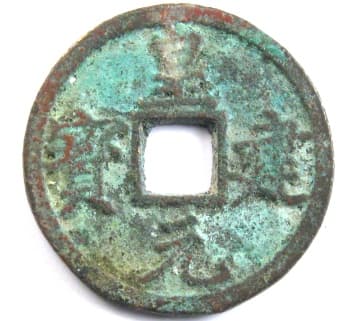
This coin was cast during the first year (1210) of the Huang Jian reign of Emperor Xiang Zong (1206-1211) of the Xi Xia (Western Xia) Dynasty.
The inscription is read clockwise as huang jian yuan bao (皇建元宝).
The coin has a diameter of 25.5 mm and a weight of 4.9 grams.
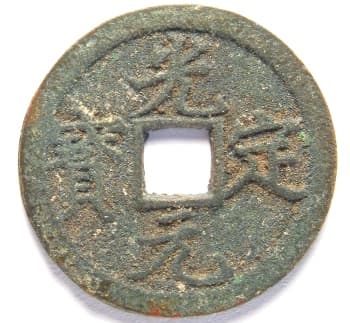
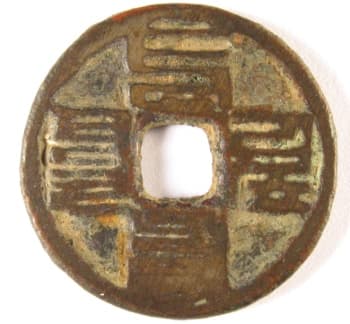
This coin is from the reign of Kublai Khan (Emperor Shi Zu) (1260-1294) of the Yuan Dynasty.
The inscription (je �en tung baw) is written in the Mongol script (Phags-pa). The equivalent Chinese inscription is zhi yuan tong bao (至元通宝).
The size of the coin indicates that it has a value of "2 cash" which means it was equal to two regular cash coins.
These coins were cast during the years 1285-1294.
The diameter is 29 mm and the weight is 7.3 grams.
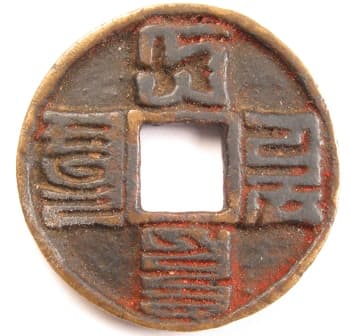
This Yuan Dynasty coin was cast during the reign of Emperor Wu Zong (Khaishan) (1308-1311).
The inscription is written in Mongolian and reads da yuan tong bao (大元通宝).
This large and heavy coin was cast during the years 1310-1311 and was equivalent in value to ten cash coins.
The diameter is 42 mm and the weight is 22.9 grams.
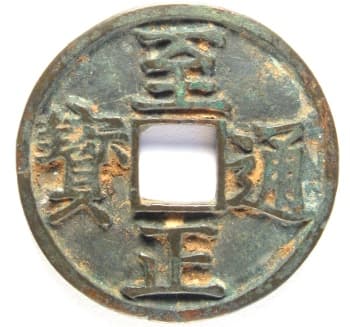
The inscription on this Yuan Dynasty cash coin reads zhi zheng tong bao (至正通宝).
The coin was cast during the reign of Emperor Shun (Toghon Temur) who ruled during the years 1333-1368.
It is a 3 cash coin which means that it had a value equivalent to 3 regular (1 cash) coins.
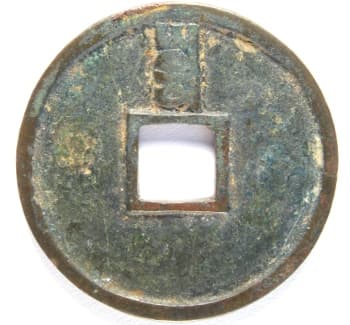
The reverse side displays the Mongol word for the Chinese cyclical character geng yin (庚寅) which means this coin was cast in the year 1350
The coin has a diameter of 33 mm and a weight of 8.8 grams.
The Ming Dynasty placed a greater reliance on coins than did the Yuan Dynasty. Even before the Mongols were defeated, Zhu Yuanzhang (朱元璋), who would become the first emperor of the Ming, established a mint (Board of Works) in 1361 at Ying Tian Fu (Nanjing) and began casting coins with the inscription da zhong tong bao (大中通宝).
In 1368 after formally becoming the first emperor of the Ming dynasty and adopting the reign title hong wu, Zhu Yuanzhang established mints in other cities and provinces including Nanking (jing 京), Peiping (beiping 北平), Henan (yu 豫), Jinan (ji 济), Zhejiang (zhe 浙), Fujian (fu 福), Hubei (e 鄂), Guangdong (guang 广), and Guilin (gui 桂). The Chinese characters in parentheses are the respective mint marks found on the reverse side of the coins.
Bronze coins were cast in five denominations: 1 cash (xiao ping 小平), 2 cash (zhe er 折二), 3 cash (zhe san 折三), five cash (zhe wu 折五), and ten cash (dang shi 当十). The coins progressed in size from smaller to larger according to the denomination.
The 1 cash coins have a single Chinese character on the reverse side indicating where the coin was cast. The reverse side of the 2 cash coins also have a Chinese character indicating the mint. However, some of the 2 cash, 3 cash, 5 cash and 10 cash coins also include on the reverse side a Chinese number indicating the value.
New rules were promulgated in 1375 which set strict standards for coins. The previous denominations would now be, respectively, 1 qian (yi qian 一钱), 2 qian (er qian 二钱), 3 qian (san qian 三钱), 5 qian (wu qian 五钱) and one liang (yi liang 一两) and the weight of each coin would be in accordance with the stated value. Additionally, it was stipulated that the coins would be made from 100% copper and that 160 of the "1 qian" cash coins would be made from one jin (斤) of copper. Each provincial mint was required to mark the reverse side of each coin with both its value and place of casting.
The Ming Dynasty included a total of seventeen reign titles but coins were not cast for every reign title. Coins were cast for the following ten reign titles: hong wu tong bao (洪 武通宝) cast during the reign of Emperor Tai Zu (1368-1398); yong le tong bao (永 乐通 宝) cast during the reign of Cheng Zu (1403-1424); xuan de tong bao (宣德通宝) cast during the reign of Emperor Xuan Zong (1426-1435); hong zhi tong bao (弘治通宝) cast during the reign of Emperor Xiao Zong (1488-1505); jia jing tong bao (嘉靖通宝) cast during the reign of Emperor Shi Zong (1522-1567); long qing tong bao (隆庆通宝) cast during the reign of Emperor Mu Zong (1567-1572); wan li tong bao (万 历通 宝) cast during the reign of Emperor Shen Zong (1573-1620); tai chang tong bao (泰昌通宝) cast during the reign of Emperor Guang Zong (1620); tian qi tong bao (天 启通 宝) cast during the reign of Emperor Xi Zong (1621-1627); and chong zhen tong bao (忠 祯通宝) cast during the reign of Emperor Si Zong (1628-1644).
The yong le tong bao (雍乐通宝) coin of Emperor Cheng Zu was produced primarily for use in foreign trade. The coin is closely associated with the Chinese maritime explorer Admiral Zheng He (郑和). Please see "Admiral Zheng He and the Yongle Tongbao Coin" for additional information.
Emperor Shi Zong has the distinction of having cast the largest coin in Chinese history. This huge jia jing tong bao (嘉靖通宝) coin weighs 41.5 kg! For more information please see "China's Biggest Ancient Coin".
No coins were cast and put into circulation with the following seven Ming Dynasty reign titles: jian wen (建文), hong xi (洪熙), zheng tong (正统), jing tai (景泰), tian shun (天顺), cheng hua (成化), and zheng de (正德).
Zheng De was the reign title (1505-1521 AD) of the Ming Dynasty emperor Wu Zong. Even though no authentic coins were believed to have been cast during his reign, one can still find zheng de tong bao (正德通宝) coins and charms which are definitely old.
According to Chinese folklore, Emperor Zheng De was a "swimming" dragon that came back to life. Beginning at about the end of the Ming Dynasty and extending through the Qing (Ch'ing) Dynasty, coins were cast privately with the inscription zheng de tong bao (正德通宝) because of the belief that carrying such a coin would act as a protective charm when crossing a river or sea.
Southern Ming coins were also cast as follows: da ming tong bao (大明通宝) cast during the reign of the Prince of Lu (1644-1646); hong guang tong bao (弘光通宝) cast during the reign of the Prince of Fu (1644-1645); long wu tong bao (隆武通宝) cast during the reign of the Prince of Tang (1645-1646); and yong li tong bao (永历通宝) cast during the reign of Prince Yongming (1646-1659).
It is interesting to note that all Ming Dynasty coins include "tong bao" (通宝) in the inscription, such as da zhong tong bao (大中通宝). Unlike previous dynasty coins, there are no Ming Dynasty coins which have "yuan bao" (元宝) in the inscription.
The reason is because the first emperor of the Ming was Zhu Yuanzhang (朱元璋) who happened to have the character yuan (元) in his name. Because of the tradition of respect accorded an emperor, it was prohibited to use the character "yuan" (元) on coinage of the Ming dynasty.
Another interesting fact concerning Ming Dynasty coins is that there are far fewer still in existence compared to, for example, coins from the even older Song Dynasty (960-1127). With the exception of da zhong tong bao (大 中通宝), hong wu tong bao (洪武通宝), tian qi tong bao (天 启通宝) and chong zhen tong bao (忠 祯通宝), coins cast with other Ming Dynasty reign titles are fairly scarce.
The reason for the comparative scarcity of Ming Dynasty coins is that they were devalued by the succeeding Qing (Ch'ing) Dynasty (1644-1911). Ten cash coins from the Ming were the equivalent of only five cash coins under the Qing. As a result, many Ming Dynasty coins were taken out of circulation and melted down with the bronze then used to cast Qing Dynasty coins.
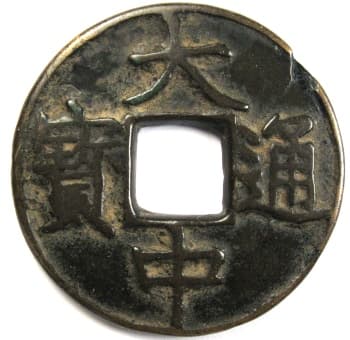
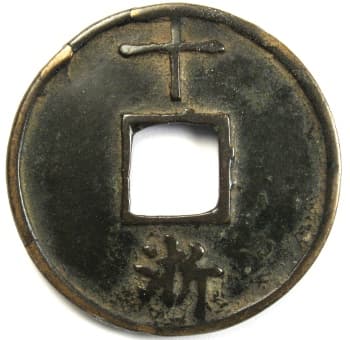 At the left is a coin cast under the
authority of Zhu Yuanzhang who was, at the time, the
Prince of Wu.
At the left is a coin cast under the
authority of Zhu Yuanzhang who was, at the time, the
Prince of Wu.
Zhu Yuanzhang was the leader of the rebellion that overthrew the Yuan Dynasty, under the rule of the Mongols, and then proceeded to establish the Ming Dynasty in 1368 with himself enthroned as Emperor Tai Zu (1368-1398).
These coins were cast during the years 1361-1368 and the inscription reads da zhong tong bao (大中通宝).
The reverse side has the number 10 (shi 十) above the square hole indicating that the coin is worth ten cash coins.
Below the square hole is the Chinese character zhe (浙) meaning that the coin was cast at the Zhejiang (浙江) mint.
This large coin has a diameter of 45.2 mm and a weight of 22.5 grams.
To learn more about Emperor Tai Zu, please see the charm describing his life at Buddhist Charms.
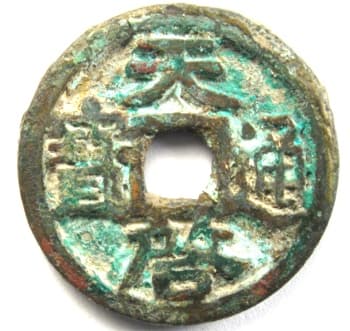
Ming Emperor Xi Zong ruled the country during the years 1621-1627.
Cash coins with the inscription tian qi tong bao (天启通宝), such as the example at the left, were cast in very large quantities and varieties.
This coin has a diameter of 22.5 mm and a weight of 4.9 grams.
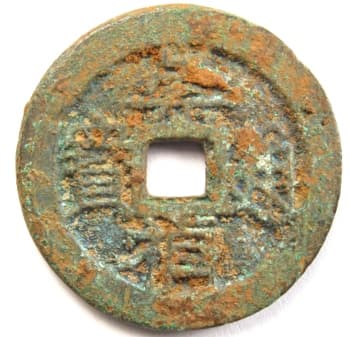
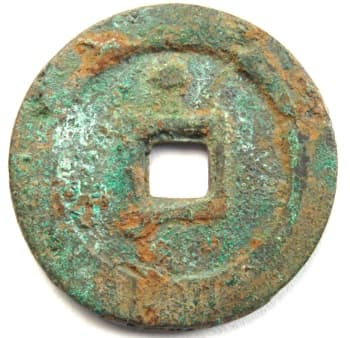
Emperor Si Zong reigned during the years 1628-1644.
A major category of chong zhen tong bao (崇祯通宝) cash coins display dots (stars), crescents (moons), circles (suns) and various lines on the reverse side.
The coin at the left is such an example with a large dot or star above the square hole on its reverse side.
The diameter of the coin is 26 mm and the weight is 5.6 grams.
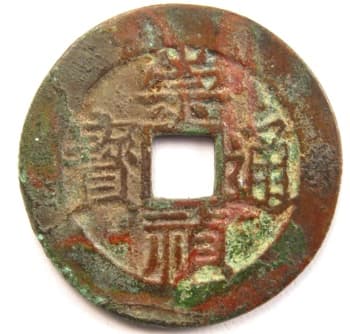
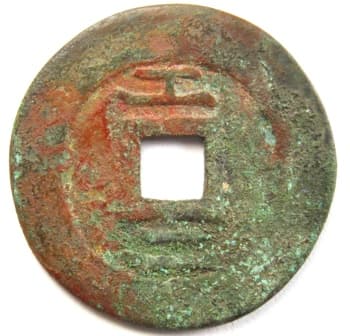
Another category of chong zhen tong bao cash coins displays the weight or value on the reverse side such as the coin to the left.
The reverse side has the Chinese character gong (工) above the square hole and the character er (二) below.
The er (二) means "two" which means that this coin had a value equivalent to two regular cash coins.
The gong (工), meaning "work", indicates that this coin was cast at the Board of Works mint.
Please also note that the zhen (祯) character in the inscription, located below the hole on the obverse side, has its left component (示) written differently from that on the coin above.
The coin has a diameter of 24.5 mm and a weight of 3.4 grams.
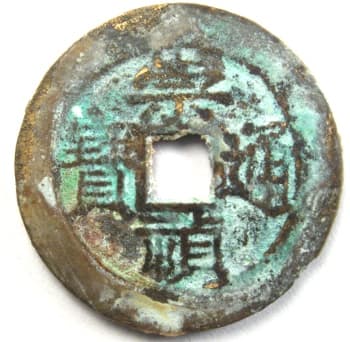
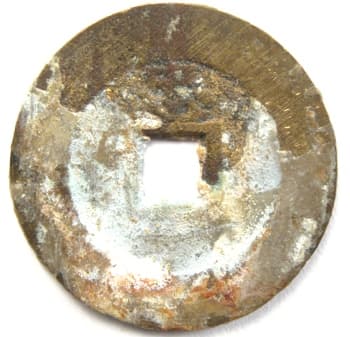 Still another
variety of chong zhen
tong bao coins have only mint marks on the
reverse side.
Still another
variety of chong zhen
tong bao coins have only mint marks on the
reverse side.
The coin at the left, for example, has the Chinese character zhong (忠) meaning loyal or honest above the square hole.
During Emperor Si Zong's reign, there were a total of 156 mint furnaces producing cash coins. It is unclear if zhong (忠) refers to a particular mint or not.
The coin has a diameter of 24.8 mm and a weight of 3 grams.
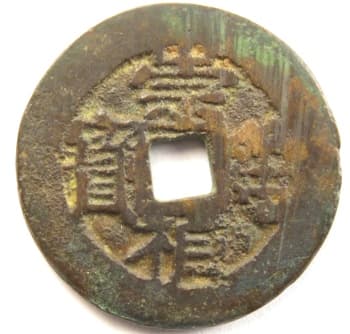
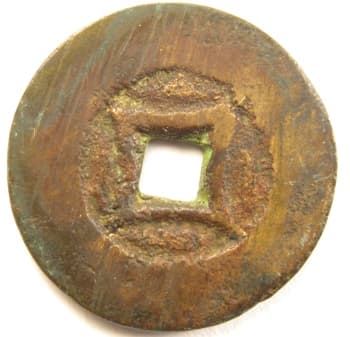
This is an unusual chong zhen tong bao coin.
The coin is thicker and heavier than normal cash coins.
Also, the reverse side has a very wide rim and the four corners of the inner rim extend outwards towards the outer rim.
This type of coin originated during the reign of Wang Mang of the Xin Dynasty (7-23 AD) and is known as a "biscuit" (bing 饼) or "cake" coin.
This coin has a diameter of 24 mm and a weight of 5.9 grams.
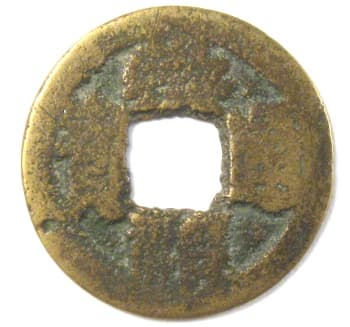
Unlike the coin above, this is a chong zhen tong bao (崇 祯通宝) coin that is both smaller and lighter than normal.
However, this coin is unusual to even a greater degree.
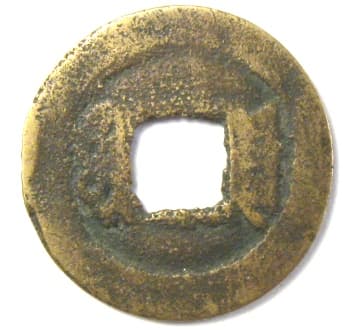 What is
fascinating about this coin is the reverse side.
What is
fascinating about this coin is the reverse side.
There are two Manchu characters typical of a Qing (Ch'ing) Dynasty (1644-1911) cash coin.
Manchu characters were never used on Ming Dynasty coins.
The earliest Manchu character mintmarks did not appear on cash coins until 1657 when shun zhi tong bao (顺治通宝) coins switched from using only Chinese characters on the reverse side to using Manchu characters on some versions.
The Manchu characters (boo yun) on this coin seem to indicate that it was cast at the Yunnan mint in south China.
The best explanation for the existence of this coin is that it was privately cast in southern China during the transition period from the Ming to the early Qing (Ch'ing). This was a period when large areas of southern China were still under the control of forces loyal to the Ming court.
This coin has a diameter of 21 mm and a weight of 1.6 grams.
Other Ming Dynasty coins are discussed at the links below.
Prior to the Manchus establishing the Qing (Ch'ing) Dynasty, Nurhachi (1616-1626), known in Chinese as Emperor Shi Zu, cast coins with the inscription tian ming tong bao (天命通宝) written in the Manchu script.
Abahai (1627-1643), also known as Hong Taiji (洪太极) or Huang Taiji (皇太极, 皇台吉), cast coins with the inscription tian cong tong bao (天聪通宝) written in Manchu.
At the beginning of the dynasty, the government set the standard that one tael (liang 两) of silver would be the equivalent of one thousand cash coins and that one li (厘) of silver would be equal to one cash coin.
Emperor Shi Zu (1644-1661) established mints at the Board of Revenue and the Board of Works in Peking and began casting bronze coins with the inscription shun zhi tong bao (顺治通宝). Coins with this inscription were cast in five varieties or types as described below.
Beginning in the year 1644, Type 1 and Type 2 coins were cast.
Type 1 coins were cast during 1644-1645 and followed the ancient tradition of having a reverse side with no characters.
Type 2 coins were produced from 1644 to 1661 and were modeled after the huichang (会昌) kai yuan tong bao (开元通宝) coins produced during the period 845-846 AD of the Tang Dynasty (618-907 AD), as well as the da zhong tong bao (大中通宝) and hong wu tong bao (洪武通宝) coins of the Ming Dynasty (1368-1644 AD). These coins have a single Chinese character on the reverse side indicating at which mint the coin was cast.
The mints casting Type 2 coins were the Board of Revenue (hu 户), the Board of Works (gong 工), Xian in Shaanxi Province (shan 陕), Linqing garrison in Shandong Province (lin 临), Xuanhua garrison in Zhili (xuan 宣), Yansui garrison in Shanxi Province (yan 延), Taiyuan in Shanxi Province (yuan (原), Shanxi Province (xi 西), Miyun garrison in Zhili (yun 云), Datong garrison in Shanxi Province (tong 同), Jingzhou garrison in Hubei Province (jing 荆), Kaifeng in Henan Province (he 河), Wuchang in Hubei Province (chang 昌), Jiangning or Nanking (ning 宁), Nanchang in Jiangxi Province (jiang (江), Hangzhou in Zhejiang Province (zhe (浙), Fuzhou in Fujian Province (fu 福), Yanghe garrison in Shanxi Province (yang 阳), and Xiangyang in Hubei Province (xiang 襄).
Type 3 coins were cast from 1653-1657 and are characterised by having the characters 一厘 (yi li), meaning "one li of silver", on the reverse side of the coin. A li (厘) was equal to one-thousandth of a tael (liang 两).
Type 3 coins also have a Chinese character on the reverse indicating the mint. The mints for Type 3 coins were the same as those casting the Type 2 coins but excluding the mints at Yansui garrison in Shanxi Province (yan 延), Shanxi Province (xi 西) and Jingzhou garrison in Hubei Province (jing 荆). Additionally, a mint at Jinan in Shandong Province (dong 东) was established to cast Type 3 coins.
Type 4 coins were cast during the years 1657-1661 and have only Manchu characters on the reverse side. To the left of the square hole is the Manchu character for bao (宝) and to the right is the Manchu character indicating the mint. These coins were cast in Peking at the Board of Revenue mint (bao quan 宝泉) and the Board of Works mint (bao yuan 宝源).
Type 5 coins were only cast during the years 1660-1661 and have both a Chinese and Manchu character on the reverse side indicating where the coin was cast. The Manchu character is located to the left of the square hole and the Chinese character is to the right.
There were twelve mints casting Type 5 coins: Xian in Shaanxi Province (shan 陕), Linqing garrison in Shandong Province (lin 临), Xuanhua garrison in Zhili (xuan 宣), Jizhou garrison in Zhili (ji 蓟), Taiyuan in Shanxi Province (yuan 原), Datong garrison in Shanxi Province (tong 同), Kaifeng in Henan Province (he 河), Wuchang in Hubei Province (chang 昌), Jiangning or Nanking (ning 宁), Nanchang in Jiangxi Province (jiang (江), Hangzhou in Zhejiang Province (zhe 浙), and Jinan in Shandong Province (dong (东).
During the reign of Emperor Sheng Zu (1662-1722), coins were cast with the inscription kang xi tong bao (康熙通宝) modeled after both the shun zhi tong bao coins with the Manchu character on the reverse (Type 4) and the shun zhi tong bao coins with both the Chinese and Manchu characters on the reverse (Type 5).
Kang xi tong bao cash coins were cast at the following mints: Datong garrison in Shanxi Province (tong 同), Fuzhou in Fujian Province (fu 福), Linqing garrison in Shandong Province (lin 临), Jinan in Shandong Province (dong 东), Nanchang in Jiangxi Province (jiang (江), Xuanhua garrison in Zhili (xuan 宣), Taiyuan in Shanxi Province (yuan 原), Suzhou in Jiangsu Province (su 苏), Jizhou garrison in Zhili (ji 蓟), Wuchang in Hubei Province (chang 昌), Jiangning or Nanking (ning 宁), Kaifeng in Henan Province (he 河), Changsha in Hunan Province (nan 南), Guangzhou in Guangdong Province (guang 广), Hangzhou in Zhejiang Province (zhe 浙), Taiwan (tai 台), Guilin in Guangxi Province (gui 桂), Xian in Shaanxi Province (shan 陕), Yunan Province (yun 云), Zhangzhou in Fujian Province (zhang 漳), Gongchang in Gansu Province (gong 巩), and West (xi 西).
The cash coins cast during the reigns of the next three emperors were basically modeled after those of Kangxi. These include the yong zheng tong bao (雍正通宝) coins of Emperor Shi Zong (1723-1735), the qian long tong bao (乾隆通宝) coins of Emperor Gao Zong (1736-1795), and the jia qing tong bao (嘉庆通宝) coins of Emperor Ren Zong (1796-1820).
During the reign of Emperor Xuan Zong (1821-1850), large quantities of silver left the country as a result of the opium trade. This meant that the price of silver in China increased drastically and, because coin production was tied to a silver standard, the cost of casting bronze cash coins now exceeded their face value.
The coins produced during Emperor Xuan Zong's reign have the inscription dao guang tong bao (道光通宝) and, in general, tend to be smaller and of poorer quality than those of his predecessors.
In addition to the mints that existed under Emperor Ren Zong, a new mint was established at Kucha (ku 库) to produce cash coins for the far western province of Xinjiang.
During his Xian Feng reign, Emperor Wen Zong (1851-1861) faced a large-scale peasant uprising (1850 -1864 AD) known as the Taiping Rebellion. The expense of the war, aggravated by the cutting off of the supply of copper from mines in the south, had a profound effect on coin production. In addition to the small cash coins (xian feng tong bao 咸丰通宝), many coins of larger denominations were also cast.
The bronze coins cast during Emperor Wen Zong's reign thus ranged from "One Wen" to "Value One Thousand". But, the size and weight of Xian Feng coins were in no way standardized. For example, a "Value Fifty" coin would be larger than a "Value One Hundred" coin. A "Value One Hundred" coin would be heavier than a "Value One Thousand" coin.
Coins with the inscription xian feng zhong bao (咸丰重宝) include the denominations "Value Four", "Value Five", "Value Ten", and "Value Fifty".
Coins with the inscription xian feng yuan bao (咸丰元宝) have the denominations "Value One Hundred", "Value Five Hundred" and "Value One Thousand".
There exists an extremely rare and famous specimen of a "Value One Hundred" pattern coin cast at the Fuzhou (福州) mint during the reign of the Xianfeng Emperor. For a discussion of this coin please see "The King of Qing Dynasty Coins".
Emperor Mu Zong (1862-1874) only lived to the age of nineteen but coins cast during his short reign include tong zhi tong bao (同治通宝) and tong zhi zhong bao (同治重宝).
Emperor De Zong (1875-1908) had coins cast with the inscription guang xu tong bao (光绪通宝) and guang xu zhong bao (光绪重宝).
In the late Qing Dynasty during the reign of Emperor De Zong, a new type of bronze coin which was round but without a square hole in the center began to make an appearance. These coins were not cast but were made by machines. The first machines were imported and installed in Guangdong Province in the 26th year (1900) of the Guang Xu reign.
With the introduction of these "struck" coins, China's 2,000 year history of casting bronze coins with a square hole in the middle was nearing its end.
These coins were generally referred to as tong ban (铜 版) and became so popular that by the 31th year (1906) of the Guang Xu reign were being produced at 15 bureaus in 12 provinces.
These machine-made coins were struck with two different inscriptions. One inscription was guang xu yuan bao (光绪元宝) which was inscribed in the center of the obverse side. Near the top of the rim was the name of the province or place of mintage. Near the lower rim was indicated the coin's parity against silver or, in most cases, its valve in relation to the traditional bronze coins ("cash coins") with square holes in the middle. Many of the coins had the name of the mint written in Manchu characters either in the very center or near the rim on the right and left sides.
The reverse side of the guang xu yuan bao coin usually had an image of a dragon. The dragon could be portrayed as coiled, flying or swimming. There were many different dragon designs which resulted in a great variety of guang xu yuan bao coins.
The second category of inscription used on these machine-made coins was da qing tong bi (大清铜币) which means "bronze coin of the great Qing (Dynasty)". These coins began to be struck during the 31st year (1906) of the Guang Xu reign at the "General Mint of the Ministry of the Interior and Finance" which had changed its name from the "Tianjin Silver Money General Mint". Soon afterwards, mints in other provinces began to strike coins with this inscription.
The da qing tong bi coins were minted in four denominations during the Guang Xu reign. The largest denomination was "20 wen" (文) meaning it was equivalent in value to 20 of the common bronze coins with a square hole. The other denominations were "10 wen", "5 wen" and "2 wen", each being worth the respective number of traditional "cash coins".
In comparison to the large number of varieties of the guang xu yuan bao coins, the da qing tong bi coins were more uniform. Similar to the guang xu yuan bao coins, the inscription da qing tong bi written in Chinese characters occupied the center portion of the obverse side. In the very center of the coin was one or two small Chinese characters indicating the province where the coin was produced. Near the top of the rim, the inscription da qing tong bi was written again but this time in Manchu characters. Near the right and left sides of the rim were two characters representing the "Ministry of the Interior and Finance" which was later replaced by the "Ministry of Revenue and Expenditure".
The reverse side of the da qing tong bi coin also had the design of a dragon but with much fewer variations in comparison to that of the guang xu yuan bao. Near the upper rim were the Chinese characters guang xu nian zao (光绪年造) meaning "minted during the Guang Xu years". Near the lower rim was written in English letters "Tai-Ching-Ti-Kuo Copper Coin".
Emperor Puyi (1909-1912) was the last emperor of the Qing (Ch'ing) Dynasty, as well as last emperor of imperial China. Cash coins cast during his reign have the inscription xuan tong tong bao (宣统通宝).
Also, machine-made da qing tong bi coins continued to be struck during the Xuan Tong reign. The da qing tong bi coins had xuan tong nian zao (宣统年造), meaning "minted during the Xuan Tong years", inscribed near the upper rim on the reverse side of the coins.
During the second year (1910) of the Xuan Tong reign, an additional four denominations of the machine-made bronze coins were struck. These denominations included the "two fen" (二分), "one fen" (一分), "five li" (五厘) and "one li" (一厘). However, few of these coins were actually made because the Qing Dynasty soon collapsed as a result of the Xinhai Revolution of 1911.
Described below are examples of Qing (Ch'ing) Dynasty coins.
Emperor Gao Zong ruled under the reign title Qian Long from 1736 to 1795. He abdicated the throne after sixty years in favor of his son Jia Qing as a sign of respect to not reign longer that his grandfather Kang Xi.
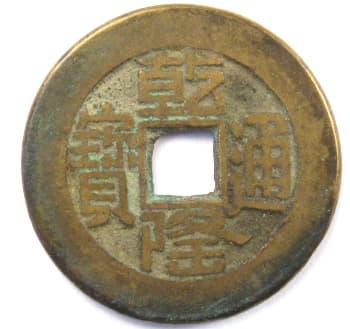
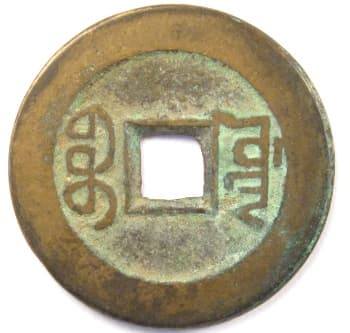 The
well-made coin at the left is typical of the cash
coins cast during the early part of his reign.
The
well-made coin at the left is typical of the cash
coins cast during the early part of his reign.
A very large quantity of qian long cash coins were cast but their size and quality, in comparison to that of the Kang Xi and Yong Zheng era, gradually deteriorated during his reign.
The inscription on the obverse side reads qian long tong bao (乾隆通宝).
A special characteristic of some qian long coins, and which can be seen here, is that the bottom character long (隆) is sometimes written with a fou (缶) instead of a sheng (生).
All qianlong cash coins have the mint name written in Manchu only. The reverse side of this coin has the Manchu character boo, meaning "building" on the left, and the Manchu character yuwan meaning Board of Works on the right.
The coin, cast at the Board of Works mint in Peking (Beijing), has a diameter of 26 mm and a weight of 5.3 grams.
A fascinating discovery was made in 2017 during renovations at the Forbidden City in Beijing. A dragon made of qian long tong bao (乾隆通宝) coins was found attached to a roof beam in the Hall of Mental Cultivation. This is the first "coin dragon" ever discovered and is discussed in detail at Coin Dragon.
Emperor Xuan Zong reigned during the years 1821-1850 and cash coins were cast with the reign title Dao Guang (道 光).
The number of mints producing cash coins was almost the same as that during the reign of Jia Qing. However, two new mints marks appeared, namely xin (新) for Xinjiang Province and kuche (库车) for Kucha, Xinjiang Province.
In general, however, the overall quality of the dao guang coins is inferior to that of the predecessors. The price of silver rose precipitously at the time as a consequence of the opium trade and, as a result, it cost more to cast cash coins than they were worth.
The mint in Fujian Province was closed in 1824 and gradually those in Shanxi, Shaanxi, Jiangsu, Hunan, Hubei, Guizhou and Zhili Provinces were also shutdown.
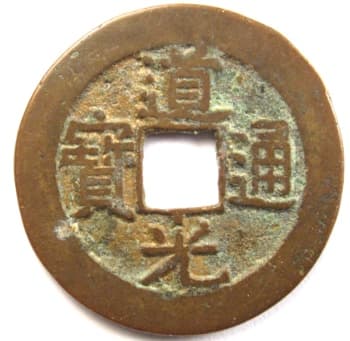
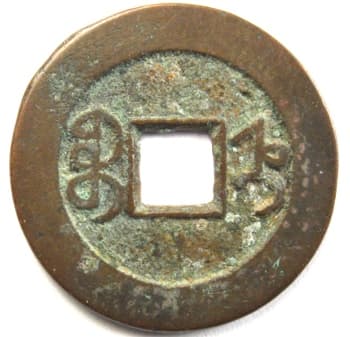
The inscription of this coin reads dao guang tong bao (道光通宝).
The Manchu character on the reverse side to the right of the square hole is jyi indicating that the coin was cast during the years 1821-1823 at the mint in Baoding, Zhili.
The diameter is 25 mm and the weight is 3.6 grams.
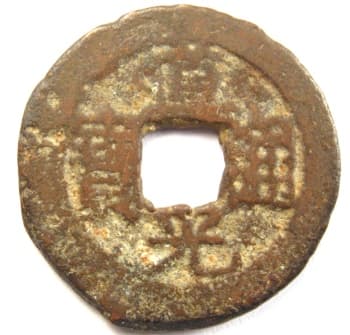
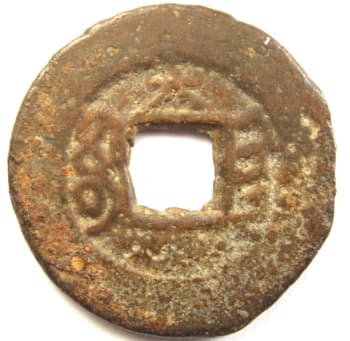 This
is another dao guang tong bao (道光通宝) cash coin.
This
is another dao guang tong bao (道光通宝) cash coin.
The Manchu character at the right of the square hole on the reverse side is kiyan which refers to the mints in Guiyang, Guizhou Province.
There is a character above the hole which is either da (大) or liu (六). There is no consensus on which character this is. Da could stand for the city of Da Ding (Dading). The character may be liu, however, in which case it would be the number "six".
The coin has a diameter of 25 mm and a weight of 4.4 grams.
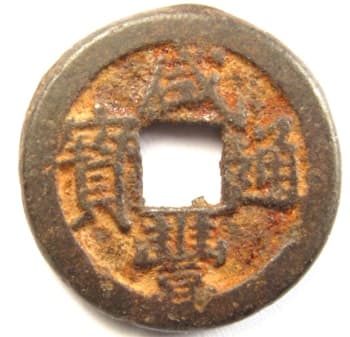
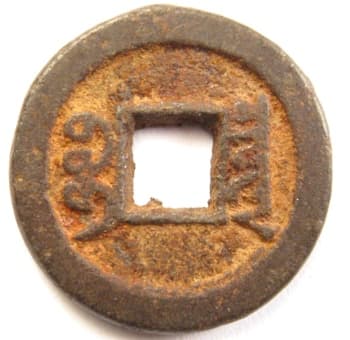 Emperor
Wen Zong (1851-1861) ruled under the reign title Xian Feng and was
on the throne during a very difficult time when the
country suffered wars, rebellions, famines, etc.
Emperor
Wen Zong (1851-1861) ruled under the reign title Xian Feng and was
on the throne during a very difficult time when the
country suffered wars, rebellions, famines, etc.
The Taiping rebellion (1850-1864) in the south cut off the supply of copper from Yunnan Province needed for coinage. As a result, Emperor Wen Zong's reign was characterized by large coins of high denominations as well as iron coins.
The coin at the left is an example of an iron coin from the 1854-1859 period.
The inscription reads xian feng tong bao (咸丰通宝) and the Manchu character to the right of the hole on the reverse side indicates that the coin was cast at the Board of Revenue mint in Peking (Beijing).
The diameter is 22.5 mm and the weight is 4.7 grams.
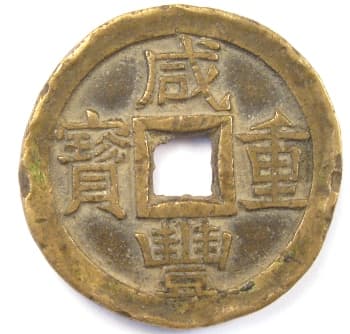
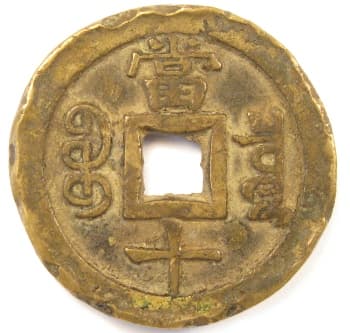 This
is an example of the large denomination token coinage
from the Xian Feng era.
This
is an example of the large denomination token coinage
from the Xian Feng era.
The inscriptions on these coins used yuan bao (元宝) or zhong bao (重宝) instead of the tong bao (通 宝) used on the smaller cash coins.
The inscription on this coin is xian feng zhong bao (咸丰通宝) and the Manchu character to the right of the hole on the reverse side indicates that it was cast at the Board of Revenue mint in Peking (Beijing).
The Chinese characters above and below the square hole on the reverse are dang shi (当十) which means the coin is a Value Ten (10) or a denomination equal to ten cash coins.
The diameter of the coin is 37.5 mm and the weight is 22 grams.
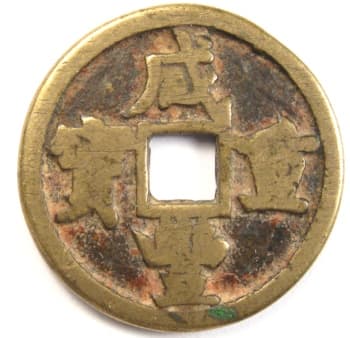
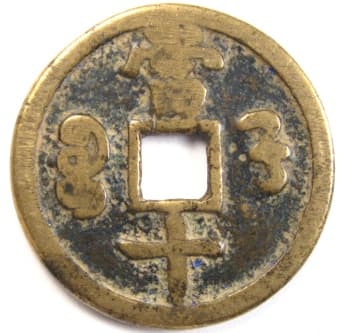
This is another xian feng zhong bao (咸丰通宝) coin.
The reverse side also has the Chinese characters dang shi (当十) meaning it has Value Ten (10) or a denomination equal to ten cash coins.
The Manchu character to the right of the hole is jyi which means the coin was cast at Baoding, Zhili.
The diameter is 34.5 mm and the weight is 12.6 grams.
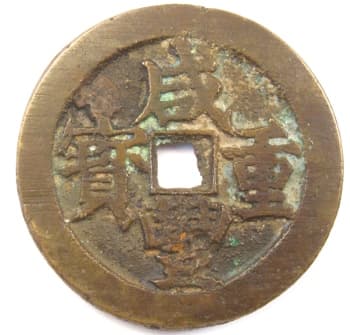
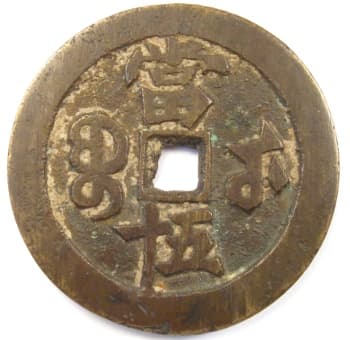
This xian feng zhong bao (咸丰通宝) coin is a Value Fifty (50) as evidenced by the Chinese characters dang wu shi (当五十) above and below the hole on the reverse side.
The Manchu character to the right of the hole on the reverse is su indicating that the coin was cast at the Suzhou, Jiangsu mint.
This coin was cast during the years 1854-1855.
The diameter of the coin is 49 mm.
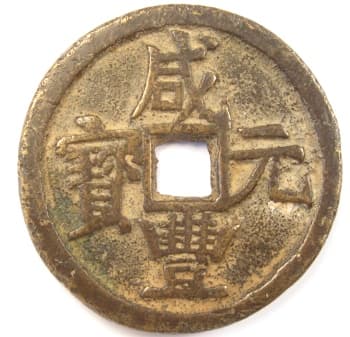
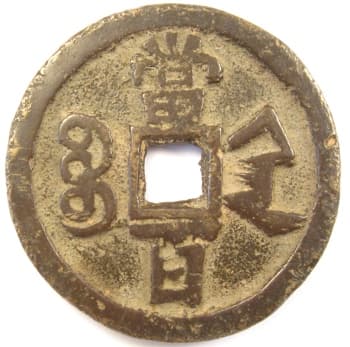
The inscription on this large coin is xian feng yuan bao (咸丰元宝) and it is a Value One Hundred (100) as indicated by the Chinese characters dang bai (当百) above and below the square hole on the reverse side.
The Manchu character shan on the reverse shows that the coin was cast at the mint in Xian, Shaanxi Province.
The coin has a diameter of 52 mm.
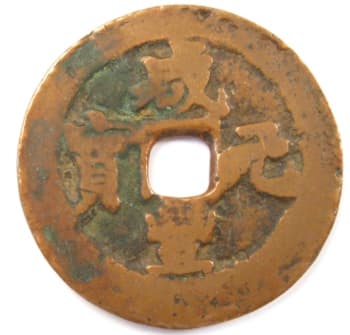
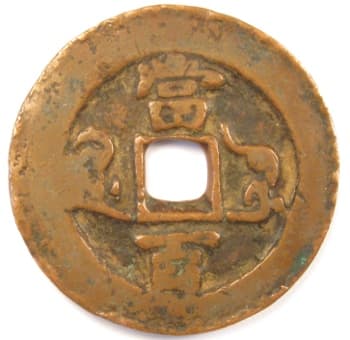
Large denomination coins were cast at the Kuche mint in Xinjiang Province during the years 1853-1856.
Xinjiang coins are characterized by a red appearance as is the case with this xian feng yuan bao (咸丰元宝) coin.
The denomination stated on the reverse side is Value One Hundred (100) according to the Chinese characters dang bai (当百).
The diameter is 40.5 mm and the weight is 21.2 grams.
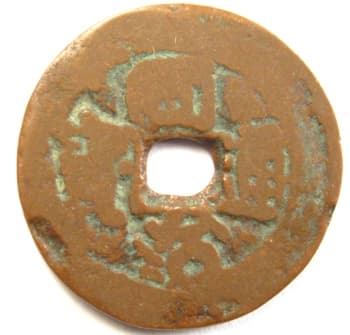
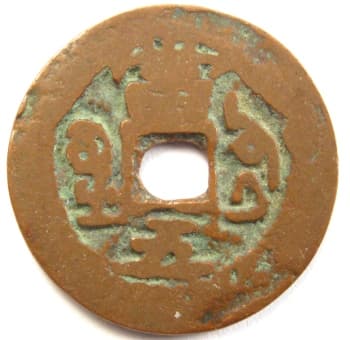
During the reign of Emperor Mu Zong (1862-1874) coins were also cast at the Kuche mint in Xinjiang Province.
Emperor Mu Zong used the title Tong Zhi and the inscription on the coin at the left reads tong zhi tong bao (同治通宝).
The Chinese characters dang wu (当五) on the reverse side states that this coin is a Value Five (5).
The diameter is 24.2 mm and the weight is 4.2 grams.
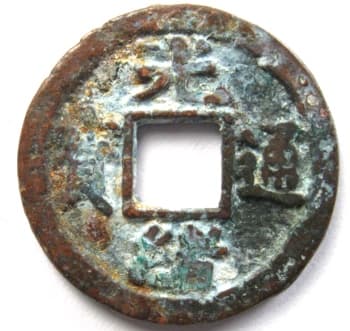
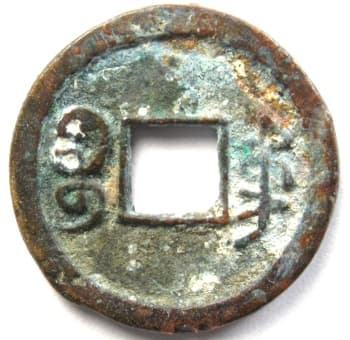
This cash coin was cast during the reign of Emperor De Zong (1875-1908) who adopted the reign title of Guang Xu.
The inscription is guang xu tong bao (光绪通宝) and the Manchu character dung on the reverse side indicates that the coin was cast at the Yantai (Chefoo) mint in Shandong Province.
The diameter of the coin is 24 mm and the weight is 3.4 grams.
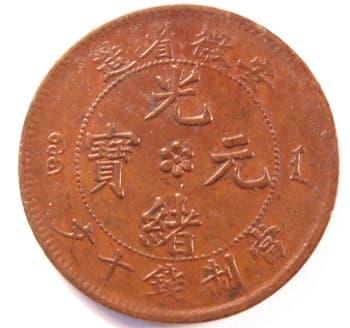
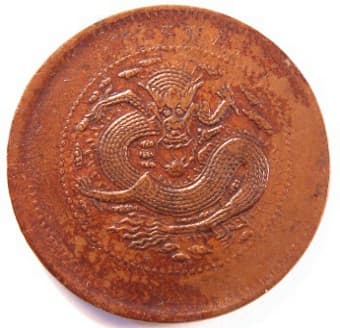 This is an
example of a machine-made tong ban (铜 版) coin struck during the reign of
Emperor De Zong.
This is an
example of a machine-made tong ban (铜 版) coin struck during the reign of
Emperor De Zong.
The obverse side, at the far left, has the Chinese inscription guang xu yuan bao (光绪元宝) written in the center of the coin. At the top of the coin is written an hui sheng zao (安徽省造) which translates as "minted at Anhui Province".
These coins were produced in Anhui during the years 1902-1905.
The small Manchu characters near the right and left side of the rim are bao an which also indicates that the coin was struck at Nanking in Anhui.
The Chinese characters near the bottom of the coin are dang zhi qian shi wen (当制钱十文) which means the coin is worth ten (10) "cash coins" which were the traditional cast bronze coins with a square hole in the center.
The reverse side of the coin, shown at the right, has "An Hwei" (Anhui) written in English letters near the top of the rim and has a dragon design in the center of the coin.
This coin has a diameter of 28 mm and a weight of 7.6 grams.
Please visit the following links to view other Qing Dynasty coins.
The Republic
(1912-1949)
Return to Ancient Chinese Charms and Coins
China achieved the ability to cast very refined works of
bronze early on as evidenced by its extraordinary
Shang and Zhou Dynasty ritual bronzes. Based
on this technology, the first metallic coins, which even
included "bronze" sea shells, appeared in various forms in
different regions of the country during the Western Zhou
Dynasty (11th century ~ 771 BC), the Spring and Autumn Period
(770-476 BC) and the Warring States Period (475-221 BC).Some of these first forms of money were cast in shapes which resembled tools of the time such as spades or shovels (bubi 布币). An early example of spade-shaped money from the Kingdom of Zhou is shown at the left.
Another type of money was based on an ancient bronze implement known as a xue (削). This implement was in the shape of a knife and this knife-shaped money (dao bi 刀币) circulated in the states of Qi, Yan and Zhao.
Still another type of money that appeared during the Warring States Period was ring-shaped (huan qian 环 钱). Because this form of money was circular with a round hole in the center, such coins are also known as "round" money (yuan qian 圆钱). These coins are believed to have been patterned after jade rings or, perhaps, a spinning wheel.
One additional type of bronze money from this time period consisted of small oval pieces cast in the State of Chu. This form of money is known as "ant nose" (yi bi qian 蚁鼻钱), and "devil" or "ghost" faced money (gui lian qian 鬼脸钱) because the characters inscribed on them resemble a human face.
When Qin Shi Huang unified the
country in 221 BC and established the Qin Dynasty, he
abolished the above-mentioned forms of money that had been
circulating in the other Warring States and stipulated that
the legal coinage would be a round coin with a square hole in
the center weighing a half tael or ban liang. This type of coin, known as a ban liang (半两),
continued to be cast through the end of the Qin Dynasty and
into the Western Han Dynasty.A ban liang from the Qin Dynasty is displayed at the left.
In 118 BC, Emperor Wu of the Western Han Dynasty (206 BC - 24 AD) replaced the ban liang with a different type of round coin with a square hole in the center. This coin was also named according to its weight and is known as the wu zhu or wu shu (五 铢). This basic coin shape was adopted by subsequent dynasties and continued to be cast in various forms for more than 700 years.
In 621 AD, Emperor Gao Zu of the Tang Dynasty (618-907) cast a new coin known as the kai yuan tong bao (开元通宝). From this time on, Chinese cash coins were no longer named according to their weight. Instead, they were named tong bao (通宝), zhong bao (重 宝) or yuan bao (元 宝). This practice continued through the subsequent dynasties down to the end of the last dynasty, the Qing Dynasty (1644-1911).
Chinese "charms", as a form independent of coins, did not really appear until the Han Dynasty. But, even some of the earliest forms of metal money such as spades and knives had charm-like qualities in that they had "auspicious" or "good luck" characters and inscriptions.
This website primarily explores facets of Chinese culture through an examination of Chinese charms. While Chinese charms evolved into a number of different shapes and forms over a period of 2,000 years, the most common shape continued to resemble the familiar shape of ancient Chinese coins which were round with a square hole in the center.
Because of the close relationship between Chinese coins and charms, a variety of old Chinese coins from the various dynasties are discussed in different topics and on different pages of this website to provide a clearer picture of the background and historical context from which Chinese charms emerged.
Many visitors to this website, however, have a specific interest in these ancient Chinese coins themselves. In order to facilitate their research, I am providing links on this page to the Chinese coins scattered throughout the website.
Additionally, I have included on this page the images and a short introduction to other old Chinese coins in my collection which have not been discussed on other pages but which visitors may also find of interest.
Zhou Dynasty (11th Century BC - 221 BC)
Cowrie
shells
were
the
earliest
form
of
money
to
appear
during
the
Shang
Dynasty
(16th
Century
BC
-
11th
Century
BC)
in
China.
Cowrie
shells
had
certain
qualities
which
made
them
desirable
as
objects
of
value. They were white and glossy, were fairly
uniform in size and weight, and, if ground flat on one
side to form an opening, large numbers of cowrie shells
could be easily strung together to make carrying
convenient.Because conditions for transportation and trade were very primitive at the time, cowrie shells became more and more valuable the further inland they were carried.
During Shang times, it was considered an honor for officials to be bestowed cowrie shells by their superiors. In fact the Chinese word for "bestow" (ci 赐) even has the Chinese character for shell (bei 贝) as the left component of the character. Other Chinese words relating to "money" still retain the "shell" character (bei 贝) component, such as "wealth" (cai 财), "trade" (mao 贸), "money" or "goods" (huo 货), etc.
By the time of the Eastern Zhou Dynasty (770 BC - 256 BC), however, cowrie shells were being replaced by imitation shells made of bone or metal. Even so, there are records indicating that real cowrie shells continued to be used as money even as late as the Yuan (1271-1368 AD) and Ming Dynasties (1368-1644 AD) in parts of Yunnan Province.
The earliest man-made forms of money were actually "imitation" cowrie shells made of bone such as the example here.
This example of bone shell money has a length of 23 mm, a width of 15 mm and a weight of 2.3 grams.
During the Warring States period of the Zhou Dynasty (475 BC - 221 BC), the State of Chu used a form of bronze money called Ant Nose Money (yi bi qian 蚁鼻钱) or Ghost Face Money (gui lian qian 鬼脸钱).
The Ant Nose Money specimen at the left has an inscription, read from top to bottom, which is currently believed to be "each six zhu" (ge liu zhu 各六朱). The zhu was an ancient measure of weight and each of these early forms of money would have been the equivalent of six zhu.
This particular example has a length of 17.8 mm, a width of 10 mm and a weight of 1.8 grams.
This is another example of Ant Nose Money.
It has a single character which is believed to be jun (君).
The Chinese character jun (君) means a "chief","sovereign" or "ruler" but it is unclear what this character may have signified during the period in history when this form of money circulated.
This specimen has a length of 18 mm, a width of 10.5 mm and a weight of 1.7 grams.
This type of spade money is characterized by an arched or rounded crotch between the two legs.
This spade money was cast approximately 400-300 BC during the Warring States period of the Zhou Dynasty.
The spade coin at the left has an inscription which is believed to be liang yi jin (梁一 釿).
Liang was one of the ancient states of China.
The "yi jin" means "one" jin with a jin being a unit of weight.
This spade money has a length of 56 mm and a width of 35 mm. The weight is 15.2 grams.
This
is an example of a flat handled spade money from the Zhou
Dynasty.The characteristic of this type of spade money is that it has a round handle, round shoulders and round feet.
This type of spade money may have been cast during the late Warring States period in the States of Qin and Zhao.
It is also possible that these coins were cast in the 4th century BC in the State of Zhong Shan.
The obverse side at the far left has the archaic Chinese character lin (蔺).
The reverse side of the spade coin is shown at the near left and appears to be inscribed with a number(s). The inverted "v" in the center may represent the number "six". The horizontal line below the "six" may represent the number "one".
It is unclear what the number "61" may signify.
This spade money has a length of 67.5 mm and a maximum width of 37 mm. The weight is 9.3 grams.
A very distinctive and rare type of spade money is the "three hole spade" (san kong bu 三孔布). Please see "Three Hole Spades" and "Rare 'Three Hole Spade' Sold at Auction" for a detailed discussion of "the king of ancient coins".
Displayed below is an example of knife money from the Spring and Autumn Period (770-476 BC) of the Zhou Dynasty.
This form of money circulated during the years 600-400 BC in the State of Yan in northeast China.
This specific form of ancient Chinese money is known as a "pointed tip" knife (jian shou dao 尖首刀) because the end of the blade extends to a point.
If you examine the knife closely you will see a single character inscription near the bottom edge of the blade. This character is believed to be the Chinese character bu (卜) which means "to divine" or "to foretell". However, the characters on these ancient forms of money are not well understood and it is not clear as to their exact meaning or reference.
This specimen of Pointed Tip knife money has a length of 16 cm and a weight of 15.9 grams.
This is one of the first round coins
cast in ancient China.Ring-shaped coins, known as huan qian (环钱), first appeared during the Warring States period (475-221 BC).
The simple round shape, which would eventually evolve into the universally recognized Chinese "cash coin", made the coins more convenient to carry than the knife and spade money that had been circulating.
The origin for the round shape with a round hole is believed to have been from either the spinning wheel or the ancient Chinese jade ring known as a bi (璧). The exact purpose of the bi is unknown but it may have originally been a symbol for the sky. It also seemed to have symbolized morality and official rank.
The inscription is one character only and is believed to be gong (共). Gong was a city in the ancient State of Liang.
The coin has a diameter of 44.5 mm and a weight of 9.8 grams.
This is another Zhou Dynasty round coin.
The inscription is currently believed to be qi yuan yi jin (漆垣一钅斤) which translates as "Qiyuan one jin".
Older texts had interpreted the inscription as chang yuan yi jin (长垣 一钅 斤).
This coin was cast in the State of Liang during the period 350-220 BC.
The diameter of the coin is 37 mm and the weight is 9.4 grams.
To see other examples of Zhou Dynasty spade money and round coins please click on the desired link below:
| Descript |
Type | Pinyin | Years Cast | State |
| Pointed
Shoulder Spade Money |
布币 | bubi | 500-400 BC | Zhou |
| Sloping
Shoulder Spade Money |
卢 氏 | lu shi | 400-300 BC | Zhou |
| Square Foot Spade
Money |
公 | gong | 350-250 BC | |
| Zhou Round
Coin |
一化 | yi hua | 300-220 BC | Yan |
| Three
Hole Spade |
三孔布 |
san kong bu |
300-250 BC |
Zhao? Zhong Shan? |
Qin Dynasty (221 BC - 207 BC)
Emperor Qin Shi Huang conquered the other "warring states" in 221 BC and in so doing unified China for the first time in its history. He proceeded to standardize the various scripts, weights and measures that were in use.
In order to standardize the monetary system, he abolished the other forms of money. This meant that the cowrie, spade money, knife money, and round coins of the other states could no longer circulate. Instead, there would be a two tier system with a "higher" form of currency (shang bi 上币) made of gold and a "lower" form of currency (xia bi 下币) made of bronze.
The
"lower" form of currency, shown at the left, was
established as a round bronze coin having a square hole in
the middle and with a value of a half "tael" or half liang (两).
A "liang" consisted of 24 zhu (铢) so the
coin pictured here was worth half (ban 半)
a "liang", or 12 zhu (铢),
and is known as a ban liang (banliang 半 两) coin.The Qin Dynasty ban liang was a coin that was named after its weight. It was rimless in that it did not have a rim on either the outside edge of the coin or around the central square hole. It also had a flat reverse side with no inscription.
This is a fairly rare
Qin Dynasty ban liang
variety which was cast during the period 300-200 BC.As you can see, the ban (半) character to the right of the square hole is similar to that of other Qin banliangs, such as the specimen illustrated above.
However, the liang (两) character to the left of the hole is upside-down (inverted).
If you rotate or "circumgyrate" the coin clockwise 180 degrees, the liang (两) character will be right-side up on the right side of the coin and the ban (半) character will then be upside-down on the left.
The Chinese refer to this as xuan du (旋读).
It is unknown why a very small number of ban liang coins were cast in this way.
This coin has a diameter of about 31.7 mm and a weight of 6 grams.
This form of currency proved to be very practical. Coins could be easily strung together and conveniently carried. The ban liang, with its round shape and square hole, established the shape of Chinese coins for the centuries to come. This tradition of Chinese coins being round with square holes, known as "Chinese cash", continued for about 2,100 years until China's imperial history finally ended at the beginning of the 20th Century.
A very rare ban liang coin made of silver is discussed at State of Qin Silver Banliang Coin.
A more detailed discussion
of ban liang
coins, accompanied by many images of specimens with
special characteristics, can be seen at Emergence
of Chinese Charms.
Specific varieties of Qin Dynasty ban liangs can also be seen by clicking on the links below:
Specific varieties of Qin Dynasty ban liangs can also be seen by clicking on the links below:
| Type |
Inscript | Pinyin | Years Cast |
| State
of Qin ban liang ("drilled hole" variety) |
半两 |
ban liang | 475 BC - 207 BC |
| Qin ban liang | 半两 | ban liang | 221 BC - 207 BC |
| Qin
ban liang with dots (stars) |
半两 | ban liang | 221 BC - 207 BC |
| Qin/Han transitional
ban liang |
半两 | ban liang | Late Qin/Early Han |
| Qin/Han transitional
ban liang with reversed inscription |
两半 | liang ban |
Late Qin/Early Han |
Western Han Dynasty (206 BC - 25 AD)
The Han Dynasty continued the use of the ban liang (半 两) bronze coin, established during the Qin Dynasty, up until the year 118 BC when it was replaced by the wu zhu (五 铢) coin.
However, the Han did change the unit of weight for the gold or "higher" form of currency (shang bi 上币). The gold currency continued to be named according to its weight but, instead of being denominated in tael or liang (两) as it was under the Qin, was now denominated in jin (斤). A jin during Han times equaled about 250-300 grams.
This meant that one jin of the Han gold currency was equal to about 10,000 of the bronze ban liang coins.
Because the Qin ban liang was considered too heavy and inconvenient to use, the Han government beginning around the year 200 BC permitted the people to cast ban liang coins. Unfortunately, these coins tended to be very small and light and, because of their resemblance, became known as "elm seed" (yu jia 榆荚) ban liang coins.
It is important to note that these elm seed coins were still denominated by their presumed weight of "ban liang". While a ban liang from the Qin Dynasty averaged about 8 grams, the average weight of an elm seed ban liang was only slightly more than 1 gram. The heaviest weighed less than 2 grams. The lightest weighed only about 0.25 gram!
In response to the extreme disruption to the economy these very small coins were creating, Empress Lu in 186 BC stipulated that the official ban liang be cast at a weight of 8 zhu (铢). These new coins were thin but still had a diameter of about 26-30 mm and a weight of approximately 4.8-5.3 grams. An additional characteristic was that the ban liang inscription was now written in the "official script" (li shu 隶书) of the Han Dynasty.
In the sixth year (182 BC) of her reign, Empress Lu ordered the government to cast ban liang with a weight of 2.4 zhu (铢). These coins were thus smaller, only about 20 mm in diameter, and also had a large square hole. They typically weigh only about 1.5 grams. Since they were in reality only one-fifth of a ban liang, they are commonly referred to as "5 parts" (wu fen 五分) ban liang coins.
This coin is considered to be one of the rarer varieties of Han Dynasty 2.4 zhu (铢) ban liang, also known as a "5 parts" (wu fen 五分) ban liang, cast during the reign of Empress Lu Hou.
The inscription ban liang (半 两) is in its normal position to the right and left of the square hole.
What makes this coin special, however, is that this inscription is repeated with a liang (两) character above the square hole and a ban (半) character below.
If you rotate the coin 90 degrees counter-clockwise, you can still read the inscription from right to left as ban liang (半 两).
The
reverse side of this coin is also interesting because it
displays a phenomenon occasionally seen on ban liang coins.What appears to be an incused four character inscription actually is not.
During the casting of the coin, the bronze contracted as it was cooling in the mold. Areas that were high spots on the obverse side, such as the raised parts of the Chinese characters, caused the corresponding areas on the reverse side to be depressed.
For example, if you look at the area above the square hole on the reverse side, you will see what appears to be four "dots". These correspond to the "spaces" between the strokes of the liang (两) character located at the top of the coin on the obverse side.
So, these are not actually "raised" dots. It just appears that way. The area surrounding these "dots" is actually depressed to correspond with the raised area of the liang (两) character on the obverse side.
This phenomenon is easily seen on this particular coin because it is a typical "5 parts" (wu fen 五分) ban liang coin which means the metal is thin.
The coin has a diameter of 23.4 mm and a weight of 1.1 grams.
Shown at the left is another less frequently seen variety of the Han Dynasty 2.4 zhu (铢) ban liang cast during the reign of Empress Lu Hou.
This coin has a large square hole typical of "5 parts" ban liangs.
However, the coin has a very broad outside rim, which includes the Chinese inscription (ban liang 半 两), and which protrudes well above the surface of the hole.
To the Chinese, these characteristics make the coin look like the eye of a snake and this variety of ban liang is, therefore, famously known as the "snake eye" ban liang (she mu ban liang 蛇目半 两).
The coin has a diameter of 23.4 mm and a weight of 2.7 grams.
Emperor Wen changed the size of the ban liang again in the fifth year (175 BC) of his reign by ordering that the coin be cast at a value of 4 zhu (铢). The 4 zhu ban liangs typically have a diameter of about 23-25 mm and a weight of 3 grams or less.
Emperor Wu, at the beginning of his reign, made the final change to the ban liang by adding a rim.
A very few 4 zhu ban liangs are
distinguished by displaying special symbols such as
"stars" (dots), "moons" (crescents), lines and
numbers. A number of these ban liang coins with special symbols may
be seen at Emergence
of Chinese Charms.The 4 zhu ban liang shown here is another fairly rare type because it is made of lead.
It has a diameter of 23.5 mm and a weight of 3.5 grams.
The 4 zhu ban liangs were cast for a little more than 50 years until Emperor Wu, in the winter of the fourth year (119 BC) of the Yuan Shou reign, ordered that it be replaced with a new coin called the Three Zhu (san zhu 三 铢) which weighed about 2 grams.
The san zhu coin was only cast for a few months, however, and so very few exist.
Emperor Wu desperately needed to raise funds to fight the xiongnu (匈 奴) and to open up the new territories. In 119 BC, he issued a new type of coinage called bai jin san pin (白 金三品) which literally translates as "white metal three kinds".
These coins
were made of a silver-tin alloy. Bai jin san
pin coins made of lead are either counterfeit or
burial items.The three types included a round coin with a dragon motif, a square coin with a horse motif, and an oval coin with a turtle motif.
An authentic silver turtle-shaped coin, unearthed by archaeologists, is shown at the left.
The coins were not worth their stated values of being equivalent to 3,000, 500 and 300 copper coins, respectively. As a result, the coins were discontinued in 115 BC. For detailed information on these interesting coins, please see Turtle-Shaped Coin of the Han Dynasty.
In the spring of the fifth year (118 BC) of the Yuan Shou reign, Emperor Wu ordered that casting of the san zhu cease and that it be replaced with a new Five Zhu coin (wu zhu or wu shu 五 铢).
Large quantities of wu zhu coins were cast during the Han Dynasty and wu zhu coins continued to be cast throughout the dynasties that followed until they were finally replaced by the kai yuan tong bao coin in 621 AD at the beginning of the Tang Dynasty. The wu zhu was, therefore, used for over 700 years which makes it the longest used coin in Chinese history.
A more detailed history of the wu zhu, accompanied by images of a number of specimens displaying special symbols, may be seen at Emergence of Chinese Coins.
Many varieties of Han Dynasty ban liang and wu zhu (wu shu) coins can be viewed at the links below:
| Descript |
Inscript | Pinyin | Type |
Years Cast |
| Elm seed ban liang |
半两 | ban liang | Elm Seed (yu jia 榆荚) | 200 - 180 BC |
| 8 zhu ban liang |
半两 | ban liang | 8 zhu (铢) | 186 BC - ??? |
| 8 zhu ban
liang |
半两 | ban liang | 8 zhu (铢)
with flower hole |
186 BC - ??? |
| 5 parts ban liang |
半两 | ban liang | 5 parts (wu fen 五分) | 182 BC |
| 4 zhu ban liang |
半两 | ban liang | 4 zhu (铢) | 175 BC |
| 4 zhu ban
liang with reversed inscription |
两半 | liang ban |
4 zhu (铢) | 175-119 BC |
| ban
liang coins with dots |
半两 | ban liang | 4 zhu (铢) coins with stars | 175-119 BC |
| ban
liang coins with crescents |
半两 | ban liang | 4 zhu (铢)
coins with moons |
175-119 BC |
| ban liang
coins with lines |
半两 | ban liang | 4 zhu (铢)
coins with lines |
175-119 BC |
| ban liang
coins with numbers |
半两 | ban liang | 4 zhu (铢)
coins with numbers |
175-119 BC |
| Jun Guo five zhu
coin |
君国五 铢 | jun guo wu zhu | wu zhu (wu shu) |
118-115 BC |
| five
zhu coin with reverse inscription |
五铢 | wu zhu | wu zhu (wu shu) |
118 BC - 25AD |
Xin Dynasty (7-23)
Wang Mang (王莽) ruled the
Xin Dynasty (新朝) during the years 7-23 AD in the period
between the Western Han and Eastern Han Dynasties.
Unfortunately, Wang Mang lacked a basic understanding of monetary economics. He was interested in acquiring a great deal of wealth and during the very short period of time he was in power he managed to introduce 37 different kinds of money in a variety of substances, patterns and units.
Most of these forms of money had denominations which did not reflect their intrinsic worth. For example, a monetary piece may have had a stated value of 1,000 coins when it only had a real value of 3 or 4 wuzhu (五 铢) coins.
Because of the unrealistic value of the money, many people turned to casting their own coins to minimize their losses. As a countermeasure, however, Wang Mang issued edicts stipulating strict punishments for those who privately cast coins.
Dissatifaction with Wang Mang's rule ultimately became too great to bear and the people rose up against the government.
In the end, Wang Mang was killed and beheaded. His head was kept and came to symbolize a great criminal in the years that followed.
Unfortunately, Wang Mang's head was one of the objects lost in a fire that destroyed a treasury building during the Western Jin (西晋 265-316). Another treasure that was reportedly lost in the same fire was the sword of Liu Bang (刘邦), the founder of the Western Han Dynasty, had used to kill the white snake.
Wang Mang carried out four major reforms of the monetary system during his short reign. In his attempt to restore ancient institutions, he issued money in very many forms.
These included forms of money which had been used in older times such knives. In the years 7-9 AD Wang Mang issued knife money as yi dao ping wu qian (一刀平五千) which translates as "one knife worth five thousand". This particular knife coin has the yi dao (一 刀) characters, meaning "one knife", inlaid in real gold. This knife had a stated value equivalent to 5,000 standard cash coins. Authentic specimens are fairly rare and are cherished by coin collectors as exquisite works of art.
A second form of knife money has the inscription qi dao wu bai (契刀五百) which translates as "inscribed knife five hundred". The government stipulated its value as equal to 500 cash coins. Unlike the "one knife worth five thousand", the inscription on this knife does not have any inlaid gold.
Another ancient money form adopted by Wang Mang was the spade. During the years 10-14 AD, Wang Mang issued the "Ten Spades" (shi bu 十布) with the following names and denominations:
All of the above spade coins are considered to be rare.
A second type of spade money was the "Money Spade" (huo bu 货布) which had the equivalent value of 25 cash coins. The huo bu coins are not as rare as the other Wang Mang spade coins.
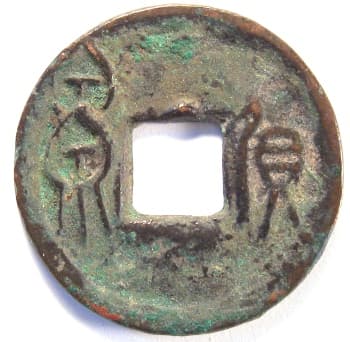
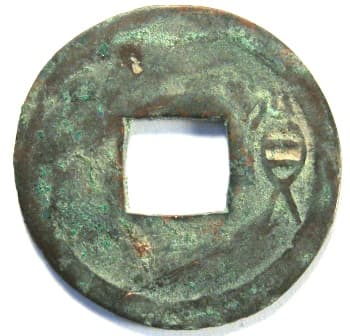 The most common form of money from the Wang
Mang era is the huo
quan (货泉) which exists in
many varieties, sizes and weights. The smallest
specimens can weigh less than 2 grams while the heaviest
can weigh 10-20 grams or more.
The most common form of money from the Wang
Mang era is the huo
quan (货泉) which exists in
many varieties, sizes and weights. The smallest
specimens can weigh less than 2 grams while the heaviest
can weigh 10-20 grams or more.
At the left are two very unusual mint errors of the huo quan coin.
The coin at the far left has two quan (泉) characters, one just above the other. It also has a "star" at the top of square hole. (diameter: 23 mm, weight: 2.7 grams)
The huo quan coin at the near left has only the huo (货) character to the right of the square hole and no quan (泉) character to the left. (diameter: 24 mm, weight: 2.6 grams)
The very light huo quan coins were probably privately cast. The heavier pieces were most likely cast during the final years of the Wang Mang reign. Most of these heavier huo quan pieces have been excavated in an area east of Baoji (宝鸡) and west of Xian (西安), known in more ancient times as Chang'an (长安).
Because these heavier huo quan coins bulge outward, they are popularly referred to as "cake money" or "biscuit money" (bing qian 饼钱). These coins are not very uniform and differ in size, weight and calligraphy.
Specimens exist which are made of iron or iron alloys. Some of these coins have no inscription at all. Others exist as two coins joined together because they were never chiseled apart after being removed from the mold.
Of course, these heavy "cake coins" would not have been valued the same as the standard cash coins. Their actual value was probably determined according to their weight.
Wang Mang issued other round coins with square holes. The coins, known as the "Six Coins" (liu quan 六泉), were cast during the years 9-14 AD with the following names and denominations:
The "Small Coin, Value One" and "Large Coin, Fifty" are fairly common but all the other coins are rare.
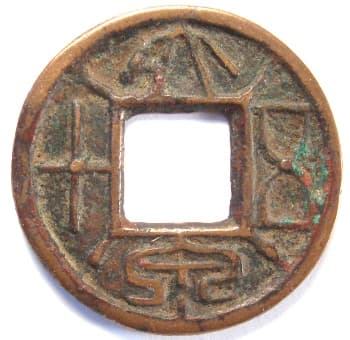 The "Large Coin,
Fifty" (da quan wu shi
大泉五十) exists in many sizes and
varieties.
The "Large Coin,
Fifty" (da quan wu shi
大泉五十) exists in many sizes and
varieties.
The example at the left is one of the rarer varieties. It has four lines extending from the corners of the hole to the rim which the Chinese refer to as si chu (四出). (diameter: 26.8 mm, weight: 4.2 grams)
One other coin issued by Wang Mang beginning in 14 AD was called the "Spade Coin" (bu quan 布泉). From the name one would think that it was shaped like the other forms of spade money. However, this "Spade Coin" is actually round with a square hole in the center and resembles the traditional Chinese cash coin.
There are two forms of money from the Wang Mang era which have created controversy among coin collectors. The first is a piece that resembles neither a coin nor any other type of ancient currency such as a spade or knife.
The piece has a round top portion and a square lower portion. The inscription surrounding the square hole at the top is written in an unusual order (top, left, right, bottom) as guo bao jin kui (国宝金匮).
The exact meaning is unclear but the inscription roughly translates as "national treasure gold deficiency".
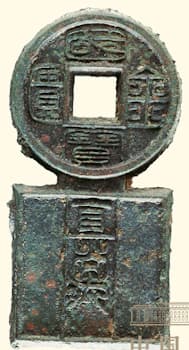 At the
left is the guo bao jin kui (国 宝金匮)
coin at the National
Museum of China (国
宝金匮).
At the
left is the guo bao jin kui (国 宝金匮)
coin at the National
Museum of China (国
宝金匮).
There are two Chinese characters on the lower part of the piece which are read top to bottom as zhi wan (直万) meaning "value ten thousand".
Some experts feel that this piece is not money but rather an emblem symbolizing that Wang Mang possessed several 10,000 jin of gold.
Other experts believe that it really is a form of money but that because its denomination was so large it never officially circulated.
There is also some discrepancy as to how many guo bao jin kui zhi wan (国 宝金匮直 万) actually exist. While the number of fake pieces seems to be unlimited, some reference books mention only one authentic piece being known to exist. Other reference sources state that there exist two pieces while other sources mention two and a half.
The "half" piece apparently refers to one specimen for which only the top portion exists.
One source states that one of the specimens was unearthed in 1921 in a field northwest of the city of Xian (西安, formerly Chang'an 长安) which was the site of government offices at the end of the Han Dynasty.
The second Wang Mang form of currency that remains embroiled in controversy is a coin with the inscription xin bu shi yi zhu (新布十一铢) which translates as "new spade eleven zhu". The only known example is at the National Museum of China (中国国家博物馆) in Beijing.
Some experts are suspicious that this piece is a fake, however, because the calligraphy is different and also the coin has four lines (sichu 四出) extending from the corners of the square hole.
Additional specimens of coins, knives and spades from the Wang Mang era may be seen at the links below.
Unfortunately, Wang Mang lacked a basic understanding of monetary economics. He was interested in acquiring a great deal of wealth and during the very short period of time he was in power he managed to introduce 37 different kinds of money in a variety of substances, patterns and units.
Most of these forms of money had denominations which did not reflect their intrinsic worth. For example, a monetary piece may have had a stated value of 1,000 coins when it only had a real value of 3 or 4 wuzhu (五 铢) coins.
Because of the unrealistic value of the money, many people turned to casting their own coins to minimize their losses. As a countermeasure, however, Wang Mang issued edicts stipulating strict punishments for those who privately cast coins.
Dissatifaction with Wang Mang's rule ultimately became too great to bear and the people rose up against the government.
In the end, Wang Mang was killed and beheaded. His head was kept and came to symbolize a great criminal in the years that followed.
Unfortunately, Wang Mang's head was one of the objects lost in a fire that destroyed a treasury building during the Western Jin (西晋 265-316). Another treasure that was reportedly lost in the same fire was the sword of Liu Bang (刘邦), the founder of the Western Han Dynasty, had used to kill the white snake.
Wang Mang carried out four major reforms of the monetary system during his short reign. In his attempt to restore ancient institutions, he issued money in very many forms.
These included forms of money which had been used in older times such knives. In the years 7-9 AD Wang Mang issued knife money as yi dao ping wu qian (一刀平五千) which translates as "one knife worth five thousand". This particular knife coin has the yi dao (一 刀) characters, meaning "one knife", inlaid in real gold. This knife had a stated value equivalent to 5,000 standard cash coins. Authentic specimens are fairly rare and are cherished by coin collectors as exquisite works of art.
A second form of knife money has the inscription qi dao wu bai (契刀五百) which translates as "inscribed knife five hundred". The government stipulated its value as equal to 500 cash coins. Unlike the "one knife worth five thousand", the inscription on this knife does not have any inlaid gold.
Another ancient money form adopted by Wang Mang was the spade. During the years 10-14 AD, Wang Mang issued the "Ten Spades" (shi bu 十布) with the following names and denominations:
| Type |
Inscription |
Pinyin |
| Small Spade, One Hundred | 小布一百 | xiao bu yi bai |
| Baby Spade, Two Hundred | 么布二百 | yao bu er bai |
| Juvenile Spade, Three Hundred | 幼布三百 | you bu san bai |
| Ordered Spade, Four Hundred | 序布四百 | xu bu si bai |
| Servant Spade, Five Hundred | 差布五百 | cha bu wu bai |
| Middle Spade, Six Hundred | 中布六百 | zhong bu liu bai |
| Adult Spade, Seven Hundred | 壮布七百 | zhuang bu zi bai |
| Graduate Spade, Eight Hundred | 第布八百 | di bu ba bai |
| Lower Spade, Nine Hundred | 次布九百 | ci bu jiu bai |
| Large Spade, Weight One Thousand | 大布黄千 | da bu heng qian |
All of the above spade coins are considered to be rare.
A second type of spade money was the "Money Spade" (huo bu 货布) which had the equivalent value of 25 cash coins. The huo bu coins are not as rare as the other Wang Mang spade coins.
The most common form of money from the Wang
Mang era is the huo
quan (货泉) which exists in
many varieties, sizes and weights. The smallest
specimens can weigh less than 2 grams while the heaviest
can weigh 10-20 grams or more.At the left are two very unusual mint errors of the huo quan coin.
The coin at the far left has two quan (泉) characters, one just above the other. It also has a "star" at the top of square hole. (diameter: 23 mm, weight: 2.7 grams)
The huo quan coin at the near left has only the huo (货) character to the right of the square hole and no quan (泉) character to the left. (diameter: 24 mm, weight: 2.6 grams)
The very light huo quan coins were probably privately cast. The heavier pieces were most likely cast during the final years of the Wang Mang reign. Most of these heavier huo quan pieces have been excavated in an area east of Baoji (宝鸡) and west of Xian (西安), known in more ancient times as Chang'an (长安).
Because these heavier huo quan coins bulge outward, they are popularly referred to as "cake money" or "biscuit money" (bing qian 饼钱). These coins are not very uniform and differ in size, weight and calligraphy.
Specimens exist which are made of iron or iron alloys. Some of these coins have no inscription at all. Others exist as two coins joined together because they were never chiseled apart after being removed from the mold.
Of course, these heavy "cake coins" would not have been valued the same as the standard cash coins. Their actual value was probably determined according to their weight.
Wang Mang issued other round coins with square holes. The coins, known as the "Six Coins" (liu quan 六泉), were cast during the years 9-14 AD with the following names and denominations:
| Type |
Inscription |
Pinyin |
| Small Coin, Value One | 小泉直一 | xiao quan zhi yi |
| Baby Coin, Ten | 么泉一十 | yao quan yi shi |
| Juvenile Coin, Twenty | 幼泉二十 | you quan er shi |
| Middle Coin, Thirty | 中泉三十 | zhong quan san shi |
| Adult Coin, Forty | 壮泉四十 | zhuang quan si shi |
| Large Coin, Fifty | 大泉五 | da quan wu shi |
The "Small Coin, Value One" and "Large Coin, Fifty" are fairly common but all the other coins are rare.
The "Large Coin,
Fifty" (da quan wu shi
大泉五十) exists in many sizes and
varieties.The example at the left is one of the rarer varieties. It has four lines extending from the corners of the hole to the rim which the Chinese refer to as si chu (四出). (diameter: 26.8 mm, weight: 4.2 grams)
One other coin issued by Wang Mang beginning in 14 AD was called the "Spade Coin" (bu quan 布泉). From the name one would think that it was shaped like the other forms of spade money. However, this "Spade Coin" is actually round with a square hole in the center and resembles the traditional Chinese cash coin.
There are two forms of money from the Wang Mang era which have created controversy among coin collectors. The first is a piece that resembles neither a coin nor any other type of ancient currency such as a spade or knife.
The piece has a round top portion and a square lower portion. The inscription surrounding the square hole at the top is written in an unusual order (top, left, right, bottom) as guo bao jin kui (国宝金匮).
The exact meaning is unclear but the inscription roughly translates as "national treasure gold deficiency".
At the
left is the guo bao jin kui (国 宝金匮)
coin at the National
Museum of China (国
宝金匮).There are two Chinese characters on the lower part of the piece which are read top to bottom as zhi wan (直万) meaning "value ten thousand".
Some experts feel that this piece is not money but rather an emblem symbolizing that Wang Mang possessed several 10,000 jin of gold.
Other experts believe that it really is a form of money but that because its denomination was so large it never officially circulated.
There is also some discrepancy as to how many guo bao jin kui zhi wan (国 宝金匮直 万) actually exist. While the number of fake pieces seems to be unlimited, some reference books mention only one authentic piece being known to exist. Other reference sources state that there exist two pieces while other sources mention two and a half.
The "half" piece apparently refers to one specimen for which only the top portion exists.
One source states that one of the specimens was unearthed in 1921 in a field northwest of the city of Xian (西安, formerly Chang'an 长安) which was the site of government offices at the end of the Han Dynasty.
The second Wang Mang form of currency that remains embroiled in controversy is a coin with the inscription xin bu shi yi zhu (新布十一铢) which translates as "new spade eleven zhu". The only known example is at the National Museum of China (中国国家博物馆) in Beijing.
Some experts are suspicious that this piece is a fake, however, because the calligraphy is different and also the coin has four lines (sichu 四出) extending from the corners of the square hole.
Additional specimens of coins, knives and spades from the Wang Mang era may be seen at the links below.
| Type |
Inscript |
Pinyin |
Descript |
| Wang Mang
large coin fifty |
大泉五十 | da quan wu shi | large coin fifty with incused radiating lines (四出) |
| Wang
Mang knife money |
金错刀 | jin cuo dao | one knife worth
five thousand |
| Wang Mang Spades |
幼布三百 | you bu san bai | juvenile spade,
three hundred |
| Wang Mang money spade |
货布 | huo bu | money spade |
| Wang Mang
wealth/money coin |
货泉 | huo quan | wealth/money coin |
| Wang Mang biscuit
coin |
货泉 | huo quan (bing qian) |
wealth/money
biscuit or cake coin |
| Wang Mang
spade coin |
布泉 | bu quan | spade coin |
Eastern Han Dynasty (25-220) and
Later Wu Zhu Coins
Dong
Zhuo (董卓) was a cruel and tyrannical warlord that lived
(138-192 AD) near the end of the Eastern Han and whose
infamy was forever immortalized in the famous 14th
Century historical novel Romance of the Three Kingdoms (san guo yan yi 三国演义)
written by Luo Guanzhong (罗贯中).He moved the capital from Luoyang to Chang'an (Xian) in 190 AD and while there melted down large bronze statues dating from the time of Emperor Qin Shi Huang of the Qin Dynasty (221-207 BC) to cast small coins.
Many of these coins were so small that they were popularly referred to as "goose eye" (e yan 鹅眼) or "chicken eye" (ji mu 鸡目) coins.
Some of these small coins, however, were also cast with the wu zhu (五 铢) inscription but because of their diminutive size only the left half of the wu (五) character and the right half of the zhu (铢) character fit on the coin.
Displayed here is an example of such a wu zhu coin attributed to Dong Zhuo. Despite its crude appearance, the characters are actually very well cast in high relief. The zhu character to the left of the square hole is particularly distinctive in that it extends from the top of the rim to the bottom.
It is also important to note that this coin is not what is referred to as a "chiselled rim" (zao bian 凿边) coin where a normal size wu zhu coin had the inside cut out so as to form two coins. This wu zhu coin was actually cast like this as evidenced by the remnant of the metal sprue (stub) from the casting process located at the rim's five o'clock position.
This small coin has a diameter of 17 mm and a weight of 1.1 grams.
Wu zhu coins were cast for more than 700 years. It is very difficult to attribute these coins to a specific reign but examples of various types of wu zhu coins can be seen at the following links.
| Descript |
Inscript | Pinyin | Special |
| five zhu coins with reverse inscription | 铢五 | wu zhu | wu
zhu (wu shu) coins with reverse inscriptions |
| five zhu
coins with dots |
五 铢 | wu zhu | wu
zhu (wu shu) coins with stars |
| five zhu
coins with circles |
五 铢 | wu zhu | wu zhu (wu shu) coins with suns |
| five
zhu coins with numbers |
五 铢 | wu zhu | wu
zhu (wu shu) coins with numbers |
| five zhu
coins with rod numbers |
五 铢 | wu zhu | wu
zhu (wu shu) coins with rod numbers |
| five zhu
coins with lines |
五 铢 | wu zhu | wu
zhu (wu shu) coins with lines |
| five
zhu coins with characters and symbols |
五 铢 | wu zhu | wu zhu (wu shu)
coins with characters and symbols |
| five
zhu coin with flower hole, dots, number and
character |
五 铢 | wu zhu | wu zhu (wu shu) coin with flower hole, stars, and number "2" or character gong (工) |
Three Kingdoms (220-280)
The "Three Kingdoms" period (san guo shi dai 三国时代) consisted of the Kingdom of Shu (蜀, "Shu Han" (蜀汉) 221-265), the Kingdom of Wu (吴, "Eastern Wu" (东吴), "Sun Wu" (孙吴) 222-280) and the Kingdom of Wei (魏, "Cao Wei" (曹魏) 220-255).
The "Three Kingdoms" period will forever be remembered as China's "Age of Chivalry" due to the popularity of the famous historical novel "Romance of the Three Kingdoms" (san guo yan yi 三国演义) written by Luo Guanzhong (罗贯中).
In reality, however, the Three Kingdoms period was a time of constant warfare, stagnant economies, and decreasing populations.
Shu Han (221-263)
A severe shortage of copper directly affected the production of coins during this period. In fact, the copper shortage was so severe that it is said that even the hooks used to hang bed curtains were melted down to make coins.
To raise funds, Liu Bei proceeded to cast zhi bai wu zhu ("Value One Hundred Wu Zhu" 直百五铢) coins with a value equivalent to 100 cash coins.
By so doing, however, he was implementing the same policy as Wang Mang by producing a large denomination coin which was not worth its stated value. The results, however, were not quite as disastrous as in Wang Mang's case because many of the coins in circulation were cast by Dong Zhuo and these small coins weighed only about one gram each.
An even smaller version of the coin, with only the two-characters zhi bai (直百) meaning "Value One Hundred", was also cast.
Other coins cast by the Kingdom of Shu include the tai ping bai qian ("Taiping One Hundred Cash" 太平百钱), zhi yi ("Value One" 直一), and ding ping yi bai ("Ding Ping One Hundred" 定平一百).
At the left is a distinctive variety of the wu zhu (五 铢) coins.
Unlike most wu zhu, there is a rim around the square hole on the obverse side.
Old Chinese coin catalogs have traditionally attributed this coin to Liu Bei and the Kingdom of Shu (221-263) and it has consequently become known as a "Shu" wu zhu (蜀五铢).
Recent archaeological discoveries, however, now cast some doubt as to these coins being from the Kingdom of Shu.
The diameter of this coin is 21.7 mm and the weight is 2.3 grams.
Wu (222-280)
The Kingdom of Wu (吴,
"Eastern Wu" 东吴, "Sun Wu" 孙吴 222-280)
was ruled by Sun Quan (孙权) who cast coins with very
large denominations. These include the da quan wu bai
("Large Coin Five Hundred" 大泉五百), da quan dang qian
("Large Coin Worth a Thousand" 大泉当千), da quan er qian
("Large Coin, Two Thousand" 大泉二千) and da quan wu qian
("Large Coin, Five Thousand" 大泉五千) coins.
Because of inflation, the real purchasing power of the da quan wu bai ("Large Coin Five Hundred") was far less than an equivalent five hundred wu zhu coins cast during the Han Dynasty.
The da quan er qian ("Large Coin, Two Thousand") and da quan wu qian ("Large Coin, Five Thousand") coins were cast in small quantities and had limited circulation. As a result, they are very rare. Only six specimens of the da quan wu qian are known to exist.
The size and weight of the coins clearly decreased over time. For example, early specimens of the da quan dang qian ("Large Coin Worth a Thousand") have diameters of 4.3 cm making them even larger than the da quan wu qian ("Large Coin, Five Thousand"). Later cast da quan dang qian coins, however, are only about 2.5 cm in diameter.
Wei (220-265)
Regarding the Kingdom of Wei (魏,
"Cao Wei" 曹魏 220-265) established by Cao Cao
(曹操), only wu zhu
coins are believed to have been cast.
Other examples of coins from the Three Kingdoms can be found at the links below.
Because of inflation, the real purchasing power of the da quan wu bai ("Large Coin Five Hundred") was far less than an equivalent five hundred wu zhu coins cast during the Han Dynasty.
The da quan er qian ("Large Coin, Two Thousand") and da quan wu qian ("Large Coin, Five Thousand") coins were cast in small quantities and had limited circulation. As a result, they are very rare. Only six specimens of the da quan wu qian are known to exist.
The size and weight of the coins clearly decreased over time. For example, early specimens of the da quan dang qian ("Large Coin Worth a Thousand") have diameters of 4.3 cm making them even larger than the da quan wu qian ("Large Coin, Five Thousand"). Later cast da quan dang qian coins, however, are only about 2.5 cm in diameter.
Wei (220-265)
Other examples of coins from the Three Kingdoms can be found at the links below.
| Inscript | Pinyin | Special |
Years Cast | Kingdom |
| 直百五铢 | zhi
bai wu zhu |
fish symbol on
reverse side |
214 |
Shu |
| 太平百钱 | tai ping bai qian | 221-265 | Shu |
|
| 太平百钱 | tai ping bai
qian |
very small
with flower hole |
221-265 | Shu |
Western Jin Dynasty (265-316)
During the short-lived Western Jin, the government storehouses were full and the country was powerful and prosperous.
No historical texts mention the casting of coins during the Western Jin. Since the economy was recovering, however, there must have been a sharp increase in the need for cash coins.
The quantity of old wu zhu coins from the Han Dynasty that were still circulating would been insufficient. Coins, most probably wu zhu, must have been produced but their characteristics are still unknown. Future archaeological discoveries may be able to provide the answer.
Eastern Jin Dynasty (317-420)
The "War of the Eight Princes" was a civil war involving eight members of the Sima (司马) family who assassinated one another with the intent of seizing political power in northern China.
The rebellion caused extreme hardship and unrest among the people.
The Jin Dynasty (晋朝) was so weakened that various ethnic minorities in the north, known collectively as the Wu Hu (五胡), were able to break away and establish sovereignty in their own areas.
These short-lived independent states are referred to as the "Sixteen Kingdoms" (shi liu guo 十六国 304-439).
Cheng Han (304-347)
Li Shou (李寿 338-343) of the Cheng Han Kingdom ruled under the reign title "Han Xing" and in the year 338 began to cast small and thin coins with the inscription Han Xing (汉兴).
The Han Xing coin is famous for being the first coin in Chinese history to use a period title in its inscription.
There are two varieties of the Han Xing coin. One variety has the inscription written horizontally (hengdu 横读) while the second variety has the inscription written vertically (zhidu 直读). The horizontally written version is the rarer of the two.
Shi Le (石勒 319-333) was a member of a small tribe situated in northern China known as the Jie (羯). He established another of the Sixteen Kingdoms known as the Later Zhao Kingdom (后赵 319-351) and installed himself as king.
King Shi Le cast coins with the inscription feng huo (丰货 "Coin of Abundance").
There exist two varieties of the feng huo coin. The "small character" (xiaozi 小字) variety has a rim around the square hole on the reverse side while the "large character" (dazi 大字) version does not.
Shi Hu (石虎 334-349) succeeded Shi Le as king. King Shi Hu's rule was exceedingly brutal and the people lived in extreme poverty. It is ironic that the coins of the realm carried the inscription "Coin of Abundance".
Former Liang (301-376)
Zhang Gui was succeeded by his eldest son Zhang Shi (张实 314-320), Duke Ming of Xiping, who cast small and thin coins with the inscription liang zao xin quan (谅造新泉 "Liang Made New Coin"). In recent years, these coins have been unearthed in the areas of Chang'an (长安, Xi'an西安 ) in Shaanxi Province and in Wuwei (武威) of Gansu Province.
Xia (407-431)
Emperor Helian Bobo cast coins with the inscription tai xia zhen xing (太夏真兴 "Great Xia Zhenxing") during his Zhenxing reign (真 兴 419-424).
These tai xia zhen xing coins are very rare.
A coin from the Later Zhou Kingdom may be seen at the link below.
| Inscription: |
Pinyin: |
Years Cast: |
Kingdom: |
| 丰货 | feng huo |
319-352 |
Later Zhou |
Southern Dynasties
The Eastern Jin Dynasty
came to an end when General Liu Yu (刘裕) seized the
throne from Emperor Gong (晋恭帝) in the year 420.
By declaring himself to be Emperor Wu (宋文帝) of Liu Song, Liu Yu effectively began the period in Chinese history known as the Southern and Northern Dynasties (南北朝 420-589).
The Southern Dynasties (南朝) consisted of the Liu Song Dynasty (刘宋朝 420-479), the Southern Qi Dynasty (南齐朝 479-502), the Liang Dynasty (梁朝 502-557) and the Chen Dynasty (陈朝 557-589).
These four dynasties are grouped together as the Southern Dynasties because they succeeded one another with their capital at Jiankang (建康) near present-day Nanjing (南京).
During the Southern Dynasties, it was common for people to cut out the middle portion of a wu zhu (五 铢) coin thus making two coins from one. The outer ring portion of the coin is usually termed a "thread ring" wu zhu (yan huan wu zhu 綖 環五铢) while the inner portion is referred to as a "chiseled rim" wu zhu (zao bian wu zhu 凿边五 铢) or "cut rim" wu zhu (jian lun wu zhu 剪轮五 铢).
Private casting of coins was also common during this period and, as a result, there were many extremely small, thin and fragile bronze coins cast which are known as "goose eye" (e yan 鹅眼) or "chicken eye" (ji mu 鸡目) coins.
There were also officially cast coins as described in detail below.
By declaring himself to be Emperor Wu (宋文帝) of Liu Song, Liu Yu effectively began the period in Chinese history known as the Southern and Northern Dynasties (南北朝 420-589).
The Southern Dynasties (南朝) consisted of the Liu Song Dynasty (刘宋朝 420-479), the Southern Qi Dynasty (南齐朝 479-502), the Liang Dynasty (梁朝 502-557) and the Chen Dynasty (陈朝 557-589).
These four dynasties are grouped together as the Southern Dynasties because they succeeded one another with their capital at Jiankang (建康) near present-day Nanjing (南京).
During the Southern Dynasties, it was common for people to cut out the middle portion of a wu zhu (五 铢) coin thus making two coins from one. The outer ring portion of the coin is usually termed a "thread ring" wu zhu (yan huan wu zhu 綖 環五铢) while the inner portion is referred to as a "chiseled rim" wu zhu (zao bian wu zhu 凿边五 铢) or "cut rim" wu zhu (jian lun wu zhu 剪轮五 铢).
Private casting of coins was also common during this period and, as a result, there were many extremely small, thin and fragile bronze coins cast which are known as "goose eye" (e yan 鹅眼) or "chicken eye" (ji mu 鸡目) coins.
There were also officially cast coins as described in detail below.
Liu Song Dynasty (420-479)
In the year 430,
Emperor Wen (宋文帝) of the Song (Liu Song) began to
circulate coins with the inscription si zhu (四柱)
which translates as "Four Zhu". The "four zhu" refers to
the actual weight of the coin.
Many of these "four zhu" coins have a dot ("star" 星) above and below the square hole on the obverse side.
Beginning in the year 454 of his Xiao Jian (孝建) reign, Emperor Xiaowu (宋孝武帝) issued coins with the inscription xiao jian (孝建) on the obverse and si zhu ("four zhu" 四柱) on the reverse. The inscriptions are written in a stylish seal script.
There are a number of varieties of the xiao jian coin including reversed inscriptions, stars above and below the square hole, etc.
However, these coins were cast in smaller and smaller sizes until they no longer were four zhu in weight. Some coins were even too small to have room for the si zhu ("four zhu") inscription on the reverse.
Emperor Qianfei (刘前废帝) ruled for only a very short period (464-465) but still managed in 465 AD to issue both the yong guang (永光) coin and the liang zhu (两 柱) coin during his yong guang reign. In the same year, he also issued the jing he (景和) coin during his jing he reign. All three coins are small and equivalent to two zhu.
The yong guang, liang zhu and jing he coins are very rare because they were cast for such a short period. A few specimens have been unearthed in the Hangzhou (杭州) and Changzhou (常州) areas.
Many of these "four zhu" coins have a dot ("star" 星) above and below the square hole on the obverse side.
Beginning in the year 454 of his Xiao Jian (孝建) reign, Emperor Xiaowu (宋孝武帝) issued coins with the inscription xiao jian (孝建) on the obverse and si zhu ("four zhu" 四柱) on the reverse. The inscriptions are written in a stylish seal script.
There are a number of varieties of the xiao jian coin including reversed inscriptions, stars above and below the square hole, etc.
However, these coins were cast in smaller and smaller sizes until they no longer were four zhu in weight. Some coins were even too small to have room for the si zhu ("four zhu") inscription on the reverse.
Emperor Qianfei (刘前废帝) ruled for only a very short period (464-465) but still managed in 465 AD to issue both the yong guang (永光) coin and the liang zhu (两 柱) coin during his yong guang reign. In the same year, he also issued the jing he (景和) coin during his jing he reign. All three coins are small and equivalent to two zhu.
The yong guang, liang zhu and jing he coins are very rare because they were cast for such a short period. A few specimens have been unearthed in the Hangzhou (杭州) and Changzhou (常州) areas.
Liang Dynasty (502-557)
Wu zhu
coins were cast during the reign of Emperor Wu
(梁武帝) of Liang (梁朝). Some of these coins
had outside rims while others did not.
Coins without outside rims were called the "Female Coin" (nu qian 女钱).
After the year 523, coins were cast in iron because iron was inexpensive and easy to obtain in the Sichuan area.
These iron coins are distinctive because they have four lines radiating outwards from the corners of the square hole on the reverse side. The Chinese refer to this as si chu ("corner coin" 四出).
Unfortunately, it became a common practice for people to privately cast these iron coins. Within a short period of time, iron coins became so plentiful that their value fell drastically which meant it took a cartload of them to buy anything.
Not surprisingly, many of these si chu iron coins have survived to this day including this specimen.
It is interesting to note that Emperor Wu of Liang was a devoted Buddhist who, around the year 520, met with the Buddhist monk Bodhidharma (菩提达摩). Bodhidharma is the famous monk recognized as the founder of the Ch'an sect (chan zong 禅宗) in China and the first Chinese patriarch. He is also believed to have been the creator of Kung Fu, the Chinese art of fighting, at the Shaolin Temple (少林寺).
Ch'an eventually evolved into Zen Buddhism in Japan.
The tai qing feng le ("Tai Qing Prosperous and Happy" 太清丰乐), which until fairly recent times had been considered to be a charm, is now generally recognized to be a coin cast during the years 547-549 of the Taiqing (太清) reign of Emperor Wu of Liang.
Emperor Yuan (梁元帝) of Liang moved the capital to Jiangling (江陵) where in 552 AD he issued wu zhu coins distinguished by having one dot ("star") above and one dot below the square hole on the obverse.
These coins were worth the equivalent of ten regular wu zhu coins and, because of their distinctive two "stars", are referred to as "Two Pillar" wu zhu (liang zhu wu zhu 两柱五铢) coins.
In Chinese numismatic circles, the "Two Pillar" wu zhu is considered to be a fairly scarce coin.
In 557 AD, Emperor Jing (梁敬帝) of Liang had wu zhu coins cast with one dot above and one dot below the square hole on both the obverse and reverse sides of the coin. There is also a variety of the coin which has the dots to the right and left of the square hole on the reverse side as opposed to above and below.
These very distinctive coins with a total of four "stars" are known as "Four Pillar" wu zhu (si zhu wu zhu 四柱五铢). The coins were originally valued as the equivalent to twenty regular wu zhu coins. In just a little more than ten days after they began to circulate, however, their value fell to being worth exactly the same as a common wu zhu coin.
Because the Four Pillar coin circulated for such a short period of time, they are now very rare. Most specimens have the dots at the right and left of the square hole on the reverse side. Specimens with the dots above and below the hole on the reverse are even rarer.
Two Pillar and Four Pillar coins weigh less than 2 or 3 grams each. Yet, they were initially valued at the equivalent of ten and twenty normal wu zhu coins, respectively, which contributed to the deteriorating economic conditions of the time.
There also exists a "Three Pillar" wu zhu (san zhu wu zhu 三柱五铢) coin which is very similar in style to the "Two Pillar" and "Four Pillar" coins.
The Three Pillar wu zhu has one dot above and one dot below the square hole on the obverse. On the reverse, there is one dot just to the left and touching the rim that surrounds the square hole.
No historical record mentions the production of a "Three Pillar" coin.
There is speculation that the "Three Pillar" wu zhu may have been cast during a very short period, perhaps only five days, in 557 AD after production of the "Four Pillar" coins had ceased. The "Three Pillar" coin, according to the theory, would have been cast to indicate that, given the economic situation, the coin should be worth less than the over-valued Four Pillar coin. The new "Three Pillar" coin would be worth ten of the common wu zhu coins which was the same as the older "Two Pillar" coin which was also considered over-valued. The new "value ten" coin could be easily differentiated from the "old" coin in the market place with its three dots instead of two.
"Three Pillar" wu zhu coins are now extremely rare because they were only cast for a very short time.
This coin has a diameter of 25 mm and a
weight of 3.4 grams.
Coins without outside rims were called the "Female Coin" (nu qian 女钱).
After the year 523, coins were cast in iron because iron was inexpensive and easy to obtain in the Sichuan area.
These iron coins are distinctive because they have four lines radiating outwards from the corners of the square hole on the reverse side. The Chinese refer to this as si chu ("corner coin" 四出).
Unfortunately, it became a common practice for people to privately cast these iron coins. Within a short period of time, iron coins became so plentiful that their value fell drastically which meant it took a cartload of them to buy anything.
Not surprisingly, many of these si chu iron coins have survived to this day including this specimen.
It is interesting to note that Emperor Wu of Liang was a devoted Buddhist who, around the year 520, met with the Buddhist monk Bodhidharma (菩提达摩). Bodhidharma is the famous monk recognized as the founder of the Ch'an sect (chan zong 禅宗) in China and the first Chinese patriarch. He is also believed to have been the creator of Kung Fu, the Chinese art of fighting, at the Shaolin Temple (少林寺).
Ch'an eventually evolved into Zen Buddhism in Japan.
The tai qing feng le ("Tai Qing Prosperous and Happy" 太清丰乐), which until fairly recent times had been considered to be a charm, is now generally recognized to be a coin cast during the years 547-549 of the Taiqing (太清) reign of Emperor Wu of Liang.
Emperor Yuan (梁元帝) of Liang moved the capital to Jiangling (江陵) where in 552 AD he issued wu zhu coins distinguished by having one dot ("star") above and one dot below the square hole on the obverse.
These coins were worth the equivalent of ten regular wu zhu coins and, because of their distinctive two "stars", are referred to as "Two Pillar" wu zhu (liang zhu wu zhu 两柱五铢) coins.
In Chinese numismatic circles, the "Two Pillar" wu zhu is considered to be a fairly scarce coin.
In 557 AD, Emperor Jing (梁敬帝) of Liang had wu zhu coins cast with one dot above and one dot below the square hole on both the obverse and reverse sides of the coin. There is also a variety of the coin which has the dots to the right and left of the square hole on the reverse side as opposed to above and below.
These very distinctive coins with a total of four "stars" are known as "Four Pillar" wu zhu (si zhu wu zhu 四柱五铢). The coins were originally valued as the equivalent to twenty regular wu zhu coins. In just a little more than ten days after they began to circulate, however, their value fell to being worth exactly the same as a common wu zhu coin.
Because the Four Pillar coin circulated for such a short period of time, they are now very rare. Most specimens have the dots at the right and left of the square hole on the reverse side. Specimens with the dots above and below the hole on the reverse are even rarer.
Two Pillar and Four Pillar coins weigh less than 2 or 3 grams each. Yet, they were initially valued at the equivalent of ten and twenty normal wu zhu coins, respectively, which contributed to the deteriorating economic conditions of the time.
There also exists a "Three Pillar" wu zhu (san zhu wu zhu 三柱五铢) coin which is very similar in style to the "Two Pillar" and "Four Pillar" coins.
The Three Pillar wu zhu has one dot above and one dot below the square hole on the obverse. On the reverse, there is one dot just to the left and touching the rim that surrounds the square hole.
No historical record mentions the production of a "Three Pillar" coin.
There is speculation that the "Three Pillar" wu zhu may have been cast during a very short period, perhaps only five days, in 557 AD after production of the "Four Pillar" coins had ceased. The "Three Pillar" coin, according to the theory, would have been cast to indicate that, given the economic situation, the coin should be worth less than the over-valued Four Pillar coin. The new "Three Pillar" coin would be worth ten of the common wu zhu coins which was the same as the older "Two Pillar" coin which was also considered over-valued. The new "value ten" coin could be easily differentiated from the "old" coin in the market place with its three dots instead of two.
"Three Pillar" wu zhu coins are now extremely rare because they were only cast for a very short time.
Chen Dynasty (557-589)
During the
years 560-566 AD of his Tian Jia (天
嘉) reign, Emperor Wen (陈文帝) of
Chen issued wu zhu coins which had a
value equal to ten of the very small and
lightweight "goose eye" and "chicken eye"
coins.
Unfortunately, no one seems to know for sure what these "Tian Jia" wu zhu (天嘉五铢) coins look like.
Most experts feel that the coin would be a large and well-made wu zhu coin with a rim around the square hole on the obverse side. The coin should have characteristics similar to the tai huo liu zhu (太货六铢) coin.
In the past, wu zhu coins similar to this were believed to have been cast during the period 502-519 (tian jian天监) by Emperor Wu (梁武帝) of the Liang.
More recently, however, it has been proposed that such coins were cast during the Northern Zhou since many coins like this have been unearthed in the Guanzhong (关中) region of Shaanxi Province.
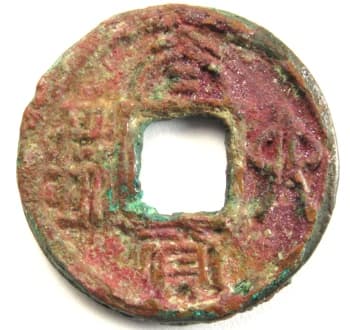 Emperor
Xuan (陈宣帝) of Chen issued the beautiful
"Large Coin Six Zhu" (tai huo liu
zhu 太货六铢) coin in 579 AD.
This coin with the beautiful calligraphy,
displayed at the left, is considered to be
the "crown jewel" of Southern Dyansty coins.
Emperor
Xuan (陈宣帝) of Chen issued the beautiful
"Large Coin Six Zhu" (tai huo liu
zhu 太货六铢) coin in 579 AD.
This coin with the beautiful calligraphy,
displayed at the left, is considered to be
the "crown jewel" of Southern Dyansty coins.
The coin was originally worth ten regular wu zhu coins but because of popular discontent was revalued to one wu zhu.
The Chinese character liu (六), meaning "six", at the right of the square hole, resembles a person standing akimbo (with hands on hips and legs apart). The saying at the time was that this symbolized the people crying before the Emperor because of the over-valued currency.
There is also a very famous and rare version of this coin which has only the inscription "Six Zhu" (liu zhu 六铢). The "Large Coin" (tai huo 太货) characters are missing. Only one specimen is known to exist.
Unfortunately, no one seems to know for sure what these "Tian Jia" wu zhu (天嘉五铢) coins look like.
Most experts feel that the coin would be a large and well-made wu zhu coin with a rim around the square hole on the obverse side. The coin should have characteristics similar to the tai huo liu zhu (太货六铢) coin.
In the past, wu zhu coins similar to this were believed to have been cast during the period 502-519 (tian jian天监) by Emperor Wu (梁武帝) of the Liang.
More recently, however, it has been proposed that such coins were cast during the Northern Zhou since many coins like this have been unearthed in the Guanzhong (关中) region of Shaanxi Province.
Emperor
Xuan (陈宣帝) of Chen issued the beautiful
"Large Coin Six Zhu" (tai huo liu
zhu 太货六铢) coin in 579 AD.
This coin with the beautiful calligraphy,
displayed at the left, is considered to be
the "crown jewel" of Southern Dyansty coins.The coin was originally worth ten regular wu zhu coins but because of popular discontent was revalued to one wu zhu.
The Chinese character liu (六), meaning "six", at the right of the square hole, resembles a person standing akimbo (with hands on hips and legs apart). The saying at the time was that this symbolized the people crying before the Emperor because of the over-valued currency.
There is also a very famous and rare version of this coin which has only the inscription "Six Zhu" (liu zhu 六铢). The "Large Coin" (tai huo 太货) characters are missing. Only one specimen is known to exist.
Northern Dynasties
Northern Wei Dynasty (386-534)
Emperor Xiaowen (孝文帝) of
the Northern Wei Dynasty (Later Wei, Yuan Wei 北魏朝) was
determined to reform the backwardness of his nomadic
Xianbei (鲜卑) people by adopting the administrative style
and many of the customs of the Han Chinese. As an
example, he moved the capital to Luoyang (洛阳) in 494 AD
which had been the capital of previous Chinese
dynasties. He also implemented policies requiring
that Chinese be spoken and that Chinese style clothes be
worn.
In line with his "Sinicization" program, Emperor Xiaowen issued coins with the inscription tai he wu zhu (太和五铢) written in seal script.
Tai he wu zhu coins are fairly scarce.
There is one variety of tai he wu zhu which has the tai (太) character written in a style similar to that of the tai on the tai huo liu zhu (太货六铢) coin of the Chen Dynasty. This particular variety, however, seems to only exist in rubbings published in old coin catalogs. For this reason, there is some doubt that the coin is real.
The Northern Wei issued wu zhu (五铢) coins again in the year 510 but the special characteristics of these coins are unknown.
The authority of the Northern Wei Dynasty was seriously weakened following the decade long rebellions of the "Six Frontier Towns" (liu zhen qi yi 六镇起义) which began in 523 AD.
In spite of this, Emperor Xiaozhuang (孝庄帝) in 529 AD during his Yongan (永 安) reign (528-530) began casting the yong an wu zhu (永安五铢) coin.
In 534 AD, Emperor Xiaowu (孝武帝) fled the capital and the Northern Wei Dynasty split into the Eastern Wei Dynasty (东魏朝 534-550) and the Western Wei Dynasty (西魏朝 534-557).
Even though the Eastern Wei and Western Wei would survive for only a few years, both dynasties continued to issue yong an wu zhu coins and these coins still exist in large quantities and in a number of varieties.
During this time period, other coins circulated with such names as "Auspicious Cash" (ji qian 吉钱) and "Heavenly Pillar" (tian zhu 天株). Both coins, as well as others, may actually have been varieties of yong an wu zhu coins.
The "Auspicious Cash" coin, for example, may be the variety of yong an wu zhu which has the Chinese character meaning "earth" (tu 土) above the square hole on the reverse side. Since the square hole looks like the Chinese character 口 (kou), the " 土" character with the "口" beneath resembles the character "吉" (ji) which means "auspicious".
The "Heavenly Pillar" coin may be the variety of yong an wu zhu that has a "dot" ("star" 星) in the lower right area of the obverse side. When the coin is held upright, it is pointing towards "heaven" (tian 天). The "star" can also be referred to as a "pillar" (zhu 株) because it is cylindrical and rises up from the surface (rou 肉) of the coin. For this reason, the "Heavenly Pillar" coin was most probably this particular variety of yong an wu zhu.
There is also a variety of yong an wu zhu (si chu 四出) which has four lines extending outwards from the corners of the square hole to the rim on the reverse side.
As mentioned, there were other coins that circulated at this time which also had descriptive names such as "Yongzhou Green-Red" (yong zhou qing chi 雍州青赤), "Liangzhou Born Thick" (liang zhou sheng hou 梁州生厚), "Tight Cash" (jin qian 紧钱) and "Red Halter" (chi qian 赤牵). These coins may also be references to specific varieties of yong an wu zhu coins which have yet to be clearly identified.
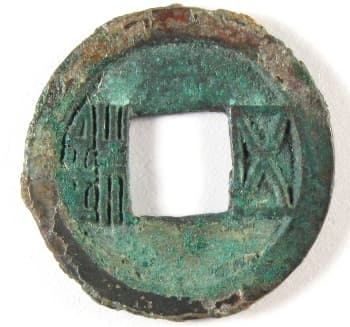
Wu zhu coins were cast during the Datong (535-551 大统) reign of the Western Wei Dynasty (西魏朝).
The calligraphy on these coins is similar to that of the yong an wu zhu and the Sui wu zhu.
At the left is an example of a Western Wei wu zhu coin.
The special characteristic of these Datong wu zhu coins are the broad outer rim with an inner rim only by the wu (五) character to the right of the square hole.
This coin has a diameter of 25 mm and a weight of 3.8 grams.
A Northern Zhou coin on which many charms
are based can be seen at the link below.
In line with his "Sinicization" program, Emperor Xiaowen issued coins with the inscription tai he wu zhu (太和五铢) written in seal script.
Tai he wu zhu coins are fairly scarce.
There is one variety of tai he wu zhu which has the tai (太) character written in a style similar to that of the tai on the tai huo liu zhu (太货六铢) coin of the Chen Dynasty. This particular variety, however, seems to only exist in rubbings published in old coin catalogs. For this reason, there is some doubt that the coin is real.
The Northern Wei issued wu zhu (五铢) coins again in the year 510 but the special characteristics of these coins are unknown.
The authority of the Northern Wei Dynasty was seriously weakened following the decade long rebellions of the "Six Frontier Towns" (liu zhen qi yi 六镇起义) which began in 523 AD.
In spite of this, Emperor Xiaozhuang (孝庄帝) in 529 AD during his Yongan (永 安) reign (528-530) began casting the yong an wu zhu (永安五铢) coin.
In 534 AD, Emperor Xiaowu (孝武帝) fled the capital and the Northern Wei Dynasty split into the Eastern Wei Dynasty (东魏朝 534-550) and the Western Wei Dynasty (西魏朝 534-557).
Even though the Eastern Wei and Western Wei would survive for only a few years, both dynasties continued to issue yong an wu zhu coins and these coins still exist in large quantities and in a number of varieties.
During this time period, other coins circulated with such names as "Auspicious Cash" (ji qian 吉钱) and "Heavenly Pillar" (tian zhu 天株). Both coins, as well as others, may actually have been varieties of yong an wu zhu coins.
The "Auspicious Cash" coin, for example, may be the variety of yong an wu zhu which has the Chinese character meaning "earth" (tu 土) above the square hole on the reverse side. Since the square hole looks like the Chinese character 口 (kou), the " 土" character with the "口" beneath resembles the character "吉" (ji) which means "auspicious".
The "Heavenly Pillar" coin may be the variety of yong an wu zhu that has a "dot" ("star" 星) in the lower right area of the obverse side. When the coin is held upright, it is pointing towards "heaven" (tian 天). The "star" can also be referred to as a "pillar" (zhu 株) because it is cylindrical and rises up from the surface (rou 肉) of the coin. For this reason, the "Heavenly Pillar" coin was most probably this particular variety of yong an wu zhu.
There is also a variety of yong an wu zhu (si chu 四出) which has four lines extending outwards from the corners of the square hole to the rim on the reverse side.
As mentioned, there were other coins that circulated at this time which also had descriptive names such as "Yongzhou Green-Red" (yong zhou qing chi 雍州青赤), "Liangzhou Born Thick" (liang zhou sheng hou 梁州生厚), "Tight Cash" (jin qian 紧钱) and "Red Halter" (chi qian 赤牵). These coins may also be references to specific varieties of yong an wu zhu coins which have yet to be clearly identified.
Western Wei Dynasty (535-556)
Wu zhu coins were cast during the Datong (535-551 大统) reign of the Western Wei Dynasty (西魏朝).
The calligraphy on these coins is similar to that of the yong an wu zhu and the Sui wu zhu.
At the left is an example of a Western Wei wu zhu coin.
The special characteristic of these Datong wu zhu coins are the broad outer rim with an inner rim only by the wu (五) character to the right of the square hole.
This coin has a diameter of 25 mm and a weight of 3.8 grams.
Northern Qi Dynasty (550-577)
Emperor
Wenxuan (文宣帝), who founded the Northern Qi
Dynasty (北齐朝), began casting coins in 553 AD
with the inscription chang ping wu zhu ("Constant
and Regular Wu Zhu" 常平五铢).
Northern Zhou Dynasty (557-581)
The coins of
the Northern Zhou Dynasty (北周朝), referred to
as the "Northern Zhou Three Coins" (bei zhou san
qian 北周三钱), are recognized for
their distinctive and beautiful calligraphy
known as "jade chopstick" (yu zhu
玉箸).
The "Spade Coin" (bu quan 布泉) was cast beginning in the year 561 during the reign of Emperor Wu (周武帝). The coin is almost identical to the "Spade Coin" of Wang Mang's Xin Dynasty. The only significant difference is in the writing of the "quan" (泉) character. Wang Mang's coin has a small break in the middle of the vertical line. The line is continuous in the Northern Zhou version.
When first issued, the Northern Zhou "Spade Coin" was worth the equivalent of five yong an wu zhu coins.
Beginning in 574, Emperor Wu ordered the casting of the "Large Coin of the Five Elements" (wu xing da bu 五行大布). This coin was initially valued at the equivalent of ten of the bu quan, or fifty of the yong an wu zhu coins.
In 579, Emperor Xuan (周宣帝) issued the "Everlasting Circulation in Ten Thousand Kingdoms" (yong tong wan guo 永通万国) coin. The coin was declared to be equivalent to ten wu xing da bu which meant it was worth five hundred yong an wu zhu coins.
The market could not sustain such inflated values and after a few years both the "Spade Coin" and the "Large Coin of the Five Elements" had gradually devalued to the equivalent of a common cash coin.
As a result, the "Everlasting Circulation in Ten Thousand Kingdoms" coin became worth the equivalent of ten cash coins.
The "Spade Coin" (bu quan 布泉) was cast beginning in the year 561 during the reign of Emperor Wu (周武帝). The coin is almost identical to the "Spade Coin" of Wang Mang's Xin Dynasty. The only significant difference is in the writing of the "quan" (泉) character. Wang Mang's coin has a small break in the middle of the vertical line. The line is continuous in the Northern Zhou version.
When first issued, the Northern Zhou "Spade Coin" was worth the equivalent of five yong an wu zhu coins.
Beginning in 574, Emperor Wu ordered the casting of the "Large Coin of the Five Elements" (wu xing da bu 五行大布). This coin was initially valued at the equivalent of ten of the bu quan, or fifty of the yong an wu zhu coins.
In 579, Emperor Xuan (周宣帝) issued the "Everlasting Circulation in Ten Thousand Kingdoms" (yong tong wan guo 永通万国) coin. The coin was declared to be equivalent to ten wu xing da bu which meant it was worth five hundred yong an wu zhu coins.
The market could not sustain such inflated values and after a few years both the "Spade Coin" and the "Large Coin of the Five Elements" had gradually devalued to the equivalent of a common cash coin.
As a result, the "Everlasting Circulation in Ten Thousand Kingdoms" coin became worth the equivalent of ten cash coins.
| Inscription: | Pinyin: | Years Cast | Emperor |
| 五行大布 | wu xing da bu | 574-576 |
Wu |
Sui Dynasty
In the first year
(581) of his Kaihuang (开皇) reign, Emperor Wen (隋文帝)
of the Sui Dynasty (隋朝 581-618) ordered the casting
of wu zhu
coins. Older coins were gradually abolished
and, after the Chen
was defeated, the "Sui wu zhu" (隋五
铢) became the legal
currency for the entire reunified country.
This coin is also referred to as the "kai huang wu zhu" (开皇五铢).
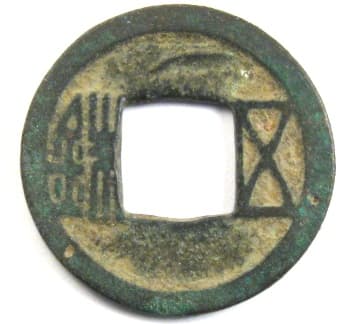 As can be seen at
the left, the "Sui wu zhu" coin has narrow characters
with a broad rim.
As can be seen at
the left, the "Sui wu zhu" coin has narrow characters
with a broad rim.
The wu (五) character has an extra vertical stroke to its left similar to the yong an wu zhu coin of the Northern Wei.
This coin is also referred to as the "kai huang wu zhu" (开皇五铢).
As can be seen at
the left, the "Sui wu zhu" coin has narrow characters
with a broad rim.The wu (五) character has an extra vertical stroke to its left similar to the yong an wu zhu coin of the Northern Wei.
This particular specimen is very unusual in that it has a nail mark or crescent moon above the square hole. The coin has a diameter of 23 mm and a weight of 2.9 grams.
Sui wu zhu coins can be can be found in large and small sizes. The smaller coins with their reduced weights were cast at a later period.
There is one variety of Sui wu zhu made of "white copper" (bai tong 白铜) which is particularly well-made. The wu character is slightly more curved where the lines cross. The coin is termed the bai qian wu zhu (白钱五铢) and is believed to have been produced in the Jiangnan area (江南).
The Sui was another short-lived dynasty that finally collapsed due to its ruthlessness, failed military campaigns and the heavy burden placed on its people.
As it was nearing its end, the economic situation became so bad that even scraps of iron, paper and leather were being used as money.
The situation did not improve until the beginning of the Tang Dynasty.
The ancient Buddhist
kingdom of "Qiuci" (Qiuzi, Kucha, Kuche guici 龟兹) was
centered around present-day Kucha City (库车) in Xinjiang
(新疆).Qiuci was one of the important kingdoms on the Silk Road (si chou zhi lu 丝绸之路) during the period between the Western Han and the Tang dynasties.
Qiuci cast several types of small bronze coins including some with no inscription at all.
As early as the 3rd or 4th century AD, Qiuci began to cast coins based on the small, devalued and degenerate wu zhu coins of post-Han Dynasty China.
At the left are two examples of the Qiuci wu zhu which Chinese coin collectors refer to as the "Han Gui bilingual wu zhu coin" (han gui er ti wu zhu qian 汉龟二体五铢钱).
The specimens are representative of the Qiuci coins in that they are small, thin and irregular with weak inscriptions.
The obverse side (left image) is very similar to other wuzhu coins of the time with the Chinese character wu (五) on the right and the character zhu (铢) on the left.
What distinguishes these coins are the reverse sides which have the inscription written in the Qiuci script. You will notice that the Qiuci characters above and below the square hole are transposed on the second specimen.
The ancient Qiuci language is not well understood and there is no consensus as to the meaning.
Some believe that the Qiuci inscription is a translation of the "five zhu" written in Chinese on the obverse.
Others believe that the inscription translates as the name of the kingdom.
These coins are fairly scarce.
The first coin has a diameter of about 21.5 mm and a weight of 2.2 grams. The second coin's diameter is approximately 21 mm and its weight is only 1.3 grams.
The Tang Dynasty Buddhist monk Xuanzang (玄奘; tangseng 唐僧 602-664) made a seventeen-year journey along the Silk Road to India to study and bring back sacred Buddhist texts. He wrote about the pilgrimage in his "Great Tang Records on the Western Regions" (da tang xi yu ji 大唐西域记) where he described his visit to Guici in the year 630.
In the book, Xuanzang mentions the "small bronze coins" of Guici. He was almost certainly referring to these Han Gui bilingual wu zhu coins.
Xuanzang's journey to India and his return to China, along with his subsequent research and translation work, are considered monumental achievements in Chinese Buddhism.
The very famous 16th century Chinese epic novel "Journey to the West" (xiyouji 西游记; "Monkey") is a fictional account of his adventures.
As mentioned above, Qiuci cast not only the bilingual cash coins but also small bronze coins with no inscription at all. These coins are believed to have been cast during the period of about 265-589 AD.
These small coins without inscriptions can be divided into four types.
One type is round with a rim around the square hole on one side. The other side is flat. The coins are thicker in the middle and thinner at the outside edge. These coins have diameters ranging from 9 mm to 18 mm and weights of 0.4 grams to 1.7 grams.
The second type is similar to the first except that the coins do not have a rim around the square hole. The coins are 8 to 13 mm in diameter and weigh 0.2 to 0.4 grams.
The third type of inscriptionless coin is square, not round, with a large rimless square hole in the center. The coins are very thin with diameters of 8 to 11 mm and weights of 0.2 to 0.5 grams.
The fourth type of Qiuci coin with no inscription is very irregular in shape. These coins are small, thin and poorly cast. Some are only 5 mm in diameter and weigh just 0.2 grams.
Tang Dynasty (618-907)
At the beginning of the Tang Dynasty, the wu zhu (五 铢) coins of the Sui Dynasty (581-618) were still in common use.
However, in the 4th year (621) of the Wu De (武德) reign of Emperor Gaozu (高 祖) use of the wu zhu was abolished. A new coin began to be cast with the inscription kai yuan tong bao (开元通宝) under the strict standard that ten of the new coins would be equal in weight to one liang (两).
This marked a monumental change in the history of Chinese coinage. Chinese coins would no longer be named after their weight, such as "half tael" (ban liang 半两) or "five zhu" (wu zhu 五铢). Instead, cash coins would have inscriptions with tong bao (通寶), yuan bao (元 寶) and zhong bao (重 寶).
Another important change was that the coin inscription would no longer be written in the ancient zhuan shu (篆书) or "seal" script. The coin inscription would now be written in li shu (隶书) or "official" script which is a square and plain style of Chinese calligraphy.
Emperor Gaozu had one of the Tang Dynasty's most famous calligraphers, Ouyang Xun (欧阳询), wrote the inscription for the new coin.
These changes meant that the more that 700 year "reign" of the wu zhu (五铢) coin had finally come to an end. The new kai yuan tong bao, with an inscription stipulating tong bao ("universal" or "circulating" currency) instead of its weight, and written in "official" script instead of "seal" script, would become the model for most of the coins cast in the dynasties that followed.
The kai yuan tong bao would continue to be cast for 200 years. So great was the influence of the new Tang Dynasty coin that it also became the model for the coinage of Japan, Korea and Annam (Vietnam).
Because the kai yuan tong bao was cast for such a long period of time from mints located throughout the country, there are slight differences in the coins resulting in several hundred varieties.
The kai yuan tong bao coins cast at the beginning and the height of the Tang Dynasty tend to be very well made. Early versions of the coins that can be accurately dated by being found in early Tang Dynasty tombs confirm that the first horizontal stroke (yi 一) of the character yuan (元) was short. This variety, appropriately enough, is known as a "short one yuan" (duan yi yuan 短一元).
A small number of these early "short one yuan" coins were cast in white bronze (white copper). These white bronze (bai tong 白铜) kai yuan tong bao coins have deep rims and are unusually well made. During Tang times they were referred to as "pure coins" (qing qian 青钱). The term "qing" took on an extended meaning. The writings of Emperor Gaozong (649-683) were described as being like "pure coins" (青钱) and his "nickname" (wai hao 外号) was "pure coin scholar" (qing qian xue shi 青钱学士).
The second horizontal stroke in the yuan (元) character has four different styles according to whether or not the end of the stroke, referred to as a "shoulder", slants upwards or not: left shoulder (zuo tiao 左挑), right shoulder (you tiao 右挑), two shoulders (shuang tiao 双挑), no shoulders (不挑). The last three varieties are fairly scarce.
Excavations at a Buddhist pagoda on Niushou Hill (牛首山) in Jiangning (江宁) prefecture in Jiangsu Province (江苏省) during the 1950's provided some evidence that the kai yuan tong bao coins with the yuan (元) having "right shoulders" and "two shoulders" were probably cast in the Nanjing (南京) area.
The reverse sides of kai yuan tong bao coins frequently have crescent moons (yue wen 月纹) or other symbols. Several stories have passed down through history as to the origin of this "moon" symbol. Some say that Empress Wende (wen de huang hou 文德皇后), who was the wife of Emperor Taizong and mother of Emperor Gaozong, pressed her fingernail into the wax specimen. Others identify the person as Empress Taimu (tai mu huang hou 太穆皇后), who was the mother of Emperor Taizong. Still other stories say that it was Yang Guifei (杨贵妃), one of the four beauties of ancient China, who was the imperial consort of Emperor Xuanzong. There are also sources that say the symbol may have been influenced by foreign coins.
It is generally believed, however, that the symbols are actually marks of quality from the various mints.
The placement of the crescent moon on the reverse side is not standardized. Also, besides crescents, other symbols are found including crescents paired closely together with a dot ("star") known as "pregnant stars" (yun xing 孕星). There are also "double moons" (shuang yue 双月). There are dots and crescents separated from each other known as "star and moon" (xing yue 星月). Other symbols seen on these coins are "clouds" or "auspicious clouds" (yun wen 云纹), waves (bo wen 波纹), three moons (san yue 三月), four moons (si yue 四月), and four stars (si xing 四星). The last several varieties are fairly scarce.
Another characteristic of the early period kai yuan tong bao coins is that the Chinese characters are deeply cut and do not touch the rim. The Chinese term for this characteristic is ge lun (隔轮) which, appropriately enough, translates as "separate from the rim". Additionally, the rim on the reverse side of these coins tends to be clear and uniform.
This is in contrast to later varieties of the coins where many specimens have excess metal between the strokes of the characters. On the obverse side, the later varieties also tend to have longer strokes which touch the rim. The rims on the reverse sides of these coins are usually fairly flat and irregular.
In 1987 during renovations at Famen Temple, thirteen kai yuan tong bao coins made from sea turtle shell were discovered in an underground palace. Also discovered was a sacred relic of the Buddha. These turtle shell coins were the first ever discovered in China and may the the earliest coins made of turtle shell in world history. These turtle shell coins are discussed in detail at Coins Made of Turtle Shell Discovered at Famen Temple.
In the first year (666 AD) of the Qian Feng reign of Emperor Gaozong, coins were cast with the inscription qian feng quan bao (乾封泉宝). Chinese coin inscriptions are traditionally written with the characters read in the following order: top, bottom, right, left. On this coin, however, the inscription is read in a clockwise manner beginning with the character at the top. These coins weigh about 5 grams.
Because military expenses were very high at this time, these coins were stipulated to be worth 10 of the older cash coins as a means for the government to raise funds. To avoid loses with this unfair exchange rate, the merchants and common people simply refused to make purchases and began to hoard the older cash coins. As a result, the price of goods soared and after only one year the government stopped casting the qian feng quan bao coins. Because the casting period was so short, these coins are now fairly scarce.
Unfortunately, qian feng quan bao coins have been reproduced in fairly large numbers in recent years. Compared to a "real" coin, the reproductions tend to be slightly smaller. Also, the first stroke of the bao (宝) character is shorter.
Shi Siming (史思明) (703-761), one of the leaders of the devastating Anshi Rebellion (an shi zhi luan 安史之乱) which lasted from 755-763, cast the de yi yuan bao (得壹元宝) and shun tian yuan bao (顺天元宝) coins during the period 758-761. These coins were valued as equal to 100 each of the kai yuan tong bao coins. After the An Shi Rebellion, these large denomination coins no longer circulated and were melted down. For this reason, very few of these coins still exist.
Because of their scarcity, there exist a large number of fake de yi yuan bao coins. Many of these fakes were cast from molds created with a real de yi yuan bao coin so it can be difficult to differentiate an authentic coin from a fake by just looking at rubbings in coin reference books.
The reverse sides of De Yi yuan bao coins sometimes have a "moon". Some have four moons or auspicious clouds. All these varieties are considered to be fairly rare.
Shun tian yuan bao coins can also have moons, or moons and stars, on the reverse. Interestingly enough, it is the coins with none of these symbols on the reverse that tend to be scarce.
There is, allegedly, one shun tian yuan bao coin with a tian (天) character on the reverse above the square hole which is rumored to be in Japan.
There are also shun tian yuan bao coins with waves, auspicious clouds, and even a phoenix on the reverse. It is speculated that these coins were cast to dedicate the opening of a new furnace or mint. (See Shun Tian Yuan Bao Charm for a gilt and engraved coin with bat, fish and lotus symbols.)
The Anshi Rebellion, referred to above, had a very serious affect on the economy. To support the large military expenditures, Emperor Suzong (711-762) cast the qian yuan zhong bao (乾元重宝) coin during the first year (758 AD) of his Qian Yuan reign. Each of these coins was equivalent to ten of the older cash coins.
The qian yuan zhong bao was the first coin in Chinese history to carry the designation zhong bao (重 宝). These value ten coins were approximately 28 mm in diameter and weighed about 7 grams.
In the second year (759 AD) of the Qian Yuan reign, qian yuan zhong bao coins were cast with a double rim (chong lun 重轮) on the reverse side. These coins weighed about 22 grams and were valued at fifty of the older cash coins.
Issuing large denomination coins not worth their stated value was very profitable for the government. However, this caused very serious inflation. A "dou" (斗) of rice, which was about a ladle full of rice during Tang times, went from a price of 10 cash coins to a price of 7,000 cash coins! It was simply impossible for these large denomination coins to maintain their stated value.
When Emperor Daizong assumed the throne in 762 AD, he attempted to restore some sanity to the economy by reevaluating the coins in circulation. The old kai yuan tong bao coin was to be valued as one cash coin, the qian yuan zhong bao was declared to be equivalent to two cash coins, and the double-rim qian yuan zhong bao was valued as three cash coins.
But after only 10 days, the government rescinded this order and proclaimed that all qian yuan zhong bao coins were now to be valued as one cash coins, the same as the kai yuan tong bao. The government finally acknowledged the fact that so many qian yuan zhong bao coins had been counterfeited over the years that many weighed as little as 4 grams, which was about the same weight as the kai yuan tong bao.
As a result of this decision, large and heavy coins no longer circulated in the market. Many of these coins were melted down to be used to make metal utensils and, as a result, few of these coins exist today.
There is one variety of qian yuan zhong bao which is quite rare. This coin has the character "ten" (shi 十) on the reverse side. It is believed to have been among the very first coins cast and had the character "ten" to indicate the value of the new coinage.
Qian yuan zhong bao coins continued to be cast even after the reign of Emperor Daizong. Since these coins were valued as one cash coins, they circulated together with kai yuan tong bao coins no matter if they were large, small, heavy or light. However, varieties with stars, moons, or both stars and moons on the reverse side are scarce.
There also exist a very small number of qian yuan zhong bao coins with the Chinese character hong (洪) on the reverse. It is believed that these coins were cast in Jiangxi (江西) sometime after the fifth year (845 AD) of the Hui Chang reign of Emperor Wuzong (840-846 AD). Even though very few of these coins have been found, their existence proves that the small qian yuan zhong bao coin continued to be cast even to the end of the Tang Dynasty.
There are other scarce varieties of qian yuan zhong bao coins which have "clouds" or "auspicious clouds" (yun 云) and "sparrows" (que 雀) on the reverse. Most of these coins have been discovered in Sichuan. In contrast to charms and amulets, coins with "pictures" on the reverse side were not frequently cast in ancient China. However, there are varieties of tai ping bai qian (太 平百钱) with waves on the reverse. There are also a few kai yuan tong bao (开元 通宝) and qian yuan zhong bao (乾 元重宝) coins which have clouds on the reverse.
Auspicious clouds and sparrows frequently appear on bronze mirrors from the Tang Dynasty. During the Sui and Tang dynasties, the study of divination was in vogue and clouds and sparrows were seen as auspicious objects.
During the Da Li reign of Emperor Daizong (766-779), coins were cast in the Kucha area of Xinjiang with the inscription da li yuan bao (大历元宝). The Jian Zhong reign of Emperor Dezong (780-783) saw the casting of jian zhong tong bao (建中通宝) coins. The majority of these coins were not particularly well cast and both are scarce. Some versions of the coins only have the single character yuan (元) or zhong (中) which was an abbreviated way to write the inscriptions da li yuan bao (大 历元宝) and jian zhong tong bao (建中通宝), respectively.
A few of the da li yuan bao coins are large and well cast but almost all of the jian zhong tong bao coins are small and thin.
There is also a coin with the single Chinese character "da" (大) as the inscription. Based on the color of the bronze and the similarity in casting, the coin is believed to be an abbreviated inscription of da li yuan bao (大历元宝).
In order to obtain funds for his military and also to try to purge China of foreign influences, Emperor Wuzong (840-846 AD), a devoted Daoist (Taoist), in the fifth year (845) of his Hui Chang (会昌) reign began to cast coins with the inscription "kai yuan tong bao", the same inscription as used on the coins of Emperor Gaozu at the beginning of the Tang Dynasty. The coins were made from the bronze obtained from statues, bells and other copper possessions of the Buddhist temples that he ordered confiscated and melted down. These coins differed from those cast earlier in the dynasty by Emperor Gaozu in that they had the character chang (昌) on the reverse side. Other mints soon followed with each producing a coin with a character on their reverse side indicating the mint of production.
A total of 23 different mints cast these so-called "hui chang" kai yuan tong bao (会昌开元 通宝) coins including mints at the following locations:
昌 chang for hui chang
京 jing for Jingzhao (Xian)
洛 luo for Luoyang (Henan)
益 yi for Yi Prefecture (Chengdu)
荆 jing for Jing Prefecture (Hubei)
襄 xiang for Xiang Prefecture (Hubei)
蓝 lan for Lantian (Shanxi)
越 yue for Yue Prefecture (Zhejiang)
宣 xuan for Xuan Prefecture (Anhui)
洪 hong for Hong Prefecture (Jiangxi)
潭 tan for Changsha (Hunan)
兖 yan for Yan Prefecture (Shandong)
润 run in Jiangsu
鄂 e for E Prefecture (Wuchang)
平 ping for Ping Prefecture (Zhili)
兴 xing for Xingyuan (Shaanxi)
梁 liang for Liang Prefecture (Shaanxi)
广 guang for Guangzhou (Guangdong)
梓 zi for Dongchuan (Sichuan)
福 fu for Fuzhou (Fujian)
桂 gui for Guiyang (Hunan) or Guizhou (Guangxi)
丹 dan for Dan Prefecture (Shaanxi)
永 yong for Yong Prefecture (Hunan)
Coins with the "yong" (永) for Yong Prefecture are considered the rarest. Next rarest include those cast at the "fu" (福) for Fuzhou (Fujian), "dan" (丹) for Dan Prefecture (Shaanxi), "gui" (桂) for Guiyang (Hunan) or Guizhou (Guangxi), and "ping" (平) for Ping Prefecture (Zhili) mints.
For coins cast at the Fuzhou (Fujian) mint, the "fu" (福) character is usually located above the square hole. Coins with the "fu" character below or to the right of the hole are even scarcer. There is only one known example of a coin with the "fu" character on the reverse but no inscription at all on the obverse side. This coin is considered to be authentic and apparently was the result of a casting error.
There is a rare version of the "hui chang" kai yuan tong bao with the "jing" (京) character reversed right to left (fan shu 反书) meaning the character appears as its mirror image.
There exists a lead version of the "hui chang" kai yuan tong bao that has the "tan" (潭) for Changsha (Hunan) character on the reverse.
A rare version of kai yuan tong bao from the lan (蓝) for Lantian (Shanxi) mint has three clouds on the reverse. Another rare variety from this mint has the four character inscription "tai ping da wang" (太平大王).
There are no known authentic kai yuan tong bao coins with the mintmarks yang (扬), shu (蜀) or xi (西).
On the other hand, there allegedly exists a coin believed to be authentic with a "qing" (清) character on the reverse side.
Emperor Yizong (859-873 AD) during the 11th year (870 AD) of his Xian Tong reign cast coins with the inscription "xian tong xuan bao" (咸通玄宝). There coins are very rare.
Chinese coin collectors will sometimes encounter very large kai yuan tong bao coins weighing about 20 grams. Most of these were probably cast to commemorate the opening of a mint and are referred to in Chinese as kai lu (开炉) coins. Since later dynasties also cast such coins, it can be difficult trying to date specific coins but a few guidelines are presented here to try to assist in the endeavor.
In general, if the Chinese characters are deeply cut and the ends of the strokes are clearly defined, the coin was probably cast during the Tang Dynasty (618-907). If the outside rim is fairly broad and similar to that of the rare yong tong quan huo (永通泉货) coin cast during the reign of Emperor Yuanzu (Li Jing) of the Southern Tang Kingdom then it was most probably cast during the Southern Tang (937-975). If the strokes are rounded and simple, and the color of the bronze indicates that it is fairly new, the coin was most likely cast during a later period.
If the tong (通) and bao (宝) characters are written in the Slender Gold style (shou jin shu 瘦金书) then the coin cannot be earlier than the Northern Song (960-1127). If the bao (宝) character is written in the seal script then the coin cannot be earlier than the Jin Dynasty (1115-1234). If the tong (通) and bao (宝) characters are similar to that of the da zhong tong bao ((大中通宝)) and hong wu tong bao (洪武通 宝) coins then the coin cannot be earlier than the Ming Dynasty (1368-1644).
Following the Huang Chao Rebellion (黄巢起义) (874-884), the authority of the Tang emperor declined drastically and the casting of Tang coins finally ceased.
In 907, Zhu Wen (Emperor Taizu) deposed Emperor Ai (904-907), the last of the Tang emperors, and in so doing established the Later Liang Dynasty (852-912) and the beginning of the Five Dynasties and Ten Kingdoms Period (907-960).
The vast
majority of kai yuan
tong bao (开元 通宝) coins
were made of bronze.Among the many kai yuan tong bao varieties, however, are also ones made of gold, silver, lead, "white copper" ("white bronze"), and iron.
The kai yuan tong bao at the left dates from the Tang Dynasty and is made of iron. Many of these coins were produced in Sichuan where there was a lack of copper. Casting coins made of iron was thus more practical and less expensive.
There is also some evidence that during the Tang Dynasty iron kai yuan tong bao coins circulated in Hebei as well.
This coin has a diameter of 24 mm and a weight of 2.3 grams.
This coin was cast in the year 666 of the reign of Emperor Gao Zong (649-683) of the Tang Dynasty.
The inscription is written clockwise as qian feng quan bao (乾封泉宝).
The coin was originally valued as the equivalent to ten cash coins.
However, this valuation prompted extensive forgery and the coin was withdrawn from circulation after only one year.
The diameter is 25 mm and the weight is 3.8 grams.
Additional Tang Dynasty coins displayed on this website can be viewed by clicking on the appropriate link below:
| Inscript | Pinyin | Special |
Years cast | Emperor |
| 开元通宝 | kai yuan tong bao | flower hole |
621-907 | Gao Zu |
| 开元通宝 | kai yuan tong bao | dot (star) on
obverse, crescent (moon) on reverse |
621-907 |
Gao Zu |
| 乾元重宝 | qian yuan zhong bao | auspicious
cloud and crescent (moon) on reverse |
759-762 |
Su Zong |
| 乾元重宝 | qian yuan zhong
bao |
ordinary one
cash coin with flower hole |
759-762 | Su Zong |
| 乾元重宝 | qian yuan zhong
bao |
Value Fifty
with double rim reverse, flower hole |
759-762 |
Su Zong |
| 顺天元宝 | shun tian yuan bao | crescent
(moon) on reverse |
759-761 |
Shi Siming |
| 大历元宝 |
da li yuan bao |
flower hole |
766-779 |
Dai Zong |
| 开元通宝 | kai yuan tong bao |
Hui Chang Kai Yuan
cast at Yan Prefecture with flower hole |
845-846 |
Wu Zong |
Five Dynasties and Ten Kingdoms (907-960)
Following the collapse
of the great Tang Dynasty in 907 AD, China entered into
a prolonged period of disunity known as the Five
Dynasties and Ten Kingdoms (wu dai shi guo 五代十国).
The Five Dynasties (wu dai 五代) refers to a series of short-lived dynasties in the north, with capitals in either Kaifeng (开封) or Luoyang (洛阳), which included the Later Liang Dynasty (后梁 907-923), the Later Tang Dynasty (后唐 923-936), the Later Jin Dynasty (后晋 936-947), the Later Han Dynasty (后汉 948-951) and the Later Zhou Dynasty (后周 951-960).
The Ten Kingdoms existed in the south and included Wu (吴 902-937), Former Shu (前蜀 907-925), Wuyue (吴越国 907-978), Min (闽 909-945), Southern Han (南汉 917-971), Jingnan (荆南, Nanping 南平 924-963), Later Shu (后蜀 926-965), Chu (楚 927-951), Southern Tang (南唐 937-975), and Northern Han (北汉 951-979).
Later
Liang Dynasty (907-923)
This is another coin cast during the rule of Wang Yan
of the Former Shu Kingdom.
The inscription reads clockwise as xian kang yuan bao (咸康元宝).
This coin was cast in the year 925.
The coin has a diameter of about 23 mm and a weight of 3.3 grams.
While lead coins had occasionally appeared in earlier dynasties, they were not regularly cast in large quantities.
The earliest forms of money made of lead actually appeared during the Warring States Period (475-221 BC) and included the yi hua (一 化) round coin from the State of Yan as well as the ghost face money (ant nose money) from the State of Chu. There are also examples of lead ban liang coins from the Qin (221-207 BC) and lead ban liangs from the Western Han (206 BC -24 AD) Dynasties.
However, large quantities of lead coins were not cast until the Ten Kingdoms period. As a result of decades of constant warfare, copper mining became disrupted and administrative centers were frequently cutoff from a source of copper. Lacking copper to make bronze, mints had little choice but to turn to lead and iron for the casting of coins.
The earliest use of lead for the regular production of cash coins is generally believed to have occurred in the year 916 during the reign of Wang Shenzhi, the Prince of Min, of the Kingdom of Min. The coin, made of lead, was a copy of the bronze kai yuan tong bao (开 元通宝) of the Tang Dynasty but had the Chinese character min (闽) or fu (福), indicating the area of Fujian, on its reverse side.
The Southern Han Kingdom was another of the Ten Kingdoms that existed in southeast China during the years 905-971.
Both bronze and lead coins were cast during the years 917-924 of the reign of Emperor Lie Zu (Liu Yan) of the Southern Han Kingdom.
An example of this Southern Han coinage would be the lead kai yuan tong bao (开 元通宝) cast in 917 in the area of Canton (Guangzhou), then known as Xingwangfu.
Some of the lead coins from this period cannot as yet be attributed to a specific kingdom and ruler.
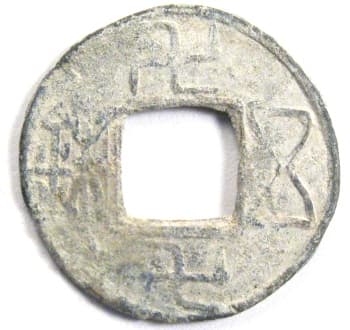 This is an
example of such a lead coin that can only be attributed
to the Southern Han Kingdom or Kingdom
of Chu and which was most likely cast in the
period 900-971.
This is an
example of such a lead coin that can only be attributed
to the Southern Han Kingdom or Kingdom
of Chu and which was most likely cast in the
period 900-971.
The inscription reads wu zhu (五 铢) and the coin resembles the wu zhu coins of the Han and later dynasties.
The coin is distinctive because of the swastikas above and below the square hole.
The swastika, which can also be found on earlier wu zhu coins, is an ancient Chinese symbol and is believed to represent the Chinese character wan (万) meaning "ten-thousand". The extended meaning is "many".
The swastika is also an ancient Buddhist symbol and Buddhism was a major religion in China at the time this coin was cast.
The reverse side of the coin is flat.
The coin has a diameter of 25 mm and a weight of 2.9 grams.
The Five Dynasties (wu dai 五代) refers to a series of short-lived dynasties in the north, with capitals in either Kaifeng (开封) or Luoyang (洛阳), which included the Later Liang Dynasty (后梁 907-923), the Later Tang Dynasty (后唐 923-936), the Later Jin Dynasty (后晋 936-947), the Later Han Dynasty (后汉 948-951) and the Later Zhou Dynasty (后周 951-960).
The Ten Kingdoms existed in the south and included Wu (吴 902-937), Former Shu (前蜀 907-925), Wuyue (吴越国 907-978), Min (闽 909-945), Southern Han (南汉 917-971), Jingnan (荆南, Nanping 南平 924-963), Later Shu (后蜀 926-965), Chu (楚 927-951), Southern Tang (南唐 937-975), and Northern Han (北汉 951-979).
Five Dynasties
Later
Liang Dynasty (907-923)
Zhu Wen (朱温)
defeated the Tang in 907 AD and established himself
as Emperor Taizu (后梁太祖) of
the Later Liang Dynasty (后梁 907-923)
with its capital at Bianjing (汴京, Kaifeng 开封).
The era name was Kaiping (开平 907-910).
Only two coins from this reign period are known to exist. One is a kai ping yuan bao (开平元 宝) and the other is a kai ping tong bao (开平通 宝). Only one specimen of each exists.
The one specimen of kai ping yuan bao is black with no patina. The kai ping tong bao has a reddish patina.
However, there is a great deal of controversy as to whether these two coins are authentic or not.
It is generally assumed, however, that the Later Liang Dynasty continued to use old coins from the Tang Dynasty.
Only two coins from this reign period are known to exist. One is a kai ping yuan bao (开平元 宝) and the other is a kai ping tong bao (开平通 宝). Only one specimen of each exists.
The one specimen of kai ping yuan bao is black with no patina. The kai ping tong bao has a reddish patina.
However, there is a great deal of controversy as to whether these two coins are authentic or not.
It is generally assumed, however, that the Later Liang Dynasty continued to use old coins from the Tang Dynasty.
Later Tang Dynasty (923-936)
Li Siyuan (李嗣源)
assumed the throne as Emperor Mingzong (后
唐明宗) of the Later Tang
Dynasty (后唐 923-936)
and during his Tiancheng reign (天成 926-930) cast
the tian
cheng yuan bao (天成元宝) coin.
The tian cheng yuan bao was modeled after the kai yuan tong bao (开元通宝) of the Tang Dynasty but was larger and heavier.
Very few of these coins still exist. The reason is that copper was very expensive at the time and it was more profitable to melt down coins to make utensils.
Li Congke (李从珂) succeeded his father in 934 AD and reigned as Emperor Mo (后唐末 帝) with the era name Qingtai (清泰). However, the situation in the country deteriorated rapidly, the government treasuries were bare and the army could not be supported. As a result, the country was conquered by the Jin just two years later.
While it is unlikely that Emperor Mo produced any new coins during the short time he was in power, there is one coin with the inscription qing tai yuan bao (清泰元宝) known to exist. However, the bao (宝) character is very similar to that of the chong ning zhong bao (崇 宁重宝 1102-1106) of the Northern Song. Also, the coin's reverse side has the characteristics of Northern Song coins so it is probable that this qing tai yuan bao was created at some later date from a chong ning zhong bao mold that had been altered.
The tian cheng yuan bao was modeled after the kai yuan tong bao (开元通宝) of the Tang Dynasty but was larger and heavier.
Very few of these coins still exist. The reason is that copper was very expensive at the time and it was more profitable to melt down coins to make utensils.
Li Congke (李从珂) succeeded his father in 934 AD and reigned as Emperor Mo (后唐末 帝) with the era name Qingtai (清泰). However, the situation in the country deteriorated rapidly, the government treasuries were bare and the army could not be supported. As a result, the country was conquered by the Jin just two years later.
While it is unlikely that Emperor Mo produced any new coins during the short time he was in power, there is one coin with the inscription qing tai yuan bao (清泰元宝) known to exist. However, the bao (宝) character is very similar to that of the chong ning zhong bao (崇 宁重宝 1102-1106) of the Northern Song. Also, the coin's reverse side has the characteristics of Northern Song coins so it is probable that this qing tai yuan bao was created at some later date from a chong ning zhong bao mold that had been altered.
Later Jin Dynasty (936-947)
The Later
Jin Dynasty (后晋 936-947)
faced a different problem.
Because there was insufficient coinage in circulation, Emperor Gaozu (后晋高 祖) in the third year (938) of his Tianfu (天福) reign issued an order stating that the private casting of bronze coins was to be permitted. The privately cast coins were required to bear the inscription tian fu yuan bao (天福元宝). The coins had to be made of bronze. They could not be lead, iron or mixtures of these metals.
Many varieties of tian fu yuan bao exist because for a period of time both the government and individuals were casting the coins.
There is a variety of tian fu yuan bao which has a very large fu (福) character. The second horizontal stroke of the yuan (元) character has a left shoulder and the last stroke of the tian (天) character is very long. This large bronze coin is well-made and is considered to have been cast by the government.
Regarding the privately cast coins, it is difficult to find any two coins with the same obverse and reverse. Most of these coins are small and thin with poorly written inscriptions. Because of their poor quality, the government in 939 AD ordered that the private casting of coinage would no longer be allowed and that only the government would cast coins.
Because there was insufficient coinage in circulation, Emperor Gaozu (后晋高 祖) in the third year (938) of his Tianfu (天福) reign issued an order stating that the private casting of bronze coins was to be permitted. The privately cast coins were required to bear the inscription tian fu yuan bao (天福元宝). The coins had to be made of bronze. They could not be lead, iron or mixtures of these metals.
Many varieties of tian fu yuan bao exist because for a period of time both the government and individuals were casting the coins.
There is a variety of tian fu yuan bao which has a very large fu (福) character. The second horizontal stroke of the yuan (元) character has a left shoulder and the last stroke of the tian (天) character is very long. This large bronze coin is well-made and is considered to have been cast by the government.
Regarding the privately cast coins, it is difficult to find any two coins with the same obverse and reverse. Most of these coins are small and thin with poorly written inscriptions. Because of their poor quality, the government in 939 AD ordered that the private casting of coinage would no longer be allowed and that only the government would cast coins.
Later Han Dynasty (948-951)
The
casting of coins by the Later Han
Dynasty (后汉 948-951)
began in the first year (948) of the
Qianyou (乾祐) reign of Emperor
Gaozu (后汉高
祖). This was the period following
the invasion of the Khitan (qidan
契丹) from the south. The
principalities and counties were in
disarray and the central government
lacked funds in its treasury.
Copper material was gathered in order to cast coins with the inscription han yuan tong bao (汉元 通宝). These coins are identical to the Tang Dynasty kai yuan tong bao (开元通 宝) except that the first character is han (汉).
Clearly, an altered kai yuan tong bao mold was used to cast these coins.
Many of these coins also have the same star and moon symbols found on kai yuan tong bao coins. There is a variety of han yuan tong bao with a "pregnant star" (yunxing 孕星) above the square hole on the reverse side which is considered very scarce.
Copper material was gathered in order to cast coins with the inscription han yuan tong bao (汉元 通宝). These coins are identical to the Tang Dynasty kai yuan tong bao (开元通 宝) except that the first character is han (汉).
Clearly, an altered kai yuan tong bao mold was used to cast these coins.
Many of these coins also have the same star and moon symbols found on kai yuan tong bao coins. There is a variety of han yuan tong bao with a "pregnant star" (yunxing 孕星) above the square hole on the reverse side which is considered very scarce.
Later Zhou Dynasty (951-960)
Emperor
Shizong (后周世宗)
of the Later Zhou Dynasty (后
周 951-960) reigned under
the period title Guangshun (广顺) from
951-953. While coins with the
inscription guang
shun yuan bao (广
顺元宝)
are sometimes seen, no authentic
coins from this period are known to
exist and coins with this
inscription are believed to have
been cast at some later date.
Emperor Shizong did cast coins in earnest beginning in 955 AD, the second year of his Xiande (显德) reign, with the inscription zhou yuan tong bao (周 元通宝).
To obtain the copper to make the coins, Emperor Shizong ordered the confiscation of bronze statues from 3,336 Buddhist temples. He also mandated that citizens turn in to the government all bronze utensils with the exception of bronze mirrors.
Zhou yuan tong bao coins are very well made and still exist in large quantities. Because the coins were made from Buddhist statues, they are considered to have special powers. For example, it was believed that the zhou yuan tong bao coin could cure malaria and help women going through a difficult labor.
Because of the common belief that the coin has special powers, the zhou yuan tong bao became very popular as the basis for charms and amulets. There are many charms with the inscription zhou yuan tong bao on the obverse and a dragon and phoenix on the reverse. Images of the Buddha, zodiac animals, and other auspicious objects can also be found on the reverse sides of zhou yuan tong bao charms.
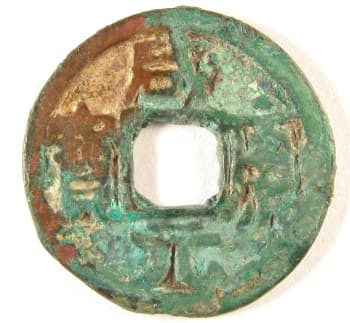
Emperor Shizong did cast coins in earnest beginning in 955 AD, the second year of his Xiande (显德) reign, with the inscription zhou yuan tong bao (周 元通宝).
To obtain the copper to make the coins, Emperor Shizong ordered the confiscation of bronze statues from 3,336 Buddhist temples. He also mandated that citizens turn in to the government all bronze utensils with the exception of bronze mirrors.
Zhou yuan tong bao coins are very well made and still exist in large quantities. Because the coins were made from Buddhist statues, they are considered to have special powers. For example, it was believed that the zhou yuan tong bao coin could cure malaria and help women going through a difficult labor.
Because of the common belief that the coin has special powers, the zhou yuan tong bao became very popular as the basis for charms and amulets. There are many charms with the inscription zhou yuan tong bao on the obverse and a dragon and phoenix on the reverse. Images of the Buddha, zodiac animals, and other auspicious objects can also be found on the reverse sides of zhou yuan tong bao charms.
Ten Kingdoms
Former Shu (907-925)
Wang
Jian (王建 907-918) established
the Former Shu ("Great Shu" 前蜀)
and in the year 911 changed the
reign title to Yong Ping
(永平). Under his authority,
coins were cast with the
inscription yong
ping yuan bao
(永平元宝). Yong
ping yuan bao coins are
very rare.
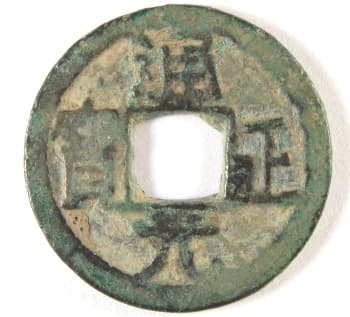
Other coins issued by Wang Jian include tong zheng yuan bao (通正元宝), tian han yuan bao (天汉元宝), and guang tian yuan bao (光天元宝).
The tong zheng yuan bao (通正元宝) is the scarcest among the group. There is one variety of tong zheng yuan bao with large characters and a broad "tong" (通) character that is particularly scarce.
A tong zheng yuan bao (通 正元宝) cash coin is shown at the left.
The inscription is read clockwise.
The diameter of this bronze cash coin is 24 mm and the weight is 3.8 grams.
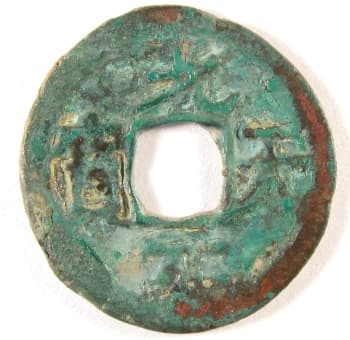 Tian han yuan
bao (天汉元宝)
coins with either a "star"
("dot") or "moon" ("crescent")
on the reverse side are also
fairly scarce.
Tian han yuan
bao (天汉元宝)
coins with either a "star"
("dot") or "moon" ("crescent")
on the reverse side are also
fairly scarce.
At the left is an example of a guang tian yuan bao (光天元宝) coin cast during the reign of Wang Jian.
The inscription is written clockwise and this coin was cast in the year 918.
The reverse side has a crescent moon above the square hole.
This coin has a diameter of about 24 mm and a weight of 3 grams.
Wang Jian was succeeded by his son Wang Yan (王衍 918-925) who proceeded to cast cons during his Qian De (乾德) reign (919-924) with the inscriptions qian de yuan bao (乾德元宝) and xian kang yuan bao (咸康元宝).
Because his reign title was used for a relatively long period of time, there are more of these coins than others from the Former Shu.
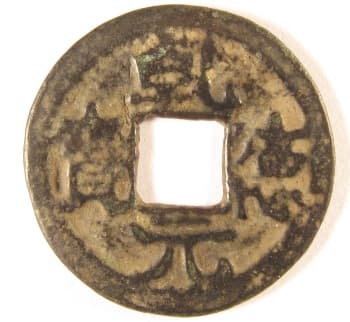
The coin to the left is a qian de yuan bao (乾德元宝) cast during the reign of Wang Yan of the Former Shu.
The inscription is read clockwise.
These coins were cast during the years 919-924.
The diameter of this coin is 24 mm and the weight is 2.5 grams.
Other coins issued by Wang Jian include tong zheng yuan bao (通正元宝), tian han yuan bao (天汉元宝), and guang tian yuan bao (光天元宝).
The tong zheng yuan bao (通正元宝) is the scarcest among the group. There is one variety of tong zheng yuan bao with large characters and a broad "tong" (通) character that is particularly scarce.
A tong zheng yuan bao (通 正元宝) cash coin is shown at the left.
The inscription is read clockwise.
The diameter of this bronze cash coin is 24 mm and the weight is 3.8 grams.
Tian han yuan
bao (天汉元宝)
coins with either a "star"
("dot") or "moon" ("crescent")
on the reverse side are also
fairly scarce.At the left is an example of a guang tian yuan bao (光天元宝) coin cast during the reign of Wang Jian.
The inscription is written clockwise and this coin was cast in the year 918.
The reverse side has a crescent moon above the square hole.
This coin has a diameter of about 24 mm and a weight of 3 grams.
Wang Jian was succeeded by his son Wang Yan (王衍 918-925) who proceeded to cast cons during his Qian De (乾德) reign (919-924) with the inscriptions qian de yuan bao (乾德元宝) and xian kang yuan bao (咸康元宝).
Because his reign title was used for a relatively long period of time, there are more of these coins than others from the Former Shu.
The coin to the left is a qian de yuan bao (乾德元宝) cast during the reign of Wang Yan of the Former Shu.
The inscription is read clockwise.
These coins were cast during the years 919-924.
The diameter of this coin is 24 mm and the weight is 2.5 grams.
The inscription reads clockwise as xian kang yuan bao (咸康元宝).
This coin was cast in the year 925.
The coin has a diameter of about 23 mm and a weight of 3.3 grams.
Kingdom of Min (909-945)
Wang
Shenzhi (王审知 "Emperor Taizu of Min" 闽太祖)
founded the Kingdom of Min (闽)
and cast lead and bronze coins beginning in the year
916 (Zhen Ming 2nd year 贞明二年).
These lead coins had the inscription kai yuan tong bao (开元通宝). The reverse sides have the Chinese character min (闽), referring to the Fujian area, or the character fu (福) meaning Fuzhou.
Beginning in the year 922 (2nd year of Long De reign 龙德二年), Wang Shenzhi issued large kai yuan tong bao coins made of iron and lead. The reverse sides of these coins can have a large dot ("star"), crescent ("moon") or the character min (闽).
Bronze coins of this type were also cast but are extremely rare.
In the year 939, Wang Yanxi (王延羲) became king and during his Yong Long (永隆) reign began to cast lead and iron coins with the inscription yong long tong bao (永隆通宝).
The location where the yong long tong bao (永隆通宝) coins were produced has been discovered along with a large number of the clay moulds used to cast the coins. For a detailed discussion please see "Ancient Kingdom of Min Coins Cast in Quanzhou".
In 944, Wang Yanzheng (王延正) during the 2nd year of his Tian De (天德) reign issued bronze and iron coins with the inscription tian de zhong bao (天德重宝). The reverse sides have the character yin (殷) which referred to the name of the kingdom at that time.
Tian de zhong bao (天德重宝) coins are very rare.
Historical records state that in the year 944 coins with the inscription tian de tong bao (天德通 宝) were also cast. Large iron coins with this inscription do exist. A large bronze coin with the inscription tian de tong bao is known to have existed in the past. However, there is some dispute as to whether the coin was authentic or not.
These lead coins had the inscription kai yuan tong bao (开元通宝). The reverse sides have the Chinese character min (闽), referring to the Fujian area, or the character fu (福) meaning Fuzhou.
Beginning in the year 922 (2nd year of Long De reign 龙德二年), Wang Shenzhi issued large kai yuan tong bao coins made of iron and lead. The reverse sides of these coins can have a large dot ("star"), crescent ("moon") or the character min (闽).
Bronze coins of this type were also cast but are extremely rare.
In the year 939, Wang Yanxi (王延羲) became king and during his Yong Long (永隆) reign began to cast lead and iron coins with the inscription yong long tong bao (永隆通宝).
The location where the yong long tong bao (永隆通宝) coins were produced has been discovered along with a large number of the clay moulds used to cast the coins. For a detailed discussion please see "Ancient Kingdom of Min Coins Cast in Quanzhou".
In 944, Wang Yanzheng (王延正) during the 2nd year of his Tian De (天德) reign issued bronze and iron coins with the inscription tian de zhong bao (天德重宝). The reverse sides have the character yin (殷) which referred to the name of the kingdom at that time.
Tian de zhong bao (天德重宝) coins are very rare.
Historical records state that in the year 944 coins with the inscription tian de tong bao (天德通 宝) were also cast. Large iron coins with this inscription do exist. A large bronze coin with the inscription tian de tong bao is known to have existed in the past. However, there is some dispute as to whether the coin was authentic or not.
Southern Han Kingdom (905-971)
Liu Yin (刘隐),
the Prince of Nanping, began issuing lead coins
with the inscription kai ping yuan bao (开平元宝).
In 917, Liu Yin's brother Liu Yan (刘龑) declared the founding of the kingdom Great Yue (大越) and cast bronze coins with the inscription qian heng tong bao (乾亨通宝) and qian heng zhong bao (乾亨重宝). The qian heng tong bao coin is the scarcer of the two.
In 918, Liu Yan changed the name of the kingdom to Great Han (大汉).
In general, these Southern Han(南汉) coins are not finely made with most specimens having bronze filling in parts of the characters.
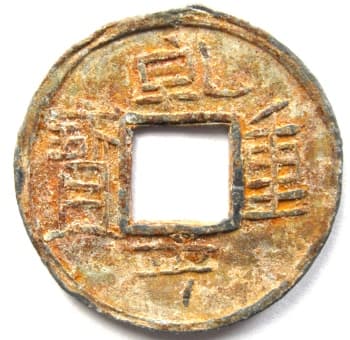
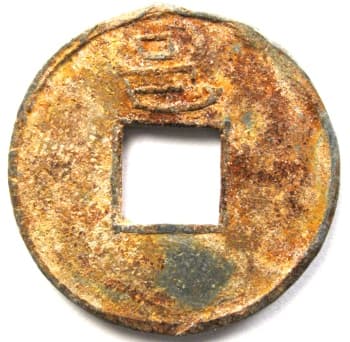
Beginning in 918, Liu Yan had the qian heng zhong bao (乾亨重宝) coins cast in lead. The Chinese characters on these coins tend to be poorly written.
An example of a lead qian heng zhong bao is displayed at the left.
Some of the coins, including this one, have the character 邑 (yi) written on the reverse side.
The yi (邑) is probably meant to be yong (邕) which refers to Yongzhou (邕州) in Guangxi.
Many of these lead qian heng zhong bao coins have been unearthed in recent years.
This particular coin has a diameter of 27 mm and a weight of 4.3 grams.
In 917, Liu Yin's brother Liu Yan (刘龑) declared the founding of the kingdom Great Yue (大越) and cast bronze coins with the inscription qian heng tong bao (乾亨通宝) and qian heng zhong bao (乾亨重宝). The qian heng tong bao coin is the scarcer of the two.
In 918, Liu Yan changed the name of the kingdom to Great Han (大汉).
In general, these Southern Han(南汉) coins are not finely made with most specimens having bronze filling in parts of the characters.
Beginning in 918, Liu Yan had the qian heng zhong bao (乾亨重宝) coins cast in lead. The Chinese characters on these coins tend to be poorly written.
An example of a lead qian heng zhong bao is displayed at the left.
Some of the coins, including this one, have the character 邑 (yi) written on the reverse side.
The yi (邑) is probably meant to be yong (邕) which refers to Yongzhou (邕州) in Guangxi.
Many of these lead qian heng zhong bao coins have been unearthed in recent years.
This particular coin has a diameter of 27 mm and a weight of 4.3 grams.
Later Shu (926-965)
Meng
Zhixiang (孟知祥) established the Later Shu
(后蜀) kingdom in 934 with the reign title of
Ming De (明德).
There exist coins with the inscriptions ming de tong bao (明德通宝) and ming de yuan bao (明德元 宝). These coins, however, are not from the Later Shu but were actually produced in Annam (Vietnam).
Meng Zhixiang was succeeded by his son Meng Chang (孟昶) who reigned during the period 934-965.
Meng Chang cast coins made of bronze, iron and lead with the inscription guang zheng tong bao (广政通宝). All these coins are considered to be rare.
There also exist coins with the inscription da shu tong bao (大蜀通宝) which are similar in style to the guang zheng tong bao coins. For this reason, the da shu tong bao coins are believed to have been cast during the reign of Meng Chang.
One notable characteristic of the money
from the Ten Kingdoms era is the casting of
coins made of lead in addition to those made
of bronze and iron.
There exist coins with the inscriptions ming de tong bao (明德通宝) and ming de yuan bao (明德元 宝). These coins, however, are not from the Later Shu but were actually produced in Annam (Vietnam).
Meng Zhixiang was succeeded by his son Meng Chang (孟昶) who reigned during the period 934-965.
Meng Chang cast coins made of bronze, iron and lead with the inscription guang zheng tong bao (广政通宝). All these coins are considered to be rare.
There also exist coins with the inscription da shu tong bao (大蜀通宝) which are similar in style to the guang zheng tong bao coins. For this reason, the da shu tong bao coins are believed to have been cast during the reign of Meng Chang.
Chu (907-951)
The
state of Chu (楚) came into existence in
907 and the kingdom of Chu (楚) was
established in 927.
In order to commemorate his promotion to Supreme Commander of Tiance in 911 by Emperor Taizu (后梁太祖, Zhu Wen 朱温) of the Later Liang (后梁), Ma Yin (马殷) issued coins with the inscription tian ce fu bao (天策府宝) in both bronze and iron.
An extremely small number of the tian ce fu bao bronze coins were gilded (covered with gold). Please see the article Kingdom of Chu "Tian Ce Fu Bao" Gilt Bronze Coin for a detailed discussion.
The tian ce fu bao coins have always been highly prized by Chinese coin collectors. For this reason, there are also many reproductions. These fake coins are often made from impressions of authentic coins. Some of the fakes also have additional characters on the reverse side such as chu (楚), yin (殷), etc.
Ma Yin also issued large iron coins with the inscription qian feng quan bao (乾封泉宝). There are a number of varieties of these iron coins with some larger and some smaller. Some of the coins have characters on the reverse side such as tian (天), tian fu (天府), ce (策), tian ce (天策), and ce fu (策府).
There are also large qian feng quan bao coins made of bronze. Some have tian (天) or tian fu (天府) inscriptions on the reverse side. All are very rare.
Historical records mention that Ma Yin also issued lead coins but do not give details as to their appearance or inscription.
Lead coins with the inscriptions kai yuan tong bao (开元通宝) and qian yuan zhong bao (乾元重宝) are frequently unearthed in this area. Unfortunately, it is difficult to determine if these coins were cast by the Kingdom of Chu or were privately cast during the Tang Dynasty.
However, the Kingdom of Chu did produce a small quantity of large qian yuan zhong bao (乾元重宝) coins made of bronze. The calligraphy is similar to that of the large iron qian feng quan bao (乾封泉宝) coins and differs considerably from that of the Tang Dynasty coins with the same inscription. For this reason, these large bronze coins are considered to have been cast in Chu.
In order to commemorate his promotion to Supreme Commander of Tiance in 911 by Emperor Taizu (后梁太祖, Zhu Wen 朱温) of the Later Liang (后梁), Ma Yin (马殷) issued coins with the inscription tian ce fu bao (天策府宝) in both bronze and iron.
An extremely small number of the tian ce fu bao bronze coins were gilded (covered with gold). Please see the article Kingdom of Chu "Tian Ce Fu Bao" Gilt Bronze Coin for a detailed discussion.
The tian ce fu bao coins have always been highly prized by Chinese coin collectors. For this reason, there are also many reproductions. These fake coins are often made from impressions of authentic coins. Some of the fakes also have additional characters on the reverse side such as chu (楚), yin (殷), etc.
Ma Yin also issued large iron coins with the inscription qian feng quan bao (乾封泉宝). There are a number of varieties of these iron coins with some larger and some smaller. Some of the coins have characters on the reverse side such as tian (天), tian fu (天府), ce (策), tian ce (天策), and ce fu (策府).
There are also large qian feng quan bao coins made of bronze. Some have tian (天) or tian fu (天府) inscriptions on the reverse side. All are very rare.
Historical records mention that Ma Yin also issued lead coins but do not give details as to their appearance or inscription.
Lead coins with the inscriptions kai yuan tong bao (开元通宝) and qian yuan zhong bao (乾元重宝) are frequently unearthed in this area. Unfortunately, it is difficult to determine if these coins were cast by the Kingdom of Chu or were privately cast during the Tang Dynasty.
However, the Kingdom of Chu did produce a small quantity of large qian yuan zhong bao (乾元重宝) coins made of bronze. The calligraphy is similar to that of the large iron qian feng quan bao (乾封泉宝) coins and differs considerably from that of the Tang Dynasty coins with the same inscription. For this reason, these large bronze coins are considered to have been cast in Chu.
Southern Tang (937-975)
Xu
Zhigao (徐知诰, Li Bian 李昪, Emperor
Liezu 南唐烈祖 937-943), the Prince of
Qi (齐), established the Southern
Tang kingdom (nan
tang 南唐,
originally called da
tang 大唐) in 937 AD.
There is a coin with the inscription da qi tong bao (大齐通宝) that most Chinese numismatists believe was cast during the kingdom's establishment by Xu Zhigao.
Only two specimens of the da qi tong bao coin are believed to exist and one specimen's whereabouts is now unknown.
The other da qi tong bao coin has four small holes and is popularly referred to as the "four eye da qi" (四眼大齐).
There are many fake da qi tong bao coins. These fakes are usually made from a tai ping tong bao (太平通宝) mold that has been altered. The style of these fake da qi tong bao coins is therefore the same as that of the tai ping tong bao.
Li Jing (李璟) succeeded Li Bian as the ruler of the Southern Tang and he adopted the reign title Baoda (保大). Li Jing began casting both bronze and iron coins in the year 943 with the inscription bao da yuan bao (保大元宝). These coins are very rare.
In the 5th year (962) of the Xiande (显德) reign, Li Jing cast the yong tong quan huo (永通泉货) coin with a value equal to ten small bronze coin. These coins exist in "official style" (li shu 隶书) and seal script (zhuan shu 篆书). Some of the seal script coins are small and light. These coins may have been cast in a later period.
After the 6th year (963) of the Xiande reign, the tang guo tong bao (唐国通宝) and da tang tong bao (大唐通宝) coins were cast.
In the beginning, the tang guo tong bao (唐国通宝) coins were produced in two denominations. The Value 10 (dang shi 当十) coin weighed about 12 grams and had its inscription written in seal script.
The Value 2 (dang er 当二) tang guo tong bao coin was cast as "matched coins" (dui qian 对钱, dui pin 对品, he he qian 和合钱) in both seal and li script. This means the coin was produced in two calligraphic styles but in all other aspects were the same including diameter, thickness, size of hole, composition, etc.
"Matched coins" (dui qian 对钱), which began with the tang guo tong bao coins of the Southern Tang, would become quite popular in the coinage of the Song Dynasty.
Some tang guo tong bao coins have a large star above the square hole on the reverse side.
Slightly later cast tang guo tong bao coins were produced as matched coins in seal and regular (kai shu 楷书) scripts. These coins also have a broad rim and small characters.
There is also a tang guo tong bao coin with the inscription written in regular script.
There are actually a number of varieties of the seal script tang guo tong bao which are fairly rare. One variety has large characters written in an unusual manner. Another variety has the tang (唐) character written with abbreviated strokes.
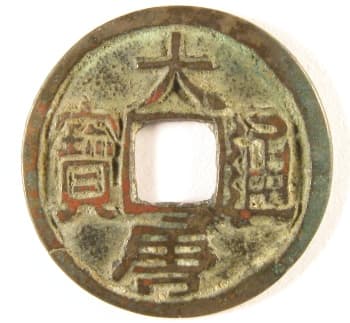 The
da
tang tong bao (大
唐通宝) coins have
inscriptions in official style
script (li
shu
隶书).
These coins are not as well-made as
the tang guo tong bao.
There is also a rare variety of the
da
tang tong bao which is
large and has a broad rim.
The
da
tang tong bao (大
唐通宝) coins have
inscriptions in official style
script (li
shu
隶书).
These coins are not as well-made as
the tang guo tong bao.
There is also a rare variety of the
da
tang tong bao which is
large and has a broad rim.
An example of a da tang tong bao is displayed at the left.
These coins began to be cast in the year 959.
The diameter of this coin is 23 mm and the weight is 2.9 grams.
Over the course of a few years, both the tang guo tong bao and da tang tong bao coins gradually were cast in smaller and lighter sizes. It is not likely that these coins were able to maintain a value equivalent to two of the Tang dynasty kai yuan tong bao (开 元通宝) coins.
The Southern Tang also cast kai yuan tong bao (开 元通宝) cash coins as matched coins in seal script and official script. These coins still exist in large quantities.
These kai yuan tong bao coins can be differentiated from those of the Tang Dynasty because they have very broad rims.
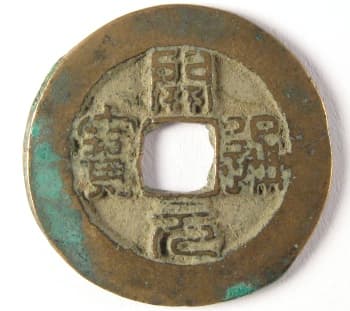 An example of a kai
yuan tong bao coin in seal
script with a broad rim is shown
here.
An example of a kai
yuan tong bao coin in seal
script with a broad rim is shown
here.
These coins began to be cast in the year 961.
This coin has a diameter of 25 mm and a weight of 4.3 grams.
There also exists a variety of Southern Tang kai yuan tong bao which is large and very similar in appearance to the official script version of the yong tong quan huo coin.
Another variety of Southern Tang kai yuan tong bao is slightly smaller than the above coin but still larger than a common cash coin. The coin is believed to have been a Value Three (dang san 当三) coin and may in fact be a reduced weight Value 10 coin. This variety is very rare.
There is a coin with the inscription da qi tong bao (大齐通宝) that most Chinese numismatists believe was cast during the kingdom's establishment by Xu Zhigao.
Only two specimens of the da qi tong bao coin are believed to exist and one specimen's whereabouts is now unknown.
The other da qi tong bao coin has four small holes and is popularly referred to as the "four eye da qi" (四眼大齐).
There are many fake da qi tong bao coins. These fakes are usually made from a tai ping tong bao (太平通宝) mold that has been altered. The style of these fake da qi tong bao coins is therefore the same as that of the tai ping tong bao.
Li Jing (李璟) succeeded Li Bian as the ruler of the Southern Tang and he adopted the reign title Baoda (保大). Li Jing began casting both bronze and iron coins in the year 943 with the inscription bao da yuan bao (保大元宝). These coins are very rare.
In the 5th year (962) of the Xiande (显德) reign, Li Jing cast the yong tong quan huo (永通泉货) coin with a value equal to ten small bronze coin. These coins exist in "official style" (li shu 隶书) and seal script (zhuan shu 篆书). Some of the seal script coins are small and light. These coins may have been cast in a later period.
After the 6th year (963) of the Xiande reign, the tang guo tong bao (唐国通宝) and da tang tong bao (大唐通宝) coins were cast.
In the beginning, the tang guo tong bao (唐国通宝) coins were produced in two denominations. The Value 10 (dang shi 当十) coin weighed about 12 grams and had its inscription written in seal script.
The Value 2 (dang er 当二) tang guo tong bao coin was cast as "matched coins" (dui qian 对钱, dui pin 对品, he he qian 和合钱) in both seal and li script. This means the coin was produced in two calligraphic styles but in all other aspects were the same including diameter, thickness, size of hole, composition, etc.
"Matched coins" (dui qian 对钱), which began with the tang guo tong bao coins of the Southern Tang, would become quite popular in the coinage of the Song Dynasty.
Some tang guo tong bao coins have a large star above the square hole on the reverse side.
Slightly later cast tang guo tong bao coins were produced as matched coins in seal and regular (kai shu 楷书) scripts. These coins also have a broad rim and small characters.
There is also a tang guo tong bao coin with the inscription written in regular script.
There are actually a number of varieties of the seal script tang guo tong bao which are fairly rare. One variety has large characters written in an unusual manner. Another variety has the tang (唐) character written with abbreviated strokes.
The
da
tang tong bao (大
唐通宝) coins have
inscriptions in official style
script (li
shu
隶书).
These coins are not as well-made as
the tang guo tong bao.
There is also a rare variety of the
da
tang tong bao which is
large and has a broad rim.An example of a da tang tong bao is displayed at the left.
These coins began to be cast in the year 959.
The diameter of this coin is 23 mm and the weight is 2.9 grams.
Over the course of a few years, both the tang guo tong bao and da tang tong bao coins gradually were cast in smaller and lighter sizes. It is not likely that these coins were able to maintain a value equivalent to two of the Tang dynasty kai yuan tong bao (开 元通宝) coins.
The Southern Tang also cast kai yuan tong bao (开 元通宝) cash coins as matched coins in seal script and official script. These coins still exist in large quantities.
These kai yuan tong bao coins can be differentiated from those of the Tang Dynasty because they have very broad rims.
An example of a kai
yuan tong bao coin in seal
script with a broad rim is shown
here.These coins began to be cast in the year 961.
This coin has a diameter of 25 mm and a weight of 4.3 grams.
There also exists a variety of Southern Tang kai yuan tong bao which is large and very similar in appearance to the official script version of the yong tong quan huo coin.
Another variety of Southern Tang kai yuan tong bao is slightly smaller than the above coin but still larger than a common cash coin. The coin is believed to have been a Value Three (dang san 当三) coin and may in fact be a reduced weight Value 10 coin. This variety is very rare.
While lead coins had occasionally appeared in earlier dynasties, they were not regularly cast in large quantities.
The earliest forms of money made of lead actually appeared during the Warring States Period (475-221 BC) and included the yi hua (一 化) round coin from the State of Yan as well as the ghost face money (ant nose money) from the State of Chu. There are also examples of lead ban liang coins from the Qin (221-207 BC) and lead ban liangs from the Western Han (206 BC -24 AD) Dynasties.
However, large quantities of lead coins were not cast until the Ten Kingdoms period. As a result of decades of constant warfare, copper mining became disrupted and administrative centers were frequently cutoff from a source of copper. Lacking copper to make bronze, mints had little choice but to turn to lead and iron for the casting of coins.
The earliest use of lead for the regular production of cash coins is generally believed to have occurred in the year 916 during the reign of Wang Shenzhi, the Prince of Min, of the Kingdom of Min. The coin, made of lead, was a copy of the bronze kai yuan tong bao (开 元通宝) of the Tang Dynasty but had the Chinese character min (闽) or fu (福), indicating the area of Fujian, on its reverse side.
The Southern Han Kingdom was another of the Ten Kingdoms that existed in southeast China during the years 905-971.
Both bronze and lead coins were cast during the years 917-924 of the reign of Emperor Lie Zu (Liu Yan) of the Southern Han Kingdom.
An example of this Southern Han coinage would be the lead kai yuan tong bao (开 元通宝) cast in 917 in the area of Canton (Guangzhou), then known as Xingwangfu.
Some of the lead coins from this period cannot as yet be attributed to a specific kingdom and ruler.
This is an
example of such a lead coin that can only be attributed
to the Southern Han Kingdom or Kingdom
of Chu and which was most likely cast in the
period 900-971.The inscription reads wu zhu (五 铢) and the coin resembles the wu zhu coins of the Han and later dynasties.
The coin is distinctive because of the swastikas above and below the square hole.
The swastika, which can also be found on earlier wu zhu coins, is an ancient Chinese symbol and is believed to represent the Chinese character wan (万) meaning "ten-thousand". The extended meaning is "many".
The swastika is also an ancient Buddhist symbol and Buddhism was a major religion in China at the time this coin was cast.
The reverse side of the coin is flat.
The coin has a diameter of 25 mm and a weight of 2.9 grams.
Other coins from the
Five Dynasties and Ten Kingdoms can be seen at the links
below.
| Inscript | Pinyin | Years cast | Special |
Emperor |
| 天汉元宝 | tian han yuan bao | 917 |
flower (rosette) hole | King Wang Jian |
| 乾德元宝 | qian de yuan bao |
919-924 |
flower (rosette)
hole |
Wang Yan |
| 汉元通宝 | han yuan tong bao | 947-948 |
Gao Zu |
|
| 周元通宝 | zhou yuan tong bao | 955-??? |
Shi Zong |
|
| 大唐通宝 | da tang tong bao | 959-961 |
Yuan Zu (Li
Jing) |
|
| 开元通宝 | kai
yuan tong bao (lead coin) |
900-971 |
Liu Yan of
Southern Han |
You Zhou Autonomous Region (900-914)
Liu Rengong (刘仁恭)
and his son Liu Shouguang (刘守光), who overthrew him,
reigned over the You Zhou Autonomous Region (幽州)
during the period 900-914. The geographical
location, consisting of present-day Bejing and parts
of Hebei, allowed it to maintain some degree of
independence from the Five Dynasties
and Ten Kingdoms that existed at the same time
to the south.
The father and son instituted a brutal regime.
They confiscated the bronze coins that were in circulation and buried them in a cave under their control. As a consequence, the people had to rely on money made of clay (ni qian 泥钱).
The regime also issued a variety of large denomination iron coins which were poorly-made.
The iron coins include the "value ten" yong an yi shi (永安一十), "value one hundred" yong an yi bai (永安一百), "value five hundred" yong an wu bai (永安五百), and "value one thousand" yong an yi qian (永安一千).
Also issued were iron coins with the inscription shun tian yuan bao (千顺天元宝). The shun tian yuan bao coins have characters on the reverse side including bai ("hundred" 百) and qian ("thousand" 千).
An iron coin resembling the ancient Chinese spade money of Wang Mang was also cast with the inscription huo bu san bai ("spade money three hundred" 货布三百).
Iron coins resembling the bronze wu zhu coin of the Sui Dynasty ("Sui wu zhu" 隋五铢) were also cast.
A very small number of yong an yi shi (永安一十) and yong an wu bai (永安五百) coins made of bronze are also known to exist.
In the year 911, Liu Shouguang proclaimed himself the Emperor of Yan (da yan huang di 大燕皇帝). The reign was short-lived, however, and ended with his execution in 914.
During his reign as Emperor of Yan, Liu Shouguang ruled under the reign title Ying Tian (应天). There exists a bronze coin with the inscription ying tian yuan bao (应天元宝) which has the character qian ("thousand" 千) on the reverse. There also exists a bronze qian sheng yuan bao (乾圣元宝) with the character bai ("hundred" 百) on the reverse. Finally, there is a bronze coin with the inscription ying sheng yuan bao (应圣元宝) with the character shi ("ten" 拾) on the reverse.
The calligraphy on these three bronze coins is similar and the coins are believed to have been cast during the period when Liu Shouguang was Emperor of Yan.
However, there is some dispute as to the attribution of these coins. The calligraphy is similar to that of the kai ping yuan bao (开 平元宝) and kai ping tong bao (开平通宝) coins of the Later Liang Dynasty. Also, it is generally believed that only one specimen of each of these coins exists. All these coins are reportedly now in collections in Japan where they are unavailable for further research.
The father and son instituted a brutal regime.
They confiscated the bronze coins that were in circulation and buried them in a cave under their control. As a consequence, the people had to rely on money made of clay (ni qian 泥钱).
The regime also issued a variety of large denomination iron coins which were poorly-made.
The iron coins include the "value ten" yong an yi shi (永安一十), "value one hundred" yong an yi bai (永安一百), "value five hundred" yong an wu bai (永安五百), and "value one thousand" yong an yi qian (永安一千).
Also issued were iron coins with the inscription shun tian yuan bao (千顺天元宝). The shun tian yuan bao coins have characters on the reverse side including bai ("hundred" 百) and qian ("thousand" 千).
An iron coin resembling the ancient Chinese spade money of Wang Mang was also cast with the inscription huo bu san bai ("spade money three hundred" 货布三百).
Iron coins resembling the bronze wu zhu coin of the Sui Dynasty ("Sui wu zhu" 隋五铢) were also cast.
A very small number of yong an yi shi (永安一十) and yong an wu bai (永安五百) coins made of bronze are also known to exist.
In the year 911, Liu Shouguang proclaimed himself the Emperor of Yan (da yan huang di 大燕皇帝). The reign was short-lived, however, and ended with his execution in 914.
During his reign as Emperor of Yan, Liu Shouguang ruled under the reign title Ying Tian (应天). There exists a bronze coin with the inscription ying tian yuan bao (应天元宝) which has the character qian ("thousand" 千) on the reverse. There also exists a bronze qian sheng yuan bao (乾圣元宝) with the character bai ("hundred" 百) on the reverse. Finally, there is a bronze coin with the inscription ying sheng yuan bao (应圣元宝) with the character shi ("ten" 拾) on the reverse.
The calligraphy on these three bronze coins is similar and the coins are believed to have been cast during the period when Liu Shouguang was Emperor of Yan.
However, there is some dispute as to the attribution of these coins. The calligraphy is similar to that of the kai ping yuan bao (开 平元宝) and kai ping tong bao (开平通宝) coins of the Later Liang Dynasty. Also, it is generally believed that only one specimen of each of these coins exists. All these coins are reportedly now in collections in Japan where they are unavailable for further research.
Northern Song Dynasty (960-1127)
The Song Dynasty produced a vast variety of coins of very high esthetic value and with a large number of names and titles. Each new emperor minted coins not only after enthronement but many times with each change of the nian hao (年号) which was the "imperial title", also known as "reign title" or "period title".
Coins were also cast in a number of major calligraphic styles including seal script (zhuan shu 篆书), regular script (kai shu 楷书 or zhen shu 真书), clerk or official script (li shu 隶书), running script (xing shu 行书), and grass script (cao shu 草书).
The variety of coins from the Song is so vast that many collectors and researchers specialize in just the coins of this dynasty.
Emperor Tai Zu (960-976) was the first emperor of the Song Dynasty and established its capital at Kaifeng in Henan. Coins were cast in very large quantities with the inscription song yuan tong bao (宋元通宝). The inscription song yuan, meaning "inauguration of the Song", was modeled on the kai yuan tong bao (开元通宝) which was the inaugural coin of the Tang Dynasty. Similar to the Tang coin, many of the song yuan tong bao coins have dots (stars) and crescents (moons) in various positions on their reverse sides.
After "pacifying" Sichuan, the Song ruler had the bronze coins circulating in the area sent back to the capital. The bronze coins were replaced with those cast of iron which caused the price of goods to soar resulting in great hardship to the local populace.
Emperor Tai Zong (976-997) began the tradition of casting new coins with each change of reign title. Coins with the reign titles of Tai Ping (太平 975-989), Chun Hua (淳化 990-994) and Zhi Dao (至道 995-997) were produced. The tai ping tong bao coins resembled the song yuan tong bao (宋元通宝) coins. The coins with the inscriptions (legends) chun hua yuan bao (淳化元宝) and zhi dao yuan bao (至 道元宝) are noteworthy because the calligraphy was done by Emperor Tai Zong himself in regular script, running script and grass script.
One can make an interesting observation concerning these first four coins of the Song dynasty. As already mentioned, the first coin, the song yuan tong bao, is similar to the first coin of the Tang Dynasty, the kai yuan tong bao, in that there are many varieties with dots (stars) and crescents (moons) in various positions on the reverse side. But the appearance of such symbols on the reverse side of the coins gradually decreased with the introduction of each successive reign title. For example, these symbols are found much less often on the tai ping tong bao and chun hua yuan bao coins, and are fairly rare by the time the zhi dao yuan bao (至 道元 宝) coins were issued.
The tai ping tong bao
(太平通宝) coin shown at the left is an example of a
slightly later Northern Song Dynasty coin that still has
a symbol on the reverse side. (diameter: 25.5 mm,
weight: 3.9 grams)In this case, however, the symbol is not a "star" or "crescent".
The reverse side displays lines radiating outward from the four corners of the square hole which do not extend entirely to the rim. In Chinese, this is called si jue (四诀).
This symbol dates from ancient times but is rarely seen on a Song Dynasty coin.
One other characteristic of Song Dynasty coins was established with these first issues and can be seen on this coin. The coins have an obverse side with strong, deeply impressed characters and rims. The reverse sides, on the other hand, exhibit weak and shallow features.
During the reign of Emperor Zhen Zong (998-1022) coins were cast with the period titles Xian Ping (咸平 998-1003), Jing De (景德 1004-1007), Xiang Fu (祥符 1008-1016), and Tian Xi (天禧 1017-1022). All these coins have inscriptions written in regular script. Also, all the coins have blank reverses with the exception of an extremely few xiang fu tong bao coins which have dots and crescents.
A small number of xian ping yuan bao (咸 平元宝) and xiang fu yuan bao (祥符元宝) coins which are unusually distinctive were cast during the reign of Emperor Zhen Zong. These large coins are similar to the thick and heavy bing qian (饼 钱) coins known as "cake money" or "biscuit money" cast during the reign of Wang Mang of the Xin Dynasty. The Song dynasty "biscuit" coins, however, are not only large, thick and heavy but also have very broad rims. For a detailed discussion of these "biscuit" or "cake" coins, please see Song Dynasty Biscuit Coins.
Emperor Ren Zong (1023-1063) had coins with eight period titles cast during his reign. These include Tian Sheng (天圣1023-1031), Ming Dao (明道 1032-1033), Jing You (景佑 1034-1038), Huang Song (皇 宋 1039-1054?), Kang Ding (康定 1040), Qing Li (庆历 1041-1048), Zhi He (至和 1054-1055) and Jia You (嘉佑 1056-1063).
One interesting and very rare variety of the huang song tong bao (皇宋通宝) coin has the inscription written in "ninefold" script (jiu die zhuan 九叠篆) which was a style of calligraphy usually reserved for use only on official Song Dynasty seals.
Huang You (皇佑 1049-1053) was another period title used during Emperor Ren Zong's reign but no authentic coins with this inscription have ever been found and, most probably, none were ever cast.
Emperor Ying Zong (1064-1067) reigned for a very short time and only zhi ping yuan bao (治平元 宝) and zhi ping tong bao (治平通宝) coins were cast. There exists one extremely rare set of zhi ping "matched coins" (dui qian 对 钱) consisting of a zhi ping yuan bao and a zhi ping tong bao with four oblique lines (si chu 四出) extending outward from each corner of the hole to the rim on the reverse sides.
Emperor Shen Zong (1068-1085) only had two reign titles, Xi Ning (熙宁 1068-1077) and Yuan Feng (元丰 1078-1085), for which coins were cast but these coins were produced in enormous quantities. In one year alone, more than 5 million strings of coins were produced. A "string" consisted of 1,000 coins so 5 million strings means that 5 billion cash coins were cast in just one year! Not surprisingly, xi ning and yuan feng coins are among the most common Song Dynasty coins found today and exist in many, many varieties.
Emperor Zhe Zong (1086-1100) cast coins with the period titles Yuan You (元祐 1086-1093), Shao Sheng (绍圣 1086-1100) and Yuan Fu (元符 1098-1100). For some unknown reason, quite a number of shao sheng yuan bao (绍 圣元宝) coins have dots (stars) and crescents (moons) on their reverse sides.
Also, as a result of government corruption, a large number of iron coins were cast near the end of Emperor Zhe Zong's reign.
Emperor Hui Zong (1101-1125) was a man of culture and the arts but one whose decisions regarding administration of the state resulted in the fall of the Northern Song through defeat by the Jin. Nevertheless, the coins cast during his reign are considered among the very best produced during the Song Dynasty in terms of their quality, artistic essence and calligraphy.
Coins were cast for the following reign titles: Jian Guo (建国 1101), Sheng Song (圣宋 1101-1106?), Chong Ning (崇宁 1102-1106), Da Guan (大观 1107-1110), Zheng He (政和 1111-1117), Chong He (重和 1118) and Xuan He (宣和 1119-1125).
One variety of jian guo tong bao (建国通宝) cast in white bronze is so rare that the only known specimen is at the National Museum of China (formerly the Museum of Chinese History) in Beijing.
The sheng song yuan bao (圣 宋元宝) coins produced as a matched pair in seal and running script are particularly exquisite and exist in a number of varieties. The sheng song tong bao (圣宋通 宝) coins, on the other hand, were cast in far fewer numbers.
Emperor Hui Zong did the calligraphy for the inscription on the chong ning tong bao coins. His calligraphy is quite distinctive and is known as "slender gold" script (shou jin shu 瘦金书) because the characters resemble twisted gold filaments. While the smaller 1 cash chong ning tong bao (崇 宁通 宝) coins are fairly scarce, the larger 10 cash chong ning tong bao (崇宁通宝) and 10 cash chong ning zhong bao (崇宁元宝) coins are plentiful and exist in many varieties.
Unfortunately, these "10 cash" coins were not worth their stated value but served instead as a means for the government to confiscate wealth.
There is a humorous story dating from this time period which illustrates the hardship caused by the lack of 1 cash coins. The story relates that a patron bought a bowl of soup and paid for it with a "10 cash" coin. The soup seller did not have any small change and so encouraged the customer to eat more and more soup. The customer continued to eat but finally sighed and said, "it is fortunate that my coin is only a "10 cash". If it had been a "100 cash" it would have killed me!"
These 10 cash coins were so overvalued that they were eventually devalued until they were worth the equivalent of 3 cash coins.
While coins of Emperor Hui Zong's Chong Ning years were produced as chong ning tong bao (崇宁通宝), chong ning yuan bao (崇 宁元 宝) and chong ning zhong bao (崇宁重 宝), all the coins cast during the Da Guan years were da guan tong bao (大观通 宝). Many of the 1 cash and 10 cash da guan tong bao coins display the Emperor's "slender gold" calligraphy.
During the Zheng He reign of Emperor Hui Zong, coins were cast as zheng he tong bao (政和通宝) and zheng he zhong bao (政和重宝).
Emperor Hui Zong's Chong He reign only lasted three months and only coins with the inscription chong he tong bao (重 和通宝) were cast.
The Xuan He reign produced a large number of xuan he tong bao (宣和通 宝) coins but only a small number of xuan he yuan bao (宣和元宝) coins.
Emperor Qin Zong (1126-1127) reigned for only a very short time because of the invasion by the Jin. As a result, only a small number of jing kang tong bao (靖康通宝) and jing kang yuan bao (靖康元宝) coins were cast and they are all considered to be rare. The inscription on these coins is believed to be the calligraphy of Emperor Qin Zong.
This is an iron coin cast during the reign of Emperor Hui Zong (1101-1125) of the Northern Song Dynasty.
The inscription is written in Li script and reads clockwise as sheng song yuan bao (圣宋元宝).
These coins were cast during the period 1101-1106).
The reverse side displays a crescent moon above the square hole.
The diameter is 32.5 mm and the weight is 8.2 grams.
Emperor Hui Zong was known for his calligraphy and is credited with creating a personal style known as "slender gold script".
The inscription on the 1 cash coin at the left is written in slender gold script and reads clockwise as chong ning tong bao (崇宁通宝).
The diameter is 24.2 mm and the weight is 4.6 grams.
Other Northern Song Dynasty coins, including many with flower or rosette holes, can be viewed at the following links:
| Inscript | Pinyin | Special |
Years cast | Emperor |
| 太 平通宝 | tai ping tong bao | li script |
976-989 |
Tai Zong |
| 至道元宝 | zhi dao yuan bao |
running script |
995-997 | Tai Zong |
| 景德元宝 |
jing de yuan bao |
regular script |
1004-1007 |
Zhen Zong |
| 样符元宝 | xiang
fu yuan bao |
regular script |
1008-1016 | Zhen Zong |
| 天禧通宝 | tian xi tong bao | regular script |
1017-1022 | Zhen Zong |
| 天圣元宝 | tian sheng
yuan bao |
regular script | 1023-1031 |
Ren Zong |
| 明道元宝 | ming dao yuan bao | regular script |
1032-1033 | Ren Zong |
| 皇宋通宝 | huang song tong bao | seal script |
1039-1054 | Ren Zong |
| 至和通宝 | zhi he tong bao |
regular script |
1054-1055 | Ren Zong |
| 至和通宝 | zhi he tong bao |
seal script | 1054-1055 |
Ren Zong |
| 嘉祐通寳 | jia you tong bao | seal script |
1056-1063 | Ren Zong |
| 治平元宝 | zhi ping yuan bao |
seal script | 1064-1067 | Ying Zong |
| 治平元宝 | zhi ping yuan
bao |
regular script |
1064-1067 |
Ying Zong |
| 治平通宝 |
zhi ping tong bao |
seal script |
1064-1067 |
Ying Zong |
| 熙宁元宝 | xi ning yuan bao | regular script |
1068-1077 | Shen Zong |
| 熙宁元宝 | xi ning yuan bao |
seal script |
1068-1077 | Shen Zong |
| 熙宁重宝 | xi ning zhong bao |
seal script,
large cash coin |
1071-1077 |
Shen Zong |
| 熙宁重宝 | xi ning zhong bao |
regular script, large cash coin | 1071-1077 | Shen Zong |
| 元丰通宝 | yuan feng tong bao | running script
with engraving |
1078-1085 | Shen Zong |
| 元丰通宝 | yuan feng tong bao |
seal script |
1078-1085 | Shen Zong |
| 元祐通寳 | yuan you tong bao | seal script | 1086-1093 | Zhe Zong |
| 元祐通寳 | yuan you tong bao |
seal script,
large cash coin |
1086-1093 | Zhe Zong |
| 元祐通寳 | yuan you tong bao |
running style |
1086-1093 | Zhe Zong |
| 绍圣元宝 | shao sheng yuan bao | seal script | 1094-1097 | Zhe Zong |
| 绍圣元宝 | shao sheng yuan
bao |
seal script,
large cash coin |
1094-1097 | Zhe Zong |
| 绍圣元宝 | shao sheng yuan
bao |
running script |
1094-1097 | Zhe Zong |
| 元符通宝 | yuan fu tong bao |
seal script |
1098-1100 |
Zhe Zong |
| 圣宋元宝 | sheng
song yuan bao |
seal script | 1101-1106 |
Hui Zong |
| 圣宋元宝 | sheng song yuan bao | running script | 1101-1106 | Hui Zong |
| 崇宁重宝 | chong ning zhong bao | 10 Cash, li
script |
1102 - 1106 | Hui Zong |
| 崇宁重宝 | chong ning zhong
bao |
10 Cash with
engraving |
1102 - 1106 | Hui Zong |
| 大观通宝 | da guan tong bao | slender gold
script |
1107-1110 | Hui Zong |
| 政和通宝 | zheng he tong bao | seal script |
1111-1117 | Hui Zong |
| 宣和通宝 | xuan he tong bao | seal script | 1119-1125 | Hui Zong |
Southern Song
Dynasty (1127-1279)
The capital of the
Southern Song was established at Hangzhou. Because
Hangzhou is not near any sources of copper, the quantity
of bronze coins cast during the Southern Song was
considerably less than what was produced during the
Northern Song.
There are also other reasons why the production of iron coins was so prevalent during the Southern Song. One reason was due to economic development and the increased demand for money. A second reason had to do with external affairs. It was necessary to prevent the flow of copper north to the areas controlled by Liao, Jin and Western Xia. To accomplish this, the imperial court adopted policies to segregate where iron and copper coins would be used. Iron coins would circulate on the roads and areas closest to the border areas. A third reason was that wars were frequent which meant that a large quantity of copper was needed to cast weapons. For these reasons, mints to produce iron coins were established at Erhu (二湖), Erguang (二广), Fujian (福建), Liangzhe (两浙) and Chuangui (川贵).
There are some difficulties encountered in collecting iron coins from the Southern Song. While huge quantities of these iron coins are constantly being excavated, the vast majority are seriously corroded and rusted together. It is, therefore, difficult to find specimens in good condition with clear inscriptions. Also, in the past, collectors of ancient Chinese coins have focused on collecting copper coins, sycee, and gold and silver coins. There was much less interest in the iron coins and, as a result, many have been lost and even melted down for their scrap value.
Emperor Gao Zong (1127-1162) had coins cast during his Jian Yan reign years (1127-1130) as jian yan yuan bao (建炎元宝), jian yan zhong bao (建炎重宝) and jian yan tong bao (建炎通宝). The jian yan tong bao (建炎通宝) coins are fairly plentiful but there are very few jian yan yuan bao (建炎元宝) and jian yan zhong bao (建炎重宝) coins.
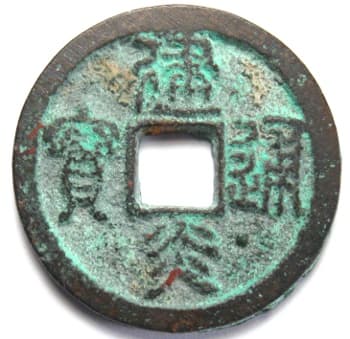 Jian yan yuan bao (建炎元宝) coins
were cast as 1 cash with inscriptions written in seal (zhuan 篆) or
official (li 隶)
script. Jian
yan zhong bao (建炎重宝) coins were only cast as
bronze coins in seal script with a value of 3
cash. Jian yan
tong bao (建 炎通宝) coins were cast in both
bronze and iron with inscriptions written in seal or
official scripts and with values of 1 cash, 2 cash and 3
cash.
Jian yan yuan bao (建炎元宝) coins
were cast as 1 cash with inscriptions written in seal (zhuan 篆) or
official (li 隶)
script. Jian
yan zhong bao (建炎重宝) coins were only cast as
bronze coins in seal script with a value of 3
cash. Jian yan
tong bao (建 炎通宝) coins were cast in both
bronze and iron with inscriptions written in seal or
official scripts and with values of 1 cash, 2 cash and 3
cash.
The coin at the left is an example of a "2 cash" jian yan tong bao (建 炎通宝) written in seal script. (diameter: 29 mm, weight: 9.3 grams)
This coin is the equivalent in value to two of the smaller 1 cash coins.
This particular specimen is unusual because it has a "dot", known as a "star" (xing 星), located at the 5 o'clock position between the tong (通) and yan (炎) characters.
During the Shao Xing (1131-1162) reign years of Emperor Gao Zong, coins were cast as shao xing yuan bao (绍兴元宝) and shao xing tong bao (绍兴通宝) only. No authentic shao xing zhong bao (绍兴重宝) coins are known to exist.
The shao xing yuan bao (绍兴元宝) coins were cast in bronze and iron with inscriptions in seal and regular scripts and with values of 1 cash, 2 cash and 3 cash. The shao xing tong bao (绍兴通宝) bronze and iron coins were written in official script as 1 cash, 2 cash and 3 cash.
The quantity of shao xing coins produced exceeded that of the jian yan coins but most are "2 cash" or "3 cash" coins. Very few "1 cash" (xiao ping 小平) coins were cast.
Emperor Xiao Zong ruled during the period 1163-1190 and had coins cast with the reign titles of Long Xing (1163-1164), Qian Dao (1165-1173) and Chun Xi (1173-1190). Because it was not considered worth the expense in either raw materials or labor, no official "1 cash" bronze coins were cast during the Long Xing and Qian Dao period title years. There were also very few official "2 cash" coins cast during the Long Xing years.
During Emperor Xiao Zong's Long Xing (1163-1164) reign, coins were cast as long xing yuan bao (隆兴元宝) with seal and official scripts. Only 2 cash coins were cast in bronze. One cash, 2 cash and 3 cash coins were produced in iron.
Long xing tong bao (隆兴通宝) were only cast as iron coins with a value of 2 cash.
Coins cast during Emperor Xiao Zong's Qian Dao (1165-1173) years included qian dao yuan bao (乾道元宝) and qian dao tong bao (乾道通宝). Qian dao yuan bao (乾道元宝) coins were cast in seal and official scripts in bronze as 2 cash and in iron as 1 cash and 2 cash. The qian dao tong bao (乾道通宝) coins were only cast in iron as 1 cash and 2 cash.
In 1173 the period title was proclaimed to be Chun Xi with chun written as 纯. Only 6 days later, the chun was officially changed to be written as 淳. The Tongan mint in in Anhui produced a very small number of chun xi yuan bao (纯熙元宝) iron coins with the chun written as 纯. These small iron coins are very rare.
Beginning in the 7th year (1180) of the Chun Xi reign of Emperor Xiao Zong, a number indicating the year of the period title in which the coin was cast was added to the reverse side of coins. This measure was taken to help reduce the illegal casting of private coins. It was believed that those casting private coins would not adopt the technology necessary to prepare and mate properly the obverse and reverse molds to produce coins with well cast inscriptions. Most privately cast coins of that time tended to be thin with flat reverses.
From this time until the end of the Song Dynasty in 1279, there tended to be few officially produced bronze coins with the period title year cast on the reverse side of the coin. Many iron coins, however, were cast with the year indicated on the reverse.
Also, beginning with the Chun Xi era coins and continuing to the end of the Song Dynasty, the inscriptions on bronze cash coins tended to be written in what is now known as the "Song style" or "regular script". For this reason, there are fewer varieties of bronze cash coins.
Emperor Xiao Zong during the years 1174-1189 had coins cast as chun xi yuan bao (淳熙元宝) and chun xi tong bao (淳熙通宝). The chun xi yuan bao (淳熙元宝) coins were cast in bronze and iron, in both seal and regular scripts, as 1 cash, 2 cash and 3 cash. The chun xi tong bao (淳熙通宝) iron coins were written in seal script and issued as 1 cash and 2 cash.
During the short reign of Emperor Guang Zong (1190-1194), bronze coins were cast with the inscription shao xi yuan bao (绍熙元宝) in values of both "1 cash" and "2 cash". Shao xi yuan bao coins cast in iron were produced as 1 cash, 2 cash and 3 cash. The reverse sides display years 1 (yuan 元) through 5.
Shao xi tong bao (绍 熙通宝) coins, however, were only cast in iron and only in values of 1 cash and 2 cash.
In the 4th year (1193) of the Shao Xi reign, "5 cash" coins were cast as both shao xi yuan bao and shao xi tong bao but these coins are very rare.
Emperor Ning Zong (1195-1224) produced coins under a number or period titles including Qing Yuan (1195-1200), Jia Tai (1201-1204), Kai Xi (1205-1207), Jia Ding (1208-1224) and Sheng Song (1208-1210).
Qing yuan tong bao (庆元通宝) coins began to be cast in 1195 in both bronze and iron and in values of 1 cash, 2 cash and 3 cash. Qing yuan yuan bao (庆元元宝) coins were only cast as a 5 cash iron coin.
Beginning in the first year (1201) of Emperor Ning Zong's Jia Tai reign, jia tai tong bao (嘉泰通宝) bronze coins were cast in values of 1 cash, 2 cash and 3 cash. Iron coins with this inscription were cast as 1 cash and 2 cash. Jia tai yuan bao (嘉泰元宝) coins were only cast in iron and in values of 1 cash, 2 cash and 3 cash.
Emperor Ning Zong's Kai Xi reign began in 1205 and produced both bronze and iron coins with the inscription kai xi tong bao (开禧通宝) in both 1 cash and 2 cash values. Coins with the legend kai xi yuan bao (开禧元宝) were only cast in iron and only with a value of 3 cash.
During Emperor Ning Zong's Jia Ding (1208-1224) title reign, jia ding tong bao (嘉定通宝) bronze coins were cast in 1 cash and 2 cash values. Jia ding tong bao coins were also produced in iron with values of 1 cash, 2 cash and 5 cash.
Jia ding yuan bao (嘉 定元宝) bronze coins were only cast as a large "10 cash" coin. Iron jia ding yuan bao coins, however, were cast as 2 cash, 3 cash and 5 cash coins.
Most coin inscriptions include the characters tong bao (通宝), yuan bao (元宝) or zhong bao (重宝). Emperor Ning Zong's Jia Ding reign, however, is noted for producing a number of coins with inscriptions that had not previously been seen. These are all large 2 cash and 3 cash iron coins and include such new inscriptions as jia ding chong bao (嘉定崇宝), jia ding quan bao (嘉定全宝), jia ding yong bao (嘉定永宝), jia ding zhen bao (嘉定真宝), jia ding xin bao (嘉定新宝), jia ding an bao (嘉定安宝), jia ding long bao (嘉定隆宝), jia ding quan bao (嘉定泉宝), jia ding zheng bao (嘉定正宝), jia ding hong bao (嘉定洪宝), jia ding wan bao (嘉定万宝), jia ding zhi bao (嘉定之宝), jia ding zhen bao (嘉定珍宝), and jia ding xing bao (嘉定兴宝).
Some even larger "5 cash" iron coins were cast as jia ding zhen bao (嘉定珍宝), jia ding xing bao (嘉定兴宝), jia ding zhong bao (嘉定重宝), jia ding zhi bao (嘉定之宝), and jia ding quan bao (嘉定全宝). Five cash coins, with never seen before inscriptions, include the jia ding zhi bao (嘉定至宝) and the jia ding feng bao (嘉定封宝).
Emperor Ning Zong also cast coins during his Sheng Song (1208-1210) reign. These are all 5 cash iron coins with the inscription sheng song zhong bao (圣宋重宝) that were produced at the Shaoxing (绍兴) mint in Li Prefecture (利洲) in Sichuan (四川).
The Southern Song is noted for the very large quantity of iron coins cast. The period 1163-1224, during the reigns of Emperor Xiao Zong and Emperor Ning Zong, saw the largest production of iron coins of the dynasty.
Emperor Li Zong ruled during the years 1225-1264 which included nine period titles. The reign titles are Bao Qing (1225), Da Song (1225-1227), Shao Ding (1228-1233), Duan Ping (1234-1236), Jia Xi (1237-1240), Chun You (1241-1252), Huang Song (1253-1258), Kai Qing (1259), and Jing Ding (1260-1264).
During his Bao Qing (1225) reign, Emperor Li Zong ordered 1 cash and 2 cash iron coins cast with the inscription bao qing yuan bao (宝庆元宝).
The Da Song (1225-1227) era of Emperor Li Zong saw production of da song yuan bao (大宋元宝) 1 cash and 2 cash bronze coins as well as 1 cash and 3 cash iron coins. Da song tong bao (大宋通宝) coins were cast as 10 cash coins in bronze and 1 cash coins in iron.
The Shao Ding (1228-1233) years saw the minting of shao ding tong bao (绍定通宝) bronze and iron 1 cash and 2 cash coins. The shao ding yuan bao (绍定元宝) coins were only cast in iron with a value of 3 cash.
Emperor Li Zong's Duan Ping (1234-1236) reign had duan ping yuan bao (端平元宝) coins cast as 1 cash in bronze, and 3 cash and 5 cash in iron. Bronze 5 cash coins, as well as 1 cash and 5 cash iron coins, were minted as duan ping tong bao (端平通宝). Duan ping zhong bao (端 平重宝) coins were only produced as 5 cash bronze coins.
During the Jia Xi (1237-1240) reign of Emperor Li Zong, jia xi tong bao (嘉熙通宝) coins in bronze were cast as 1 cash and 2 cash. Large 5 cash and 10 cash coins with this inscription were also cast in iron. Only bronze 5 cash coins were made with the inscription jia xi zhong bao (嘉熙重宝).
Emperor Li Zong's Chun You (1241-1252) period saw chun you yuan bao (淳佑元宝) coins minted as 1 cash and 2 cash bronze coins. Chun you tong bao (淳佑通宝) coins were cast as 1 cash, 2 cash, 3 cash and 100 cash (当百) in bronze, as well as 20 cash and 100 cash in iron.
The Huang Song (1253-1258) years of Emperor Li Zong's rule produced only bronze coins of 1 cash and 2 cash with the inscription huang song yuan bao (皇宋元宝).
Emperor Li Zong's Kai Qing (1259) reign lasted just one year and produced only bronze 1 cash and 2 cash coins with the inscription kai qing tong bao (开庆通宝).
The ninth and final dynastic title of Emperor Li Zong was Jing Ding (1260-1264). Only bronze jing ding yuan bao (景定元宝) bronze coins were cast with values of 1 cash and 2 cash.
Emperor Du Zong (1265-1274) was the last Song Dynasty emperor to cast coins. Coins during his title reign of Xian Chun (1265-1274) were produced as 1 cash and 2 cash in bronze only with the inscription xian chun yuan bao (咸淳元宝).
Because of the invasion by the Mongol army, the last three Song emperors were constantly on the run and, therefore, did not have the means to establish mints. For this reason, no coins were cast with the dynastic titles of De You (德佑), Jing Yan (景炎) and Xiang Xing (祥兴). In the past, and in order to meet the demand for such coins by avid coin collectors, a few unscrupulous ancient Chinese coin dealers produced fake de you and jing yan coins. There is also a small, thin xiang xing coin that can be found but this coin was cast in Annam (Vietnam) and is in no way associated with Song Dynasty coinage.
Because of serious inflation during the last years of the Southern Song, the government also cast a type of very small coin tablet or coin tally known as qian pai (钱牌). These coin tallies were made of bronze or lead and were issued in denominations of 10 cash, 40 cash, 100 cash 200 cash, 300 cash and 500 cash. Most of these coin tallies have the inscription lin an fu xing yong (临安府行用) which translates as "(for) use in Lin An Prefecture". Lin An is the old name for Hangzhou which was the capital of the Southern Song.
There are also other reasons why the production of iron coins was so prevalent during the Southern Song. One reason was due to economic development and the increased demand for money. A second reason had to do with external affairs. It was necessary to prevent the flow of copper north to the areas controlled by Liao, Jin and Western Xia. To accomplish this, the imperial court adopted policies to segregate where iron and copper coins would be used. Iron coins would circulate on the roads and areas closest to the border areas. A third reason was that wars were frequent which meant that a large quantity of copper was needed to cast weapons. For these reasons, mints to produce iron coins were established at Erhu (二湖), Erguang (二广), Fujian (福建), Liangzhe (两浙) and Chuangui (川贵).
There are some difficulties encountered in collecting iron coins from the Southern Song. While huge quantities of these iron coins are constantly being excavated, the vast majority are seriously corroded and rusted together. It is, therefore, difficult to find specimens in good condition with clear inscriptions. Also, in the past, collectors of ancient Chinese coins have focused on collecting copper coins, sycee, and gold and silver coins. There was much less interest in the iron coins and, as a result, many have been lost and even melted down for their scrap value.
Emperor Gao Zong (1127-1162) had coins cast during his Jian Yan reign years (1127-1130) as jian yan yuan bao (建炎元宝), jian yan zhong bao (建炎重宝) and jian yan tong bao (建炎通宝). The jian yan tong bao (建炎通宝) coins are fairly plentiful but there are very few jian yan yuan bao (建炎元宝) and jian yan zhong bao (建炎重宝) coins.
Jian yan yuan bao (建炎元宝) coins
were cast as 1 cash with inscriptions written in seal (zhuan 篆) or
official (li 隶)
script. Jian
yan zhong bao (建炎重宝) coins were only cast as
bronze coins in seal script with a value of 3
cash. Jian yan
tong bao (建 炎通宝) coins were cast in both
bronze and iron with inscriptions written in seal or
official scripts and with values of 1 cash, 2 cash and 3
cash.The coin at the left is an example of a "2 cash" jian yan tong bao (建 炎通宝) written in seal script. (diameter: 29 mm, weight: 9.3 grams)
This coin is the equivalent in value to two of the smaller 1 cash coins.
This particular specimen is unusual because it has a "dot", known as a "star" (xing 星), located at the 5 o'clock position between the tong (通) and yan (炎) characters.
During the Shao Xing (1131-1162) reign years of Emperor Gao Zong, coins were cast as shao xing yuan bao (绍兴元宝) and shao xing tong bao (绍兴通宝) only. No authentic shao xing zhong bao (绍兴重宝) coins are known to exist.
The shao xing yuan bao (绍兴元宝) coins were cast in bronze and iron with inscriptions in seal and regular scripts and with values of 1 cash, 2 cash and 3 cash. The shao xing tong bao (绍兴通宝) bronze and iron coins were written in official script as 1 cash, 2 cash and 3 cash.
The quantity of shao xing coins produced exceeded that of the jian yan coins but most are "2 cash" or "3 cash" coins. Very few "1 cash" (xiao ping 小平) coins were cast.
Emperor Xiao Zong ruled during the period 1163-1190 and had coins cast with the reign titles of Long Xing (1163-1164), Qian Dao (1165-1173) and Chun Xi (1173-1190). Because it was not considered worth the expense in either raw materials or labor, no official "1 cash" bronze coins were cast during the Long Xing and Qian Dao period title years. There were also very few official "2 cash" coins cast during the Long Xing years.
During Emperor Xiao Zong's Long Xing (1163-1164) reign, coins were cast as long xing yuan bao (隆兴元宝) with seal and official scripts. Only 2 cash coins were cast in bronze. One cash, 2 cash and 3 cash coins were produced in iron.
Long xing tong bao (隆兴通宝) were only cast as iron coins with a value of 2 cash.
Coins cast during Emperor Xiao Zong's Qian Dao (1165-1173) years included qian dao yuan bao (乾道元宝) and qian dao tong bao (乾道通宝). Qian dao yuan bao (乾道元宝) coins were cast in seal and official scripts in bronze as 2 cash and in iron as 1 cash and 2 cash. The qian dao tong bao (乾道通宝) coins were only cast in iron as 1 cash and 2 cash.
In 1173 the period title was proclaimed to be Chun Xi with chun written as 纯. Only 6 days later, the chun was officially changed to be written as 淳. The Tongan mint in in Anhui produced a very small number of chun xi yuan bao (纯熙元宝) iron coins with the chun written as 纯. These small iron coins are very rare.
Beginning in the 7th year (1180) of the Chun Xi reign of Emperor Xiao Zong, a number indicating the year of the period title in which the coin was cast was added to the reverse side of coins. This measure was taken to help reduce the illegal casting of private coins. It was believed that those casting private coins would not adopt the technology necessary to prepare and mate properly the obverse and reverse molds to produce coins with well cast inscriptions. Most privately cast coins of that time tended to be thin with flat reverses.
From this time until the end of the Song Dynasty in 1279, there tended to be few officially produced bronze coins with the period title year cast on the reverse side of the coin. Many iron coins, however, were cast with the year indicated on the reverse.
Also, beginning with the Chun Xi era coins and continuing to the end of the Song Dynasty, the inscriptions on bronze cash coins tended to be written in what is now known as the "Song style" or "regular script". For this reason, there are fewer varieties of bronze cash coins.
Emperor Xiao Zong during the years 1174-1189 had coins cast as chun xi yuan bao (淳熙元宝) and chun xi tong bao (淳熙通宝). The chun xi yuan bao (淳熙元宝) coins were cast in bronze and iron, in both seal and regular scripts, as 1 cash, 2 cash and 3 cash. The chun xi tong bao (淳熙通宝) iron coins were written in seal script and issued as 1 cash and 2 cash.
During the short reign of Emperor Guang Zong (1190-1194), bronze coins were cast with the inscription shao xi yuan bao (绍熙元宝) in values of both "1 cash" and "2 cash". Shao xi yuan bao coins cast in iron were produced as 1 cash, 2 cash and 3 cash. The reverse sides display years 1 (yuan 元) through 5.
Shao xi tong bao (绍 熙通宝) coins, however, were only cast in iron and only in values of 1 cash and 2 cash.
In the 4th year (1193) of the Shao Xi reign, "5 cash" coins were cast as both shao xi yuan bao and shao xi tong bao but these coins are very rare.
Emperor Ning Zong (1195-1224) produced coins under a number or period titles including Qing Yuan (1195-1200), Jia Tai (1201-1204), Kai Xi (1205-1207), Jia Ding (1208-1224) and Sheng Song (1208-1210).
Qing yuan tong bao (庆元通宝) coins began to be cast in 1195 in both bronze and iron and in values of 1 cash, 2 cash and 3 cash. Qing yuan yuan bao (庆元元宝) coins were only cast as a 5 cash iron coin.
Beginning in the first year (1201) of Emperor Ning Zong's Jia Tai reign, jia tai tong bao (嘉泰通宝) bronze coins were cast in values of 1 cash, 2 cash and 3 cash. Iron coins with this inscription were cast as 1 cash and 2 cash. Jia tai yuan bao (嘉泰元宝) coins were only cast in iron and in values of 1 cash, 2 cash and 3 cash.
Emperor Ning Zong's Kai Xi reign began in 1205 and produced both bronze and iron coins with the inscription kai xi tong bao (开禧通宝) in both 1 cash and 2 cash values. Coins with the legend kai xi yuan bao (开禧元宝) were only cast in iron and only with a value of 3 cash.
During Emperor Ning Zong's Jia Ding (1208-1224) title reign, jia ding tong bao (嘉定通宝) bronze coins were cast in 1 cash and 2 cash values. Jia ding tong bao coins were also produced in iron with values of 1 cash, 2 cash and 5 cash.
Jia ding yuan bao (嘉 定元宝) bronze coins were only cast as a large "10 cash" coin. Iron jia ding yuan bao coins, however, were cast as 2 cash, 3 cash and 5 cash coins.
Most coin inscriptions include the characters tong bao (通宝), yuan bao (元宝) or zhong bao (重宝). Emperor Ning Zong's Jia Ding reign, however, is noted for producing a number of coins with inscriptions that had not previously been seen. These are all large 2 cash and 3 cash iron coins and include such new inscriptions as jia ding chong bao (嘉定崇宝), jia ding quan bao (嘉定全宝), jia ding yong bao (嘉定永宝), jia ding zhen bao (嘉定真宝), jia ding xin bao (嘉定新宝), jia ding an bao (嘉定安宝), jia ding long bao (嘉定隆宝), jia ding quan bao (嘉定泉宝), jia ding zheng bao (嘉定正宝), jia ding hong bao (嘉定洪宝), jia ding wan bao (嘉定万宝), jia ding zhi bao (嘉定之宝), jia ding zhen bao (嘉定珍宝), and jia ding xing bao (嘉定兴宝).
Some even larger "5 cash" iron coins were cast as jia ding zhen bao (嘉定珍宝), jia ding xing bao (嘉定兴宝), jia ding zhong bao (嘉定重宝), jia ding zhi bao (嘉定之宝), and jia ding quan bao (嘉定全宝). Five cash coins, with never seen before inscriptions, include the jia ding zhi bao (嘉定至宝) and the jia ding feng bao (嘉定封宝).
Emperor Ning Zong also cast coins during his Sheng Song (1208-1210) reign. These are all 5 cash iron coins with the inscription sheng song zhong bao (圣宋重宝) that were produced at the Shaoxing (绍兴) mint in Li Prefecture (利洲) in Sichuan (四川).
The Southern Song is noted for the very large quantity of iron coins cast. The period 1163-1224, during the reigns of Emperor Xiao Zong and Emperor Ning Zong, saw the largest production of iron coins of the dynasty.
Emperor Li Zong ruled during the years 1225-1264 which included nine period titles. The reign titles are Bao Qing (1225), Da Song (1225-1227), Shao Ding (1228-1233), Duan Ping (1234-1236), Jia Xi (1237-1240), Chun You (1241-1252), Huang Song (1253-1258), Kai Qing (1259), and Jing Ding (1260-1264).
During his Bao Qing (1225) reign, Emperor Li Zong ordered 1 cash and 2 cash iron coins cast with the inscription bao qing yuan bao (宝庆元宝).
The Da Song (1225-1227) era of Emperor Li Zong saw production of da song yuan bao (大宋元宝) 1 cash and 2 cash bronze coins as well as 1 cash and 3 cash iron coins. Da song tong bao (大宋通宝) coins were cast as 10 cash coins in bronze and 1 cash coins in iron.
The Shao Ding (1228-1233) years saw the minting of shao ding tong bao (绍定通宝) bronze and iron 1 cash and 2 cash coins. The shao ding yuan bao (绍定元宝) coins were only cast in iron with a value of 3 cash.
Emperor Li Zong's Duan Ping (1234-1236) reign had duan ping yuan bao (端平元宝) coins cast as 1 cash in bronze, and 3 cash and 5 cash in iron. Bronze 5 cash coins, as well as 1 cash and 5 cash iron coins, were minted as duan ping tong bao (端平通宝). Duan ping zhong bao (端 平重宝) coins were only produced as 5 cash bronze coins.
During the Jia Xi (1237-1240) reign of Emperor Li Zong, jia xi tong bao (嘉熙通宝) coins in bronze were cast as 1 cash and 2 cash. Large 5 cash and 10 cash coins with this inscription were also cast in iron. Only bronze 5 cash coins were made with the inscription jia xi zhong bao (嘉熙重宝).
Emperor Li Zong's Chun You (1241-1252) period saw chun you yuan bao (淳佑元宝) coins minted as 1 cash and 2 cash bronze coins. Chun you tong bao (淳佑通宝) coins were cast as 1 cash, 2 cash, 3 cash and 100 cash (当百) in bronze, as well as 20 cash and 100 cash in iron.
The Huang Song (1253-1258) years of Emperor Li Zong's rule produced only bronze coins of 1 cash and 2 cash with the inscription huang song yuan bao (皇宋元宝).
Emperor Li Zong's Kai Qing (1259) reign lasted just one year and produced only bronze 1 cash and 2 cash coins with the inscription kai qing tong bao (开庆通宝).
The ninth and final dynastic title of Emperor Li Zong was Jing Ding (1260-1264). Only bronze jing ding yuan bao (景定元宝) bronze coins were cast with values of 1 cash and 2 cash.
Emperor Du Zong (1265-1274) was the last Song Dynasty emperor to cast coins. Coins during his title reign of Xian Chun (1265-1274) were produced as 1 cash and 2 cash in bronze only with the inscription xian chun yuan bao (咸淳元宝).
Because of the invasion by the Mongol army, the last three Song emperors were constantly on the run and, therefore, did not have the means to establish mints. For this reason, no coins were cast with the dynastic titles of De You (德佑), Jing Yan (景炎) and Xiang Xing (祥兴). In the past, and in order to meet the demand for such coins by avid coin collectors, a few unscrupulous ancient Chinese coin dealers produced fake de you and jing yan coins. There is also a small, thin xiang xing coin that can be found but this coin was cast in Annam (Vietnam) and is in no way associated with Song Dynasty coinage.
Because of serious inflation during the last years of the Southern Song, the government also cast a type of very small coin tablet or coin tally known as qian pai (钱牌). These coin tallies were made of bronze or lead and were issued in denominations of 10 cash, 40 cash, 100 cash 200 cash, 300 cash and 500 cash. Most of these coin tallies have the inscription lin an fu xing yong (临安府行用) which translates as "(for) use in Lin An Prefecture". Lin An is the old name for Hangzhou which was the capital of the Southern Song.
Examples of coins from
the Southern Song are discussed at the links below.
| Inscript | Pinyin | Special |
Years cast | Emperor |
| 绍兴元宝 | shao xing yuan bao | 2 Cash, seal
script, moon and star, flower (rosette) hole |
1131-1162 | Gao Zong |
| 绍兴元宝 | shao xing yuan
bao |
2 Cash,
regular script, moon and star on reverse |
1131-1162 | Gao Zong |
| 淳熙元宝 | chun xi yuan bao |
Large cash
coin, regular script, moon and star on reverse |
1174-1189 |
Xiao Zong |
| 绍熙元宝 | shao xi yuan bao | regular
script, yuan
(元) on reverse |
1190-1194 |
Guang Zong |
| 庆元通宝 | qing yuan tong bao | san (三) on
reverse, flower (rosette) hole |
1195 - 1200 | Ning Zong |
| 绍定通宝 | shao ding tong bao |
liu (六)
on reverse, flower (rosette) hole |
1233 |
Li Zong |
| 开庆通宝 | kai qing tong bao |
yuan (元)
on reverse, flower (rosette) hole |
1259 |
Li Zong |
Liao Dynasty (907-1125)
The Liao Dynasty was
established by a nomadic people known as the Qidan (Khitan) (契丹)
and occupied an area of the northern prairies that
included Manchuria, a portion of Mongolia as well as parts
of Hebei and Shanxi provinces.
While the bronze coins of the Liao Dynasty were patterned after those of the Song, the Chinese character inscriptions and the overall quality do not meet the same high standards exhibited by Song Dynasty coinage.
The very earliest Liao coins were cast in very small quantities and extant examples are extremely rare. For example, there is only one known specimen of a tian xian tong bao (天显通宝) coin cast during the reign of Emperor Tai Zong (927-947). It is estimated that not more than 20 examples exist of the tian lu tong bao (天禄通宝) coin cast during the rule of Emperor Shi Zong (947-951). And, there are only about 5 specimens each known to exist of the ying li tong bao (应历通宝) and bao ning tong bao (保宁通宝) coins from the reigns of Emperor Mu Zong (951-969) and Emperor Jing Zong (969-982), respectively.
On the other hand, Liao coins beginning from the time of Emperor Xing Zong (1031-1055), such as the chong xi tong bao (重 熙通宝), are much less scarce and examples of these coins may be seen below.
While the bronze coins of the Liao Dynasty were patterned after those of the Song, the Chinese character inscriptions and the overall quality do not meet the same high standards exhibited by Song Dynasty coinage.
The very earliest Liao coins were cast in very small quantities and extant examples are extremely rare. For example, there is only one known specimen of a tian xian tong bao (天显通宝) coin cast during the reign of Emperor Tai Zong (927-947). It is estimated that not more than 20 examples exist of the tian lu tong bao (天禄通宝) coin cast during the rule of Emperor Shi Zong (947-951). And, there are only about 5 specimens each known to exist of the ying li tong bao (应历通宝) and bao ning tong bao (保宁通宝) coins from the reigns of Emperor Mu Zong (951-969) and Emperor Jing Zong (969-982), respectively.
On the other hand, Liao coins beginning from the time of Emperor Xing Zong (1031-1055), such as the chong xi tong bao (重 熙通宝), are much less scarce and examples of these coins may be seen below.
The coin at the left was cast during the reign of Emperor Dao Zong (道宗帝 1055-1101) of the Liao Dynasty.
The inscription is read clockwise as qing ning tong bao (清宁通宝).
These coins were cast during the years 1055-1064.
There are a number of varieties of qing ning tong bao. For example, underneath the "宀" at the top of the ning (寧) character can be a "一", "心" or "必". The tong (通) character can be written in "official" style (隶书) or "regular" style (楷书). There is also a variety that has a "dot" or "star" (星) beneath the square hole on the reverse side.
This coin has a diameter 24.3 mm and a weight of 3 grams.
This cash coin was also cast during the reign of Emperor Dao Zong (道宗帝).
The inscription is also written clockwise and reads da kang tong bao (大康通宝).
Da kang tong bao coins were cast during the years 1075-1084.
There are three known varieties of the da kang tong bao coin. There is the "regular style" (楷 书) tong (通) variety. There is an "official style" (隶 书) tong (通) variety which is fairly scarce. Finally, there is a mu zhu ban (牡助版) variety which is even rarer.
This coin has a diameter of 23.2 mm and a weight of 3.2 grams.
This is another cash coin
cast during the reign of Emperor Dao Zong (道宗帝)
of the Liao Dynasty.The inscription is read clockwise as da an yuan bao (大安元宝) and the coins were cast during the years 1085-1094.
There are several varieties of the da an yuan bao including the "long an (安)" (长安) and "short (small) an (安)" (短安) varieties. The yuan (元) character on some of the "long an" coins have "two shoulders" (双挑). The yuan (元) on some "short an" coins have a "right shoulder" (右挑).
There are also mu zhu ban (牡助版) and die zi ban (叠字版) varieties of the coin.
Some coins have a "star" (星) or "moon" (月) on the reverse side.
The diameter of this specimen is 24.2 mm and the weight is 4 grams.
This Liao Dynasty cash coin was cast during the reign of Emperor Tian Zuo (天祚帝 1101-1125).
The inscription reads clockwise as qian tong yuan bao (乾统元宝) and these coins were cast during the years 1101-1110.
There are a number of varieties of the qian tong yuan bao. The yuan (元) can have a left shoulder or two shoulders. The middle horizontal line in the 日 part of the qian (乾) can be written in several ways. The qian (乾) can be written with a 艸 at the top. Some coins have a "star" (星) below the square hole on the reverse side.
The coin shown here has a diameter of 24 mm and a weight of 2.7 grams.
The following are other Liao Dynasty coins displayed on this website which may be viewed by clicking on the appropriate link:
| Inscription |
Pinyin |
Years
cast |
Emperor |
| 千秋万岁 | qian qiu wan sui |
938 |
Tai Zong |
| 重熙通宝 | chong xi tong bao | 1032-1055 | Xing Zong |
| 大安元宝 | da an yuan bao |
1085-1093 | Dao Zong |
| 寿昌元宝 | shou chang yuan bao | 1095-1101 | Dao Zong |
| 乾统元宝 | qian tong yuan bao | 1101-1110 | Tian Zuo |
| 天庆元宝 | tian qing yuan bao | 1111-1120 | Tian Zuo |
Xi Xia Dynasty
(1032-1227)
Like the Liao Dynasty, the
Xi Xia (Western Xia) Dynasty was established by a minority
nationality that existed in northwest China. The
Tangut tribe established the Xi Xia Dynasty in 1032
situated in an area that now encompasses Ningxia Province,
Gansu Province and the western part of Inner Mongolia.
At first, coins with inscriptions written in the Tangut or Xi Xia script were cast but coins with Chinese inscriptions were later produced. Inscriptions are read clockwise as opposed to top to bottom and right to left.
Although coins were cast over a period of about 170 years, the quantity was not great and many types are considered rare.
The first coins were cast in the years 1053-1055 with the inscription fu sheng bao qian (福圣宝钱), written not in Chinese but in the Tangut script, during the reign of Emperor Yi Zong (1048-1067).
Emperors Hui Zong (1068-1086), Chong Zong (1086-1139), Ren Zong (1139-1193) and Huan Zong (1194-1206) cast coins with both Tangut and Chinese inscriptions during their reigns.
The reigns of Emperors Xiang Zong (1206-1211) and Shen Zong (1211-1223) produced coins with Chinese inscriptions only.
Western Xia coins with inscriptions in Seal script are very rare and are discussed in detail at "Unique Western Xia Coin Written in Seal Script Unearthed in Ningxia".
In general, the coins of the Xi Xia are considered to be of a higher quality than those of the Liao Dynasty.
Except for the bronze and iron versions of the tian sheng yuan bao (天盛元宝) cast in the years 1149-1169 and the iron version of the qian you yuan bao (乾佑元宝) cast in the period 1170-1193 during the reign of Emperor Ren Zong, most other coins of the Xi Xia are considered to be scarce or rare.
At first, coins with inscriptions written in the Tangut or Xi Xia script were cast but coins with Chinese inscriptions were later produced. Inscriptions are read clockwise as opposed to top to bottom and right to left.
Although coins were cast over a period of about 170 years, the quantity was not great and many types are considered rare.
The first coins were cast in the years 1053-1055 with the inscription fu sheng bao qian (福圣宝钱), written not in Chinese but in the Tangut script, during the reign of Emperor Yi Zong (1048-1067).
Emperors Hui Zong (1068-1086), Chong Zong (1086-1139), Ren Zong (1139-1193) and Huan Zong (1194-1206) cast coins with both Tangut and Chinese inscriptions during their reigns.
The reigns of Emperors Xiang Zong (1206-1211) and Shen Zong (1211-1223) produced coins with Chinese inscriptions only.
Western Xia coins with inscriptions in Seal script are very rare and are discussed in detail at "Unique Western Xia Coin Written in Seal Script Unearthed in Ningxia".
In general, the coins of the Xi Xia are considered to be of a higher quality than those of the Liao Dynasty.
Except for the bronze and iron versions of the tian sheng yuan bao (天盛元宝) cast in the years 1149-1169 and the iron version of the qian you yuan bao (乾佑元宝) cast in the period 1170-1193 during the reign of Emperor Ren Zong, most other coins of the Xi Xia are considered to be scarce or rare.
This coin was cast during the first year (1210) of the Huang Jian reign of Emperor Xiang Zong (1206-1211) of the Xi Xia (Western Xia) Dynasty.
The inscription is read clockwise as huang jian yuan bao (皇建元宝).
The coin has a diameter of 25.5 mm and a weight of 4.9 grams.
This coin is from the
reign of Emperor Shen Zong (1211-1223) of the Xi Xia or
Western Xia Dynasty.
The inscription on this
coin is written in Chinese and is read clockwise as guang ding yuan bao
(光定元宝).
The diameter is 25.5 mm
and the weight is 3.8 grams.
Jin Dynasty (1115-1234)
The Jin Dynasty
(1115-1234) was established by the Jurched (Nuzhen) (女贞)
nationality in northern China during the late Northern
Song Dynasty.
The Jurched defeated the Liao and, at first, used the coins of the Liao and the Song Dynasties.
In 1154, the Jin began to issue paper money, known as jiao chao (交钞).
The Jin did not begin to cast its own coins until 1157 which means the history of Jin coinage spans only about 60 years.
Unlike the Liao, however, the coins of the Jin, such as the zheng long yuan bao (正 隆元宝), tend to be very well made. While there are fewer types of coins than the Liao, they were cast in larger quantities.
Modeled after the Song Dynasty da guan tong bao (大观 通宝) coin which displayed the personal calligraphy style of Emperor Hui Zong, the da ding tong bao (大定通 宝) coins of Emperor Shi Zong exhibit a similar high degree of workmanship and calligraphy.
The tai he zhong bao (泰和重宝) coin, with its seal script calligraphy in high relief, and cast during the years 1204-1209 of the reign of Emperor Zhang Zong (1190-1209), is surely one of the most beautiful of all Chinese coins. It is said that the inscription was written by the famous calligrapher Tang Huai Ying (堂坏英). This style of seal script is variously known as "jade tendon", "jade chopstick", and "jade ligament" (yu jin zhuan 玉筋篆).
Coins cast in the later years of the Jin are very rare.
During the rule of King Wei Shao (1209-1213), the chong qing tong bao (崇庆通宝) and chong qing yuan bao (崇庆元宝) coins were cast in the years 1212-1213. Only one specimen of chong qing yuan bao is known to exist.
Also cast during the reign of King Wei Shao was the zhi ning yuan bao (至宁元宝) of which only one example of the coin is known to have survived to the present time.
The zhen you tong bao (贞 佑通宝) and zhen you yuan bao (贞 佑元宝) coins cast in the years 1213-1217 of the reign of Emperor Zuan Zong (1213-1224) are also very rare. Only one specimen of zhen you yuan bao is known to exist.
The Jurched defeated the Liao and, at first, used the coins of the Liao and the Song Dynasties.
In 1154, the Jin began to issue paper money, known as jiao chao (交钞).
The Jin did not begin to cast its own coins until 1157 which means the history of Jin coinage spans only about 60 years.
Unlike the Liao, however, the coins of the Jin, such as the zheng long yuan bao (正 隆元宝), tend to be very well made. While there are fewer types of coins than the Liao, they were cast in larger quantities.
Modeled after the Song Dynasty da guan tong bao (大观 通宝) coin which displayed the personal calligraphy style of Emperor Hui Zong, the da ding tong bao (大定通 宝) coins of Emperor Shi Zong exhibit a similar high degree of workmanship and calligraphy.
The tai he zhong bao (泰和重宝) coin, with its seal script calligraphy in high relief, and cast during the years 1204-1209 of the reign of Emperor Zhang Zong (1190-1209), is surely one of the most beautiful of all Chinese coins. It is said that the inscription was written by the famous calligrapher Tang Huai Ying (堂坏英). This style of seal script is variously known as "jade tendon", "jade chopstick", and "jade ligament" (yu jin zhuan 玉筋篆).
Coins cast in the later years of the Jin are very rare.
During the rule of King Wei Shao (1209-1213), the chong qing tong bao (崇庆通宝) and chong qing yuan bao (崇庆元宝) coins were cast in the years 1212-1213. Only one specimen of chong qing yuan bao is known to exist.
Also cast during the reign of King Wei Shao was the zhi ning yuan bao (至宁元宝) of which only one example of the coin is known to have survived to the present time.
The zhen you tong bao (贞 佑通宝) and zhen you yuan bao (贞 佑元宝) coins cast in the years 1213-1217 of the reign of Emperor Zuan Zong (1213-1224) are also very rare. Only one specimen of zhen you yuan bao is known to exist.
Jin Dynasty coins may be
viewed at the links below.
| Inscription |
Pinyin |
Years Cast |
Emperor |
| 正隆元宝 | zheng long yuan bao | 1158-1161 |
Wan Yan Liang
(King Hai Ling) |
| 大定通宝 | da ding tong bao | 1178-1189 |
Shi Zong |
| 泰和重宝 | tai he zhong bao | 1204-1209 | Zhang Zong |
Yuan Dynasty (1271-1368)
The Mongols, through a
series of ruthless military campaigns, successfully
created an enormous empire during the 13th and
14th centuries that spanned from East Asia to
eastern Europe and which became known as the Mongol
Empire, Mongol World Empire, or Empire of the Great
Khan. It was the largest contiguous empire in the
history of the world.
Prior to the formal establishment of the Yuan Dynasty in 1280, it is quite probable that the Mongols, in order to help restore the economy, allowed coins to be locally produced on a very small scale in those areas formerly ruled by the Jin Dynasty. This is because monetary policies adopted during the late Jin Dynasty resulted in the paper money of the Jin Dynasty being seriously depreciated. These locally cast coins were then allowed to circulate along with older coins from previous Chinese dynasties.
Some of these newly cast coins were similar to those cast during the Song Dynasty. One such coin was the da guan tong bao (大 观通 宝) but with the inscription written in a calligraphy different from the "slender gold" style of the Song coin.
Coins similar to those of the Jin Dynasty, such as the tai he tong bao (泰和重 宝) and da ding tong bao (大 定通 宝), were also cast. Because these coins have characteristics slightly different from those officially produced during those dynasties, they were previously known as "frontier" or "border" area coins, or "later" cast coins.
The Mongol Empire, also known as the "great dynasty" (da chao 大 朝), cast bronze and silver coins of its own in China with the appropriate inscription da chao tong bao (大朝通宝). These coins are said to have been cast by Ghengis Khan and are very rare.
Following the establishment of Kublai Khan as the Great Khan in 1260, a very few bronze coins were cast with the inscriptions zhong tong yuan bao.
The zhong tong yuan bao (1260-1263), which exists in seal script and regular script versions, probably began to be cast at about the same time as the paper money began to be issued. Very few of these coins exist.
With the founding of the Yuan Dynasty in 1280, the primary form of money was paper money and, to a much smaller extent, silver ingots (sycee 细 丝 or yuanbao 元 宝).
During the 1260-1294 reign of Emperor Shi Zu (Kublai Khan or Khubilai Khan), coins with the inscription zhong tong yuan bao (中统元宝) were cast in the years 1260-1263.
Zhi yuan tong bao (至 元通宝) coins were cast during the years 1285-1294 of Kublai Khan's reign. The zhi yuan tong bao coin was cast in two versions. One version has the inscription in regular script (kai shu) while the other version is written in Mongol script, also known as "Phags-pa" (Phagspa). Matidhvaja Sribhadra was a Tibetan Lama commissioned by Kublai Khan in 1269 to create a Mongolian alphabet. The resulting alphabet closely resembles Tibetan and is known as the Phags-pa script.
The reign of Emperor Cheng Zong (Temur Oljeitu) during the years 1294-1307 saw the production of a small quantity of yuan zhen yuan bao (元贞元宝), yuan zhen tong bao (元贞通宝) and da de tong bao (大德通宝) bronze coins. These coins were only cast for symbolic reasons during the years 1295-1296, in both Chinese and Phags-pa versions, since the primary currrency was paper money.
When Emperor Wu Zong (Khaishan) became the ruler in 1308, he almost emptied the national treasury by appointing his own relatives to official positions and by bestowing gifts. In 1309 he tried to rectify the situation by issuing a new form of paper money called zhi da yin chao (至大银钞).
During the period 1310-1311 Emperor Wu Zong also ordered the casting of bronze coins with the inscription zhi da yuan bao (至 大元宝) and zhi da tong bao (至大通宝). The zhi da tong bao 1 cash coins are the most common Yuan Dynasty coins found today. The 2 cash and 3 cash versions, however, are rare.
Also during the years 1310-1311 Emperor Wu Zong cast da yuan tong bao (大元通 宝) coins in both Chinese and Mongol (Phags-pa) script versions and in values of 1 cash and 10 cash.
Emperor Ren Zong (Ayurbarwada) took power in 1312 and proceeded to stop the production of bronze coins. For about the next 40 years the government permitted only the circulation of paper currency although coins did continue to be used privately by the people. A small quantity of small bronze coins were cast during this period but these coins are referred to as "temple coins" and were not intended to be used as currency.
The Yuan Dynasty is famous for these "temple coins" or "offering coins" (gong yang qian 供养钱). Because the Yuan Dynasty emperors were Buddhist, the Buddhist temples tended to receive official support. The larger Buddhist temples cast bronze Buddha statues and other religious artifacts and it was therefore easy for them to also cast these coins which could be used by the faithful as offerings to Buddha. In general, these coins tend to be small and crudely made. However, because these coins still had intrinsic value, they sometimes served as currency particular during difficult economic times when paper money was not considered to be of value.
Emperor Shun (Toghon Temur) reigned during the period 1333-1368. He continued the use of paper money while only allowing limited casting of the small bronze "temple coins". In the tenth year (1350) of his Zhi Zheng reign, however, Emperor Shun ordered the printing of a new type of paper money known as zhi zheng jiao chao (至正交钞).
At the same time, Emperor Shun resumed the casting of bronze coins with the inscription zhi zheng tong bao (至 正通宝) to circulate together with the new paper currency.
Zhi zheng tong bao coins can be divided into four basic types. The first type has the Earthly Stem, indicating the year cast, written in Mongol script above the square hole on the reverse side. The years are as follows: 寅 (yin 1350), 卯 (mao 1351), 辰 (chen 1352), 巳 (si 1353), and 午 (wu 1354). These coins were cast in values of 1 cash, 2 cash and 3 cash.
The zhi zheng tong bao coins with the 寅 (yin 1350) on the reverse are the most scarce because the order to begin casting these coins was not made until November which means the casting period was very short.
The second type of zhi zheng tong bao has, on the reverse side, the year written as the Earthly Stem in Mongol above the square hole and also the denomination written below the hole. To give an example, 戌十 (xu shi) would be the year 1358 and a denomination of 10 cash. Denominations were cast as 2 cash, 3 cash, 5 cash and 10 cash.
The third type of zhi zheng tong bao coin has, on the reverse side, the year written as the Earthly Stem in Mongol above the square hole and the weight written below the hole. For example, 亥 (hai) written above the hole indicates the year 1359 and 壹两重 (yi liang zhong) written below the hole means 1 liang in weight.
The fourth type of coin actually has the inscription zhi zheng zhi bao (至 正之 宝). The calligraphy for the inscription was done by Zhou Boqi (周伯琦) who was a famous poet and calligrapher of the time. On the reverse side to the right of the square hole are the characters quan chao (权钞) which means equivalent to paper money. On the reverse side to the left of the hole are Chinese characters indicating that the coin is worth, for example, the equivalent of wu qian (伍钱) or 5 qian in paper money.
Several examples of Yuan Dynasty coins are displayed below.
Prior to the formal establishment of the Yuan Dynasty in 1280, it is quite probable that the Mongols, in order to help restore the economy, allowed coins to be locally produced on a very small scale in those areas formerly ruled by the Jin Dynasty. This is because monetary policies adopted during the late Jin Dynasty resulted in the paper money of the Jin Dynasty being seriously depreciated. These locally cast coins were then allowed to circulate along with older coins from previous Chinese dynasties.
Some of these newly cast coins were similar to those cast during the Song Dynasty. One such coin was the da guan tong bao (大 观通 宝) but with the inscription written in a calligraphy different from the "slender gold" style of the Song coin.
Coins similar to those of the Jin Dynasty, such as the tai he tong bao (泰和重 宝) and da ding tong bao (大 定通 宝), were also cast. Because these coins have characteristics slightly different from those officially produced during those dynasties, they were previously known as "frontier" or "border" area coins, or "later" cast coins.
The Mongol Empire, also known as the "great dynasty" (da chao 大 朝), cast bronze and silver coins of its own in China with the appropriate inscription da chao tong bao (大朝通宝). These coins are said to have been cast by Ghengis Khan and are very rare.
Following the establishment of Kublai Khan as the Great Khan in 1260, a very few bronze coins were cast with the inscriptions zhong tong yuan bao.
The zhong tong yuan bao (1260-1263), which exists in seal script and regular script versions, probably began to be cast at about the same time as the paper money began to be issued. Very few of these coins exist.
With the founding of the Yuan Dynasty in 1280, the primary form of money was paper money and, to a much smaller extent, silver ingots (sycee 细 丝 or yuanbao 元 宝).
During the 1260-1294 reign of Emperor Shi Zu (Kublai Khan or Khubilai Khan), coins with the inscription zhong tong yuan bao (中统元宝) were cast in the years 1260-1263.
Zhi yuan tong bao (至 元通宝) coins were cast during the years 1285-1294 of Kublai Khan's reign. The zhi yuan tong bao coin was cast in two versions. One version has the inscription in regular script (kai shu) while the other version is written in Mongol script, also known as "Phags-pa" (Phagspa). Matidhvaja Sribhadra was a Tibetan Lama commissioned by Kublai Khan in 1269 to create a Mongolian alphabet. The resulting alphabet closely resembles Tibetan and is known as the Phags-pa script.
The reign of Emperor Cheng Zong (Temur Oljeitu) during the years 1294-1307 saw the production of a small quantity of yuan zhen yuan bao (元贞元宝), yuan zhen tong bao (元贞通宝) and da de tong bao (大德通宝) bronze coins. These coins were only cast for symbolic reasons during the years 1295-1296, in both Chinese and Phags-pa versions, since the primary currrency was paper money.
When Emperor Wu Zong (Khaishan) became the ruler in 1308, he almost emptied the national treasury by appointing his own relatives to official positions and by bestowing gifts. In 1309 he tried to rectify the situation by issuing a new form of paper money called zhi da yin chao (至大银钞).
During the period 1310-1311 Emperor Wu Zong also ordered the casting of bronze coins with the inscription zhi da yuan bao (至 大元宝) and zhi da tong bao (至大通宝). The zhi da tong bao 1 cash coins are the most common Yuan Dynasty coins found today. The 2 cash and 3 cash versions, however, are rare.
Also during the years 1310-1311 Emperor Wu Zong cast da yuan tong bao (大元通 宝) coins in both Chinese and Mongol (Phags-pa) script versions and in values of 1 cash and 10 cash.
Emperor Ren Zong (Ayurbarwada) took power in 1312 and proceeded to stop the production of bronze coins. For about the next 40 years the government permitted only the circulation of paper currency although coins did continue to be used privately by the people. A small quantity of small bronze coins were cast during this period but these coins are referred to as "temple coins" and were not intended to be used as currency.
The Yuan Dynasty is famous for these "temple coins" or "offering coins" (gong yang qian 供养钱). Because the Yuan Dynasty emperors were Buddhist, the Buddhist temples tended to receive official support. The larger Buddhist temples cast bronze Buddha statues and other religious artifacts and it was therefore easy for them to also cast these coins which could be used by the faithful as offerings to Buddha. In general, these coins tend to be small and crudely made. However, because these coins still had intrinsic value, they sometimes served as currency particular during difficult economic times when paper money was not considered to be of value.
Emperor Shun (Toghon Temur) reigned during the period 1333-1368. He continued the use of paper money while only allowing limited casting of the small bronze "temple coins". In the tenth year (1350) of his Zhi Zheng reign, however, Emperor Shun ordered the printing of a new type of paper money known as zhi zheng jiao chao (至正交钞).
At the same time, Emperor Shun resumed the casting of bronze coins with the inscription zhi zheng tong bao (至 正通宝) to circulate together with the new paper currency.
Zhi zheng tong bao coins can be divided into four basic types. The first type has the Earthly Stem, indicating the year cast, written in Mongol script above the square hole on the reverse side. The years are as follows: 寅 (yin 1350), 卯 (mao 1351), 辰 (chen 1352), 巳 (si 1353), and 午 (wu 1354). These coins were cast in values of 1 cash, 2 cash and 3 cash.
The zhi zheng tong bao coins with the 寅 (yin 1350) on the reverse are the most scarce because the order to begin casting these coins was not made until November which means the casting period was very short.
The second type of zhi zheng tong bao has, on the reverse side, the year written as the Earthly Stem in Mongol above the square hole and also the denomination written below the hole. To give an example, 戌十 (xu shi) would be the year 1358 and a denomination of 10 cash. Denominations were cast as 2 cash, 3 cash, 5 cash and 10 cash.
The third type of zhi zheng tong bao coin has, on the reverse side, the year written as the Earthly Stem in Mongol above the square hole and the weight written below the hole. For example, 亥 (hai) written above the hole indicates the year 1359 and 壹两重 (yi liang zhong) written below the hole means 1 liang in weight.
The fourth type of coin actually has the inscription zhi zheng zhi bao (至 正之 宝). The calligraphy for the inscription was done by Zhou Boqi (周伯琦) who was a famous poet and calligrapher of the time. On the reverse side to the right of the square hole are the characters quan chao (权钞) which means equivalent to paper money. On the reverse side to the left of the hole are Chinese characters indicating that the coin is worth, for example, the equivalent of wu qian (伍钱) or 5 qian in paper money.
Several examples of Yuan Dynasty coins are displayed below.
This coin is from the reign of Kublai Khan (Emperor Shi Zu) (1260-1294) of the Yuan Dynasty.
The inscription (je �en tung baw) is written in the Mongol script (Phags-pa). The equivalent Chinese inscription is zhi yuan tong bao (至元通宝).
The size of the coin indicates that it has a value of "2 cash" which means it was equal to two regular cash coins.
These coins were cast during the years 1285-1294.
The diameter is 29 mm and the weight is 7.3 grams.
This Yuan Dynasty coin was cast during the reign of Emperor Wu Zong (Khaishan) (1308-1311).
The inscription is written in Mongolian and reads da yuan tong bao (大元通宝).
This large and heavy coin was cast during the years 1310-1311 and was equivalent in value to ten cash coins.
The diameter is 42 mm and the weight is 22.9 grams.
The inscription on this Yuan Dynasty cash coin reads zhi zheng tong bao (至正通宝).
The coin was cast during the reign of Emperor Shun (Toghon Temur) who ruled during the years 1333-1368.
It is a 3 cash coin which means that it had a value equivalent to 3 regular (1 cash) coins.
The reverse side displays the Mongol word for the Chinese cyclical character geng yin (庚寅) which means this coin was cast in the year 1350
The coin has a diameter of 33 mm and a weight of 8.8 grams.
Ming Dynasty (1368-1644)
The Ming Dynasty placed a greater reliance on coins than did the Yuan Dynasty. Even before the Mongols were defeated, Zhu Yuanzhang (朱元璋), who would become the first emperor of the Ming, established a mint (Board of Works) in 1361 at Ying Tian Fu (Nanjing) and began casting coins with the inscription da zhong tong bao (大中通宝).
In 1368 after formally becoming the first emperor of the Ming dynasty and adopting the reign title hong wu, Zhu Yuanzhang established mints in other cities and provinces including Nanking (jing 京), Peiping (beiping 北平), Henan (yu 豫), Jinan (ji 济), Zhejiang (zhe 浙), Fujian (fu 福), Hubei (e 鄂), Guangdong (guang 广), and Guilin (gui 桂). The Chinese characters in parentheses are the respective mint marks found on the reverse side of the coins.
Bronze coins were cast in five denominations: 1 cash (xiao ping 小平), 2 cash (zhe er 折二), 3 cash (zhe san 折三), five cash (zhe wu 折五), and ten cash (dang shi 当十). The coins progressed in size from smaller to larger according to the denomination.
The 1 cash coins have a single Chinese character on the reverse side indicating where the coin was cast. The reverse side of the 2 cash coins also have a Chinese character indicating the mint. However, some of the 2 cash, 3 cash, 5 cash and 10 cash coins also include on the reverse side a Chinese number indicating the value.
New rules were promulgated in 1375 which set strict standards for coins. The previous denominations would now be, respectively, 1 qian (yi qian 一钱), 2 qian (er qian 二钱), 3 qian (san qian 三钱), 5 qian (wu qian 五钱) and one liang (yi liang 一两) and the weight of each coin would be in accordance with the stated value. Additionally, it was stipulated that the coins would be made from 100% copper and that 160 of the "1 qian" cash coins would be made from one jin (斤) of copper. Each provincial mint was required to mark the reverse side of each coin with both its value and place of casting.
The Ming Dynasty included a total of seventeen reign titles but coins were not cast for every reign title. Coins were cast for the following ten reign titles: hong wu tong bao (洪 武通宝) cast during the reign of Emperor Tai Zu (1368-1398); yong le tong bao (永 乐通 宝) cast during the reign of Cheng Zu (1403-1424); xuan de tong bao (宣德通宝) cast during the reign of Emperor Xuan Zong (1426-1435); hong zhi tong bao (弘治通宝) cast during the reign of Emperor Xiao Zong (1488-1505); jia jing tong bao (嘉靖通宝) cast during the reign of Emperor Shi Zong (1522-1567); long qing tong bao (隆庆通宝) cast during the reign of Emperor Mu Zong (1567-1572); wan li tong bao (万 历通 宝) cast during the reign of Emperor Shen Zong (1573-1620); tai chang tong bao (泰昌通宝) cast during the reign of Emperor Guang Zong (1620); tian qi tong bao (天 启通 宝) cast during the reign of Emperor Xi Zong (1621-1627); and chong zhen tong bao (忠 祯通宝) cast during the reign of Emperor Si Zong (1628-1644).
The yong le tong bao (雍乐通宝) coin of Emperor Cheng Zu was produced primarily for use in foreign trade. The coin is closely associated with the Chinese maritime explorer Admiral Zheng He (郑和). Please see "Admiral Zheng He and the Yongle Tongbao Coin" for additional information.
Emperor Shi Zong has the distinction of having cast the largest coin in Chinese history. This huge jia jing tong bao (嘉靖通宝) coin weighs 41.5 kg! For more information please see "China's Biggest Ancient Coin".
No coins were cast and put into circulation with the following seven Ming Dynasty reign titles: jian wen (建文), hong xi (洪熙), zheng tong (正统), jing tai (景泰), tian shun (天顺), cheng hua (成化), and zheng de (正德).
Zheng De was the reign title (1505-1521 AD) of the Ming Dynasty emperor Wu Zong. Even though no authentic coins were believed to have been cast during his reign, one can still find zheng de tong bao (正德通宝) coins and charms which are definitely old.
According to Chinese folklore, Emperor Zheng De was a "swimming" dragon that came back to life. Beginning at about the end of the Ming Dynasty and extending through the Qing (Ch'ing) Dynasty, coins were cast privately with the inscription zheng de tong bao (正德通宝) because of the belief that carrying such a coin would act as a protective charm when crossing a river or sea.
Southern Ming coins were also cast as follows: da ming tong bao (大明通宝) cast during the reign of the Prince of Lu (1644-1646); hong guang tong bao (弘光通宝) cast during the reign of the Prince of Fu (1644-1645); long wu tong bao (隆武通宝) cast during the reign of the Prince of Tang (1645-1646); and yong li tong bao (永历通宝) cast during the reign of Prince Yongming (1646-1659).
It is interesting to note that all Ming Dynasty coins include "tong bao" (通宝) in the inscription, such as da zhong tong bao (大中通宝). Unlike previous dynasty coins, there are no Ming Dynasty coins which have "yuan bao" (元宝) in the inscription.
The reason is because the first emperor of the Ming was Zhu Yuanzhang (朱元璋) who happened to have the character yuan (元) in his name. Because of the tradition of respect accorded an emperor, it was prohibited to use the character "yuan" (元) on coinage of the Ming dynasty.
Another interesting fact concerning Ming Dynasty coins is that there are far fewer still in existence compared to, for example, coins from the even older Song Dynasty (960-1127). With the exception of da zhong tong bao (大 中通宝), hong wu tong bao (洪武通宝), tian qi tong bao (天 启通宝) and chong zhen tong bao (忠 祯通宝), coins cast with other Ming Dynasty reign titles are fairly scarce.
The reason for the comparative scarcity of Ming Dynasty coins is that they were devalued by the succeeding Qing (Ch'ing) Dynasty (1644-1911). Ten cash coins from the Ming were the equivalent of only five cash coins under the Qing. As a result, many Ming Dynasty coins were taken out of circulation and melted down with the bronze then used to cast Qing Dynasty coins.
At the left is a coin cast under the
authority of Zhu Yuanzhang who was, at the time, the
Prince of Wu.Zhu Yuanzhang was the leader of the rebellion that overthrew the Yuan Dynasty, under the rule of the Mongols, and then proceeded to establish the Ming Dynasty in 1368 with himself enthroned as Emperor Tai Zu (1368-1398).
These coins were cast during the years 1361-1368 and the inscription reads da zhong tong bao (大中通宝).
The reverse side has the number 10 (shi 十) above the square hole indicating that the coin is worth ten cash coins.
Below the square hole is the Chinese character zhe (浙) meaning that the coin was cast at the Zhejiang (浙江) mint.
This large coin has a diameter of 45.2 mm and a weight of 22.5 grams.
To learn more about Emperor Tai Zu, please see the charm describing his life at Buddhist Charms.
Ming Emperor Xi Zong ruled the country during the years 1621-1627.
Cash coins with the inscription tian qi tong bao (天启通宝), such as the example at the left, were cast in very large quantities and varieties.
This coin has a diameter of 22.5 mm and a weight of 4.9 grams.
Emperor Si Zong reigned during the years 1628-1644.
A major category of chong zhen tong bao (崇祯通宝) cash coins display dots (stars), crescents (moons), circles (suns) and various lines on the reverse side.
The coin at the left is such an example with a large dot or star above the square hole on its reverse side.
The diameter of the coin is 26 mm and the weight is 5.6 grams.
Another category of chong zhen tong bao cash coins displays the weight or value on the reverse side such as the coin to the left.
The reverse side has the Chinese character gong (工) above the square hole and the character er (二) below.
The er (二) means "two" which means that this coin had a value equivalent to two regular cash coins.
The gong (工), meaning "work", indicates that this coin was cast at the Board of Works mint.
Please also note that the zhen (祯) character in the inscription, located below the hole on the obverse side, has its left component (示) written differently from that on the coin above.
The coin has a diameter of 24.5 mm and a weight of 3.4 grams.
Still another
variety of chong zhen
tong bao coins have only mint marks on the
reverse side.The coin at the left, for example, has the Chinese character zhong (忠) meaning loyal or honest above the square hole.
During Emperor Si Zong's reign, there were a total of 156 mint furnaces producing cash coins. It is unclear if zhong (忠) refers to a particular mint or not.
The coin has a diameter of 24.8 mm and a weight of 3 grams.
This is an unusual chong zhen tong bao coin.
The coin is thicker and heavier than normal cash coins.
Also, the reverse side has a very wide rim and the four corners of the inner rim extend outwards towards the outer rim.
This type of coin originated during the reign of Wang Mang of the Xin Dynasty (7-23 AD) and is known as a "biscuit" (bing 饼) or "cake" coin.
This coin has a diameter of 24 mm and a weight of 5.9 grams.
Unlike the coin above, this is a chong zhen tong bao (崇 祯通宝) coin that is both smaller and lighter than normal.
However, this coin is unusual to even a greater degree.
What is
fascinating about this coin is the reverse side.There are two Manchu characters typical of a Qing (Ch'ing) Dynasty (1644-1911) cash coin.
Manchu characters were never used on Ming Dynasty coins.
The earliest Manchu character mintmarks did not appear on cash coins until 1657 when shun zhi tong bao (顺治通宝) coins switched from using only Chinese characters on the reverse side to using Manchu characters on some versions.
The Manchu characters (boo yun) on this coin seem to indicate that it was cast at the Yunnan mint in south China.
The best explanation for the existence of this coin is that it was privately cast in southern China during the transition period from the Ming to the early Qing (Ch'ing). This was a period when large areas of southern China were still under the control of forces loyal to the Ming court.
This coin has a diameter of 21 mm and a weight of 1.6 grams.
Other Ming Dynasty coins are discussed at the links below.
| Inscript |
Pinyin |
Special |
Years Cast |
Emperor |
| 洪武通宝 | hong wu tong bao | flower (rosette)
hole |
1368-1398 |
Tai Zu |
| 洪武通宝 | hong wu tong bao |
dot (star) on
obverse, crescent (moon) on reverse |
1368-1398 | Tai Zu |
| 永乐通宝 | yong le tong bao | flower (rosette)
hole |
1403-1424 | Cheng Zu |
| 万历通宝 | wan li tong bao | 4 dots (stars)
on obverse |
1573-1620 | Shen Zong |
| 万历通宝 | wan li tong bao |
chop marks on
rim |
1573-1620 | Shen Zong |
| 崇祯通宝 | chong zhen tong bao | tai ping
(太 平) on
reverse |
1628-1644 |
Si Zong |
| 崇祯通宝 | chong zhen tong bao |
flower (rosette)
hole |
1628-1644 | Si Zong |
Qing (Ch'ing) Dynasty (1644-1911)
Prior to the Manchus establishing the Qing (Ch'ing) Dynasty, Nurhachi (1616-1626), known in Chinese as Emperor Shi Zu, cast coins with the inscription tian ming tong bao (天命通宝) written in the Manchu script.
Abahai (1627-1643), also known as Hong Taiji (洪太极) or Huang Taiji (皇太极, 皇台吉), cast coins with the inscription tian cong tong bao (天聪通宝) written in Manchu.
At the beginning of the dynasty, the government set the standard that one tael (liang 两) of silver would be the equivalent of one thousand cash coins and that one li (厘) of silver would be equal to one cash coin.
Emperor Shi Zu (1644-1661) established mints at the Board of Revenue and the Board of Works in Peking and began casting bronze coins with the inscription shun zhi tong bao (顺治通宝). Coins with this inscription were cast in five varieties or types as described below.
Beginning in the year 1644, Type 1 and Type 2 coins were cast.
Type 1 coins were cast during 1644-1645 and followed the ancient tradition of having a reverse side with no characters.
Type 2 coins were produced from 1644 to 1661 and were modeled after the huichang (会昌) kai yuan tong bao (开元通宝) coins produced during the period 845-846 AD of the Tang Dynasty (618-907 AD), as well as the da zhong tong bao (大中通宝) and hong wu tong bao (洪武通宝) coins of the Ming Dynasty (1368-1644 AD). These coins have a single Chinese character on the reverse side indicating at which mint the coin was cast.
The mints casting Type 2 coins were the Board of Revenue (hu 户), the Board of Works (gong 工), Xian in Shaanxi Province (shan 陕), Linqing garrison in Shandong Province (lin 临), Xuanhua garrison in Zhili (xuan 宣), Yansui garrison in Shanxi Province (yan 延), Taiyuan in Shanxi Province (yuan (原), Shanxi Province (xi 西), Miyun garrison in Zhili (yun 云), Datong garrison in Shanxi Province (tong 同), Jingzhou garrison in Hubei Province (jing 荆), Kaifeng in Henan Province (he 河), Wuchang in Hubei Province (chang 昌), Jiangning or Nanking (ning 宁), Nanchang in Jiangxi Province (jiang (江), Hangzhou in Zhejiang Province (zhe (浙), Fuzhou in Fujian Province (fu 福), Yanghe garrison in Shanxi Province (yang 阳), and Xiangyang in Hubei Province (xiang 襄).
Type 3 coins were cast from 1653-1657 and are characterised by having the characters 一厘 (yi li), meaning "one li of silver", on the reverse side of the coin. A li (厘) was equal to one-thousandth of a tael (liang 两).
Type 3 coins also have a Chinese character on the reverse indicating the mint. The mints for Type 3 coins were the same as those casting the Type 2 coins but excluding the mints at Yansui garrison in Shanxi Province (yan 延), Shanxi Province (xi 西) and Jingzhou garrison in Hubei Province (jing 荆). Additionally, a mint at Jinan in Shandong Province (dong 东) was established to cast Type 3 coins.
Type 4 coins were cast during the years 1657-1661 and have only Manchu characters on the reverse side. To the left of the square hole is the Manchu character for bao (宝) and to the right is the Manchu character indicating the mint. These coins were cast in Peking at the Board of Revenue mint (bao quan 宝泉) and the Board of Works mint (bao yuan 宝源).
Type 5 coins were only cast during the years 1660-1661 and have both a Chinese and Manchu character on the reverse side indicating where the coin was cast. The Manchu character is located to the left of the square hole and the Chinese character is to the right.
There were twelve mints casting Type 5 coins: Xian in Shaanxi Province (shan 陕), Linqing garrison in Shandong Province (lin 临), Xuanhua garrison in Zhili (xuan 宣), Jizhou garrison in Zhili (ji 蓟), Taiyuan in Shanxi Province (yuan 原), Datong garrison in Shanxi Province (tong 同), Kaifeng in Henan Province (he 河), Wuchang in Hubei Province (chang 昌), Jiangning or Nanking (ning 宁), Nanchang in Jiangxi Province (jiang (江), Hangzhou in Zhejiang Province (zhe 浙), and Jinan in Shandong Province (dong (东).
During the reign of Emperor Sheng Zu (1662-1722), coins were cast with the inscription kang xi tong bao (康熙通宝) modeled after both the shun zhi tong bao coins with the Manchu character on the reverse (Type 4) and the shun zhi tong bao coins with both the Chinese and Manchu characters on the reverse (Type 5).
Kang xi tong bao cash coins were cast at the following mints: Datong garrison in Shanxi Province (tong 同), Fuzhou in Fujian Province (fu 福), Linqing garrison in Shandong Province (lin 临), Jinan in Shandong Province (dong 东), Nanchang in Jiangxi Province (jiang (江), Xuanhua garrison in Zhili (xuan 宣), Taiyuan in Shanxi Province (yuan 原), Suzhou in Jiangsu Province (su 苏), Jizhou garrison in Zhili (ji 蓟), Wuchang in Hubei Province (chang 昌), Jiangning or Nanking (ning 宁), Kaifeng in Henan Province (he 河), Changsha in Hunan Province (nan 南), Guangzhou in Guangdong Province (guang 广), Hangzhou in Zhejiang Province (zhe 浙), Taiwan (tai 台), Guilin in Guangxi Province (gui 桂), Xian in Shaanxi Province (shan 陕), Yunan Province (yun 云), Zhangzhou in Fujian Province (zhang 漳), Gongchang in Gansu Province (gong 巩), and West (xi 西).
The cash coins cast during the reigns of the next three emperors were basically modeled after those of Kangxi. These include the yong zheng tong bao (雍正通宝) coins of Emperor Shi Zong (1723-1735), the qian long tong bao (乾隆通宝) coins of Emperor Gao Zong (1736-1795), and the jia qing tong bao (嘉庆通宝) coins of Emperor Ren Zong (1796-1820).
During the reign of Emperor Xuan Zong (1821-1850), large quantities of silver left the country as a result of the opium trade. This meant that the price of silver in China increased drastically and, because coin production was tied to a silver standard, the cost of casting bronze cash coins now exceeded their face value.
The coins produced during Emperor Xuan Zong's reign have the inscription dao guang tong bao (道光通宝) and, in general, tend to be smaller and of poorer quality than those of his predecessors.
In addition to the mints that existed under Emperor Ren Zong, a new mint was established at Kucha (ku 库) to produce cash coins for the far western province of Xinjiang.
During his Xian Feng reign, Emperor Wen Zong (1851-1861) faced a large-scale peasant uprising (1850 -1864 AD) known as the Taiping Rebellion. The expense of the war, aggravated by the cutting off of the supply of copper from mines in the south, had a profound effect on coin production. In addition to the small cash coins (xian feng tong bao 咸丰通宝), many coins of larger denominations were also cast.
The bronze coins cast during Emperor Wen Zong's reign thus ranged from "One Wen" to "Value One Thousand". But, the size and weight of Xian Feng coins were in no way standardized. For example, a "Value Fifty" coin would be larger than a "Value One Hundred" coin. A "Value One Hundred" coin would be heavier than a "Value One Thousand" coin.
Coins with the inscription xian feng zhong bao (咸丰重宝) include the denominations "Value Four", "Value Five", "Value Ten", and "Value Fifty".
Coins with the inscription xian feng yuan bao (咸丰元宝) have the denominations "Value One Hundred", "Value Five Hundred" and "Value One Thousand".
There exists an extremely rare and famous specimen of a "Value One Hundred" pattern coin cast at the Fuzhou (福州) mint during the reign of the Xianfeng Emperor. For a discussion of this coin please see "The King of Qing Dynasty Coins".
Emperor Mu Zong (1862-1874) only lived to the age of nineteen but coins cast during his short reign include tong zhi tong bao (同治通宝) and tong zhi zhong bao (同治重宝).
Emperor De Zong (1875-1908) had coins cast with the inscription guang xu tong bao (光绪通宝) and guang xu zhong bao (光绪重宝).
In the late Qing Dynasty during the reign of Emperor De Zong, a new type of bronze coin which was round but without a square hole in the center began to make an appearance. These coins were not cast but were made by machines. The first machines were imported and installed in Guangdong Province in the 26th year (1900) of the Guang Xu reign.
With the introduction of these "struck" coins, China's 2,000 year history of casting bronze coins with a square hole in the middle was nearing its end.
These coins were generally referred to as tong ban (铜 版) and became so popular that by the 31th year (1906) of the Guang Xu reign were being produced at 15 bureaus in 12 provinces.
These machine-made coins were struck with two different inscriptions. One inscription was guang xu yuan bao (光绪元宝) which was inscribed in the center of the obverse side. Near the top of the rim was the name of the province or place of mintage. Near the lower rim was indicated the coin's parity against silver or, in most cases, its valve in relation to the traditional bronze coins ("cash coins") with square holes in the middle. Many of the coins had the name of the mint written in Manchu characters either in the very center or near the rim on the right and left sides.
The reverse side of the guang xu yuan bao coin usually had an image of a dragon. The dragon could be portrayed as coiled, flying or swimming. There were many different dragon designs which resulted in a great variety of guang xu yuan bao coins.
The second category of inscription used on these machine-made coins was da qing tong bi (大清铜币) which means "bronze coin of the great Qing (Dynasty)". These coins began to be struck during the 31st year (1906) of the Guang Xu reign at the "General Mint of the Ministry of the Interior and Finance" which had changed its name from the "Tianjin Silver Money General Mint". Soon afterwards, mints in other provinces began to strike coins with this inscription.
The da qing tong bi coins were minted in four denominations during the Guang Xu reign. The largest denomination was "20 wen" (文) meaning it was equivalent in value to 20 of the common bronze coins with a square hole. The other denominations were "10 wen", "5 wen" and "2 wen", each being worth the respective number of traditional "cash coins".
In comparison to the large number of varieties of the guang xu yuan bao coins, the da qing tong bi coins were more uniform. Similar to the guang xu yuan bao coins, the inscription da qing tong bi written in Chinese characters occupied the center portion of the obverse side. In the very center of the coin was one or two small Chinese characters indicating the province where the coin was produced. Near the top of the rim, the inscription da qing tong bi was written again but this time in Manchu characters. Near the right and left sides of the rim were two characters representing the "Ministry of the Interior and Finance" which was later replaced by the "Ministry of Revenue and Expenditure".
The reverse side of the da qing tong bi coin also had the design of a dragon but with much fewer variations in comparison to that of the guang xu yuan bao. Near the upper rim were the Chinese characters guang xu nian zao (光绪年造) meaning "minted during the Guang Xu years". Near the lower rim was written in English letters "Tai-Ching-Ti-Kuo Copper Coin".
Emperor Puyi (1909-1912) was the last emperor of the Qing (Ch'ing) Dynasty, as well as last emperor of imperial China. Cash coins cast during his reign have the inscription xuan tong tong bao (宣统通宝).
Also, machine-made da qing tong bi coins continued to be struck during the Xuan Tong reign. The da qing tong bi coins had xuan tong nian zao (宣统年造), meaning "minted during the Xuan Tong years", inscribed near the upper rim on the reverse side of the coins.
During the second year (1910) of the Xuan Tong reign, an additional four denominations of the machine-made bronze coins were struck. These denominations included the "two fen" (二分), "one fen" (一分), "five li" (五厘) and "one li" (一厘). However, few of these coins were actually made because the Qing Dynasty soon collapsed as a result of the Xinhai Revolution of 1911.
Described below are examples of Qing (Ch'ing) Dynasty coins.
Emperor Gao Zong ruled under the reign title Qian Long from 1736 to 1795. He abdicated the throne after sixty years in favor of his son Jia Qing as a sign of respect to not reign longer that his grandfather Kang Xi.
The
well-made coin at the left is typical of the cash
coins cast during the early part of his reign.A very large quantity of qian long cash coins were cast but their size and quality, in comparison to that of the Kang Xi and Yong Zheng era, gradually deteriorated during his reign.
The inscription on the obverse side reads qian long tong bao (乾隆通宝).
A special characteristic of some qian long coins, and which can be seen here, is that the bottom character long (隆) is sometimes written with a fou (缶) instead of a sheng (生).
All qianlong cash coins have the mint name written in Manchu only. The reverse side of this coin has the Manchu character boo, meaning "building" on the left, and the Manchu character yuwan meaning Board of Works on the right.
The coin, cast at the Board of Works mint in Peking (Beijing), has a diameter of 26 mm and a weight of 5.3 grams.
A fascinating discovery was made in 2017 during renovations at the Forbidden City in Beijing. A dragon made of qian long tong bao (乾隆通宝) coins was found attached to a roof beam in the Hall of Mental Cultivation. This is the first "coin dragon" ever discovered and is discussed in detail at Coin Dragon.
Emperor Xuan Zong reigned during the years 1821-1850 and cash coins were cast with the reign title Dao Guang (道 光).
The number of mints producing cash coins was almost the same as that during the reign of Jia Qing. However, two new mints marks appeared, namely xin (新) for Xinjiang Province and kuche (库车) for Kucha, Xinjiang Province.
In general, however, the overall quality of the dao guang coins is inferior to that of the predecessors. The price of silver rose precipitously at the time as a consequence of the opium trade and, as a result, it cost more to cast cash coins than they were worth.
The mint in Fujian Province was closed in 1824 and gradually those in Shanxi, Shaanxi, Jiangsu, Hunan, Hubei, Guizhou and Zhili Provinces were also shutdown.
The inscription of this coin reads dao guang tong bao (道光通宝).
The Manchu character on the reverse side to the right of the square hole is jyi indicating that the coin was cast during the years 1821-1823 at the mint in Baoding, Zhili.
The diameter is 25 mm and the weight is 3.6 grams.
This
is another dao guang tong bao (道光通宝) cash coin.The Manchu character at the right of the square hole on the reverse side is kiyan which refers to the mints in Guiyang, Guizhou Province.
There is a character above the hole which is either da (大) or liu (六). There is no consensus on which character this is. Da could stand for the city of Da Ding (Dading). The character may be liu, however, in which case it would be the number "six".
The coin has a diameter of 25 mm and a weight of 4.4 grams.
Emperor
Wen Zong (1851-1861) ruled under the reign title Xian Feng and was
on the throne during a very difficult time when the
country suffered wars, rebellions, famines, etc.The Taiping rebellion (1850-1864) in the south cut off the supply of copper from Yunnan Province needed for coinage. As a result, Emperor Wen Zong's reign was characterized by large coins of high denominations as well as iron coins.
The coin at the left is an example of an iron coin from the 1854-1859 period.
The inscription reads xian feng tong bao (咸丰通宝) and the Manchu character to the right of the hole on the reverse side indicates that the coin was cast at the Board of Revenue mint in Peking (Beijing).
The diameter is 22.5 mm and the weight is 4.7 grams.
This
is an example of the large denomination token coinage
from the Xian Feng era.The inscriptions on these coins used yuan bao (元宝) or zhong bao (重宝) instead of the tong bao (通 宝) used on the smaller cash coins.
The inscription on this coin is xian feng zhong bao (咸丰通宝) and the Manchu character to the right of the hole on the reverse side indicates that it was cast at the Board of Revenue mint in Peking (Beijing).
The Chinese characters above and below the square hole on the reverse are dang shi (当十) which means the coin is a Value Ten (10) or a denomination equal to ten cash coins.
The diameter of the coin is 37.5 mm and the weight is 22 grams.
This is another xian feng zhong bao (咸丰通宝) coin.
The reverse side also has the Chinese characters dang shi (当十) meaning it has Value Ten (10) or a denomination equal to ten cash coins.
The Manchu character to the right of the hole is jyi which means the coin was cast at Baoding, Zhili.
The diameter is 34.5 mm and the weight is 12.6 grams.
This xian feng zhong bao (咸丰通宝) coin is a Value Fifty (50) as evidenced by the Chinese characters dang wu shi (当五十) above and below the hole on the reverse side.
The Manchu character to the right of the hole on the reverse is su indicating that the coin was cast at the Suzhou, Jiangsu mint.
This coin was cast during the years 1854-1855.
The diameter of the coin is 49 mm.
The inscription on this large coin is xian feng yuan bao (咸丰元宝) and it is a Value One Hundred (100) as indicated by the Chinese characters dang bai (当百) above and below the square hole on the reverse side.
The Manchu character shan on the reverse shows that the coin was cast at the mint in Xian, Shaanxi Province.
The coin has a diameter of 52 mm.
Large denomination coins were cast at the Kuche mint in Xinjiang Province during the years 1853-1856.
Xinjiang coins are characterized by a red appearance as is the case with this xian feng yuan bao (咸丰元宝) coin.
The denomination stated on the reverse side is Value One Hundred (100) according to the Chinese characters dang bai (当百).
The diameter is 40.5 mm and the weight is 21.2 grams.
During the reign of Emperor Mu Zong (1862-1874) coins were also cast at the Kuche mint in Xinjiang Province.
Emperor Mu Zong used the title Tong Zhi and the inscription on the coin at the left reads tong zhi tong bao (同治通宝).
The Chinese characters dang wu (当五) on the reverse side states that this coin is a Value Five (5).
The diameter is 24.2 mm and the weight is 4.2 grams.
This cash coin was cast during the reign of Emperor De Zong (1875-1908) who adopted the reign title of Guang Xu.
The inscription is guang xu tong bao (光绪通宝) and the Manchu character dung on the reverse side indicates that the coin was cast at the Yantai (Chefoo) mint in Shandong Province.
The diameter of the coin is 24 mm and the weight is 3.4 grams.
This is an
example of a machine-made tong ban (铜 版) coin struck during the reign of
Emperor De Zong.The obverse side, at the far left, has the Chinese inscription guang xu yuan bao (光绪元宝) written in the center of the coin. At the top of the coin is written an hui sheng zao (安徽省造) which translates as "minted at Anhui Province".
These coins were produced in Anhui during the years 1902-1905.
The small Manchu characters near the right and left side of the rim are bao an which also indicates that the coin was struck at Nanking in Anhui.
The Chinese characters near the bottom of the coin are dang zhi qian shi wen (当制钱十文) which means the coin is worth ten (10) "cash coins" which were the traditional cast bronze coins with a square hole in the center.
The reverse side of the coin, shown at the right, has "An Hwei" (Anhui) written in English letters near the top of the rim and has a dragon design in the center of the coin.
This coin has a diameter of 28 mm and a weight of 7.6 grams.
Please visit the following links to view other Qing Dynasty coins.
| Inscription | Pinyin | Years Cast | Emperor |
| 康熙通宝 | kang xi tong bao | 1713 | Sheng Zu |
| 康熙通宝 | kang xi tong bao
with engraved rims (Jinan mint) |
1667-1670 |
Sheng Zu |
| 雍正通宝 | yong zheng tong
bao |
1727-1729 | Shi Zong |
| 嘉庆通宝 | jia qing tong bao | 1796-1820 | Ren Zong |
| 祺祥通宝 | qi xiang tong bao |
1861 |
|
| 祺祥重宝 | qi xiang zhong bao | 1861 |
Taiping Rebellion (1850-1864)
The Taiping Rebellion
(tai ping tian guo
太平天国) refers to a large-scale revolt led by Hong
Xiuquan (洪秀全) that occurred during the period
1850-1864.
Hong Xiuquan, who believed he was the brother of Jesus Christ, established the "Taiping Heavenly Kingdom" ("Heavenly Kingdom of Great Peace") with its capital at Nanjing. The new regime was based on Hong Xiuquan's theology incorporating a mixture of Protestantism and communist beliefs.
At its peak, the movement involved about 30 million Chinese and covered a good portion of southern China. During the military campaigns against the Qing Dynasty forces an estimated 20 million people died before the uprising was suppressed. Many of these were civilian deaths resulting from famine and plague.
The Taiping Heavenly Kingdom cast a number of different coins and varieties during its short existence.
For example, coins with the inscription tai ping tian guo (太平天国) with the characters sheng bao (圣宝) on the reverse can be found in "Song" style (song ti 宋体), regular script (kai shu 楷书), and yin qi wen (隐起文). Yin qi wen refers to coins that, due to the casting process, have an unevenness in the height of the character strokes. Some strokes rise higher above the surface of the coin than other strokes.
Some varieties of Taiping Heavenly Kingdom coins are very rare.
There is a very rare variety of tai ping sheng bao (太平圣宝) in which the bao (宝) is written as a simplified character.
Other rare varieties of Taiping Rebellion coins include a tian guo tai ping (天国太平) coin written in "Song style" (宋体) with the sheng bao (圣宝) characters on the reverse side written vertically (zhi du 直读). The "Value 2" sized (zhe er 折二) tian guo sheng bao (天国圣宝) coin with tai ping (太 平) written vertically on the reverse side is another rare coin.
There are also very rare varieties with tian guo (天 国) on the obverse and tong bao (通宝) on the reverse.
The very large coins as well as large "charms" (hua qian 花钱) from this period are also rare.
Unfortunately, coin collectors must be very diligent in collecting coins from this era. There exist a large number of fake Taiping Rebellion coins. Also, "fantasy" coins (du xuan 杜撰), which refer to varieties that never actually existed, are also quite prevalent.
A coin cast during the Taiping Rebellion is displayed at the following link.
Hong Xiuquan, who believed he was the brother of Jesus Christ, established the "Taiping Heavenly Kingdom" ("Heavenly Kingdom of Great Peace") with its capital at Nanjing. The new regime was based on Hong Xiuquan's theology incorporating a mixture of Protestantism and communist beliefs.
At its peak, the movement involved about 30 million Chinese and covered a good portion of southern China. During the military campaigns against the Qing Dynasty forces an estimated 20 million people died before the uprising was suppressed. Many of these were civilian deaths resulting from famine and plague.
The Taiping Heavenly Kingdom cast a number of different coins and varieties during its short existence.
For example, coins with the inscription tai ping tian guo (太平天国) with the characters sheng bao (圣宝) on the reverse can be found in "Song" style (song ti 宋体), regular script (kai shu 楷书), and yin qi wen (隐起文). Yin qi wen refers to coins that, due to the casting process, have an unevenness in the height of the character strokes. Some strokes rise higher above the surface of the coin than other strokes.
Some varieties of Taiping Heavenly Kingdom coins are very rare.
There is a very rare variety of tai ping sheng bao (太平圣宝) in which the bao (宝) is written as a simplified character.
Other rare varieties of Taiping Rebellion coins include a tian guo tai ping (天国太平) coin written in "Song style" (宋体) with the sheng bao (圣宝) characters on the reverse side written vertically (zhi du 直读). The "Value 2" sized (zhe er 折二) tian guo sheng bao (天国圣宝) coin with tai ping (太 平) written vertically on the reverse side is another rare coin.
There are also very rare varieties with tian guo (天 国) on the obverse and tong bao (通宝) on the reverse.
The very large coins as well as large "charms" (hua qian 花钱) from this period are also rare.
Unfortunately, coin collectors must be very diligent in collecting coins from this era. There exist a large number of fake Taiping Rebellion coins. Also, "fantasy" coins (du xuan 杜撰), which refer to varieties that never actually existed, are also quite prevalent.
A coin cast during the Taiping Rebellion is displayed at the following link.
| Inscription | Pinyin | Years Cast |
| 太 平天国 | tai ping tian
guo |
1861-1864?? |
The Republic
(1912-1949)
The Republic of
China was established in 1912 following the Xinhai
Revolution of 1911.
The last "cash coins" were produced in the same year bringing to a close China's 2,000 year tradition of casting round bronze coins with a square hole in the center.
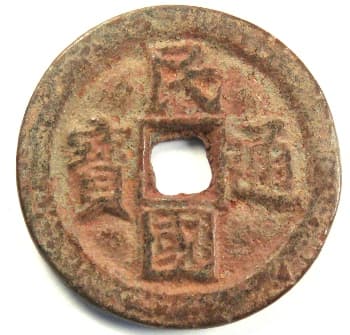
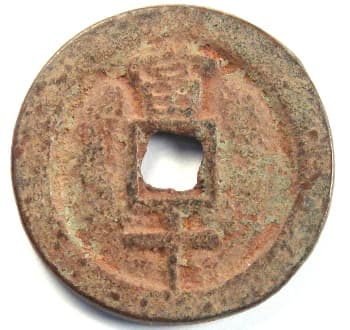
This is the last Chinese cash coin produced in China and was cast in Dongchuan, Yunnan.
The inscription on the obverse side (far left) reads min guo tong bao (民国通宝) which translates as "currency of the Republic of China".
The reverse side (near left) has the two Chinese characters dang shi (当十) which means it was worth 10 (ten) of the traditional "cash coins".
The coin has a diameter of 26.5 mm and a weight of 6.6 grams.
The last "cash coins" were produced in the same year bringing to a close China's 2,000 year tradition of casting round bronze coins with a square hole in the center.
This is the last Chinese cash coin produced in China and was cast in Dongchuan, Yunnan.
The inscription on the obverse side (far left) reads min guo tong bao (民国通宝) which translates as "currency of the Republic of China".
The reverse side (near left) has the two Chinese characters dang shi (当十) which means it was worth 10 (ten) of the traditional "cash coins".
The coin has a diameter of 26.5 mm and a weight of 6.6 grams.
Return to Ancient Chinese Charms and Coins