One of the most easily recognized silver coins from the early days of the Republic of China displays the profile of Dr. Sun Yat-sen, the first president, with the English inscription “Memento Birth of Republic of China” on the reverse side.
An earlier version of the coin had been struck in 1912 to commemorate the establishment of the Republic of China but production ceased when Yuan Shikai became president in 1913.
These “one yuan” (“one dollar”) coins later resumed production and the specimen displayed here was struck in Nanjing in 1927.
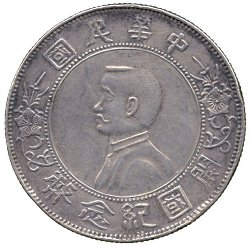
What is not generally understood is the meaning of the symbols in the design of the coin.
For example, the Chinese character min (民), which means “people”, is written is a very unusual manner. The character can be seen at about the 11 o’clock position on the coin. If you look closely, you will see that the line that is the “right leg” actually extends upwards to just above the very top of the character.
The Chinese have the expression “to go out the head” (chu tou 出头) which means “lift one’s head” or “free oneself”. Just as the character is written with a stroke “going out the head”, the implied meaning is that the Chinese people should free themselves from the past thousands of years of imperial rule.
Also, at both the 3 o’clock and 9 o’clock positions, are five-petal flowers representing the plum blossom. The plum flower is a traditional symbol of courage and hope and also refers to the “five blessings”. While it would later become the national flower, here it symbolizes the “Five-Power Constitution” advocated by Dr. Sun Yat-sen. The five powers or branches of government included the legislative yuan, executive yuan, judicial yuan, examination yuan and censorate (control) yuan.
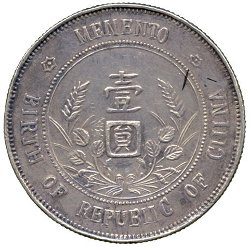
The reverse side of the coin has the denomination “one yuan” (壹圓) written vertically in the middle.
Representations of grains, such as the ears of wheat, are on both sides. Dr. Sun Yat-sen wanted the new coin to display the “five cereals” or “five grains” (wugu 五谷) to signify the importance of agriculture and the hope that the Chinese people would have enough to eat.
Below the ears of wheat are rice plants signifying a bountiful harvest. Above the rice are three leaves. The three leaves are meant to represent the Three People’s Principles” (Nationalism, Democracy and the People’s Livelihood) as advocated by Dr. Sun Yat-sen.
Finally, at the 2 o’clock and 10 o’clock positions are six-sided stars. Previously struck Chinese coins often displayed stars of various shapes but they were usually placed on the obverse side. On this coin, the stars were placed on the reverse side in order to distinguish it as a “new” type of coin for the newly established government.




Leave a Reply to Christian Alexander Cancel reply