Lu Xun (鲁迅 1881-1936) is recognized as one of the greatest Chinese writers of the 20th Century and the founder of modern Chinese literature.
Few people, however, are aware of Lu Xun’s contributions to Chinese numismatics. He was not only a collector of ancient Chinese coins but he also wrote a manuscript annotating Chinese coins from the 7th to the 17th Century.
According to a Xinhua news dispatch, this treatise on Chinese coins written by Lu Xun is now being published for the first time in commemoration of the 62nd anniversary of the founding of the People’s Republic of China.
The manuscript was written in 1913 while Lu Xun was working for the Ministry of Education in Peking (Beijing). During that time, he began to study ancient books on Chinese coins and he frequently went to Liulichang (琉璃厂) to buy old Chinese coins for his own collection.
Lu Xun was familiar with the famous work on Chinese coins known as Quan Zhi (泉志) written by Hong Zun (洪遵) in 1149 during the Song Dynasty. The Quan Zhi has the honor of being recognized as the world’s oldest extant coin book.
The Quan Zhi annotated the various forms of Chinese money from the very earliest times to the Song Dynasty. Lu Xun wanted to supplement this great work. In his manuscript, he wrote about Chinese coins beginning with those of the Tang and Five Dynasties and ending with the coins of the Ming Dynasty. He cataloged 1,311 different coins from this time period thus adding an additional 700 years to the field of numismatic research.
But Lu Xun’s involvement in Chinese numismatics went even further for he was actually involved in the design of one of the coins of the time.
According to an entry in Lu Xun’s diary dated August 28, 1912, he along with two colleagues, Xu Shouchang (许寿裳) and Qian Taoxun (钱韬逊), designed a twelve symbol emblem.
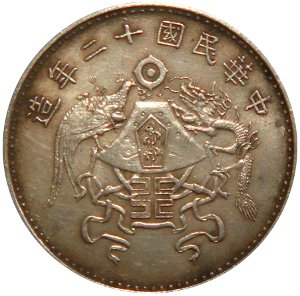
This emblem, seen on the coin at the left, was designed by Lu Xun to be the national emblem for the newly established Republic of China.
Lu Xun incorporated into the design the auspicious elements known as the Twelve Symbols (十二章), which date from the Spring and Autumn Period (770 BC – 476 BC), that had traditionally been used on the clothing of Chinese emperors.
These ancient symbols include the dragon and pheasant. However, the Chinese have traditionally mistaken the pheasant (雉) as being a phoenix (凤) and so the design is usually referred to as the “dragon and phoenix”.
Besides the dragon and pheasant (“phoenix”), the Twelve Symbols include the axe head (斧 located between the dragon and pheasant), rice (粉米 small circles on the axe), the sun (日 above the axe), the moon (月 the dragon’s horn), fire (火 on dragon’s body), the fu (黻 under the axe), stars (星辰 the three dots above the pheasant’s crest), the mountain (山 bottom of axe), the grail (宗彝 in claws of dragon and pheasant), and seaweed (藻 in pheasant’s beak).
At the top of the coin is written “Made in the 12th Year of the Republic of China” (中華民國十二年造) which would be the year 1923.
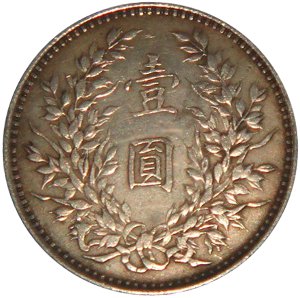
The other side of the coin has the denomination “One Yuan” (“One Dollar” 壹圓) written within a wreath of grain (嘉禾). There are two versions of the coin depending on if the two Chinese characters are written “large” (大字) or “small” (小字).
This “dragon and phoenix silver dollar” was produced as a pattern or trial piece at the mint in Tianjin. Only a small number were produced and the coins were not put into circulation because the design was considered by some to retain too much symbolism from China’s imperial past.
The lead mold used by the Tianjin Mint to produce these pattern coins can be seen at the Lu Xun Museum in Beijing (北京鲁迅博物馆).


Leave a Reply to Gary Ashkenazy Cancel reply