Month: November 2011

  • The Huainanzi and Vietnamese Coins

    The huainanzi (淮南子), variously translated as “The Masters of Huainan”, “The Huainan Philosophers” and “The Book of the Master of Huainan”, is an ancient Chinese philosophical work on the proper way for a monarch to govern.

    The huainanzi also records some of China’s most ancient myths and stories including “Nu Wa Repairs the Sky” (nu wa bu tian 女娲补天), “Hou Yi Shot the Suns” (hou yi she ri 后羿射日), “Chang’e Flies to the Moon” (chang e ben yue 嫦娥奔月), and “Yu the Great Tames the Flood” (xia yu zhi shui 夏禹治水).

    Liu An (刘安), the Prince of Huainan, was a grandson of Liu Bang (刘邦), the founder of the Han Dynasty, and also the uncle and adviser to Emperor Wu (武帝).  He, together with a gifted group of literary scholars known as the “Eight Immortals of Huainan” (淮南八仙), wrote this major treatise which he then presented to Emperor Wu in 139 BC.

    To be successful, according to the huainanzi, a ruler should embrace both Daoist and Confucian principles.  The monarch should adopt the practice of self-cultivation with the goal of attaining sagehood.  At the same time, he must actively engage in the mundane and practical activities of government administration.
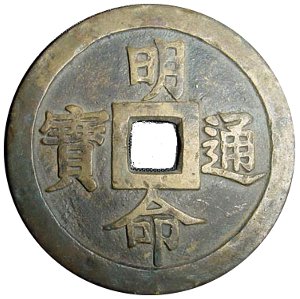
    Vietnamese "Minh Mang Thong Bao" Coin
    Vietnamese “Minh Mang Thong Bao” Coin

    The huainanzi established the proper way for a king to rule and its influence spread to neighboring countries including Vietnam, also known as Annam.

    The large Vietnamese presentation coin displayed here has the inscription Minh Mang Thong Bao (Chinese: ming ming tong bao 明命通宝) which was used on coins cast during the reign (1820-1840) of King Nguyen Thanh To of the Nguyen Dynasty.

    Because minh mang (明命) has the auspicious meaning of “intelligent decree” or “bright life” (明命), the inscription can also be found on Vietnamese charms and amulets.
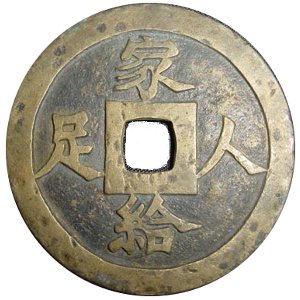
    Vietnamese coin with inscription from the Huainanzi
    Vietnamese Coin with Inscription from the Huainanzi

    The inscription on the reverse side is jia ji ren zu (家给人足).

    This phrase is taken directly from the chapter entitled “Fundamental Norm” <淮南子 · 本经训> of the huainanzi:

    衣食有余,家给人足

    yi shi you yu, jia ji ren zu

    “When clothing and food are plentiful, every family enjoys a rich life.”

    According the the huainanzi, an enlightened ruler should strive to ensure that the common people have the basic necessities.  In so doing, the people will live in contentment and the country can be at peace.

    This large Vietnamese cash coin has a diameter of 48 mm.

    Although no denomination is stated, these coins were valued at the equivalent of one hundred small cash coins.

    These large and well-made Minh Mang Thong Bao presentation coins are famous for their inscriptions based on the Chinese classics.  There are at least seventeen known varieties with a four-character inscription and twenty-three known varieties with an eight-character inscription.
  • Ancient Chinese Mirrors Donated To Shanghai Museum

    An outstanding private collection of ancient Chinese bronze mirrors owned by Lloyd Cotsen is being donated to the Shanghai Museum according to press releases issued in China and by The Huntington in San Marino, California.

    Lloyd Cotsen, a successful American entrepreneur and noted philanthropist, began collecting ancient Chinese mirrors in the 1950’s after being exposed to Chinese art as an undergraduate at Princeton University.  His collection of 95 pieces includes mirrors from the “Qijia Culture” (齐家文化 2100-1700 BC) as well as specimens produced during the Warring States Period, the Tang and later dynasties.

    The collection will be exhibited at The Huntington from November 2011 to May 2012, and then will be transferred to the Shanghai Museum in China for permanent display.

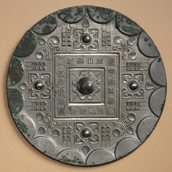
    Western Han Dynasty Inscribed Mirror
    Western Han Dynasty Inscribed Mirror

    At the left is a mirror from the Cotsen collection which is one of the earliest to include an inscription.  The inscription on this Western Han Dynasty (206 BC-24 AD) mirror reads:

    長貴福樂無事日有熹宜酒食常得君喜

    “May you enjoy noble status and blessings for a long time. May you have pleasure without incident. May you have brightness every day. May you have plentiful wine and food. And may you regularly obtain lordly delights.”

    The museum describes the piece as “quatrefoil, grass motifs, stars, and linked arc” incorporating cosmic symbols of space, time, earth and the heavens.

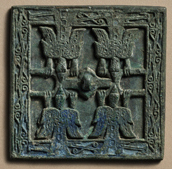
    Mirror from Warring States Period
    Mirror from Warring States Period

    This mirror was produced even earlier during the Warring States Period (475-221 BC).

    It is unusual in being layered or “tiered” and, unlike most mirrors, is square instead of round.

    In ancient Chinese cosmology, the earth was believed to be “square” while “the heavens” were seen to be “round”.

    The museum describes this as a “square double tier mirror with four opposed birds”.

    Tang Dynasty Mirror
    Tang Dynasty Mirror

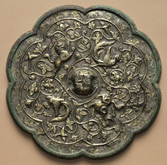
    The mirror at the left dates from the Tang Dynasty (618-907).

    According to the museum, it is an “eight-lobed mirror with vines, birds, and mythical animals”.

    The surface is covered with “hammerings” which are small pieces of soft metal placed over a carved form, tapped into shape with a hammer, and then attached to the mirror.

    The vines, birds and mythical animals on this mirror were all created in this manner.

    The mirror also exhibits “chasing” which is a technique for making intricate detail and texture on the surface of a mirror by using a hard stylus tapped with a hammer.

    Mr. Cotsen explained at the press conference in California that he decided to donate his collection of ancient Chinese mirrors to the Shanghai Museum because of its reputation and commitment to public education.

    Mr. Chen Kelun (陈克伦), the Deputy Director of the Shanghai Museum (上海博物馆副馆长), commented that the mirrors were exquisite.  He said that no data existed for some of them which means that they will be very valuable for research.

    Mr. Cotsen began his collecting in the 1950’s and acquired his first set of Chinese bronze mirrors at an auction in Hong Kong.  He did not know it at the time but the other key bidder was the Swedish government bidding on behalf of the King of Sweden.

  • Ancient Coins Discovered in Golden Horse River

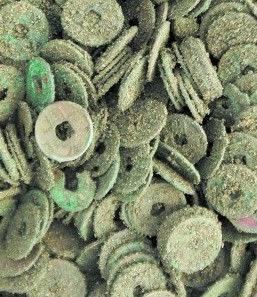
    More than 100 local villagers were seen busily overturning rocks in a small flood plain area of Sichuan Province’s “Golden Horse River” (金马河) once word spread that a large number of ancient Chinese coins had been discovered, according to a report by the Sichuan News Network (四川新闻网).

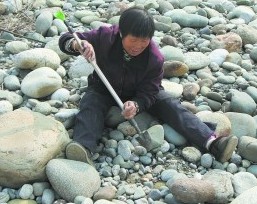
    Villager digging for coins
    Villager digging for coins

    Villagers of the Wenjiang District (温江区) of Chengdu City (成都市) arrived with shovels, hoes, sickles and any other digging implement they could find to turn over the cobblestones.

    Casual observers first thought the villagers were digging up edible “whip worms” (皮鞭虫) before they realized that there was real “treasure” buried there.

    Some of the treasure hunters came away with several kilograms of coins while others were only able to find 10 or 20 coins.

    The discovery is considered particularly unusual because, unlike most hoards, these bronze cash coins come from many different dynasties.

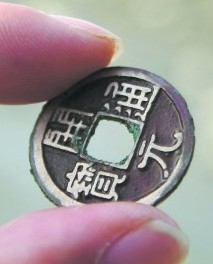
    Tang Dynasty "kai yuan tong bao" coin

    The oldest coins are wu zhu (五铢) coins from the Han Dynasty (206 BC-220 AD) and huo quan (货泉) coins dating from Wang Mang’s Xin Dynasty (7-23 AD).

    The most recent coins were cast during the reign of the Qianlong Emperor (乾隆 1736-1795) and the Guangxu Emperor (光绪 1875-1908) of the Qing Dynasty.

    The coins thus span almost 2,000 years of Chinese history.

    The vast majority of coins, however, are from the Tang Dynasty (618-907).  Most have the inscription kai yuan tong bao (开元通宝) but some have the inscription qian yuan zhong bao (乾元重宝).

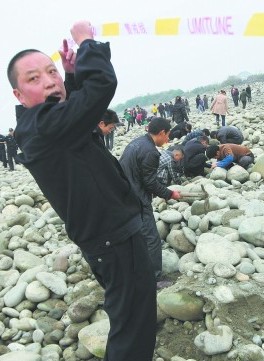
    Local police try to cordon off the area
    Local police try to cordon off the area

    The frantic activity attracted the notice of the authorities who immediately called in the police to prevent further “looting” and to protect the site.

    Experts from the local Bureau of Cultural Relics were also dispatched to carry out research.

    The Chengdu archaeologists determined that the coins were strewn over an area approximately 200 meters long and 100 meters wide.  The archaeologists themselves were able to dig up more than 5 kilograms of coins in a short period of time.

    While it still has not been determined how the ancient coins came to be scattered along the rocky bottom of the Golden Horse River, two of the archaeologists were willing to speculate.

    Coins from the Han to the Qing Dynasties spanning 2,000 years
    Coins from the Han to the Qing Dynasties spanning 2,000 years

    Mr. Liu Yumao (刘雨茂) said that throughout history, it has been the custom to place old coins into structures built for irrigation and water conservancy as a means to promote good fortune and to avoid disaster.  He said the coins may have been buried in such a structure that eroded and washed away over time.  The coins could then have been carried by the river current and deposited in this area.

    As to why the majority of coins are from the Tang Dynasty, Mr. Wang Zongxiong (王仲雄) said that in olden times heavy cargoes were transported by rivers and canals.  It is possible that during the Tang Dynasty a boat carrying coins may have sunk and the coins were hidden underwater until now.

    According to the cultural relics experts, it is not practical to try to excavate or even preserve the site because of the possibility of flood waters suddenly appearing.

    The authorities are encouraging the villagers not to continue to dig for coins or worms because of the danger.

    Although the coins are very old, they are still considered to be very common.

    Nevertheless, the villagers are asked to return all the coins to the authorities because, according to law, all cultural relics buried on land or found in the waters or seas within the territorial boundaries of China are considered to be the property of the state.

  • China’s Biggest Ancient Coin

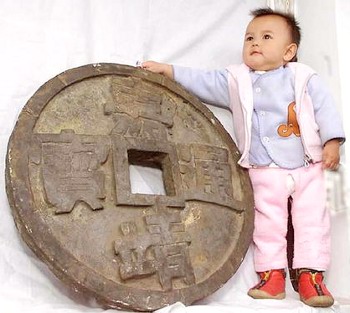
    The official New China News Agency (新华社) revealed in 1997 that Chinese archaeologists working in the southwestern province of Yunnan had unearthed a huge Ming Dynasty coin which was described as the largest and heaviest ancient Chinese coin ever found.

    China's Largest and Heaviest Ancient Coin
    China’s Largest and Heaviest Ancient Coin

    The coin was cast during the reign of Emperor Shi Zong (1522-1567) to commemorate the opening of a mint in dongchuanfu (东川府) which is now known as Huize County (会泽县).

    This commemorative coin (开炉钱) is now on display at the Huize County Lead and Zinc Mine Archives (会泽县的铅锌矿档案馆).

    The inscription on this giant bronze cash coin reads jia jing tong bao (嘉靖通宝).

    The coin has a diameter of 57.8 cm (22.8 in), a thickness of 3.7 cm (1.5 in) and a weight of 41.5 kg (91.5 lbs).

    An assay in 1990 revealed that the coin is primarily composed of 91% copper, 3% lead, 0.6% zinc and 0.6% aluminum.

    While the history of this region dates back more than 2,000 years, bronze cash coins did not circulate until very late.  Cowrie shells were still being used as a form of money even into the Ming Dynasty (1368-1644).  The economy relied to a great extent on barter.  The upper class used silver for their purchases.

    The casting of coins required approval from the imperial government.  It was not until the jia jing period (1522-1567) when large-scale copper mining and smelting were permitted in the area.  Yunnan’s rich mineral resources coupled with China’s mature casting technology were then used to produce these first bronze coins with the jia jing tong bao inscription.

    Following the reign of Emperor Shi Zong, coins continued to be cast at this mint for the succeeding Ming rulers.  These coins included Emperor Shen Zong’s wan li tong bao (万历通宝 1573-1620), Emperor Xi Zong’s tian qi tong bao (天启通宝 1621-1627), and Emperor Si Zong’s chong zhen tong bao (崇祯通宝 1628-1644).

    Coins of the Southern Ming, including the yong li tong bao (永历通宝 1646-1659) of Prince Yongming (永明王) and the xing chao tong bao (兴朝通宝 1648-1657) of Sun Kewang (孙可望), were also cast at this mint.

    With the establishment of the mint, and following the casting of the special commemorative coin, standard “cash coins” with the the same jia jing tong bao inscription were cast.  Additionally, a few larger denomination coins with the jia jing tong bao inscription were produced in values equivalent to 2, 3, 5 and 10 of the smaller “cash” coins.  All of these larger denomination coins are now rare.

    However, even the largest “Value 10” coin, with a diameter of 4.5 cm (1.8 in), pales in comparison with the special commemorative coin made to celebrate the first use of the furnace to cast bronze coins at the new mint.

  • Coffin Contains Coin Instead of Corpse

    An article in the Suqian Evening News (宿迁晚报) reported an unusual discovery.  Chinese archaeologists excavating a multiple tomb site in Suqian (宿迁), a city in northern Jiangsu Province (江苏), unearthed a coffin with no corpse.  The only thing inside the casket was a coin.

    Most of the tombs being excavated at the site date from the Han Dynasty (206 BC-220 AD).

    However, the tomb with the coin, designated the “No. 4 Tomb”, is from the much later Republican era (1912-).

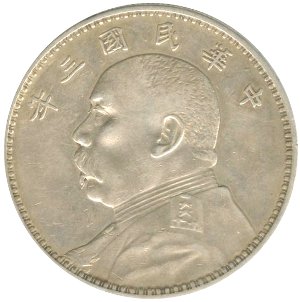
    Yuan Shikai "Silver Dollar"

    The archaeologists know the tomb is from the Republican period because the coin in the casket is a Yuan Shikai “silver dollar” (yin yuan 银元).  Yuan Shikai (袁世凯) was President of the Republic of China during the years 1912-1916 and coins from that era prominently display his portrait.

    The newspaper article did not include an image of the coin found in the casket but a typical example of a Yuan Shikai “silver dollar” is shown at the left.

    The archaeologists are a little puzzled as to why the casket contains just a coin but no corpse.

    They speculate that the tomb may be a “cenotaph” (衣冠冢) which is an “empty tomb” meant to be a memorial to a person whose remains may be elsewhere.  In lieu of a corpse, personal effects of the deceased are placed in the coffin instead.

    A village elder at the scene offered an alternative explanation.  He said Suqian has a local custom of reinterment.  Relatives of the deceased may have exhumed the body and reburied it in another place.