Category: Chinese charms

  • Bodhidharma Holding a Wu Zhu Coin

    Bodhidharma (菩提达摩) was a Buddhist monk who came to China from Central Asia or the Indian subcontinent during the 5th or 6th centuries. Little is known about him but he is regarded as the founder of Chan Buddhism () in China. Chan Buddhism eventually migrated to Japan where it further evolved into what is known as Zen.

    Bodhidarma is highly recognized and respected in Japan where he is referred to as Daruma. As part of this adoration, the Japanese created a very popular doll in his honor.

    These dolls are known as a daruma dolls. Daruma dolls are seen as symbols of perseverance, good luck and prosperity by the Japanese.

    Daruma dolls are ubiquitous in Japan. Some are even used as “coin banks” (“piggy banks“) in which to save coins.
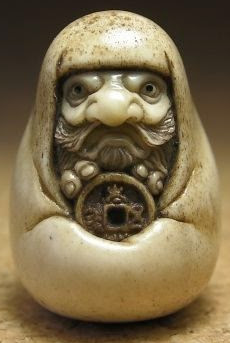
    Sculpture of Bodhidharma holding a wu zhu () coin
    Daruma doll showing Bodhidharma holding a tai he wu zhu (太和五铢) coin

    The daruma doll at the left is a most interesting and unusual example because Bodhidharma is shown holding a Chinese coin in his hands.

    Bodhidharma has a striking appearance. He was not of Chinese ancestry and is described in ancient texts as being wide-eyed, heavy bearded and ill-tempered. Some texts even refer to him as the “Blue-eyed Barbarian”.

    The Chinese coin he is holding is round with a square hole in the middle and is popularly known as a “cash coin”. Cash coins were used for more than 2,000 years in China and also became the model for the standard coinage of both Japan and Korea.

    What is remarkable is that the daruma doll’s coin is so accurately detailed that it can be readily identified.
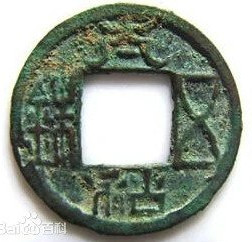
    "tai he wu zhu" coin
    Tai He Wu Zhu coin issued in 495 AD by Emperor Xiaowen of the Northern Wei dynasty

    This type of coin is known as a “wu zhu” (五铢) and the inscription reads tai he wu zhu (太和五铢). Taihe (太和) is the era name of Emperor Xiaowen and wu zhu is the monetary denomination “five zhu“.

    The tai he wu zhu coin was minted in 495 AD by Emperor Xiaowen (孝文帝 471-499) of the Northern Wei (北魏) in the capital city of Luoyang (洛阳).

    This was the first coin issued during the Northern Wei. The inscription is a mixture of seal script (篆书) and clerical script (隶书) which comprises the classic Wei stelae style (魏碑体).

    Tai he wu zhu coins tend to be fairly crudely made and vary in size and weight. Larger specimens are about 2.5 cm in diameter and weigh about 3 grams. Smaller specimens are about 2 cm and 2.3 grams.

    These coins circulated only in the areas around Luoyang and never became the currency for the Northern Wei as a whole. For this reason, tai he wu zhu coins are relatively scarce.

    It is important to note that Bodhidharma lived in the Luoyang area during the time that this coin circulated. Placing this specific coin in his hands is, therefore, historically accurate.

    As mentioned above, Bodhidharma is usually portrayed as being “wide-eyed”. This alludes to a story concerning his nine years of staring at a cave wall while meditating. The legend goes that one day he fell asleep. In order to prevent this from ever happening again, he cut off his eyelids.

    A Japanese legend states that after sitting and meditating in the cave for nine years his limbs atrophied. For this reason, daruma dolls do not have arms or legs. This particular daruma doll is a very rare exception. While it does not have arms or legs, it does have “hands” or, more accurately, a few fingers.

    The Chinese have the expression jian qian yan kai (见钱眼开) which translates as “one’s eyes grow round with delight at the sight of money”. The expression first appeared in the famous Ming dynasty (明朝 1368-1644) novel Jin Ping Mei (金瓶梅) which is translated into English as The Golden Lotus or The Plum in the Golden Vase.

    By a remarkable coincidence, there is a story dating from the Southern Song dynasty (南宋 1127-1279) that precisely illustrates this expression of a person going wide-eyed over the sight of a tai he wu zhu coin which is the same coin as in Bodhidharma’s hands.

    The story takes place in the city of Suzhou (苏州) and concerns an elderly businessman with the surname Chai () who literally loved money above everything else. He was extremely wealthy and was also extremely greedy and stingy.

    One day he was out walking when he saw a group of children playing with some coins in the street. Because he loved money so much, he fixed his eyes on the coins. His eyes lit up when he noticed that some of the coins were tai he wu zhu. Tai he wu zhu coins were very valuable at this time and were much loved by the people.

    Suddenly, one of the tai he wu zhu coins rolled under his feet. He quickly stepped on it to hide it from the children.

    The children walked over and asked for the coin but the old man said, “I didn’t take your money.” One of the children replied, “It’s under your foot.”

    The man quickly turned around and while his back was facing the children he picked up the coin. He then turned back around to face the children and said, “Look for yourselves, I don’t have any money under my foot.”

    A child then pointed to the man’s hands and said, “It’s in your hand!”

    The man spun around again and while his back was facing the children he put the coin in his mouth. He turned back to face the children and stretched out his hands to show there was no coin.

    A child said, “It’s in your mouth!”

    Knowing he had to hide the coin, he quickly swallowed it. He then opened his mouth wide so that the children could see there was no coin.

    The man returned home with the coin stuck in his throat. He kept trying to cough it out but it would not budge. In less than a day, his throat became swollen and he had difficulty breathing.

    His four sons wanted to call a doctor but the old man glared angrily at them and gestured with his hand to bring him a brush and ink. He then wrote, “For the sake of money, what would be the reason to spend money?”

    By the third day, the man was close to death. His four sons came to his bed to discuss the funeral. The eldest son said, “You have worked hard all you life and should therefore have a coffin made of cypress.” The father just glared at his eldest son and shook his head indicating disapproval.

    The Number 2 Son then said, “You have saved all your life and should have a coffin made of willow in order to save a lot of money.” The father again shook his head in disagreement.

    The Number 3 Son then said, “After your death, we could wrap your body in the old reed mat on your bed and bury you. Would this satisfy you?” The father again shook his head.

    The Number 4 Son was only 14 or 15 years of age but said, “After you die, we could chop your body into little pieces and fed the meat to your big yellow dog.”

    The man smiled and vigorously nodded his head approvingly. He picked up his brush and breathlessly wrote the last words of his life:

    After I die, chop me into pieces of meat and feed me to the dog.

    But, don’t let him eat the tai he wu zhu coin!

    The story serves as an example of a person being extremely wide-eyed in love with hoarding money and refusing to spend any of it even at the end of his life.
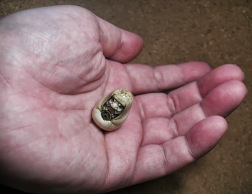
    This daruma doll is very small as can be seen in comparison to a hand
    The daruma doll is very small

    This daruma doll is carved from bone and has exquisite detail.

    It is quite small as can be seen in the photo at the left.

    Finally, we should not forget that Bodhidharma was a Buddhist monk who renounced the world, lived a very austere life in a cave, and spent a lifetime seeking true reality.

    Over the centuries, Daruma’s legacy in Japan has evolved to the point where dolls are made in his image to serve as good luck charms and coin banks.

    While the Japanese daruma dolls are very cute and symbolize perseverance, good luck and prosperity, the idea of associating the founder of Chan (Zen) Buddhism with something as secular and mundane as money is not consistent with his teachings.
  • Daoist Talisman and the Five Great Mountains

    During the Eastern Jin dynasty (东晋 317-420), map-like charts began to be used as a guide in understanding the ultimate reality, i.e. the “true form” of things according to the Dao (Tao ), during pilgrimages to China’s Five Great Mountains (五岳).

    The “true form” is the original, formless, inner shape of the mountain, as part of the Dao, as opposed to its physical, visible, outer shape. Daoists (Taoists) believed that if one understood the true form (zhenxing 真形) of a thing or spirit, one could have control over it.

    Daoists discovered sacred sites in the highest of places and, in particular, mountains and caves. They believed that caves were the very heart of a mountain and were a fountain of the vital life force known as qi (气). These mountainous areas had forests and streams where one could find medicinal plants and the ingredients for elixirs of life and pills of immortality.

    Ge Hong1 (葛洪 283-343), a scholar and alchemist who lived during the Eastern Jin, warned: “Most of those who are ignorant of the proper method for entering mountains will meet with misfortune and mishap”.

    Those accustomed to living in the plains and valleys were unfamiliar with mountainous topography, weather, and geology. They feared the tigers and other strange beasts as well as the local spirits and demons.

    These charts (albums), which contained images that took the form of esoteric mountain landscapes seen from a bird’s-eye view, provided the guidance and protection needed during travels through the sacred areas.

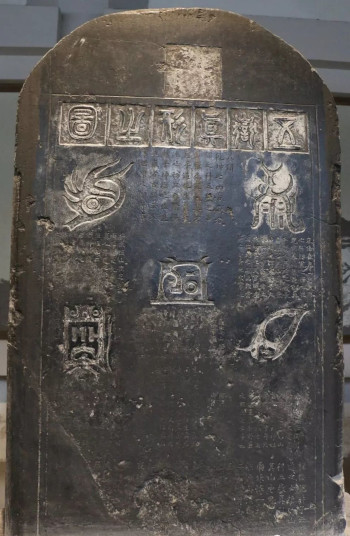
    Five Sacred Mountains Stele
    Stele at the Dai Temple on Mount Taishan showing the “True Form” of the Five Sacred Peaks

    One of the most famous of these charts was the “True Forms Chart of the Five Sacred Peaks” (五岳真形图), also known as “True Forms of the Five Marchmounts“, which was a book illustrating the “true form” of the Five Great Mountains (五岳) of China.

    Ge Hong stated: “Having the Album of the True Forms of the Five Marchmounts in your home enables you to deflect violent assault and repulse those who wish to do you harm; they themselves will suffer the calamity they seek to visit upon you.”

    Daoists later created talismans (charms) which displayed these charts. A talisman was more easily carried on the person and provided protection for seekers of the Dao as they journeyed into these mountainous areas.

    Ge Hong wrote: “Others do not understand how to wear the divine talismans at their belt. Some do not obtain the methods to enter the mountains and let the mountain deities bring calamities to them. Goblins and demons will put them to the test, wild animals will wound them, poisons from pools will hit them, and snakes will bite them. There will be not one but many prospects of death.”

    Unfortunately, only scriptures that refer to the “True Form Chart of the Five Sacred Peaks” still exist. The original text is no longer extant.

    Fortunately, the talismans still exist because they continued to be cast and carried during the centuries that followed. The specimen discussed below dates to the Qing dynasty (清朝 1644-1912).

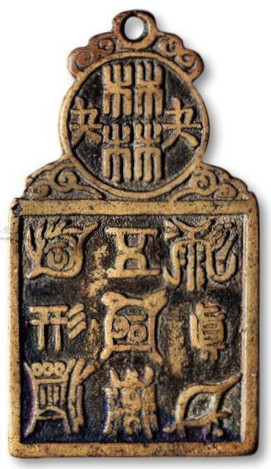
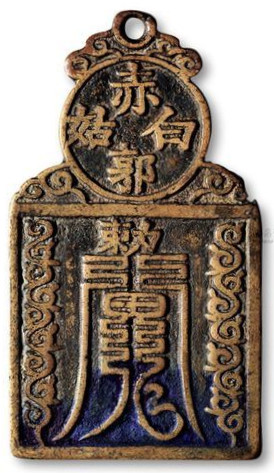
    Daoist plaque charm displaying the True Forms of the Five Marchmounts (Five Sacred Mountains)
    Daoist plaque charm displaying the True Forms of the Five Marchmounts (Five Sacred Mountains)

    Shown at the left is the obverse side of a Daoist plaque (pendant) charm which is an example of a Daoist talisman (道教符箓).

    A talisman is a charm that includes Daoist magic writing (fulu 符箓) which are special written characters that give orders to deities, spirits, demons, etc.

    At the top of the charm is a medallion with the four-character Chinese inscription chi guo bai gu (赤郭白姑).

    “Chi Guo” (赤郭) and “Bai Gu” were two mythical beings who provided protection from demons and were described as “ghost-eaters”.

    Francois Thierry, an expert in East Asian currency, describes Chi Guo (“Lord Red”) as a supernatural giant, originally from southeastern China, who wore a red garment and had a red serpent wrapped around his neck. Lord Red was capable of swallowing 800 demons in the morning and 300 or 500 at night.2

    Bai Gu was a mythical maiden also known for devouring evil spirits.

    Any charm carrying the names of these two ghost-eaters would provide protection to those seeking the Dao in sacred summit areas.

    The bottom portion of the charm is square with two small characters and one large character.

    The two small Chinese characters at the top are 勅令 (chi ling) which translates as “edict”. The edict is expressed by the large character directly below.

    The large character is not a Chinese character but rather Daoist magic writing, known as fulu (符箓) or lingfu (灵符). This character with its secret “edict” is what makes the charm a Daoist talisman.

    Only Daoist priests know the exact meaning of magic writing but this character is believed to protect against disasters and to bring blessings.

    To the left and right of the magic writing can be seen a curly grass pattern (唐草纹) which became popular during the Tang dynasty (唐朝 618-907).

    Reverse side of Daoist plaque charm displaying the Five Sacred Mountains
    Reverse side of Daoist plaque charm displaying the Five Sacred Mountains

    Shown at the left is the reverse side of the charm.

    The four-character inscription at the top reads lin lin guai guai (林林夬夬). Lin translates as “forest” and guai refers to the 43rd of the 64 hexagrams (六十四卦) in the Book of Changes (Yi Jing 易经).

    The 43rd hexagram guai (夬) has the meaning “to respond strongly against opposing forces”.

    This charm protects a Daoist from demons and savage beasts encountered in mountainous forests.

    The lower square portion of the charm contains nine symbols. Some of these are Chinese characters and others are the “true form” maps of the five great mountains.

    At the 12, 3, 6 and 9 o’clock positions are Chinese seal script (篆书) characters. Reading (top, bottom, right, left), they are wu yue zhen xing (五岳真形) which translates as the “true form of the five peaks”.

    The other five special-shaped symbols are the “charts” (‘true form’ maps) of each of the five sacred mountains.

    According to legend, Taishang Daojun (“Supreme Lord Tai Shang”, “Grand Lord of the Dao” 太上道君) passed these charts to the people to be used to prevent disasters and bring good fortune.

    These symbols give a map-like representation of the mountains. As an example, the Japanese geographer Takuji Ogawa (小川琢治 1870-1941) believed that the “true form” map of Mount Tai was very similar to its topographic map.

    The ancient Chinese had a strong belief in the number five (5) which originated with the Five Elements (wuxing 五行 metal, wood, water, fire, earth) also known as the Five Phases (五行).

    The primal concept of the number five may have had its roots in a mathematical system based on five (one hand of five fingers) as opposed to a base ten (two hands with ten fingers).

    Much of the Daoist worldview could be ordered into fives.

    For example, there are the five great mountains and each is associated with one of the five directions (五方 north, south, east, west, center), five mythical animals (Four Auspicious Beasts (四象) and the Yellow Dragon), five colors (五色 yellow, red, green, black, white), and five emperors (Five Yue Emperors) (五岳大帝).

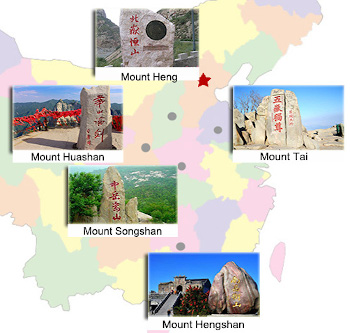
    The five great mountains (五岳) and these associations are described below.3

    Mount Tai in Daoist magic writing
    Mount Tai

    Mount Tai (Taishan 泰山) in East China’s Shandong (山东) province has been the “abode of the immortals” (xian ) since ancient times and is the “East Peak” (东岳) of the Five Sacred Peaks. It is the holiest mountain in Daoism. For more than 3,000 years, Daoist pilgrims have journeyed to its Jade Emperor Peak (玉皇顶). The stone stele (), shown at the beginning of this article, is located at the Dai Temple (岱庙) on Mount Taishan.

    Mount Tai is identified with the Wood () Element and the Azure Dragon (青龙). Azure is green-blue which is the color of the eastern fertile plains and the ocean.

    The emperor of this peak is the “Holy Emperor Tian Qiren of Mount Taishan in Dongyue” (Grand Emperor of Mount Tai) (东岳泰山天齐仁圣大帝).

    Mount Hengshan in Daoist magic writing
    Mount Heng (Hunan)

    Mount Heng (Hengshan 衡山) in Hunan (湖南) province is the South Peak (南岳). At the foot of the mountain is the Grand Temple of Mount Heng (南岳大庙) which is the largest temple in south China. The temple contains an Imperial Tablet with an inscription written by the Kangxi Emperor stating “Mount Heng is the giant pillar in the south … and is also called Mount Longevity”.

    Mount Heng is associated with the Fire () Element and the Vermilion Bird (朱雀). Vermilion is a reddish color which describes the red soils of the Sichuan (四川) and Yunnan (云南) provinces.

    The emperor of this peak is the “Holy Emperor Si Tianzhao of Mount Hengshan in Nanyue” (Holy Emperor of Mount Heng 南岳圣帝) (南岳衡山司天昭圣大帝).

    Mount Hengshan
    Mount Heng (Shanxi)

    Mount Heng (Hengshan 恒山) in Shanxi (山西) province is the “North Peak (北岳). Mount Heng was the center of Quanzhen Daoism (全真道) and is where Yin Zhiping made pills of immortality.

    Near Mount Heng is the famous Hanging Temple (悬空寺), built into a cliff 246 feet above ground, with a history of more than 1,500 years.

    Mount Heng is associated with the Water () Element and Xuanwu (玄武) who is the “Mysterious Warrior” or Black Tortoise (龟蛇).

    The emperor of this peak is the “Holy Emperor An Tianxuan of Mount Hengshan in Beiyue” (北岳恒山安天玄圣大帝).

    Mount Hua
    Mount Hua

    Mount Hua (Huashan 华山) in Shaanxi (陕西) province is the West Peak (西岳). The five peaks of Mount Hua resemble a five-petaled flower explaining its common name as the “Flowery Mountain”. Mount Hua is considered the cradle of Chinese civilization and the “hua” in its name is also the origin of the Chinese name for China which is zhong hua (中华).

    Mount Hua is associated with the Metal () Element and the White Tiger (白虎). White describes the snows of Tibet.

    The emperor of this peak is the “Holy Emperor Jin Tianyuan of Mount Huashan in Xiyue” (西岳大帝) (西岳华山金天愿圣大帝).

    Mount Song in Daoist magic writing
    Mount Song

    Mount Song (Songshan 嵩山) in Henan (河南) province is the Center Peak (中岳) and where the Shaolin Temple (少林寺) is located.

    Mount Song is associated with the the Earth () Element and the Yellow Dragon (黄龙). The loess soils of the Yellow River are yellow.

    The emperor of this peak is the “Holy Emperor Zhong Tianchong of Mount Songshan in Zhongyue” (中岳嵩山中天崇圣大帝).

    This Daoist charm, displaying ‘true form’ symbols, was created to guide and protect pilgrims traveling to the Five Great Mountains in their quest to discover the true reality known as the Dao.

    If one were to ignore the advice to carry such a talisman, Ge Hong warned: “If someone enters the mountains possessing no magical arts, he will suffer harm”.

    This charm is 86.6 mm long, 49 mm wide, and 3 mm thick. The weight is 67.1 grams. The charm sold at auction in 2018 for $3,900 (RMB 25,300).


    1Ge Hong wrote the Baopuzi (抱朴子). An excerpt of this Taoist text is engraved at the bottom of the Stele at the Dai Temple on Mount Taishan.

    2Francois Thierry, Amulettes de Chine (Paris: Bibliotheque nationale de France, 2008), 86.

    3There are divergent opinions expressed in various Chinese references in regard to which chart symbol is associated with which mountain. In this article, I have associated the chart and mountain according to the inscriptions carved centuries ago on the Dai Temple stone stele at Mount Tai.

  • Coin Dragon

    According to an article in the December 4, 2020 edition of the Science and Technology Daily (科技日报) written by Mr. Zhou Qian (周乾) who is a researcher at the museum, a surprising discovery was made in 2017 during renovation of the Hall of Mental Cultivation (yangxin dian 养心殿) in the Forbidden City (Palace Museum 紫禁城) in Beijing where the emperors of China lived and worked from 1420 to 1911.

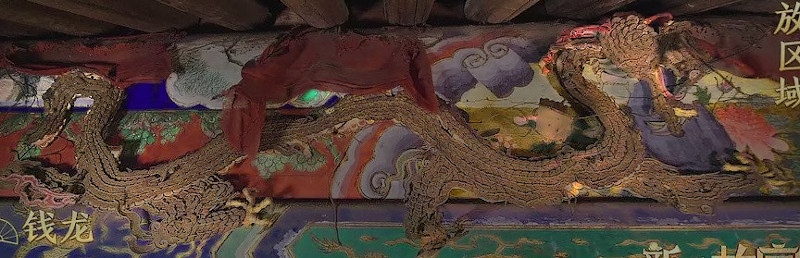
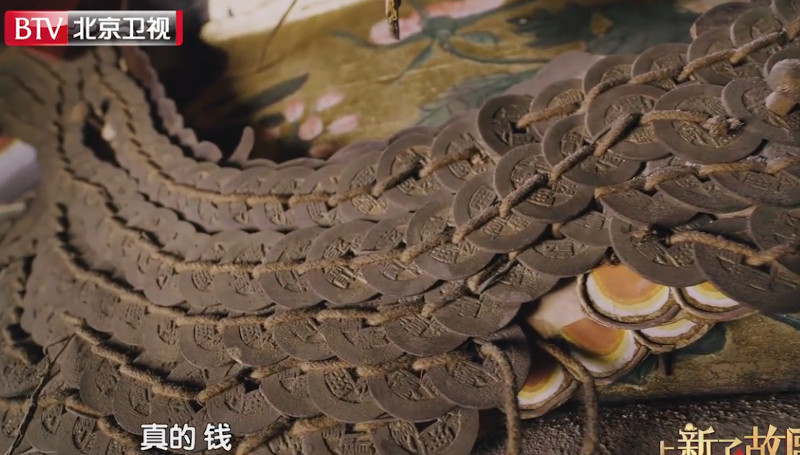
    Attached to the side of the ridge beam supporting the roof is a dragon. While painted dragons can be found throughout the palace, this dragon is not a painting. It is a “coin dragon”, seen in the image below, which is a dragon sculpture made entirely of old Chinese coins.

    Coin Dragon discovered in Forbidden City (gugong)
    Coin Dragon discovered in the Hall of Mental Cultivation in the Forbidden City

    Since ancient times, a grand ceremony (上梁) always takes place when the main roof beam of a palace building is raised and installed. Hanging above the coin dragon can still be seen the remnants of the red silk satin from this topping-out ceremony which occurred several centuries ago.

    Good luck charms, frequently including coins, would traditionally be attached to a roof beam to provide protection from evil spirits, fire and other disasters. There would also be charms expressing the wish for peace and good fortune. In the case of the Hall of Mental Cultivation, this tradition takes the unique form of a dragon made of coins.

    There are no historical documents that mention the existence of this coin-dragon so, apparently, it was meant to stay hidden and kept a secret.

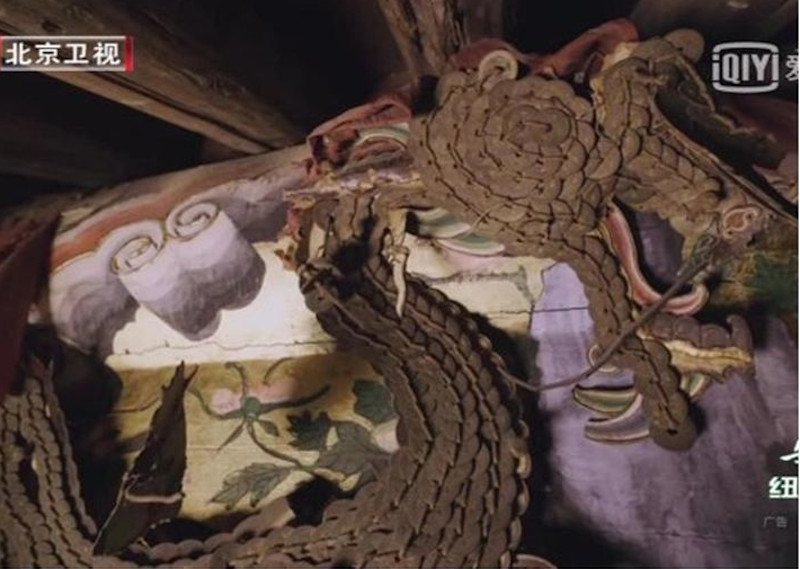
    The above photograph is actually a still image of the ‘coin dragon’ (‘money dragon’ 钱龙) taken from a video broadcast by Beijing TV on March 2, 2020. (The coin dragon can be seen beginning at around 1:41 in this video.)

    The “coin dragon” is composed of Chinese cash coins linked together on strings. The dragon is 182 cm (5.97 ft) long and 47 cm (1.5 ft) high. The backboard is made of paperboard on which is painted a colorful dragon. The strings of coins create the shape of the dragon and are attached to the backboard and beam by “gold-plated round-head copper nails”.
    The newspaper describes the dragon’s appearance as “mighty and shocking with fierce teeth and dancing claws, creating clouds and driving the mist“.

    Head of Coin Dragon
    The head of the Coin Dragon

    The construction of the coin-dragon can be better seen in the above close-up of the head.

    In defining a ‘coin dragon’, the Baidu Encyclopedia (百度百科) specifically refers to this specimen in the Hall of Mental Cultivation. No other examples are mentioned so it is likely that this particular work of imperial sculptural art is unique.

    Coin Dragon 'qianlong tongbao' coins
    Coin Dragon constructed from strings of ‘Qian Long Tong Bao’ coins

    The above image gives a closer view of the dragon’s body and how the coins are connected to each other by strings or cords made of hemp. The coins are traditional Chinese cash coins which are round with a square hole in the middle. Many believe that the shape of the cash coin reflects the ancient Chinese philosophy that the ‘sky is round and the earth is square’ (天圆地方).

    Although Chinese cash coins were used for more than 2,000 years, the coin dragon is composed entirely of one specific coin.

    The Qianlong Emperor (乾隆帝) reigned from 1735 to 1796 during the Qing dynasty (清朝). He resided and also held audiences with high government officials in the Hall of Mental Cultivation where the coin dragon “lives”.

    Qian Long Tong Bao coin
    ‘Qian Long Tong Bao’ coin

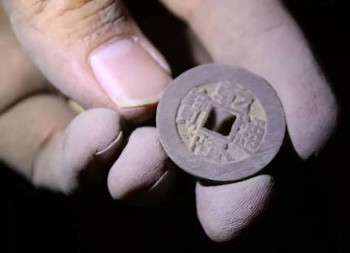
    As can be seen at the left, all the coins have the inscription qian long tong bao (乾隆通宝). Qianlong (乾隆) represents the era name (年号) of this emperor and translates as “Lasting Eminence”. Tongbao (通宝) translates as “circulating treasure” and refers to money.

    The coins are about 2.8 cm in diameter and are identical in every way to those that were minted for normal circulation during this emperor’s reign. However, none of these coins show any wear so they were all newly cast for this dragon sculpture and were not taken from circulation.

    Dragons have been a totemic symbol of Chinese emperors since the very earliest times. In traditional Chinese culture, the dragon represents the ultimate power and authority in the sky. The emperor, being the ultimate power and authority on earth, is the thus the counterpart to the dragon. (See paper money showing the Qianlong Emperor with dragon symbols.)

    Using coins to construct the dragon is consistent with this sky (round) and earth (“square” hole) relationship.

    The coin dragon thus serves as the supreme representation of the Chinese belief in charms as objects with supernatural powers able to defeat ghosts and demons, deter disasters, and bring forth peace and good fortune.

    Given the close association of a Chinese emperor with a dragon, why is it that a coin dragon did not make an appearance prior to the time of the Qianlong Emperor?

    The explanation is actually quite straightforward. By coincidence, this emperor’s name is qian long and the Chinese expression for ‘coin dragon’ is also qian long. The emperor’s name is pronounced exactly the same as ‘coin dragon’!

    Because no previous Chinese emperor had a name that sounded like ‘coin dragon’, there had never before been a reason to create a dragon sculpture made of coins to honor a reigning monarch.

    While the pronunciation is identical, the qian long Chinese characters are different and have different meanings. ‘Coin dragon’ is written 钱龙 while the emperor’s name is written 乾隆.
    What could be a more fitting tribute to the supreme authority of the empire than creating a dragon, literally in his name, made of symbols of wealth to represent the power and prosperity of the country?

    There is, however, an intriguing and as yet unsolved mystery concerning the coin dragon.

    Portrait of the Qianlong Emperor at the Cleveland Museum of Art
    Detail from a portrait of the Qianlong Emperor at the Cleveland Museum of Art

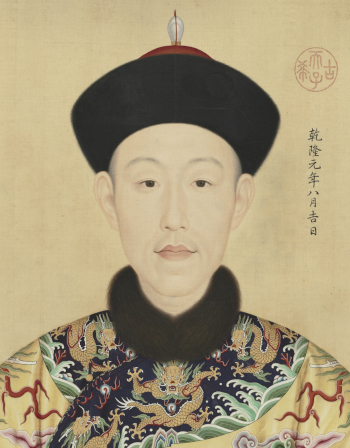
    At the left is a detail from an official portrait of the Qianlong Emperor painted in 1736 which was the year he ascended the throne. The painting is by the Jesuit missionary-artist Giussepe Castiglione (郎世宁) and is in the collection of the Cleveland Museum of Art.

    As can be clearly seen, the emperor’s robe displays dragons with five claws.
    During the Qing dynasty, all depictions of dragons associated with the emperor had to have five claws. Importantly, only the emperor and his immediate family could display five-claw dragons. High-ranking government officials could display dragons but only with three or four claws depending on rank.
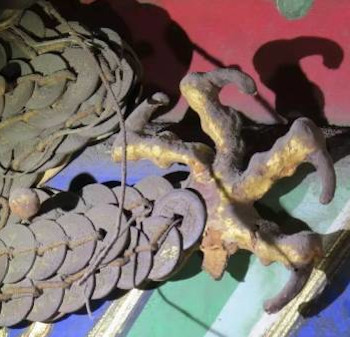
    However, the Beijing TV video reveals that the coin dragon has only four claws instead of five.

    Coin Dragon Claw
    Coin Dragon missing one of its five claws

    At the left is a still image from the video showing the four claws. On closer examination, however, there are four claws and also a stub at the very bottom.

    The coin dragon must have had five claws originally but, according to the Baidu Encyclopedia (百度百科), “for some reason, all of its legs now have only four claws and one broken claw”.

    The reason for the missing “fifth claw” remains an intriguing and unsolved mystery.

    Finally, the discovery of the coin dragon was not the only surprise that occurred during the renovation of the building.

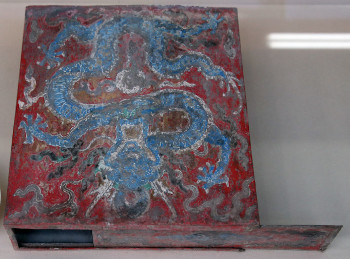
    Treasure Box discovered under the roof of the Hall of Mental Cultivation
    Treasure Box discovered under the roof of the Hall of Mental Cultivation

    Discovered under the roof was a sealed “treasure box” (宝匣) made of tin and decorated with an azure dragon (青龙) having five claws.

    The square box is 27 cm (10.6 in) on the sides and 6.5 cm (2.6 in) high.

    The inscription on the treasure box reads “the sixth year of Emperor Jiaqing” (嘉庆六年) which would be the year 1801.

    The Jiaqing Emperor (嘉慶帝) was the son of the Qianlong Emperor and ascended the throne in 1795.

    The azure dragon is one of the dragon gods of the Five Deities (五帝) which is associated with the five colors (五色), five phases (wuxing 五行), etc. The box contained various “treasures” including Buddhist sutras, gems in five colors (五色宝石), satins in five colors (五色缎), silk threads in five colors (五色丝线), five spices (五香), five herbal medicines (五药), and five cereal seeds (五谷).

    Unfortunately, the scroll, satins, and silk threads had deteriorated to such an extent that they were barely visible. The spices, medicines and grains were also in poor condition and difficult to identify.

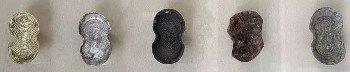
    Sycee (yuanbao) discovered in Hall of Mental Cultivation "Treasure Box"
    Sycee (yuanbao) discovered in the Hall of Mental Cultivation “Treasure Box”

    The treasure box also contained five “sycee” (细丝) which are shown in the image at the left.

    Sycee, also known as yuanbao (元宝), were a form of currency used during the Qing dynasty. These ingots were usually made of either gold or silver and their value was determined by their weight.

    The five sycee found in the treasure box are made of five different metals including one each of gold, silver, copper, iron and tin (seen in the image above from left to right).

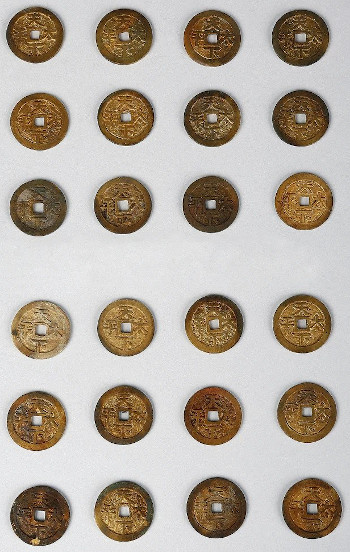
    Gold coins found in treasure box at Hall of Mental Cultivation
    Twenty-four gold coins with the inscription (Chinese and Manchu) meaning “May the world be at peace” found in a Treasure Box under the roof of the Hall of Mental Cultivation

    But, what is perhaps the most interesting treasure found in the box were the 24 gold coins shown at the left.

    The 24 coins equal the number of gold coins found in the Hall of Supreme Harmony (太和殿) where the grandest rituals took place. These are the most gold coins found among the 50 treasure boxes discovered in the Forbidden City.

    These 16k gold coins were not minted to be used as money. They are actually charms and have a traditional ‘good luck’ inscription as opposed to a “coin” inscription such as found on the coins of the coin dragon.

    The gold charms are 25.4 to 28.4 mm in diameter, 1.7 to 2.1 mm thick, and weigh 10.7 to 11.36 grams.

    The meaning of the inscription is the same on both the obverse and reverse sides. One side is written in Chinese and the other side is written in the Manchu script (满文). Manchu was the native language of the emperors of the Qing dynasty.

    The characters read tian xia tai ping (天下太平) which, after all, is a fitting inscription for an imperial treasure. This inscription translates as “May the world be at peace”.

    (It should be noted that besides the coin dragon, Chinese coins have also been used to create charms in the shape of a sword. The British Museum has a coin-sword made from qianlong tongbao coins which are the same coins used for the coin dragon. For additional information on sword charms, please see Swords and Amulets.)

  • ‘Chang Ming Fu Gui’ Plaque Charm

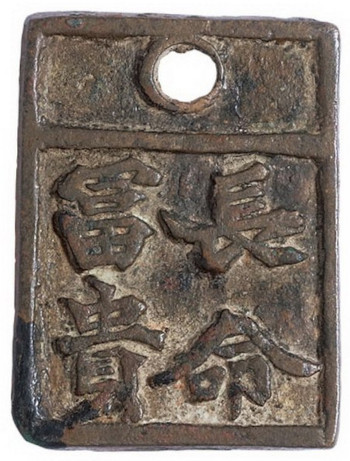
    One of the most popular ‘good luck’ inscriptions found on old Chinese charms is chang ming fu gui (長命富貴) which is the wish for “long life, riches and honor”.

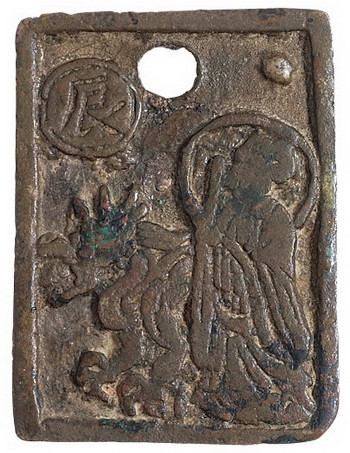
    “Chang Ming Fu Gui” pendant (plaque) charm

    Shown here is a Song dynasty (宋朝 960-1279 AD) pendant (plaque) charm sold in 2009 by Chengxuan Auctions in Beijing.

    The inscription reads as follows: top right (chang ), bottom right (ming ), top left (fu ), bottom left (gui ).

    An easily overlooked feature of this charm is that the character fu (富), meaning “riches” or “wealth”, is written in an unusual manner.

    The character fu is normally written as 富. On this charm, however, the character fu is written as .

    Do you see the subtle difference?

    The top of the character is written as “冖” (mi “cover”) instead of “宀” (mian “roof”), i.e. the small dot or vertical line at the very top is missing.

    Writing the fu character in this manner is known as fu zi wu tou (富字无头) which translates as “fu character without a top or limit”. This implies “riches without an end”. “Endless riches” are, after all, better than mere “riches”!

    Reverse side of “Chang Ming Fu Gui” plaque charm

    The reverse side of the charm is shown at left.

    On the right side stands a star god known as the Star Official of Dominant Vitality (本命星官).

    In Daoist (Taoist 道教) thought, each person is protected by the star god associated with the zodiacal year in which that person was born. (See Daoist Charms.)

    The star god is shown with a halo around the head and wearing a long robe.

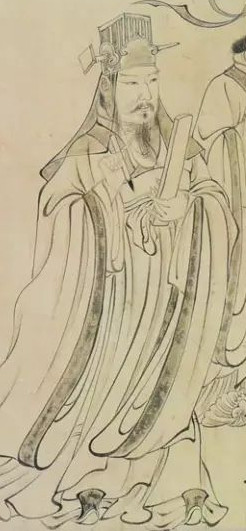
    Clasped in his hands is a hu (笏板).

    Detail from a painting by Wu Daozi showing official holding a hu (ritual tablet or flat scepter)

    A hu is a plaque or tablet that is held in front of the chest by officials. It serves as a badge when being received in audience by the emperor. Depending on the rank of the official, the hu can be made of jade, ivory or bamboo.

    A drawing of an official holding a hu is shown at the left. This is a detail from a painting by Wu Daozi (吴道子) who was one of the most famous painters of the Tang dynasty (唐朝 618-907 AD).

    It is appropriate that a painting by Wu Daozi is used in the discussion of this charm. Some numismatists believe that the depiction of the star god on this charm is in the charming style of Wu Daozi as seen in his “The Eighty-seven Immortals” (八十七神仙圖) painting at the Xu Beihong Memorial Museum (徐悲鴻紀念館) in Beijing.

    Continuing with a description of the reverse side of the charm, there is a ferocious dragon on the left side. Only the front half of the dragon is seen because it is standing behind the star god. The dragon is the 5th of the 12 animals of the Chinese zodiac (生肖). Its presence confirms that this star god is the one in charge of those born in the year of the dragon.

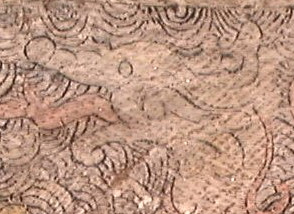
    Detail of a dragon from a bow discovered in a tomb from the Wei Jin dynasties

    The charm’s dragon is similar in style to dragons depicted during the Wei Jin dynasties (220-420 AD).

    This similarity in style can be seen in the image at left of a dragon found on a wooden bow discovered in a tomb from the Wei Jin (魏晋) dynasties.

    It should be pointed out that in the mouth of dragon on the charm is a large pearl. The pearl is a symbol of riches.

    Above the dragon is a round object representing the sun. The Chinese character displayed in the sun is chen () which is the fifth of the Earthly Branches (地支) and refers to the dragon of the Chinese zodiac.

    Above the head of the star god is a raised dot representing the moon.

    Both the inscription and images confirm that this is a ‘good luck’ charm. In ancient times, this type of charm would have been given to a newborn child or an infant having reached one-month of age (man yue 满月). The charm would have been especially appropriate for a child born in the year of the dragon.

    The charm is 31 mm in length and 24.5 mm in width. It sold at the Chengxuan auction in 2009 for $380 (RMB 2464).

  • A Talented and Noble Young Man

    When emperors ruled China, the dream of Chinese parents was to have a son successfully pass the imperial examinations and be appointed to an important government position bringing honor and prosperity to the family.

    The charm displayed below is representative of the Chinese charms expressing such a wish.

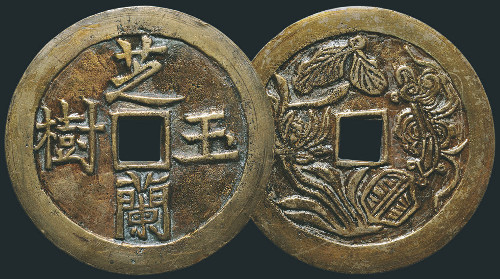
    "Zhi Lan Yu Shu" (芝蘭玉樹) charm cast during the Qing Dynasty
    “Zhi Lan Yu Shu” (芝蘭玉樹) charm cast during the Qing Dynasty

    This bronze charm has finely sculptured characters and a broad rim.  Both the obverse and reverse sides are displayed together in the single image.

    The Chinese inscription reads zhi lan yu shu (芝蘭玉樹).  Zhi lan (芝蘭) translates as “irises and orchids” but has the implied meaning of “noble character”.

    Yu shu (玉樹) translates as a “tree made of jade” but the expression is used to describe a handsome or talented young man. “Jade tree” also has the meaning of a “scholar tree” and is a laudatory title for sons.

    The charm’s inscription therefore translates as a talented young man of noble character or a child with outstanding future prospects.  Such an individual would be expected to do well in the imperial examinations.

    The reverse side of the charm has what appears to be a random collection of objects.

    On the left side is a lotus (he ).

    Below the square hole at about the five o’clock position is a round box (he 盒) also known as a “treasure box” (bao he 宝盒).

    A round box is the symbol for Han Shan (寒山), a Tang dynasty “laughing immortal” poet, who along with Shi De (拾得) are popularly known as the Immortals of Peace and Harmony (和合二仙).  (A Chinese charm showing Han Shan holding his signature round “treasure box” may be seen here. Shi De is standing next to him holding a lotus which is his signature symbol.)

    To the right of the square hole is a ruyi sceptre (如意) hanging vertically and wrapped in ribbons or fillets.  (A ruyi may be seen more clearly on this charm.)

    To understand the hidden meaning of this specific assembly of objects, one must understand that the Chinese love a visual pun also known as a rebus.

    The “lotus” (he 荷) has the same pronunciation as “harmony” (he 和).  The Chinese word for “box” (he 盒) has the same pronunciation as “union” (he 合).  The “ruyi sceptre” (如意) has the same pronunciation as “as you wish” (ru yi 如意).

    The visual pun is thus he he ru yi (荷盒如意) which has the meaning of “may you have a harmonious union with all your wishes fulfilled”.

    This wish is commonly used in reference to marriages.  In fact, the Immortals of Peace and Harmony mentioned above are believed to bestow blessings on marriages.

    This charm, which has a diameter of 59.5 mm and was cast in Yunnan (云南) during the Qing dynasty (请朝 1644-1911), sold at a China Guardian Auction (中国嘉德国际拍卖有限公司) in 2015 for about $1,200 (RMB 8050).

    Please see the article “Cassia and Orchid Charm” for a discussion of another Qing dynasty charm with a similar content.

  • Shun Tian Yuan Bao Charm

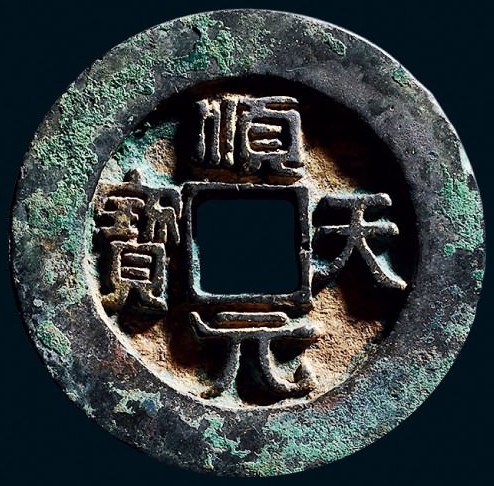
    This beautifully engraved and gilded shun tian yuan bao (顺天元寶) charm dating from the Tang Dynasty (唐朝) appeared at an auction in China in 2015.

    Shun tian yuan bao coins were issued during the years 759-761 by Shi Siming (史思明), a rebel leader who seized control of the Tang dynasty capital of Luoyang (洛阳).  Luoyang was a major center of Buddhism  (中国佛教) in ancient China.

    Shun tian (顺天) refers to the Shi Siming’s era name.

    The shun tian yuan bao was the first coin to use the term yuan bao (元寶) meaning “original currency”.

    The character bao (寶), at the left of the square hole, is written in the same style as used on the kai yuan tong bao (開元通寶) coins of the Tang dynasty.  The yuan (元) character, below the square hole, has a left shoulder similar to the majority of kai yuan tong bao coins.

    Shun Tian Yuan Bao gilded charm
    Shun Tian Yuan Bao gilded charm

    The obverse side, shown above, is the same as a standard shun tian yuan bao coin.  The only difference is that this coin is slightly larger.  The diameter is 39.7 mm while most of the coins are 36.5 – 37.5 mm.  Because of its size, this coin may have been an early issue.

    Shown below is the reverse side.

    Bat, fish and lotus symbols on reverse side of Shun Tian Yuan Bao charm
    Bat, fish and lotus symbols on reverse side of Shun Tian Yuan Bao charm

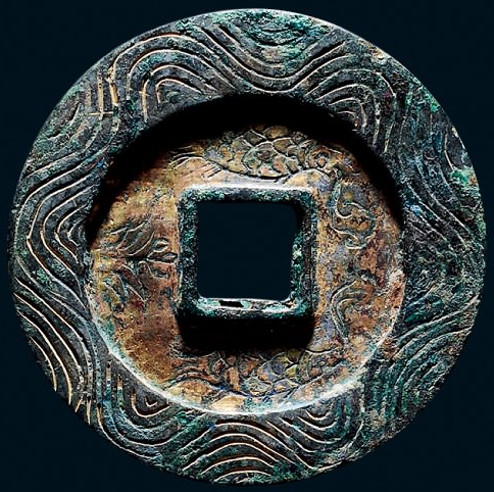
    As can be clearly seen, the reverse side of this coin has been embellished and gilded (鎏金).  The broad rim has been engraved with a wave-like pattern and the area surrounding the center hole has four symbols making the coin into a charm.

    The description in the auction catalogue describes the charm as being exquisitely engraved with waves and “auspicious cloud” symbols, and that it was probably an offering to a Buddhist temple during the Tang dynasty.

    However, upon careful examination it can be seen that the so-called “auspicious clouds” (祥云) are in fact something quite different.

    The bat implies good fortune and happiness
    The bat implies good fortune and happiness

    I have rotated the coin so that the symbols can be viewed more easily.

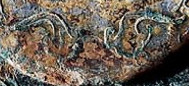
    Shown at the left is the symbol at the right of the hole.  The symbol is actually that of a bat with its wings spread.

    The bat is considered an auspicious symbol to the Chinese because its pronunciation fu (蝠) is the same as the pronunciation of the Chinese word fu (福) which means “good fortune” or “happiness”.

    The bat symbol is therefore a “visual pun” or rebus for “good fortune”.

    (Please see Bat Open Work Charm for a more in-depth discussion of the bat symbol.)

    Fish symbols above and below the square hole
    Fish symbols above and below the square hole

    Rotating the charm 180 degrees, the symbols above and below the square hole can more easily be identified.

    As can be clearly seen, there is a fish above and a fish below the square hole.

    The fish symbol is frequently seen on Chinese charms because it also serves as a visual pun.

    The Chinese character for fish is 鱼 which is pronounced yu.

    The Chinese word for “abundant” (余) is also pronounced yu.

    The fish symbol therefore means “more” as in “more happiness” or “more good fortune”.

    The depiction of two fish takes on an additional meaning.  Because fish lay many eggs, its reproductive abilities is a symbol of fertility in marriage.  Having many sons was particularly important to the ancient Chinese because of the importance of ancestor worship.

    A pair of fish (shuang yu 双鱼) can also represent happiness in marriage.

    The fish symbol can also be seen on other ancient Chinese coins.  A fine example is this zhi bai wu zhu (“Value One Hundred Wu Zhu” 直百五铢) coin issued in 214 AD by Liu Bei (刘备) who founded the State of Shu (蜀汉) during the Three Kingdoms period (三国) AD 220-280.

    (For a more detailed discussion of the fish symbol, please see Fish Charms.)

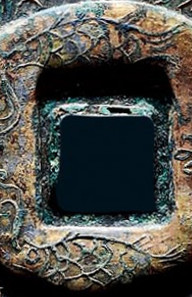
    The lotus
    The lotus

    The final symbol on the reverse side is shown at the left.

    This is a lotus (lian hua 莲花 or he hua 荷花).

    The lotus is an important Buddhist symbol signifying purity and enlightenment.

    Additionally, the Chinese character 莲 (lian) for lotus has the same pronunciation as 连 (lian) meaning “continuous”.  A lotus therefore also implies that good fortune and happiness should continue forever.

    In regard to fertility, the 莲/连 pun implies that boy babies will be born one after another.

    As mentioned above, the Chinese character 荷 (he) also means lotus.  This character has the same pronunciation as 和 (he) meaning “harmony”.  The lotus thus also has the hidden meaning of harmony in marriage.

    (For a further discussion of the lotus symbol, please see a Lotus Open Work Charm.)

    This beautifully engraved and gilded shun tian yuan bao charm sold at auction in 2015 for about $5,243 (RMB 34,500).

  • Lu Dongbin Charm

    Lu Dongbin (吕洞宾), a poet and scholar who lived during the Tang dynasty (唐朝 618-907), is one of the rare historical figures who attained the status of an “immortal” in popular culture.

    He is perhaps the best known of the Chinese “Eight Immortals” (八仙).

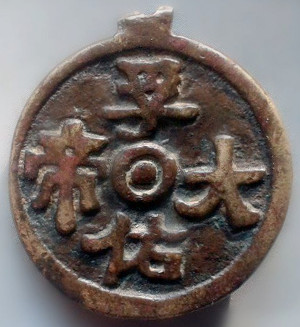
    Chinese charm with the inscription "Great Emperor of Trustworthy Protection" referring to Lu Dongbin
    Chinese charm with the inscription “Great Emperor of Trustworthy Protection” referring to Lu Dongbin

    Over the centuries, Lu Dongbin was posthumously honored with a number of titles.

    Emperor Wuzong of Yuan (元武宗) bestowed upon him the title “Imperial Lord of Trustworthy Protection” (fu you di jun 孚佑帝君).

    A popular derivation of this title can be seen on the old charm shown at the left.

    The inscription reads fu you da di (孚佑大帝) which translates as the “Great Emperor of Trustworthy Protection”.

    A circle with a dot in the middle takes the place of the square hole found in the center of most Chinese charms.

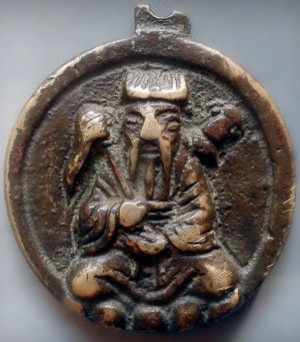
    Portrait of Lu Dongbin in high relief on an old Chinese charm
    Portrait of Lu Dongbin in high relief on an old Chinese charm

    The reverse side of the charm, shown at the left, has a portrait of Lu Dongbin sculpted in very high relief.

    In his right hand is a “fly whisk” (拂尘) which allows him to walk on clouds or fly to the heavens.

    Lu Dongbin was known for his drinking and fighting ability.

    Extending outward from his left shoulder can be seen the hilt of a sword which he carries across his back.

    This is his famous devil-slaying sword (宝剑) which symbolizes victory over evil.

    This specimen is a nice example of a Lu Dongbin charm from the Qing dynasty (清朝 1644-1912), and the bronze has acquired an attractive patina.

    For a further discussion of Lu Dongbin charms, please see Daoist Charms.

  • May There Be the Birth of One Honorable Son after Another

    This very attractive hand carved charm from the Qing dynasty (清朝 1644-1912) was sold at a China Guardian auction in Beijing in 2013.

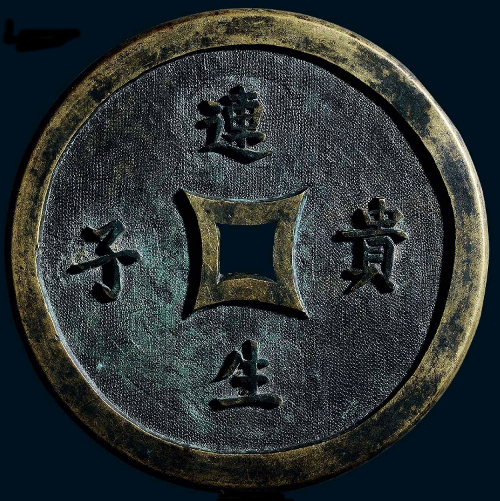
    "May there be the birth of one honorable son after another"
    “May there be the birth of one honorable son after another”

    The inscription on the obverse side of the charm (shown above) reads lian sheng gui zi (连生贵子) which translates as “May there be the birth of one honorable son after another”.

    Sons were highly desired in a marriage because they carried on the family line and were responsible for performing the ancestor worship rituals.

    The ideal Confucian family was considered to have five sons and two daughters.

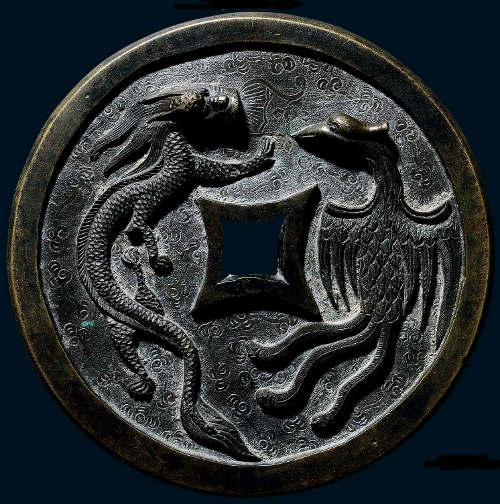
    The dragon and phoenix on the reverse side of the charm

    The reverse side (shown above) has a dragon (long ) on the left and a phoenix (feng huang 凤凰) on the right.  Both are depicted in great detail in high relief.

    The dragon represents the male or yang () force while the phoenix represents the female or yin () force.  Yin and yang are the two complementary principles of the Chinese universe.

    A dragon and phoenix paired together represent a married couple and is a traditional Chinese wedding motif.

    This beautiful charm has a diameter of 13.6 cm and sold at the auction for $5,418 (RMB 34,500).

  • “Dragon Soaring and Phoenix Dancing” Charm

    Wang Bo (王勃) was a Tang dynasty poet and is considered one of the Four Paragons of the Early Tang (初唐四杰).

    His masterpiece is the Preface to the Prince of Teng’s Pavilion (tengwang ge xu 滕王阁序) which describes the scene at a grand banquet he attended at the Pavilion of Prince Teng.

    The Pavilion of Prince Teng (滕王阁) is located in Nanchang (南昌), Jiangxi Province (江西省).  Prince Teng (李元婴) was the younger brother of Emperor Taizong (唐太宗) of the Tang dynasty (唐朝 618-907).

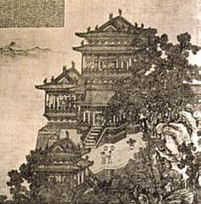
    Song dynasty painting of the Pavilion of Prince Teng
    Song dynasty painting of the Pavilion of Prince Teng

    Construction of the pavilion began in the year 653.

    In 675, Wang Bo wrote the poem that would commemorate the pavilion to this day.

    At the left is a painting of the Pavilion of Prince Teng as it appeared during the Song dynasty (宋朝 960-1279).

    Over the centuries, the pavilion would serve as the venue for banquets attended by noblemen, artists and even emperors.

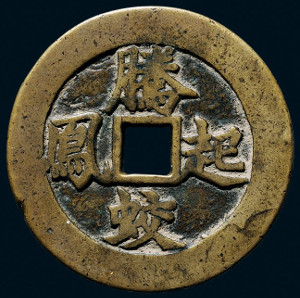
    "Dragon soaring and phoenix dancing" charm
    “Dragon soaring and phoenix dancing” charm

    Shown here is a Qing dynasty (清朝 1644-1911) charm with the inscription teng wen qi feng (腾蛟起凤) which translates as “a dragon soaring and a phoenix dancing”.

    “Dragon soaring and phoenix dancing” is a phrase found in this excerpt from Wang Bo’s poem:

    十旬休假,胜友如云;千里逢迎,高朋满座。腾蛟起凤 , 孟学士之词宗;紫电青霜,王将军之武库。家君作宰,路出名区;童子何知,躬逢胜饯.

    “On this official holiday, which falls on every tenth day, good friends gather together, and a galaxy of distinguished guests from distant places fill the hall.  Also present at the gathering, are Master Meng, whose literary grace is as imposing as a dragon soaring and a phoenix dancing, and the General Wang, who has weapons as sharp as the famous swords “Purple Lightning” and “Blue Frost” in his armory.  I, as an immature young man, have the good fortune to take part in this grand banquet on my journey to visit my father, who is a magistrate of a county.”

    Wang Bo used the descriptive phrase “dragon soaring and phoenix dancing” (腾蛟起凤) to praise the literary works of the banquet guest Master Meng.  The phrase refers to a person having exceptional literary or artistic talent.

    “Purple Lightning and Blue Frost” refers to two famous ancient Chinese swords

    The inscription on the reverse side of the charm, shown at the left, is zi dian qing shuang (紫电青霜) which translates as “Purple Lightning and Blue Frost”.

    According to the Baidu Encyclopedia (百度百科):

    紫电,青霜,古宝剑名也。传三国时吴主孙权有宝剑六柄,其二曰紫电。

    “Purple Lightning and Blue Frost were the names of ancient precious swords.  According to legend, Sun Quan (孙权), who was the leader of the Eastern Wu (吴国) during the Three Kingdoms (三国), possessed six swords (六柄宝剑) of which the second was named Purple Lightning (紫电).”

    His other five swords were named “White Rainbow” (白虹), “Eliminating Evil” (“Banisher of Evil” 辟邪 ), “Shooting Star” (“Star Rider” 流星), “Night Sky” (“Qing Ming” 青冥 ) and “Hundred Li” (“Hundred Miles” 百里).

    Unfortunately, all six of these famous swords have been lost to history.

    Regarding the “Blue Frost” sword:

    汉高祖刘邦斩白蛇剑,刃上常带霜雪,故常以青霜代宝剑之名。

    Emperor Gaozu of the Han (Liu Bang) cut (in two) a white snake.  The edge of the sword showed blue frost.  Consequently, ‘Blue Frost’ was taken to be the name of the precious sword.

    Liu Bang (刘邦), the first emperor of the Han dynasty (汉朝 206 BC – 220 AD), owned a sword with the Chinese characters chi xiao (赤宵) engraved on it.  The Chi Xiao Sword (赤宵剑), which translates as “Red Night Sword”, is one of the Ten Famous Swords of ancient China.

    Liu Bang used this sword to cut in two a very large white snake (汉高祖醉斩白蛇).  Because the edge of the sword was said to resemble blue frost, the sword became known as “Blue Frost” (霜雪).

    In Wang Bo’s poem, General Wang is praised for having swords in his arsenal as sharp as the famous “Purple Lightning” and “Blue Frost” of old.

    As mentioned in the poem, Wang Bo stopped to attend the grand banquet at the Pavilion of Prince Teng while travelling to visit his father.  His father actually lived in present-day northern Vietnam which was part of China during the Tang dynasty.

    Not long after departing the banquet, Wang Bo tragically drowned in the South China Sea.  He was only 26 years of age but his timeless poem, including the inscriptions found on this charm, is the legacy of one of the great poets of the Tang dynasty.

  • Chinese Charm with Musicians, Dancers and Acrobats

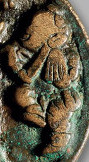
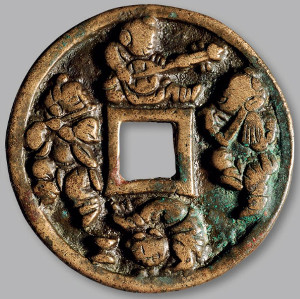
    This is a rare and exquisitely made charm.  However, there is no Chinese inscription and collectors are still uncertain as to its theme.

    The charm, which first appeared during the Liao (辽朝 907-1125) or Song (宋朝 960-1279) dynasties, is believed to depict huren playing musical instruments, dancing, and doing acrobatics (胡人乐舞杂伎).

    Hu (胡) means “beard” so the term huren (胡人) means “bearded people”.  Huren referred to foreigners from north, west and central Asia who wore thick beards.  In ancient times, the term huren translated as “barbarian” because the Chinese believed the huren were “uncivilized” in comparison to the Han Chinese (汉族) and their great culture.

    Nevertheless, these “barbarians” would eventually rule China during the Tartar dynasties.  The Liao dynasty (907-1125) was ruled by the Qidan (Khitan 契丹族), the Jin dynasty (金朝 1115-1234) was ruled by the Nuzhen (Jurchen 女真族), and the Western Xia (Xi Xia 西夏 1032-1227) was ruled by the Tangut (西藏人).

    Charm depicting three dancing musicians and an acrobat
    Charm depicting three dancing musicians and an acrobat

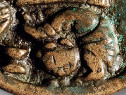
    As seen at the left, the charm displays four individuals.  Three are playing musical instruments while the fourth (bottom) is doing a handstand or similar acrobatic stunt.

    Even though the figures are referred to as huren in numismatic catalogs, none appear to have beards.

    The four figures are remarkably lively.  They can easily be compared to the famous Eastern Han (东汉朝 25-220) tomb sculpture of a storyteller dancing and beating his drum.

    Huren were noted for their musical and dancing prowess.  Poets at the time described their energetic dances as “barbarian leaps” (胡腾舞).

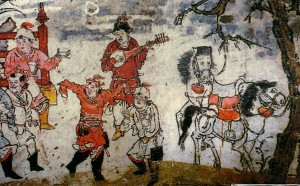
    Tang Dynasty tomb painting of Huren dancing and playing musical instruments
    Tang Dynasty tomb painting of Huren dancing and playing musical instruments

    At the left is a wall painting from a Tang dynasty (唐朝 618-907) tomb that was excavated in Loyang (洛阳), Henan province (河南省).

    The painting depicts a similar scene of beardless huren from central Asia being proficient in music and dance.

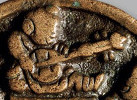
    Huren playing a string instrument
    Huren playing a string instrument

    As can be seen in the detail at the left, the musician above the square hole of the charm is playing a string instrument.

    If you look closely, you can see that the instrument has four strings as confirmed by the four pegs near the end of the long neck.

    (Based on his energetic dance moves, the musician might have been the Chuck Berry of his time.)

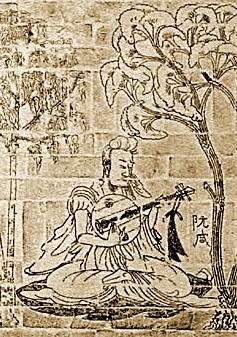
    Ruan Xian playing the ruan
    Ruan Xian playing the ruan

    The four string instrument may be a ruan (阮).

    The ruan was named after Ruan Xian (阮咸) who lived during the Six Dynasties (220-289).  The pipa (琵琶), or Chinese lute, evolved from this early string instrument.

    The ruan was held horizontally and played with a plectrum (pick) in a manner similar to today’s guitar.

    In the Tang and Song dynasties, however, musicians gradually began to hold the instrument vertically which is the way the pipa is played today.

    Huren playing a flute
    Huren playing a flute

    The musician at the left of the square hole is dancing and playing a flute (dizi 笛子).

    Flutes are among the world’s oldest musical instruments.

    Chinese archaeologists have discovered flutes dating back more than 9,000 years.

    A huren flutist can also be seen on this sculpture.

    A Ming dynasty (明朝 1368-1644) porcelain  also displays a huren playing the flute.

    Huren playing a wooden fish
    Huren playing a wooden fish

    The figure to the right of the square hole is standing on his left leg.  He is holding a stick in his right hand and striking an object in his left hand.

    He appears to be playing an ancient musical instrument known as a wooden fish (muyu 木鱼).

    The wooden fish was originally used in rituals by Confucians, Buddhists and Daoists.

    Over time, however, the common people began to use the wooden fish as a musical instrument.

    Huren doing a handstand
    Huren doing a handstand

    The figure at the bottom is performing a handstand or similar acrobatic stunt.

    To the left is another musical instrument, or possibly a Chinese yo-yo (kongzhu 空竹).

    Historical documents are unclear as to when the Chinese yo-yo, which evolved from the very ancient Chinese “gyro” (陀螺), actually appeared.  Some references mention the yo-yo appearing as early as the Three Kingdoms (三国 220-280) while others indicate a later date such as the Yuan (元朝 1271-1638) or Ming dynasties.

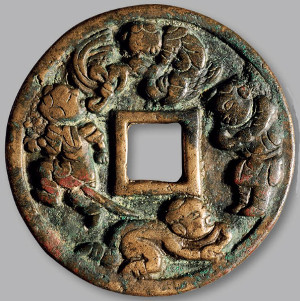
    Four children playing and having fun
    Four children playing and having fun

    The reverse side of the charm is usually described as showing four “babies” playing and having fun (婴孩嬉戏玩耍).

    It is not unusual for Liao dynasty charms to include children playing.

    Also, the figure above the square hole is often shown riding a dragon.

    The dragon-riding figure is the “mother” known as Xi Wangmu (西王母), the “Queen Mother of the West“, as can be seen in this Liao dynasty charm.

    Regarding the charm shown here, however, the person at the top is not the Queen Mother of the West.  The figure resembles the other “babies” but, nevertheless, does appear to be riding something.

    As mentioned above, this is a very rare charm.  It sold at auction in 2011 for about $46,280 (RMB 287,500).

  • Legacy of an Untarnished Reputation

    China has historically admired government officials who displayed the highest degree of learning and moral integrity in their work.

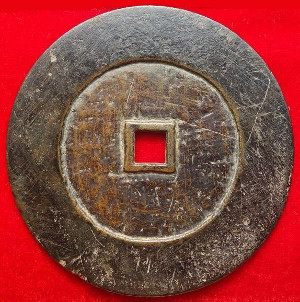
    Chinese charm written in "tadpole script" honoring Yang Zhen, an official of the Eastern Han Dynasty
    Chinese charm written in “tadpole script” honoring Yang Zhen, an official of the Eastern Han Dynasty

    At the left is a charm which honors such an official.

    The inscription, written in a particular style of seal script to be discussed later, reads qing bai chuan jia (清白传家) which translates as “pureness handed down in the family”.

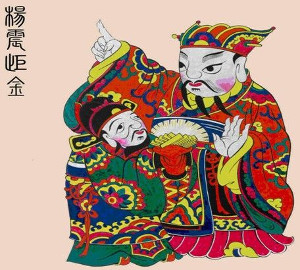
    This inscription refers to Yang Zhen (样震 ?-124 AD) who was a government official during the Eastern Han dynasty (25-220 AD).

    Reverse side of charm honoring Yang Zhen
    Reverse side of charm honoring Yang Zhen

    Yang Zhen was known for his erudition and impeccable moral character.

    There is a famous story concerning Yang Zhen told in Chinese as follows:

    当他前往郡里路过昌邑时,从前他推举的荆州茂才王密正任昌邑县长,去看望杨震,晚上又送给杨震金十斤。杨震说:“老朋友知道你,你为什么不知道老朋友呢?”王密说:“现在是深夜,没有人会知道。”杨震说:“天知、神知、我知、你知,怎么说没有人知道呢。”王密惭愧地离开.

    Yang Zhen was appointed the prefecture governor of Jingzhou (荆州刺史).

    On the way to Jingzhou, he passed through Changyi prefecture (昌邑县).

    An old friend by the name of  Wang Mi (王密) came out late at night to meet him.

    Yang Zhen refuses the gold
    Yang Zhen refuses the gold

    Yang Zhen had appointed Wang Mi as the Changyi prefecture head (昌邑县长).

    Wang Mi wanted to thank his friend with a gift of ten catties (jin 斤) of gold.

    Yang Zhen refused to accept the gold.

    Yang Zhen said to Wang Mi, “This old friend knows you but why is it that you do not know your old friend?”

    Wang Mi replied, “It is now the middle of the night, no one will know”.

    Yang Zhen replied, “Heaven knows, the spirits know, I know and you know.  How can you say that no one would know?”

    Wang Mi departed feeling very ashamed.

    Yang Zhen felt that an untarnished reputation would be the greatest legacy he could leave to his descendants.

    This untarnished legacy has served as a rich inheritance for the Yang clan through the generations down to the present time.

    In Chinese, the word “know” (zhi 知) is the same as the word “wisdom” (zhi 知).

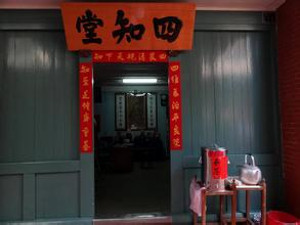
    The Hall of Four Wisdoms
    The Hall of Four Wisdoms

    The expression “Heaven knows, the spirits know, I know and you know” is known as the “Four Knows” or “Four Wisdoms” (si zhi 四知).

    The Yang clan even today name their clan hall the “Hall of Four Wisdoms” (四知堂) as can seen in the image at the left.

    Qing bai chuan jia charms have a very strong aesthetic appeal because the inscription is always written in a specific seal script style.

    The calligraphy is known as “tadpole script” (ke dou wen 蝌蚪文 or ke dou shu 蝌蚪书).

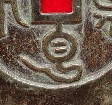
    Tadpole script
    Tadpole script

    Tadpole script, as you might guess, resembles tadpoles.  As can be seen here with the character bai (白) in the inscription, the top (head) of the character tends to be large.  The stroke then narrows so that the bottom (tail) of the character is very thin.

    Tadpole script was developed after the Han dynasty (汉朝 206 BC – 220 AD).

    At the time, the term “tadpole script” also referred to the script that had been used during the Zhou dynasty (周朝 c.1046 BC – 256 BC).

    Tadpole script was short-lived, however, and by the time of the Tang dynasty (唐朝 618-907) was not frequently used.

    These charms first appeared during the Song dynasty (宋朝 960-1279) and usually have a diameter of 62.5 mm, a thickness of 4 mm, and a weight of 62.9 grams.  The specimen shown above, however, is unusually large with a diameter of about 90 mm.

    This Chinese charm, with the distinctive tadpole script, serves as a testament to the qualities the ancient Chinese admired in a government official.  Officials were expected to be well-versed in the classics and to display the highest moral character.

    Please also see “Not Being Greedy is a Treasure” for a discussion of another charm with a similar theme.

    For charms written in “Bird Worm Seal Script”, which is similar to “Tadpole Script”, please see “Chinese Charms and Bird-Worm Seal Script“.

  • Vault Protector Coins

    On special occasions in ancient times, Chinese mints would cast an unusually large, thick, heavy and well-made coin.

    The coin was known as a “vault protector” (zhen ku qian 镇库钱).

    The coin was not for circulation but occupied a special place at the treasury.

    The treasury had a spirit hall where offerings could be made to various gods including the God of Wealth (财神).  The special coin would sometimes be hung with red silk and tassels above the incense table in the spirit hall.

    The vault protector coin was believed to have charm-like powers that provided protection from disaster and evil while ensuring good fortune and wealth.

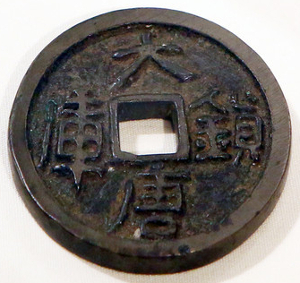
    Vault protector coin "da tang zhen ku" of Southern Tang
    Vault protector coin “da tang zhen ku” of Southern Tang

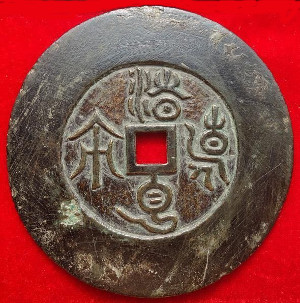
    Shown at the left is the earliest vault protector coin know to exist, and also the most famous.

    The inscription da tang zhen ku (大唐镇库) translates as “Vault Protector of the Tang Dynasty”.

    The translation is a little misleading, however, because the coin was not produced during the great Tang Dynasty (618-907).

    The coin is actually attributed to the short-lived Southern Tang (nan tang 南唐 937-976) which was one of the Ten Kingdoms that existed after the fall of the Tang.

    The coin was cast during the baoda period  (保大 943-957) of the reign of Yuanzong (元宗), also known as Li Jing (李景 or 李璟), of the Southern Tang.

    Yuan Zong cast large quantities of coins including kai yuan tong bao (开元通宝), tang guo tong bao (唐国通宝), bao da yuan bao (保大元宝) and da tang tong bao (大唐通宝).

    In addition to the da tang tong bao (大唐通宝) coins, he also had cast this large vault protector coin with the inscription da tang zhen ku (大唐镇库).

    The coin retains the characteristics of Southern Tang coins.

    The diameter is 6 cm, the thickness is 0.6 cm, the diameter of the hole is 1.24 cm and the coin weighs 93.7 grams.

    The coin was originally acquired in the early 20th century by Mr. Fang Yaoyu (方药雨), a well-known coin collector in Tianjin.  The coin was later owned by Mr. Chen Rentao (陈仁涛).

    Since the early 1950’s, this famous da tang zhen ku vault protector coin has been in the collection of the National Museum of China (中国国家博物馆).

    It is the only authentic specimen known to exist.

    Qing Dynasty vault protector on display at the Leizhou City Museum
    Qing Dynasty vault protector on display at the Leizhou City Museum

    At the left is a vault protector coin dating from the Qing dynasty on display at the Leizhou City Museum (雷州市博物馆).

    Leizhou City (雷州市) is located in Guangdong province (广东省).

    The obverse side (not shown) of the coin has the inscription xian feng tong bao (咸丰通宝) which means the coin was cast during the reign of the Xianfeng Emperor (咸丰帝), 1850-1861.

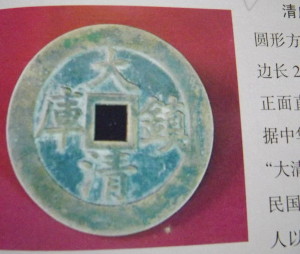
    The inscription on the reverse side, seen above, is da qing zhen ku (大清镇库) which means “Vault Protector of the Qing Dynasty”.

    According to this article, there were a total of five of these special vault protector coins cast.  In the early years of the Republic (1912-1949), a eunuch stole the coins.  Three of the coins were sold to an Englishman for “a large amount of money”.  One of the remaining coins is at the Leizhou City Museum and the other is at The Palace Museum (故宫博物院) in Beijing.

    The coin has a diameter of 14 cm.  The square hole is 2.5 cm.  The coin weighs 1050 grams.

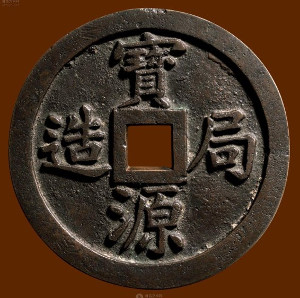
    Vault protector coin cast at the Board of Works during the reign of the Xianfeng Emperor of the Qing Dynasty
    Vault protector coin cast at the Board of Works during the reign of the Xianfeng Emperor of the Qing Dynasty

    Shown at the left is another vault protector coin from the Qing Dynasty.

    The inscription reads bao yuan ju zao (宝源局造) which means “made by the Board of Works”.

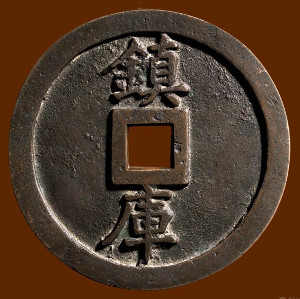
    The reverse side has the Chinese inscription zhen ku (镇库) which means “vault protector”.

    According to Mr. Ma Dingxiang (马定祥), one of the most famous Chinese numismatists of the 20th century, this vault protector is consistent with the style of coins cast during the reign of the Xianfeng Emperor.

    Reverse side of vault protector coin cast during the reign of the Xianfeng Emperor
    Reverse side of vault protector coin cast during the reign of the Xianfeng Emperor

    This very large coin has a diameter of 11.52 cm and weighs 837.3 grams.  The center hole is 1.8 cm.

    According to “Coins in China’s History” published in 1936 by Arthur B. Coole (邱文明), only 4 or 5 of these vault protector coins from the Board of Works (宝源局) exist.  Mr. Ma Dingxiang states in his book on the coins of Xianfeng (咸丰泉汇), that there exists just one specimen of a companion vault protector coin that was cast at the same time at the Board of Revenue (宝泉局).

    This coin sold at auction in 2013 for $408,279 (RMB 2,530,000) which, at the time, broke the record for the most ever paid for a Qing dynasty coin.

    In 1861 during the last days of his life, the Xianfeng emperor made arrangements for his son, Zaiqun, to succeed him as emperor.

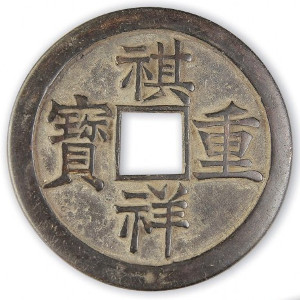
    Rare Qixiang vault protector coin
    Rare Qixiang vault protector coin

    The new emperor was to take the reign title of Qixiang (祺祥).

    With the passing of Xianfeng, however, a coup took place resulting in a change of the reign title.  The new reign title was to be Tongzhi (同治).

    For a period of about one month, however, the mints produced coins with the inscription Qixiang.  Authentic Qixiang coins are scarce because they were only cast for a very short period of time.

    Displayed above is a rare Qixiang vault protector coin.

    The inscription reads qi xiang zhong bao (祺祥重宝).

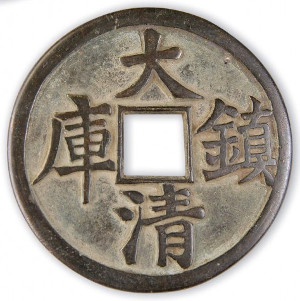
    Reverse side of Qixiang vault protector
    Reverse side of Qixiang vault protector

    The inscription on the reverse side is da qing zhen ku (大请镇库) which translates as “Vault Protector of the Qing Dynasty”.

    This coin is 10.1 cm in diameter and has a thickness of 0.47 cm.

    The coin does not indicate the mint that produced it.

    This very large and rare Qixiang vault protector coin sold at auction in 2013 for $745,755 (HK$5,750,000).

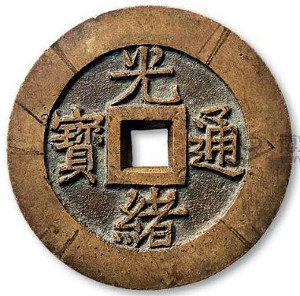
    Qing dynasty "guangxu tong bao" vault protector coin
    Qing dynasty “guangxu tong bao” vault protector coin

    Another vault protector coin from the Qing dynasty is shown at the left.

    The inscription reads guang xu tong bao (光绪通宝).

    The coin was cast as a vault protector during the reign of the Guangxu Emperor (光绪帝) 1875-1908.

    The coin is very well cast and the bronze is exquisite.

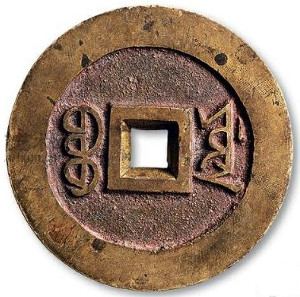
    Reverse side of Qing dynasty vault protector coin
    Reverse side of Qing dynasty vault protector coin

    The reverse side, shown at the left, has the inscription bao yuan (宝源) meaning it was cast at the Board of Works in Beijing.

    The diameter is 6.2 cm.

    The thickness is a remarkable 1 cm.

    This coin sold at auction in 2010 for $51,485  (RMB 319,200).

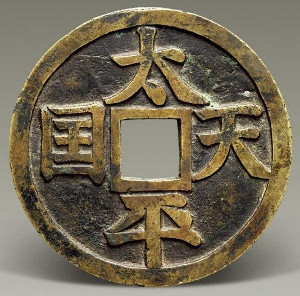
    Taiping Rebellion "Taiping Tian Guo" vault protector coin
    Taiping Rebellion “Taiping Tian Guo” vault protector coin

    According to Mr. Ma Dingxiang (马定祥), this is a vault protector coin cast during the Taiping Rebellion (1850-1864).

    The inscription on the obverse reads tai ping tian guo (太平天国) which translates as the “Heavenly Kingdom of Great Peace”.

    The coin has a diameter of 7.6 cm.

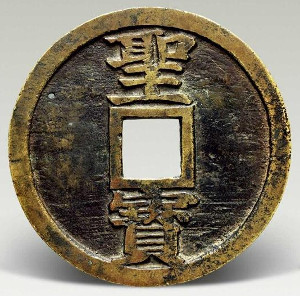
    Reverse side of Taiping Rebellion vault protector coin
    Reverse side of Taiping Rebellion vault protector coin

    The reverse side of the coin has the inscription sheng bao (圣宝) which translates as “Sacred Currency”.

    Mr. Ma discusses the coin in his book “Coins of the Taiping Heavenly Kingdom” (太平天国钱币).

    These large, well-crafted vault protector coins were produced during the later period of the Taiping Rebellion in Hunan, Suzhou and Hangzhou.

    This specimen was in the collection of Mr. Ma and sold at auction in 2011 for $111,286 (RMB 690,000).

    There are only five or six of these coins known to exist and they all display very slight differences.

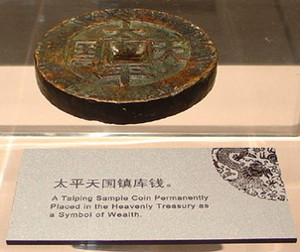
    Taiping Heavenly Kingdom vault protector coin at Taiping Heavenly Kingdom History Museum
    Taiping Heavenly Kingdom vault protector coin at Taiping Heavenly Kingdom History Museum

    Another specimen of a Taiping Heavenly Kingdom vault protector coin (太平天国镇库钱) is shown at the left.

    The coin is in the collection of the Taiping Heavenly Kingdom History Museum (太平天国厉史博物馆) in Nanjing.

    The description in the exhibit reads “A Taiping Sample Coin Permanently Placed in the Heavenly Treasury as a Symbol of Wealth”.

    It can be clearly seen in this image just how thick these vault protector coins really are.

    There is some speculation that a very large and heavy banliang coin (半两) made of silver was cast by the State of Qin (秦) in 336 BC to serve as a vault protector.  Please see “State of Qin Silver Banliang Coin” for a detailed discussion.

    Because vault protector coins are so rare, there is no shortage of fakes appearing on the market.  In doing research for this article, I found several coins described as vault protectors which I found questionable.  Collectors of these special coins therefore need to be especially careful.

    China nowadays issues on a regular basis a large variety of special commemorative coins made of precious metals such as gold or silver.  These coins are not meant for circulation.  They are popular as collectables and investments.

    Some of these modern coins are modeled after the vault protector coins of ancient times.

    In 1998, a gold coin modeled after the “Vault Protector of the Tang Dynasty” discussed above was issued.  A gold version of the Emperor Xianfeng vault protector discussed above was minted in 1990.  Finally, a gold coin based on a different Emperor Xianfeng vault protector was produced in 1982.