Category: Chinese charms

  • “Battle of Jimo” Horse Coin

    Most ancient Chinese horse coins display only a horse with no rider.

    Horse coins displaying a horse with a rider are much scarcer and those originating from the Song Dynasty (960-1279 AD) are particularly rare.
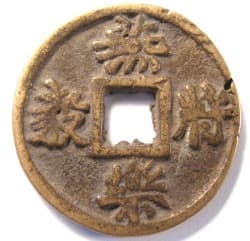
    Old Chinese horse coin commemorating the "Battle of Jimo"
    “Battle of Jimo” Horse Coin

    The specimen at the left is a later version of one of these Song Dynasty horse coins with a rider.

    Instead of honoring the horse, though, these horse coins commemorate the famous generals and battles of ancient Chinese history.

    The inscription on the horse coin at the left is read in a clockwise order, beginning with the character at the top, as yan jiang yue yi (燕將樂毅).

    The inscription translates as “General Yue Yi of the State of Yan”.  (The name is sometimes translated as “General Le Yi of the State of Yan”.)
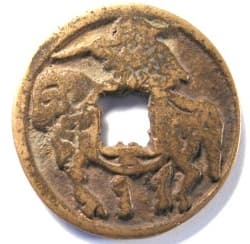
    Chinese horse coin depicting General Yue Yi of the State of Yan on horseback
    General Yue Yi with weapon on horseback

    As can be seen here, the reverse side of the horse coin shows a man holding a spear-like weapon and riding a horse.

    The rider is intended to be General Yue Yi who participated in the battle of Jimo which is one of the most famous battles of ancient China.

    Sima Qian (司马迁) (145 BC – 86 BC), the great historian of the Han Dynasty, wrote about the battle of Jimo in his monumental work “Records of the Grand Historian” (史记).

    Annotations by Tang Dynasty poet Du Mu (803-852 AD) to the famous Chinese military treatise “The Art of War” by Sun Tzu (Sunzi 孙子), written in the 6th Century BC during the Spring and Autumn Period (722 BC – 481 BC), included the Battle of Ji Mo to illustrate the successful application of the strategies by Sun Tzu.

    A brief narrative of the Battle of Jimo is as follows.

    In the year 284 BC, the state of Yan commenced a campaign to conquer the state of Qi.  General Yue Yi led the Yan army and within the short span of only six months had conquered seventy of Qi’s cities.

    In 283 BC, General Yue Yi attacked the city of Jimo.  The commanding officer of Jimo died in the battle and was replaced by General Tian Dan who would become a major figure in the Battle of Jimo.

    Having only 7,000 soldiers, General Tian Dan had to rely on superior tactics to inspire both his troops and the citizens to defend the city against the Yan army which was at least ten times as large.

    Failing to take the city by force, General Yue Yi soon realized that the only way to victory was to somehow win the hearts of the people of Jimo and convince them that to surrender would be better than to continue to resist.

    General Yue Yi therefore began a “benevolent” siege of the city which ended up lasting three years.  His army, for example, provided food and water to the residents of the city and even allowed them to till their fields outside the city walls.

    During this three year period, the king of Yan died and his son ascended to the throne.  The son, unlike his father, was not pleased that General Yue Yi was unable to conquer Jimo.

    Also, the new king harbored fears that General Yue Yi was interested in replacing him as king.

    General Tian Dan of Jimo was keenly aware of this situation and, to foment discontent, secretly sent spies to the capital of Yan to spread rumors that General Yue Yi did indeed want to be king.

    The rumors spread quickly and upon reaching the king’s ears only “confirmed” his suspicions.  The king immediately replaced General Yue Yi as head of the army and installed a new general who would prove to be much less competent.

    General Yue Yi, having lost his position, felt that the king would now try to eliminate any perceived threat to his power.  Fearing the king would try to assassinate him, General Yue Yi sought refuge in the state of Zhao.

    The new Yan army general abandoned the long siege and immediately commenced attacking the city.  But again, due to the competent leadership of General Tian Di, the troops and citizens defended themselves successfully despite being greatly outnumbered.

    To further strengthen his people’s resolve, General Tian Di sent spies into the camp of the Yan army to spread rumors that the people of the city would definitely surrender in fear if only the Yan soldiers were to “cut off the noses” of any captured Qi soldiers and also “dig up the graves of buried Qi ancestors”.

    The new Yan army general fell for these lies and ordered his soldiers to do these exact things.  As General Tian Di anticipated, these actions of savagery and desecration of the tombs so infuriated his troops and the residents of the city that they resolved to fight on at all costs.

    With the unconditional backing of his people, General Tian Di knew that this was the opportune time to take the offensive.  Knowing he did not have the number of troops to fight the enemy head on, he devised a very clever plan.

    He had his soldiers gather a thousand oxen.  He then had his men make the oxen look like “dragons” by tying daggers to their horns and lashing dried wood to their backs.

    At midnight, General Tian Di opened the city gates and had his men set fire to the wood on the backs of the oxen which then stampeded directly towards the Yan army camp.   In the darkness, the flaming oxen looked just like fiery dragons.  The enraged “dragons” killed many of the sleeping enemy troops and simultaneously set fire to the camp.  General Tian Di then ordered his five thousand soldiers to attack the much larger Yan army.

    His tactics not only succeeded in defeating the Yan army at the city of Jimo, but the tide was now turned, and General Tian Di was eventually able to free from Yan rule all seventy cities.

    Both General Tian Di, as well as the former Yan General Yue Yi, knew that the key to victory at Jimo depended on winning the hearts of the people.  Whichever side succeeded in this endeavor would win the battle.

    General Tian Di cleverly turned the enemy’s king against the competent leader of his own army.  And by devising a plan which enticed the Yan army into adopting tactics so despicable that the residents of Jimo vowed to defend the city to the very end, General Tian Di was able to turn an almost certain defeat into one of the great victories in Chinese history.
     

  • Safe Journey Charm

    In ancient times just as today, people were concerned about their safety when they traveled.  So it is not surprising that safe journey or safe travel charms compose a major category of old Chinese charms.

    Shui Lu Ping An Charm
    Safe Passage Charm

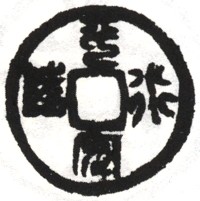
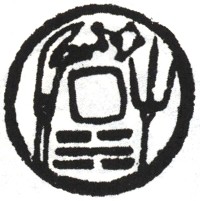
    A rubbing of one of the more interesting examples of this type of charm is shown here.

    The inscription, written in seal script, reads “shui lu ping an” which literally means “may you have peace by land and water” or, more simply, “I wish you a safe journey”.

    The reverse side has an unusual mix of Chinese charm symbols.

    Above the square hole are seven dots connected by a zigzag line which represents the star constellation known as the “Big Dipper” or “Ladle”.

    Charm displaying ancient Chinese weapons, Big Dipper and Eight Trigrams
    Weapons, Big Dipper and Trigram

    The “Big Dipper” was seen by the ancient Chinese as the Emperor’s chariot which, rotating around the fixed and unmoving North Star, demonstrated his control over the universe.

    Below the hole is one of the “eight trigrams” (bagua).  This is the trigram kan which represents “water” and the direction “north”.

    To the left and right of the hole are ancient Chinese blade weapons.

    The weapon depicted to the left of the square hole has particular significance.  It is a guan dao or “Green Dragon Crescent Blade”.  The notch in the blade was to catch and parry the enemy’s weapon.

    This was the weapon of choice of Guan Yu, who was originally a beancurd seller, but who joined with Liu Bei and became immortalized as a military hero during the period of the Three Kingdoms (220-280 AD).

    History, legend and myth gradually merged over the centuries to make Guan Yu the “God of War”.

    The weapon to the right of the center hole is known as a “Trident”.  It was primarily used as a hunting weapon but one which could also be thrown.

    The linking of the “Big Dipper” with swords established the belief that the weapons could be used not only in wars against human enemies but in battles against evil spirits as well.

    The images of the bladed weapons, the Big Dipper and the “water” trigram, along with the association of the “God of War”, combined to provide powerful protection to a person whether he traveled by land or sea.

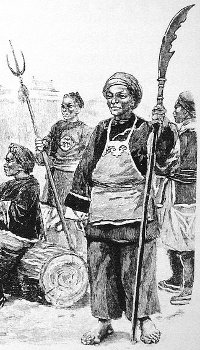
    Chinese Boxers with their weapons
    Boxers with Weapons

    But there are some who believe that this “charm” played a role even more important than simply being a travel talisman.

    Around the year 1900, there was a secret society in China consisting primarily of poor peasants and workers known as the “Righteous Fists of Harmony” (yi he tuan) which opposed various “evils” affecting the country.  These evils included the opium trade, foreign imperialism, unequal treaties and Christian missionary work.

    The “Righteous Fists of Harmony” became the “Righteous Harmony Society” and adopted the slogan “support the Qing, destroy the Foreign”.

    The group believed that a mixture of the martial arts, spirit possession, and swords, would make them invulnerable to guns.

    This ragtag army became known as the “Boxers” and the uprising is referred to as the “Boxer Rebellion“.  The rebellion, however, was ultimately put down by the combined forces of eight foreign countries.

    The Chinese charm dates from this same time period and is believed by some to have been a secret “badge” carried by members of the Boxers.  As can be seen in the illustration above, which dates from the year 1900, the weapons used by the Boxers were the same as those displayed on the charm.

    As already mentioned, the trigram kan represents “water”.  According to the Daoists, nothing is softer or weaker than water.  But water can wear away even the hardest substance.  The trigram is thus a symbol that a mass movement of Chinese peasants could defeat the smaller but better equipped army of Western “devils”.

    The “Righteous Harmony Society” was organized into eight groups named after the eight trigrams with one of the groups being the “Kan Trigram (Group) of the Righteous Harmony Society”.

    The trigram kan also represents the direction “north” and the Boxers were from northern China.

    Many old Chinese charms were created with the purpose of ensuring protection during a person’s comings and goings.  This particular charm has the additional distinction of being involved in one of the major historical events leading up to the collapse of the 2,000 year old Chinese empire.

  • Chinese Pavilion Open Work Charm

    “Open work” charms are among the most interesting and oldest of all Chinese charms.  These are bronze charms which have irregular shaped “openings” or “holes” between very exquisite design elements.

    The themes are purely pictorial so there is rarely any Chinese character or inscription.  Also, owing to the design, both sides of the charm are identical.

    The most common themes seen in open work charms include animals, particularly dragons, and flowers.  Themes including people and buildings are much less common.

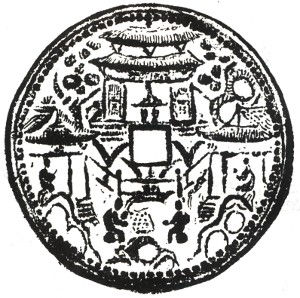
    Chinese Pavilion Open Work Charm
    Chinese Pavilion Open Work Charm

    One of the most interesting themes is a scene from a pavilion or temple complex as shown in the rubbing at the left.

    There are a number of activities taking place.

    Just above the square hole in the middle is a two-story pavilion.  Inside can be seen a person playing the guqin.  The guqin is an ancient Chinese stringed musical instrument closely associated with Confucius and the scholarly class.  In the scene shown here, the guqin is the horizontal line upon which the musician has placed his hands.

    There is one person each in the the small pavilions at the 3 o’clock and 9 o’clock positions.  While we cannot be certain, they may be composing poetry or practicing calligraphy or painting.

    There are two additional figures, near the bottom center of the charm, seated between these two pavilions.  They are playing the Chinese game weiqi (围棋) or go and the board with little round pieces can be seen between them.

    In the very center of the charm is an arched bridge surrounded by a railing.

    At the 5 o’clock and 7 o’clock positions are “longevity stones“.  “Longevity stones” are strange-shaped rocks which by their very age symbolize “long life”.

    Also, just above the small pavilions on the right and left are bamboo trees.  Bamboo symbolizes the Confucian scholar because it is seen as being upright, strong and resilient yet gentle, graceful and refined.

    The charm appears to portray the leisurely and carefree life of scholars and retired officials although others believe that the scene is actually an idealized “Temple of Confucius” and that the individuals represent Confucius himself.

    One characteristic of pavilion charms is that, unlike other types of open work charms, the center hole tends to be square instead of round.

    Pavilion open work charms of this type first appeared during the Song Dynasty (960-1279) and most are believed to have been cast in Dali, Yunnan Province.

  • Kazakhstan Zodiac Charm

    I received a fascinating email from a visitor to my website from Kazakhstan in which he described a rare ancient zodiac charm in his possession.

    The Chinese zodiac is based on a twelve year cycle with an animal having unique qualities representing each year.  The zodiac charm discussed here has the animals displayed on one side.  The other side has a Chinese inscription and symbols including several swastikas.

    The visitor’s story is so interesting that I am going to let him speak for himself:

    Obverse side of Kazakhstan Zodiac Charm
    Ancient Kazakhstan Zodiac Charm with Chinese Characters and Swastikas

    “Actually my interest in zodiac charms has appeared because I have one. One great archaeologist gifted it to my grandfather many years ago. It was found around 1940-1950 in the Southern Kazakhstan. Photos of mine charm are attached to this mail. It’s size is 43 mm in diameter, 2mm – thickness. It is made of bronze.

    “Our national institute of archeology have carefully viewed this charm and have stated that it’s age seems to be about 1st. century BCE. As I’ve discovered from your web site, it was the period of occurrence of such kind of charms (Han Dynasty), and the rise of popularity of them was few ages later till Ming Dynasty.

    Reverse side of Kazakhstan Zodiac Charm
    Ancient Kazakhstan Charm Displaying Zodiac Animals

    “One interesting thing about my charm is that the statements in Chinese on the front side of it are translated as follows: “The first one”, “The honorable”, “The noble”, or “I’m the noble”, “I’m the first”, “I’m the honorable”. Our scientists say, that it is possible, that this charm was owned by some powerful person, or family chief, etc. As it was stated on your web site, there were a great numbers of charms, depicting different purposes: for good luck, for marriage, for some other purposes. Basing on such type of categories, I’m concluding, that my charm appears to be the charm of “power”, or the charm of “gentility”. Did you ever hear about charms of “power” or “gentility”?

    “As you’ve quoted, the practical reason of the square holes in charms is that they were put on the square metal rod to remove the extra metal on the rim of the coins. By isn’t is a technological development for cutting the extra metal? I mean that maybe first coins and charms didn’t have any square holes, and only after technological development, the holes appeared as we can see them? This hypothesis corresponds to the age of my charm – 1 st. century BCE, when the process of making metal coins and charms was just developing, so that’s why my charm doesn’t have any square holes. What do you think of it? Or I might be mistaken?”

    The pertinent parts of my reply follow:

    “None of my Chinese reference books discuss any charm quite like yours.  It may very well have originated in the ancient lands of Kazakhstan and therefore have distinctive characteristics particular to that region of the world.

    “I am not familiar with charms of “power”.  However, there were tallies, such as the famous “tiger tallies”, used in ancient China as symbols of authority.  Perhaps your charm had a similar purpose.

    “The very first Chinese money did not have holes in the middle.  In fact, they were not even round and did not resemble coins as we know them.  They were based on implements such as shovels and knives.

    “I should have mentioned in my first message that another reason ancient Chinese coins had a hole in the center was that their value was fairly low (especially compared to gold, silver and jade) and to make purchases a person needed to use many coins.  The hole in the middle facilitated carrying the coins because the coins could be placed on a string.  A typical “string” of cash coins might have 100 or 1,000 coins.

    “Early charms tended to be modeled after coins and therefore most had a square or round hole in the center.  The charm could be worn around the neck as a necklace or hung from the waist.  However, there was no need to carry a large number of charms on a string so, unlike coins, the hole in the center was not really needed.  As is the case with your charm, a number of charms were made as pendants to be worn.

    “This is the practical reason why most Chinese coins and charms have square holes.

    “There is a philosophical reason for the square hole as well.  The Chinese believed that heaven was a “circle” and the earth was a “square”.

    “Thank you again for providing the background and images of your zodiac charm.  It is a real treasure.”

  • “Quest for Longevity” Daoist Charm

    The Chinese have a long history in regard to the quest for longevity.

    Qin Shi Huang (259 BC – 210 BC), the first emperor of China, sent expeditions looking for the mystical Penglai Island, where the immortals lived, in his quest to obtain the elixir of life which would allow him to live forever.

    His search for the elixir of immortality actually cost him his life.  He died after eating pills meant to make him immortal but which were made from mercury.

    While longevity was important to the Confucians because they believed that wisdom came with age, it was a primary pursuit of the Daoists because they, like Emperor Qin Shi Huang, wanted to become immortal and live forever.

    For this reason, there is a large variety of Daoist charms relating to longevity.

    Daoist longevity charm
    Daoist Charm with Immortal, Incense Burner, Crane and Tortoise

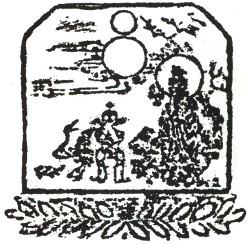
    As an example, here is a rubbing of an old Daoist longevity charm which is both unusual in its shape and not often found.

    At the top center is a small hole from which the charm could be hung.

    Shown at the right is an “immortal”.  The “circle” surrounding the head designates the person as someone special in a manner similar to a “halo” found in Western paintings.

    The Immortal is sitting under a pine tree.  In the sky is a moon (larger circle beneath the hole) surrounded by clouds.

    Immediately to the left of the “immortal” is a four-legged incense burner or cauldron on a stand.

    To the left of the incense burner is a crane with an open mouth and at the extreme left corner is a tortoise.

    The very bottom of the charm consists of leaves on a peach branch with a peach at the very center.

    The symbols on this charm are all associated with “longevity”. The immortal, of course, is one who lives forever. The crane, tortoise, peach and pine tree are all symbols of longevity.

    The cauldron or incense burner alludes to the Daoist quest to find the “elixir of immortality”.  The Daoists believed in alchemy and the incense burner or cauldron symbolizes their attempt to make the “elixir of immortality” from cinnabar (mercury).

    The “moon” is a reference to the story of the “Moon Hare” (“Jade Rabbit”) who pounds leaves of the cassia (cinnamon) tree with mortar and pestle in an attempt to make the “pill of immortality”.

    The “peach” is the food of the immortals. It is associated with the Queen Mother of the West who had a peach orchard. Eating one of these peaches would allow a person to live 3,000 years.

    Daoist magic writing

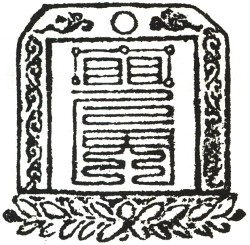
    The reverse side of the charm has a large character written in what is known as Daoist “magic writing” or “magic script”.  Unfortunately, with the possible exception of Daoist priests, the meaning of these characters remain unknown.

    However, this particular character is very similar to the character located to the left of the round hole on an old Daoist charm of mine.  While the exact meaning of the character on my charm is unknown, it happens to be paired together with the Chinese character “chang” which means “long”. Again, it is unknown if this pairing has any relationship or not.

    Daoist charms of this type first appeared during the Song Dynasty (960-1279 AD) although later reproductions also exist.

  • “Song of Unending Sorrow” Charm

    I received an email from a visitor to my website asking if I could provide him with any information on the charm shown here.

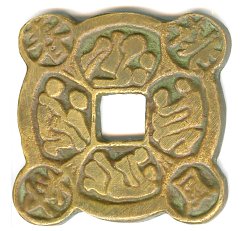
    Song of Unending Sorrow Charm

    The area surrounding the square hole shows four couples making love in various positions.  (Or, one couple making love in four positions.)

    Charms of this type are actually fairly common.

    The charm is modeled after this charm discussed in detail at Chinese Marriage Charms.

    The four Chinese characters at the “corners” of the charm are taken from a poem written by Bai Juyi (772-846 AD) who was a very famous poet of the Tang Dynasty (618-907 AD).

    The poem is entitled “Song of Unending Sorrow” or “Song of Everlasting Regret” and describes the great love of Emperor Xuanzong (685-762 AD) for his beautiful consort Yang Guifei, and his deep sorrow upon her death.

    The Chinese characters on the charm are as follows.

    The character at the upper left is “spring” (chun).  The character at the lower right is “wind” (feng).  The character at the upper right is “peach” (tao), and the character at the lower left is “plum” (li).

    The inscription is read in the same order as “spring, wind, peach, plum”.

    These are the first four characters of a line from the poem which translates as “Gone were the breezy spring days when the peach and plum trees were in bloom”.

    Yang Guifei is considered to have been one of the most beautiful woman in Chinese history and is known as one of the Four Beauties.

    A different charm with an inscription that refers to this love affair is discussed here.

    I had not seen this particular charm before and have not been able to find it in any of my reference books.  I am not even sure it is Chinese.  It could be Korean, Japanese, Taiwanese or Vietnamese.

    Also, based on the image, I do not think it is “old”.  My guess is that it was privately cast sometime during the 20th century.

  • Little Shoe Charms to Find Love

    I received an email regarding a Chinese tradition of girls hanging little shoe charms over their beds in the hope of finding love:

    “Recently I was in Cape Cod and went to a very interesting store where a woman was selling ancient Chinese charms.
    “She told me the story of how Chinese girls used to hang these little shoe charms over their bed for good luck in finding love.
    “I bought a pair of these tiny shoes because I loved the novelty behind it.  (They are only about an inch long).
    “Is this a true tale and, if so, would you be able to give me more info about it?”

    My reply is as follows:
    Customs and symbols vary widely in China because of its large territory and long history.  I have not actually seen the little shoe charms you mention but I will try to offer one possible origin for the custom.

    Small shoes mean small feet.

    During ancient times, Chinese men found women with small feet to be particularly attractive.  Since women with small feet were considered more attractive, their chances of finding a husband were enhanced.

    Therefore, a “small shoe” charm should bring good luck in finding a husband.

    You must understand that by “small” feet we mean really small.  In this case, we are talking about a total foot length of about 3 inches from toes to heel.  This did not occur naturally but was accomplished through the barbaric practice of foot-binding.

    For a girl, foot-binding started at a very young age, usually at 3-5 years of age, and continued for the rest of her life.  It was an extremely painful process where the foot was bound in such a way that the toes were forced down and back towards the heel.

    Such small feet were referred to as “lotus feet” and the small shoes that were worn were called “lotus shoes”.

    Girls with bound-feet were considered more desirable for a number of reasons.  Because they could not walk normally, they were perceived to be of a “higher status” since they did not have to work in the fields like the vast majority of girls.

    Men also found women with bound feet to have more sex appeal for several reasons.

    One reason was that women with bound-feet walked in a swaying and seductive manner similar to women who wear high heels.

    Also, men believed a woman’s foot was, in a sense, the center of sexuality which should be covered from public view.  Even more importantly, it was believed that foot-binding made a women’s vagina narrower and thus provide more pleasure to the man during sexual intercourse.

    As a consequence, a woman with bound feet would have more chances to become pregnant and give birth to more male babies which, in a traditional Confucian culture, would bring her more prestige.

    Families realized that they would have a better opportunity to improve their own status if their daughters married well and produced male offspring so even poor families wanted for their daughters to be foot-bound if possible.

    As I mentioned earlier, I am not familiar with the small shoe charm you purchased so the above discussion is just speculation on my part concerning the possible origin of such a custom.

    In conclusion, I would like to mention that shoes were an important symbol in other areas of ancient Chinese culture as well.  Shoes were a symbol of wealth (resemble silver ingots) and fertility as I explain at “Hidden Meaning of Chinese Charm Symbols” and shoes also played an important role in the traditional marriage ceremony as discussed at Ancient Chinese Marriage Charms.

  • Royal Lord of the East and the Queen Mother of the West

    I received the following inquiry:

    “I have been trying to decipher, without total success, a chinese cast bronze charm – my very tentative guess would be Ming Dynasty – and wondered if I could send along a digital image of the two sides?

    On the front side two of the characters are (I believe) for longevity, but the other two I do not know.

    The reverse has a male figure (left) and female figure (right), with what looks like a folded big dipper above and a design in a cartouche below.

    Please let me know if I can send scans.

    Thanks!”

    My reply was as follows:

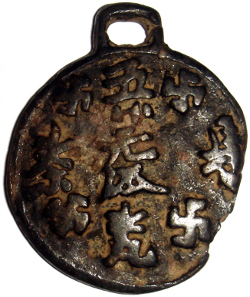
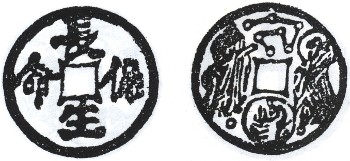
    "Chang Sheng Bao Ming" Charm
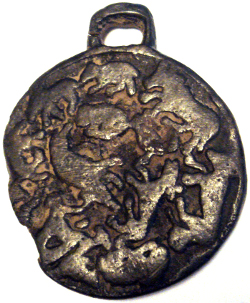
    King Mu Seeking Drug of Immortality from Queen Mother of the West

    The inscription reads chang sheng bao ming.  The chang sheng would translate as “long life” and bao ming translates as “protect life”.

    The symbols on the reverse side are as follows:
    1.  At the top are seven dots connected by a zigzag line which is meant to represent the “Big Dipper“.
    2.  The figure at the left is “Dong Wang Gong”, the Royal Lord of the East, who was actually King Mu of the Zhou (Zhou Mu Wang).
    3.  The figure at the right is the Queen Mother of the West (Xi Wang Mu).
    4.  At the bottom is a circle (which represents the moon).  Inside the circle is a rabbit using a pestle and mortar.

    The scene describes King Mu asking the Queen Mother of the West to give him the drug of immortality.  The drug of immortality was made by the rabbit that lived on the moon.

    Because of the wear on the charm, it is difficult to see the rabbit.  If you look closely at the circle, the rabbits ears are at the 12 o’clock position, the tail is at 3 o’clock, and the legs are at 5 o’clock.  The rabbit is facing left and slightly bent over.  The rabbit is making the drug of immortality using the pestle and mortar.  The top of the pestle is pointing to the 11 o’clock position.

    It is very difficult to date charms but charms like this first appeared in the Jin (1115-1234) or Yuan (1271-1368) dynasties.

    A size of 58 mm is about right for this charm.

    Hope you find the above information helpful.

    Thanks for writing,
    Gary

  • Huo Bu Charm

    I frequently receive correspondence from people who have a coin or charm they would like identified.

    The following is my reply to such an inquiry and I have attached a rubbing of the charm for reference.

    Chinese huobu charm

    It is a charm.

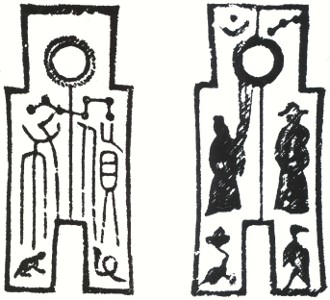
    However, it is based on an ancient form of spade money called a “Huo Bu”.  If you visit my Chinese Spade Charms web page you will see a real “Huo Bu” cast in the year 14 AD during the reign of Wang Mang.

    As best I can tell from reference books, your charm is actually fairly modern.  Apparently, it first appeared during the early years of the Republic of China sometime after 1911.  From your photos, I would say that your particular charm is a very recent copy of this older charm.

    One of my reference books says that this charm may actually be Japanese and not Chinese.

    The charm has some interesting features.  It has the same Chinese inscription “Huo Bu” as the original Wang Mang spade coin upon which it is based.  It is much much bigger in size.  Just above the Chinese characters is the seven star “Big Dipper”constellation.  There is a snake on the lower right foot and a “three -legged toad” on the left foot.

    The reverse side has the sun (the dot) and moon (crescent) at the upper left.  At the upper right are three stars connected by a line.  This refers to the three “Star Gods”.  The two “human figures” are unknown.  On the right foot may be a heron or egret.  I am not certain what symbol is on the left foot but I believe it is a tortoise exhaling an “auspicious cloud“.

    To learn more about these symbols, please look under the appropriate entry at my Hidden Meaning web page.

    I hope the above is helpful to you.

    Thank you for writing,
    Gary