Category: Uncategorized

  • Archaeological Blind Boxes and Ancient Chinese Coins

    Staff at Henan Museum digging for treasure in blind box
    Staff member at the Henan Museum using a ‘Luoyang shovel’ to dig for treasure in a blind box

    For several years, Chinese museums have been offering archaeological blind boxes (考古盲盒) in an effort to promote and popularize archaeology to the general public. These boxes are sold in museum gift shops and are especially popular with the younger generation.

    A blind box is a box in which a replica of an ancient cultural artifact is buried. The object is encased in soil or clay. To discover the artifact, one needs to carefully remove the clay in a manner similar to that of an archaeologist unearthing objects in the field.

    The outside of the box does not indicate what cultural artifact is “buried” inside. Much of the fun and excitement of these boxes is the surprise of discovery similar to what an archaeologist would experience.
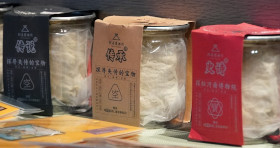
    Archaeological blind boxes
    Blind boxes for sale at the Henan Museum

    To enhance the reality of the experience, the clay/soil in the box is sometimes the same as that in which the original artifact was found. Also, many blind boxes include a small brush and a digging tool.

    A very interesting video shows a Henan Museum staff member “excavating” treasure from a blind box.
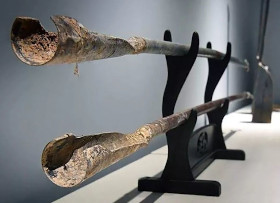
    The blind boxes from the Henan Museum (河南博物院) in Zhengzhou (郑州) include a small chopstick-sized version of a digging tool known as a “Luoyang shovel” (洛阳铲) which is the traditional tool used in actual archaeological excavations.

    The Luoyang shovel, shown at the left, was invented in 1923 by a grave robber from Luoyang.

    Mr. Song Hua (宋华), the Director of the Cultural and Creative office (河南博物院文创办主任) of the museum, says that the blind boxes have been offered since 2019 and a brochure introducing items which may be “excavated” is included in each box.

    Mr. Song also says that the soil in the Henan Museum blind boxes is mixed with clay from the Mangshan Mountains (阳北邙山) in Luoyang which is where royal mausoleums from many dynasties have been unearthed.
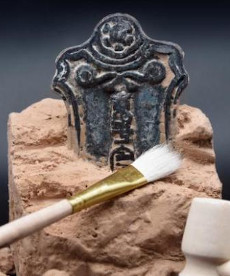
    Blind box treasure being unearthed
    Blind box “memorial tablet” being unearthed

    There are a variety of archaeological blind boxes available including ones with replicas of ancient coins, silver ingots (元宝 sycee), seals (图章) of the 12 animals of the Chinese zodiac (生肖), and miniature bronze cooking vessels (gong ) from 3,500 years ago.

    Other boxes may include replicas of a tiger-shaped tally (虎符) issued to army generals in ancient times, a silver medal (银牌), a bronze mirror (铜鉴), jade ware (玉器) or a small bronze Buddha statue (铜佛).

    These blind boxes are extremely popular and can be difficult to buy because they are frequently sold out. Prices start at about $6.15 (40 yuan).

    Mr. Song mentions that 600 blind boxes were offered for sale online on December 8, 2020. Even though there was a limit of 3 boxes to a customer, the boxes sold out in 35 seconds. A total of 14,000 boxes were sold in that month alone.

    Other Chinese museums also offer blind boxes for sale.
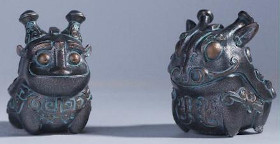
    The Shaanxi History Museum (陕西历史博物馆) in Xi’an (西安), where the world renowned terracotta warriors (兵马俑) were discovered, offers blind boxes with a series of bronzeware from the Shang (商朝) and Zhou (周朝) dynasties.

    The Sanxingdui Museum (三星堆博物馆), where the ruins of an ancient Bronze Age culture are located, has blind boxes with replica dolls based on its collection of bronze face masks and figurines.

    Other museums which sell their own blind boxes are the National Museum of China (中国国家博物馆), the Palace Museum (故宫博物院), the Hebei Museum (河北博物院), the Suzhou Museum (苏州博物馆) and the Shanghai Museum (上海博物馆).
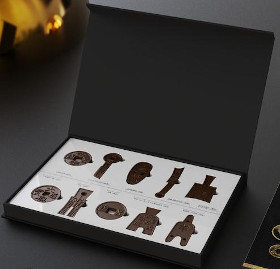
    Ancient Chinese coins made of chocolate
    Blind box with chocolate coins modeled after ancient coins in the collection of the Henan Museum

    For the Spring Festival (Chinese New Year 春节) in 2021, the Henan Museum offered a special archaeological blind box with replica ancient Chinese coins.

    Upon lifting the cover of this blind box, however, one realizes that the replica coins are not encased in clay or require any digging. The coins are already visible.

    These ancient coins are made of chocolate (古钱币巧克力) as can be seen in the photo.
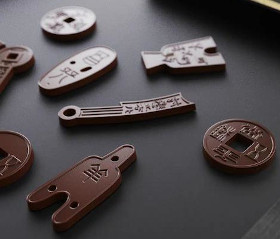
    Ancient Chinese coins made of chocolate
    Chocolate coins from Henan Museum blind box

    Although made of chocolate, these are replicas of actual coins unearthed by archaeologists and now on display at the museum.

    There are 10 ‘coins’ in the box representing coinage from the Spring and Autumn period (春秋 770-476 BC), Warring States period (战国 475-221 BC), Western Han (西汉 202 BC – 8 AD), Xin dynasty (新莽 9-23), Northern Qi (北齐 550-577), and Northern Song (北宋 960-1127).

    To see specimens of the real coins upon which the chocolate coins are modeled, please see six character knife, gold inlaid knife, three hole spade, spade money, Wang Mang spade money, ant nose money, wuzhu coins, chang ping wu zhu, and Northern Song dynasty coins.

    If you enjoy learning about “edible” cultural relics, please also see Chinese Chess Mooncakes.
  • Chinese Villager Unearths ‘Old Coin’ While Digging Ancestral Grave

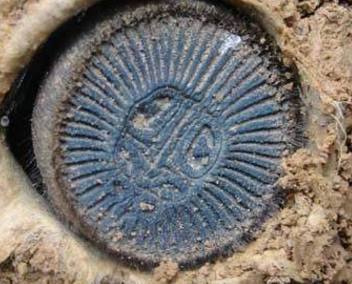
    ‘Ancient Chinese coin’ discovered by villager while digging at ancestral burial site

    A recent newspaper article tells the story of a Chinese villager who decided to move his family’s ancestral graves to a place with better feng shui (风水).

    While digging, he accidentally uncovered an ancient coin.

    He had heard stories of people becoming rich by digging up ancient Chinese coins and selling them. Now this was happening to him. He was thrilled with his good luck and anticipated that he would reap a large fortune.

    He calmed down and began to dig more slowly and carefully. Just as he was about to dig the coin out, the coin moved and frightened him.

    Once the coin was uncovered, he could “see its true face”. He did not know whether to laugh or cry.

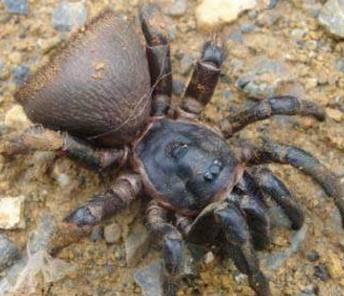
    Rare Chinese ‘Money Trapdoor Spider’ (Chinese Hourglass Spider) discovered by villager

    He was stunned that the object was not a coin at all but rather a living thing. He described it as a “scary and extremely ugly-looking spider”.

    Searching the internet, he discovered that this was an extremely rare trapdoor spider known as a Chinese Hourglass Spider (Cyclocosmia ricketti 里氏盤腹蛛).

    In China, however, it is better known as a “Money Trapdoor Spider” (金钱活板门蛛) or “Money Living-Door Spider” (金钱活门蛛). Another common name is the “Severed Abdomen Spider” (截腹蛛).

    Nevertheless, the villager was saddened that he would not be making a fortune from his “coin”.

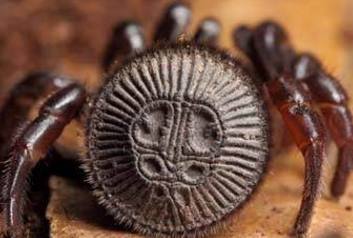
    Money Trapdoor Spider

    As can be seen in the image at the left from Baidu Baike (百度百科), the spider has a very distinctive plate or disk on its abdomen which resembles an ancient coin, seal or grinding disc.

    These money trapdoor spiders are found in Fujian (福建), Zhejiang (浙江), Sichuan (四川) and Yunnan (云南) provinces in China as well as the tropical rain forests of Southeast Asia.

    Sichuan is the farthest north this species has been recorded. There is still much to learn about these spiders since it was previously believed that the species could not survive in areas where temperatures could drop below 13 degrees Celsius. Winters in Sichuan can get even colder.

    The males are about 2.5 cm in length and the females are slightly larger at about 2.7 cm. The largest can exceed 3 cm. The disk has a radius of about 1.6 cm.

    Mr. Zhao Li (赵力), the Director and Senior Biological Engineer at the Insect Museum of West China (华希昆虫博物馆) located in Chengdu (成都), says in another article that the money trapdoor spider fits the description of a type of arachnid mentioned in an ancient Chinese text known as the Erya尔雅》. The Erya is believed to be the oldest extant Chinese dictionary and dates to the fifth century BC.

    References to what is likely the trapdoor spider can also be found in ancient texts on Chinese medicine. For example, the “Supplement to the Materia Medica” (Bencao Shiyi 《本草拾遗》) by Tang dynasty pharmacologist Chen Cangqi (陈藏器) written in 739 AD states that “the diedang (螲蟷 a species of spider living in underground burrows) is found everywhere……it resembles a spider….a hole in the ground is the nest and on top of the hole is a cover.” The diedang can be used to treat “boils, gangrene and other sores, sarcoma (malignant tumor), …”.

    Mr. Zhao says money trapdoor spiders are very rare and there have been only eight sightings in China since the year 2000.

    Because of their rarity, these spiders bring a high price as pets. Most of the “money trapdoor spiders”, as they are called in the pet market, are artificially bred in Thailand. One spider can sell for as much as $3,860 (RMB 25,000).

    Mr. Zhao explained that the spider rests during the day and comes out at night.

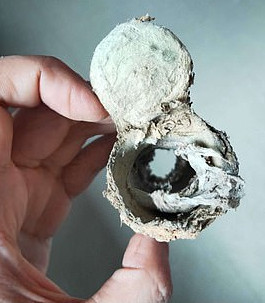
    Money Trapdoor Spider Burrow

    Money trapdoor spiders do not build webs. They dig burrows in the ground and line it with silk threads and mud.

    Mr. Zhao is seen holding such a silk-lined burrow in the image at left.

    The spider can protect itself by blocking the entrance to the burrow using its hard “coin” as a shield.

    Another article explains that “the money trapdoor spider is not good at spinning silk and weaving webs in the air so it uses its weird butt to plug the opening of the burrow. Because its ‘copper coin’ is relatively hard, it can protect itself well. When a small insect steps on its ‘copper coin’, the spider will shrink its abdomen allowing the small insect to fall into the burrow and be eaten. The ‘coin’ makes it difficult for the insect to escape. When faced with a non-threatening insect, the spider can just get out of the hole and grab it”.

    Even though the villager was frightened and disappointed that he was not lucky enough to find buried treasure, the spider is nevertheless considered an auspicious symbol in China.

    The reason is that one of the Chinese words for “spider” is chongxizi (虫喜子). The chong (虫) means “insect”, the xi (喜) means “happy” and the zi (子) means “son”. The Chinese like puns. If you say “spider” (chong xi zi) you are at the same time saying the word “happy” (xi) as well as “happy son” (xizi).

    According to Chinese law, the government owns everything of value in the ground, in the rivers and within the country’s territorial waters. This means that even if the villager had discovered an ancient coin or other buried treasure, all could have been legally confiscated by the state.

    However, these laws would not apply to an insect and the villager could probably have sold the spider for more money than many rare Chinese coins.

    The newspaper article, unfortunately, does not say what the villager decided to do with his “scary and extremely ugly-looking spider”.

  • Chinese Museum Offers Reward for Deciphering Ancient Gold Coin Inscription

    The Cultural Relics Bureau of Jinshi City (湖南省津市市文物局), located in Hunan Province (湖南省), is offering a reward of $1,500 (RMB 10,000) to anyone who can decipher the inscription on some ancient gold coins in the city’s museum, according to an article published February 16, 2016 in the Beijing Daily (北京日报).

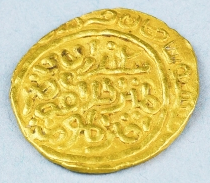
    Unknown gold coin with inscription written in a "rare type" of Arabic
    Unknown gold coin with inscription written in a “rare type” of Arabic

    The six gold coins, which are classified as first-level national cultural relics (国家一级文物), were discovered during the 1960s buried in a small white glazed pot at a farm in Jinshi (津市).

    The coins were moved to Jinshi City’s museum in the 1980s.

    According to Mr. Peng Jia (彭佳), Director of the Cultural Relics Bureau of Jinshi City, the coins are hammered in a manner similar to that used by the ancient Greeks.

    In 2001, it was determined that the coins were minted by the Delhi Sultanate (德里苏丹国 1206-1526) in northern India around the time of China’s Yuan dynasty (元朝 1271-1368).

    According to Mr. Peng, the inscription on the obverse side of the coins is the name of a king written in a rare form of Arabic.

    The museum staff, as well as other Chinese and foreign experts, have been unable to decipher the inscription on the reverse side of the coins which is shown in the image above.

    By offering the reward, it is hoped that the mystery surrounding the coins can be solved.

  • Byzantine Gold Coin Found in Tomb of Emperor Jiemin of Northern Wei

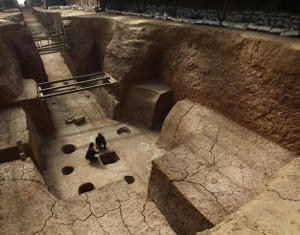
    Chinese archaeologists recently completed their work excavating an ancient tomb located near Luoyang (洛阳), Henan Province (河南省), according to recent reports in the Chinese press.

    Archaeologists believe the tomb belongs to Emperor Jiemin of Northern Wei
    Archaeologists believe the tomb belongs to Emperor Jiemin of Northern Wei

    The archaeologists from the Luoyang Municipal Institute of Cultural Relics and Artifacts (洛阳市文物考古研究院) can be seen working in the tomb in the image at the left.

    The archaeologists believe that the tomb belongs to Emperor Jiemin (节闵帝) of the Northern Wei (北魏).  Emperor Jiemin is sometimes referred to by his personal name Yuan Gong (元恭).

    The Northern Wei was a Mongolian dynasty and Emperor Jiemin ruled during the years 498-532 AD.

    Historical sources reveal that after the capital was moved to Luoyang, six Northern Wei emperors died and were buried in the area.  Documents specifically mention the tombs of Emperor Xiaowen (孝文帝长陵), Emperor Xuanwu (宣武帝景陵), Emperor Xiaoming (孝明帝定陵) and Emperor Xiaozhuang (孝庄帝静陵).

    The historical records are not clear in regard to the tombs of Yuan Ye (Prince of Changguang 长广王元晔) and Emperor Jiemin.

    Because Yuan Ye reigned for only a few months (530-531), the archaeologist do not believe that a tomb of this magnitude could not have been built during his reign.

    Given the scale of the tomb, its location and configuration, as well as the length of time it would have taken to build, the archaeologists have preliminarily concluded that the tomb must therefore belong to Jiemin.

    This would be the fifth Northern Wei emperor tomb discovered in Luoyang.

    The path leading down to the grave is 39.7 meters in length and 2.9 meters in width.  The tomb chamber is 19.2 meters in length and 12 meters in width.

    While a number of artifacts were recovered, many had suffered damage.

    Gold coin found in the tomb of Emperor Jiemin of Northern Wei and minted during the reign of Anastasius I of the Byzantine Empire.
    Gold coin found in the tomb of Emperor Jiemin of Northern Wei and minted during the reign of Anastasius I of the Byzantine Empire.

    However, the most important artifact discovered in the tomb was a gold coin (solidus) in excellent condition.

    The coin, shown at the left, was minted during the reign of Anastasius I (阿纳斯塔修斯一世) who was the Byzantine Emperor during the period 491-518 AD.

    The coin is 2.1-2.2 cm in diameter and is one of only a few Byzantine gold coins ever unearthed by archaeologists in China.

    According to the archaeologists, the discovery of this Byzantine gold coin in a Chinese emperor’s tomb provides further evidence that Luoyang was the eastern terminus of the ancient Silk Road (丝绸之路).

  • Buy Donkey Burgers with Ancient Chinese Coins

    Now there is a restaurant in Beijing where you can spend ancient Chinese money to buy “donkey burgers” (lurou huoshao 驴肉火烧).

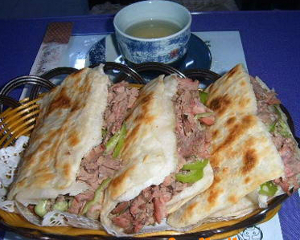
    An article in the November 26, 2012 edition of the Beijing Evening News (beijing wanbao 北京晚报) describes a restaurant that sells donkey burgers with the prices denominated in ancient Chinese money.  Donkey burgers are a specialty of Baoding (保定) and Hejian (河间) and consist of chopped donkey meat and vegetables placed between two buns.

    A sign hanging in the restaurant states “Money from the last 500 years may be used to buy donkey burgers here”.

    This means that old Chinese coins dating back to the Ming (1368-1644) and Qing (1644-1911) dynasties can be used to pay for the sandwiches.

    Donkey burgers actually originated during the Ming Dynasty when soldiers had nothing to eat and so killed their horses and put the meat between two buns.

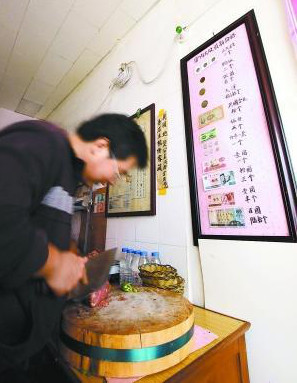
    Preparing donkey burgers with price list in ancient Chinese coins hanging on wall
    Preparing donkey burgers with price list in ancient Chinese coins hanging on wall

    “Little Yan” (小闫), the owner of the restaurant, has a “new” menu hanging on the wall (see photo).  The menu has various old coins and paper money attached and beside each is written how many donkey burgers each will buy.

    For example, three common Ming or Qing dynasty “cash coins” (small bronze coins with a square hole in the middle) will buy one donkey burger.

    A “one dollar” banknote (一元钞票) with the portrait of Sun Yat-sen (孙中山) issued during the Republic of China (1912-1949) will purchase 10 donkey burgers.

    However, a silver dollar minted during the Republic of China era will buy 80 donkey burgers.

    Donkey Burgers
    Donkey Burgers

    “Little Yan” explained that he was poor growing up but still liked to collect old things.  While working for wages in Beijing, he would go to the antique market at the Baoguo Temple (报国寺) to learn the prices of ancient Chinese coins and how to tell authentic coins from the fakes and reproductions.

    Even though his “new menu” with ancient money prices has been hanging on the wall for more than a week, “Little Yan” concedes that no one as yet has come in to buy his “authentic” Hejian donkey burgers with old money.

    He is not bothered, though.  He admits that he did this for fun because people find it interesting that they can come and buy food with ancient money.  He says that even when people come in but do not want to eat, he is still happy just to discuss ancient Chinese coins with them.

    “Little Yan” also has a confession to make.  Although he has genuine ancient Chinese coins in his collection, the specimens he has attached to the price list on the wall are all fakes.

  • “Ministers of Fire” Chinese Chess Piece

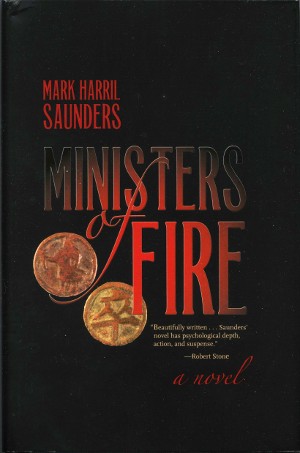
    Old Chinese chess piece on cover of "Ministers of Fire"
    Old Chinese chess piece on cover of “Ministers of Fire”

    Ministers of Fire” is a newly-published critically-acclaimed novel by Mark Harril Saunders which displays an ancient Chinese soldier on its dust jacket.

    The soldier is not a creation of a graphics designer but is actually an ancient Chinese chess piece dating back about 1000 years.

    The author contacted me late last year after seeing the old Chinese chess piece on my website.  He asked for permission to use the image on the cover of his new novel to be published by Swallow Press (Ohio University Press) in early 2012.

    I was happy to grant permission and provided the high resolution images.

    The book is a fast-moving spy thriller which has received outstanding reviews from such notable authors as Robert Stone and John Casey, both of whom are National Book Award winners.

    The book has also earned a “starred review” from Publishers Weekly.

    It is quite exciting to see a piece from your own collection on the book jacket of a major novel.

  • Coin Design Discovered on Wall Bricks from Kingdom of Min

    The ruins of an ancient city wall dating from the Tang Dynasty were recently discovered in Fuzhou (福州), the capital city of China’s southeastern province of Fujian (福建), according to a local newspaper article.

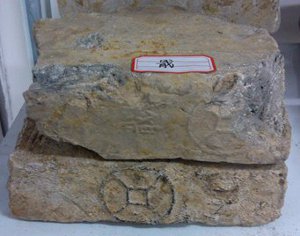
    The city wall dates back 1,100 years and is unusual because some of the bricks display the design of an ancient Chinese cash coin.  Cash coins were distinctive because of their round shape with a square hole in the center.

    Coin design on wall bricks of Kingdom of Min
    Coin design on wall bricks of Kingdom of Min

    The coin design can be clearly seen on the bottom brick in the picture at the left.  The coin design is also on the upper brick just to the right of center.

    The discovery of the bricks with the coin design allowed archeologists to identify the site as the ruins of a city wall from the time of the Kingdom of Min (909-945 AD).

    Construction of the wall began in the year 901 under the direction of Wang Shenzhi (王审知) who was the military commissioner for the area under the Tang Dynasty.

    However, the great Tang Dynasty collapsed in 907, and in the year 909 Wang Shenzhi named himself the Prince of Min (閩忠懿王; Emperor Taizu of Min 闽太祖) and the ruler of the Kingdom of Min.

    Historical records specifically mention the unusual coin design on the bricks used to build the “Luo city wall” (罗城).

    Confirmation that the archaeological find is indeed the famous “Luo wall” of the Kingdom of Min was obtained when other bricks were discovered to have the Chinese characters 威武军 (wei wu jun) which translates as the “Powerful Army”.  Wei Wu Jun was the name of the army Wang Shenzhi commanded.

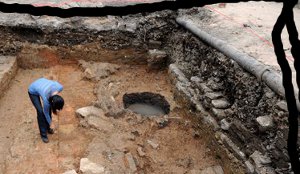
    Ancient city wall from Kingdom of Min
    Ancient city wall from Kingdom of Min

    The newly unearthed ancient wall can be seen in the image at the left. The wall thus far unearthed measures 74 meters in length and 8 meters in width.

    Historical records describe the wall as having been severely damaged in battles during the Song Dynasty (960-1279).

    In more recent times, the site was used as a garbage dump and later became the location of a transport station.

    Wang Shenzhi is well known to collectors of ancient Chinese coins because he predominately issued coins made of lead or iron.  While lead and iron coins had been cast in earlier dynasties, most coins were made of bronze.

    However, the coin design on the wall bricks actually has nothing to do coins!

    The Chinese character for “cash coin” (qian 钱) also happens to be a Chinese surname or family name.

    The surname of the ruling family of the neighboring kingdom of Wuyue was Qian (钱) which is the very same Chinese character used for “coin”.

    In 916, Wang Shenzhi arranged for the marriage of his daughter to Qian Chuanxiang (钱传珦) who was the son of Qian Liu (钱鏐) the King of Wuyue (吴越国).

    It was a common practice for rulers to try to marry their offspring to important family members of neighboring states in order to establish strong diplomatic ties.

    The image of the coin on the city wall bricks was intended to symbolize the marriage and the newly established ties to the Qian family of the Kingdom of Wuyue.

    The Kingdom of Min would only exist for a short time after Wang Shenzhi’s death in 925.

    Li Hongxi (李弘羲) became ruler of Fuzhou in 945 but was forced to surrender to the forces of Wuyue.

    The King of Wuyue at the time was Qian Hongzuo (钱弘佐; Qian Zuo 钱佐) who was the nephew of Qian Chuanxiang.

    The Qian family of Wuyue thus became the new rulers of Fuzhou.  It is said that the citizens of Fuzhou considered the coin design on the bricks of the Luo Wall to have been an omen predicting that the Qian family would one day rule the country.

    As mentioned earlier, Wang Shenzhi is known for having been among the first to use lead for the regular production of cash coins.

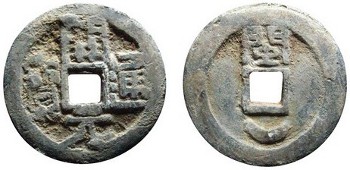
    Large lead coin from Kingdom of Min
    Large lead coin from Kingdom of Min

    An example of a large lead coin cast during Wang Shenzhi’s reign is displayed at the left.

    The inscription on the obverse side is kai yuan tong bao (開元通寶) which is the same as that on the coins of the Tang Dynasty.

    The reverse side has the Chinese character min (閩) indicating the Kingdom of Min.

    These large coins made of lead or iron from the Kingdom of Min are fairly scarce.  Specimens made of bronze are even rarer.

  • “Four Happinesses” Window

    A 200-year-old carved wooden window, described as a rare and exquisite treasure, was recently discovered in a small village flea market in China’s southwest Yunnan Province, according to an article in the Kunming Daily (昆明日报).

    Mr. Yang Anning (杨安宁), a well-known expert in ancient Chinese architecture, described the well-preserved window as a “cultural heritage gem” having the distinctive artistic style of a Yunnan carved wooden window from the late Qing Dynasty (1644-1911).

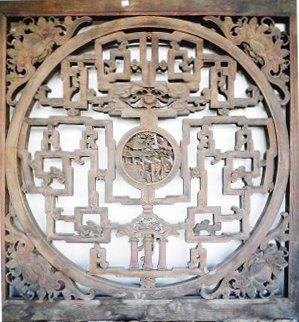
    "Four Happinesses" carved wooden window

    The “theme” of the window, according to Mr. Yang, is “four happinesses surrounding longevity” (si fu peng shou 四福捧寿).

    The intricate design within the large circle is actually a very stylized version of the Chinese character for “longevity” (shou 壽).

    At each of the four corners of the window frame are bats with wings extended and heads facing the circle.

    The Chinese love rebuses which are “visual puns”.  In this case, the Chinese word for “bat” (fu 蝠) has exactly the same pronunciation as the word for “happiness” (fu 福).

    Because “four bats” (si fu 四蝠) sounds like “four happinesses” (si fu 四福), there are “four happinesses surrounding longevity”.

    The origin of the “four happinesses” is a poem by Hong Mai (洪迈 1123-1202) who was a scholar-official during the Southern Song Dynasty:

    久旱逢甘雨, 他乡遇故知, 洞房花烛夜, 金榜题名时

    • “Sweet rain after a long drought” (jiu han feng gan yu 久旱逢甘雨)
    • “Meeting an old friend in a faraway place” (ta xiang yu gu zhi 他乡遇故知)
    • “The wedding night” (“the night of lighting a candle in the bridal chamber”) (dong fang hua zhu ye 洞房花烛夜)
    • “Having one’s name on the list of successful candidates of the imperial examination” (jin bang ti ming shi 金榜题名时)

    The window also illustrates the “Five Happinesses” (wu fu 五福), sometimes translated as the “Five Blessings” or “Five Good Fortunes”, which comes from the very ancient “Classic of History” (shujing 书经) compiled during the Warring States Period (475 BC -221 BC).

    The “Five Happinesses” consist of longevity (寿), wealth (富), health and composure (康宁), virtue (修好德), and the desire to die a natural death in old age (老终命).

    You will notice that the character for “longevity”, which occupies the center of the window, is also one of the “Five Happinesses” (wu fu 五福).

    Adding the “longevity” fu to the four fu represented by the bats makes a total of five fu thus symbolizing the “Five Happinesses”.

    The window has an abundance of hidden meanings.

    For example, the shape of the window expresses the ancient Chinese belief that heaven is round and the earth is square (tian yuan di fang 天圆地方) also known as the circle in a square.

    As another example, the large circle resembles an old Chinese “cash” coin (qian 钱) which is round with a hole in the center.

    The hole in the center of a Chinese coin is called the “eye” (yan 眼).  Because the Chinese words for “before” (前) and “coin” (钱) are both pronounced qian, the window has the implied meaning of “happiness is before your eyes” (fu zai yan qian 福在眼前) (happiness (fu) = bats (fu); before (qian) = coin (qian); eye (yan) = hole in center of coin (yan)).

    The newspaper article concludes with Mr. Yang revealing that the very detailed scene in the small circle at the center of the window has “visual puns” meaning:

    • “May you have good fortune, longevity, and an abundance of blessings, years and offspring” (福寿三多 fu shou san duo)
    • “A pair of dragons play with longevity” (双龙戏寿 shuang long xi shou)
    • “Happiness falls from heaven” (喜从天降 xi cong tian jiang)
    • “Wealth and honor again and again” (富贵连连 fu gui lian lian)
    • “The plum blossoms with the Five Happinesses” (梅开五福 mei kai wu fu)
    • “To add flowers to embroidery” (锦上添花  jin shang tian hua)

    For a different artistic representation of the “four happinesses” please see “Four Happiness Boys“.

  • Coffin Contains Coin Instead of Corpse

    An article in the Suqian Evening News (宿迁晚报) reported an unusual discovery.  Chinese archaeologists excavating a multiple tomb site in Suqian (宿迁), a city in northern Jiangsu Province (江苏), unearthed a coffin with no corpse.  The only thing inside the casket was a coin.

    Most of the tombs being excavated at the site date from the Han Dynasty (206 BC-220 AD).

    However, the tomb with the coin, designated the “No. 4 Tomb”, is from the much later Republican era (1912-).

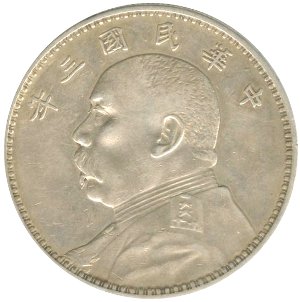
    Yuan Shikai "Silver Dollar"

    The archaeologists know the tomb is from the Republican period because the coin in the casket is a Yuan Shikai “silver dollar” (yin yuan 银元).  Yuan Shikai (袁世凯) was President of the Republic of China during the years 1912-1916 and coins from that era prominently display his portrait.

    The newspaper article did not include an image of the coin found in the casket but a typical example of a Yuan Shikai “silver dollar” is shown at the left.

    The archaeologists are a little puzzled as to why the casket contains just a coin but no corpse.

    They speculate that the tomb may be a “cenotaph” (衣冠冢) which is an “empty tomb” meant to be a memorial to a person whose remains may be elsewhere.  In lieu of a corpse, personal effects of the deceased are placed in the coffin instead.

    A village elder at the scene offered an alternative explanation.  He said Suqian has a local custom of reinterment.  Relatives of the deceased may have exhumed the body and reburied it in another place.

  • Xian Numismatic Museum

    The official opening of the Xian Numismatic Museum (西安钱币博物馆) was announced today in a Chinese newspaper article.

    The new money museum is located in the ancient city of Xian (西安), the capital of Shaanxi Province (陕西).  Xian, formerly known as Changan (长安), has a history of more than 3,100 years and was the eastern terminus of the Silk Road.  Xian (Chang’an) became the first capital of China when Qin Shi Huang (秦始皇) united the country in 221 BC and is where the famous terracotta army is located.

    The coin museum was established by the Xian Branch of the The People’s Bank of China (中国人民银行) and occupies an area of 324 square meters (3,487 square feet).

    More than 5,000 coins, paper currency and other forms of ancient and modern money dating back more than 4,000 years are on display.

    The museum’s exhibits include some very rare items.  According to Mr. Zhao Xiaoming (赵晓明), the Secretary-General of the Xian Numismatic Society (西安钱币学会), the first “piled” coin mold (叠范) ever discovered for the 4 zhu ban liang (四铢半两), valued at more than “one million yuan” ($156,500), is on display.

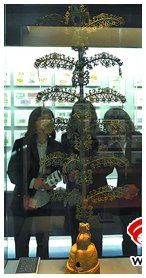
    Ancient Chinese Money Tree
    Ancient Chinese Money Tree

    Considered among the “greatest treasures” on display are two “money trees” (yao qian shu 摇钱树) from the Eastern Han Dynasty (25-220 AD).

    Ancient Chinese legends spoke of trees from which coins would fall like leaves when shaken.

    Museum visitors examining one of the money trees can be seen in the photo at the left.

    The money tree is 138 cm (54 inches) in height and has a series of seated Buddhas at the top.  The money tree branches are decorated with wu zhu (五铢) coins, “immortals” and “fairies”, monkey gods and other auspicious animals.

    Exquisite examples of money trees, such as the two on display, have been found in Han Dynasty tombs in southwest China.  These burial objects are believed to have been used by the deceased as a “map” or guide leading up to heaven and then used as a means of support while there.

    For additional information on the origin and history of “money trees”, please see “Chinese Money Trees“.

  • Store Signs of Ancient Chinese Coins

    Store signs (招牌) in ancient China started to become common during the Song Dynasty (960-1127).  By the time of the Ming (1368-1644) and Qing (1644-1911) dynasties, stores had developed several types of signs to establish their identity.

    The first store signs consisted of a simple piece of cloth with some Chinese characters which was hung in front of the door.  Often, only “tea house”, “restaurant”, or “drugstore” was written.  Sometimes the name of the shop or shop owner was written instead.

    Another type of shop sign displayed a sample of the product being sold.  For example, a shoe store might hang a shoe from a pole or a tobacco store may have a large wooden model of a tobacco leaf.

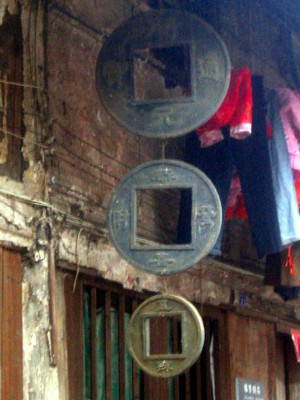
    Store sign displaying ancient Chinese coins
    Store sign displaying ancient Chinese coins

    Yet another type of store sign that became popular was totally independent of the line of business and relied instead on symbols of “good luck” and “prosperity”, such as ancient Chinese coins or the image of the “God of Wealth” (caishen 财神).

    China still retains some of these old sign traditions although they are getting more and more difficult to find among the glitter and clutter of the modern signage now common in the large cities.

    The sign at the left is located on a small side street in the city of Luzhou (泸州) in Sichuan Province (四川省).  Luzhou is an old city famous for its liquor and spirits.

    This particular sign does not identify the name of the store nor does it reveal the line of business but instead expresses a wish for prosperity and good luck.

    Strung together are three large coins which decrease in size from top to bottom.  These round coins with square holes in the center look exactly like the ancient bronze and brass “cash” coins that the Chinese used for more than 2,000 years.

    Interestingly enough, the “coin” in the middle has a traditional Chinese charm inscription.  The inscription reads shou xi fa cai (寿喜发财) which translates as “longevity, happiness, and make a fortune”.

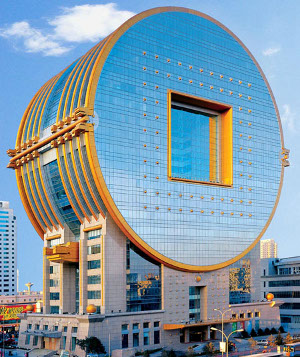
    Building shaped like Chinese cash coins
    Building shaped like Chinese cash coins

    Although traditional store signs with the ancient Chinese coin theme are gradually disappearing, the modern era now allows for this symbol of good luck and wealth to be displayed in a new way.

    The modern building at the left is shaped like a stack of ancient Chinese cash coins.  The 25-story Fang Yuan Building (方圆大厦), which was completed in 2001, is located in the city of Shenyang (沈阳) in Liaoning Province (辽宁省).

    The building was designed by the renown Taiwanese architect C.Y. Lee who also designed the “Taipei 101” (台北101) skyscraper which from 2004 to 2010 was the tallest building in the world.

    Though on a far grander scale, the Fang Yuan Building continues the tradition of hanging a sign consisting of ancient Chinese coins over the front door in order to welcome customers and bring good fortune.

  • Chinese Chess Mooncakes

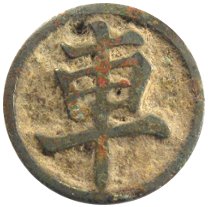
    Ancient Chinese Chess Piece
    Ancient Chinese Chess Piece

    Chinese chess or xiangqi (象棋) is one of the most ancient forms of chess.

    Old Chinese chess pieces, similar to the “chariot” (車) piece displayed here, were made of bronze and can date back to the Song Dynasty (960-1279 AD).

    A complete set of these old Chinese chess pieces would be extremely difficult to collect.

    A modern set of red and black Chinese chess pieces, on the other hand, is usually made of plastic or wood and can be easily purchased.

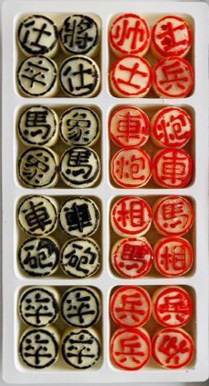
    Mooncakes in the shape of Chinese Chess Pieces
    Mooncakes in the shape of Chinese Chess Pieces

    At the left is what a modern set of Chinese chess pieces looks like.

    This particular set, however, is very special.

    The “pieces” are actually “mooncakes” (yue bing 月饼) made to resemble Chinese chess pieces.

    Mooncakes are the traditional pastry eaten during the Mid-Autumn Festival (zhong qiu jie 中秋节) which occurs on the 15th day of the 8th month according to the traditional Chinese calendar.

    The festival coincides with the autumnal equinox when the moon is at its fullest.  This year the festival falls on September 12th.

    Mooncakes are round and usually have an auspicious Chinese character such as “longevity” (shou 壽) imprinted on top.  They have a thin crust with a lotus seed paste filling and, sometimes, have a salted duck’s egg yolk in the center.

    The mooncake not only symbolizes the full moon but also evokes the story of Chang’e (嫦娥), the beautiful wife of Houyi (后羿), who ate the pill of immortality and as punishment must now live on the moon with only the Jade Rabbit (yu tu 玉兔) as a companion.

    It is a happy coincidence that this traditional festival food can be made to look exactly like the pieces from the ancient game of Chinese chess.  Now during game play, the pieces can be eaten once they are captured by the opposing player.