Category: Uncategorized

  • Chinese Rock Art of “Feather Man” or Alien

    A giant boulder with a prehistoric carving of either the mythical Chinese “Feather Man” or an “alien from outer space” was recently discovered by archaeologists near a village in Guangdong Province.

    An article entitled “Guangdong’s Luoding Village Discovers Rare Rock Art” describes the rock drawing as a person wearing a helmet with a feather attached to each side and an “antenna” sticking out the top.
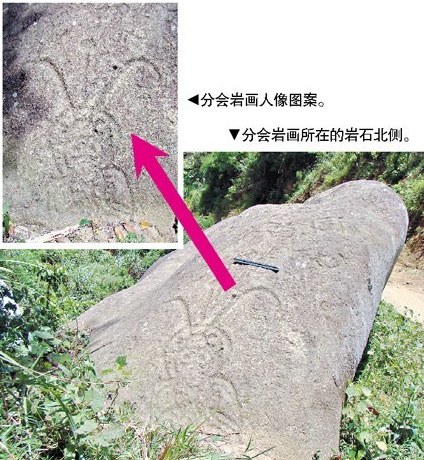
    Rock Drawing of "Feather Man" or "Alien from Outer Space"

    According to the article, experts disagree as to the identity of the portrait.  Some believe that it is an alien from outer space.  Others believe that it is a leader of the ancient “Bai Yue” people (百越人).  Still other experts believe that it is actually an astronomical observation tool or compass.

    The boulder is very large with a length of 14-15 meters, a width of 6 meters and a height of about 10 meters.

    In addition to the strange portrait, the rock has many other petroglyphs.  Most appear to be star constellations with stars represented by circles with a dot in the center.  There is also a picture of a horse and there are symbols which resemble written characters.

    According to Mr. Chen Dayuan (陈大远), the former head of the Luoding Municipal Museum (罗定市博物馆), there are three carvings of people on the rock.  The one that is the clearest shows a person wearing a helmet.  The eyes and nose can be easily recognized and there is a circle drawn on the forehead.  A line extends upward and outward from each side of the helmet.  Another line, which resembles an “antenna”, extends straight up from the top of the helmet and has a small ball at the tip.

    Mr. Chen states that no historical records exist concerning the rock.  He believes that, based on the designs and the primitive method of carving, the boulder probably served as a prehistoric ritual site.  People have tried to make rubbings of the rock art but have not been successful because the incised lines are too shallow.  He says this is probably the result of the artist having had to use blunt stone tools to chisel the designs.  This is further evidence that the rock art dates from the Stone Age.

    The article proposes three possible explanations for the “amazing” portrait.

    Mr. Chen believes it may be the image of the mythical “Feather Man”.  “Feather Man” (yu ren 羽人) was a legendary immortal who had wings and a body covered with feathers.  He was first mentioned in “The Classic of Mountains and Seas” (山海经), an ancient Chinese text dating back more than 2,200 years.

    The Daoists (Taoists) also believed that “Feather Man” would appear to assist a person as he neared immortality because an immortal’s arms transform into wings enabling him to fly.

    If the figure is not “Feather Man”, Mr. Chen says it may be an alien from outer space.

    A third theory is suggested by Mr. Han Dongshan (韩东山) of the Guangzhou Five Goats Planetarium (广州五羊天象馆).

    Mr. Han believes that the large red sandstone boulder was used by the ancient “Bai Yue” people that inhabited the area as an astronomical observation platform.

    Mr. Han discovered that the “antenna” on the top of the helmet points precisely south and he therefore believes that the portrait may actually be the very earliest example of a fixed south-pointing compass.

    While this large boulder with the mysterious rock art is recognized by archaeologists as “an important newly discovered cultural relic”, it has been known to the local villagers as the “Parents-in-law Rock” (公婆石) for a very long time.  Mr. Shen Guangquan (沈广泉), an elderly villager of more than 70 years of age, can recall his great-grandfather telling him that many years ago people would go to the rock to bow in worship and to burn incense.

  • Hundreds of Spanish Silver Dollars Found in Dirt Pile

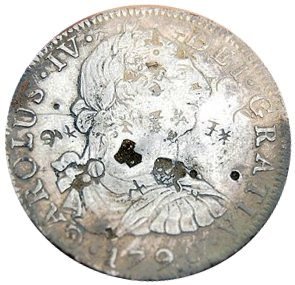
    Spanish silver dollar found in pile of dirt
    Spanish silver dollar found in pile of dirt

    According to a July 6, 2011 Chinese newspaper article, hundreds of old Spanish silver dollars were recently found in an abandoned pile of dirt.

    A villager walking down the street in Longhai Village in Fujian Province noticed something shiny in some dirt that had recently been dumped.  Picking the object up he realized it was an old Spanish silver dollar.

    News of the find spread quickly setting off a “digging frenzy”.

    Villagers digging for silver dollars
    Villagers digging for silver dollars

    Soon a hundred villagers appeared with hoes, shovels and basins and began digging in two piles of dirt, measuring about 20 square meters, looking for more silver dollars.

    Reportedly, several hundred silver dollars were found.

    By the time the police and cultural relics personnel could arrive on scene, however, most of the lucky villagers had already scattered.

    According to two experts with the Zhangzhou City Collections Society, the coins are Spanish silver dollars which came into the area as a result of foreign trade during the middle of the Qing Dynasty.  These silver dollars are frequently found here and villagers refer to them as “funny face” coins.

    One young man was fortunate enough to find more than 20 of the coins in the dirt pile.

    Another villager informed the reporter that the oldest coin found that morning was dated 1775 with the most recent being 1802.

    Dirt originally came from this site
    Dirt originally came from this site

    The dirt, which came from the digging of a foundation for a new house, had been dumped on the vacant lot four days earlier but no one had paid much attention until the villager happened to notice the shiny object.

    The “owner” of the dirt, a Mr. Huang, said that his previous house had been more than 200 years old.  Mr. Huang said that until he heard the news, he had no idea of the treasure that he had inadvertently thrown away.

  • Ancient Chinese “Piggy Banks”

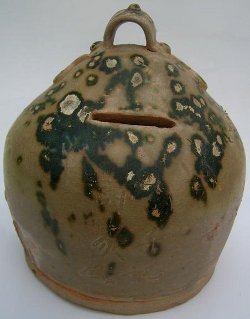
    Tang Dynasty "Piggy Bank"

    China has been using “piggy banks” for thousands of years.  While these ancient coin banks were not actually in the shape of a pig and were not primarily used by children, they did serve the purpose of storing coins.

    Coin banks, known as puman (扑满), were originally created as a means to enforce the laws regarding currency and market reforms.  Their primary purpose was to prevent corruption and embezzlement by businessmen.

    Ancient texts reveal that these coin banks existed at least as early as the time of Emperor Wu (141 BC – 87 BC) of the Han Dynasty.  They were made of pottery, porcelain or bamboo.  When full of coins the banks had to be smashed open to retrieve the money so very few examples have survived to this day.

    The appearance of “piggy banks” during the Qin and Han dynasties is closely linked with the monetary reform which began with the creation of a united China by Qin Shi Huang.  Under the Qin Dynasty (221 BC – 207 BC), the country’s currency was standardized on the banliang (半两) coin which was round with a square hole in the center and of a specific weight. A strict legal system ensured that the monetary reform laws were promulgated and enforced.

    As an example, the “Laws on Markets” (guanshilu 关市律) stipulated the rules on the collection of money and required the use of the puman or “piggy bank”.  In collecting money, whether for business or government purposes, the coins had to be put into these coin containers.  Businessmen and peddlers had to personally watch the coins being inserted. The laws were also very clear in stating that coins could only be put in and not taken out.

    If the laws were not strictly followed, the person committing the illegal activity would be fined “one suit of armor”.

    These laws and the use of the piggy banks were intended to prevent corruption and graft.

    Additionally, the laws and piggy banks were aimed at preventing disruption to the money supply by making it difficult for businessmen to substitute counterfeit and underweight coins for the legal tender banliang and wuzhu (五铢) coins.

    There is an interesting story concerning a famous official of the Han dynasty and the piggy bank.  In imperial China, government officials were selected according to their achievements in the imperial examination system which was based primarily on the Confucian classics and other ancient texts.

    Gongsun Hong (公孙弘) came from a very poor family and did not even begin to study for the examinations until he was already more than 40 years of age.  In 140 BC, he achieved the highest honors among all the scholars and was eventually selected to be the prime minister during the reign of Emperor Wu.

    Before he assumed the office, however, an elder from his village offered him the following advice and used the “piggy bank” as an analogy.

    The old man said that the piggy bank takes in money and when full it is smashed open and destroyed so that the coins can be removed.  If a government official is only concerned with honors and accumulating wealth, he will eventually suffer a similar fate.

    The old man said that just like the piggy bank which is simply made of clay, it is better for a person to live a frugal life.  Wealth must not just be accumulated but must be distributed as well.  In this way, a person can gradually become wealthier but not reach the point where he will be so full of riches that he will be destroyed.

    It is clear then that the piggy bank was first used in China in the enforcement of monetary laws.  It was only afterwards that these coin banks assumed the role of being a convenient means for saving money.

    Today we know the piggy bank as a toy which can help children learn the value of saving money.  The piggy bank displayed above served this purpose.  The inscription states that it was made to celebrate the birth of a child on April 6th of the 8th year (867 AD) of the Xian Tong reign of Emperor Yizong (懿宗) of the Tang Dynasty.

    One last point of interest.  As already mentioned, Gongsun Hong came from a very poor family but eventually became the prime minister of the country.  Following the sage advice of the village elder, Gongsun Hong became known for living a frugal life.  He never forgot that prior to becoming a public official he had made his living by herding pigs for others.

  • Kazakhstan Zodiac Charm

    I received a fascinating email from a visitor to my website from Kazakhstan in which he described a rare ancient zodiac charm in his possession.

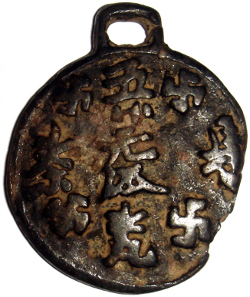
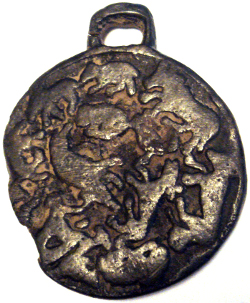
    The Chinese zodiac is based on a twelve year cycle with an animal having unique qualities representing each year.  The zodiac charm discussed here has the animals displayed on one side.  The other side has a Chinese inscription and symbols including several swastikas.

    The visitor’s story is so interesting that I am going to let him speak for himself:

    Obverse side of Kazakhstan Zodiac Charm
    Ancient Kazakhstan Zodiac Charm with Chinese Characters and Swastikas

    “Actually my interest in zodiac charms has appeared because I have one. One great archaeologist gifted it to my grandfather many years ago. It was found around 1940-1950 in the Southern Kazakhstan. Photos of mine charm are attached to this mail. It’s size is 43 mm in diameter, 2mm – thickness. It is made of bronze.

    “Our national institute of archeology have carefully viewed this charm and have stated that it’s age seems to be about 1st. century BCE. As I’ve discovered from your web site, it was the period of occurrence of such kind of charms (Han Dynasty), and the rise of popularity of them was few ages later till Ming Dynasty.

    Reverse side of Kazakhstan Zodiac Charm
    Ancient Kazakhstan Charm Displaying Zodiac Animals

    “One interesting thing about my charm is that the statements in Chinese on the front side of it are translated as follows: “The first one”, “The honorable”, “The noble”, or “I’m the noble”, “I’m the first”, “I’m the honorable”. Our scientists say, that it is possible, that this charm was owned by some powerful person, or family chief, etc. As it was stated on your web site, there were a great numbers of charms, depicting different purposes: for good luck, for marriage, for some other purposes. Basing on such type of categories, I’m concluding, that my charm appears to be the charm of “power”, or the charm of “gentility”. Did you ever hear about charms of “power” or “gentility”?

    “As you’ve quoted, the practical reason of the square holes in charms is that they were put on the square metal rod to remove the extra metal on the rim of the coins. By isn’t is a technological development for cutting the extra metal? I mean that maybe first coins and charms didn’t have any square holes, and only after technological development, the holes appeared as we can see them? This hypothesis corresponds to the age of my charm – 1 st. century BCE, when the process of making metal coins and charms was just developing, so that’s why my charm doesn’t have any square holes. What do you think of it? Or I might be mistaken?”

    The pertinent parts of my reply follow:

    “None of my Chinese reference books discuss any charm quite like yours.  It may very well have originated in the ancient lands of Kazakhstan and therefore have distinctive characteristics particular to that region of the world.

    “I am not familiar with charms of “power”.  However, there were tallies, such as the famous “tiger tallies”, used in ancient China as symbols of authority.  Perhaps your charm had a similar purpose.

    “The very first Chinese money did not have holes in the middle.  In fact, they were not even round and did not resemble coins as we know them.  They were based on implements such as shovels and knives.

    “I should have mentioned in my first message that another reason ancient Chinese coins had a hole in the center was that their value was fairly low (especially compared to gold, silver and jade) and to make purchases a person needed to use many coins.  The hole in the middle facilitated carrying the coins because the coins could be placed on a string.  A typical “string” of cash coins might have 100 or 1,000 coins.

    “Early charms tended to be modeled after coins and therefore most had a square or round hole in the center.  The charm could be worn around the neck as a necklace or hung from the waist.  However, there was no need to carry a large number of charms on a string so, unlike coins, the hole in the center was not really needed.  As is the case with your charm, a number of charms were made as pendants to be worn.

    “This is the practical reason why most Chinese coins and charms have square holes.

    “There is a philosophical reason for the square hole as well.  The Chinese believed that heaven was a “circle” and the earth was a “square”.

    “Thank you again for providing the background and images of your zodiac charm.  It is a real treasure.”

  • Piggy Banks Cause Embarrassment

    An embarrassed government education department in Taiwan had to issue an apology in regard to piggy banks it had given some children.

    According to a report in The China Post, the mayor of New Taipei City held a “summit” for elementary school students on April 29th “to promote financial responsibility and planning for their future”.

    To emphasize and help promote these goals, each student was given a new piggy bank.

    These were high-tech electronic piggy banks which were calibrated to automatically identify and calculate the total amount of money being deposited.

    A problem arose, however, when some of the parents attending the event noticed that the boxes in which the piggy banks were packaged had instructions written in “simplified” Chinese, which is used in mainland China, as opposed to the traditional Chinese characters still used in Taiwan.

    But even more embarrassing was that the instructions stated the piggy banks were “for depositing coins that circulate in mainland China”!

    This surely was not the “planning for the future” the Taiwan mayor had intended.

    As it turned out, the piggy banks were built at a factory in mainland China that is owned by a Taiwanese business.  In the rush to ship the piggy banks in time for the meeting, the wrong packaging was used.