Month: May 2015

  • Two Rare Coins Discovered in Ningxia

    Two rare ancient Chinese coins were recently discovered in northwest China’s Ningxia Hui Autonomous Region (宁夏回族自治区) according to an official government website.

    According to an article on the Pengyang County (彭阳县) website published May 11, 2015, one coin is from the Western Xia (西夏 ) and the other coin is from the Northern Song dynasty.

    Mr. Qi Yuezhang (祁悦章) with the Pengyang County Office of Chronicles Compilation (彭阳县史志办公室) is the author of the article.  Based on his more than 10 years experience in cultural relics, he states that the coins are authentic.

    The coins were obtained by a local Pengyang County coin collector from a Mr. Hu (虎姓) who lives in Mengyuan Village (孟塬乡).
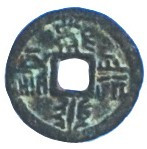
    Rare "Da An Bao Qian" coin from the Western Xia
    Rare “Da An Bao Qian” coin from the Western Xia

    Shown at the left is a rare coin minted during the Western Xia (xi xia 西夏 1038-1227).

    The inscription is written in Tangut (xi xia wen 西夏文) which was the script used by the Tangut people who ruled during the Western Xia.

    The inscription (Chinese translation) reads da an bao qian (大安宝钱) and the coin was cast during the years 1075-1085 of the reign (1068-1086) of Emperor Hui Zong (惠宗, 李秉常).

    Unfortunately, the images of the coins published with the article are small.  However, the coin appears to be the “slanted character” variety (斜字版).

    This bronze coin has a blank reverse side and a diameter of 2.4 cm.
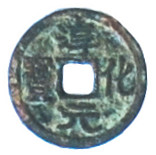
    Rare variety of "Chun Hua Yuan Bao" coin from the Northern Song Dynasty
    Rare variety of “Chun Hua Yuan Bao” coin from the Northern Song Dynasty

    The second rare bronze coin, shown at the left, was cast during the years 990-994 of the reign of Emperor Tai Zong (太宗, 赵光义 976-997) of the Northern Song dynasty (959-1126).

    The inscription is written in regular script (kai shu 楷书) and reads chun hua yuan bao (淳化元宝).

    Chun hua yuan bao coins written in regular script are actually very common.

    However, this particular coin is a very rare variety.

    The radical (shui 氵), which resembles three vertical dots and is on the left side of the first character chun (淳) at the top of the coin, is “shortened” and does not extend all the way to the bottom of the character.
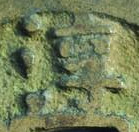
    "Chun" character on common "Chun Hua Yuan Bao" coin
    “Chun” character on common “Chun Hua Yuan Bao” coin

    This may be easily seen by comparing the coin’s chun (淳) character with that of a “common” variety of chun hua yuan bao coin as displayed in the image at the left.

    The coin is thus known to Chinese numismatists as the “shortened shui” or “shrunken shui” variety (suo shui ban 缩水版) and very few authentic specimens are known to exist.

    According to legend, Emperor Tai Zong personally did the calligraphy for the chun hua yuan bao coin inscription.  For this reason, the coin is known as “royally inscribed currency” (yu shu qian 御书钱).

    Pengyang County is located in the territory once ruled by the Western Xia and large quantities of both Western Xia and Song dynasty coins have been excavated in the area.

    Not surprisingly, more than half of the ancient coins in the collection of the Pengyang County Office of Cultural Relics (彭阳县文物馆) date from the Western Xia and Song dynasty.
  • Chinese “Laid to Rest” Burial Charm

    There is a certain Chinese bronze “coin” that is not included in Chinese coin catalogues.

    It is sometimes referred to as a “charm” but is not included in Chinese charm catalogues either.

    It seems that no one wants to have this coin in their collection.

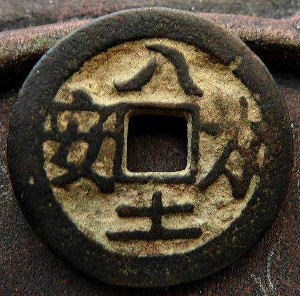
    Chinese "laid to rest" burial charm
    Chinese “laid to rest” burial charm

    At the left is an example of the “coin”.

    The inscription reads ru tu wei an (入土为安) which means “to be laid to rest” or “burial brings peace”.

    The coin was not minted to circulate as money but was privately cast as a funerary object.  It was buried  with the corpse with the hope that the deceased will rest in peace and that the living relatives will have peace of mind.

    The coin has a diameter of 2.45 cm and a thickness of 0.13 cm.

    Because these coins are not included in catalogues or other Chinese coin references, it is difficult finding authoritative information.

    However, an article published in the Xinmin Evening News (新民晚报) in 2007 provides some insight.

    The article states that several of these coins were discovered in a grave dating to the late Qing dynasty (1644-1911).

    The article also emphasizes the importance the ancient Chinese placed on proper burial of the dead and that coins with the inscription ru tu wei an were placed in graves as a matter of course.

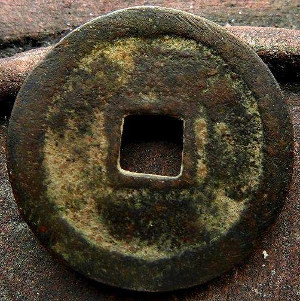
    Reverse side of "laid to rest" funerary charm
    Reverse side of “laid to rest” funerary charm

    The coins discovered in the grave had a diameter of 2.4 cm, a thickness of 0.14 cm and a weight of 3.8 grams.

    The coins also had a broad rim of 0.3 cm and a fairly small square hole with a diameter of 0.6 cm.

    The reverse sides of the coins were blank with no inscription.

    Other specimens of this funerary coin may be seen here and here.

    In years past, there was some controversy regarding the age of these coins.

    The controversy centered on how the Chinese character wei (为) is written in the inscription.

    On the coin, the wei is written in simplified Chinese (为) instead of traditional Chinese (為).  The argument was that because simplified Chinese did not exist prior to its adoption in 1956, these coins could not date from the Qing Dynasty or earlier.

    Research has shown, however, that variant forms of the character wei, including 为, existed at least from the time of the Ming dynasty (1368-1644) so the controversy has been put to rest.

    A different specimen is particularly interesting.  According to the description, the coin was found in a hoard of coins from the Northern Song dynasty (959-1126).

    If the account is true, this burial coin would be considerably older than those from the Qing dynasty.

    Comments to Chinese coin forums clearly demonstrate the prevailing attitude towards these funerary coins.

    Forum members describe the coins as “really scary” and “horrifying”.  Many members state that they would not buy or own such a coin.

    One forum member mentioned that because these coins were “put into the mouth of the deceased” during burial, they should be “thrown away because they are unlucky”.

    In China today, the tradition of burying the dead has changed.  Cemeteries require a great deal of land and with China’s immense population, burials are no longer allowed.  Cremation is the law of the land although enforcement, particularly in rural areas, can be lax.

    But traditions die hard and before the law came into effect some elderly people actually committed suicide to ensure that they would receive a proper burial.

    Even now, some Chinese have a coin placed in their mouth upon death.  After cremation, the remains are interred and the coin is given to the family.

    For a related article concerning money buried with the dead, please see Chinese Burial Money.

  • Kingdom of Chu “Tian Ce Fu Bao” Gilt Bronze Coin

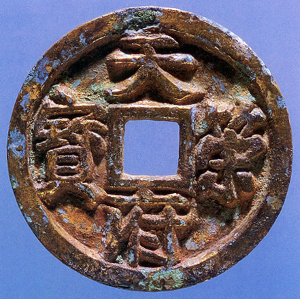
    Among the rarest of ancient Chinese coins is the tian ce fu bao (天策府宝) coin which was minted by Ma Yin (马殷) of the Kingdom of Chu (楚 907-951) during the Five Dynasties and Ten Kingdoms period.

    Both bronze and iron specimens exist.

    Very rare Tian Ce Fu Bao gilt bronze coin (National Museum of China)
    Very rare Tian Ce Fu Bao gilt bronze coin (National Museum of China)

    At the left is an example of a bronze tian ce fu bao.

    This coin is particularly rare because it is gilded in gold (鎏金) and only a very few gilt bronze (铜质鎏金) tian ce fu bao coins have been discovered.

    Ma Yin began minting these coins in the year 911 to commemorate his promotion to the rank of Supreme Commander of the Tiance Prefecture (天策上将军) as bestowed by Emperor Taizu of Later Liang (后梁太祖).

    Both the bronze and iron coins have a nominal value of 10 which means they had a denomination equivalent to ten normal size bronze “cash” coins.

    The inscription is read in a clockwise fashion (xuan du 旋读) beginning with the top character.

    The characters are deeply cut in regular script (kai shu 楷书) and the coin is well-made.

    This coin has a distinctive feature.  Regarding the tian (天) character at the top, the vertical line connecting the two horizontal strokes is very short.  Most of the other coins exhibit a slightly greater distance between the two horizontal strokes.  For this reason, the coin is known as the “short neck Tian” (短颈天) variety.

    As mentioned above, this very rare coin has a gold coating although the reason why only a few specimens were treated in this manner is unknown.

    Gilt tian ce fu bao coins tend to be slightly larger than the plain bronze coins and the iron coins.

    This particular specimen has a diameter of 43 mm and weighs 36.6 grams.  The width of the square hole is 9.5 mm and the coin has a thickness of 5.5 mm.

    The coin is in the collection of the National Museum of China (中国国家博物馆).  It was donated by Mr. Luo Bozhao (罗伯昭) who was one of the most respected Chinese numismatists of the 20th century.

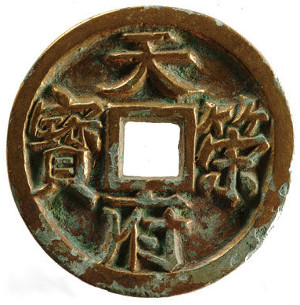
    Tian Ce Fu Bao gilt bronze coin (Shanghai Museum)
    Tian Ce Fu Bao gilt bronze coin (Shanghai Museum)

    The Shanghai Museum also has a gilt tian ce fu bao coin.

    According to the Shanghai Museum website, this coin has a tian (天) character above the square hole on the reverse side.  The website, however, does not show an image of the reverse side of this coin.

    I have learned that the Shanghai Museum actually has three of these very rare gold-gilt tian ce fu bao coins.

    A Chinese reference book (中华珍泉追踪录) displays rubbings of both the obverse and reverse sides of these three coins.  The rubbings do not show a character on the reverse so I believe the Shanghai Museum website is in error.

    Regarding the rarity of the coins, Baidu Baike (百度百科), the online encyclopedia of China’s major search engine, states that among the approximately 40 specimens of bronze tian ce fu bao coins known to exist, only 5 are gilded with gold.