Month: June 2011

  • Old Korean Charm

    Old Korean Charm
    Old Korean Charm

    Korean charms are much scarcer and frequently much more elaborate than Chinese charms.

    A visitor to my website recently asked if I could provide any information on this old charm which was purchased in Shanghai in the 1930’s.

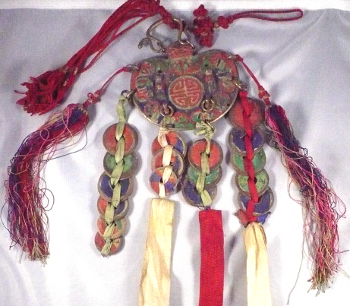
    This is a traditional Korean charm fully embellished with tassels, ribbons and old Korean coins.
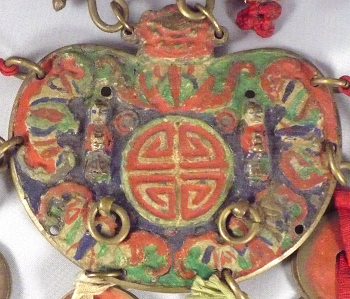
     

    Korean charm with "Longevity" symbol, two children and five bats

    This side of the charm shows a large and very stylized Chinese character shou (壽), meaning “longevity”, in the very center.

    To the right and left of the “longevity” character are images of children.

    Around the perimeter of the charm are images of five bats with their wings highlighted in red.

    The “bats” are a visual pun or rebus.  The Chinese word for “bat” (fu) has the same pronunciation as word for “happiness” or “blessing” (fu).

    The “five bats” therefore are a symbol of the “five happinesses” or “five blessings” which are: longevity, wealth, health and composure, virtue, and the desire to die a natural death in old age.
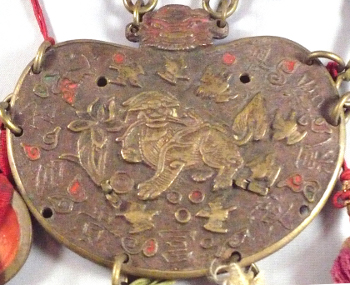
    Korean charm displaying "lion", seven birds, and Chinese characters for "Five Blessings"

    The other side of the charm has the image of a “lion” in the center.  The image may actually be a “fu dog” which is a symbol of protection.

    Surrounding the “lion” are a number of flying birds which may be magpies.  Magpies symbolize “happiness” because the first character in the Chinese word for “magpie” (xi que) has the same pronunciation as the Chinese character for “happiness” (xi).

    There are seven “magpies” depicted which may refer to the ancient love story of the Oxherd and the Weaver Girl.  The two lovers were separated in the heavens for eternity but are allowed to meet each other once a year by crossing a celestial bridge composed of “magpies” on the 7th day of the 7th month.

    The Chinese characters for the “Five Blessings” are written around the perimeter of the charm.

    The coins hanging from the bottom of the charm are ancient Korean “sang pyong tong bo” cash coins which were produced during the years 1633-1891.  While these coins do not display the year they were cast, many can be dated to a specific time period due to the mint marks and other symbols on their reverse sides.

    The charm is made of brass and was probably made sometime during the 1800’s although it could possibly be even older.

    This charm is an outstanding example of ancient Korean folk culture.
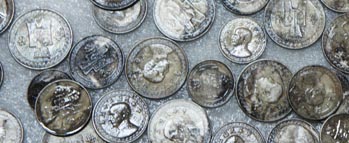
  • Tons of Chinese Coins Found in Sunken World War II Japanese Ship

    According to a report in the June 8, 2011 edition of the Korea Joongang Daily, a Korean underwater excavation company has recovered 3.3 tons of foreign coins from a Japanese freighter that was sunk by an American warplane off the west coast of Korea during World War II.

    Chinese coins recovered from sunken WWII Japanese freighter
    Chinese coins recovered from sunken WWII Japanese freighter

    The coins number about one million with most being Chinese coins made of silver and minted during the 1920’s and 1930’s.

    Pyun Do-young, the owner of the Sea Love, Ltd. underwater excavation company, said that his divers found the old coins in rotting wooden boxes on the deck of what is believed to be the WWII Japanese freighter Nishima Maru No. 10.

    While the coins are estimated to be worth about $4.6 million, the company is most interested in finding the 10 tons of gold bars the ship is believed to have been carrying.

    Mr. Pyun said that near the end of the war some high-ranking Japanese government officials secretly shipped back to Japan stolen gold, cultural assets, jewelry and minerals from China and Southeast Asian countries.

    The gold would be part of the so-called “Yamashita’s Treasure” which refers to war loot stolen by the Japanese forces under the command of General Tomoyuki Yamashita.

    The gold would be worth about $480 million at today’s prices.

    To find the gold bars, however, the divers must first remove the thick layers of mud covering the ship.

    The coins are presently stored at the government’s Gunsan Regional Maritime Affairs and Port Office to allow a possible owner of the ship to claim possession.  If no claim is made, the company will receive 80% of the coins with the remaining 20% going to the Korean government.

  • Sun Yat-sen “Memento” Coin

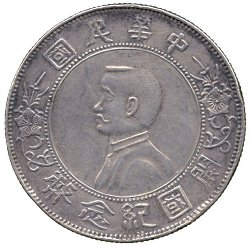
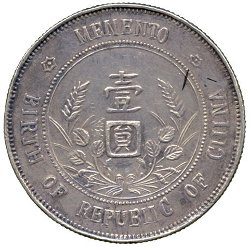
    One of the most easily recognized silver coins from the early days of the Republic of China displays the profile of Dr. Sun Yat-sen, the first president, with the English inscription “Memento Birth of Republic of China” on the reverse side.

    An earlier version of the coin had been struck in 1912 to commemorate the establishment of the Republic of China but production ceased when Yuan Shikai became president in 1913.

    These “one yuan” (“one dollar”) coins later resumed production and the specimen displayed here was struck in Nanjing in 1927.

    Silver coin commemorating the founding of the Republic of China
    Silver coin commemorating the founding of the Republic of China

    What is not generally understood is the meaning of the symbols in the design of the coin.

    For example, the Chinese character min (民), which means “people”, is written is a very unusual manner.  The character can be seen at about the 11 o’clock position on the coin.  If you look closely, you will see that the line that is the “right leg” actually extends upwards to just above the very top of the character.

    The Chinese have the expression “to go out the head” (chu tou 出头) which means “lift one’s head” or “free oneself”.  Just as the character is written with a stroke “going out the head”, the implied meaning is that the Chinese people should free themselves from the past thousands of years of imperial rule.

    Also, at both the 3 o’clock and 9 o’clock positions, are five-petal flowers representing the plum blossom.  The plum flower is a traditional symbol of courage and hope and also refers to the “five blessings”.  While it would later become the national flower, here it symbolizes the “Five-Power Constitution” advocated by Dr. Sun Yat-sen.  The five powers or branches of government included the legislative yuan, executive yuan, judicial yuan, examination yuan and censorate (control) yuan.

    Reverse side of Sun Yat-sen "Memento" Coin

    The reverse side of the coin has the denomination “one yuan” (壹圓) written vertically in the middle.

    Representations of grains, such as the ears of wheat, are on both sides.  Dr. Sun Yat-sen wanted the new coin to display the “five cereals” or “five grains” (wugu 五谷) to signify the importance of agriculture and the hope that the Chinese people would have enough to eat.

    Below the ears of wheat are rice plants signifying a bountiful harvest.  Above the rice are three leaves.  The three leaves are meant to represent the Three People’s Principles” (Nationalism, Democracy and the People’s Livelihood) as advocated by Dr. Sun Yat-sen.

    Finally, at the 2 o’clock and 10 o’clock positions are six-sided stars.  Previously struck Chinese coins often displayed stars of various shapes but they were usually placed on the obverse side.  On this coin, the stars were placed on the reverse side in order to distinguish it as a “new” type of coin for the newly established government.

  • 1,000 Coins Discovered in Han Dynasty Grave

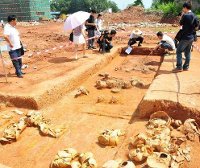
    Eastern Han Dynasty Grave
    Eastern Han Dynasty Grave

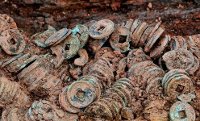
    During the excavation of a recently discovered Eastern Han Dynasty grave, the Guangzhou Cultural Relics Archaeological Research Institute has discovered a pile of more than 1,000 bronze coins.

    The coins have the inscription “da quan wu shi” (大泉五十) which means “large coin fifty”.

    These large coins were worth the equivalent of 50 cash coins.  They were cast during the reign of Wang Mang who usurped the throne and ruled during a short period (7-23 AD) between the Western Han and Eastern Han dynasties.

    According to the report, this grave is one of the best preserved Eastern Han graves having an abundance of bronze objects that has been unearthed in recent years.

    Han Dynasty Coins
    Han Dynasty Coins

    The grave is 8.2 meters long and 5.02 meters wide.

    In addition to the coins, the grave also contains nearly 100 other objects including a bronze mirror, pottery, colored tile as well as ornaments and jewelry made of jade and agate.

  • Four Happiness Boys

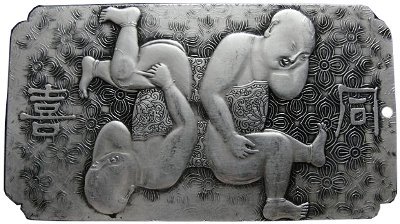
    One of the most commonly seen Chinese “good luck” pictures is the “Four Happiness Boys” (si xi wa 四喜娃).  This is the image of two boys which are connected in such a way as to give the illusion there are four boys.

    Four Happiness Boys
    Four Happiness Boys

    This motif dates from the Ming Dynasty (1368-1644 AD).

    A picture of the “Four Happiness Boys” is often given as a wedding gift in the hope that the newlyweds will have many children.

    Sometimes the picture is given when there is a birth to wish the child happiness and good fortune.

    The Chinese inscription on the image of the “Four Happiness Boys” displayed here reads tong xi (同喜) which means “shared happiness”.

    For two thousand years, in order to become a government official, with the accompanying wealth and prestige, one had to do well in the very difficult imperial examinations which were based on such ancient Confucian texts as the “Four Books” and the “Five Classics”.

    A child prodigy by the name of Jie Jin (解缙), who lived in Jishui Prefecture in Jiangnan Province, was able to master these books when he was only five years old!

    This was such an extraordinary achievement that the emperor invited Jie Jin to participate in the examinations which he easily passed.

    Jie Jin was then assigned to a special school to further his studies.

    Unfortunately, one teacher was jealous of Jie Jin’s abilities and purposely tried to make things difficult for him.

    One assignment required Jie Jin to draw a picture of a bountiful harvest.  He drew a picture of a ruyi sceptre and the “fungus of immortality” (ruyi lingzhi 如意灵芝), both being very auspicious objects, but the teacher was not satisfied.  Jie Jin then drew a picture based on the saying “beckoning and acquiring good fortune” (ying fu na ji 迎福纳吉) but the teacher again expressed disappointment.

    Sensing the teacher’s hostile attitude, Jie Jin then drew a figure with two heads and eight limbs.  The teacher immediately proceeded to scold him in front of his classmates for drawing such a deformed creature.

    Jie Jin then calmly explained that the image was of four boys connected together at the waist and that the image expressed the meaning of “four happinesses joined together” (si xi he ju 四喜合局).  The “four happinesses” were the wedding night, success in the imperial exams, encountering a friend far from home, and rain after a long drought.

    The teacher was so impressed that he never bothered Jie Jin again.

  • 200,000 Ancient Chinese Coins Found in Old Well

    Coin Stash Found in Well
    Coin Stash Found in Well

    Approximately 200,000 ancient coins dating from the Northern Song Dynasty (960-1127 AD) were recently unearthed from an old well in eastern China.

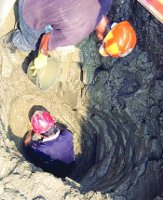
    The Xinhua News Agency reported on June 4, 2011 that a construction crew building a road in the city of Suzhou in Jiangsu Province uncovered the old well on June 1st.  The opening to the well was located 4-5 meters below the surface.

    Digging stopped immediately after the well was discovered and the construction crew quickly determined that this well was different from those usually encountered.  Instead of being round, the opening was eight-sided.

    Digging a little deeper, the crew was surprised to find a large quantity of ancient Chinese coins inside the well.

    Archaeologist Examines Coins
    Archaeologist Examines Coins

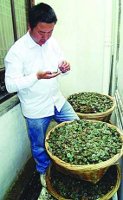
    The Suzhou Archaeology Research Bureau was immediately notified and eight experts were sent to the site.

    The archaeologists removed more than 80 bags of coins. Each bag weighed more than 50 kilograms so the total weight of the coins was about 4 tonnes (metric tons).

    There were more than 200,000 coins dating from the Northern Song Dynasty.

    Mr. Zhang Tiejun (张铁军), the assistant to the president of the bureau, described the find as “large”.  He said the coins were in two layers.  The top layer was neatly arranged while the lower layer was fairly disorganized.

    The upper layer included larger coins such as chong ning zhong bao (崇宁重宝 1102-1106 AD) while the lower layer had smaller coins such as yuan feng tong bao (元丰通宝 1078-1085 AD) and shao sheng yuan bao (绍圣元宝 1094-1097 AD).

    According to Mr. Zhang, the inscriptions on the coins indicated that they were from the middle to late Northern Song Dynasty (960-1127 AD).

    Sheng Song Yuan Bao Silver Coin
    Sheng Song Yuan Bao Silver Coin

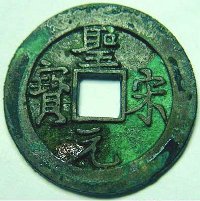
    Mr. Zhang was particularly excited about one coin in particular.  The cache included a coin with the inscription sheng song yuan bao (圣宋元宝) which was cast during the first year (1101 AD) of the Jing Guo (靖国) reign of Emperor Hui Zong (徽宗). The coin is made of silver instead of bronze and for this reason is considered very rare and valuable.

    Mr. Zhang said it would be difficult to say how much the total cache was worth.

    As to the question of why such a large quantity of coins was stored in a well, Mr. Zhang said that Suzhou’s economy was fairly well developed during this period of the Northern Song Dynasty.  Most likely, a wealthy businessman was suddenly faced with the chaos associated with war and decided it best to hide his money.

    Mr. Zhang said he did not think the money came from a “rich and influential family”.  Very wealthy families would usually have gold and silver instead of bronze coins and they would not likely keep these valuables at home.

    Also, the type of jugs commonly used to fetch water were found at the bottom of the well.  This indicates that the structure had been a functioning water well and had not been built specifically to store money.

    Mr. Zhang conjectured that the combination of the haphazard placement of the coins, plus the fact that the structure itself had functioned as a well, meant that someone probably found himself caught in a war zone and needed to immediately bury his money for safekeeping.

    The article concluded with Mr. Zhang stating that his team had researched the history of the area and discovered an interesting fact.  At that time period, the area had been the scene of a fierce battle between the Song army and the army of the Jurchens.  The Song army was led by Han Shizhong (韩世忠), one of the most famous generals of the Song Dynasty.  His wife *Liang Hongyu (梁红玉), who was a famous warrior in her own right, also participated in the battle.

    *Liang Hongyu is credited with implementing new war tactics such as the use of drums to relay orders to the troops at the battle of Gold Mountain.  For more about Liang Hongyu and Gold Mountain, please see Chinese Paper Money.

  • Ancient Chinese “Piggy Banks”

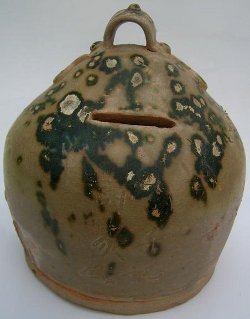
    Tang Dynasty "Piggy Bank"

    China has been using “piggy banks” for thousands of years.  While these ancient coin banks were not actually in the shape of a pig and were not primarily used by children, they did serve the purpose of storing coins.

    Coin banks, known as puman (扑满), were originally created as a means to enforce the laws regarding currency and market reforms.  Their primary purpose was to prevent corruption and embezzlement by businessmen.

    Ancient texts reveal that these coin banks existed at least as early as the time of Emperor Wu (141 BC – 87 BC) of the Han Dynasty.  They were made of pottery, porcelain or bamboo.  When full of coins the banks had to be smashed open to retrieve the money so very few examples have survived to this day.

    The appearance of “piggy banks” during the Qin and Han dynasties is closely linked with the monetary reform which began with the creation of a united China by Qin Shi Huang.  Under the Qin Dynasty (221 BC – 207 BC), the country’s currency was standardized on the banliang (半两) coin which was round with a square hole in the center and of a specific weight. A strict legal system ensured that the monetary reform laws were promulgated and enforced.

    As an example, the “Laws on Markets” (guanshilu 关市律) stipulated the rules on the collection of money and required the use of the puman or “piggy bank”.  In collecting money, whether for business or government purposes, the coins had to be put into these coin containers.  Businessmen and peddlers had to personally watch the coins being inserted. The laws were also very clear in stating that coins could only be put in and not taken out.

    If the laws were not strictly followed, the person committing the illegal activity would be fined “one suit of armor”.

    These laws and the use of the piggy banks were intended to prevent corruption and graft.

    Additionally, the laws and piggy banks were aimed at preventing disruption to the money supply by making it difficult for businessmen to substitute counterfeit and underweight coins for the legal tender banliang and wuzhu (五铢) coins.

    There is an interesting story concerning a famous official of the Han dynasty and the piggy bank.  In imperial China, government officials were selected according to their achievements in the imperial examination system which was based primarily on the Confucian classics and other ancient texts.

    Gongsun Hong (公孙弘) came from a very poor family and did not even begin to study for the examinations until he was already more than 40 years of age.  In 140 BC, he achieved the highest honors among all the scholars and was eventually selected to be the prime minister during the reign of Emperor Wu.

    Before he assumed the office, however, an elder from his village offered him the following advice and used the “piggy bank” as an analogy.

    The old man said that the piggy bank takes in money and when full it is smashed open and destroyed so that the coins can be removed.  If a government official is only concerned with honors and accumulating wealth, he will eventually suffer a similar fate.

    The old man said that just like the piggy bank which is simply made of clay, it is better for a person to live a frugal life.  Wealth must not just be accumulated but must be distributed as well.  In this way, a person can gradually become wealthier but not reach the point where he will be so full of riches that he will be destroyed.

    It is clear then that the piggy bank was first used in China in the enforcement of monetary laws.  It was only afterwards that these coin banks assumed the role of being a convenient means for saving money.

    Today we know the piggy bank as a toy which can help children learn the value of saving money.  The piggy bank displayed above served this purpose.  The inscription states that it was made to celebrate the birth of a child on April 6th of the 8th year (867 AD) of the Xian Tong reign of Emperor Yizong (懿宗) of the Tang Dynasty.

    One last point of interest.  As already mentioned, Gongsun Hong came from a very poor family but eventually became the prime minister of the country.  Following the sage advice of the village elder, Gongsun Hong became known for living a frugal life.  He never forgot that prior to becoming a public official he had made his living by herding pigs for others.

  • Taiping Rebellion Coins Saved from Furnace

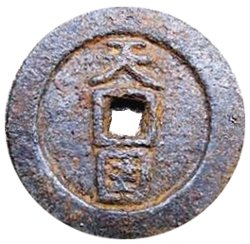
    Taiping Rebellion Iron Coin
    Taiping Rebellion Iron Coin

    A recent Chinese newspaper article describes how some valuable coins from a popular peasant uprising at the end of the Qing Dynasty were saved from being used as scrap iron for a backyard furnace during the Great Leap Forward campaign of 1958-1961.

    The article entitled “Grandfather Saved Iron Coins from the Taiping Rebellion” was published in the May 5, 2011 edition of the “Chutian City News” (楚天都市报).

    During the Great Leap Forward, Mao Zedong encouraged every commune and urban neighborhood to establish backyard steel furnaces in order to accelerate China’s economic development.

    Since the village discussed in the article did not have the necessary iron ore to feed the furnace, every household was required to provide a specific quantity of “scrap iron”.

    But the villagers also did not have “scrap iron” so they were forced to provide perfectly good iron utensils and tools in order to meet the requirement.

    The “grandfather”, who happened to be one of the technicians in charge of the local furnace, discovered that someone had provided a string of 10-20 iron coins from the Taiping Rebellion as “scrap iron” for the furnace.  He felt that it would be “a waste” to destroy the coins so he secretly hid them in his pocket and took them home.

    Over the years, the coins were gradually passed down to various family members.

    The Taiping Rebellion (1850-1864) was a civil war which began in southern China.  The leader Hong Xiuquan (洪秀全), who was convinced that he was the younger brother of Jesus, declared himself to be the “Heavenly King” (tian wang 天王) of “The Heavenly Kingdom of Great Peace” (taiping tianguo 太平天国).

    The rebellion would eventually spread through 15 provinces and include 30 million people before it was put down by government troops aided by French and British forces.

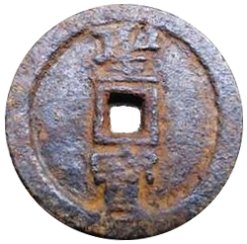
    Reverse side of Taiping Rebellion Iron Coin
    Reverse side of Taiping Rebellion Iron Coin

    Most Taiping Rebellion coins were cast in bronze with only a very small number made in iron or lead.  Gold and silver coins also exist but are extremely rare.

    The coins have some interesting characteristics.  For example, none of the coins bear a denomination.  Also, the character guo (国) in the inscription, which means “kingdom”, is written with a wang (王) character inside the “square box” (kou 口) instead of the standard yu (玉) character.

    The inscriptions on the coins can also vary.  Obverse inscriptions include tian guo (天国), taiping tianguo (太平天国) and tianguo shengbao (天国聖寶).  Reverse inscriptions can include shengbao (聖寶) and taiping (太平).

    The iron coin shown in the article and displayed here has the obverse inscription “Heavenly Kingdom” (tianguo 天国) and the reverse inscription “Holy Coin” (shengbao 聖寶).

    The coins have a diameter of 35 mm and weigh about 16.3 grams.

    The Great Leap Forward proved to be an economic disaster for China with the “backyard furnaces” being just one example.  Labor was diverted from the fields, the wood needed for the furnaces came from the doors and furniture of the peasants, the needed “scrap metal” consisted of perfectly good pots and pans, and the resulting pig iron was of such poor quality as to be useless.