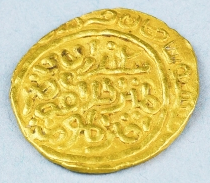
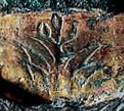
The Cultural Relics Bureau of Jinshi City (湖南省津市市文物局), located in Hunan Province (湖南省), is offering a reward of $1,500 (RMB 10,000) to anyone who can decipher the inscription on some ancient gold coins in the city’s museum, according to an article published February 16, 2016 in the Beijing Daily (北京日报).
Unknown gold coin with inscription written in a “rare type” of Arabic
The six gold coins, which are classified as first-level national cultural relics (国家一级文物), were discovered during the 1960s buried in a small white glazed pot at a farm in Jinshi (津市).
The coins were moved to Jinshi City’s museum in the 1980s.
According to Mr. Peng Jia (彭佳), Director of the Cultural Relics Bureau of Jinshi City, the coins are hammered in a manner similar to that used by the ancient Greeks.
In 2001, it was determined that the coins were minted by the Delhi Sultanate (德里苏丹国 1206-1526) in northern India around the time of China’s Yuan dynasty (元朝 1271-1368).
According to Mr. Peng, the inscription on the obverse side of the coins is the name of a king written in a rare form of Arabic.
The museum staff, as well as other Chinese and foreign experts, have been unable to decipher the inscription on the reverse side of the coins which is shown in the image above.
By offering the reward, it is hoped that the mystery surrounding the coins can be solved.
During the reign (998-1022) of Emperor Zhenzong (真宗) of the Northern Song dynasty (北宋), a small quantity of cash coins were minted that had very broad rims and/or were very thick. Chinese coin collectors refer to these coins as bing qian (饼钱) which translates as “biscuit” coins or “cake” coins.
This was not the first time such biscuit money had been produced. Wang Mang (王莽) of the Xin dynasty (新朝) during his reign (7-23) also cast huo quan (货泉) coins that were very thick and heavy. However, this earlier cake money did not have the very broad rims that distinguish the Song dynasty biscuit coins.
Emperor Zhenzong of the Song issued regular cash coins under four different reign periods: xian ping (咸平 998-1003), jing de (景德 1004-1007), da zhongxiang fu (大中祥符 1008-1016) and tian xi (天禧 1017-1021).
However, only during the xian ping and xiang fu regnal periods were biscuit coins produced having the inscriptions xian ping yuan bao (咸平元宝) and xiang fu yuan bao (祥符元宝), respectively.
No authentic biscuit coins with the inscriptions jing de yuan bao (景德元宝) or tian xi tong bao (天禧通宝) are known to exist.
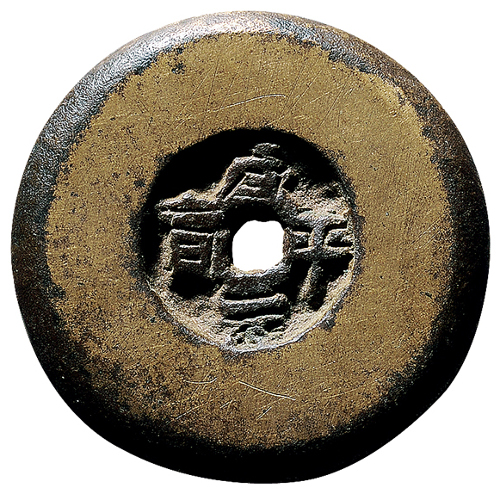
Large, broad-rimmed and thick “xian ping yuan bao” biscuit coin from the Song Dynasty
Shown above is an outstanding example of a xian ping yuan bao biscuit coin. The coin is large and heavy and has an extremely broad rim which slopes downward near the edge.
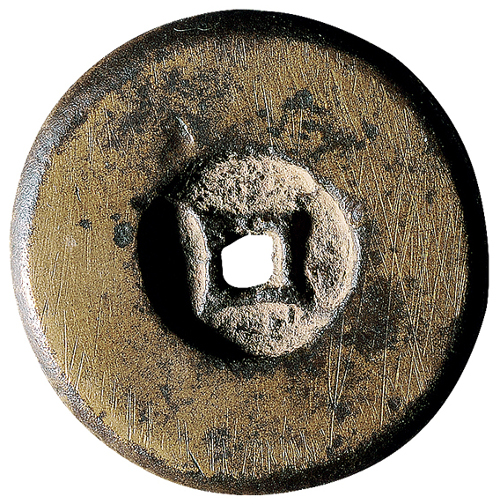
The reverse side, shown below, also has a very wide rim.
You will also notice that the corners of the square hole on the reverse side extend outwards towards the rim. This is known as si jue (四诀) and is only found on certain Song dynasty coins.
Reverse side of “xian ping yuan bao” biscuit coin displaying a broad rim and a square hole with the corners extending outwards
Common xian ping yuan bao cash coins have diameters of 2.14 – 2.6 mm and weigh 2.2 – 5.8 grams.
In contrast, this specimen has a diameter of 46.7 mm and weighs 73.2 grams.
The coin sold at auction in 2013 for US$2,623 (RMB 17,250).
The reason why these broad-rimmed and heavy coins were produced is still unknown.
Mr. Sun Zhonghui (孙仲汇), a well-known Chinese numismatist, wrote in 古錢幣圖解 (gu qian bi tu jie) that these coins were definitely cast during the Song dynasty. The coins are not standardized and their size and weight varies. He states that further research is needed to determine what their value was at the time and whether or not they actually circulated as currency.
Mr. Sun further states that many of these coins have been found in Sichuan (四川). During the Song dynasty, the government expropriated copper items and copper (bronze) cash coins resulting in a copper shortage in the province. The coins that circulated were made of iron. Because of the copper shortage, the purchasing power of the iron coins fell drastically while that of the copper coins soared. Because large and heavy copper coins like these biscuit coins would have had real value, Mr. Sun feels the probability is very good that these coins circulated as currency.
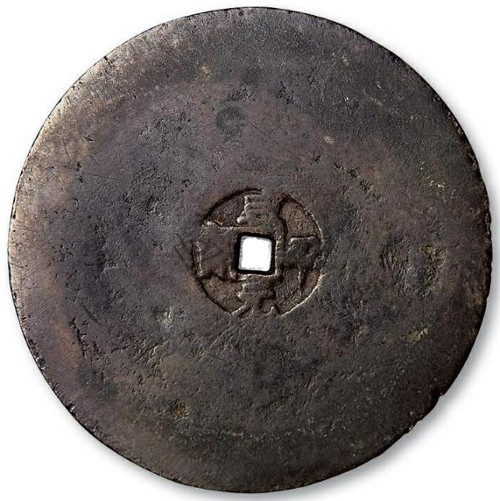
Shown below is perhaps the most famous of the Song dynasty biscuit coins.
The coin has a diameter measuring 66 mm but, unfortunately, the weight is not specified. Nevertheless, it is the largest Song dynasty biscuit coin known to exist and the only specimen of its kind.
This coin was listed at an auction in 2008 with an estimated price of $9,124 – $15,207 (RMB 60,000 – 100,000).
Other representative examples of xian ping yuan bao biscuit coins are listed below:
34.0 mm specimen from the collection of Mr. Sun Zhonghui (孙仲汇) shown here
44.0 mm/6 mm thick/72.0 gram specimen with si chu (四出) auctioned here
Regarding Song dynasty biscuit coins, there are far fewer xiang fu yuan bao (祥符元宝) known to exist than xian ping yuan bao. An example of a xiang fu yuan bao biscuit coin with a diameter of 26.4 mm was listed at this auction in Shanghai in 2014.
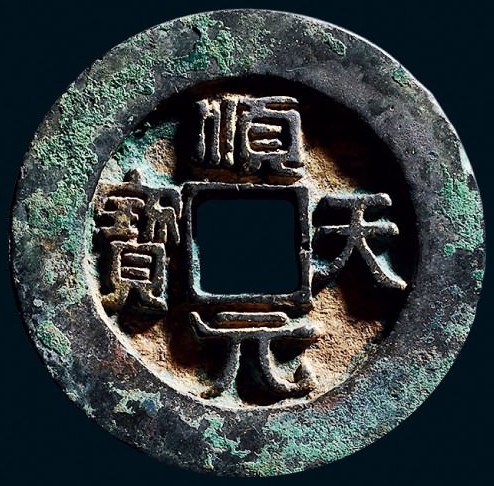
Shun tian yuan bao coins were issued during the years 759-761 by Shi Siming (史思明), a rebel leader who seized control of the Tang dynasty capital of Luoyang (洛阳). Luoyang was a major center of Buddhism (中国佛教) in ancient China.
Shun tian (顺天) refers to the Shi Siming’s era name.
The shun tian yuan bao was the first coin to use the term yuan bao (元寶) meaning “original currency”.
The character bao (寶), at the left of the square hole, is written in the same style as used on the kai yuan tong bao (開元通寶) coins of the Tang dynasty. The yuan (元) character, below the square hole, has a left shoulder similar to the majority of kai yuan tong bao coins.
Shun Tian Yuan Bao gilded charm
The obverse side, shown above, is the same as a standard shun tian yuan bao coin. The only difference is that this coin is slightly larger. The diameter is 39.7 mm while most of the coins are 36.5 – 37.5 mm. Because of its size, this coin may have been an early issue.
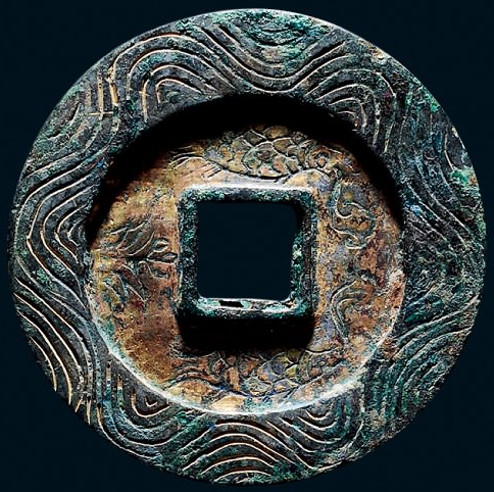
Shown below is the reverse side.
Bat, fish and lotus symbols on reverse side of Shun Tian Yuan Bao charm
As can be clearly seen, the reverse side of this coin has been embellished and gilded (鎏金). The broad rim has been engraved with a wave-like pattern and the area surrounding the center hole has four symbols making the coin into a charm.
The description in the auction catalogue describes the charm as being exquisitely engraved with waves and “auspicious cloud” symbols, and that it was probably an offering to a Buddhist temple during the Tang dynasty.
However, upon careful examination it can be seen that the so-called “auspicious clouds” (祥云) are in fact something quite different.
The bat implies good fortune and happiness
I have rotated the coin so that the symbols can be viewed more easily.
Shown at the left is the symbol at the right of the hole. The symbol is actually that of a bat with its wings spread.
The bat is considered an auspicious symbol to the Chinese because its pronunciation fu (蝠) is the same as the pronunciation of the Chinese word fu (福) which means “good fortune” or “happiness”.
The bat symbol is therefore a “visual pun” or rebus for “good fortune”.
(Please see Bat Open Work Charm for a more in-depth discussion of the bat symbol.)
Fish symbols above and below the square hole
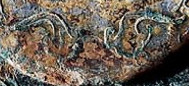
Rotating the charm 180 degrees, the symbols above and below the square hole can more easily be identified.
As can be clearly seen, there is a fish above and a fish below the square hole.
The fish symbol is frequently seen on Chinese charms because it also serves as a visual pun.
The Chinese character for fish is 鱼 which is pronounced yu.
The Chinese word for “abundant” (余) is also pronounced yu.
The fish symbol therefore means “more” as in “more happiness” or “more good fortune”.
The depiction of two fish takes on an additional meaning. Because fish lay many eggs, its reproductive abilities is a symbol of fertility in marriage. Having many sons was particularly important to the ancient Chinese because of the importance of ancestor worship.
A pair of fish (shuang yu 双鱼) can also represent happiness in marriage.
The fish symbol can also be seen on other ancient Chinese coins. A fine example is this zhi bai wu zhu (“Value One Hundred Wu Zhu” 直百五铢) coin issued in 214 AD by Liu Bei (刘备) who founded the State of Shu (蜀汉) during the Three Kingdoms period (三国) AD 220-280.
(For a more detailed discussion of the fish symbol, please see Fish Charms.)
The lotus
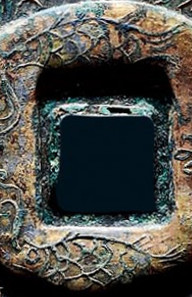
The final symbol on the reverse side is shown at the left.
The lotus is an important Buddhist symbol signifying purity and enlightenment.
Additionally, the Chinese character 莲 (lian) for lotus has the same pronunciation as 连 (lian) meaning “continuous”. A lotus therefore also implies that good fortune and happiness should continue forever.
In regard to fertility, the 莲/连 pun implies that boy babies will be born one after another.
As mentioned above, the Chinese character 荷 (he) also means lotus. This character has the same pronunciation as 和 (he) meaning “harmony”. The lotus thus also has the hidden meaning of harmony in marriage.