Month: February 2012

  • How Chinese Archaeologists Clean Coins

    Chinese archaeologists frequently unearth ancient coins at tomb sites.  While old Chinese coins do not have actual dates on them, they do have inscriptions which can help date the site being excavated.

    Having been buried for hundreds or thousands of years, it is quite common for these old bronze coins to be so severely corroded that the inscriptions cannot be read.

    Coin collectors are always warned not to clean coins because the process will lessen the value of the coin or even ruin it.

    But what do Chinese archaeologists do when they have a coin that is too corroded to identify but which could potentially provide valuable information as to when the tomb was built?

    Song Dynasty coins unearthed at ancient tomb
    Song Dynasty coins unearthed at ancient tomb

    An article discussing a tomb being excavated in the city of Fuzhou (福州) in Fujian Province provides the answer.

    More than ten old Chinese cash coins were discovered during the dig but could not be identified because of heavy corrosion.

    If you have seen archaeologists at a site then you know they work very slowly and methodically to avoid any damage to the buried cultural relics.

    You might expect they would employ a similar degree of care when it comes to cleaning coins.

    In this case, however, the archaeologists were less concerned about preserving the coins than just being able to identify them.

    The archaeologists simply put the coins in vinegar, which is a mild acid, to soak for two or three days to remove the surface dirt and corrosion.  The coins were then removed and a common toothpick was used to scrap out any corrosion in the Chinese characters.  Finally, a rubbing was made of the coins.
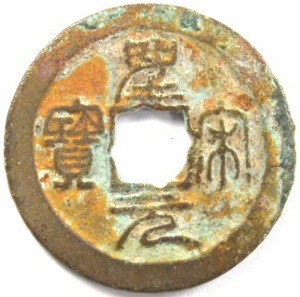
    Song Dynasty coin from 1101 AD
    Song Dynasty coin from 1101 AD

    While the coins would certainly not be very pretty after such treatment, the rubbing did reveal the inscription as sheng song yuan bao (圣宋元宝).

    Sheng song yuan bao coins were cast during the reign of Emperor Huizong (徽宗) of the Northern Song Dynasty beginning in the year 1101.

    An “uncleaned” sheng song yuan bao coin, which would be similar to the ones found in the tomb, is shown at the left.

    The archaeologists were quick to point out that this discovery does not necessarily mean that the tomb dates from the Northern Song because in ancient China coins continued to circulate for many years after they were produced.

    The archaeologists speculate that once the tomb is completely excavated it may be determined to actually be from the slightly later Southern Song Dynasty (1127-1279).

    We usually picture archaeologists as using soft brushes to gently remove dirt from cultural artifacts but sometimes more aggressive measures are used on ancient coins when they are the key to dating a site.
  • Coin Design Discovered on Wall Bricks from Kingdom of Min

    The ruins of an ancient city wall dating from the Tang Dynasty were recently discovered in Fuzhou (福州), the capital city of China’s southeastern province of Fujian (福建), according to a local newspaper article.

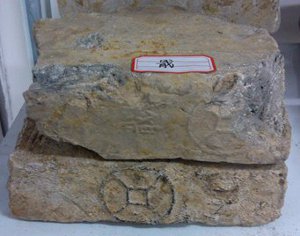
    The city wall dates back 1,100 years and is unusual because some of the bricks display the design of an ancient Chinese cash coin.  Cash coins were distinctive because of their round shape with a square hole in the center.

    Coin design on wall bricks of Kingdom of Min
    Coin design on wall bricks of Kingdom of Min

    The coin design can be clearly seen on the bottom brick in the picture at the left.  The coin design is also on the upper brick just to the right of center.

    The discovery of the bricks with the coin design allowed archeologists to identify the site as the ruins of a city wall from the time of the Kingdom of Min (909-945 AD).

    Construction of the wall began in the year 901 under the direction of Wang Shenzhi (王审知) who was the military commissioner for the area under the Tang Dynasty.

    However, the great Tang Dynasty collapsed in 907, and in the year 909 Wang Shenzhi named himself the Prince of Min (閩忠懿王; Emperor Taizu of Min 闽太祖) and the ruler of the Kingdom of Min.

    Historical records specifically mention the unusual coin design on the bricks used to build the “Luo city wall” (罗城).

    Confirmation that the archaeological find is indeed the famous “Luo wall” of the Kingdom of Min was obtained when other bricks were discovered to have the Chinese characters 威武军 (wei wu jun) which translates as the “Powerful Army”.  Wei Wu Jun was the name of the army Wang Shenzhi commanded.

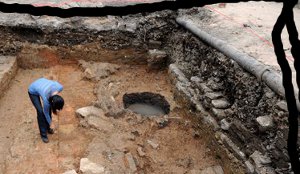
    Ancient city wall from Kingdom of Min
    Ancient city wall from Kingdom of Min

    The newly unearthed ancient wall can be seen in the image at the left. The wall thus far unearthed measures 74 meters in length and 8 meters in width.

    Historical records describe the wall as having been severely damaged in battles during the Song Dynasty (960-1279).

    In more recent times, the site was used as a garbage dump and later became the location of a transport station.

    Wang Shenzhi is well known to collectors of ancient Chinese coins because he predominately issued coins made of lead or iron.  While lead and iron coins had been cast in earlier dynasties, most coins were made of bronze.

    However, the coin design on the wall bricks actually has nothing to do coins!

    The Chinese character for “cash coin” (qian 钱) also happens to be a Chinese surname or family name.

    The surname of the ruling family of the neighboring kingdom of Wuyue was Qian (钱) which is the very same Chinese character used for “coin”.

    In 916, Wang Shenzhi arranged for the marriage of his daughter to Qian Chuanxiang (钱传珦) who was the son of Qian Liu (钱鏐) the King of Wuyue (吴越国).

    It was a common practice for rulers to try to marry their offspring to important family members of neighboring states in order to establish strong diplomatic ties.

    The image of the coin on the city wall bricks was intended to symbolize the marriage and the newly established ties to the Qian family of the Kingdom of Wuyue.

    The Kingdom of Min would only exist for a short time after Wang Shenzhi’s death in 925.

    Li Hongxi (李弘羲) became ruler of Fuzhou in 945 but was forced to surrender to the forces of Wuyue.

    The King of Wuyue at the time was Qian Hongzuo (钱弘佐; Qian Zuo 钱佐) who was the nephew of Qian Chuanxiang.

    The Qian family of Wuyue thus became the new rulers of Fuzhou.  It is said that the citizens of Fuzhou considered the coin design on the bricks of the Luo Wall to have been an omen predicting that the Qian family would one day rule the country.

    As mentioned earlier, Wang Shenzhi is known for having been among the first to use lead for the regular production of cash coins.

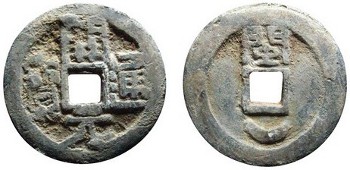
    Large lead coin from Kingdom of Min
    Large lead coin from Kingdom of Min

    An example of a large lead coin cast during Wang Shenzhi’s reign is displayed at the left.

    The inscription on the obverse side is kai yuan tong bao (開元通寶) which is the same as that on the coins of the Tang Dynasty.

    The reverse side has the Chinese character min (閩) indicating the Kingdom of Min.

    These large coins made of lead or iron from the Kingdom of Min are fairly scarce.  Specimens made of bronze are even rarer.