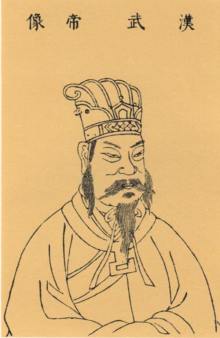
Because of expenses incurred in fighting the Xiongnu (匈奴) and opening up new territories, Emperor Wu (武帝 156 BC – 87 BC) of the Han dynasty (汉朝 202 BC – 220 AD) was in desperate need to raise revenues and in 119 BC decided to issue a new type of coinage.
Unlike the bronze ban liang coin which was the coin of the realm, this was a new form of money made of “white metal” (白金) which, according to the Records of the Grand Historian 《史记·平淮书》, was a mixture of silver and tin.
These new coins were known as the Bai Jin San Pin (白金三品) which literally translates as “white metal three kinds”.
The Bai Jin San Pin came in three denominations which differ in shape and surface pattern. In addition, they were not thin like common coins but were unusually thick and heavy and are sometimes described as “cake” or “biscuit” coins.
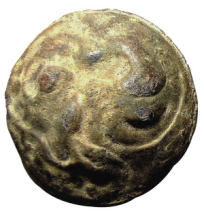
The first coin in the three coin set, shown at the left, was round and weighed 8 tael (liang 两). Incredibly, the government proclaimed that this silver coin would be worth the equivalent of 3,000 “cash” coins which at the time were the 4 zhu ban liang coin and, beginning in 118 BC, the wu zhu coin (五铢钱).
The round shape was meant to represent the sky or heavens and, consequently, the coin had the pattern design of a dragon described by one source as having a “long mouth, long neck, one horn, and flying through the clouds”.
As already mentioned, the historical texts of the Han dynasty stated that the Bai Jin San Pin coins were minted from a silver-tin alloy. To date, however, the only dragon coins unearthed have been made of lead. No authentic (i.e. silver) dragon coins are known to exist as of this writing.
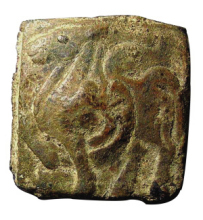
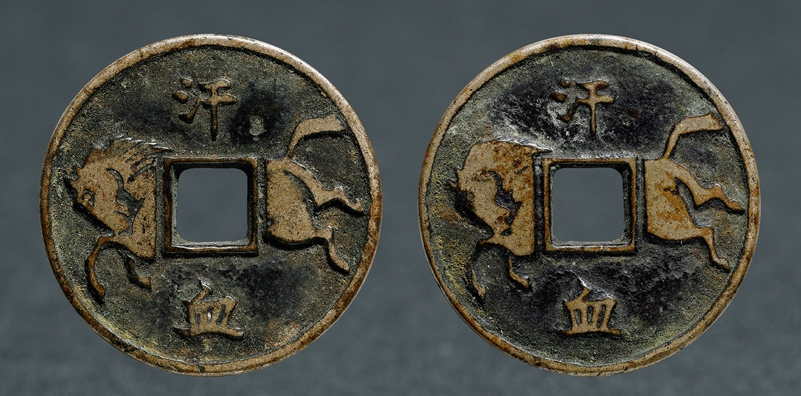
The second coin in the set was square, weighed 6 tael, and was worth 500 cash coins. It had the image of a horse which represented the square earth.
The horse is described as having its “head upright, chest high, with three legs on the ground and one hoof raised, full of vigor and and imposing momentum.”
These two coins, the “round” dragon coin and the “square” horse coin, reflect the ancient Chinese theory of the “circle and square” where heaven is represented by a circle and the earth by a square.
The third coin of the Bai Jin San Pin was oval-shaped, weighed 4 tael, and was worth 300 cash coins. It had the image of a turtle (wu gui 乌龟).
The turtle’s domed shell represents the sky above and its flat bottom represents the earth below. The turtle, therefore, represented the Chinese people who also live beneath the vaulted sky and stand on the flat earth. The turtle is also a symbol of longevity and immortality.
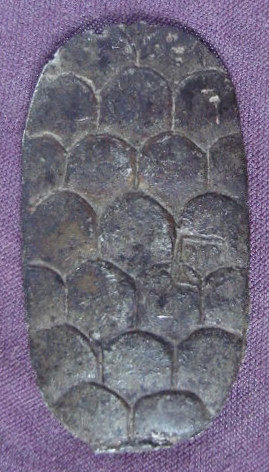
At the left is a photo of the silver turtle coin excavated in 2013 in Xian (西安). Xian (Chang’an 长安) was the capital of the Han dynasty during the reign of Emperor Wu.
The coin was discovered by sand dredgers excavating in the dried up bed of the Weihe River (渭河) in the northern suburbs of the city.
The obverse is dome-shaped with the middle thick and the edges thin.
The coin is 1.6 inches (40 mm) long, 0.8 inch (21 mm) wide, and 0.12 inch (3.1 mm) thick. It weighs 10 grams. The obverse side has a scaly armor design imitating that of a turtle.
If you look closely, you will see a small square seal stamped on the surface at the middle right of the coin. This counterstamp is believed to be the Chinese character shao (少). The character shao refers to the shaofu (少府).
The shaofu (少府) was one of the Nine Ministers of the Han dynasty. Various English translations of shaofu include Privy Treasurer, Minister Steward, Chamberlain of the Palace Revenues, and Superintendent of the Lesser Treasury. The shaofu managed the palace treasury, i.e., the private finances of the imperial clan. The Records of the Grand Historian《史记·平准书》and the Book of Han《汉书·食货志》state that the shaofu was responsible for the minting of the silver Bai Jin San Pin coins.
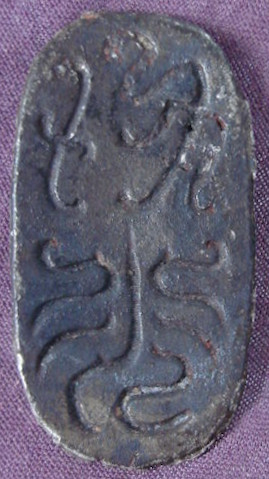
The reverse side, shown at the left, is flat. There are two seal script (篆书) characters, one above the other.
Mr. Huang Xiquan (黄锡全), a recognized expert in the field and the former head of the China Numismatic Museum (中国钱币博物馆), reads these characters as chui guang (垂光).
According to Mr. Huang, the meaning of chui guang is “glory illuminates, bounties bestowed to the world” (光辉普照,恩泽人间之意) which would refer to the achievements of Emperor Wu.
During the 1980’s, a number of these dragon, horse and turtle coins were unearthed at various archaeological digs. These coins were consistent with the description in the Records of the Grand Historian except that they were all made of lead.
As a result, these lead coins raised serious questions as to their authenticity since historical texts state that the “white metal”, from which the official coins were minted, was an alloy of silver and tin.
However, in 2007 and again in 2011, silver coins with the horse pattern were finally unearthed in Shaanxi (陕西).
And in 2013, the first silver turtle coin was unearthed. This is the turtle coin described above.
With these discoveries came the confirmation that the silver coins, and not the lead coins, were the authentic legal coins described in the ancient texts. Lead coins are either counterfeit or burial money.
Please again note that to date, there has not been any confirmed archaeological excavations of a silver round coin with the dragon motif. There exits a number of examples of lead round coins with a dragon motif, such as the one pictured above, but a coin which historical texts describe as being worth the equivalent of 3,000 bronze ban liang or wu zhu coins would not be made of the base metal lead when the lower denomination horse and turtle coins are now confirmed to have been made of silver.
Besides, the laws of the Han dynasty specified that it was illegal for the government to issue coins made of a base metal such as lead.
Nevertheless, during the Han dynasty many individuals found counterfeiting Bai Jin San Pin coins using lead instead of silver to be easy and very profitable.
However, only the emperor had the right to mint coins at the time and minting by individuals was strictly forbidden. Thousands of counterfeiters were executed for their acts.
The Bai Jin San Pin coins are generally recognized to be the first official silver coins produced in China. However, it is probably more accurate to say that the Bai Jin San Pin, although not pure silver and not in the traditional shape of a coin, were the first legal silver coins minted by the government for general circulation and recorded in official documents.
Even older forms of silver money have been found but they are not mentioned in official documents. Examples include spade money made of silver from the Warring States period (战国时代 475 BC – 221 BC) as well as a silver ban liang coin from the State of Qin (秦国 770 BC – 207 BC).
In the end, the Bai Jin San Pin coins were short-lived. They were considered to be “empty coins” (虛幣) and inflationary because they were not worth their stated value. Also, people could easily counterfeit them using the base metal lead instead of the precious metal silver. In 115 BC, only five years after their introduction, the government abolished the circulation of the Bai Jin San Pin coins.