Category: Vietnamese coins and charms

  • 700-Year-Old Coin Pit Discovered in Hunan Province

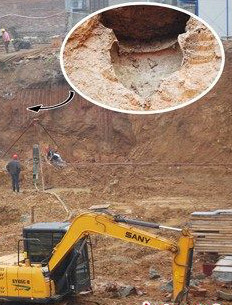
    Construction site in Hunan Province where Tang, Song and Yuan dynasty coins were unearthed
    Construction site in Hunan Province where Tang, Song and Yuan dynasty coins were unearthed

    On February 20, 2013 workers digging at a construction site in Chenzhou City (郴州市) located in Anren Prefecture (安仁县) in the southeastern part of Hunan Province (湖南省) unearthed a money pit dating back some 700 years according to Chinese newspaper reports.

    The money pit contained approximately 7.5 kg of coins from the late Song (960-1279) and early Yuan (1280-1368) dynasties.

    The construction site can be seen in the photo at the left.  The oval shows a close-up of the money pit and the arrow points to where the discovery was made.
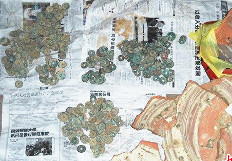
    Some of the coins discovered in the Hunan coin pit
    Some of the coins discovered in the Hunan coin pit

    According to the newspaper reports, most of the coins are from the late Song dynasty.  More than 20 types of Song dynasty coins were recovered including chong ning tong bao (崇宁通宝), chong ning zhong bao (崇宁重宝), zheng he tong bao (政和通宝), huang song tong bao (皇宋通宝), and xian ping zhong bao (咸平重宝).

    The reports also mention that Tang dynasty coins such as kai yuan tong bao (开元通宝) were also found in the pit.

    Some early Yuan Dynasty coins such as da de tong bao (大德通宝) were also discovered.
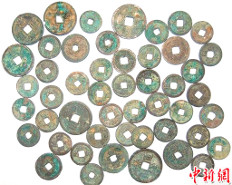
    Well-preserved small and large coins from the money pit
    Well-preserved small and large coins from the money pit

    On February 22nd, the China News Service dispatched a news team to Chenzhou City to cover the story.

    The video broadcast includes commentary in Chinese.  But even if you do not understand Chinese, you will see images of the construction site where the coin hoard was unearthed.  The video shows archaeologists cleaning and examining the coins.  There are also short interviews with Mr. Cai Ning (蔡宁) of the Anren Prefecture Cultural Relics Administrative Office (安仁县文物管理所) and Mr. Duan Bangqiong (段邦琼) of the Anren Prefecture Bureau of Culture, Broadcasting and the Press (安仁县文广新局).

    The print media, as well as the China News Service, mention that some of the coins in the cache are considered to be fairly scarce.  Among these are the jing yuan tong bao (景元通宝) and the chun hua tong bao (淳化通宝).

    Coins with the inscription jing yuan tong bao (景元通宝) are believed to have come from Annam (Vietnam) although it is still uncertain as to when these coins were actually cast.

    What would definitely be the greatest find from the money pit, however, would be chun hua tong bao (淳化通宝) and xian ping zhong bao (咸平重宝) coins.

    During the reign of Emperor Tai Zong of the Northern Song Dynasty, a large number of chun hua yuan bao (淳化元宝) coins were cast during the years 990-994.  As far as I have been able to determine, however, there are no historical records documenting a chun hua tong bao (淳化通宝) version of this coin and no authentic specimens are known to exist.

    Emperor Zhen Zong of the Northern Song issued coins with the inscription xian ping yuan bao (咸平元宝) during the years 998-1003.  However, I am not aware of any historical records of a xian ping zhong bao (咸平重宝) coin ever being cast during his reign.  This coin is not included in the major Chinese coin catalogs.

    Nevertheless, another major coin cache unearthed in 2010 in Shaanxi Province (陕西省) also claims to have discovered a xian ping zhong bao (咸平重宝) coin.

    Images of the chun hua tong bao (淳化通宝) and xian ping zhong bao (咸平重宝) coins reportedly recovered from the Hunan money pit have not yet been published.

    If the reports turn out to be true then this would certainly be considered a significant new discovery in Chinese numismatics.
  • The Huainanzi and Vietnamese Coins

    The huainanzi (淮南子), variously translated as “The Masters of Huainan”, “The Huainan Philosophers” and “The Book of the Master of Huainan”, is an ancient Chinese philosophical work on the proper way for a monarch to govern.

    The huainanzi also records some of China’s most ancient myths and stories including “Nu Wa Repairs the Sky” (nu wa bu tian 女娲补天), “Hou Yi Shot the Suns” (hou yi she ri 后羿射日), “Chang’e Flies to the Moon” (chang e ben yue 嫦娥奔月), and “Yu the Great Tames the Flood” (xia yu zhi shui 夏禹治水).

    Liu An (刘安), the Prince of Huainan, was a grandson of Liu Bang (刘邦), the founder of the Han Dynasty, and also the uncle and adviser to Emperor Wu (武帝).  He, together with a gifted group of literary scholars known as the “Eight Immortals of Huainan” (淮南八仙), wrote this major treatise which he then presented to Emperor Wu in 139 BC.

    To be successful, according to the huainanzi, a ruler should embrace both Daoist and Confucian principles.  The monarch should adopt the practice of self-cultivation with the goal of attaining sagehood.  At the same time, he must actively engage in the mundane and practical activities of government administration.

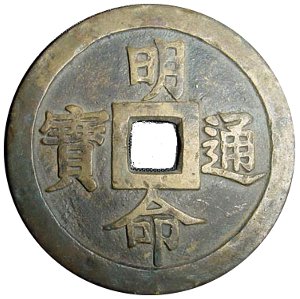
    Vietnamese "Minh Mang Thong Bao" Coin
    Vietnamese “Minh Mang Thong Bao” Coin

    The huainanzi established the proper way for a king to rule and its influence spread to neighboring countries including Vietnam, also known as Annam.

    The large Vietnamese presentation coin displayed here has the inscription Minh Mang Thong Bao (Chinese: ming ming tong bao 明命通宝) which was used on coins cast during the reign (1820-1840) of King Nguyen Thanh To of the Nguyen Dynasty.

    Because minh mang (明命) has the auspicious meaning of “intelligent decree” or “bright life” (明命), the inscription can also be found on Vietnamese charms and amulets.

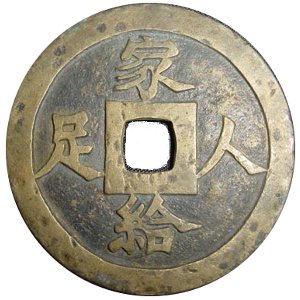
    Vietnamese coin with inscription from the Huainanzi
    Vietnamese Coin with Inscription from the Huainanzi

    The inscription on the reverse side is jia ji ren zu (家给人足).

    This phrase is taken directly from the chapter entitled “Fundamental Norm” <淮南子 · 本经训> of the huainanzi:

    衣食有余,家给人足

    yi shi you yu, jia ji ren zu

    “When clothing and food are plentiful, every family enjoys a rich life.”

    According the the huainanzi, an enlightened ruler should strive to ensure that the common people have the basic necessities.  In so doing, the people will live in contentment and the country can be at peace.

    This large Vietnamese cash coin has a diameter of 48 mm.

    Although no denomination is stated, these coins were valued at the equivalent of one hundred small cash coins.

    These large and well-made Minh Mang Thong Bao presentation coins are famous for their inscriptions based on the Chinese classics.  There are at least seventeen known varieties with a four-character inscription and twenty-three known varieties with an eight-character inscription.