The mystique and rarity surrounding the “three hole spade” (san kong bu 三孔布) is such that many Chinese coin collectors consider it to be “the king of ancient coins”.
Even though catalogs of ancient Chinese coins have existed for almost 900 years, “three hole spades” from the Warring States period (475-221 BC) are so rare that their existence was essentially unknown until about 200 years ago.
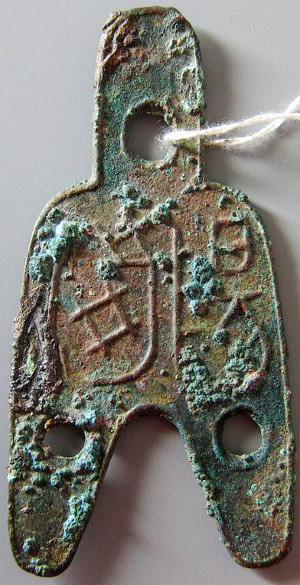
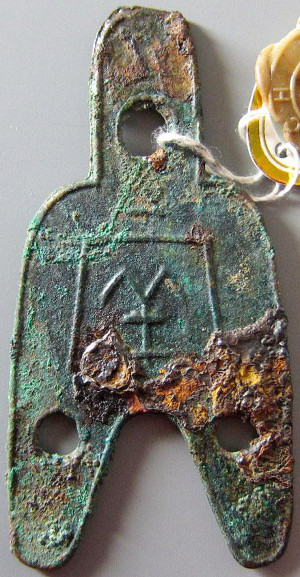
Rare ‘three hole spade’ minted at Yang Jian in the State of Zhao during the Warring States period
The shape of the three hole spade is based on an ancient farming implement similar to a shovel. The three holes distinguish it from similar forms of spade money of the time.
The three hole spade shown here was sold on April 23, 2013 at an online auction (华夏古泉网) for approximately US$402,675 (RMB 2,475,000).
Three hole spades have the name of the city where they were cast inscribed on their obverse side.
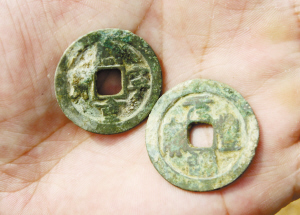
Also found were some shao xing yuan bao (绍兴元宝) coins cast during the period 1131-1162 of the reign of Emperor Gao Zong (1127-1162) of the Southern Song Dynasty.
While coins from the Jin Dynasty (1115-1234) were also recovered, the newspaper article does not provide additional details.
According to the archaeologists, this is the largest cache of ancient bronze coins ever discovered in Dingxi City.
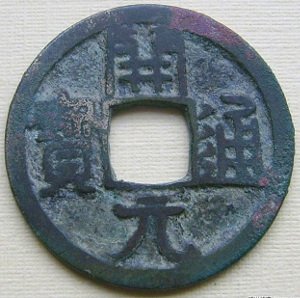
Tang Dynasty ‘kai yuan tong bao’ coin unearthed in Anhui
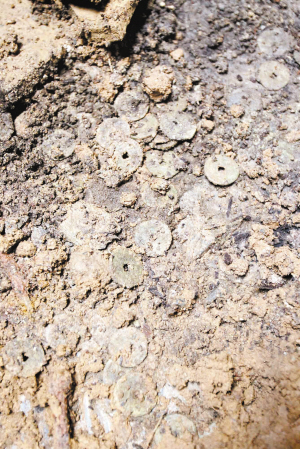
The more than 500 pounds (500余斤) of coins was discovered about one meter below the surface and includes coins with the inscription kai yuan tong bao (开元通宝) which were first minted during the Tang Dynasty (618-907).
The coins were found stacked in a very orderly manner. The archaeologists speculate that most of the coins would have been threaded together on strings and then neatly arranged.
However, the strings have long since rotted away and many of the coins are now corroded together.
The news reports state that the coins probably belonged to a rich family of the Northern Song that wanted to hide the money from robbers or during a time of unrest.
Why would a Ming Dynasty tomb contain coins only from the Song Dynasty?
This was the question faced by archaeologists excavating a tomb in Longshan Village (龙山村) according to an article published in the May 6, 2013 edition of the Pengcheng Daily (彭城晚报).
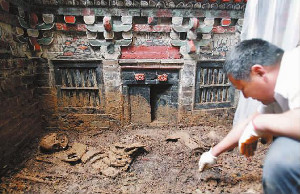
The extraordinary interior paintings of the Ming Dynasty tomb discovered in Longshan Village
The brick tomb was discovered near Xuzhou (徐州), Jiangsu Province (江苏省) in March of this year.
The tomb is considered remarkable because of the exquisite paintings on the entrance and in the coffin chamber.
As can be seen here, the paintings remain vivid even after being sealed underground for more than 400 years.
The tomb contains the skulls of two people who the archaeologists believe were a married couple. The wooden caskets have completely decayed and only some coffin nails can be found on the floor.
The tomb can be dated to the Ming Dynasty. Written clearly above the door of the coffin chamber is wan li er shi san nian si yue wang ri (万历二十三年四月望日) which translates as the “15th day of the 4th (lunar) month of the 23rd year of Wanli”.
This would date the tomb to the year 1595 during the reign of the Wanli Emperor of the Ming Dynasty.
As can be seen in the image above, the coffin chamber is built to resemble a traditional Chinese courtyard.
If you look carefully, you will see that there are a number of roof tiles on the floor. Since the ceiling of the chamber is in the shape of a dome, the archaeologists were puzzled as to why there would even be roof tiles. Also, none of the tiles are damaged so it is not likely that they could have fallen down.
The experts now believe that the tiles were never attached to the ceiling but were in fact placed on top of the caskets in accordance with a local funeral custom of the time.
Only Song Dynasty coins have been found in this Ming Dynasty tomb
As seen in the image at the left, “several tens” of Chinese cash coins have been discovered on the floor on the left side of the coffin chamber. The newspaper article mentions that the room had been “disturbed” so it is unclear if this was the original location of the coins.
The archaeologists now believe that, according to burial customs of the time, the coins were most likely placed underneath the corpse or in some other part of the wooden casket.
Cultural relics experts have identified the coins as being from the Song Dynasty (960-1279). The Song Dynasty was followed by the Yuan Dynasty (1271-1368) and then the Ming Dynasty (1368-1644).
Song Dynasty ‘xi ning zhong bao’ and ‘yuan feng tong bao’ coins
The inscriptions on these coins have auspicious meanings. “Xi ning” (熙宁) means “peaceful prosperity” and “yuan feng” (元丰) translates as “primary abundance”.
The tomb can be very accurately dated to the Ming Dynasty yet there are no coins from that time period.
Coins are usually a fairly reliable way to date a tomb but not in this case.
The archaeologists believe that “unless the deceased were Buddhists or coin collectors”, the answer to this puzzling question must have to do with another burial custom of the time.
Since very ancient times, the Chinese have believed that certain coins have charm characteristics that can can bring good luck and provide protection from evil spirits.
The archaeologists give a couple of modern examples.
One example is a certain coin sometimes found buried in tombs dating from the early 1900’s. This coin is a Chinese silver dollar with the portrait of Yuan Shikai (袁世凯) and is colloquially referred to as a yuan da tou (袁大头) or “Yuan Big Head”. (Please see “Coffin Contains Coin Instead of Corpse“).
Numismatists outside of China usually refer to this coin with the unflattering term “Fatman” dollar.
Another example would be the so-called “Five Emperor Coins” (五帝钱). This refers to a set of coins from the first five emperors of the Qing Dynasty (1644-1912).
China was powerful and prosperous under the reign of these emperors and many contemporary Chinese believe that their coins have the power to ensure prosperity and protection from evil spirits.
The term “Five Emperors” also alludes to the highly revered mythological rulers of ancient China known as the “Three Sovereigns and Five Emperors“.
顺治通宝 (shun zhi tong bao) cast during the reign of the Shunzhi Emperor. “Shunzhi” translates as “to rule smoothly”.
康熙通宝 (kang xi tong bao) cast during the reign of the Kangxi Emperor. “Kangxi” translates as “healthy and prosperous”.
雍正通宝 (yong zheng tong bao) cast during the reign of the Yongzheng Emperor. “Yongzheng” translates as “harmony and upright”.
乾隆通宝 (qian long tong bao) cast during the reign of the Qianlong Emperor. The “qian” (乾) has exactly the same pronunciation as the word “qian” (钱) meaning “money”.
嘉庆通宝 (jia qing tong bao) cast during the reign of the Jiaqing Emperor. “Jiaqing” translates as “good and celebrate”.
Just as contemporary Chinese believe in the powers of the “Five Emperor Coins” and the “Yuan Big Head” coin, the archaeologists feel the people of the Ming Dynasty may have held a similar belief in certain coins from the Song Dynasty.
As can be seen, the paintings in this tomb are exquisite. In order to protect the paintings and ensure that the colors do not fade, the archaeologists have installed four instruments to monitor humidity levels in the tomb during the excavation and preservation phases of their work.
The final phase of their work, however, is to use the most advanced technology possible to remove the entire tomb and move it to the Suining County Museum (睢宁县博物馆).
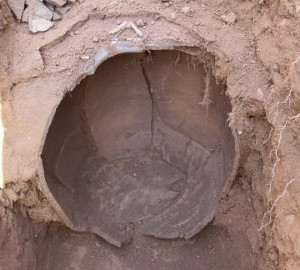
A villager in Pingquan County (平泉县), Hebei Province (河北省) accidentally discovered a buried clay pot containing about 600 specimens of knife money from the Warring States Period (475 BC -221 BC), according to a dispatch from the China News (中新网) dated May 3, 2013.
Knife money from the ancient State of Yan being unearthed in Hebei
Mr. Wang Yongtie (王永铁), the village chief of Guangxingdian Village (广兴店村), explained that a resident of the village, Mr. Liu Jiafu (刘佳富), discovered the buried money while digging a ditch.
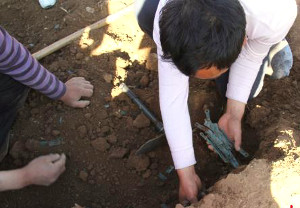
In the image at the left, some of the knives can be seen in the archaeologist’s left hand as he removes the artifacts from the clay pot.
Example of a “ming” knife from the State of Yan
Mr. Wang stated that this is the first time this type of cultural artifact has ever been discovered in the village.
The ming knives were discovered buried in this clay pot
About 600 knives were recovered according to Mr. Chang Wen (常文) who works at the Cultural Relics Protection Bureau of Pingquan County (平泉县问保所).
The knives all have a Chinese character inscribed on them which traditionally has been interpreted to be ming (明).
Although there are other interpretations for this character, this ancient form of money continues to be referred to as “ming knife money”.