Month: July 2011

  • Five Goat Coin

    A recent article in a Chinese newspaper described how a Chinese coin collector hid his coins during the Cultural Revolution (1966-1976) to save them from the Red Guards who were intent on “destroying the old”.  The collector is now donating the coins to the Zhuhai Museum.  Among the coins being donated is a very rare copper coin minted in 1936.
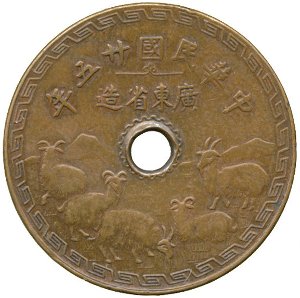
    Chinese copper coin minted in 1936 displaying five goats
    Chinese copper coin minted in 1936 displaying five goats

    This coin is remarkable for its design and use of symbols.

    The inscription at the top translates as “Republic of China 25th Year” and “Made in Guangdong Province”.

    The lower half of the coin displays five goats.  The five goats are a reference to an ancient myth concerning the city of Guangzhou (Canton) which is located in Guangdong Province.

    While specific details of the myth vary, the basic story is as follows.  During the reign (899 BC – 892 BC) of King Yi (周懿王) of the Zhou Dynasty, the ancient city of Guangzhou (chuting 楚庭) suffered a great famine.  The fields were parched and the people were starving.  One day, five immortals (“celestial beings”) descended from the sky.  Each immortal rode a goat and floated down on a cloud.  In the mouths of each goat was a six-eared rice stalk.  The immortals blessed the land to be forever free of famine and gave the stalks of rice to the people.  The immortals then rode their clouds back into the sky.  The five goats remained on a hillside and were transformed into stone.

    With the gift of the rice stalks the famine ended and Guangzhou has enjoyed bountiful harvests ever since.

    Based on this myth, Guangzhou is known as the “City of Goats” (yangcheng 羊城), “Sheaves of Rice City” (suicheng 穗城) and the “City of Five Goats” (wuyangcheng 五羊城).  In translation from the Chinese, the English words “goat” and “ram” can be used interchangeably.

    On the coin, each of the five goats is shown in a different pose and in such detail as to include whiskers.

    Other symbols of Guangzhou include the design surrounding the round hole which is meant to represent the battlements of the ancient wall that encircled the city.

    To the left and right of the center hole are mountains from the Guangzhou area.  If you look very carefully, you will notice that the mountain on the left appears to be farther in the distance than the one on the right.

    The attention to detail even includes displaying patches of grass for the goats to eat to signify that food is plentiful.
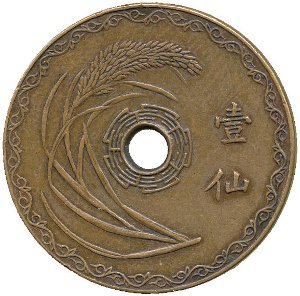
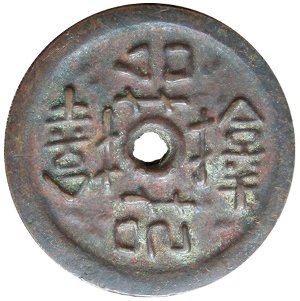
    Reverse side of "Five Goat" coin

    The reverse side of the coin is also rich in symbolic design.

    To the left of the hole is a rice stalk with six branches which refers to the rice stalks carried in the mouths of the goats in the ancient myth.  This is also the official emblem of the city of Guangzhou.

    Surrounding the hole is a clever design based on the Chinese character for “goat” (yang 羊).  The artist has taken five of these characters and written them in ancient seal script.  What appears at first glance to be a design is in fact “five goats” connected in a circle.

    To the right of the hole are two Chinese characters which mean “one cent” (yi xian 壹仙).  The character for “cent” (xian 仙) is used because it sounds like the English word “cent”.

    However, this character (仙) also means “immortal” and thus symbolizes the five immortals that descended from the heavens to save the people from the famine.

    The goat was a symbol of “good luck” to the ancient Chinese and was frequently used in sacrifice offerings to ancestors.  For this reason, the Chinese word for “auspicious” or “lucky” (xiang 祥) includes the word “goat” (羊) as part of the character.

    Because the “five goat” coin minted in Guangdong Province was determined not to be in accordance with the newly adopted national “legal tender” (fabi 法币) reforms of 1936, the coins were recalled and melted down after circulating for only a very short period of time.  As a consequence, extremely few of these coins exist and at auction they now sell for more than $20,000.
  • Panda Coin Counterfeiters Arrested

    Fake Chinese coins continue to flood the market and are a major headache to both collectors and investors.

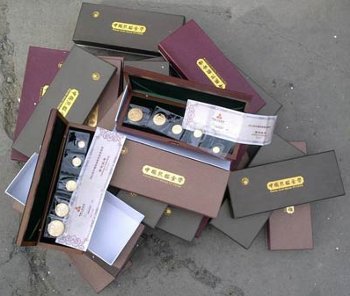
    Fake Panda Gold and Silver Coins
    Fake Panda Gold and Silver Coins

    An article published on the “China Gold Coin Net” (中国金币网) reports the success of a joint operation by the Hebei and Zhejiang police in breaking up a counterfeiting ring that specialized in producing fake “Panda” gold and silver coins.

    According to the report, the authorities arrested five suspects.

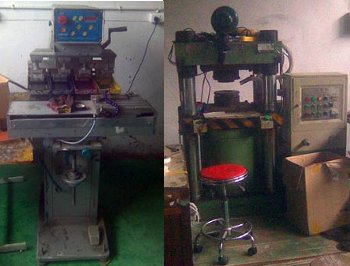
    Counterfeit Coin Equipment
    Counterfeit Coin Equipment

    The authorities also confiscated 435 coin sets and 1,108 individual coins.

    The fake coins included not only the very popular “Panda” coins, but also gold and silver coins commemorating the “2011 Year of the Rabbit”, as well as gold and silver commemorative coins marking “The 90th Anniversary of the Founding of the Communist Party of China”.

    The authorities also confiscated the equipment used in minting the counterfeit coins, along with the coin dies, fake seals, and fake gold and silver bars.

  • Chinese Football Charm

    In ancient China, charms were created to promote good luck and fortune in the major events of a person’s life such as marriage, the birth of children and promotion to an important government position.

    The celebration of sports was not a major theme of either Chinese coins or charms until very modern times with the current popularity of souvenir and commemorative coins.

    According to FIFA, the earliest documented evidence for the origin of football is a Chinese military manual dating from the second to third centuries BC which describes an exercise of kicking a leather ball filled with feathers and hair through an opening 30-40 cm wide into a small net fixed on long bamboo canes.

    The Chinese called this football sport cuju (蹴鞠).  Cu means “kick the ball with the feet” and ju refers to “a ball made of hide”.   The game of cuju was popular at least as early as the Warring States Period (475 BC – 221 BC) when it was used for military training.

    Ancient Chinese Football Charm
    Ancient Chinese Football Charm

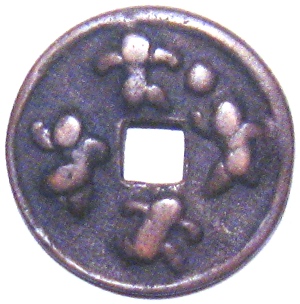
    The “football” charm shown here recently appeared in “China Numismatics”* and dates from the Song Dynasty (960-1279 AD).

    Not only is the subject unusual but this charm exhibits some of the outstanding artistic characteristics of the Song Dynasty which is considered one of the golden eras of Chinese art.

    The four football players surrounding the square hole are sculpted in a minimalist style that conveys energy and movement with each player displaying a different action.

    The players at the top and bottom are seen moving towards the right while the two players on the sides are running towards the left.

    The figure at the top is running toward the ball, which is shown at the one o’clock position, preparing to kick it.  The player at the right has just “headed” the ball.  The player below the hole is running at full speed while the player at the left appears to have just kicked the ball.

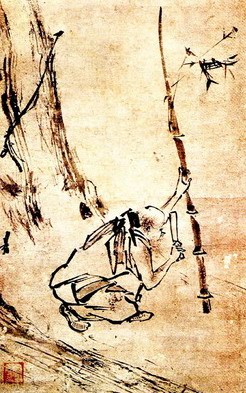
    "The Sixth Patriarch Cutting Bamboo" by Liang Kai

    This minimalist style was epitomized  by the famous Southern Song Dynasty painter Liang Kai (梁楷).

    Liang Kai (1140-1210 AD) relied on only the essential details to convey the essence of the subject.

    In his quest to find the essence of being, he ultimately resigned his position at the court in order to practice Chan Buddhism.

    The principles of Chan Buddhism (禅宗) include spontaneity and “sudden enlightenment” which can be seen in his own style of painting.

    China’s Chan Buddhism would eventually spread to Japan where it evolved into Zen.

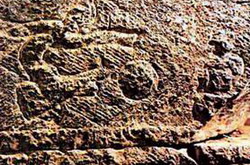
    Han Dynasty stone engraving of woman playing football
    Han Dynasty stone engraving of woman playing football

    Interestingly enough, the game of football was also played by women in ancient China.

    Shown at the left is the image of a woman kicking a ball.  This stone engraving is from a Han Dynasty tomb (206 BC -220 AD).

    Women were traditionally limited in regard to outside public activities but football became a popular sport for women, particularly those of the court, during the Tang Dynasty (618-907 AD) and especially during the Song Dynasty.

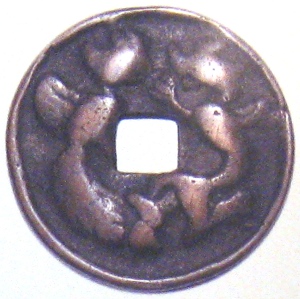
    Reverse side of football charm displaying dragon and phoenix
    Reverse side of football charm displaying dragon and phoenix

    It seems appropriate, therefore, that the reverse side of this old football charm would display, in a minimalist style, the traditional symbols of a man and a woman.

    The animated dragon can be recognized at the right even though it lacks such details as scales.

    The phoenix with its wings and graceful posture is at the left.


    * Charm images from Issue #112 (2011) of “China Numismatics” (中國錢幣).

  • Japanese Charm with Unknown Characters

    Japanese Charm with Unknown Characters
    Japanese Charm with Unknown Characters

    This unusual charm can be found in China but has been puzzling Chinese coin collectors for many years.

    The reason is that the characters are not Chinese and are not easily recognized as Japanese, either.

    However, an article in the August 1992 issue of the Japanese magazine “Collections” (收集) provides a plausible answer to the riddle.

    According to the article, the charm was created in the year 1937 (Showa 12) by the director of the Japanese mint to serve as a protective amulet.  It is said that the form of this charm resembles the base of the canon emplacements that were used to protect the Japanese shores from pirate ships.

    The author of the article stated that when he was preparing to leave his village as a soldier in the Second Sino-Japanese War (1937-1945), a village elder gave him the coin for protection.  The author wore it at his waist because the Japanese consider the lower abdomen, as opposed to the area of the heart, as the center of life.  During moments of life and death, he would reach down, touch it and pray that it would help him to survive.

    Also during World War II, Japanese would write these characters on a piece of paper and attach it to the roofs of their houses in the belief that the amulet would protect them from incendiary bombs dropped by American bombers.

    Use of this talisman did not end with the war, however.  Nowadays, Japanese can go to shops located at shrines and buy this charm to carry as a means of protection when they travel.

    This amulet, which has its roots in the Second World War, now serves a role similar to the St. Christopher medal carried by travelers in the West.

  • Hundreds of Spanish Silver Dollars Found in Dirt Pile

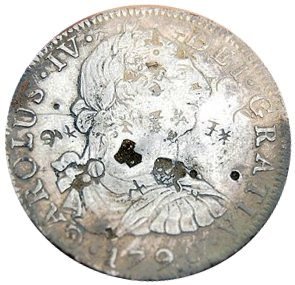
    Spanish silver dollar found in pile of dirt
    Spanish silver dollar found in pile of dirt

    According to a July 6, 2011 Chinese newspaper article, hundreds of old Spanish silver dollars were recently found in an abandoned pile of dirt.

    A villager walking down the street in Longhai Village in Fujian Province noticed something shiny in some dirt that had recently been dumped.  Picking the object up he realized it was an old Spanish silver dollar.

    News of the find spread quickly setting off a “digging frenzy”.

    Villagers digging for silver dollars
    Villagers digging for silver dollars

    Soon a hundred villagers appeared with hoes, shovels and basins and began digging in two piles of dirt, measuring about 20 square meters, looking for more silver dollars.

    Reportedly, several hundred silver dollars were found.

    By the time the police and cultural relics personnel could arrive on scene, however, most of the lucky villagers had already scattered.

    According to two experts with the Zhangzhou City Collections Society, the coins are Spanish silver dollars which came into the area as a result of foreign trade during the middle of the Qing Dynasty.  These silver dollars are frequently found here and villagers refer to them as “funny face” coins.

    One young man was fortunate enough to find more than 20 of the coins in the dirt pile.

    Another villager informed the reporter that the oldest coin found that morning was dated 1775 with the most recent being 1802.

    Dirt originally came from this site
    Dirt originally came from this site

    The dirt, which came from the digging of a foundation for a new house, had been dumped on the vacant lot four days earlier but no one had paid much attention until the villager happened to notice the shiny object.

    The “owner” of the dirt, a Mr. Huang, said that his previous house had been more than 200 years old.  Mr. Huang said that until he heard the news, he had no idea of the treasure that he had inadvertently thrown away.

  • Chinese Daoist Mirrors

    Chinese bronze mirrors are usually circular with one side highly polished to provide a reflective surface and the other side decorated with an inscription and symbols.

    Simple undecorated bronze mirrors first appeared during neolithic times while the earliest decorated mirror, which was discovered in a tomb in Qinghai Province, dates to the Xia Dynasty (2100-1600 BC).

    In terms of quality and production, the period from the Warring States (475-221 BC) through the Tang Dynasty (618-907 AD) was the heyday of Chinese bronze mirrors.  By the middle of the Qing (Ch’ing) Dynasty (1644-1911 AD), bronze mirrors began to be replaced by glass mirrors and the 4,000 year history of bronze mirror use was nearing its end.

    Chinese bronze mirrors were primarily used for vanity purposes but were also used to start fires by concentrating sunlight.

    However, mirrors were also used for ritual and spiritual purposes.

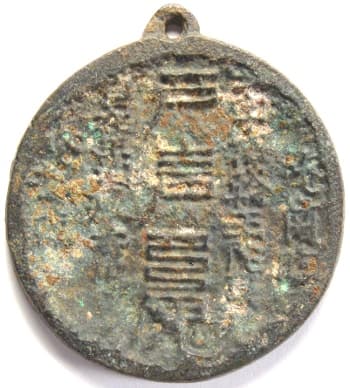
    Chinese bronze mirror with Daoist "magic writing" characters

    This is an example of an old Chinese Daoist (Taoist) mirror.

    The inscription is written in Daoist “magic writing” (fuwen 符文) and its meaning can only be understood by a Daoist priest.

    Mirrors were believed to have strong amuletic powers that could ward off evil spirits.  An invisible demon would flee when it saw its reflection in a mirror.

    For this reason, Daoists often wore these mirrors hanging down the back to protect against being blind-sided by a ghost.

    These mirrors were also hung in traditional Chinese houses in order to scare away evil spirits.

    So even though the exact meaning of the inscription on the mirror is unknown, we can reasonably believe that it is meant to provide protection from demons.

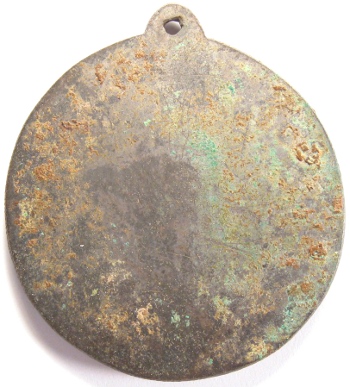
    Reflective side of Daoist mirror
    Reflective side of Daoist mirror

    This is the “reflective” side of the mirror.

    Since it is believed that this mirror was used to provide protection, the mirror was probably hung with the inscription side facing outwards.

    Mirrors used for this purpose frequently had concave surfaces.  This mirror is actually concave on its inscription side.  A concave mirror “inverts” the image of a ghost, and thus “overturns” any evil influences.

    Daoist priests also used the concave bronze mirrors to collect dew which, because of its “purity”, was used in rituals.

    This talisman mirror with Daoist magic script characters was probably cast during the Qing Dynasty and is actually quite small.  It has a width of 5.3 cm and a weight of 37.6 grams.

  • Japanese Charm of the “Great Buddha of Kamakura”

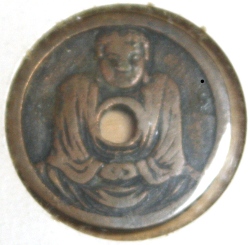
    Japanese Buddhist Charm
    Japanese Buddhist Charm

    A reader was having trouble identifying this “Chinese” charm and wrote me asking if I could provide any assistance.

    The image displays a Buddha meditating in a lotus position.

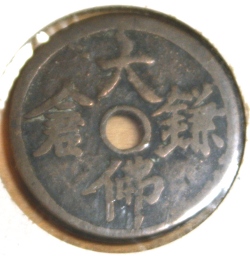
    The charm is made of bronze, has a broad rim, and has a round hole in the center.


    Inscription: "Great Buddha of Kamakura"

    The Chinese characters on the other side of the charm are read in the following order: top, bottom, right, left.

    The inscription is da fo lian cang (大佛鐮倉), using Chinese pronunciation, and translates as “Great Buddha of Kamakura”.

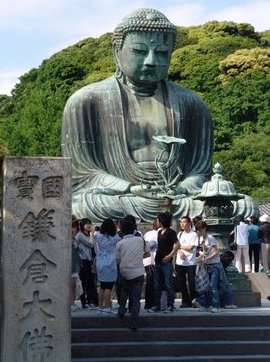
    Great Buddha of Kamakura
    Great Buddha of Kamakura

    The charm is actually Japanese and the image is of a large statue in Japan known as the “Great Buddha of Kamakura”.

    At the left is a picture of the “Great Buddha” (Daibutsu in Japanese) which is a very large bronze statue at the Kotokuin Buddhist temple near the city of Kamakura, Japan.

    The Buddha is 13.35 meters (43.8 feet) tall and weighs 93 tons.  It is the second largest monumental Buddha in Japan.

    The statue was cast in 1252 AD and was originally enclosed inside a wooden structure.  During the late 1400’s, the wooden structure was washed away during a tsunami and the Buddha has been sitting outdoors ever since.

    This is the Amitabha (Amida) Buddha associated with the Pure Land sect of Buddhism which originated in China and spread to Japan during the 12th century.

    The inscription on the stone tablet seen in the picture translates as “National Treasure: Great Buddha of Kamakura”.

    Over the centuries, Buddhist charms originating in Japan have frequently been found in China.  These charms are discussed at Buddhist Charms.