Arthur Henderson Smith was a famous American missionary who went to China in 1872. He worked in Shandong Province until the Boxer Rebellion forced him to flee and take refuge at the Legation Quarter in Peking in 1900.
Smith wrote several books about China including “Village Life in China” which was published in 1899.
Stringing Cash Coins
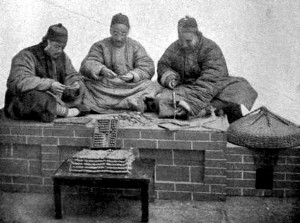
The book contains a rare photograph, shown at the left, of men in the process of putting cash coins on strings.
Counting the coins and placing them on strings was a laborious task as described below:
“The sales which have been made during the day are for small sums only, and as all the cash has to be counted and strung on hemp cords so as to make the full string of 1,000 cash (or 500 in some parts of the country), this counting and stringing of the money takes a great deal of time, and is very tiresome work when done by the quantity…”
“Money-changers charge for the trouble of stringing the coins and also for the cost of the string by deducting a certain number of Cash from each roll. This rate of discount is fixed locally so that the Tiao (diao 吊), which normally consists of 1,000 Cash, may contain in one district 965 and in another 980 actual coins.”
Even in stringing cash coins, the Chinese did not want to miss an opportunity to make an additional profit as Smith describes below:
“In the case of firms having any considerable business, after the day’s work is all over, the clerks are liable to be required to spend the evening in untying all the numerous strings of cash that have come in, with a view to the discovery of any rare coins that might be sold at a special price. All is fish that comes to a Chinese net, and sooner or later there is very little that does not find its way there to the profit of its owner.”
While it is common for coin collectors to closely examine each coin in a string of cash looking for rare specimens, it is surprising to learn that merchants during the Qing Dynasty routinely did so as well.
The two American cyclists reach north China in 1892. Few Chinese had ever seen a Westerner, much less a bicycle.
Two Americans decided to take a trip.
The year was 1890 and Thomas G. Allen Jr. and William L. Sachtleben had just graduated from my alma mater, Washington University in St. Louis.
The “ordinary” (“penny-farthing“) bicycle with the very large front wheel and very small back wheel was just beginning to be replaced by the new “safety” bicycle which had two small wheels with the rear wheel driven by chain and sprocket.
They decided to ride around-the-world on this new type of bicycle. They also purchased the newly introduced Kodak film camera to record their journey.
Their adventure was documented in a book they authored entitled “Across Asia on a Bicycle” and published in 1894.
During the three year journey, they experienced tremendous adventures.
Their travel across China began in 1892 in Kuldja which was the Russian name for the city of Yining in the far western region of Xinjiang.
Preparations for the grueling crossing to Peking were meticulous:
“Our work of preparation was principally a process of elimination. We now had to prepare for a forced march in case of necessity.
“Handle-bars and seat-posts were shortened to save weight…
“The cutting off of buttons and extra parts of our clothing, as well as shaving of our heads and faces, was also included…”
But a major challenge was how to carry money as these excerpts reveal:
“And now the money problem was the most perplexing of all.
“This alone,” said the Russian consul, “if nothing else, will defeat your plans.
“We thought we had sufficient money to carry us, or, rather, as much as we could carry…for the weight of the Chinese money necessary for a journey of over three thousand miles was, as the Russian consul thought, one of the greatest of our almost insurmountable obstacles.
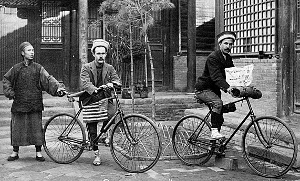
William L. Sachtleben (right) with a Russian friend “loaded with enough Chinese ‘cash’ to pay for a meal at a Kuldja restaurant”.
“In the interior of China there is no coin except the chen or sapeks (referring to qian 钱 or “cash coins”), an alloy of copper and tin, in the form of a disk, having a hole in the center by which the coins may be strung together.
“The very recently coined liang, or tael (referring to Chinese minted ‘silver dollar’ coins), the Mexican piaster (referring to the Mexican silver coin) specially minted for the Chinese market, and the other foreign coins, have not yet penetrated from the coast. For six hundred miles over the border, however, we found … the Russian money… serviceable among the Tatar merchants, while the tenga (a silver coin of Russian Turkestan), or Kashgar silver-piece, was preferred by the natives even beyond the Gobi, being much handier than the larger or smaller bits of silver broken from the yambabricks.
“All, however, would have to be weighed in the tinza, or small Chinese scales we carried with us, and on which were marked the fün, tchan, and liang of the monetary scale.
“But the value of these terms is reckoned in chen (Chinese cash coins), and changes with almost every district. This necessity for vigilance, together with the frequency of bad silver and loaded yambas, and the propensity of the Chinese to “knock down” on even the smallest purchase, tends to convert a traveler in China into a veritable Shylock.
“There being no banks or exchanges in the interior, we were obliged to purchase at Kuldja all the silver we would need for the entire journey of over three thousand miles.
“How much would it take?” was the question… That our calculations were close is proved by the fact that we reached Peking with silver in our pockets to the value of half a dollar.
“Our money now constituted the principal part of our luggage…
“Most of the silver was chopped up into small bits, and placed in the hollow tubing of the machines to conceal it from Chinese inquisitiveness, if not something worse.
“We are glad to say, however, that no attempt at robbery was ever discovered, although efforts at extortion were frequent, and sometimes…of a serious nature.”
The journey took three years and ended in New York in 1893. They became instant celebrities just as bicycling was beginning to become very popular.
Their extraordinary adventure, which I encourage you to read in its entirety, was described by one journalist as “the greatest journey since Marco Polo”.
In the year 621 AD, Emperor Gaozu of the newly established Tang Dynasty introduced a new coin with the inscription kai yuan tong bao (開元通寶) which set a standard that lasted for some 1200 years.
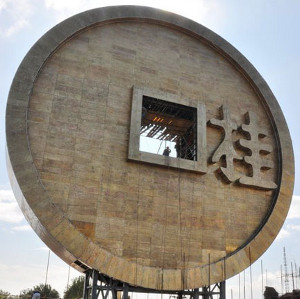
Although the last kai yuan tong bao coin was cast many centuries ago, a new kai yuan tong bao coin recently appeared in Guiyang Prefecture (桂阳县) which is part of the city of Chenzhou (郴州) located in China’s southern province of Hunan (湖南).
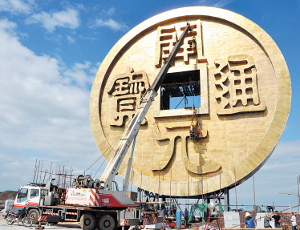
The ancient coin measured about 24 mm in diameter. The new “coin” is actually a sculpture and is considerably larger with a diameter of 24 meters (78.7 feet).
This is the largest copper coin sculpture in the world according to Chinese news reports published August 30, 2013.
World’s largest copper coin sculpture at the Baoshan National Mining Park in Guiyang.
At the left is the image of the new copper sculpture of a kai yuan tong bao coin being put on display at the Baoshan National Mining Park (宝山国家矿山工园).
The Baoshan National Mining Park is a theme park commemorating the long history of mining in the area which dates back to the Han Dynasty (206 BC – 220 AD).
The new coin sculpture will be open to the public beginning in the middle of September.
The coin sculpture has an internal steel structure with copper sheets on the exterior. It has a thickness of 3.8 meters (12.5 feet).
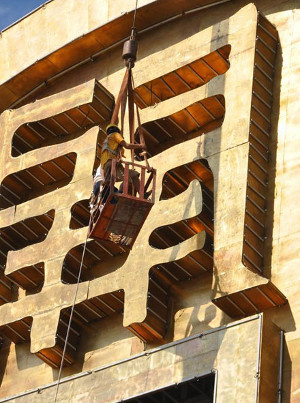
A construction worker is dwarfed by the huge Chinese characters on the coin sculpture.
This image gives a better indication of the large scale of the sculpture.
Workers are dwarfed by the huge size of the Chinese characters forming the coin’s inscription.
The calligraphy on the original coins was done by Ouyang Xun (欧阳询) who was one of the most famous calligraphers of the time.
The style is a unique combination of “seal” (zhuan 篆), “official” (li 隶) and “regular” (kai 楷) scripts evoking a solemn and dignified appearance which had a profound impact on the calligraphy used on the generations of cash coins that followed.
The coins cast during the earlier years of the Tang Dynasty had no Chinese characters on the reverse side although some did exhibit “moons” (月) and “stars” (星).
This changed, however, during the reign (840-846) of Emperor Wu Zong who was devotee of Daoism. During his “Huichang” (会昌 841-846) era, he ordered the confiscation of copper statues, bells, gongs, etc. from Buddhist temples and used the copper to cast kai yuan tong bao coins.
These “Huichang” period coins are distinguished from the earlier ones by having a Chinese character on the reverse side indicating where the coin was minted.
There were a total of 22 mints operating at the time.
One of the 22 mints was in Guiyang near where the coin sculpture is located.
The Chinese character “gui” represents the coin mint in Guiyang during the Tang Dynasty.
As can be seen in the image at the left, the reverse side of the coin sculpture also has the Chinese character gui (桂).
Emperor Wu Zong reigned for only 6 years.
The “huichang” era kai yuan tong bao coins did not begin to be produced at the Guiyang mint until the 5th year (845) of this reign period. Coins with the “gui” (桂) mint mark were only cast for a little more than one year.
The news reports state that because not many of these coins were cast, they are now fairly difficult for coin collectors to obtain.
As already mentioned, this sculpture of a copper coin is believed to be the largest in the world. The Guiyang Tourism Department has arranged for representatives from Guinness World Records to visit the site this month to verify the fact.
(A video of this large coin sculpture may be seen here.)