A large quantity of coins dating to the Tang and Song dynasties was recently unearthed by a large excavator removing silt from a river in Yancheng (盐城市), Jiangsu Province, according to media reports.
At approximately 10:00 AM on March 21, the excavator was dredging a small 6-meter wide river that runs through Longgang Town (龙冈镇) in Yancheng when it uncovered a pile of ancient Chinese cash coins that had been stored in a earthenware pot.
Villagers digging for buried coins
Word of the discovery quickly spread and, as can be seen in the image at the left, many of the local villagers hurried to the site to search for “treasure” buried in the mud.
It is estimated that the villagers recovered 200 – 300 catties (斤) equivalent to about 267 – 400 lbs (121 – 181 kgs) of coins before the authorities arrived on the scene to restore order and protect the “cultural relics” which, according to Chinese law, belong to the state.
Mr. Zhao Yongzheng (赵永正) of the Archaeology Department of the Yancheng Museum (盐城市博物馆考古部) rushed to the scene and provided information on the discovery.
A preliminary investigation, according to Mr. Zhao, identifies the coins as dating to the Tang and Song Dynasties.
Media reports mention that among the coins dug up were kai yuan tong bao (开元通宝) from the Tang dynasty as well as tai ping tong bao (太平通宝), zheng he tong bao (正和通宝), and xiang fu yuan bao (祥符元宝) from the Northern Song dynasty.
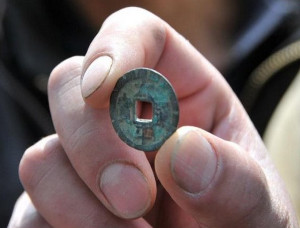
“Tai ping tong bao” coin dating from the Song Dynasty found by a Yancheng villager
The image is clear enough that the coin can be identified as a tai ping tong bao (太平通宝) which was cast during the years 976 – 989 of the reign of Emperor Taizong of the Northern Song Dynasty.
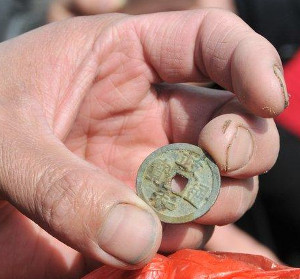
“Tian sheng yuan bao” coin from the Song Dynasty
Another coin dug up by a villager can be seen in this image.
The coin is a tian sheng yuan bao (天圣元宝) written in seal script.
Coins with this inscription were cast during the years 1023 – 1031 of the reign of Emperor Renzong of the Northern Song Dynasty.
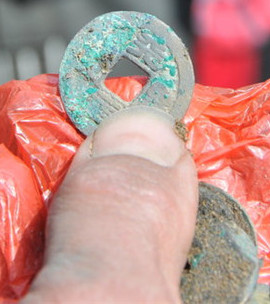
The newspaper articles contained the image of one additional Song Dynasty coin.
“Zheng he tong bao” coin from the Song Dynasty found by a villager
This coin was cast during the years 1111 – 1117 of the reign of Emperor Huizong of the Northern Song.
Mr. Zhao stated that because the coins were mainly from the Tang and Northern Song dynasties, this coin cache was probably buried at the beginning of the Southern Song dynasty (1127 – 1279).
Several of the village elders were able to provide information in regard to the possible source of the coins.
In the distant past, a temple was situated on the site. The temple was later destroyed but the coins may be linked to the ancient temple.
The village elders also recalled that old coins were discovered in about the same area in 2007.
Beginning in very ancient times, the Chinese included money among the objects buried with the deceased.
This burial money was referred to as yi qian (瘗钱), meaning “buried money”, or ming qian (冥钱), meaning “dark money”.
The money was to be used by the deceased in the afterlife to make life more comfortable. It was also offered as a “bribe” to Yan Wang (阎王 or yanluowang 阎罗王), the judge of the underworld, to encourage him to act quickly and favorably in regard to the spirit.
Ancient China had a number of interesting forms of money.
Graves evacuated from the Shang Dynasty (商朝 c. 1600 BC – 1046 BC) sometimes include thousands of cowrie shells. As an example, the Tomb of Fu Hao (妇好墓), dating from about 1200 BC, was found to contain 6,900 cowry shells.
Because the quantity of natural cowries were limited and could not meet the demand, bronze versions of the cowrie shell were cast and circulated as money.
During the Warring States period (战国时代 475 BC – 221 BC), other metal forms of money appeared. These early “coins” took on various shapes and included spade (bubi 布币), knife (daobi 刀币), ring-shaped coin (huan qian 环钱), ant nose (yibiqian 蚁鼻钱) and banliang (“half-tael” 半两).
These forms of money were also buried as funerary objects.
Unfortunately, the custom of burying money in tombs attracted the attention of grave robbers who throughout the ages have dug up graves in order to steal buried money and other valuable artifacts.
Having the grave of a relative desecrated in such a manner was extremely unsettling to the living relatives. The spirit of the deceased was disturbed and the money meant to ensure his comfort in the afterlife was gone.
To minimize the chances that a tomb would be disturbed, a change took place involving burial money. Instead of real money, imitation money was sometimes used.
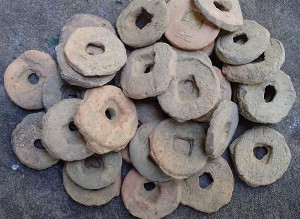
This imitation money resembled real money but instead of being made of bronze, silver or gold, it was made of hardened clay.
These imitation coins are known as “clay money” (ni qian 泥钱) or “earthenware money” (tao tu bi 陶土币).
According to “Han Material Culture” by Sophia-Karin Psarras, any representation of currency was acceptable as legal tender in the afterlife. Therefore, surrogate forms of money made of clay could be used in lieu of real bronze, silver or gold money.
Since clay money had no value in the world of the living, it was believed that grave robbers would leave the deceased to rest in peace.
The use of surrogate currency was used by both the rich and poor alike since even families of modest means could afford to buy the imitation coins to bury with their relatives.
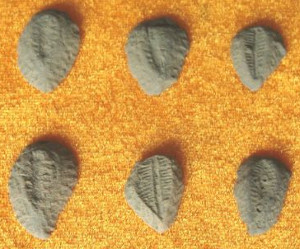
Clay cowrie shell money (泥贝币)
The wealthy who buried real money in tombs would often also include coins made of clay.
At the left can be seen cowries made of clay that were produced specifically to be buried in graves.
These particular specimens are unusually well-made.
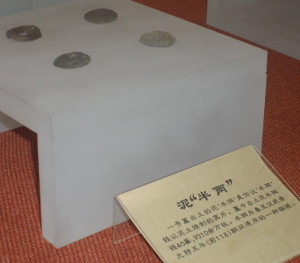
Clay banliang (泥半两) coins excavated from a Han Dynasty tomb at Mawangdui
The primary form of money that circulated during the Qin Dynasty (秦朝 221 BC – 206 BC), as well as the early Western Han Dynasty (西汉 206 BC – 24 AD), was the banliang (半两) coin made of bronze.
At the left are several clay banliang coins (泥半两) that were excavated from Tomb No.1 at Mawangdui and are seen here at an exhibit held at the Tianjin Museum.
Mawangdui (马王堆) is a major archaeological site located at Changsha (长沙), Hunan Province that includes three Western Han Dynasty tombs.
Tomb No. 1 is the resting place of Lady Dai (Xin Zhui 辛追).
Lady Dai’s tomb was one of China’s most important archaeological discoveries. As an example, more than 100,000 clay banliang coins were recovered from her tomb.
Clay wuzhu coins (泥五铢) unearthed from a Han Dynasty grave
Beginning in 118 BC of the Western Han Dynasty (西汉) and continuing for more than 700 years, the major form of currency was the bronze wuzhu (五铢) coin.
These coins are commonly referred to as “cash coins”.
In addition, the “zhu” in wuzhu can refer to the trunk of the 300 li tall fusang (扶桑) tree which is an auspicious symbol that guides the dead on the journey to the heavens and immortality, according to Susan Erickson in her article “Money Trees of the Eastern Han Dynasty”.
(For more information about money trees discovered in Han Dynasty tombs please see “Chinese Money Trees“.)
The wuzhu coins played a more down-to-earth role as well. The Chinese view of the afterlife gradually evolved so that the spirit world was seen to be similar to the earthly world. The money in the tombs could therefore be used by the deceased to pay taxes to the otherworldly government.
Clay “daquan wushi” (泥大泉五十) coin
Clay versions of coins from later dynasties have also been unearthed in tombs.
As an aside, during the Tang Dynasty there was an autonomous region in what is now Hebei that was under the control of a warlord named Liu Rengong (刘仁恭). He minted clay coins and iron coins, and then forced the people to trade in their bronze coins for these coins. This is a rare case where clay coins were officially minted for circulation and not for funeral use. Unfortunately, no specimens of these clay coins are known to exist.
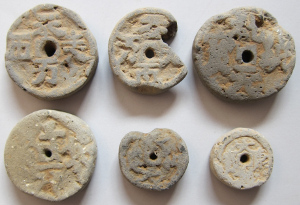
Clay burial coins which imitate Song and Jin dynasty coins discovered in a tomb in Shanxi Province.
The coin at the far right, for example, is a clay version of the chong ni zhong bao (崇宁重宝) coin written in Li script (“clerical script” 隶书) and minted during the years 1102-1106 of the reign of Emperor Huizong of the Northern Song Dynasty.
The inscription on the clay coin at the top left, for example, is tian chao wan shun (天朝万顺). Authentic Liao coins with the inscription tian chao wan shun are extremely rare and even clay burial versions are not often seen.
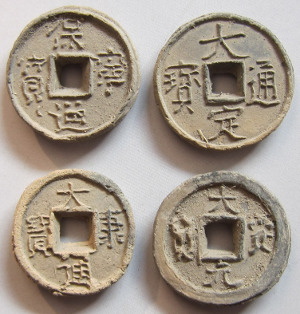
Liao and Jin dynasty clay coins recovered from a Liao dynasty pagoda
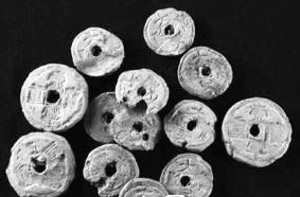
Clay burial coins with inscriptions of other very rare Liao coins were also discovered in the foundation of a Liao Dynasty pagoda.
Examples of these coins can be seen at the left.
The clay Liao coins included bao ning tong bao (保宁通宝), seen at the top left, and da kang tong bao (大康通宝) , seen at the bottom left.
Also discovered were a clay version of the da ding tong bao (大定通宝) coin from the Jin Dynasty which is shown at the top right.
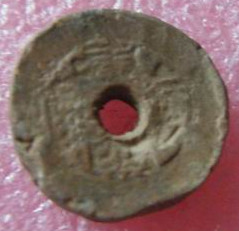
Clay burial coin from the Qing Dynasty
Clay coins for burial use were being “minted” even as late as the Qing Dynasty (1644-1911).
Coins with this inscription were cast during the years 1736-1795 of the reign of the Qianlong Emperor.
In addition to “low currency” (下币) money consisting of bronze coins such as the banliang and wuzhu coins that commonly circulated during the Qin and Han dynasties, there was also a “high currency” (上币) form of money that made its appearance during the Warring States period.
This money was made of gold and was used as currency as well as for sacrificial offerings, rewards, fines, etc.
Kings, nobility and the wealthy were frequently buried with this type of gold money in their tombs.
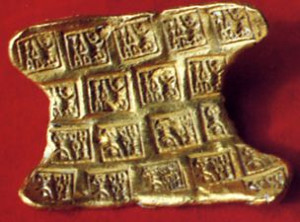
Gold plate money (ying yuan 爰金) from the State of Chu
An example of the gold money that circulated in the State of Chu during the Warring States period may be seen at the left.
This money is known as yuan jin (爰金) and consists of small square gold cubes connected together in a form best described as a slab, plate or sheet. Individual squares could be broken off and spent as needed.
The yuan (爰) was a unit of weight and jin (金) means “gold”.
Each of the gold squares was also inscribed with Chinese characters. For this reason, these “coins” are also known as yin zi jin (印子金), jin ban (金钣) or gui bi (龟币). They are sometimes referred to in English as “ying yuan”, “gold plates”, “seal gold”, or “gold cube money”.
Some have the characters ying yuan (郢爰). Ying (郢), which was situated in what is now Jingzhou (荆州) County in Hubei Province, was the capital of the State of Chu.
The other inscription found on these gold coins is chen yuan (陈爰). After the Qin army captured the capital city of Ying, the State of Chu moved their capital to Chen which was located in what is now Huaiyang (淮阳), Henan Province.
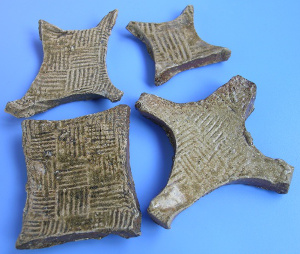
Clay versions of State of Chu gold plate money (泥”郢称”(楚国黄金货币)) found buried in tombs of the Warring States Period
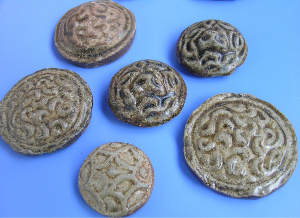
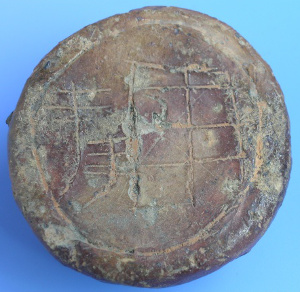
At the left are clay specimens of the State of Chu’s yuan jin gold money (泥”郢称”(楚国黄金货币)) that have been recovered from tombs.
These particular specimens were unearthed in Zhejiang Province which was part of the ancient State of Chu during the Warring States period.
More than 300 pieces of this clay replica gold currency were also recovered from Lady Dai’s tomb at Mawangdui.
As can be seen, the imitation money has the same overall shape as the real gold money but is made of clay.
Careful observation shows that the surface design on these imitation sheets of gold money resembles square pieces of cloth or fabric.
This design could not be adequately explained prior to the discovery of Lady Dai’s tomb.
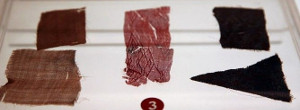
Silk funerary money (丝织品做的冥币) recovered from Tomb No. 1 (Lady Dai) at Mawangdui
Silk was a valuable commodity in ancient times and bolts of silk could also function as a form of currency. Small “denominations” of this “money” were created by cutting the silk into small squares.
Several of these small square silk “coins” (丝织品做的冥币) were recovered from Lady Dai’s tomb at Mawangdui. This was the first time such silk squares functioning as a form of burial money had been discovered.
It is believed that the State of Chu’s distinctive sheet form of gold money with the connected small squares may have been based on this very early type of silk money.
This would also explain why the clay imitation version of the gold money has a surface design that resembles fabric.
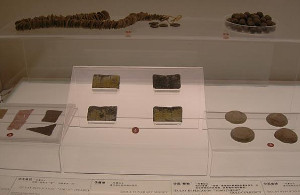
Various forms of burial money recovered from Tomb No. 1 (Lady Dai) at Mawangdui
Lady Dai’s tomb actually contained a rich assortment of burial money.
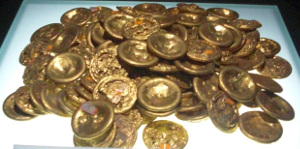
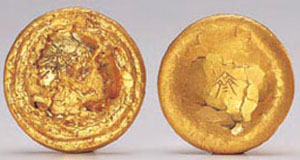
One type of gold currency was about the size of a “cookie” and had the shape of a flattened half-sphere with the top convex and the bottom concave.
This form of gold money is variously referred to as a gold pie, gold cake, gold biscuit, gold bing ingot, gold button ingot, etc.
In Chinese it is known as jin bing (金饼).
According to this article, a gold pie has a high gold content of 97-99% and weighs about 248 grams (210 ~ 250 g.) which would be the equivalent of about 1 jin (斤) during the Han Dynasty.
Nowadays, Chinese burial customs have changed somewhat. Real and imitation money is no longer buried with the dead. Instead, paper money known as joss paper (“gold paper” 金纸, 阴司纸), Hell money, Hell banknotes, and ghost money is burned instead.
While the custom has evolved, the basic concern for the financial well-being of the deceased remains the same.
Hell bank notes burned at funerals today have hyperinflated denominations of $10,000 to $5,000,000,000 or more.
While such large bank note denominations may appear excessive to us today, we have already seen that 2000 years ago there existed “clay” gold cake money valued at 1,000,000 cash coins.
Printed paper money involves two of the Four Great Inventions attributed to the Chinese, namely the inventions of papermaking and printing.
Cai Lun (蔡伦 50 – 121 AD), an official of the imperial court during the Han Dynasty, is recognized as the inventor of paper.
The Chinese were the first to use paper money which began during the Tang Dynasty (618 – 907 AD) but was not widely used until the beginning of the Song Dynasty (960 – 1279).
Historians can only speculate as to what that first paper money from the Tang Dynasty, known as “flying cash” or “flying money” (飞钱), may have looked like since no verified specimens are known to exist.
And, it is possible that the first paper money may have been printed on yellow paper in order to give the appearance of the ancient gold sheet money dating back to the State of Chu.
There exist specimens of paper money which some collectors claim to be authentic “flying money” notes from the Tang Dynasty that are “printed on yellow paper using black ink”.
The current practice of burning joss and hell bank notes to provide money for the afterlife can be seen as the latest stage in the evolution of a custom that began in very ancient times with the burying of real and imitation money.