Month: July 2015

  • Song Dynasty Coin Moulds Found in Salt Lake

    Two enthusiasts of the “salt lake culture” were taking pictures of birds at the Yuncheng “salt lake” (运城盐池) when they accidentally discovered a number of clay moulds (模具) used to cast iron coins (铁钱) during the Northern Song dynasty (北宋 960-1127), according to an article published June 16, 2015 by the Yuncheng News Network (运城新闻网).

    Yuncheng (运城) is located in north China’s Shanxi Province (山西) and its large salt lake (盐湖) is known as “China’s Dead Sea” (中国死海).

    Because of its huge quantities of salt, the salt lake has historically been a valuable resource.  Beginning in the Tang Dynasty (唐朝 618-907), a “Forbidden Wall” (禁墙) was built around the lake to protect this important source of tax revenue and to prevent stealing and smuggling.

    While the wall no longer exists, it is fortunate that a few old and rare photographs have survived which show the wall’s gates.

    This photograph, which is in the archives of the Smithsonian Institution (史密森学会), shows one of the wall’s gates seen by the Robert Sterling Clark expedition in 1908-1909.  Also, the undated photograph in this article shows the wall’s middle gate (中禁门).

    Two bird photographers at the Yuncheng salt lake discover more than 500 clay moulds used to cast iron coins during the Song Dynasty
    Two bird photographers at the Yuncheng salt lake discover more than 500 clay moulds used to cast iron coins during the Song Dynasty

    The image above shows Mr. Jing Xiaoxiong (景晓雄) and Mr. Zhang Xiaobie (张小别) who are credited with discovering the coin moulds at the Yuncheng salt lake.

    They recovered more than 500 moulds although many are in poor condition.

    Inscriptions on the coin moulds include chong ning tong bao (崇宁通宝), zheng he tong bao (政和通宝) and zheng he zhong bao (政和重宝) written in seal script (篆体), as well as da guan tong bao (大观通宝) and yuan feng tong bao (元丰通宝).
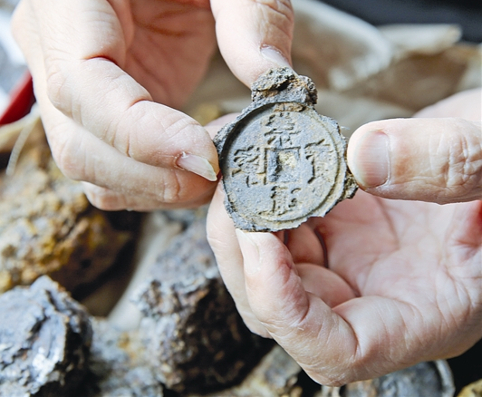
    Clay mould used to cast "chong ning tong bao" iron coins during the Song Dynasty
    Clay mould used to cast “chong ning tong bao” iron coins during the Song Dynasty

    As can be clearly seen in the above image, the inscription is chong ning tong bao (崇宁通宝) which indicates that this mould was used to cast iron coins during the years 1102-1106 of the reign of Emperor Huizong (宋徽宗) of the Northern Song dynasty.

    The beautiful calligraphy used for this coin is known as “Slender Gold” script (瘦金书) and was done by Emperor Huizong himself.
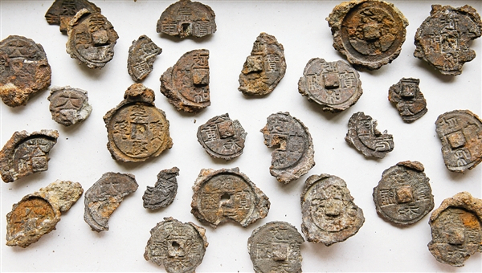
    Examples of moulds used to cast Northern Song iron coins discovered at Yuncheng's salt lake
    Examples of moulds used to cast Northern Song iron coins discovered at Yuncheng’s salt lake

    The image above displays 26 of the coin moulds.

    The inscriptions are still very distinct.
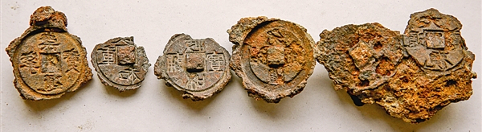
    Several of the better preserved clay coin moulds
    Several of the better preserved clay coin moulds

    The inscriptions on the clay moulds in the image above are identified in the article as “chong ning tong bao (崇宁通宝), zheng he zhong bao (政和重宝),   zheng he tong bao (政和通宝), and yuan feng tong bao (元丰通宝)”.

    However, the inscription on the mould at the far right appears to me to be da guan tong bao (大观通宝).

    The discovery of the coin moulds is actually quite puzzling.

    Yuncheng was known as Hedong (河东) in ancient times.  According to historical documents, Hedong did not have a mint during the Song dynasty.  Furthermore, no ruins of any mint have ever been discovered in the area.

    The discovery of the clay moulds will encourage further study of Song dynasty ruins in the Yuncheng area in the search for an ancient coin mint.


  • Villagers Dig for Coins in Grand Canal

    Villagers in Linqing (临清), Shandong Province (山动省) dig for old coins in China’s ancient Grand Canal (大运河) when the water level is low, according to an article published July 2, 2015 by linqing zaixian (临清在线).

    The Grand Canal is the longest canal in the world.  Construction began in the 5th century BC.  The canal runs from Beijing (北京) to Hangzhou (杭州) and links the Yellow River (Huang He 黄河) and the Yangtze River (Chang Jiang 长江).

    The Grand Canal beneath the Linqing Bridge. Villagers can be seen digging for coins at the lower left.
    The Grand Canal beneath the Linqing Bridge. Villagers can be seen digging for coins at the lower left.

    Linqing is located about 380 km (240 mi) south of Beijing where the Wei River (卫河) meets the Grand Canal.

    During the Ming (明朝 1368-1644) and Qing (清朝 1644-1912) dynasties, Linqing was an important trading center for textiles and grains.  It was also famous for its brickyards which produced bricks that were used to build palaces and tombs in the capital.

    Linqing’s nightlife was immortalized in the famous Ming dynasty sexually graphic novel Jin Ping Mei (金瓶梅), known in the West as The Plum in the Golden Vase or The Golden Lotus:

    《金瓶梅》书中所写临清是个热闹大码头去处,“有三十二条花柳巷,七十二座管弦楼”.

    Linqing is a place having large and bustling docks with “thirty-two ‘Flower and Willow’ lanes and seventy-two ‘Wind and String’ houses”.

    “Flower and Willow” refers to a red-light district (花街柳巷) and “Wind and String” (musical instruments) refers to sing song houses.

    Villagers digging for buried coins
    Villagers digging for buried coins

    The months of June and July are traditionally the dry period along the Wei River.  Whenever the water level is low, the villagers take the opportunity to dig for ancient coins on the river bottom.

    At the left, villagers can be seen digging for the buried “treasure”.  The villager in the red shirt can even be spotted in the image of the bridge above.

    The coins recovered are usually from the Ming or Qing dynasties but much older coins are also found.

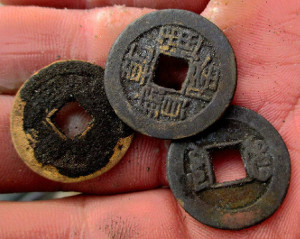
    Qing Dynasty coins dug up in Grand Canal
    Qing Dynasty coins dug up in Grand Canal

    Shown at the left are the Qing dynasty coins a villager found after only a few minutes of digging.

    Even though the coins have been buried for hundreds of years and show surface corrosion, the coin inscriptions can still be easily read.

    The inscription on the coin at the top is qian long tong bao (乾隆通宝) which means the coin was cast during the years 1736-1795 of the reign of the Qianlong Emperor (乾隆帝).

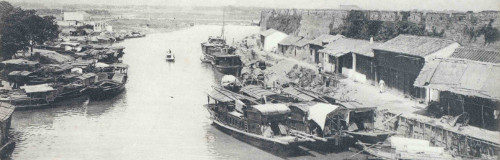
    The Grand Canal in Suzhou during the Qing dynasty
    The Grand Canal in Suzhou during the Qing dynasty

    The photograph above shows the Grand Canal as it existed in Suzhou (苏州) during the Qing dynasty.

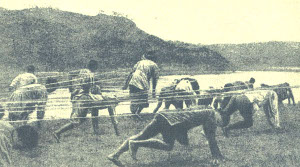
    Boat trackers towing a boat on the Grand Canal during the Qing Dynasty
    Boat trackers towing a boat on the Grand Canal during the Qing Dynasty

    When conditions permitted, the boats relied on wind power to move along the canal.

    Otherwise, the boats were pulled on ropes by teams of men known as “boat trackers” (纤夫), as can be seen in this Qing dynasty photograph.

    Since there usually was no tow-path on the shore, trackers frequently waded through chest deep water in the canal.

    The boats and barges had flat bottoms.  In bad weather conditions, winds could cause them to overturn and lose their cargoes.

    After having been buried for several centuries, some of those cargoes have been recovered and are displayed in the the China Great Canal Museum (中国京杭大运河博物馆) located in Hangzhou (杭州).

    Among the coins on display are wu zhu (隋五珠) coins dating from the time of the Sui dynasty (隋朝 581-618) when the various sections of the canal were finally combined.

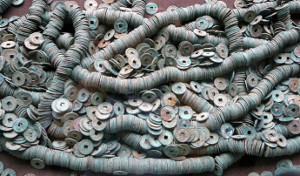
    Some of more than 40,000 Tang dynasty "kai yuan tong bao" coins excavated from the Grand Canal in 2004
    Some of more than 40,000 Tang dynasty “kai yuan tong bao” coins excavated from the Grand Canal in 2004

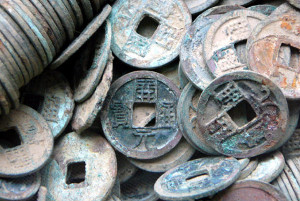
    At the left is a small portion of the more than 40,000 Tang dynasty (唐朝 618-907) kai yuan tong bao (开元通宝) coins that are on display at the museum.

    These coins were unearthed in 2004 from the Grand Canal in an area near the Da Guan Bridge (大关桥) in Hangzhou.

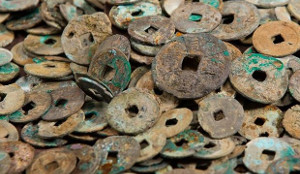
    Close-up of "kai yuan tong bao" coins dug up from the Grand Canal in 2004
    Close-up of “kai yuan tong bao” coins dug up from the Grand Canal in 2004

    A more detailed view of some of the coins is shown here.

    As can be seen, the coins are very well preserved despite having been buried for more than 1,300 years.

    Large quantities of ancient coins from other dynasties have also been recovered.

    Song dynasty coins recovered from the Grand Canal on display at the Zhongce Accounting Museum in Hangzhou
    Song dynasty coins recovered from the Grand Canal on display at the Zhongce Accounting Museum in Hangzhou

    At the left are some of the Song dynasty (宋朝 960-1279) coins that have been unearthed from the canal.

    These coins are on display at the Zhongce Accounting Museum (中策财会博物馆) in Hangzhou.

    Like the Great Wall (万里长城), the Grand Canal was one of the monumental engineering projects of ancient China, and to this day continues to reveal its history through discoveries of long buried treasures.

  • Chinese Charm with Musicians, Dancers and Acrobats

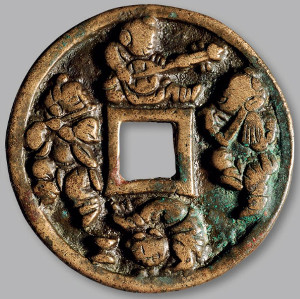
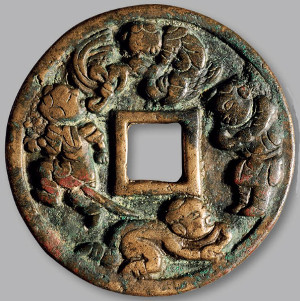
    This is a rare and exquisitely made charm.  However, there is no Chinese inscription and collectors are still uncertain as to its theme.

    The charm, which first appeared during the Liao (辽朝 907-1125) or Song (宋朝 960-1279) dynasties, is believed to depict huren playing musical instruments, dancing, and doing acrobatics (胡人乐舞杂伎).

    Hu (胡) means “beard” so the term huren (胡人) means “bearded people”.  Huren referred to foreigners from north, west and central Asia who wore thick beards.  In ancient times, the term huren translated as “barbarian” because the Chinese believed the huren were “uncivilized” in comparison to the Han Chinese (汉族) and their great culture.

    Nevertheless, these “barbarians” would eventually rule China during the Tartar dynasties.  The Liao dynasty (907-1125) was ruled by the Qidan (Khitan 契丹族), the Jin dynasty (金朝 1115-1234) was ruled by the Nuzhen (Jurchen 女真族), and the Western Xia (Xi Xia 西夏 1032-1227) was ruled by the Tangut (西藏人).

    Charm depicting three dancing musicians and an acrobat
    Charm depicting three dancing musicians and an acrobat

    As seen at the left, the charm displays four individuals.  Three are playing musical instruments while the fourth (bottom) is doing a handstand or similar acrobatic stunt.

    Even though the figures are referred to as huren in numismatic catalogs, none appear to have beards.

    The four figures are remarkably lively.  They can easily be compared to the famous Eastern Han (东汉朝 25-220) tomb sculpture of a storyteller dancing and beating his drum.

    Huren were noted for their musical and dancing prowess.  Poets at the time described their energetic dances as “barbarian leaps” (胡腾舞).

    Tang Dynasty tomb painting of Huren dancing and playing musical instruments
    Tang Dynasty tomb painting of Huren dancing and playing musical instruments

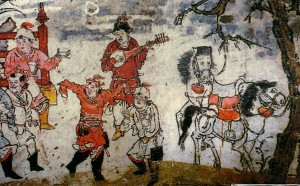
    At the left is a wall painting from a Tang dynasty (唐朝 618-907) tomb that was excavated in Loyang (洛阳), Henan province (河南省).

    The painting depicts a similar scene of beardless huren from central Asia being proficient in music and dance.

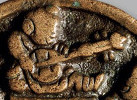
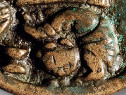
    Huren playing a string instrument
    Huren playing a string instrument

    As can be seen in the detail at the left, the musician above the square hole of the charm is playing a string instrument.

    If you look closely, you can see that the instrument has four strings as confirmed by the four pegs near the end of the long neck.

    (Based on his energetic dance moves, the musician might have been the Chuck Berry of his time.)

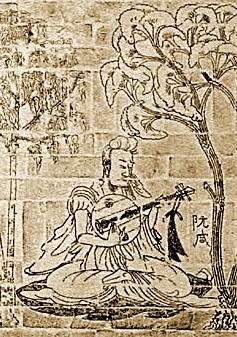
    Ruan Xian playing the ruan
    Ruan Xian playing the ruan

    The four string instrument may be a ruan (阮).

    The ruan was named after Ruan Xian (阮咸) who lived during the Six Dynasties (220-289).  The pipa (琵琶), or Chinese lute, evolved from this early string instrument.

    The ruan was held horizontally and played with a plectrum (pick) in a manner similar to today’s guitar.

    In the Tang and Song dynasties, however, musicians gradually began to hold the instrument vertically which is the way the pipa is played today.

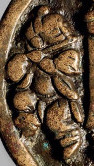
    Huren playing a flute
    Huren playing a flute

    The musician at the left of the square hole is dancing and playing a flute (dizi 笛子).

    Flutes are among the world’s oldest musical instruments.

    Chinese archaeologists have discovered flutes dating back more than 9,000 years.

    A huren flutist can also be seen on this sculpture.

    A Ming dynasty (明朝 1368-1644) porcelain  also displays a huren playing the flute.

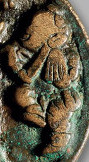
    Huren playing a wooden fish
    Huren playing a wooden fish

    The figure to the right of the square hole is standing on his left leg.  He is holding a stick in his right hand and striking an object in his left hand.

    He appears to be playing an ancient musical instrument known as a wooden fish (muyu 木鱼).

    The wooden fish was originally used in rituals by Confucians, Buddhists and Daoists.

    Over time, however, the common people began to use the wooden fish as a musical instrument.

    Huren doing a handstand
    Huren doing a handstand

    The figure at the bottom is performing a handstand or similar acrobatic stunt.

    To the left is another musical instrument, or possibly a Chinese yo-yo (kongzhu 空竹).

    Historical documents are unclear as to when the Chinese yo-yo, which evolved from the very ancient Chinese “gyro” (陀螺), actually appeared.  Some references mention the yo-yo appearing as early as the Three Kingdoms (三国 220-280) while others indicate a later date such as the Yuan (元朝 1271-1638) or Ming dynasties.

    Four children playing and having fun
    Four children playing and having fun

    The reverse side of the charm is usually described as showing four “babies” playing and having fun (婴孩嬉戏玩耍).

    It is not unusual for Liao dynasty charms to include children playing.

    Also, the figure above the square hole is often shown riding a dragon.

    The dragon-riding figure is the “mother” known as Xi Wangmu (西王母), the “Queen Mother of the West“, as can be seen in this Liao dynasty charm.

    Regarding the charm shown here, however, the person at the top is not the Queen Mother of the West.  The figure resembles the other “babies” but, nevertheless, does appear to be riding something.

    As mentioned above, this is a very rare charm.  It sold at auction in 2011 for about $46,280 (RMB 287,500).