Month: January 2021

  • ‘Chang Ming Fu Gui’ Plaque Charm

    One of the most popular ‘good luck’ inscriptions found on old Chinese charms is chang ming fu gui (長命富貴) which is the wish for “long life, riches and honor”.
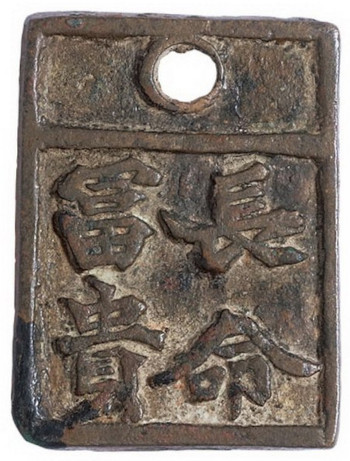
    “Chang Ming Fu Gui” pendant (plaque) charm

    Shown here is a Song dynasty (宋朝 960-1279 AD) pendant (plaque) charm sold in 2009 by Chengxuan Auctions in Beijing.

    The inscription reads as follows: top right (chang ), bottom right (ming ), top left (fu ), bottom left (gui ).

    An easily overlooked feature of this charm is that the character fu (富), meaning “riches” or “wealth”, is written in an unusual manner.

    The character fu is normally written as 富. On this charm, however, the character fu is written as .

    Do you see the subtle difference?

    The top of the character is written as “冖” (mi “cover”) instead of “宀” (mian “roof”), i.e. the small dot or vertical line at the very top is missing.

    Writing the fu character in this manner is known as fu zi wu tou (富字无头) which translates as “fu character without a top or limit”. This implies “riches without an end”. “Endless riches” are, after all, better than mere “riches”!
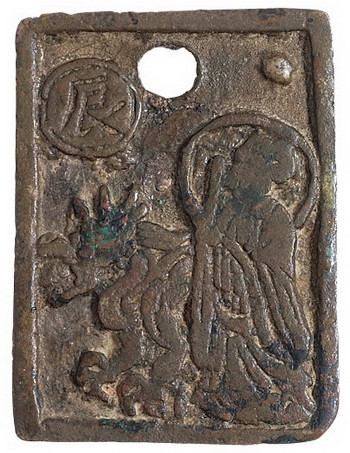
    Reverse side of “Chang Ming Fu Gui” plaque charm

    The reverse side of the charm is shown at left.

    On the right side stands a star god known as the Star Official of Dominant Vitality (本命星官).

    In Daoist (Taoist 道教) thought, each person is protected by the star god associated with the zodiacal year in which that person was born. (See Daoist Charms.)

    The star god is shown with a halo around the head and wearing a long robe.

    Clasped in his hands is a hu (笏板).
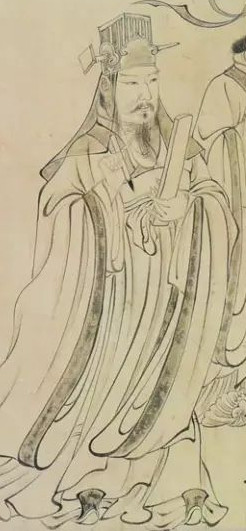
    Detail from a painting by Wu Daozi showing official holding a hu (ritual tablet or flat scepter)

    A hu is a plaque or tablet that is held in front of the chest by officials. It serves as a badge when being received in audience by the emperor. Depending on the rank of the official, the hu can be made of jade, ivory or bamboo.

    A drawing of an official holding a hu is shown at the left. This is a detail from a painting by Wu Daozi (吴道子) who was one of the most famous painters of the Tang dynasty (唐朝 618-907 AD).

    It is appropriate that a painting by Wu Daozi is used in the discussion of this charm. Some numismatists believe that the depiction of the star god on this charm is in the charming style of Wu Daozi as seen in his “The Eighty-seven Immortals” (八十七神仙圖) painting at the Xu Beihong Memorial Museum (徐悲鴻紀念館) in Beijing.

    Continuing with a description of the reverse side of the charm, there is a ferocious dragon on the left side. Only the front half of the dragon is seen because it is standing behind the star god. The dragon is the 5th of the 12 animals of the Chinese zodiac (生肖). Its presence confirms that this star god is the one in charge of those born in the year of the dragon.
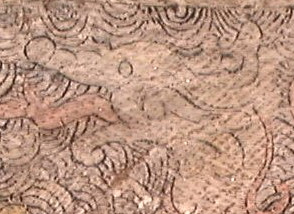
    Detail of a dragon from a bow discovered in a tomb from the Wei Jin dynasties

    The charm’s dragon is similar in style to dragons depicted during the Wei Jin dynasties (220-420 AD).

    This similarity in style can be seen in the image at left of a dragon found on a wooden bow discovered in a tomb from the Wei Jin (魏晋) dynasties.

    It should be pointed out that in the mouth of dragon on the charm is a large pearl. The pearl is a symbol of riches.

    Above the dragon is a round object representing the sun. The Chinese character displayed in the sun is chen () which is the fifth of the Earthly Branches (地支) and refers to the dragon of the Chinese zodiac.

    Above the head of the star god is a raised dot representing the moon.

    Both the inscription and images confirm that this is a ‘good luck’ charm. In ancient times, this type of charm would have been given to a newborn child or an infant having reached one-month of age (man yue 满月). The charm would have been especially appropriate for a child born in the year of the dragon.

    The charm is 31 mm in length and 24.5 mm in width. It sold at the Chengxuan auction in 2009 for $380 (RMB 2464).
  • Chinese Villager Unearths ‘Old Coin’ While Digging Ancestral Grave

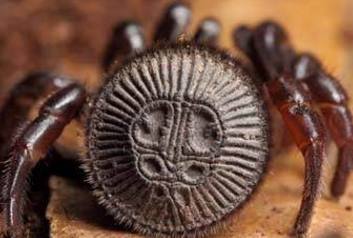
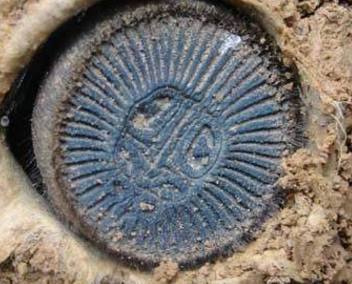
    ‘Ancient Chinese coin’ discovered by villager while digging at ancestral burial site

    A recent newspaper article tells the story of a Chinese villager who decided to move his family’s ancestral graves to a place with better feng shui (风水).

    While digging, he accidentally uncovered an ancient coin.

    He had heard stories of people becoming rich by digging up ancient Chinese coins and selling them. Now this was happening to him. He was thrilled with his good luck and anticipated that he would reap a large fortune.

    He calmed down and began to dig more slowly and carefully. Just as he was about to dig the coin out, the coin moved and frightened him.

    Once the coin was uncovered, he could “see its true face”. He did not know whether to laugh or cry.

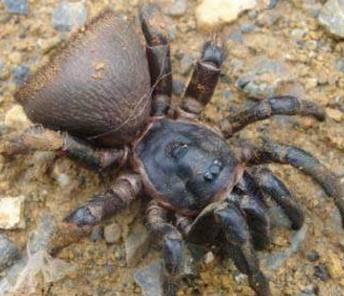
    Rare Chinese ‘Money Trapdoor Spider’ (Chinese Hourglass Spider) discovered by villager

    He was stunned that the object was not a coin at all but rather a living thing. He described it as a “scary and extremely ugly-looking spider”.

    Searching the internet, he discovered that this was an extremely rare trapdoor spider known as a Chinese Hourglass Spider (Cyclocosmia ricketti 里氏盤腹蛛).

    In China, however, it is better known as a “Money Trapdoor Spider” (金钱活板门蛛) or “Money Living-Door Spider” (金钱活门蛛). Another common name is the “Severed Abdomen Spider” (截腹蛛).

    Nevertheless, the villager was saddened that he would not be making a fortune from his “coin”.

    Money Trapdoor Spider

    As can be seen in the image at the left from Baidu Baike (百度百科), the spider has a very distinctive plate or disk on its abdomen which resembles an ancient coin, seal or grinding disc.

    These money trapdoor spiders are found in Fujian (福建), Zhejiang (浙江), Sichuan (四川) and Yunnan (云南) provinces in China as well as the tropical rain forests of Southeast Asia.

    Sichuan is the farthest north this species has been recorded. There is still much to learn about these spiders since it was previously believed that the species could not survive in areas where temperatures could drop below 13 degrees Celsius. Winters in Sichuan can get even colder.

    The males are about 2.5 cm in length and the females are slightly larger at about 2.7 cm. The largest can exceed 3 cm. The disk has a radius of about 1.6 cm.

    Mr. Zhao Li (赵力), the Director and Senior Biological Engineer at the Insect Museum of West China (华希昆虫博物馆) located in Chengdu (成都), says in another article that the money trapdoor spider fits the description of a type of arachnid mentioned in an ancient Chinese text known as the Erya尔雅》. The Erya is believed to be the oldest extant Chinese dictionary and dates to the fifth century BC.

    References to what is likely the trapdoor spider can also be found in ancient texts on Chinese medicine. For example, the “Supplement to the Materia Medica” (Bencao Shiyi 《本草拾遗》) by Tang dynasty pharmacologist Chen Cangqi (陈藏器) written in 739 AD states that “the diedang (螲蟷 a species of spider living in underground burrows) is found everywhere……it resembles a spider….a hole in the ground is the nest and on top of the hole is a cover.” The diedang can be used to treat “boils, gangrene and other sores, sarcoma (malignant tumor), …”.

    Mr. Zhao says money trapdoor spiders are very rare and there have been only eight sightings in China since the year 2000.

    Because of their rarity, these spiders bring a high price as pets. Most of the “money trapdoor spiders”, as they are called in the pet market, are artificially bred in Thailand. One spider can sell for as much as $3,860 (RMB 25,000).

    Mr. Zhao explained that the spider rests during the day and comes out at night.

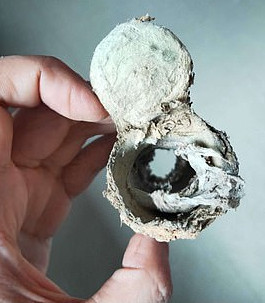
    Money Trapdoor Spider Burrow

    Money trapdoor spiders do not build webs. They dig burrows in the ground and line it with silk threads and mud.

    Mr. Zhao is seen holding such a silk-lined burrow in the image at left.

    The spider can protect itself by blocking the entrance to the burrow using its hard “coin” as a shield.

    Another article explains that “the money trapdoor spider is not good at spinning silk and weaving webs in the air so it uses its weird butt to plug the opening of the burrow. Because its ‘copper coin’ is relatively hard, it can protect itself well. When a small insect steps on its ‘copper coin’, the spider will shrink its abdomen allowing the small insect to fall into the burrow and be eaten. The ‘coin’ makes it difficult for the insect to escape. When faced with a non-threatening insect, the spider can just get out of the hole and grab it”.

    Even though the villager was frightened and disappointed that he was not lucky enough to find buried treasure, the spider is nevertheless considered an auspicious symbol in China.

    The reason is that one of the Chinese words for “spider” is chongxizi (虫喜子). The chong (虫) means “insect”, the xi (喜) means “happy” and the zi (子) means “son”. The Chinese like puns. If you say “spider” (chong xi zi) you are at the same time saying the word “happy” (xi) as well as “happy son” (xizi).

    According to Chinese law, the government owns everything of value in the ground, in the rivers and within the country’s territorial waters. This means that even if the villager had discovered an ancient coin or other buried treasure, all could have been legally confiscated by the state.

    However, these laws would not apply to an insect and the villager could probably have sold the spider for more money than many rare Chinese coins.

    The newspaper article, unfortunately, does not say what the villager decided to do with his “scary and extremely ugly-looking spider”.

  • Unusual Variations of the ‘Kai Yuan Tong Bao’ Coin

    With the minting of the kai yuan tong bao (開元通寶) coin beginning in 621 AD during the reign of Emperor Gaozu (唐高祖) of the Tang dynasty (唐朝), almost 700 years of the continuous casting of the wu zhu (五铢) coin ended.

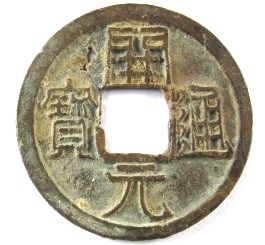
    Kai Yuan Tong Bao coin from the Tang dynasty

    The kai yuan tong bao, shown at left, became the model for most of the coins cast during the dynasties that followed up until the very end of the imperial era in 1911.

    “Kai yuan” (開元) translates as “opening a new era” and “tong bao” (通寶) means “circulating treasure”.

    There are some interesting variations of this coin and a few of the more unusual ones are discussed below.

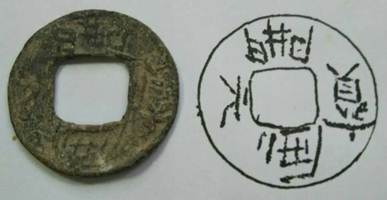
    Kai Yuan Tong Bao lead coin minted by the State of Chu (Kingdom of Chu) or Southern Han Kingdom

    The image above shows a most unusual kai yuan tong bao coin on the left. On the right is a rubbing of the same coin making it is easier to read the inscription.

    This coin is believed to have been minted by either Chu ( 907-951 AD) or the Southern Han Kingdom (南汉 905-971 AD). While Tang dynasty coins are well-cast copper coins with uniform-sized Chinese characters written in clerical script (隶书), this lead coin is poorly-cast with very irregular and poorly written characters.

    Not only is the coin made of lead, which has a much less intrinsic value than copper, it is also smaller, thinner, and lighter than the Tang dynasty coin. It also has a larger square hole which means it contains even less metal.

    This coin has the same kai yuan tong bao inscription. However, the inscription is not read in the same order (top, bottom, right, left). Instead, the characters are read starting at the top and going counterclockwise (top, left, bottom, right).

    The first character kai (開) is upside down. (For illustrative purposes, I am using the Chinese characters from the copper coin.)

    The next character, yuan (元), is rotated to the right so that its top is facing the square hole.

    The third character, tong (通), is rotated to the left with its right side facing the square hole.

    Finally, the fourth character, bao (寶), is upside down.

    This is certainly a most unusual kai yuan tong bao coin.

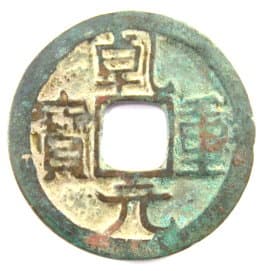
    Coins that were declared by the emperor to be worth more than the standard cash coin would sometimes have the inscription “zhong bao” (重寶) instead of “tong bao” (寶). The zhong (重) means “heavy” to imply that it has greater value.

    Qian Yuan Zhong Bao coin cast in 759 AD by Emperor Su Zong of the Tang dynasty
    Qian Yuan Zhong Bao was the first “zhong bao” coin

    Shown at the left is a qian yuan zhong bao (乾元重寶) which was cast in 759 AD by Emperor Suzong (唐肅宗 756-762 AD) of the Tang dynasty.

    This “zhong bao” coin was declared to be worth the equivalent of 10 regular cash coins such as the kai yuan tong bao.

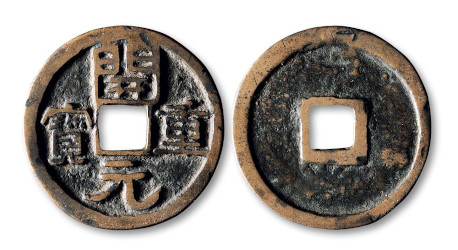
    While there are no historical records stating that a “kai yuan zhong bao” (開元寶) was ever officially minted, shown below is such a coin.

    Kai Yuan Zhong Bao (開元重寶) coin made of copper and sold by China Guardian Auctions in 2011

    The inscription is read in the traditional order (top, bottom, right, left). The coin is made of copper and is well-made. The characters are uniform but appear to be of slightly different sizes. The coin is 33 mm in diameter which makes it larger than a Tang dynasty coin which is about 24 mm.

    This coin would not have been minted during the Tang dynasty but rather sometime later. At this time, it is not clear when or where the coin originated. The coin may be of Japanese origin, or even a charm, but it was not presented at the auction as either of these. This kai yuan zhong bao copper coin was sold at China Guardian Auctions in 2011 for about $925.

    Kai Yuan Zhong Bao coin made of lead

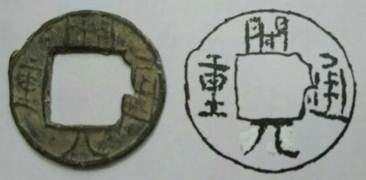
    Even more unusual than the kai yuan zhong bao described above is the kai yuan zhong bao coin made of lead shown at the left.

    The kai (開) at top, the yuan (元) at bottom and the zhong (重) at right can be clearly identified.

    The bao (寶) at left is, however, very strange until you realize that it is not the Chinese character bao (寶).

    Remember that the Chinese character bao (寶) translates as “treasure”.

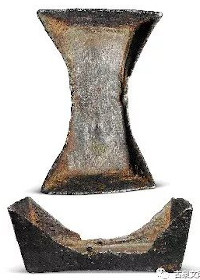
    Silver Ingot (top and side views)

    The “character” to the left of the square hole in this lead kai yuan zhong bao coin is, in fact, not a Chinese character at all but rather a picture of an ingot.

    Shown at the left is another form of ancient Chinese money known as an ingot (sycee 细丝). Sycee were made of either silver or gold and could be cast in a number of different shapes. The silver ingot (银锭) at the left is the most common and its shape would be easily recognizable by the Chinese people.

    The ingot, being a very high denomination form of money, would therefore represent a “treasure” and easily substitutes for the Chinese character bao, meaning “treasure”, on this coin.

    So, the inscription on the coin is indeed kai yuan zhong bao.

    While it is not clear when or where the copper kai yuan zhong bao described above originated, it is much clearer where the lead coin came from since it was found in the same area as the State of Chu and Southern Han Kingdom lead coins discussed earlier.

    Finally, I would like to introduce the most unusual variation of the “kai yuan” coin theme. It is another lead coin. It was also found in the same area as the other lead coins discussed above and, therefore, is also attributed to the State of Chu or the Southern Han Kingdom.

    “Kai Yuan Tong Zhong” lead coin

    Looking at the coin above, you can clearly see from the rubbing that it has the kai (開) at the top, the yuan (元) at the bottom, and the tong (通) at the right.

    But, you can also clearly see that the character at the left is zhong (重). This is the position where you would always expect to see the Chinese character bao (寶) meaning “treasure”.

    This means that the inscription reads kai yuan tong zhong (開元通重) which makes no sense at all! Remember the tong (通) character signifies a one cash coin while coins with the zhong (重) character represent a higher denomination such as, for example, being worth 10 cash coins.

    How could a coin be worth both 1 cash and 10 cash at the same time?

    The owner of this coin believes that whoever made the coin mould was just careless and mistakenly wrote zhong (重) instead of bao (寶). We know that scribes can sometimes make mistakes in manuscripts so it is certainly possible that the same can happen to those writing the inscriptions in coin moulds.

    It appears that after making the mould, no one noticed or cared about the error and coins were cast. It is likely that very few coins were produced from this one mould and, as far as is known, this is the only specimen to have survived to the present time.

    The owner of the coin even speculates that this may be the earliest specimen of any Chinese coin having such a clerical error to have been discovered.

    The coins described above are just a few of the more interesting and unusual examples of coins based on the Tang dynasty kai yuan tong bao to have been discovered.