Month: December 2011

  • “Four Happinesses” Window

    A 200-year-old carved wooden window, described as a rare and exquisite treasure, was recently discovered in a small village flea market in China’s southwest Yunnan Province, according to an article in the Kunming Daily (昆明日报).

    Mr. Yang Anning (杨安宁), a well-known expert in ancient Chinese architecture, described the well-preserved window as a “cultural heritage gem” having the distinctive artistic style of a Yunnan carved wooden window from the late Qing Dynasty (1644-1911).
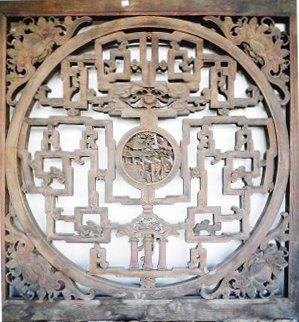
    "Four Happinesses" carved wooden window

    The “theme” of the window, according to Mr. Yang, is “four happinesses surrounding longevity” (si fu peng shou 四福捧寿).

    The intricate design within the large circle is actually a very stylized version of the Chinese character for “longevity” (shou 壽).

    At each of the four corners of the window frame are bats with wings extended and heads facing the circle.

    The Chinese love rebuses which are “visual puns”.  In this case, the Chinese word for “bat” (fu 蝠) has exactly the same pronunciation as the word for “happiness” (fu 福).

    Because “four bats” (si fu 四蝠) sounds like “four happinesses” (si fu 四福), there are “four happinesses surrounding longevity”.

    The origin of the “four happinesses” is a poem by Hong Mai (洪迈 1123-1202) who was a scholar-official during the Southern Song Dynasty:

    久旱逢甘雨, 他乡遇故知, 洞房花烛夜, 金榜题名时

    • “Sweet rain after a long drought” (jiu han feng gan yu 久旱逢甘雨)
    • “Meeting an old friend in a faraway place” (ta xiang yu gu zhi 他乡遇故知)
    • “The wedding night” (“the night of lighting a candle in the bridal chamber”) (dong fang hua zhu ye 洞房花烛夜)
    • “Having one’s name on the list of successful candidates of the imperial examination” (jin bang ti ming shi 金榜题名时)

    The window also illustrates the “Five Happinesses” (wu fu 五福), sometimes translated as the “Five Blessings” or “Five Good Fortunes”, which comes from the very ancient “Classic of History” (shujing 书经) compiled during the Warring States Period (475 BC -221 BC).

    The “Five Happinesses” consist of longevity (寿), wealth (富), health and composure (康宁), virtue (修好德), and the desire to die a natural death in old age (老终命).

    You will notice that the character for “longevity”, which occupies the center of the window, is also one of the “Five Happinesses” (wu fu 五福).

    Adding the “longevity” fu to the four fu represented by the bats makes a total of five fu thus symbolizing the “Five Happinesses”.

    The window has an abundance of hidden meanings.

    For example, the shape of the window expresses the ancient Chinese belief that heaven is round and the earth is square (tian yuan di fang 天圆地方) also known as the circle in a square.

    As another example, the large circle resembles an old Chinese “cash” coin (qian 钱) which is round with a hole in the center.

    The hole in the center of a Chinese coin is called the “eye” (yan 眼).  Because the Chinese words for “before” (前) and “coin” (钱) are both pronounced qian, the window has the implied meaning of “happiness is before your eyes” (fu zai yan qian 福在眼前) (happiness (fu) = bats (fu); before (qian) = coin (qian); eye (yan) = hole in center of coin (yan)).

    The newspaper article concludes with Mr. Yang revealing that the very detailed scene in the small circle at the center of the window has “visual puns” meaning:

    • “May you have good fortune, longevity, and an abundance of blessings, years and offspring” (福寿三多 fu shou san duo)
    • “A pair of dragons play with longevity” (双龙戏寿 shuang long xi shou)
    • “Happiness falls from heaven” (喜从天降 xi cong tian jiang)
    • “Wealth and honor again and again” (富贵连连 fu gui lian lian)
    • “The plum blossoms with the Five Happinesses” (梅开五福 mei kai wu fu)
    • “To add flowers to embroidery” (锦上添花  jin shang tian hua)

    For a different artistic representation of the “four happinesses” please see “Four Happiness Boys“.
  • Chinese Treasure Bowl Charm

    Since ancient times, there have been stories of a magical “treasure bowl” (ju bao pen 聚宝盆) that can create unlimited riches, and sometimes great sorrow, for its owner.

    While the actual treasure bowl remains to be found, its image has became a popular symbol of good fortune.

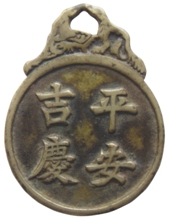
    Charm Inscription "Peace and Happiness"

    At the left is an old Chinese “hanging” charm with the inscription ping an ji qing (平安吉慶) which is a simple wish for “peace and happiness”.

    The Chinese characters are beautifully written and stand out prominently against the dark patina of an unadorned field.

    Adding to the “charm” of this piece is the loop at the top.  The loop is actually a dragon.  The dragon’s head, at the bottom of the loop, is looking back at its two hind legs and tail.


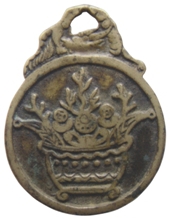
    Chinese "Treasure Bowl"

    A “treasure bowl” filled with riches is displayed on the reverse side of the charm.  These valuables are members of the “Eight Treasures” (八宝).

    In the very middle of the bowl is a round “flaming pearl” (火珠) with its flames extending upwards to the top of the rim.  The pearl is an ancient symbol of riches but also has the power to grant wishes and is a metaphor for perfection and enlightenment.  Chinese dragons are often depicted as “playing” with a flaming pearl.

    To the right and left of the pearl are two smaller round objects, with a square hole in the center, which represent traditional Chinese gold coins (金钱).

    Directly under each gold coin is a comma-shaped object representing a silver ingot (银锭).  Silver ingots were used as money particularly during the Yuan Dynasty (1271-1368).

    On the side of each gold coin is a branch-like object which is coral (珊瑚).  Coral symbolizes longevity, and red coral is considered especially auspicious.

    The two objects sticking out of the treasure bowl at the 3 o’clock and 9 o’clock positions are rhinoceros horns.  The rhinoceros horn (犀角) is a visual pun or rebus for “happiness” (喜) because both words share the same pronunciation xi.  A pair of rhino horns represents “double happiness” which is a traditional Chinese  symbol for a happy marriage.

    At the very bottom of the pile of treasures, and supporting the pearl and silver ingots, is the lotus.  The Chinese word for lotus (lian hua 莲花) has the same pronunciation as the word “continuous” (lian 连).  The hidden or implied meaning is that the treasures will continue to be produced endlessly.

    The treasure bowl itself is decorated with a string of seven “dots” which symbolize the seven-star “Big Dipper” constellation (北斗星).

    There are a number of stories associated with the Chinese treasure bowl (“wealth pot”, “basin of treasures”) which is usually portrayed as having the magical power to multiply whatever is placed inside of it.  Put a grain of rice in and the bowl will be filled with rice.  Place a gold coin in and the bowl will suddenly be filled with gold coins.

    One of the best known stories is of a fisherman named Shen Wan San (沈万三) who lived during the late Yuan and early Ming dynasties.  One day he saw a person who had caught a large number of frogs to eat.  Shen Wan San felt sorry for the frogs.  So he bought them and released them into a nearby pond.

    That night he was awakened by the loud croaking of the frogs.  He went to investigate and discovered a clay pot in the midst of the frogs.

    Shen Wan San took the pot home.  By chance, his wife accidentally dropped a silver object into the pot and immediately the pot was filled with silver.

    As it turned out, the pot was really a “treasure basin” which allowed Shen Wan San to become one of the richest men in Chinese history.

    But great wealth can also be a curse.

    When the first emperor of the Ming Dynasty, the Hongwu Emperor (洪武帝; Emperor Taizu 明太祖), began to build his capital at Nanjing in 1366, he “requested” Shen Wan San to donate a third of the cost.

    The newly constructed South Gate was named the “Gate of Gathering Treasure” (Ju bao Men 聚宝门).  The gate was so named because the emperor ordered that Shen Wan San’s treasure bowl be seized and buried underneath the gate to rectify a flooding problem that was causing it to collapse.

    It is believed that the emperor also wanted to demonstrate that no person would be permitted to challenge the empire in regard to wealth.

    The “Gate of Gathering Treasure” was subsequently renamed the “Zhonghua Gate” (中华门) in 1931 to commemorate the Revolution of 1911 (辛亥革命) and the founding of the Republic of China (Zhonghua Minguo 中华民国).

    This story is unusual in that it involves real historical figures and an actual historical site, thus giving some credence to the existence of a “treasure bowl”.

    Many of the other “treasure bowl” stories have a stronger moral content.  Honest and modest people are able to enjoy the bounties of the treasure bowl.  Dishonest and greedy people end up suffering.

    The stories of the Chinese “treasure bowl” have much in common with the Chinese legend of a “money tree” from which coins fall down when shaken.  For a further discussion, please visit “Chinese Money Trees” (摇钱树).