Month: August 2011

  • Liao Dynasty Charm

    The Liao Dynasty (辽朝 916-1125) was ruled by a nomadic people known as the Qidan (Khitan 契丹) and occupied an area of the northern prairies of China that included Manchuria, a portion of Mongolia, as well as parts of Hebei and Shanxi provinces.

    Charms from the Liao Dynasty are fairly rare and, because the Qidan script is not well understood, the inscriptions can be difficult to understand.

    Dr. Werner Burger (布威纳), a recognized expert in Chinese numismatics, published an article in the 108th issue (2010) of “China Numismatics” (中國錢幣) in which he introduced an old Liao Dynasty charm which had not previously appeared in any catalog or reference book.

    Liao Dynasty Charm with Daoist Inscription
    Liao Dynasty Charm with Daoist Inscription

    The image at the left is the picture of the charm as published in the magazine.

    Although the Qidan people used Chinese characters on their coinage, they preferred to use their own script for their charms or “folk custom coins” (民俗钱).

    The Qidan script had two types of characters, namely “large characters” and “small characters”.

    The inscription on this charm is written in the “small character” Qidan script.

    The characters are similar to Chinese but still different enough that only experts in the Qidan language are able to offer a translation.

    Rubbing of the Qidan Script Characters
    Rubbing of the Qidan Script Characters

    These distinctive Qidan script characters can be seen more clearly in the rubbing at the left.

    While inscriptions on Liao Dynasty coins tend to be read clockwise beginning with the character at the top of the square hole, the characters on this Liao Dynasty charm are read counter-clockwise beginning at the bottom of the round hole.

    According to the experts, the character at the bottom is tian (天), which means “heaven”, and the character at the right is chang (長) which translates as “of long duration”.  The character at the top is di (地) meaning “earth” and the character at the left is yong (永) which means “forever”.

    According to the article, the “meaning” of the inscription is tian chang di jiu (天长地久) or “as eternal and unchanging as the universe”.

    This inscription is taken from the Dao De Jing (Tao Te Ching 道得经), the ancient Daoist (Taoist) text attributed to Laozi.

    The article explains that it is not unusual for a Liao Dynasty charm to have a Daoist inscription.  While the Han people were influenced by Confucius and the Mongols by Buddha, the Qidans had a strong belief in Daoism.  Few Qidan writings exist today but it is known that a number of Daoist texts were translated into the Qidan language while Confucian and Buddhist texts were not.

    This coin has a diameter of 27 mm and a weight of 11.5 grams.  The reverse side is blank with no characters.

    Dr. Burger concludes the article by stating that, with the exception of this Liao Dynasty charm, he is not aware of the existence of any other Chinese charm with this Daoist inscription earlier than the Qing Dynasty (1644-1911).

    For examples of Qing Dynasty charms with this same Daoist inscription, please see my discussions of a rarely seen vase-shaped pendant charm, a lock charm and a peach charm.
  • Chinese Rock Art of “Feather Man” or Alien

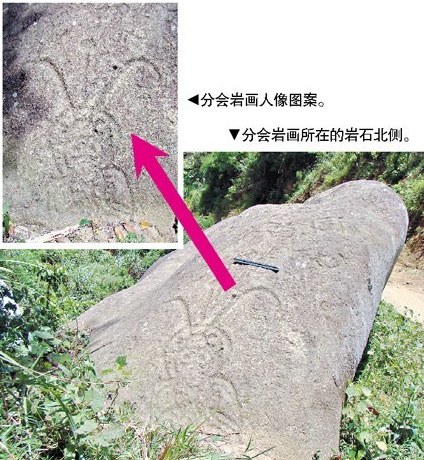
    A giant boulder with a prehistoric carving of either the mythical Chinese “Feather Man” or an “alien from outer space” was recently discovered by archaeologists near a village in Guangdong Province.

    An article entitled “Guangdong’s Luoding Village Discovers Rare Rock Art” describes the rock drawing as a person wearing a helmet with a feather attached to each side and an “antenna” sticking out the top.

    Rock Drawing of "Feather Man" or "Alien from Outer Space"

    According to the article, experts disagree as to the identity of the portrait.  Some believe that it is an alien from outer space.  Others believe that it is a leader of the ancient “Bai Yue” people (百越人).  Still other experts believe that it is actually an astronomical observation tool or compass.

    The boulder is very large with a length of 14-15 meters, a width of 6 meters and a height of about 10 meters.

    In addition to the strange portrait, the rock has many other petroglyphs.  Most appear to be star constellations with stars represented by circles with a dot in the center.  There is also a picture of a horse and there are symbols which resemble written characters.

    According to Mr. Chen Dayuan (陈大远), the former head of the Luoding Municipal Museum (罗定市博物馆), there are three carvings of people on the rock.  The one that is the clearest shows a person wearing a helmet.  The eyes and nose can be easily recognized and there is a circle drawn on the forehead.  A line extends upward and outward from each side of the helmet.  Another line, which resembles an “antenna”, extends straight up from the top of the helmet and has a small ball at the tip.

    Mr. Chen states that no historical records exist concerning the rock.  He believes that, based on the designs and the primitive method of carving, the boulder probably served as a prehistoric ritual site.  People have tried to make rubbings of the rock art but have not been successful because the incised lines are too shallow.  He says this is probably the result of the artist having had to use blunt stone tools to chisel the designs.  This is further evidence that the rock art dates from the Stone Age.

    The article proposes three possible explanations for the “amazing” portrait.

    Mr. Chen believes it may be the image of the mythical “Feather Man”.  “Feather Man” (yu ren 羽人) was a legendary immortal who had wings and a body covered with feathers.  He was first mentioned in “The Classic of Mountains and Seas” (山海经), an ancient Chinese text dating back more than 2,200 years.

    The Daoists (Taoists) also believed that “Feather Man” would appear to assist a person as he neared immortality because an immortal’s arms transform into wings enabling him to fly.

    If the figure is not “Feather Man”, Mr. Chen says it may be an alien from outer space.

    A third theory is suggested by Mr. Han Dongshan (韩东山) of the Guangzhou Five Goats Planetarium (广州五羊天象馆).

    Mr. Han believes that the large red sandstone boulder was used by the ancient “Bai Yue” people that inhabited the area as an astronomical observation platform.

    Mr. Han discovered that the “antenna” on the top of the helmet points precisely south and he therefore believes that the portrait may actually be the very earliest example of a fixed south-pointing compass.

    While this large boulder with the mysterious rock art is recognized by archaeologists as “an important newly discovered cultural relic”, it has been known to the local villagers as the “Parents-in-law Rock” (公婆石) for a very long time.  Mr. Shen Guangquan (沈广泉), an elderly villager of more than 70 years of age, can recall his great-grandfather telling him that many years ago people would go to the rock to bow in worship and to burn incense.

  • Chinese Chess Pieces Found in Old Tomb

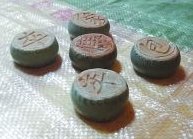
    Chinese Chess Pieces from Song Dynasty
    Chinese Chess Pieces from Song Dynasty

    According to a report in the Yangzi Evening News, archaeologists recently unearthed five ancient Chinese chess (xiangqi 象棋) pieces from a tomb located at Tiger Hill in Suzhou, Jiangsu Province.

    The tomb dates from the Song Dynasty (960-1279).

    Archaeologist Mr. Zhang Tiejun (张铁军) emphasized that, among the burial objects, only five Chinese chess pieces were discovered. Each piece is made of porcelain and is green in color.

    He noted that they are actually very similar to the Chinese chess pieces used today except for being slightly heavier.

    The pieces include two “soldiers” (zu 卒), one “cannon” (pao 炮), one “horse” (ma 马), and one “elephant” (xiang 象).

    According to Mr. Zhang, the person buried in the tomb was most likely a “chess fanatic”.

    Chinese chess has a very long history with official records dating from the Warring States Period (475 BC – 221 BC).

    By the time of the Song Dynasty (960-1279), the game had become a popular pastime and the major game characteristics had already evolved into essentially the same game as played today.  The game then, as now, was played with 32 chess pieces on a board having two “palaces” and divided in the middle by a “river”.

    During the Song, there were already craftsmen who specialized in making the chess boards and pieces.

    Books on game theory and play written by Hong Mai (洪迈), Ye Maoqing (叶茂卿) and Chen Yuanliang (陈元靓) were also popular.

    Not surprisingly, a number of famous Chinese from the Song Dynasty were known to be Chinese chess aficionados including such famous poets as Li Qingzhao (李清照) and Liu Kezhuang (刘克庄).  Other notable players included Hong Zun (洪遵), author of one of China’s first books on numismatics, and Wen Tianxiang (文天祥), the scholar-general who is recognized as one of China’s great heroes and patriots.

  • 1910 Chinese Yunnan Spring Dollar

    With only two specimens known to exist, the Yunnan Spring Dollar is considered among the very rarest of Chinese coins.

    One coin sold for $1,035,000 at a Hong Kong auction in August 2010.  The only other known specimen is scheduled to be auctioned in September 2011.

    As you might expect, there is a great deal of excitement and publicity concerning this upcoming auction since it is not likely that either of these coins will be available again to collectors or museums for many years or perhaps even generations to come.

    Besides their rarity, one of the main attractions of these coins has to do with the reference “spring” dollar.  These are the only coins in Chinese history to include a season in the inscription and it has been considered a mystery as to why this was done.

    Chinese Yunnan Spring Dollar
    Chinese Yunnan Spring Dollar

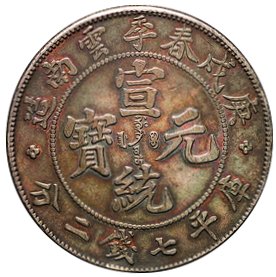
    At the left is the Yunnan Spring 1910 Silver Dragon Dollar which was auctioned last year.  I personally consider this coin to be the more visually appealing of the two even though its “official” grade (“AU55 NGC”) is slightly below that of the coin (“AU58 NGC”) to be auctioned next month.

    The four large Chinese characters at the center of the coin read xuan tong yuan bao (宣统元宝) which means it was minted during the reign of the Xuantong Emperor (1908-1912) also known as “The Last Emperor”.

    The denomination of the coin is written at the very bottom as ku ping qi qian er fen (库平七钱二分) which is “Treasury Standard 7 Mace and 2 Candareens”.  In English, the coin is usually called a “dollar”.

    The Chinese inscription at the top reads geng xu qun ji yun nan zao (庚戌春季云南造) which translates as “made in Yunnan Province in the spring of the year geng xu (1910).”

    The official announcement for the September auction emphasizes the mystery concerning the inclusion of “spring” in the coin’s inscription:

    “This enigmatic issue, one of China’s rarest coins (and with only two genuine pieces known), has been a coin of mystery and legend since its discovery, around 1920.  Although there has been constant research in Chinese numismatic circles, over time, no definite reason, or meaning of the term, “Spring 1910″, has yet been discovered.”

    Unfortunately, this is not quite correct.

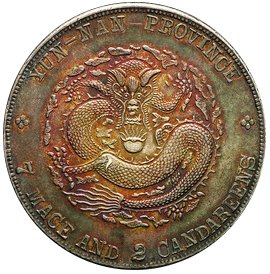
    Reverse side of Yunnan Spring Dollar
    Reverse side of Yunnan Spring Dollar

    According to several Chinese websites including the “Baidu Library” (百度文库), which is the online encyclopedia maintained by China’s major search engine “Baidu” (百度), the reason that “spring” was included in the inscription is as follows.

    The coin is intimately connected with the monetary reforms which were taking place in China at the time.  On April 15, 1910, the Qing Dynasty government promulgated “Currency Regulations” (币制则例) in order to standardize the minting of the silver coinage of the country.  The authority to mint silver coins was taken away from all provinces and consolidated at the mint in Tianjin.  However, since China covers such a vast area, it was not considered practical to have all silver coins made at one mint and therefore branch mints were established at Hankou, Guangzhou, Chengdu and Yunnan.

    The new regulations required the silver dollar coins to be of a uniform design, purity, weight and size.  Since this was not the case with the coins that were being minted at the four branch mints, these mints were ordered to cease production and await further instructions from the Tianjin mint.  The branch mints were also to wait until they received the new standardized dies before resuming production.

    However, a few of the branch mints, for selfish reasons, refused to cease the minting of silver coins.  The Yunnan branch took dies that had been used to make the 1909 coins and engraved at the top the additional inscription “made in the Spring of 1910”.  According to the traditional Chinese calendar in use at the time, “spring” referred to the first three months of the year, namely, January, February and March.  In this way, the Yunnan mint attempted to circumvent the new regulations by saying that the coins were made before April of that year.

    The Chinese central government discovered the scheme at the Yunnan mint and ordered that all these new coins be withdrawn and melted down.  However, a very very few of the coins escaped being destroyed and these are the specimens that are now known as the Yunnan Spring Dollars.

    Thus, the “mystery” surrounding the appearance of the word “spring” on these coins is a mystery no more.

  • Empress Dowager Cixi Commemorative Coin

    A recent Chinese newspaper article published pictures of a very rare Chinese silver coin which is believed to have been minted to commemorate the birthday of one of imperial China’s last rulers.  The coin is owned by a Mr. He who lives in Anqing City in Anhui Province.

    The Empress Dowager Cixi
    The Empress Dowager Cixi

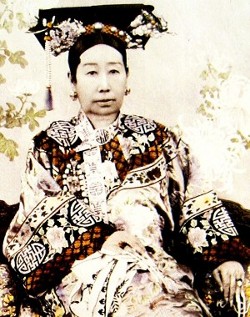
    The Empress Dowager Cixi (慈禧太后 1835-1908) was a concubine of the Xianfeng Emperor.   She gave birth to a son who became the Tongzhi Emperor upon the death of the Xianfeng Emperor.

    She became the regent for her young son, who was only 5 years old, and essentially established absolute rule for herself.  The Tongzhi Emperor died of smallpox at the age of 18.

    She then established her nephew, the Guangxu Emperor, as the new ruler in 1875 but she remained the real power behind the throne until her death in 1908.

    Coin commemorating 70th birthday of Empress Dowager Cixi
    Coin commemorating 70th birthday of Empress Dowager Cixi

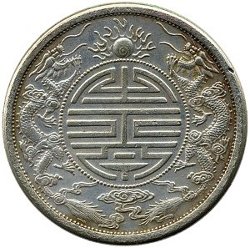
    The beautiful silver coin shown here is believed to have been minted in 1905 to commemorate the 70th birthday of the Empress Dowager Cixi.

    Two five-claw dragons, symbolizing the emperor, are on each side of the coin, and are separated by a “flaming pearl” at the very top.

    In the middle of the coin is a large and very stylized version of the Chinese character shou (壽) which means “longevity”.

    You will notice that the exquisite robe the Empress Dowager is wearing in the photograph is decorated with the same Chinese character.  The photograph was taken by the official court photographer in the same year of 1905.

    The other side of the coin has the inscription guang xu yuan bao (光緒元寶) indicating that it was produced during the reign of Emperor Guangxu.  This silver coin was struck at the mint in Guangdong Province and the denomination is the “treasury standard one tael” (庫平重壹兩).

    These coins are considered very rare with estimates of only ten or more authentic specimens known to exist.

  • Good Fortune, Salary, Longevity and Happiness

    One of the major characteristics of Chinese charms is the rebus or “visual pun” where a picture is used to represent a word.  While it can sometimes be challenging, it is always interesting to figure out what, at first glance, the haphazard collection of animals and objects displayed on a Chinese charm are supposed to mean.

    A very knowledgeable collector of Chinese charms recently contacted me regarding an old Chinese charm he had just acquired.  From the reading of the Chinese characters and based on his experience, he had a good idea of what the images on the reverse side had to be.

    But even knowing this, he was having difficulty identifying one of the pictures.

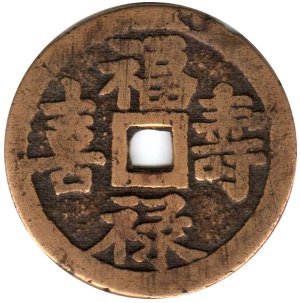
    Chinese charm with inscription "good fortune, salary, longevity and happiness"

    The inscription on his charm reads fu lu shou xi (福禄寿喜) which translates as good fortune, salary (emolument), longevity and happiness.

    This particular charm is a good example of the Chinese fondness for visual puns or rebuses.

    Knowing this, the four pictures on the reverse side should either be pronounced fu, lu, shou or xi, or “symbolize” good fortune, salary, longevity or happiness.

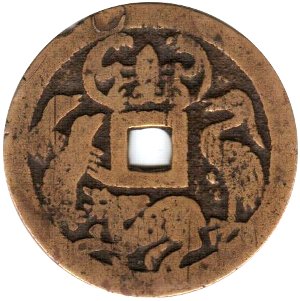
    Reverse side of charm displaying bat, deer, crane and magpies
    Reverse side of charm displaying bat, deer, crane and magpies

    This is the reverse side of the charm.

    At the very top is a bat flying upside down.  The Chinese word for “bat” is fu (蝠) which has the same pronunciation as “good fortune” (fu 福) in the written inscription on the other side of the charm.

    But the “pun” goes even deeper.  The Chinese word for “upside down” (dao 倒) happens to have the same pronunciation as the word “to arrive” (dao 到).  Therefore, if a person were to say “the bat is upside down” (fu dao 蝠倒), it would sound exactly as if one had said “good fortune has arrived” (fu dao 福到)!

    As you have probably guessed, the image below the square hole has the same pronunciation as the Chinese character in the same position on the other side of the charm.  The image is of a “deer” and the Chinese word for “deer” (lu 鹿) does in fact have the same pronunciation as the word for “salary” (lu 禄).

    There is an image of a bird to the right of the hole.  In this case, the bird does not have the same pronunciation as the corresponding Chinese character (shou 寿) in the inscription, but instead is a traditional Chinese symbol with the same meaning of “longevity”.  To the Chinese, the “crane” (he 鹤) is a symbol of longevity because it was believed to live to a very old age and also because its feathers are white.

    Truth be told, the artist that designed this charm long ago made a slight mistake which goes unnoticed by most people.  If you look very closely, and if you know your birds, you will see that the bird is actually not a “crane”, which it surely was intended to be, but rather a “heron”.  The “heron” or “egret” (lu 鹭), nevertheless, still works as a rebus because it shares the same pronunciation as the word for “salary” (lu 禄).

    To be consistent with the rebus theme of the charm, the picture to the left of the hole should be pronounced xi just like the corresponding Chinese character (“happiness”) on the other side of the charm.  This is where my collector friend ran into a slight problem.  He knew the Chinese word for “mandarin duck” is xi (鸂) but the image on the charm does not look like a duck!

    He had the correct pronunciation but the wrong bird.  The bird is actually a “magpie” (xi qui 喜鹊) which has the word “happiness” (xi 喜) as part of its name.  Even more interesting, the charm shows two magpies so the meaning is “double happiness” ()!

    I thank my friend for sharing with me this new addition to his collection.

    This old charm, which is 38 mm in diameter and dates from the Qing (Ch’ing) Dynasty (1644-1911), exemplifies the special characteristics of the Chinese language, the richness of Chinese symbolism along with the fondness of the Chinese for the rebus or “visual pun”.