Chinese Peach Charms
Introduction to Peach Charms
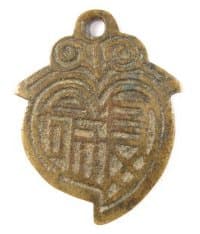 The peach (tao 桃) symbolizes
longevity
and peach charms are very commonly seen in China.
The peach (tao 桃) symbolizes
longevity
and peach charms are very commonly seen in China.Peach wood is also believed to have a special power to keep away evil spirits.
The Chinese have traditionally placed a very high value on a long life. With the immense influence of Confucianism, great reverence was placed on old age and the elderly enjoyed high respect and a life of comparatively more ease and less toil than those younger in age.
One of the greatest gifts a government minister could receive was the Chinese character for longevity (shou 壽) written personally by the Emperor. Even persons of the lowest social class who had attained great age were distinguished by the Emperor.
According to legend, the Queen Mother
of the West (xiwangmu
西王母) possessed a peach orchard near her palace in the Kunlun
mountains. The trees would only blossom every 3,000
years and the fruit would take another 3,000 years to ripen.
It was believed that eating one of these peaches would bestow upon the eater the same length of life as it took for the fruit to ripen -- 3,000 years.
Another story, tells of the Queen Mother of the West visiting Emperor Wu of the Han Dynasty in the year 110 AD. She brought with her seven of the peaches from her orchard. She ate two of the peaches and explained that eating one fruit would allow the eater to live 3,000 years. The Emperor then asked her if he could keep the seeds. The Queen Mother of the West at that moment saw Tung Fang-So peeping at her through the window. She pointed at him and said "that child has stolen three of my peaches and he is now 9,000 years old."
Traditionally, most Chinese families would have in their homes for good luck either pictures or small statues of the "Three Immortals". One of these immortals is Shou (壽), the God of Longevity. He is usually shown with a walking stick and carrying a peach to symbolize long life. (For more on the "Three Immortals", please see lock charms.)
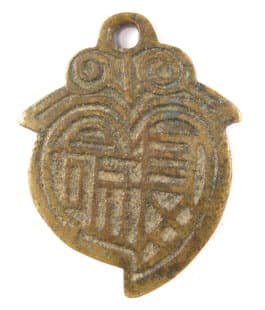
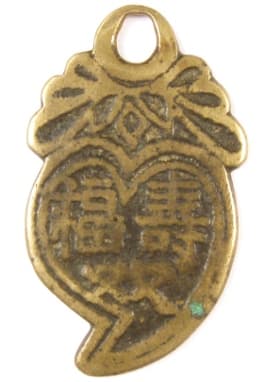
This is one side of an old Chinese peach charm.
There are two Chinese characters written in a very stylized seal script.
The characters are read right to left as chang ming (长命) which means "long life".
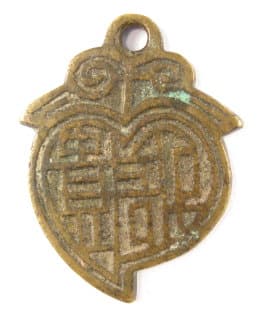
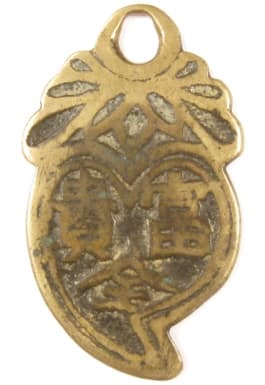
This is the reverse side of the charm.
The two Chinese characters are again written in a very stylized seal script.
The characters are read right to left as fu gui (富贵) meaning "wealth and rank".
The charm is 45 mm in length and 35 mm in width.
The weight is 17.7 grams.
It was believed that eating one of these peaches would bestow upon the eater the same length of life as it took for the fruit to ripen -- 3,000 years.
Another story, tells of the Queen Mother of the West visiting Emperor Wu of the Han Dynasty in the year 110 AD. She brought with her seven of the peaches from her orchard. She ate two of the peaches and explained that eating one fruit would allow the eater to live 3,000 years. The Emperor then asked her if he could keep the seeds. The Queen Mother of the West at that moment saw Tung Fang-So peeping at her through the window. She pointed at him and said "that child has stolen three of my peaches and he is now 9,000 years old."
Traditionally, most Chinese families would have in their homes for good luck either pictures or small statues of the "Three Immortals". One of these immortals is Shou (壽), the God of Longevity. He is usually shown with a walking stick and carrying a peach to symbolize long life. (For more on the "Three Immortals", please see lock charms.)
Peach Wood as an Amulet to Dispel Evil Spirits
According to an ancient
Chinese text, "The Classic of Mountains and Seas" (shanhaijing 山海经),
there was a very large peach tree on Dushuo Mountain (dushuoshan 度朔山) whose
branches formed an archway through which evil spirits
could pass between the spirit world and the earth.
The Emperor of Heaven (tiandi
天帝) was concerned that the evil spirits might harm the
people on earth and so he assigned two brothers, Shen Tu
(神荼) and Yu Lei (郁垒), to guard the passageway. If
the evil spirits caused any harm, the two brothers were
instructed to tie them up and feed them to the tigers which lived
at the base of the mountain.
In honor of the two brothers' bravery, they became known as the "Door Gods" and a tradition gradually developed to engrave their portraits in peach wood which were then hung on gates and doors for protection from evil influences.
This tradition further evolved during the Song Dynasty when the peach wood Door God charms (taofu 桃符) were replaced by spring couplets (chunlian 春联) which are auspicious verses written on red paper and hung above and at the sides of doors and gates.
Swords, arrows and amulets were also carved from peach wood in ancient times to ward off evil spirits. This is because the Chinese word for peach (tao 桃) shares the same pronunciation as the Chinese word for "flee" or "run away" (tao 逃).
Also in ancient China, parents would cut the pit or stone of a peach into a type of lock and then tie one of the these padlocks to each foot of the child using the same type of string that was used to bind a queue (a long braid of hair hanging down the back of the neck). It was believed that this practice would confer longevity, bind the child to life and ward off evil influences.
It was believed that the wood used to make a child's bed could also contribute to future happiness. As a result, the most sought after wood was peach wood. Other wood choices included that of the Chinese jujube or date fruit tree because the name of the tree (zao 枣) has the same pronunication as the word for "early" or "soon" (zao 早). The hope was that the child would grow up and "early" on be successful in the examination system to obtain a position as a government official. Wood from the pine tree was also acceptable for a child's bed because pine trees are ever green and are associated with longevity and the God of Longevity.
Because of the many taboos associated with the raising of silkworms, peach branches were inserted in the eaves of sericulturist's homes to protect them from evil.
In honor of the two brothers' bravery, they became known as the "Door Gods" and a tradition gradually developed to engrave their portraits in peach wood which were then hung on gates and doors for protection from evil influences.
This tradition further evolved during the Song Dynasty when the peach wood Door God charms (taofu 桃符) were replaced by spring couplets (chunlian 春联) which are auspicious verses written on red paper and hung above and at the sides of doors and gates.
Swords, arrows and amulets were also carved from peach wood in ancient times to ward off evil spirits. This is because the Chinese word for peach (tao 桃) shares the same pronunciation as the Chinese word for "flee" or "run away" (tao 逃).
Also in ancient China, parents would cut the pit or stone of a peach into a type of lock and then tie one of the these padlocks to each foot of the child using the same type of string that was used to bind a queue (a long braid of hair hanging down the back of the neck). It was believed that this practice would confer longevity, bind the child to life and ward off evil influences.
It was believed that the wood used to make a child's bed could also contribute to future happiness. As a result, the most sought after wood was peach wood. Other wood choices included that of the Chinese jujube or date fruit tree because the name of the tree (zao 枣) has the same pronunication as the word for "early" or "soon" (zao 早). The hope was that the child would grow up and "early" on be successful in the examination system to obtain a position as a government official. Wood from the pine tree was also acceptable for a child's bed because pine trees are ever green and are associated with longevity and the God of Longevity.
Because of the many taboos associated with the raising of silkworms, peach branches were inserted in the eaves of sericulturist's homes to protect them from evil.
Peach Charms
This is one side of an old Chinese peach charm.
There are two Chinese characters written in a very stylized seal script.
The characters are read right to left as chang ming (长命) which means "long life".
This is the reverse side of the charm.
The two Chinese characters are again written in a very stylized seal script.
The characters are read right to left as fu gui (富贵) meaning "wealth and rank".
The charm is 45 mm in length and 35 mm in width.
The weight is 17.7 grams.