Author: Gary Ashkenazy

  • Laozi and Zhang Daoling Charm

    The Chinese have been producing coin-shaped charms and amulets in a variety of themes for more than 2,000 years.  One of the most visually appealing types of charms involves scenes of people.

    Unfortunately, it is often difficult to interpret what historic or legendary scene is being presented.
    Laozi and Zhang Daoling Charm
    Laozi and Zhang Daoling Charm

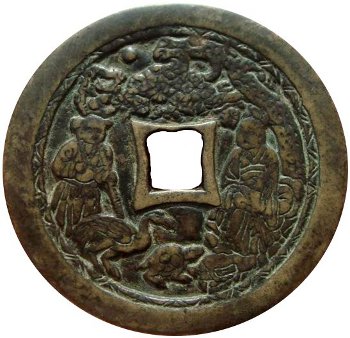
    The charm at the left is frequently referred to by Chinese collectors as a “boy under a pine tree” (松下童子) or a “boy worships an immortal” (童子拜仙人).

    More serious collectors, however, feel that the scene must be an event of special importance.

    The charm is believed to depict a meeting between Laozi (老子) and Zhang Daoling (张道陵).

    Laozi, the mystic founder of Daoism (Taoism) and the author of the Dao De Jing (道德经), is shown seated under a pine tree on the right.

    The “youth” on the left is Zhang Daoling who is clearly carrying a cane or staff.  The Chinese word for “cane” (zhang 杖) has the same pronunciation as the “Zhang” in Zhang Daoling’s name and, therefore, helps confirm his identify.

    Zhang Daoling spent a good part of his life seeking the secret of immortality and there are several symbols which help to reinforce the longevity theme of this charm.  Below the square hole are a crane and a tortoise facing Laozi.  Both are traditional symbols of longevity as is the pine tree.

    In the gap above the pine tree can be seen a full moon where the “Jade Rabbit” lives and makes the “elixir of immortality”.

    According to Daoist accounts, Laozi appeared before Zhang Daoling on “Crane Cry Mountain” (hemingshan 鹤鸣山), in what is now Sichuan Province, in the year 142 AD and proclaimed him the “Celestial Master” who would deliver the people from the evils of the Han Dynasty.

    Zhang Daoling would subsequently establish the first organized Daoist religious sect known as the “Five Bushels of Rice” (wudou mi dao 五斗米道).
    Chinese Zodiac side of charm
    Chinese Zodiac side of charm

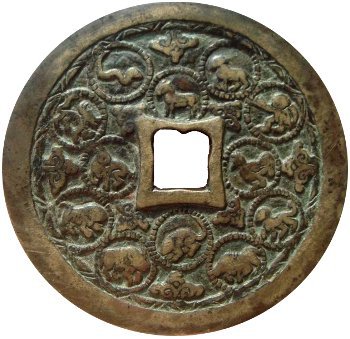
    The reverse side of the charm displays the twelve animals of the Chinese Zodiac (十二生肖) with each animal in its own circle.

    Interspersed among the animal circles are eight “auspicious clouds“.  “Eight” is considered a lucky number because in certain Chinese dialects it shares the same pronunciation as the word for “wealth”.

    The auspicious clouds at the top, bottom, right and left sides of the rim indicate the four directions.  The other four clouds are at the protruding corners of the square hole.

    This charm is particularly well-made and probably dates from the Jin (金 1115-1234) or Yuan (元 1271-1368) dynasties.

    Another old charm portraying the meeting of Laozi and Zhang Daoling on “Crane Cry Mountain”, but with a different set of symbols, may be seen at Daoist Charms.


  • Coins Discovered at Rufu Stone Pagoda

    Rufu Stone Pagoda
    Rufu Stone Pagoda

    Chinese archaeologists working at an ancient stone pagoda in Hainan Province (海南省) recently made a discovery which will help to establish the date when the pagoda was originally built.

    An article in the October 27, 2011 edition of the Haikou Evening News (海口晚报) describes the restoration work being done at the Rufu Stone Pagoda (儒符石塔) near Haikou.  The pagoda is distinctive because it is built from volcanic rock but has fallen into disrepair over the centuries.

    Hidden vault where tortoise box was found
    Hidden vault where tortoise box was found

    Few records exist concerning the history of the pagoda with the oldest references dating to the Ming Dynasty.

    The pagoda is believed to have been built during the late Song Dynasty but no historical evidence exists to prove this.

    The Buddhist pagoda is one of the oldest structures in the province and its design reflects Indian influences.

    While working at the base of the pagoda a worker discovered a hidden vault.

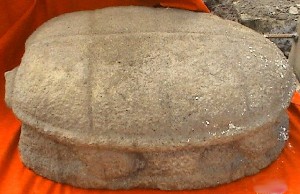
    Inside the vault was a stone tortoise-shaped box.

    Tortoise-shaped box
    Tortoise-shaped box

    According to Mr. Wang Daxin (王大新), the Director of the Haikou City Bureau of Cultural Relics (海口市文物局), the tortoise box contained a number of items.

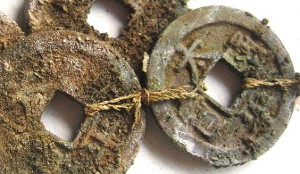
    In the box were more that seventy Chinese bronze coins.  Remarkably, the coins still retain remnants of the cord with which they had been bound together.

    "Tai Ping Tong Bao" Song Dynasty coins

    The majority of the coins have the inscription tai ping tong bao (太平通宝) which means they were cast during the years 976-989 of the reign of Emperor Tai Zong of the Song Dynasty.

    Coins are always considered an important find because they can be accurately dated.  Since the majority of the coins are tai ping tong bao, it is most likely that the pagoda was built during this same time period.

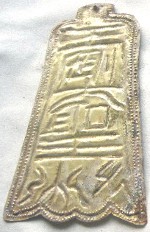
    Silver tablet with unknown meaning
    Silver tablet with unknown meaning

    Among the most puzzling artifacts found in the box, however, were six metal tablets.  Originally thought to be made of tin, after cleaning they were found to be made of silver.  Unfortunately, three of the tablets were too fragile to be cleaned so they are being kept in their original state.  This also means that their inscriptions cannot be read.

    Of the other three silver tablets, two have auspicious connotations.  One has the inscription fu de chang shou (福德长寿) which translates as “good fortune, virtue and a long life”.  Another has the inscription qian yuan heng li zhen (乾元亨利贞) which is a cryptic phrase from the ancient Chinese “Book of Changes” (I Ching 易经).

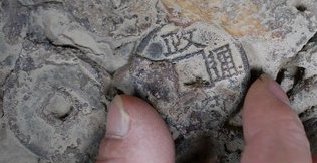
    The last silver tablet, displayed above, has the inscription wang gang da sheng (王刚大圣).  The experts are still trying to understand the meaning of this inscription.

    Mr. Wang made clear that while the archaeologists continue to study the cultural relics found at the site, the work to restore the pagoda to its original state is continuing with completion of the project expected by the end of this year.

  • Lu Xun and Chinese Coins

    Lu Xun (鲁迅 1881-1936) is recognized as one of the greatest Chinese writers of the 20th Century and the founder of modern Chinese literature.

    Few people, however, are aware of Lu Xun’s contributions to Chinese numismatics.  He was not only a collector of ancient Chinese coins but he also wrote a manuscript annotating Chinese coins from the 7th to the 17th Century.

    According to a Xinhua news dispatch, this treatise on Chinese coins written by Lu Xun is now being published for the first time in commemoration of the 62nd anniversary of the founding of the People’s Republic of China.

    The manuscript was written in 1913 while Lu Xun was working for the Ministry of Education in Peking (Beijing).  During that time, he began to study ancient books on Chinese coins and he frequently went to Liulichang (琉璃厂) to buy old Chinese coins for his own collection.

    Lu Xun was familiar with the famous work on Chinese coins known as Quan Zhi (泉志) written by Hong Zun (洪遵) in 1149 during the Song Dynasty.  The Quan Zhi has the honor of being recognized as the world’s oldest extant coin book.

    The Quan Zhi annotated the various forms of Chinese money from the very earliest times to the Song Dynasty.  Lu Xun wanted to supplement this great work.  In his manuscript, he wrote about Chinese coins beginning with those of the Tang and Five Dynasties and ending with the coins of the Ming Dynasty.  He cataloged 1,311 different coins from this time period thus adding an additional 700 years to the field of numismatic research.

    But Lu Xun’s involvement in Chinese numismatics went even further for he was actually involved in the design of one of the coins of the time.

    According to an entry in Lu Xun’s diary dated August 28, 1912, he along with two colleagues, Xu Shouchang (许寿裳) and Qian Taoxun (钱韬逊), designed a twelve symbol emblem.

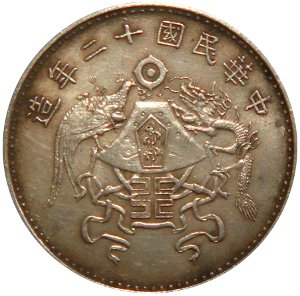
    Dragon and Phoenix Silver Dollar
    Dragon and Phoenix Silver Dollar

    This emblem, seen on the coin at the left, was designed by Lu Xun to be the national emblem for the newly established Republic of China.

    Lu Xun incorporated into the design the auspicious elements known as the Twelve Symbols (十二章), which date from the Spring  and Autumn Period (770 BC – 476 BC), that had traditionally been used on the clothing of Chinese emperors.

    These ancient symbols include the dragon and pheasant.  However,  the Chinese have traditionally mistaken the pheasant (雉) as being a phoenix (凤) and so the design is usually referred to as the “dragon and phoenix”.

    Besides the dragon and pheasant (“phoenix”), the Twelve Symbols include the axe head (斧 located between the dragon and pheasant),  rice (粉米 small circles on the axe), the sun (日 above the axe), the moon (月 the dragon’s horn), fire (火 on dragon’s body), the fu (黻 under the axe), stars (星辰 the three dots above the pheasant’s crest), the mountain (山 bottom of axe), the grail (宗彝 in claws of dragon and pheasant), and seaweed (藻 in pheasant’s beak).

    At the top of the coin is written “Made in the 12th Year of the Republic of China” (中華民國十二年造) which would be the year 1923.

    Reverse side of Dragon and Phoenix Silver Dollar
    Reverse side of Dragon and Phoenix Silver Dollar

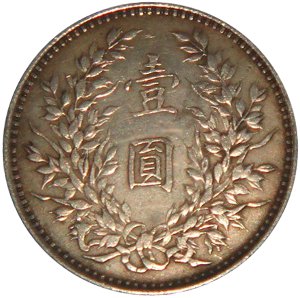
    The other side of the coin has the denomination “One Yuan” (“One Dollar” 壹圓) written within a wreath of grain (嘉禾).  There are two versions of the coin depending on if the two Chinese characters are written “large” (大字) or “small” (小字).

    This “dragon and phoenix silver dollar” was produced as a pattern or trial piece at the mint in Tianjin.  Only a small number were produced and the coins were not put into circulation because the design was considered by some to retain too much symbolism from China’s imperial past.

    The lead mold used by the Tianjin Mint to produce these pattern coins can be seen at the Lu Xun Museum in Beijing (北京鲁迅博物馆).

  • “Cassia and Orchid” Charm

    An article in “The Oriental Collection” (dongfang shoucang 东方收藏) introduced a rarely seen Chinese charm from the Qing Dynasty (1644-1911).

    Honorable sons and noble grandsons
    Honorable sons and noble grandsons

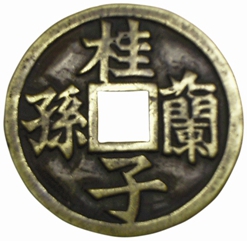
    One side of the charm has the inscription gui zi lan sun (桂子蘭孫).

    Gui (桂) refers to a plant known as the “cassia” and zi  (子) refers to “seeds”.  Lan (蘭) is the “orchid” and sun (孫) means “grandson”.

    So, what does “cassia seeds and orchid grandsons” mean?

    The Chinese love puns and the Chinese language has many homonyms which facilitates the making of puns.

    The word for cassia (gui 桂) shares the same pronunciation as “honorable” (gui 贵).  And,  “seeds” (zi 子) can also mean “sons” (zi 子).

    Therefore, “cassia seeds” sounds the same as “honorable sons”.

    The cassia also symbolizes success in the imperial examination system.

    “Orchid grandsons” is also a play on words.  The orchid (lan 蘭) is a  reference to zhilan (芝蘭) which literally means “irises and orchids” but to the Chinese has the implied meaning of “noble character”.

    “Orchid grandsons” thus means “noble grandsons”.

    The entire inscription gui zi lan sun therefore means “honorable sons and noble grandsons”.

    High position and great wealth
    High position and great wealth

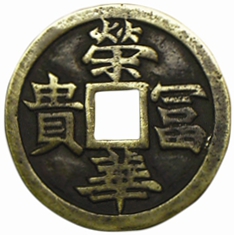
    The inscription on the reverse side of the charm reads rong hua fu gui (榮華富貴).

    Rong (榮) means “grow luxuriantly” and “flourish” but also has the meaning of “honor” and “glory”.  Hua (華) means “flowers” but is also used for “glory”.  Ronghu (榮華) can thus refer to flowers, such as the cassia and orchids, growing luxuriantly but it also has the meaning of “honor and glory”.

    Fu (富) means “wealth” and gui (貴) means “honor”.  So fugui (富貴) translates as “riches and honor”.

    The entire inscription rong hua fu gui is commonly used to express “glory, wealth and rank” or “high position and great wealth”.

    This charm was made when emperors still ruled China.  A traditional Chinese family’s greatest wish was to have sons who would be successful in passing the imperial examinations.  In so doing, they would be assigned an important position in the government bringing honor and prosperity to the entire family.

    Another charm with a related content may be seen at “A Talented and Noble Young Man“.

  • Tons of Song Dynasty Iron Coins Discovered

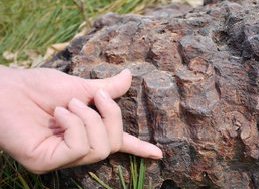
    A Chinese newspaper reported today that several tons of iron coins dating from the Song Dynasty were recently discovered in a field near the city of Cangzhou (沧州), Hebei Province in northeast China.  Although the coins protruding through the soil have rusted together, they can still be seen just the way they were arranged in stacks almost a 1,000 years ago.

    Stacks of iron coins from the Song Dynasty
    Stacks of iron coins from the Song Dynasty

    An outcropping of the pile of neatly stacked iron coins can be seen in the photo at the left.

    This was not the first time a large quantity of coins had been discovered in the area.  In July 1997, at a location just 500 meters from the newly discovered pile of coins, more than 48 tons of Song Dynasty iron coins were unearthed.

    The actual quantity of coins discovered in the new “pile” is not known at this time.  Based on preliminary calculations, the coins fill an area approximately 25 meters by 16 meters.  The top of the pile is about 0.4-0.5 meters below the surface.  Since it is not known how deep the pile is, the experts can only estimate that there are several tons of coins.

    Chinese iron coin from 1101-1125 AD
    Chinese iron coin from 1101-1125 AD

    The photo at the left displays one of the iron coins from the pile of coins discovered in 1997.

    This round cash coin with a square hole in the center has the inscription zheng he tong bao (正和通寶) which was used on coins cast during the reign (1101-1125 AD) of Emperor Hui Zong of the Northern Song Dynasty.

    Mr. Yang Fengling (杨凤岭), the Director of the Cang Prefecture Cultural Relics Institute, said it is not yet known if there is any connection between the newly discovered pile of coins and the coins discovered nearby in 1997.

    As to why such a large quantity of Song Dynasty coins might exist, Mr. Yang could only conjecture at this time.

    Mr. Yang said that during the Song Dynasty, Cangzhou was one of the places where prisoners were sent.  During ancient times, prison labor was sometimes used to produce coins.  It is possible that this had been the site of a coin foundry or mint.

    Mr. Yang also pointed out that the coins seem to have been arranged in a very orderly manner and that the site may have been a large-scale treasury where money was stored.

    Mr. Yang mentioned one other interesting possibility.  It is said that after Emperor Taizu (960-976) established the Song Dynasty, he wanted to redeem parts of present day Hebei Province, known then as the “Sixteen States of You Yun” (幽云十六州), which were occupied by the Khitan (契丹) of the Liao Dynasty (辽朝).  Cangzhou happened to be situated right at the border of the Song and Liao territories and the cache of coins may have been intended for this purpose.

    Mr. Yang further stated that this new discovery of iron coins might rewrite history.  According to historical sources, iron coins during the Song Dynasty were made and circulated in the southern part of the country.  The discovery of such a large quantity of iron coins in the north means that iron coins must have circulated here as well.  They may also have been produced here.

    Mr. Yang hopes that the mysteries surrounding this new discovery may be better explained once excavation of the site begins next month.

  • Xian Numismatic Museum

    The official opening of the Xian Numismatic Museum (西安钱币博物馆) was announced today in a Chinese newspaper article.

    The new money museum is located in the ancient city of Xian (西安), the capital of Shaanxi Province (陕西).  Xian, formerly known as Changan (长安), has a history of more than 3,100 years and was the eastern terminus of the Silk Road.  Xian (Chang’an) became the first capital of China when Qin Shi Huang (秦始皇) united the country in 221 BC and is where the famous terracotta army is located.

    The coin museum was established by the Xian Branch of the The People’s Bank of China (中国人民银行) and occupies an area of 324 square meters (3,487 square feet).

    More than 5,000 coins, paper currency and other forms of ancient and modern money dating back more than 4,000 years are on display.

    The museum’s exhibits include some very rare items.  According to Mr. Zhao Xiaoming (赵晓明), the Secretary-General of the Xian Numismatic Society (西安钱币学会), the first “piled” coin mold (叠范) ever discovered for the 4 zhu ban liang (四铢半两), valued at more than “one million yuan” ($156,500), is on display.

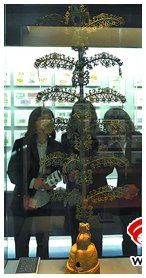
    Ancient Chinese Money Tree
    Ancient Chinese Money Tree

    Considered among the “greatest treasures” on display are two “money trees” (yao qian shu 摇钱树) from the Eastern Han Dynasty (25-220 AD).

    Ancient Chinese legends spoke of trees from which coins would fall like leaves when shaken.

    Museum visitors examining one of the money trees can be seen in the photo at the left.

    The money tree is 138 cm (54 inches) in height and has a series of seated Buddhas at the top.  The money tree branches are decorated with wu zhu (五铢) coins, “immortals” and “fairies”, monkey gods and other auspicious animals.

    Exquisite examples of money trees, such as the two on display, have been found in Han Dynasty tombs in southwest China.  These burial objects are believed to have been used by the deceased as a “map” or guide leading up to heaven and then used as a means of support while there.

    For additional information on the origin and history of “money trees”, please see “Chinese Money Trees“.

  • Chinese Palindrome Charm

    A palindrome is a word or phrase that reads the same forward or backwards.  For example, “rats live on no evil star” is the same whether you read it left to right or right to left.

    Creating palindromes is actually much easier in Chinese, which uses “characters”, than in English which uses an alphabet.  If fact, every Chinese “word” (character) is itself a palindrome because it has exactly the same pronunciation and meaning whether read left to right or vice versa.

    China has had a literary genre known as “palindromic poetry” (hui wen shi 回文诗) since ancient times.  The genre is not strictly palindromic, however, because the meaning does not have to be exactly the same when reading forward or backward.  What is important is that the phrase or sentence must make sense in both directions.

    Chinese charms with palindromic inscriptions are very rare and often not even documented in numismatic references and catalogs.

    Chinese 12 Character Palindrome Charm
    Chinese 12 Character Palindrome Charm

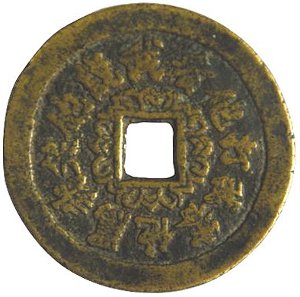
    The Chinese charm at the left is one of these rare examples with a palindromic inscription.

    The inscription consists of 12 Chinese characters inscribed around the rim which reads “我笑他说我看他打我容他骂.

    The most basic translation is “I, laugh, he, talks, I, look, he, hits, I, am tolerant, he, scolds”.

    However, the meaning of a verb may change depending on whether it precedes or follows the pronoun.

    Since this is a palindrome, you can begin with any pronoun or verb and read clockwise or counterclockwise.

    As an example, starting with the “second” character in the inscription written above, the meaning would be “laugh at him scolding me (笑他说我)”, “look at him fight me (看他打我)”, “be tolerant of him cursing me (容他骂我)”.

    Reading the same characters counter-clockwise would be “I curse and he is tolerant (我骂他容)”, “I fight and he watches (我打他看)”, “I speak and he laughs (我说他笑)”.

    Therefore, completely different meanings occur depending on which pronoun or verb you begin with and which direction you are reading.

    The charm provides us with a glimpse into the daily life of two people, namely “I” and “he (or she)”.  The two people could be husband and wife, two lovers, two friends, two co-workers, a boss and employee, two family members, etc.  The various permutations of dialogue express a range of attitudes people in a relationship may find themselves in including love, admiration, understanding, tolerance, and even not caring.

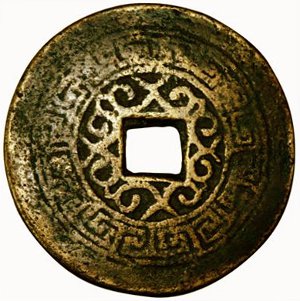
    "Cloud and Thunder" design on reverse side of charm

    The reverse side of the charm has a “cloud and thunder” pattern similar to the design found on ancient Chinese bronzes.

    Based on the calligraphy, design, metal, and casting, this charm is believed to have been made during the Qing Dynasty (1644-1911) by one of the ethnic minority groups in southern China.

    The charm is made of brass and has a diameter of 51.64 mm and a weight of 35.05 grams.

    Another example of this palindromic charm is known to exist.  However, it is slightly smaller with a diameter of 44 mm.

  • Chinese “World of Brightness” Coin

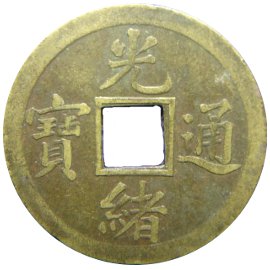
    Qing Dynasty Machine Struck Cash Coin
    Qing Dynasty Machine Struck Cash Coin

    The first Chinese machine-made cash coins were minted during the reign (1875-1908) of Emperor De Zong of the Qing Dynasty.

    As seen at the left, these brass coins had the inscription guang xu tong bao (光緒通寶).  Many of these coins were struck at the mint in Guangzhou, Guangdong Province during the years 1889-1908.

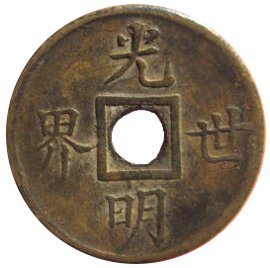
    Another coin was made about the same time that closely resembles this common guang xu tong bao coin but its meaning and history are still a mystery.

    "World of Brightness" Coin

    An example of this mysterious coin is shown at the left.  The inscription reads guang ming shi jie (光明世界) which translates as “world of brightness”.

    Several theories have been proposed as to the meaning and purpose of this coin or charm.

    Many people believe that this is “spirit money” (ming qian 冥钱), also known as “ghost money”, “hell money” or “joss money”, which is money that is buried with the dead.

    The reasoning is that this coin resembles real Chinese money.  Also, the inscription “world of brightness” is a euphemism for “world of darkness” or death.

    A different theory proposes that the coin is associated with the Tiandihui (天地会) or “Heaven and Earth Society” which was a secret organization dedicated to overthrowing the Qing Dynasty, which was ruled by the Manchus, and restoring the Ming Dynasty and the hegemony of the Han people.  Interestingly enough, the inscription on the coin uses the same character “ming” (明) that is used for Ming Dynasty (明朝), and the inscription guang ming (光明) can be interpreted to mean the “glory of the Ming”.

    One final theory is that the coin was made to be used as a game piece or gambling token.

    This coin is know to exist in three varieties with the difference being the reverse sides.

    The most commonly found reverse side is identical to that of the standard guang xu tong bao coin.  In this case, there are two Manchu characters indicating that the coin was struck at the mint in Guangzhou.

    The second version of the coin has a reverse side that is identical to the obverse side which means that the same inscription or legend is on both sides.

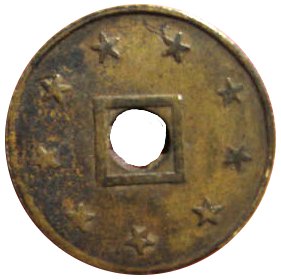
    "9 Stars" on Reverse Side

    The third version of the coin is the most interesting because it has nine stars as shown in the example at the left.

    The ancient Chinese, and particularly the Daoists, believed that the star constellation known as the “Big Dipper” or “Ladle” (beidou 北斗) consisted of the seven stars we see today along with two “invisible” or “attendant” stars making a total of nine stars.

    The “Big Dipper” was where the gods lived and also served as the emperor’s chariot.

    One of the major Buddhist and Daoist deities is the “Dipper Mother” (doumu yuanjun 斗母元君) who is also known as the “Queen of Heaven” (tianhou 天后) and the “Goddess of Beidou (“Big Dipper”)”.

    She is the mother of the Nine Emperor Gods who are represented by the nine stars.  She is honored each year on the 9th day of the 9th lunar month.

    Finally, “nine” (jiu 九) is an auspicious number to the Chinese because it has the same pronunciation as the word “forever” (jiu 久).

    While questions remain as to the true meaning and purpose of this coin, it nevertheless provides a fascinating insight into the political undercurrents and religious beliefs of China just as the imperial system that had existed for more than 2,000 years was beginning to crumble.

  • More than 2,200 Rare “Later Jin Dynasty” Coins Discovered

    According to an article published in today’s Liaoning Daily (辽宁日报), the local police have arrested a gang of thieves who unearthed more than 2,200 rare coins dating from the Later Jin (后金) Dynasty (1616-1636 AD).

    According to the report, the Bureau of Public Security of Liaoyang City (辽阳市) has arrested three men suspected of the theft and is presently looking for additional members of the gang.

    Mr. Wu, the 32-year-old leader of the gang, was previously employed as a taxi driver.  Last spring, he received word that some ancient Chinese coins had been discovered at a construction site in Liaoyang City.  He went to the site everyday with his shovel but in a year’s time was only able to dig up a little more than 300 coins.

    In order to find coins more quickly, Mr. Wu in May of this year bought a metal detector and rented a large excavator.  He also recruited a few accomplices to form a “treasure digging team” which ultimately unearthed more than 2,200 coins weighing 17 kg (37.4 lbs).

    Mr. Wu sold the coins for $101,700 (650,000 元).

    Not long after, however, the buyer of the coins was arrested.  He confessed and implicated Mr. Wu who was then arrested.

    According to the cultural relics experts involved in the case, all the coins unearthed by the thieves have inscriptions written in the Manchu script (满文).  The coins are from the Later Jin Dynasty (后金) which existed during the years 1616-1636 just prior to the Manchus conquering all of China and establishing the Qing Dynasty (清朝 1644-1911).

    Unfortunately, no images of the coins were published in the newspaper article.

    However, the coins are said to be special in that they were not used for general circulation.  The experts believe that these coins may have been used by Nurhachi (努尔哈赤), the leader of the Manchus (满族), to reward his generals for meritorious achievements.

    For this reason, the coins are considered to be very rare and the experts estimate that the market value for these Later Jin Dynasty coins (后金币) is at least $470,000 (3,000,000 元).

  • Store Signs of Ancient Chinese Coins

    Store signs (招牌) in ancient China started to become common during the Song Dynasty (960-1127).  By the time of the Ming (1368-1644) and Qing (1644-1911) dynasties, stores had developed several types of signs to establish their identity.

    The first store signs consisted of a simple piece of cloth with some Chinese characters which was hung in front of the door.  Often, only “tea house”, “restaurant”, or “drugstore” was written.  Sometimes the name of the shop or shop owner was written instead.

    Another type of shop sign displayed a sample of the product being sold.  For example, a shoe store might hang a shoe from a pole or a tobacco store may have a large wooden model of a tobacco leaf.

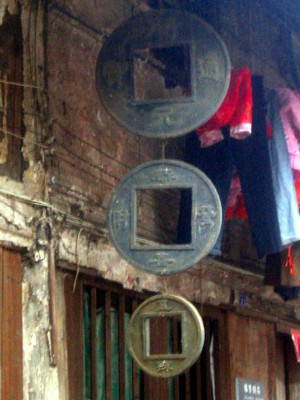
    Store sign displaying ancient Chinese coins
    Store sign displaying ancient Chinese coins

    Yet another type of store sign that became popular was totally independent of the line of business and relied instead on symbols of “good luck” and “prosperity”, such as ancient Chinese coins or the image of the “God of Wealth” (caishen 财神).

    China still retains some of these old sign traditions although they are getting more and more difficult to find among the glitter and clutter of the modern signage now common in the large cities.

    The sign at the left is located on a small side street in the city of Luzhou (泸州) in Sichuan Province (四川省).  Luzhou is an old city famous for its liquor and spirits.

    This particular sign does not identify the name of the store nor does it reveal the line of business but instead expresses a wish for prosperity and good luck.

    Strung together are three large coins which decrease in size from top to bottom.  These round coins with square holes in the center look exactly like the ancient bronze and brass “cash” coins that the Chinese used for more than 2,000 years.

    Interestingly enough, the “coin” in the middle has a traditional Chinese charm inscription.  The inscription reads shou xi fa cai (寿喜发财) which translates as “longevity, happiness, and make a fortune”.

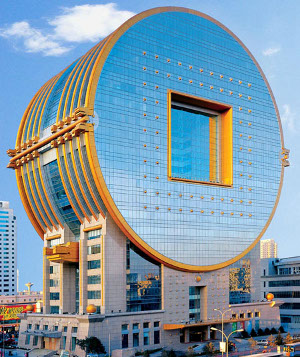
    Building shaped like Chinese cash coins
    Building shaped like Chinese cash coins

    Although traditional store signs with the ancient Chinese coin theme are gradually disappearing, the modern era now allows for this symbol of good luck and wealth to be displayed in a new way.

    The modern building at the left is shaped like a stack of ancient Chinese cash coins.  The 25-story Fang Yuan Building (方圆大厦), which was completed in 2001, is located in the city of Shenyang (沈阳) in Liaoning Province (辽宁省).

    The building was designed by the renown Taiwanese architect C.Y. Lee who also designed the “Taipei 101” (台北101) skyscraper which from 2004 to 2010 was the tallest building in the world.

    Though on a far grander scale, the Fang Yuan Building continues the tradition of hanging a sign consisting of ancient Chinese coins over the front door in order to welcome customers and bring good fortune.

  • Chinese Chess Mooncakes

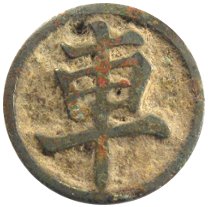
    Ancient Chinese Chess Piece
    Ancient Chinese Chess Piece

    Chinese chess or xiangqi (象棋) is one of the most ancient forms of chess.

    Old Chinese chess pieces, similar to the “chariot” (車) piece displayed here, were made of bronze and can date back to the Song Dynasty (960-1279 AD).

    A complete set of these old Chinese chess pieces would be extremely difficult to collect.

    A modern set of red and black Chinese chess pieces, on the other hand, is usually made of plastic or wood and can be easily purchased.

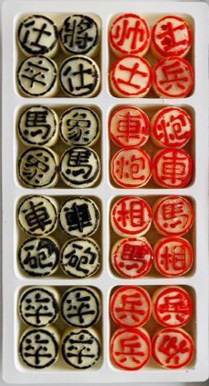
    Mooncakes in the shape of Chinese Chess Pieces
    Mooncakes in the shape of Chinese Chess Pieces

    At the left is what a modern set of Chinese chess pieces looks like.

    This particular set, however, is very special.

    The “pieces” are actually “mooncakes” (yue bing 月饼) made to resemble Chinese chess pieces.

    Mooncakes are the traditional pastry eaten during the Mid-Autumn Festival (zhong qiu jie 中秋节) which occurs on the 15th day of the 8th month according to the traditional Chinese calendar.

    The festival coincides with the autumnal equinox when the moon is at its fullest.  This year the festival falls on September 12th.

    Mooncakes are round and usually have an auspicious Chinese character such as “longevity” (shou 壽) imprinted on top.  They have a thin crust with a lotus seed paste filling and, sometimes, have a salted duck’s egg yolk in the center.

    The mooncake not only symbolizes the full moon but also evokes the story of Chang’e (嫦娥), the beautiful wife of Houyi (后羿), who ate the pill of immortality and as punishment must now live on the moon with only the Jade Rabbit (yu tu 玉兔) as a companion.

    It is a happy coincidence that this traditional festival food can be made to look exactly like the pieces from the ancient game of Chinese chess.  Now during game play, the pieces can be eaten once they are captured by the opposing player.

  • Zithers and Grasshoppers

    Zithers and grasshoppers may seem like an unlikely combination but they  are the theme of an old Chinese charm.

    The zithers in this case refer to the ancient Chinese musical instruments of the qin (琴) and the se (瑟).

    The qin or guqin (古琴) is a seven-stringed zither which was the instrument played by the sages and has a history or more than 3000 years.

    The se (瑟) is a similar musical instrument which had 25 strings although even more ancient models had 50 strings.

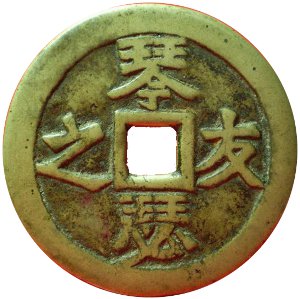
    Chinese charm with "zither" theme

    At the left is an example of an old Chinese charm with the zither and grasshopper theme.

    The inscription is qin se you zhi (琴瑟友之) which means “with the qin and the se be friendly to her” or “the qin and se zithers warm her heart”.

    The inscription comes from a poem entitled “Cry of the Ospreys” (guan ju 关雎) which is found in the ancient book of poetry known as the “Book of Songs” (shi jing 诗经) which was compiled by Confucius 2500 years ago.

    The poem celebrates giving birth to many children.

    The qin and the se gradually came to symbolize marital harmony which helps to explain the inscription on the other side of the charm.

    Chinese charm with "grasshopper" theme

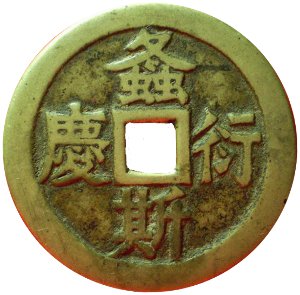
    The reverse side of the charm has the inscription zhong si yan qing ( 螽斯衍庆) which translates as “may your children be as numerous as grasshoppers”.

    The Chinese katydid or long-horned grasshopper has its own “musical instrument” and makes “music” by rubbing its wings together.

    In olden times, Chinese children loved to catch grasshoppers and raise them in small cages during the summer and autumn.

    Furthermore, grasshoppers like to gather together, similar to an extended family, and they reproduce in large numbers.

    The grasshopper was, therefore, seen as a symbol of fertility and procreation to traditional Chinese families that wished for many sons and grandsons to continue the ancestral lineage and to carry out ancestor worship.

    While zithers and grasshoppers may seem to be an unusual pairing, the ancient Chinese saw them as fitting symbols of marital harmony and procreation.