Construction site in Hunan Province where Tang, Song and Yuan dynasty coins were unearthed
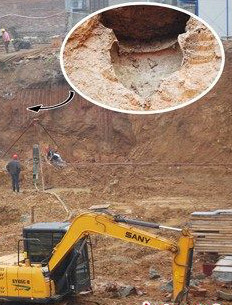
On February 20, 2013 workers digging at a construction site in Chenzhou City (郴州市) located in Anren Prefecture (安仁县) in the southeastern part of Hunan Province (湖南省) unearthed a money pit dating back some 700 years according to Chinese newspaper reports.
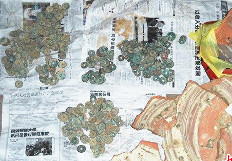
The money pit contained approximately 7.5 kg of coins from the late Song (960-1279) and early Yuan (1280-1368) dynasties.
The construction site can be seen in the photo at the left. The oval shows a close-up of the money pit and the arrow points to where the discovery was made.
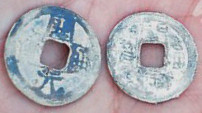
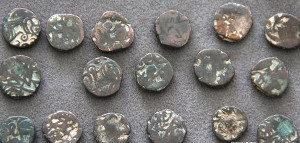
Some of the coins discovered in the Hunan coin pit
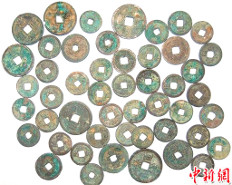
Well-preserved small and large coins from the money pit
On February 22nd, the China News Service dispatched a news team to Chenzhou City to cover the story.
The video broadcast includes commentary in Chinese. But even if you do not understand Chinese, you will see images of the construction site where the coin hoard was unearthed. The video shows archaeologists cleaning and examining the coins. There are also short interviews with Mr. Cai Ning (蔡宁) of the Anren Prefecture Cultural Relics Administrative Office (安仁县文物管理所) and Mr. Duan Bangqiong (段邦琼) of the Anren Prefecture Bureau of Culture, Broadcasting and the Press (安仁县文广新局).
The print media, as well as the China News Service, mention that some of the coins in the cache are considered to be fairly scarce. Among these are the jing yuan tong bao (景元通宝) and the chun hua tong bao (淳化通宝).
Coins with the inscription jing yuan tong bao (景元通宝) are believed to have come from Annam (Vietnam) although it is still uncertain as to when these coins were actually cast.
What would definitely be the greatest find from the money pit, however, would be chun hua tong bao (淳化通宝) and xian ping zhong bao (咸平重宝) coins.
During the reign of Emperor Tai Zong of the Northern Song Dynasty, a large number of chun hua yuan bao (淳化元宝) coins were cast during the years 990-994. As far as I have been able to determine, however, there are no historical records documenting a chun hua tong bao (淳化通宝) version of this coin and no authentic specimens are known to exist.
Emperor Zhen Zong of the Northern Song issued coins with the inscription xian ping yuan bao (咸平元宝) during the years 998-1003. However, I am not aware of any historical records of a xian ping zhong bao (咸平重宝) coin ever being cast during his reign. This coin is not included in the major Chinese coin catalogs.
Coins are one of the most easily recognized symbols of prosperity and good fortune and China, being one of the first countries in the world to use coins, has a monetary history going back more than 2,500 years.
It is not surprising then that Chinese banks also like to use ancient Chinese coin symbols in the design of their logos.
The People’s Bank of China Logo
The People’s Bank of China (PBC 中国人民银行) is China’s central bank responsible for monetary policy and the regulation of financial institutions.
The bank logo, shown above, displays a simple geometric form on the left side.
This red triangular design is actually based on a very ancient Chinese form of currency known as spade money (bubi 布币).
Spade Money from Warring States Period
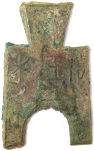
An example of spade money used by the ancient State of Liang (400 BC – 300 BC) during the Warring States Period of the Zhou Dynasty is shown at the left.
As can be seen, the logo design is actually composed of three of these “spade” coins arranged feet-to-feet.
What is also interesting about the design is that it is in the shape of a “人”. The interior “hole” of the logo has this same “人” shape.
The “人” resembles the Chinese character ren (人) which means “man” or “person”. Since there are two of these “人” the meaning is “people”. “People” (renmin 人民) is the key word in the bank’s name (The People’s Bank of China) and thus the logo, in an auspicious red color, is a very clever design combining China’s ancient money heritage with the name of the bank.
Chinese Cash Coin
When most people think of old Chinese coins they think of the traditional round bronze coin with a square hole in the middle popularly referred to as a “cash coin“. Chinese cash coins were used for more than 2,000 years.
This cultural icon is incorporated in the logo design of a number of major banks.
Bank of China Logo
The Bank of China (BOC 中国银行) is one of the big four state-owned commercial banks of China.
The bank’s logo includes the archetypal cash coin.
Instead of a simple square hole in the middle, however, the design uses a stylized version of the Chinese character zhong (中). Zhong means “middle”, as in “middle kingdom”, and here represents the first character in the Chinese word for “China” (zhongguo 中国). This simple modification to the universally recognized cash coin symbol thus becomes the logo for the “Bank of China”.
But in this case, the central hole of the cash coin is in the shape of the Chinese character “工”.
The character gong (工) translates as “commercial” which is part of the bank’s name. The character also resembles a capitalized “i” in English and thus represents the word “industrial”. The “center hole” therefore expresses the essence of the bank’s name, the “Industrial and Commercial Bank of China”.
China Construction Bank Logo
The logo for the China Construction Bank (CCB 中国建设银行) uses not one but two Chinese cash coins. The two coins are placed side-by-side with a slight overlap to give a three-dimensional effect.
Also, a small piece has been removed from the circular design so that the coins look like two of the English letter “C”. The two “C’s” stand for “China Construction”. The two attached coins in the design can be seen as a “construction” which reinforces the name, “China Construction Bank”.
Huaxia Bank Logo
The logo of the Hua Xia Bank (HXB 华夏银行) is another interesting variation of the Chinese cash coin theme.
As seen here, the “coin” is actually the white space enclosed by an auspicious red border. A gray square in the middle helps define the white space as the cash coin.
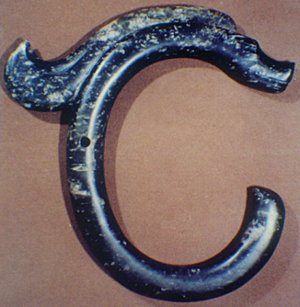
5,000 Year Old Jade Dragon from Hongshan Culture
The distinctive shape of this red border actually represents an ancient cultural artifact that was unearthed in 1971 at a site in Inner Mongolia.
The object, shown at the left, is a jade carving of a dragon from the Hongshan Culture (hongshan wenhua 红山文化) and was created some 5,000 years ago during China’s Neolithic Period (New Stone Age).
The dragon symbolizes the Chinese people and culture.
This jade carving has the distinction of being the oldest representation of a dragon ever discovered. As such, it is considered a national treasure and is now in the collection of the National Museum of China (中国国家博物馆).
The logo of the Hua Xia Bank perhaps best represents the ancient Chinese money theme popular among Chinese banks. Not only does it include the Chinese “cash coin” in its design but it also displays an easily recognized artifact representing China’s 5,000-year-long history.
They have long enjoyed a reputation for being skilled traders and competent warriors. They have strikingly beautiful homes, carve large and imposing totem poles, and wear highly decorated ceremonial clothing made of bird feathers and animal pelts.
The Tlingit believed that these old Chinese coins, made of bronze or brass and having a square hole in the middle, would provide protection from knives and bullets when fighting territorial wars against other tribes or the Russians.
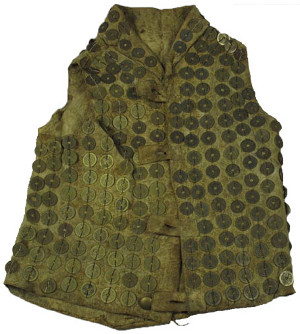
Some of these historic garbs, such as the one pictured above, are now in collections of such major museums as the American Museum of Natural History in New York.
As can be seen, this moose-hide garment is covered with many old Chinese “cash” coins sewn on with sinew.
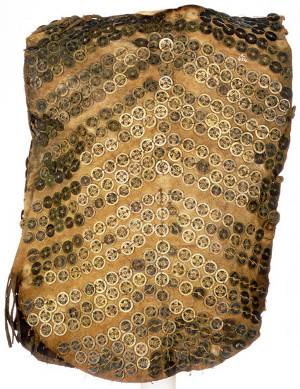
Tlingit body armor with Chinese coins in chevron pattern
Sometimes the coins would be in chevron patterns on the chest as shown on the garment at the left.
Some warrior garments are completely covered with overlapping coins.
The Tlingit believed that the coins would provide protection from bullets. There is some anecdotal evidence that such body armor was in fact effective in a battle with the Russians in the year 1792. According to Russian historical accounts, “bullets were useless against the Tlingit armor”.
Of course, it may have been that the armor was more effective in terms of psychological warfare then in actually providing protection from bullets. Russian smoothbore muskets at the time were notorious for being unreliable and inaccurate.
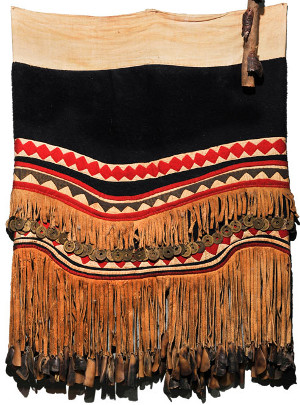
Dancing cape with Chinese coins
Besides used as armor on warriors clothing, the ancient Chinese coins were also used as decorations on Tlingit ceremonial robes and masks.
Chinese coins can be seen hanging from the top row fringe on the Gitxsan dancing cape shown at the left. The coins made noise whenever the wearer moved.
The Chinese coins were believed to symbolize wealth from a great power in a foreign land and as such enhanced the prestige of the owner by providing proof of his success in trade.
The Tlingit body armor and ceremonial robes tended to use coins only from China’s Qing Dynasty (1644-1911).
In particular, coins cast during the reigns of the Shunzhi Emperor (顺治帝 1643-1661), the Kangxi Emperor (康熙帝 1661-1722), and the Yongzheng Emperor (雍正帝 1722-1735) were preferred because these coins tended to be larger and heavier than coins cast during the time of the Xianfeng Emperor (咸丰帝 1850-1861) and later emperors.
The coins used to make the warrior and ceremonial garments were obtained from maritime merchants who traded the coins for Tlingit animal skins which they then exchanged with the Chinese for tea, silk and porcelain.
Old Chinese coins have historically been used for a number of purposes other than currency. The Chinese used them as good luck charms, ground them up for use in traditional Chinese medicine, and used them to predict the future. The Tlingit, an indigenous people living on another continent, discovered yet another use for these coins as body armor.
For additional information on ancient Chinese coins, the Tlingit and their body armor, trade between the Russians and the Tlingit, and possible evidence of a controversial theory regarding worldwide exploration by early Chinese explorers, please see an article published by Discovery News and NBC News entitled “Ancient Chinese Coin Brought Good Luck in Yukon“.
I am honored to have been interviewed for the news article because I had the rare opportunity to be the person the Canadian archaeologists contacted to identify the old Ming and Qing dynasty coins unearthed at the pre-gold rush site in the Yukon.
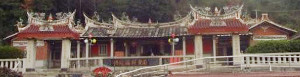
A large quantity of Tang Dynasty kaiyuan tongbao (开元通宝) coins were recently unearthed at an 1,100-year-old temple in Quanzhou (泉州), Fujian Province (福建省), according to a local newspaper report.
Fuhaiyuan Temple in Quanzhou where Tang Dynasty coins were unearthed
Construction of the Fuhaiyuan (福海院) Temple in Anxi Prefecture (安溪县) began in the year 900 AD.
The temple still has such ancient cultural artifacts as a horse-trough, a medicinal vat, and a stone bathing tank.
But during a recent renovation of one of the rear halls, a buried jar containing 27.5 kilograms of ancient Chinese coins was discovered.
Kaiyuan Tongbao coins totaling 27.5 kg discovered at Fuhaiyuan Temple
All the coins have the inscription kai yuan tong bao (开元通宝) which were first cast during the Tang Dynasty (618-907 AD).
Experts are not sure as to why the coins were buried.
Ms. Lin Meilian (林美莲), a local official, speculates that although Fuhaiyuan would have been considered one of the larger temples during the Tang Dynasty, the coins may have been buried “to provide for a rainy day”.
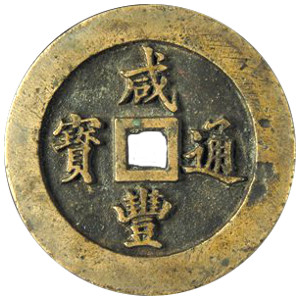
Although it is not included in most Chinese coin catalogs, this coin is known as the “King of Qing Dynasty Coins” (清钱之王).
Chinese coin collectors refer to it as the “daqing one hundred” (daqing yibai 大清壹百).
It is a denomination “100 cash” (壹百) coin cast at the Fuzhou (福州) mint during the reign (1850-1861) of the Xianfeng Emperor (咸丰帝) of the Qing Dynasty (大清).
It is an extremely rare pattern coin and is the only specimen in existence.
The coin was owned by Mr. Ma Dingxiang (马定祥), who was regarded as one of the most famous Chinese numismatists of the 20th Century, and when it was auctioned in 2009 it became the most expensive ancient Chinese coin ever sold up to that time.
Xianfeng had to contend with a number of challenges during his reign. The country’s economy was crumbling and he faced serious military challenges with the Taiping Rebellion (太平天国运动) and the Nien Rebellion (捻军起义).
He also suffered a humiliating defeat by the British and French forces in the Second Opium War (第二次鸦片战争).
To pay the huge military expenditures, Xianfeng issued a large quantity of paper money (Hu Bu Guan Piao 户部官票, Da Qing Bao Chao 大清宝钞) although the empire’s silver reserves were woefully inadequate to back the new currency. He also reduced the size and weight of the common “one cash” coins, and even issued iron coins, in order to save copper which was in short supply due to the supply lines from Yunnan Province being disrupted by the wars.
Finally, he began to issue large denomination coins (大钱) although the copper metal content did not reflect their increased value. These large coins included denominations of 4 cash, 5 cash, 10 cash, 20 cash, 30 cash, 40 cash, 50 cash, 80 cash, 100 cash, 200 cash, 500 cash and 1000 cash.
Among the various mints, the Fuzhou mint was noted for casting many varieties of these larger denomination coins with local characteristics.
For example, the obverse inscription on this coin is xian feng tong bao (咸丰通宝).
The mints, however, were supposed to use the term tong bao only for the small “one cash” coins. Coins with denominations “5 cash” to “50 cash” were to use the term zhong bao (重宝). Coins valued at “100 cash” to “1000 cash” were to be called yuan bao (元宝).
If the Fuzhou mint had followed the directives from the central authorities, the inscription on this “100 cash” pattern coin would have been xian feng yuan bao (咸丰元宝)
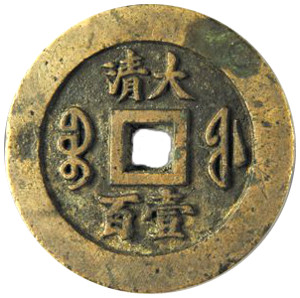
Reverse side of rare Qing Dynasty 100 cash pattern coin
Other special characteristics may be seen on the reverse side.
The inscription at the top reads da qing (大清) meaning Qing Dynasty or the “Great Qing”. At the bottom is the denomination yi bai (壹百) which translates as “one hundred” or the equivalent of 100 cash coins. To the right and left of the square hole are the Manchu characters pronounced boo fu identifying the mint in Fuzhou.
This coin is unusual in that the inscriptions state not only the reign title (xian feng), the denomination (100 cash) and the mint name (Fuzhou), but also the dynasty name (da qing).
The calligraphy is outstanding and is in a style used by the Fuzhou mint known as “mountains and valleys” (shanguti 山谷体).
This very rare pattern coin, which was never put into circulation, is large, heavy and very well cast. The diameter is 7.25 cm and the weight is 197 grams.
This coin, which was one of the prominent pieces in the collection of Ma Dingxiang, sold at the Guardian Auction on November 11, 2009 for about US$314,000 (RMB 1.96 million). At the time, this was the highest price ever paid for an ancient Chinese coin.
Many reproductions and fakes exist of this beautiful one-of-a-kind coin but the only authentic specimen now resides in the collection of the Jin Quan Coin Museum (金泉钱币博物馆).
Chinese archaeologists recently excavated approximately 3,500 kilograms of coins, as well as more than 100 clay coin casting moulds, from the ruins of an ancient Chinese mint dating from the 1st Century AD according to several newspaper reports.
The coins were found at a site in the town of Huoluochaideng (霍洛柴登) in Ordos City (鄂尔多斯) which is located in north China’s Inner Mongolia Autonomous Region (内蒙古自治区).
The discovery was made after local police cracked three theft cases in August, 2012. Information obtained from the tomb robbers identified the location of three underground vaults, according to Lian Jilin, a researcher with the regional Institute of Cultural Relics and Archaeology.
According to archaeologists, the ruins of the coin mint dates to the period from the reign of Emperor Wu (武帝 156-87 BC) of the Western Han Dynasty (西汉) to the reign of Wang Mang (王莽 9-23 AD) of the short-lived Xin Dynasty (新朝).
The newspaper article states that the discovery of such a large quantity of coins in one hoard is a rare event.
Unfortunately, none of the newspaper articles include photos of the discovery.
The digging is taking place at three pits. One site has revealed a fairly well-preserved kiln which was used to produce the clay moulds needed to cast the bronze coins. A kiln used to cast the coins was also discovered but it apparently is not as well-preserved.
In the “kiln room” and surrounding area were found more than 100 clay moulds used to cast coins. The moulds date from the period of Wang Mang. Seven of the moulds have the Chinese inscription shi jian guo yuan nian san yue (始建国元年三月). Shi jian guo (始建国) refers to the first era of Wang Mang’s reign. The inscription thus dates the coin moulds to the third month of the first year of Wang Mang’s reign which would be the year 9 AD.
The clay moulds include those used to cast the most common coins of the reign of Wang Mang, namely da quan wu shi (大泉五十 “large coin fifty”), xiao quan zhi yi (小泉直一 “small coin value one”), and huo quan (货泉 “wealth/money coin”).
The archaeologists point out that the discovery of such a large coin producing operation confirms that Wang Mang had lifted the order issued by Emperor Wu which prohibited the commanderies (prefectures) from minting coins.
Because the discovery was made so late in the year and with the winter conditions, it is unclear at this time what may ultimately be discovered at the two other sites.
Based on the size of the mint site and the coin hoard, Huoluochaideng must have been one of the important northern cities during the Western Han and Xin Dynasties. From the inscription found on a bronze seal discovered in a nearby grave, the area was known as the “West River Agriculture Commandery” (西河农令) during this period.
Various forms of non-governmental currencies began to appear in the Changzhou (常州) area of Jiangsu Province (江苏省) during the early years (1939-1941) of the Japanese invasion and occupation of China (zhongguo kangri zhanzheng 中国抗日战争).
These currencies were issued by various stores and individuals and only circulated in a very limited area. They took the form of metal tokens,bamboo tallies, paper money, etc.
The necessity for such local currencies was due to the lack of small denomination coins and paper money issued by the government.
Other factors also played a role. It was very profitable for dealers to take old Chinese copper coins and convert them to coins for local circulation. Also, the local populace had very little confidence in the currencies issued by the Japanese-backed “puppet” government.
Local businesses also found it advantageous to issue these small denomination tokens in order to facilitate business transactions, establish prestige and promote the local economy.
Among the most interesting of these local currencies were those issued for circulation in the town of zhenglu qiao (郑陆桥) which translates as “Zheng Lu Bridge”.
Prior to the Ming Dynasty (1368-1644), there was neither a town nor even a bridge in the area.
There was only a small street by the name of Zhenglu Street (郑陆街). Changzhou is the hub of a number of rivers, canals and lakes. At the time, a large number of people with the surname Zheng (郑) resided on one side of the river and people with the surname Lu (陆) dwelled on the opposite side. That is how the street got its name.
One day during the Longqing reign (隆庆 1567-1572) of the Ming Dynasty, a beautiful young woman from the Lu clan living in Dongshu Village (董墅村) happened to cross the river by ferry and was walking down Zhenglu Street when she noticed a handsome young man with a refined manner standing near the window on the second floor of his house reading poetry out loud. She glanced upwards, their eyes met, and she was immediately captivated by him.
When she returned home, she could “no longer think of food or sleep”.
As for the young man, he could no longer “smell the fragrance of flowers or read books”.
Her family immediately noticed the change in her behavior, and when asked the reason she confided her love for the young man.
The mother went to Zhenglu Street to find the object of her daughter’s affection. Several people were able to tell her the young man’s family name was Zheng. The young man was described as being generous, reliable and one who loved to read. She also discovered that the two families were very similar in regard to wealth and social status.
The two families arranged a meeting and it was decided that the two young people would marry in three months time which would be on the eve of the Spring Festival (春节).
But, in order to get to Dongshu Village from Zhenglu Street one needed to take a ferry to cross the river. For the sake of the wedding, it was decided that taking the ferry would be too dangerous. Also, it would not be convenient carrying all the wedding gifts on a ferry.
The two families therefore decided to use the three months time to build a wooden bridge to span the river. Since the families were well-off, the expense to build the bridge was not a problem.
The bridge was finished the day before the wedding and well-wishers were thus able to come and see the beautiful bride as she crossed the new bridge on her way to the wedding ceremony.
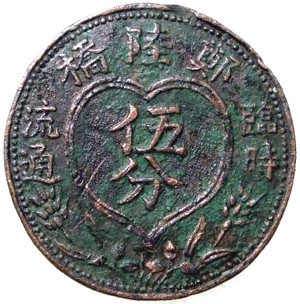
Zheng Lu Bridge token with heart symbol
To the local residents, the Zheng Lu Bridge also symbolized another famous “love” bridge. In Chinese mythology, two separated lovers known as the Cowherd and the Weaver Girl are allowed to meet once a year during the Qixi Festival (七夕节) by crossing a “Magpie Bridge” (鹊桥) which is a bridge composed of flying magpies that spans the stars.
An example of a Zheng Lu Bridge token displaying a “heart” symbolizing love is shown here. At the top is written “Zheng Lu Bridge” (鄭陸橋) and in the center of the heart is the denomination “five cents” (“five fen” 伍分). To the right and left of the heart is 臨時流通 which means “temporary circulation”.
The bridge quickly became very popular as a convenient way for people and goods to cross the river. Streets gradually were built in the area and stores, hotels and other businesses were established or moved to the area from Zhenglu Street.
However, as the years passed the wooden Zheng Lu Bridge deteriorated to the point that it had to be replaced with one made of stone.
The local people liked the story associated with the old bridge so much that they made sure that the name “Zheng Lu Bridge” was engraved in stone on the new bridge.
After several hundred years, the Zheng Lu Bridge was again rebuilt of stone in 1878.
In 1929, the area known as Zheng Lu Bridge officially became the “town” of Zheng Lu Bridge. In October of 1957, “Zheng Lu Bridge Town” was officially renamed “Zheng Lu Village”.
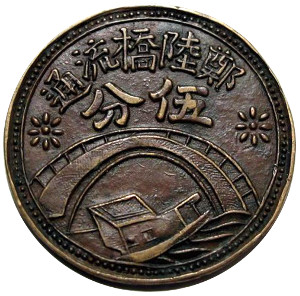
Zheng Lu Bridge token
As mentioned and illustrated above, various businesses found it advantageous to issue token forms of money during the period of the Japanese occupation.
Some of these tokens actually display images of the “Zheng Lu Bridge” as the theme.
At the left is an example of such a token. At the top of the token is the inscription zheng lu qiao liu tong (鄭陸橋流通) which translates as “Circulates in Zheng Lu Bridge”.
The two characters in the middle of the token state the denomination as “five fen” (“five cents” 伍分).
The lower half of the token displays the stone Zheng Lu Bridge with a boat passing underneath.
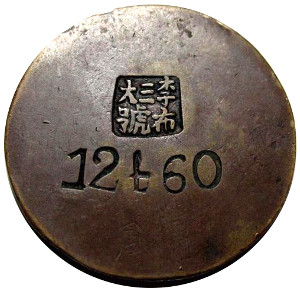
Reverse side of Zheng Lu Bridge token
The reverse side of these tokens usually displays the name of the person or business that issued the token.
The reverse side of the above token is shown at the left.
This particular token was issued by the Li Sanda Fabric Store (李三大布號). The serial number of the token is shown below the name.
Similar Zheng Lu Bridge tokens exist that were issued by other businesses and individuals.
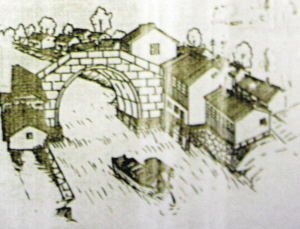
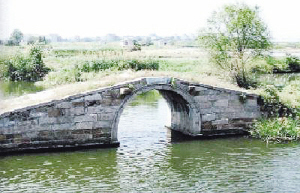
Zheng Lu Bridge as it exists today
Unfortunately, in October 1971 the old stone Zheng Lu Bridge had to be torn down in order to dredge and enlarge the Beitang River (北塘河).
However, in September 1980 an arched bridge made of concrete was built near the original site as seen in the image at the left.
In remembrance of the love story that occurred some 400 years earlier, the new bridge is appropriately named “Zheng Lu Bridge”.
Most of the other known examples are in the hands of private collectors outside of China.
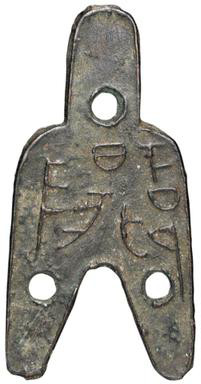
This particular three hole spade has a very well-documented provenance.
Its first documented appearance was about 200 years ago when it became part of the collection of Zhang Tingji (张廷济), a famous artist and epigrapher (1768-1848) of the Qing Dynasty. A rubbing of this specific coin appeared in his “Ancient Coin Rubbings” (古泉拓本) which made it the first three hole spade to ever appear in publication.
During the Republican era (1912-1949), the coin was obtained by the famous Chinese coin collector Zhang Shuxun (张叔驯) and the rubbing of this coin has appeared in almost every Chinese coin catalog published since then.
The Chinese characters on the obverse side are xia qu yang (下邲阳). Xia qu yang is believed to have been a city located in what is now Ningjin Prefecture (宁晋县) in Hebei Province (河北省).
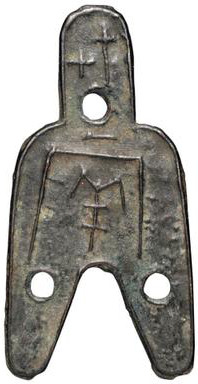
Reverse side of Three Hole Spade
The inscription on the reverse side of the coin is believed to be shi qi liang (十七两). The shi qi, written on the handle, translates as “17” and the denomination of the coin is one liang or “tael”.
Three hole spades come in two sizes: the “large” ones are about 7.2 cm in length, 3.8 cm in width and weigh approximately 15.8 grams.
The “small” three hole spades, which have a denomination of half liang (12 zhu (朱)), are about 5.2 cm in length, 2.7 cm in width and weigh approximately 8.2 grams.
This particular spade has a length of 7.35 cm, a width of 3.7 cm and a weight of 13.4 grams.
There is some controversy as to which state actually cast these coins. They are believed to have circulated as money in what is now eastern Shanxi and Hebei during the end of the Warring States period. Some experts believe the coins were cast by the State of Zhao (赵). Others believe it was Zhong Shan (中山). Still others believe it was the State of Qin (秦).
Based on archaeological digs as well as the names of the cities identified from the inscriptions on these coins, the strongest evidence is that they were cast by the State of Zhao.
Three hole spades are also noted for using the denomination liang (“tael”) and zhu which were the denominations of the coins of the State of Qin. For this reason, these coins are believed to have been produced in areas under Qin’s influence but prior to the unification of China under the Qin Dynasty in 221 BC.
Based on specimens appearing in coin catalogs dating back to the Qing Dynasty (1644-1911), there are believed to be more than ten city names used in the inscriptions and a total of more than thirty varieties of this coin. Chinese numismatists remain puzzled as to why a state would issue so many varieties in such small quantities.
While there are many very rare and valuable old Chinese coins, this three hole spade, as already mentioned, set a new record for the highest price ever paid for an ancient Chinese coin.
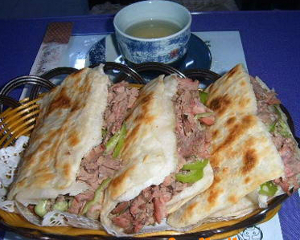
Now there is a restaurant in Beijing where you can spend ancient Chinese money to buy “donkey burgers” (lurou huoshao 驴肉火烧).
An article in the November 26, 2012 edition of the Beijing Evening News (beijing wanbao 北京晚报) describes a restaurant that sells donkey burgers with the prices denominated in ancient Chinese money. Donkey burgers are a specialty of Baoding (保定) and Hejian (河间) and consist of chopped donkey meat and vegetables placed between two buns.
A sign hanging in the restaurant states “Money from the last 500 years may be used to buy donkey burgers here”.
This means that old Chinese coins dating back to the Ming (1368-1644) and Qing (1644-1911) dynasties can be used to pay for the sandwiches.
Donkey burgers actually originated during the Ming Dynasty when soldiers had nothing to eat and so killed their horses and put the meat between two buns.
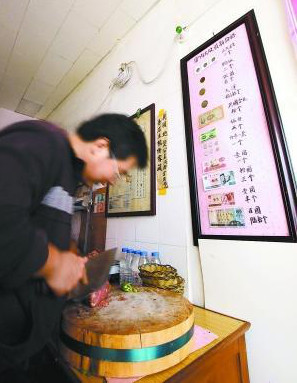
Preparing donkey burgers with price list in ancient Chinese coins hanging on wall
“Little Yan” (小闫), the owner of the restaurant, has a “new” menu hanging on the wall (see photo). The menu has various old coins and paper money attached and beside each is written how many donkey burgers each will buy.
For example, three common Ming or Qing dynasty “cash coins” (small bronze coins with a square hole in the middle) will buy one donkey burger.
A “one dollar” banknote (一元钞票) with the portrait of Sun Yat-sen (孙中山) issued during the Republic of China (1912-1949) will purchase 10 donkey burgers.
However, a silver dollar minted during the Republic of China era will buy 80 donkey burgers.
Donkey Burgers
“Little Yan” explained that he was poor growing up but still liked to collect old things. While working for wages in Beijing, he would go to the antique market at the Baoguo Temple (报国寺) to learn the prices of ancient Chinese coins and how to tell authentic coins from the fakes and reproductions.
Even though his “new menu” with ancient money prices has been hanging on the wall for more than a week, “Little Yan” concedes that no one as yet has come in to buy his “authentic” Hejian donkey burgers with old money.
He is not bothered, though. He admits that he did this for fun because people find it interesting that they can come and buy food with ancient money. He says that even when people come in but do not want to eat, he is still happy just to discuss ancient Chinese coins with them.
“Little Yan” also has a confession to make. Although he has genuine ancient Chinese coins in his collection, the specimens he has attached to the price list on the wall are all fakes.
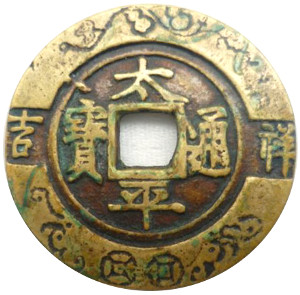
Chinese charms very often resemble Chinese coins. A number of old Chinese charms are modeled after a coin issued during the reign of Emperor Taizong (太宗 939-997 AD) of the Northern Song Dynasty. The inscription on the coin was taiping tongbao (太平通宝) which translates as “Currency of the Great Peace”.
Tai Ping Tong Bao charm from Qing Dynasty
At the left is a very interesting example of a Chinese charm cast during the Qing Dynasty (清朝 1644-1911 AD) which has the same inscription taiping tongbao.
There is also a second inscription on this charm. The two Chinese characters at the left and right rim are jixiang (吉祥) which means “good fortune”. On the reverse side of the charm are the two Chinese characters ruyi (如意), located at the top and bottom rim, which translate as “as you wish”.
These four characters thus comprise the popular expression jixiang ruyi meaning “good fortune according to your wishes”.
If you look closely, you will notice that this charm has a “double rim” (重轮) because in addition to the broad outer rim there is also a thin circular rim surrounding the four character inscription. This is very unusual for a charm.
It is even more unusual for a charm to have an inscription in a recessed area of the rim, as this one does.
It is even rare for a Chinese coin to display an inscription in a recessed area of the rim.
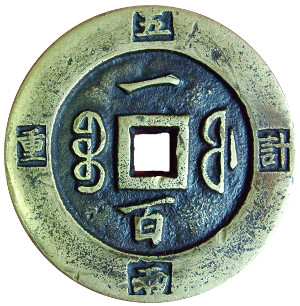
Very rare Qing Dynasty coin with inscription on rim
An example is the large coin displayed at the left.
This is a very raredenomination “One Hundred Cash” (一百) coin cast at the mint in Fuzhou (福州), Fujian Province (福建省) during the reign of the Xianfeng Emperor (1851-1861) of the Qing Dynasty. In recessed areas of the rim on the reverse side of this xianfeng zhongbao (咸豐重寶) coin are the Chinese characters wu liang ji zhong (五兩計重) which translates as “5 liang calculated weight”.
The taiping tongbao charm displays several auspicious symbols on its obverse side.
If you look at the top rim you will see symbols which resemble the number “8” and represent gourds. The gourd is believed to ward off evil spirits and disease.
At the bottom rim are two Chinese cash coins (circles with a square hole in the middle) which symbolize wealth and prosperity.
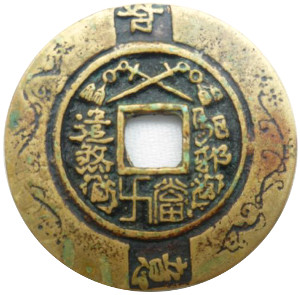
Reverse side of Tai Ping Tong Bao Charm
The reverse side of the charm, shown here at the left, includes additional inscriptions and a number of auspicious symbols.
Written vertically at the right of the square hole are the Chinese characters quxie (驱邪). At the left of the square hole are the characters qiansha (遣煞). The inscription quxie qiansha (驱邪遣煞) translates as “expel and strike dead evil influences”.
Just above the hole are two crossed swords with tassels which symbolizes “victory over evil”.
At the lower right and lower left corners of the square hole are two “bats”. The bat (fu 蝠)is a visual pun or rebus for “good fortune” or “happiness”.
Below the hole are two Chinese characters. At the right is the character dang (當) and to its left is a swastika (卍).
The Chinese “swastika” (卍) is an ancient religious and charm symbol that over the course of two millinnea has variously been interpreted to represent the sun, fire, the light emanating from the Buddha, etc.
The 卍 symbol also represents the number “ten thousand” (wan 萬). The two character inscription (dang wan 當卍) thus translates as “Value Ten Thousand” which means the denomination of this charm “coin” is equivalent to ten thousand cash coins. Quite a fortune, indeed!
Finally, along the right and left rims are very stylized dragons.
This is an extraordinary charm from the late imperial period that displays a variety of good luck symbols and inscriptions while incorporating features rarely found even on officially cast coins.
In early October, 2012, a villager digging near an old wall in wangminxianghongtaicun village (王民乡红太村) located in Xiji Prefecture (西吉县) in China’s northwest Ningxia Hui Autonomous Region (宁夏回族自治区) unearthed 17 ancient Silk Road coins, according to several reports in the Chinese press.
The newspapers interviewed Mr. Su Zhengxi (苏正喜) of the Xiji Prefecture Coin Museum (西吉县钱币博物馆) who stated that a preliminary investigation identifies these copper coins as originating from the ancient Kushan Empire (guishuang 贵霜王朝) which existed about the same time as China’s Han Dynasty.
Kushan coin with image of king
The Kushan Empire existed during the period 30 AD – 375 AD and occupied northwest India and the adjoining regions of Iran and Afghanistan. At the height of its influence, Kushan’s territorial control expanded to include parts of western China’s Xinjiang. Kushan played a major role in linking the seagoing trade of the Indian Ocean with the overland route of the Silk Road.
Various newspaper reports give slightly different descriptions of the coins. Some reports state that the coins have the image of a king on one side and the image of a cow or ox on the reverse side. Other newspaper accounts state that there are written characters on one side and an image of a cow or oxen on the reverse.
Mr. Su mentions that three of the coins have inscriptions written in a “foreign script”.
Kushan coin with inscription
One newspaper report states that the coins were minted (struck) in the same manner as ancient Greek coins and that the obverse sides have inscriptions written in “Kushanized” Greek letters. The reverse sides are said to have images of Persian and Indian gods.
Mr. Su emphasized that this is the first time these particular ancient Kushan coins have been discovered in Ningxia. Previous to this, the only coins of this type that have been unearthed in China have been “several tens of coins” discovered in the Loulan ruins (楼兰遗址) and Hetian (和田地区) in Xinjiang.
Ancient Kushan coin with inscription
The museum has 5 or 6 coins originating from the ancient Silk Road but these coins were found mixed together with other coins when unearthed in Xiji Prefecture.
Mr. Su pointed out that this was the largest hoard of such coins discovered in Ningxia and the first time Silk Road coins have been discovered not mixed with other coins.
Historical records mention that this area was part of the northern section of the Silk Road but, to date, there had been no archaeological evidence to confirm this. Mr. Su said that the discovery of these seventeen Kushan coins now provides the needed evidence to confirm the historical records.
During ancient times, a large number of merchants would have travelled through the area where the coins were unearthed on their way to and from Luoyang (洛阳) at the eastern end of the Silk Road.
A Chinese villager digging a well in his yard unearthed a large cache of knife and spade money dating to the Warring States (战国 475-221 BC) and Qin Dynasty (秦 221-207 BC) period according a recent newspaper report from Hebei Province (河北省).
This is the first time such a large and ancient hoard of coins from this time period has been discovered in Laiyuan (涞源), a town near the city of Baoding (保定).
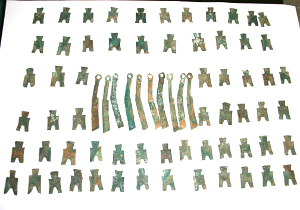
Spade and knife money unearthed from State of Yan
The knife (daobi 刀币) and spade money (bubi 布币) has been identified as originating from the ancient State of Yan (燕国) which occupied the area until it was conquered by the armies of Qin Shi Huang (秦始皇) in 222 BC.
A total of 98 specimens of knife money and 161 specimens of spades were recovered.
From the picture published with the article, there appear to be both “square foot” (fang zu bu 方足布) and “pointed foot” (jian zu bu 尖足布) spades discovered in the hoard.
Unfortunately, the newspaper article does not provide larger images or any information as to the inscriptions on these spade and knife-shaped coins.