Category: Chinese coins

  • Tons of Song Dynasty Iron Coins Discovered

    A Chinese newspaper reported today that several tons of iron coins dating from the Song Dynasty were recently discovered in a field near the city of Cangzhou (沧州), Hebei Province in northeast China.  Although the coins protruding through the soil have rusted together, they can still be seen just the way they were arranged in stacks almost a 1,000 years ago.
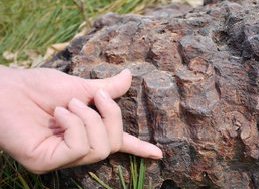
    Stacks of iron coins from the Song Dynasty
    Stacks of iron coins from the Song Dynasty

    An outcropping of the pile of neatly stacked iron coins can be seen in the photo at the left.

    This was not the first time a large quantity of coins had been discovered in the area.  In July 1997, at a location just 500 meters from the newly discovered pile of coins, more than 48 tons of Song Dynasty iron coins were unearthed.

    The actual quantity of coins discovered in the new “pile” is not known at this time.  Based on preliminary calculations, the coins fill an area approximately 25 meters by 16 meters.  The top of the pile is about 0.4-0.5 meters below the surface.  Since it is not known how deep the pile is, the experts can only estimate that there are several tons of coins.
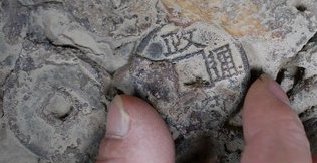
    Chinese iron coin from 1101-1125 AD
    Chinese iron coin from 1101-1125 AD

    The photo at the left displays one of the iron coins from the pile of coins discovered in 1997.

    This round cash coin with a square hole in the center has the inscription zheng he tong bao (正和通寶) which was used on coins cast during the reign (1101-1125 AD) of Emperor Hui Zong of the Northern Song Dynasty.

    Mr. Yang Fengling (杨凤岭), the Director of the Cang Prefecture Cultural Relics Institute, said it is not yet known if there is any connection between the newly discovered pile of coins and the coins discovered nearby in 1997.

    As to why such a large quantity of Song Dynasty coins might exist, Mr. Yang could only conjecture at this time.

    Mr. Yang said that during the Song Dynasty, Cangzhou was one of the places where prisoners were sent.  During ancient times, prison labor was sometimes used to produce coins.  It is possible that this had been the site of a coin foundry or mint.

    Mr. Yang also pointed out that the coins seem to have been arranged in a very orderly manner and that the site may have been a large-scale treasury where money was stored.

    Mr. Yang mentioned one other interesting possibility.  It is said that after Emperor Taizu (960-976) established the Song Dynasty, he wanted to redeem parts of present day Hebei Province, known then as the “Sixteen States of You Yun” (幽云十六州), which were occupied by the Khitan (契丹) of the Liao Dynasty (辽朝).  Cangzhou happened to be situated right at the border of the Song and Liao territories and the cache of coins may have been intended for this purpose.

    Mr. Yang further stated that this new discovery of iron coins might rewrite history.  According to historical sources, iron coins during the Song Dynasty were made and circulated in the southern part of the country.  The discovery of such a large quantity of iron coins in the north means that iron coins must have circulated here as well.  They may also have been produced here.

    Mr. Yang hopes that the mysteries surrounding this new discovery may be better explained once excavation of the site begins next month.
  • Xian Numismatic Museum

    The official opening of the Xian Numismatic Museum (西安钱币博物馆) was announced today in a Chinese newspaper article.

    The new money museum is located in the ancient city of Xian (西安), the capital of Shaanxi Province (陕西).  Xian, formerly known as Changan (长安), has a history of more than 3,100 years and was the eastern terminus of the Silk Road.  Xian (Chang’an) became the first capital of China when Qin Shi Huang (秦始皇) united the country in 221 BC and is where the famous terracotta army is located.

    The coin museum was established by the Xian Branch of the The People’s Bank of China (中国人民银行) and occupies an area of 324 square meters (3,487 square feet).

    More than 5,000 coins, paper currency and other forms of ancient and modern money dating back more than 4,000 years are on display.

    The museum’s exhibits include some very rare items.  According to Mr. Zhao Xiaoming (赵晓明), the Secretary-General of the Xian Numismatic Society (西安钱币学会), the first “piled” coin mold (叠范) ever discovered for the 4 zhu ban liang (四铢半两), valued at more than “one million yuan” ($156,500), is on display.

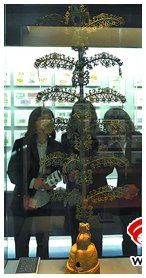
    Ancient Chinese Money Tree
    Ancient Chinese Money Tree

    Considered among the “greatest treasures” on display are two “money trees” (yao qian shu 摇钱树) from the Eastern Han Dynasty (25-220 AD).

    Ancient Chinese legends spoke of trees from which coins would fall like leaves when shaken.

    Museum visitors examining one of the money trees can be seen in the photo at the left.

    The money tree is 138 cm (54 inches) in height and has a series of seated Buddhas at the top.  The money tree branches are decorated with wu zhu (五铢) coins, “immortals” and “fairies”, monkey gods and other auspicious animals.

    Exquisite examples of money trees, such as the two on display, have been found in Han Dynasty tombs in southwest China.  These burial objects are believed to have been used by the deceased as a “map” or guide leading up to heaven and then used as a means of support while there.

    For additional information on the origin and history of “money trees”, please see “Chinese Money Trees“.

  • Chinese “World of Brightness” Coin

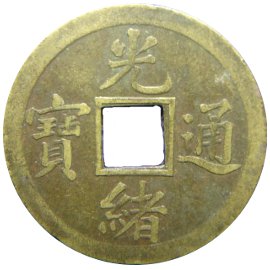
    Qing Dynasty Machine Struck Cash Coin
    Qing Dynasty Machine Struck Cash Coin

    The first Chinese machine-made cash coins were minted during the reign (1875-1908) of Emperor De Zong of the Qing Dynasty.

    As seen at the left, these brass coins had the inscription guang xu tong bao (光緒通寶).  Many of these coins were struck at the mint in Guangzhou, Guangdong Province during the years 1889-1908.

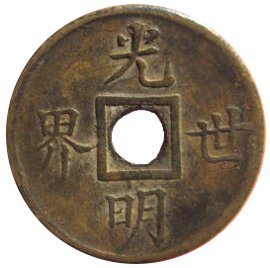
    Another coin was made about the same time that closely resembles this common guang xu tong bao coin but its meaning and history are still a mystery.

    "World of Brightness" Coin

    An example of this mysterious coin is shown at the left.  The inscription reads guang ming shi jie (光明世界) which translates as “world of brightness”.

    Several theories have been proposed as to the meaning and purpose of this coin or charm.

    Many people believe that this is “spirit money” (ming qian 冥钱), also known as “ghost money”, “hell money” or “joss money”, which is money that is buried with the dead.

    The reasoning is that this coin resembles real Chinese money.  Also, the inscription “world of brightness” is a euphemism for “world of darkness” or death.

    A different theory proposes that the coin is associated with the Tiandihui (天地会) or “Heaven and Earth Society” which was a secret organization dedicated to overthrowing the Qing Dynasty, which was ruled by the Manchus, and restoring the Ming Dynasty and the hegemony of the Han people.  Interestingly enough, the inscription on the coin uses the same character “ming” (明) that is used for Ming Dynasty (明朝), and the inscription guang ming (光明) can be interpreted to mean the “glory of the Ming”.

    One final theory is that the coin was made to be used as a game piece or gambling token.

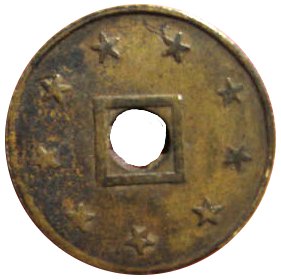
    This coin is know to exist in three varieties with the difference being the reverse sides.

    The most commonly found reverse side is identical to that of the standard guang xu tong bao coin.  In this case, there are two Manchu characters indicating that the coin was struck at the mint in Guangzhou.

    The second version of the coin has a reverse side that is identical to the obverse side which means that the same inscription or legend is on both sides.

    "9 Stars" on Reverse Side

    The third version of the coin is the most interesting because it has nine stars as shown in the example at the left.

    The ancient Chinese, and particularly the Daoists, believed that the star constellation known as the “Big Dipper” or “Ladle” (beidou 北斗) consisted of the seven stars we see today along with two “invisible” or “attendant” stars making a total of nine stars.

    The “Big Dipper” was where the gods lived and also served as the emperor’s chariot.

    One of the major Buddhist and Daoist deities is the “Dipper Mother” (doumu yuanjun 斗母元君) who is also known as the “Queen of Heaven” (tianhou 天后) and the “Goddess of Beidou (“Big Dipper”)”.

    She is the mother of the Nine Emperor Gods who are represented by the nine stars.  She is honored each year on the 9th day of the 9th lunar month.

    Finally, “nine” (jiu 九) is an auspicious number to the Chinese because it has the same pronunciation as the word “forever” (jiu 久).

    While questions remain as to the true meaning and purpose of this coin, it nevertheless provides a fascinating insight into the political undercurrents and religious beliefs of China just as the imperial system that had existed for more than 2,000 years was beginning to crumble.

  • More than 2,200 Rare “Later Jin Dynasty” Coins Discovered

    According to an article published in today’s Liaoning Daily (辽宁日报), the local police have arrested a gang of thieves who unearthed more than 2,200 rare coins dating from the Later Jin (后金) Dynasty (1616-1636 AD).

    According to the report, the Bureau of Public Security of Liaoyang City (辽阳市) has arrested three men suspected of the theft and is presently looking for additional members of the gang.

    Mr. Wu, the 32-year-old leader of the gang, was previously employed as a taxi driver.  Last spring, he received word that some ancient Chinese coins had been discovered at a construction site in Liaoyang City.  He went to the site everyday with his shovel but in a year’s time was only able to dig up a little more than 300 coins.

    In order to find coins more quickly, Mr. Wu in May of this year bought a metal detector and rented a large excavator.  He also recruited a few accomplices to form a “treasure digging team” which ultimately unearthed more than 2,200 coins weighing 17 kg (37.4 lbs).

    Mr. Wu sold the coins for $101,700 (650,000 元).

    Not long after, however, the buyer of the coins was arrested.  He confessed and implicated Mr. Wu who was then arrested.

    According to the cultural relics experts involved in the case, all the coins unearthed by the thieves have inscriptions written in the Manchu script (满文).  The coins are from the Later Jin Dynasty (后金) which existed during the years 1616-1636 just prior to the Manchus conquering all of China and establishing the Qing Dynasty (清朝 1644-1911).

    Unfortunately, no images of the coins were published in the newspaper article.

    However, the coins are said to be special in that they were not used for general circulation.  The experts believe that these coins may have been used by Nurhachi (努尔哈赤), the leader of the Manchus (满族), to reward his generals for meritorious achievements.

    For this reason, the coins are considered to be very rare and the experts estimate that the market value for these Later Jin Dynasty coins (后金币) is at least $470,000 (3,000,000 元).

  • 1910 Chinese Yunnan Spring Dollar

    With only two specimens known to exist, the Yunnan Spring Dollar is considered among the very rarest of Chinese coins.

    One coin sold for $1,035,000 at a Hong Kong auction in August 2010.  The only other known specimen is scheduled to be auctioned in September 2011.

    As you might expect, there is a great deal of excitement and publicity concerning this upcoming auction since it is not likely that either of these coins will be available again to collectors or museums for many years or perhaps even generations to come.

    Besides their rarity, one of the main attractions of these coins has to do with the reference “spring” dollar.  These are the only coins in Chinese history to include a season in the inscription and it has been considered a mystery as to why this was done.

    Chinese Yunnan Spring Dollar
    Chinese Yunnan Spring Dollar

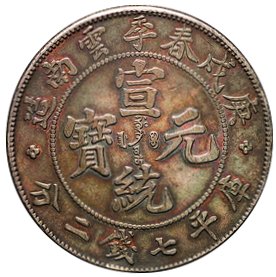
    At the left is the Yunnan Spring 1910 Silver Dragon Dollar which was auctioned last year.  I personally consider this coin to be the more visually appealing of the two even though its “official” grade (“AU55 NGC”) is slightly below that of the coin (“AU58 NGC”) to be auctioned next month.

    The four large Chinese characters at the center of the coin read xuan tong yuan bao (宣统元宝) which means it was minted during the reign of the Xuantong Emperor (1908-1912) also known as “The Last Emperor”.

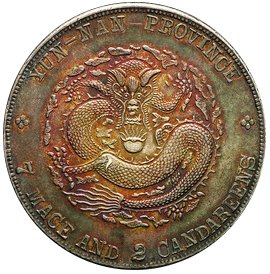
    The denomination of the coin is written at the very bottom as ku ping qi qian er fen (库平七钱二分) which is “Treasury Standard 7 Mace and 2 Candareens”.  In English, the coin is usually called a “dollar”.

    The Chinese inscription at the top reads geng xu qun ji yun nan zao (庚戌春季云南造) which translates as “made in Yunnan Province in the spring of the year geng xu (1910).”

    The official announcement for the September auction emphasizes the mystery concerning the inclusion of “spring” in the coin’s inscription:

    “This enigmatic issue, one of China’s rarest coins (and with only two genuine pieces known), has been a coin of mystery and legend since its discovery, around 1920.  Although there has been constant research in Chinese numismatic circles, over time, no definite reason, or meaning of the term, “Spring 1910″, has yet been discovered.”

    Unfortunately, this is not quite correct.

    Reverse side of Yunnan Spring Dollar
    Reverse side of Yunnan Spring Dollar

    According to several Chinese websites including the “Baidu Library” (百度文库), which is the online encyclopedia maintained by China’s major search engine “Baidu” (百度), the reason that “spring” was included in the inscription is as follows.

    The coin is intimately connected with the monetary reforms which were taking place in China at the time.  On April 15, 1910, the Qing Dynasty government promulgated “Currency Regulations” (币制则例) in order to standardize the minting of the silver coinage of the country.  The authority to mint silver coins was taken away from all provinces and consolidated at the mint in Tianjin.  However, since China covers such a vast area, it was not considered practical to have all silver coins made at one mint and therefore branch mints were established at Hankou, Guangzhou, Chengdu and Yunnan.

    The new regulations required the silver dollar coins to be of a uniform design, purity, weight and size.  Since this was not the case with the coins that were being minted at the four branch mints, these mints were ordered to cease production and await further instructions from the Tianjin mint.  The branch mints were also to wait until they received the new standardized dies before resuming production.

    However, a few of the branch mints, for selfish reasons, refused to cease the minting of silver coins.  The Yunnan branch took dies that had been used to make the 1909 coins and engraved at the top the additional inscription “made in the Spring of 1910”.  According to the traditional Chinese calendar in use at the time, “spring” referred to the first three months of the year, namely, January, February and March.  In this way, the Yunnan mint attempted to circumvent the new regulations by saying that the coins were made before April of that year.

    The Chinese central government discovered the scheme at the Yunnan mint and ordered that all these new coins be withdrawn and melted down.  However, a very very few of the coins escaped being destroyed and these are the specimens that are now known as the Yunnan Spring Dollars.

    Thus, the “mystery” surrounding the appearance of the word “spring” on these coins is a mystery no more.

  • Empress Dowager Cixi Commemorative Coin

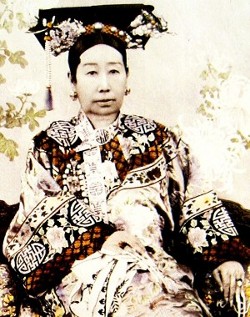
    A recent Chinese newspaper article published pictures of a very rare Chinese silver coin which is believed to have been minted to commemorate the birthday of one of imperial China’s last rulers.  The coin is owned by a Mr. He who lives in Anqing City in Anhui Province.

    The Empress Dowager Cixi
    The Empress Dowager Cixi

    The Empress Dowager Cixi (慈禧太后 1835-1908) was a concubine of the Xianfeng Emperor.   She gave birth to a son who became the Tongzhi Emperor upon the death of the Xianfeng Emperor.

    She became the regent for her young son, who was only 5 years old, and essentially established absolute rule for herself.  The Tongzhi Emperor died of smallpox at the age of 18.

    She then established her nephew, the Guangxu Emperor, as the new ruler in 1875 but she remained the real power behind the throne until her death in 1908.

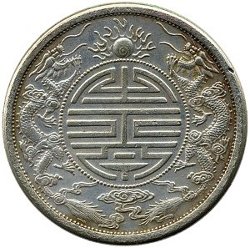
    Coin commemorating 70th birthday of Empress Dowager Cixi
    Coin commemorating 70th birthday of Empress Dowager Cixi

    The beautiful silver coin shown here is believed to have been minted in 1905 to commemorate the 70th birthday of the Empress Dowager Cixi.

    Two five-claw dragons, symbolizing the emperor, are on each side of the coin, and are separated by a “flaming pearl” at the very top.

    In the middle of the coin is a large and very stylized version of the Chinese character shou (壽) which means “longevity”.

    You will notice that the exquisite robe the Empress Dowager is wearing in the photograph is decorated with the same Chinese character.  The photograph was taken by the official court photographer in the same year of 1905.

    The other side of the coin has the inscription guang xu yuan bao (光緒元寶) indicating that it was produced during the reign of Emperor Guangxu.  This silver coin was struck at the mint in Guangdong Province and the denomination is the “treasury standard one tael” (庫平重壹兩).

    These coins are considered very rare with estimates of only ten or more authentic specimens known to exist.

  • Five Goat Coin

    A recent article in a Chinese newspaper described how a Chinese coin collector hid his coins during the Cultural Revolution (1966-1976) to save them from the Red Guards who were intent on “destroying the old”.  The collector is now donating the coins to the Zhuhai Museum.  Among the coins being donated is a very rare copper coin minted in 1936.

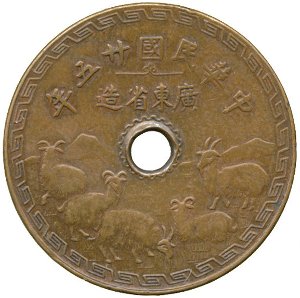
    Chinese copper coin minted in 1936 displaying five goats
    Chinese copper coin minted in 1936 displaying five goats

    This coin is remarkable for its design and use of symbols.

    The inscription at the top translates as “Republic of China 25th Year” and “Made in Guangdong Province”.

    The lower half of the coin displays five goats.  The five goats are a reference to an ancient myth concerning the city of Guangzhou (Canton) which is located in Guangdong Province.

    While specific details of the myth vary, the basic story is as follows.  During the reign (899 BC – 892 BC) of King Yi (周懿王) of the Zhou Dynasty, the ancient city of Guangzhou (chuting 楚庭) suffered a great famine.  The fields were parched and the people were starving.  One day, five immortals (“celestial beings”) descended from the sky.  Each immortal rode a goat and floated down on a cloud.  In the mouths of each goat was a six-eared rice stalk.  The immortals blessed the land to be forever free of famine and gave the stalks of rice to the people.  The immortals then rode their clouds back into the sky.  The five goats remained on a hillside and were transformed into stone.

    With the gift of the rice stalks the famine ended and Guangzhou has enjoyed bountiful harvests ever since.

    Based on this myth, Guangzhou is known as the “City of Goats” (yangcheng 羊城), “Sheaves of Rice City” (suicheng 穗城) and the “City of Five Goats” (wuyangcheng 五羊城).  In translation from the Chinese, the English words “goat” and “ram” can be used interchangeably.

    On the coin, each of the five goats is shown in a different pose and in such detail as to include whiskers.

    Other symbols of Guangzhou include the design surrounding the round hole which is meant to represent the battlements of the ancient wall that encircled the city.

    To the left and right of the center hole are mountains from the Guangzhou area.  If you look very carefully, you will notice that the mountain on the left appears to be farther in the distance than the one on the right.

    The attention to detail even includes displaying patches of grass for the goats to eat to signify that food is plentiful.

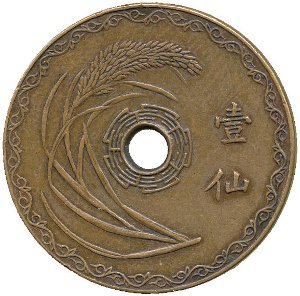
    Reverse side of "Five Goat" coin

    The reverse side of the coin is also rich in symbolic design.

    To the left of the hole is a rice stalk with six branches which refers to the rice stalks carried in the mouths of the goats in the ancient myth.  This is also the official emblem of the city of Guangzhou.

    Surrounding the hole is a clever design based on the Chinese character for “goat” (yang 羊).  The artist has taken five of these characters and written them in ancient seal script.  What appears at first glance to be a design is in fact “five goats” connected in a circle.

    To the right of the hole are two Chinese characters which mean “one cent” (yi xian 壹仙).  The character for “cent” (xian 仙) is used because it sounds like the English word “cent”.

    However, this character (仙) also means “immortal” and thus symbolizes the five immortals that descended from the heavens to save the people from the famine.

    The goat was a symbol of “good luck” to the ancient Chinese and was frequently used in sacrifice offerings to ancestors.  For this reason, the Chinese word for “auspicious” or “lucky” (xiang 祥) includes the word “goat” (羊) as part of the character.

    Because the “five goat” coin minted in Guangdong Province was determined not to be in accordance with the newly adopted national “legal tender” (fabi 法币) reforms of 1936, the coins were recalled and melted down after circulating for only a very short period of time.  As a consequence, extremely few of these coins exist and at auction they now sell for more than $20,000.

  • Panda Coin Counterfeiters Arrested

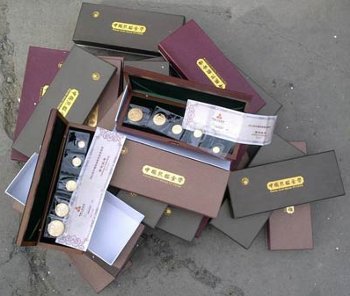
    Fake Chinese coins continue to flood the market and are a major headache to both collectors and investors.

    Fake Panda Gold and Silver Coins
    Fake Panda Gold and Silver Coins

    An article published on the “China Gold Coin Net” (中国金币网) reports the success of a joint operation by the Hebei and Zhejiang police in breaking up a counterfeiting ring that specialized in producing fake “Panda” gold and silver coins.

    According to the report, the authorities arrested five suspects.

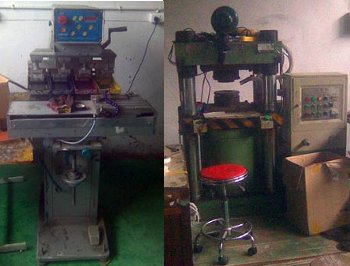
    Counterfeit Coin Equipment
    Counterfeit Coin Equipment

    The authorities also confiscated 435 coin sets and 1,108 individual coins.

    The fake coins included not only the very popular “Panda” coins, but also gold and silver coins commemorating the “2011 Year of the Rabbit”, as well as gold and silver commemorative coins marking “The 90th Anniversary of the Founding of the Communist Party of China”.

    The authorities also confiscated the equipment used in minting the counterfeit coins, along with the coin dies, fake seals, and fake gold and silver bars.

  • Tons of Chinese Coins Found in Sunken World War II Japanese Ship

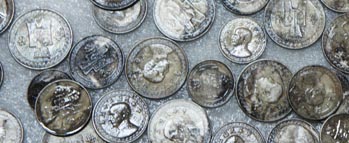
    According to a report in the June 8, 2011 edition of the Korea Joongang Daily, a Korean underwater excavation company has recovered 3.3 tons of foreign coins from a Japanese freighter that was sunk by an American warplane off the west coast of Korea during World War II.

    Chinese coins recovered from sunken WWII Japanese freighter
    Chinese coins recovered from sunken WWII Japanese freighter

    The coins number about one million with most being Chinese coins made of silver and minted during the 1920’s and 1930’s.

    Pyun Do-young, the owner of the Sea Love, Ltd. underwater excavation company, said that his divers found the old coins in rotting wooden boxes on the deck of what is believed to be the WWII Japanese freighter Nishima Maru No. 10.

    While the coins are estimated to be worth about $4.6 million, the company is most interested in finding the 10 tons of gold bars the ship is believed to have been carrying.

    Mr. Pyun said that near the end of the war some high-ranking Japanese government officials secretly shipped back to Japan stolen gold, cultural assets, jewelry and minerals from China and Southeast Asian countries.

    The gold would be part of the so-called “Yamashita’s Treasure” which refers to war loot stolen by the Japanese forces under the command of General Tomoyuki Yamashita.

    The gold would be worth about $480 million at today’s prices.

    To find the gold bars, however, the divers must first remove the thick layers of mud covering the ship.

    The coins are presently stored at the government’s Gunsan Regional Maritime Affairs and Port Office to allow a possible owner of the ship to claim possession.  If no claim is made, the company will receive 80% of the coins with the remaining 20% going to the Korean government.

  • Sun Yat-sen “Memento” Coin

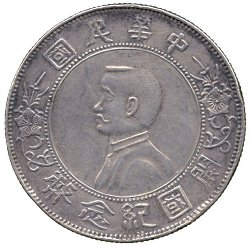
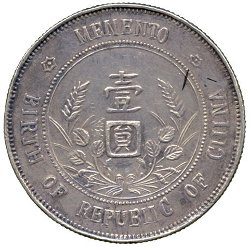
    One of the most easily recognized silver coins from the early days of the Republic of China displays the profile of Dr. Sun Yat-sen, the first president, with the English inscription “Memento Birth of Republic of China” on the reverse side.

    An earlier version of the coin had been struck in 1912 to commemorate the establishment of the Republic of China but production ceased when Yuan Shikai became president in 1913.

    These “one yuan” (“one dollar”) coins later resumed production and the specimen displayed here was struck in Nanjing in 1927.

    Silver coin commemorating the founding of the Republic of China
    Silver coin commemorating the founding of the Republic of China

    What is not generally understood is the meaning of the symbols in the design of the coin.

    For example, the Chinese character min (民), which means “people”, is written is a very unusual manner.  The character can be seen at about the 11 o’clock position on the coin.  If you look closely, you will see that the line that is the “right leg” actually extends upwards to just above the very top of the character.

    The Chinese have the expression “to go out the head” (chu tou 出头) which means “lift one’s head” or “free oneself”.  Just as the character is written with a stroke “going out the head”, the implied meaning is that the Chinese people should free themselves from the past thousands of years of imperial rule.

    Also, at both the 3 o’clock and 9 o’clock positions, are five-petal flowers representing the plum blossom.  The plum flower is a traditional symbol of courage and hope and also refers to the “five blessings”.  While it would later become the national flower, here it symbolizes the “Five-Power Constitution” advocated by Dr. Sun Yat-sen.  The five powers or branches of government included the legislative yuan, executive yuan, judicial yuan, examination yuan and censorate (control) yuan.

    Reverse side of Sun Yat-sen "Memento" Coin

    The reverse side of the coin has the denomination “one yuan” (壹圓) written vertically in the middle.

    Representations of grains, such as the ears of wheat, are on both sides.  Dr. Sun Yat-sen wanted the new coin to display the “five cereals” or “five grains” (wugu 五谷) to signify the importance of agriculture and the hope that the Chinese people would have enough to eat.

    Below the ears of wheat are rice plants signifying a bountiful harvest.  Above the rice are three leaves.  The three leaves are meant to represent the Three People’s Principles” (Nationalism, Democracy and the People’s Livelihood) as advocated by Dr. Sun Yat-sen.

    Finally, at the 2 o’clock and 10 o’clock positions are six-sided stars.  Previously struck Chinese coins often displayed stars of various shapes but they were usually placed on the obverse side.  On this coin, the stars were placed on the reverse side in order to distinguish it as a “new” type of coin for the newly established government.

  • 1,000 Coins Discovered in Han Dynasty Grave

    Eastern Han Dynasty Grave
    Eastern Han Dynasty Grave

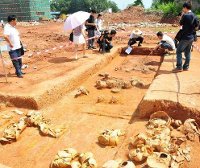
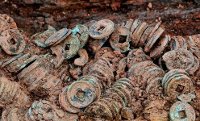
    During the excavation of a recently discovered Eastern Han Dynasty grave, the Guangzhou Cultural Relics Archaeological Research Institute has discovered a pile of more than 1,000 bronze coins.

    The coins have the inscription “da quan wu shi” (大泉五十) which means “large coin fifty”.

    These large coins were worth the equivalent of 50 cash coins.  They were cast during the reign of Wang Mang who usurped the throne and ruled during a short period (7-23 AD) between the Western Han and Eastern Han dynasties.

    According to the report, this grave is one of the best preserved Eastern Han graves having an abundance of bronze objects that has been unearthed in recent years.

    Han Dynasty Coins
    Han Dynasty Coins

    The grave is 8.2 meters long and 5.02 meters wide.

    In addition to the coins, the grave also contains nearly 100 other objects including a bronze mirror, pottery, colored tile as well as ornaments and jewelry made of jade and agate.

  • 200,000 Ancient Chinese Coins Found in Old Well

    Coin Stash Found in Well
    Coin Stash Found in Well

    Approximately 200,000 ancient coins dating from the Northern Song Dynasty (960-1127 AD) were recently unearthed from an old well in eastern China.

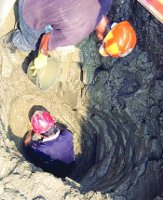
    The Xinhua News Agency reported on June 4, 2011 that a construction crew building a road in the city of Suzhou in Jiangsu Province uncovered the old well on June 1st.  The opening to the well was located 4-5 meters below the surface.

    Digging stopped immediately after the well was discovered and the construction crew quickly determined that this well was different from those usually encountered.  Instead of being round, the opening was eight-sided.

    Digging a little deeper, the crew was surprised to find a large quantity of ancient Chinese coins inside the well.

    Archaeologist Examines Coins
    Archaeologist Examines Coins

    The Suzhou Archaeology Research Bureau was immediately notified and eight experts were sent to the site.

    The archaeologists removed more than 80 bags of coins. Each bag weighed more than 50 kilograms so the total weight of the coins was about 4 tonnes (metric tons).

    There were more than 200,000 coins dating from the Northern Song Dynasty.

    Mr. Zhang Tiejun (张铁军), the assistant to the president of the bureau, described the find as “large”.  He said the coins were in two layers.  The top layer was neatly arranged while the lower layer was fairly disorganized.

    The upper layer included larger coins such as chong ning zhong bao (崇宁重宝 1102-1106 AD) while the lower layer had smaller coins such as yuan feng tong bao (元丰通宝 1078-1085 AD) and shao sheng yuan bao (绍圣元宝 1094-1097 AD).

    According to Mr. Zhang, the inscriptions on the coins indicated that they were from the middle to late Northern Song Dynasty (960-1127 AD).

    Sheng Song Yuan Bao Silver Coin
    Sheng Song Yuan Bao Silver Coin

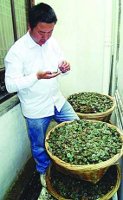
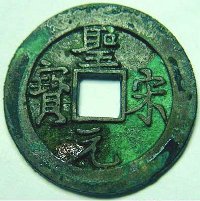
    Mr. Zhang was particularly excited about one coin in particular.  The cache included a coin with the inscription sheng song yuan bao (圣宋元宝) which was cast during the first year (1101 AD) of the Jing Guo (靖国) reign of Emperor Hui Zong (徽宗). The coin is made of silver instead of bronze and for this reason is considered very rare and valuable.

    Mr. Zhang said it would be difficult to say how much the total cache was worth.

    As to the question of why such a large quantity of coins was stored in a well, Mr. Zhang said that Suzhou’s economy was fairly well developed during this period of the Northern Song Dynasty.  Most likely, a wealthy businessman was suddenly faced with the chaos associated with war and decided it best to hide his money.

    Mr. Zhang said he did not think the money came from a “rich and influential family”.  Very wealthy families would usually have gold and silver instead of bronze coins and they would not likely keep these valuables at home.

    Also, the type of jugs commonly used to fetch water were found at the bottom of the well.  This indicates that the structure had been a functioning water well and had not been built specifically to store money.

    Mr. Zhang conjectured that the combination of the haphazard placement of the coins, plus the fact that the structure itself had functioned as a well, meant that someone probably found himself caught in a war zone and needed to immediately bury his money for safekeeping.

    The article concluded with Mr. Zhang stating that his team had researched the history of the area and discovered an interesting fact.  At that time period, the area had been the scene of a fierce battle between the Song army and the army of the Jurchens.  The Song army was led by Han Shizhong (韩世忠), one of the most famous generals of the Song Dynasty.  His wife *Liang Hongyu (梁红玉), who was a famous warrior in her own right, also participated in the battle.

    *Liang Hongyu is credited with implementing new war tactics such as the use of drums to relay orders to the troops at the battle of Gold Mountain.  For more about Liang Hongyu and Gold Mountain, please see Chinese Paper Money.