Blog

  • Chinese “10 Cash” Coins Overstruck on Korean “5 Fun” Coins

    China faced a severe shortage of small denomination coins at the end of the Qing Dynasty.  To help alleviate the shortage, the Guangdong mint in the year 1900 began to produce a new style coin that was radically different from the hand-cast bronze “cash” coins with the square hole that had been used for more than 2,000 years.

    The new coins were made of copper and did not have a hole in the center.  Moreover, these coins were produced by machines.

    The Chinese referred to the new coins as tong yuan (铜元) or tong ban (铜板) and they were minted in denominations of 1 Cash, 2 Cash, 5 Cash, 10 Cash, 20 Cash and 30 Cash.

    The new style coins were immediately well-received by both the Chinese people and the merchants because they were uniformly well-made, of standard size and weight, and convenient to carry.

    Because of the warm reception, more and more of the coins were minted.  The coins were also profitable to make.

    The mints in the other Chinese provinces quickly noticed the trend and within a short period of time there were 20 coin bureaus operating in 17 of China’s provinces producing the new copper coins.  The tong yuan coins quickly replaced the traditional “cash” coins to become the major form of small denomination coins in circulation.

    But anytime a new form of currency is introduced, counterfeit versions soon begin to appear.  The 10 Cash (十文) coin in particular was a prime target for counterfeiters.

    The first “counterfeiters” were actually the official mints themselves.  The mints were given quotas to fill but because the coins reaped a good profit, the mints began to “privately” (局私) produce the coins in quantities which exceeded their official quotas.

    Also, as has always been the case throughout China’s long history, individual Chinese began to illegally produce coins.

    And as we shall see, foreigners became involved in counterfeiting the new coins as well.

    Certain 10 Cash coins can be immediately identified as counterfeit because they tend to be poorly struck and especially because they show traces of inscriptions and symbols not found on the officially minted coins.
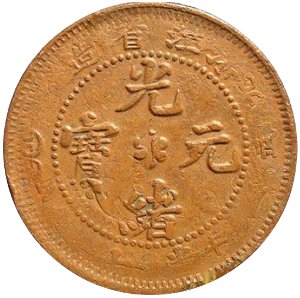
    Chinese "10 Cash" coin overstruck on Korean "5 Fun" coin
    Chinese “10 Cash” coin overstruck on Korean “5 Fun” coin

    An example of such a coin is shown at the left.

    Upon close examination, it is obvious to Chinese coin collectors that the counterfeiters used a Korean “5 Fun” (五分) denomination coin as the blank to mint this Chinese “10 Cash” coin.  The Chinese refer to these overstruck coins as han gai ban (韩改版).

    Chinese numismatists have traditionally assumed it was certain Chinese mints that had used the Korean coins as planchets to make the 10 Cash coins.  According to the theory, the Korean coins were used as planchets during the testing of the new coin presses.

    A recent article by Ye Zhenming (叶真铭) in the Chinese periodical qianbi (钱币), however, provides a different explanation.

    According to Mr. Ye, the overstruck coins were the result of collusion between Japanese “Ronins” (“wave men” 浪人) and some “unscrupulous” Korean merchants.  A Ronin was a Japanese samurai who did not have a master and was therefore considered an outsider to society.  Since it was difficult for Ronins to find legal employment, they sometimes turned to criminal activities.

    The new coinage of China provided a lucrative opportunity for some of the Ronins.

    These Ronins discovered that the Chinese mints were importing copper billet from Japan to make the new coins.  The mints found that importing the copper billet was convenient and the price still allowed for a good profit margin.

    The Ronins were able to obtain their own supply of Japanese copper billet.  They had engravers forge coin dies based on the official mint dies and, using hand operated presses, began to counterfeit the new copper coins.

    It was not long, however, before these Ronins discovered an even cheaper supply of copper blanks for the coins.

    The Koreans began minting modern copper coins in 1892, eight years before the Chinese.  These denomination “5 Fun” Korean coins were similar in size and weight to the new Chinese 10 Cash coins.

    The Ronins realized that using the Korean coins as planchets for Chinese 10 cash coins could be very profitable.

    This was due to the relative values of silver and copper.  At the time, one Chinese silver dollar could buy more than 200 of the Korean copper coins.

    But by overstriking the Korean coins to create Chinese 10 cash coins, the counterfeiters could then exchange ten of the coins for one silver dollar.  The profit margin was thus very high.

    The Ronins were able to partner with some unscrupulous Korean businessmen to obtain their supplies of Korean 5 Fun coins.
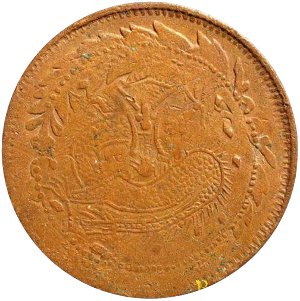
    Reverse side of overstruck "10 Cash" coin
    Reverse side of overstruck “10 Cash” coin

    However, because the pressure from the hand-operated presses used by the counterfeiters was not sufficient to totally obliterate the inscription and symbols on the Korean 5 Fun coin, the counterfeit Chinese 10 Cash coins usually exhibit a combination of both the Chinese and Korean designs.

    For example, at the left is the reverse side of an overstruck counterfeit coin.  In the middle can be seen the dragon design found on Chinese 10 Cash coins.

    You will also notice that there are traces of a wreath surrounding the dragon.  The wreath is the remnant of the design from the Korean 5 Fun coin that served as the planchet to make the counterfeit coin.
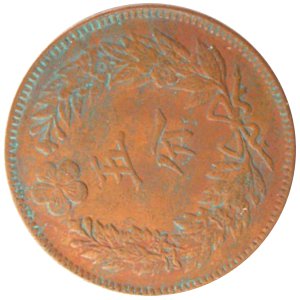
    Reverse side of Korean 5 Fun coin
    Reverse side of Korean 5 Fun coin

    The wreath can be clearly seen on the reverse side of the Korean 5 Fun coin shown at the left.

    If you closely examine the obverse side of the coin (shown above), you will also notice that traces of the original Korean coin inscription are still present.

    These counterfeit copper coins were mainly put into circulation in China’s coastal regions where they easily mixed in with the officially minted Chinese coins.

    Most of the counterfeit dies used to make these coins state “made in Zhejiang Province” or “made in Shandong Province”.  In reality, the coins could have been made anywhere but coins with inscriptions stating they were “made” in other provinces are fewer in number.

    The true origin of these overstruck coins has puzzled Chinese numismatists for years.  The traditional explanation has been that they were created during testing of the new presses by the Chinese mints.

    This new explanation is consistent with the economic situation that existed at the time.  It also introduces a degree of foreign intrigue with the involvement of Japanese samurai and Korean businessmen.

  • Liao Dynasty “Mother of Nine Sons” Charm

    A nomadic people known as the Khitan (Qidan 契丹) ruled China as the Liao Dynasty (辽朝) during the period 916-1125 AD.

    Charms from the Liao Dynasty are fairly rare and those with inscriptions can be difficult to decipher because the Qidan script is not well understood.

    Liao Dynasty charms lacking inscriptions are also a challenge to understand because the Qidan and the Chinese may have interpreted symbols differently.

    Liao Dynasty "Mother of Nine Sons" Charm

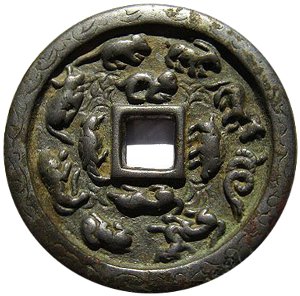
    One of the best known of the Liao Dynasty charms is generally referred to by the Chinese as a “Mother of Nine Sons” (yi mu jiu zi 一母九子) charm.  This charm has no inscription and relies solely on symbols to convey its meaning.  Both bronze and iron versions of the charm exist.

    A very well-cast specimen of the charm is displayed at the left.

    Chinese charm collectors have traditionally interpreted the figure above the square hole as being a mother riding a dragon.

    The charm also displays three groups of three people.  They are believed to represent her nine children.

    The reverse side of the charm has the twelve animals of the Chinese Zodiac (十二生肖).

    Some collectors believe that the “mother” is Xi Wangmu (西王母), the “Queen Mother of the West“.

    Others interpret the charm differently.

    For example, an article published in the 2002.1 issue of the journal of the Inner Mongolia Numismatic Society (内蒙古金融研究) proposes that the charm’s theme is “nine sons become officials” (jiu zi sheng guan 九子升官).

    Another interpretation is found in a Chinese reference book on Liao, Xixia, Jin and Yuan Dynasty charms (辽西夏金元四朝货币图录精选) which argues that the person riding the dragon is not a mother but rather a son-in-law of a high rank.

    This interpretation is based on a Chinese idiom which translates as the “dragon-riding son-in-law” (乘龙快婿).  According to a legend dating to the Spring and Autumn Period (771-476 BC), Princess Nongyu (弄玉), who was the daughter of Duke Mu of Qin (秦穆公), was so fond of playing the flute that she was only willing to marry a man with an equal love for the instrument.  She eventually found such a man and their flute-playing prowess resulted in the two of them flying to the heavens with him riding a dragon and her riding a phoenix.

    Based on this legend, every traditional Chinese family with a daughter wished for a son-in-law who would be talented enough to pass the imperial exams which would guarantee a life of honor and wealth as a high government official.  This is the meaning of a “dragon-riding son-in-law”.

    Those that accept this as the theme of the charm then interpret the three groups of three people as representing success at the three levels of the imperial examination system.

    A completely different interpretation of the charm is proposed by Mr. Pei Yuan Bo (裴元博) in an article published in the 2004.3 issue of “Inner Mongolia Financial Research” (内蒙古金融研究).

    Mr. Pei argues that to understand the true meaning of the charm one must first be familiar with a mythical story concerning Huangdi (黄帝), the “Yellow Emperor“, who returned to the Heavens by riding a dragon.

    Mr. Pei explains that Huangdi (2696-2598 BC) was the son of the “Celestial Ruler Supreme God” (Tiandi 天帝).  The father decided to send his son to Earth to be a tribal leader “to temper him through hardships and tribulations”.

    While on the Earth, Huangdi battled the Yan Emperor (Yandi 炎帝).  He invented clothing, carts and boats.  Chinese characters were invented during his reign.  He did much to improve the lives of the common people.  He gained the support of the various tribes and became the chief of the tribal union.

    Tiandi was so satisfied with his son’s achievements that he sent a dragon to bring Huangdi back to the Heavenly Palace to succeed him on the throne as the central deity.

    Mr. Pei interprets the three groups of three persons as representing the “Nine Provinces” (jiuzhou 九州), a poetic name for China, celebrating Huangdi’s ascension as the king of the heavens.

    With this as a background, Mr. Pei proposes why this Liao Dynasty charm was created.

    When the Liao Dynasty was established in 907 AD, Emperor Taizu (yelu a bao ji 耶律啊保機; Great Khan Abaoji 907-926 AD) was regarded by the Khitan people as the son of Tiandi, the “Celestial Ruler Supreme God”.  Emperor Taizu’s ascension to the throne was thus seen to be the same as when Huangdi ascended to the heavens to become the central deity several millenia earlier.

    The three groups of three persons each represent the “Nine Provinces” celebrating Emperor Taizu’s ascension.

    In the group to the left of the square hole, one person is playing the flute while another is beating a drum.  The group to the right of the hole appears to be dancing and gazing at the sky.  One member of the group below the hole seems to be pointing upwards while speaking to the others.

    The overall scene evokes a feeling of joy and celebration.

    Twelve Animals of the Chinese Zodiac
    Twelve Animals of the Chinese Zodiac

    As mentioned earlier, the reverse side of the charm displays the 12 animals of the Chinese Zodiac (十二生肖) which, according to Mr. Pei,  is a metaphor for “all the people” since everyone has to be born under the sign of one of the animals.

    Moreover, the animals are all revolving around the “center” (the square hole) which represents the “central authority” whom they all must serve.

    Mr. Pei summarizes that the charm was created to show Emperor Taizu ascending to the throne by riding a dragon in a manner similar to that of the “Yellow Emperor”.  The people, represented by the nine individuals (“Nine Provinces”), are expressing their joy and acknowledging his authority (Zodiac animals revolving around the center).

    Mr. Pei thus concludes that the theme of the charm should be the “prince rides the dragon” (tianzi cheng long 天子乘龙) instead of the “mother of nine sons”.

    As a final note, it is not surprising that a Qidan charm might claim some connection to ancient Chinese culture.

    Emperor Taizu adopted certain reforms from the Chinese which tended to move Qidan society towards cultural assimilation with the Chinese.  Also, the Liao Dynasty was founded just as the great Tang Dynasty was collapsing and it was quite common for non-Chinese rulers to claim ancestry to the Yellow Emperor to enhance their prestige and status.

  • How Chinese Archaeologists Clean Coins

    Chinese archaeologists frequently unearth ancient coins at tomb sites.  While old Chinese coins do not have actual dates on them, they do have inscriptions which can help date the site being excavated.

    Having been buried for hundreds or thousands of years, it is quite common for these old bronze coins to be so severely corroded that the inscriptions cannot be read.

    Coin collectors are always warned not to clean coins because the process will lessen the value of the coin or even ruin it.

    But what do Chinese archaeologists do when they have a coin that is too corroded to identify but which could potentially provide valuable information as to when the tomb was built?

    Song Dynasty coins unearthed at ancient tomb
    Song Dynasty coins unearthed at ancient tomb

    An article discussing a tomb being excavated in the city of Fuzhou (福州) in Fujian Province provides the answer.

    More than ten old Chinese cash coins were discovered during the dig but could not be identified because of heavy corrosion.

    If you have seen archaeologists at a site then you know they work very slowly and methodically to avoid any damage to the buried cultural relics.

    You might expect they would employ a similar degree of care when it comes to cleaning coins.

    In this case, however, the archaeologists were less concerned about preserving the coins than just being able to identify them.

    The archaeologists simply put the coins in vinegar, which is a mild acid, to soak for two or three days to remove the surface dirt and corrosion.  The coins were then removed and a common toothpick was used to scrap out any corrosion in the Chinese characters.  Finally, a rubbing was made of the coins.

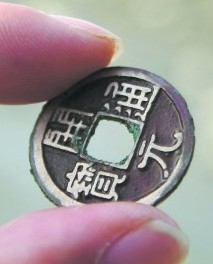
    Song Dynasty coin from 1101 AD
    Song Dynasty coin from 1101 AD

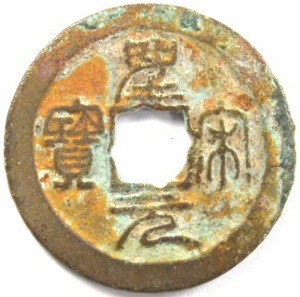
    While the coins would certainly not be very pretty after such treatment, the rubbing did reveal the inscription as sheng song yuan bao (圣宋元宝).

    Sheng song yuan bao coins were cast during the reign of Emperor Huizong (徽宗) of the Northern Song Dynasty beginning in the year 1101.

    An “uncleaned” sheng song yuan bao coin, which would be similar to the ones found in the tomb, is shown at the left.

    The archaeologists were quick to point out that this discovery does not necessarily mean that the tomb dates from the Northern Song because in ancient China coins continued to circulate for many years after they were produced.

    The archaeologists speculate that once the tomb is completely excavated it may be determined to actually be from the slightly later Southern Song Dynasty (1127-1279).

    We usually picture archaeologists as using soft brushes to gently remove dirt from cultural artifacts but sometimes more aggressive measures are used on ancient coins when they are the key to dating a site.

  • Coin Design Discovered on Wall Bricks from Kingdom of Min

    The ruins of an ancient city wall dating from the Tang Dynasty were recently discovered in Fuzhou (福州), the capital city of China’s southeastern province of Fujian (福建), according to a local newspaper article.

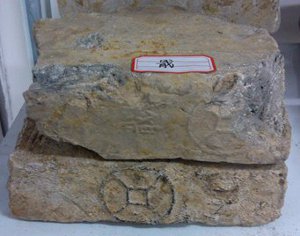
    The city wall dates back 1,100 years and is unusual because some of the bricks display the design of an ancient Chinese cash coin.  Cash coins were distinctive because of their round shape with a square hole in the center.

    Coin design on wall bricks of Kingdom of Min
    Coin design on wall bricks of Kingdom of Min

    The coin design can be clearly seen on the bottom brick in the picture at the left.  The coin design is also on the upper brick just to the right of center.

    The discovery of the bricks with the coin design allowed archeologists to identify the site as the ruins of a city wall from the time of the Kingdom of Min (909-945 AD).

    Construction of the wall began in the year 901 under the direction of Wang Shenzhi (王审知) who was the military commissioner for the area under the Tang Dynasty.

    However, the great Tang Dynasty collapsed in 907, and in the year 909 Wang Shenzhi named himself the Prince of Min (閩忠懿王; Emperor Taizu of Min 闽太祖) and the ruler of the Kingdom of Min.

    Historical records specifically mention the unusual coin design on the bricks used to build the “Luo city wall” (罗城).

    Confirmation that the archaeological find is indeed the famous “Luo wall” of the Kingdom of Min was obtained when other bricks were discovered to have the Chinese characters 威武军 (wei wu jun) which translates as the “Powerful Army”.  Wei Wu Jun was the name of the army Wang Shenzhi commanded.

    Ancient city wall from Kingdom of Min
    Ancient city wall from Kingdom of Min

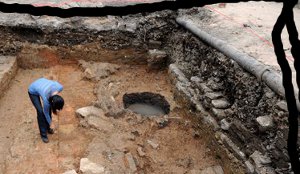
    The newly unearthed ancient wall can be seen in the image at the left. The wall thus far unearthed measures 74 meters in length and 8 meters in width.

    Historical records describe the wall as having been severely damaged in battles during the Song Dynasty (960-1279).

    In more recent times, the site was used as a garbage dump and later became the location of a transport station.

    Wang Shenzhi is well known to collectors of ancient Chinese coins because he predominately issued coins made of lead or iron.  While lead and iron coins had been cast in earlier dynasties, most coins were made of bronze.

    However, the coin design on the wall bricks actually has nothing to do coins!

    The Chinese character for “cash coin” (qian 钱) also happens to be a Chinese surname or family name.

    The surname of the ruling family of the neighboring kingdom of Wuyue was Qian (钱) which is the very same Chinese character used for “coin”.

    In 916, Wang Shenzhi arranged for the marriage of his daughter to Qian Chuanxiang (钱传珦) who was the son of Qian Liu (钱鏐) the King of Wuyue (吴越国).

    It was a common practice for rulers to try to marry their offspring to important family members of neighboring states in order to establish strong diplomatic ties.

    The image of the coin on the city wall bricks was intended to symbolize the marriage and the newly established ties to the Qian family of the Kingdom of Wuyue.

    The Kingdom of Min would only exist for a short time after Wang Shenzhi’s death in 925.

    Li Hongxi (李弘羲) became ruler of Fuzhou in 945 but was forced to surrender to the forces of Wuyue.

    The King of Wuyue at the time was Qian Hongzuo (钱弘佐; Qian Zuo 钱佐) who was the nephew of Qian Chuanxiang.

    The Qian family of Wuyue thus became the new rulers of Fuzhou.  It is said that the citizens of Fuzhou considered the coin design on the bricks of the Luo Wall to have been an omen predicting that the Qian family would one day rule the country.

    As mentioned earlier, Wang Shenzhi is known for having been among the first to use lead for the regular production of cash coins.

    Large lead coin from Kingdom of Min
    Large lead coin from Kingdom of Min

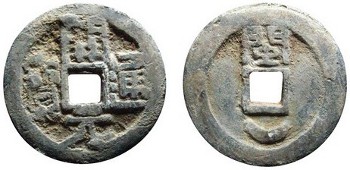
    An example of a large lead coin cast during Wang Shenzhi’s reign is displayed at the left.

    The inscription on the obverse side is kai yuan tong bao (開元通寶) which is the same as that on the coins of the Tang Dynasty.

    The reverse side has the Chinese character min (閩) indicating the Kingdom of Min.

    These large coins made of lead or iron from the Kingdom of Min are fairly scarce.  Specimens made of bronze are even rarer.

  • Chinese Coin Mirror Discovered in Song Dynasty Tomb

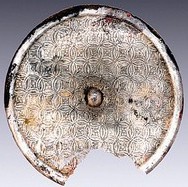
    An ancient bronze mirror with a Chinese coin design was recently unearthed from a Song Dynasty (960-1279) tomb according to a report from Qianjiang City (潜江), Hubei Province.

    The Qianjiang Cultural Relics Bureau (潜江文物局) announced that the mirror, which has some damage, was among the precious items found in a tomb located in Longwan Zhen (龙湾镇).  Also discovered in the tomb were three silver bracelets and a bronze wash basin.

    Song Dynasty bronze mirror with Chinese coin design
    Song Dynasty bronze mirror with Chinese coin design

    The mirror design incorporates multiple images of the classic Chinese cash coin, which is round with a square hole in the center, that was used for more than 2,000 years in China.

    In addition to the mirror with the coin motif, 42 ancient Chinese cash coins were excavated from the tomb.

    The coins included Han Dynasty (206 BC – 220 AD) wu zhu (五铢) coins and Tang Dynasty (618-907) kai yuan tong bao (开元通宝) coins.  There were also coins from the Song Dynasty such as tai ping tong bao (太平通宝 976 – 989), jing de yuan bao (景德元宝 998-1022), and xi ning tong bao (熙宁通宝 1068-1085).

    This is the first time coins from more than ten Emperor reigns have been discovered in a single tomb in Qianjiang.

    The report concluded by stating that the discovery of the tomb will contribute greatly to the understanding of local burial customs and the historical changes that occurred during the Song Dynasty.

  • “Four Happinesses” Window

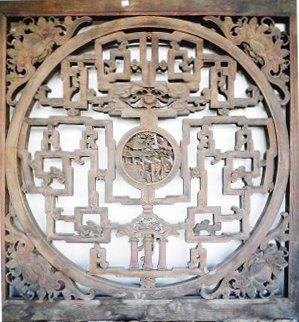
    A 200-year-old carved wooden window, described as a rare and exquisite treasure, was recently discovered in a small village flea market in China’s southwest Yunnan Province, according to an article in the Kunming Daily (昆明日报).

    Mr. Yang Anning (杨安宁), a well-known expert in ancient Chinese architecture, described the well-preserved window as a “cultural heritage gem” having the distinctive artistic style of a Yunnan carved wooden window from the late Qing Dynasty (1644-1911).

    "Four Happinesses" carved wooden window

    The “theme” of the window, according to Mr. Yang, is “four happinesses surrounding longevity” (si fu peng shou 四福捧寿).

    The intricate design within the large circle is actually a very stylized version of the Chinese character for “longevity” (shou 壽).

    At each of the four corners of the window frame are bats with wings extended and heads facing the circle.

    The Chinese love rebuses which are “visual puns”.  In this case, the Chinese word for “bat” (fu 蝠) has exactly the same pronunciation as the word for “happiness” (fu 福).

    Because “four bats” (si fu 四蝠) sounds like “four happinesses” (si fu 四福), there are “four happinesses surrounding longevity”.

    The origin of the “four happinesses” is a poem by Hong Mai (洪迈 1123-1202) who was a scholar-official during the Southern Song Dynasty:

    久旱逢甘雨, 他乡遇故知, 洞房花烛夜, 金榜题名时

    • “Sweet rain after a long drought” (jiu han feng gan yu 久旱逢甘雨)
    • “Meeting an old friend in a faraway place” (ta xiang yu gu zhi 他乡遇故知)
    • “The wedding night” (“the night of lighting a candle in the bridal chamber”) (dong fang hua zhu ye 洞房花烛夜)
    • “Having one’s name on the list of successful candidates of the imperial examination” (jin bang ti ming shi 金榜题名时)

    The window also illustrates the “Five Happinesses” (wu fu 五福), sometimes translated as the “Five Blessings” or “Five Good Fortunes”, which comes from the very ancient “Classic of History” (shujing 书经) compiled during the Warring States Period (475 BC -221 BC).

    The “Five Happinesses” consist of longevity (寿), wealth (富), health and composure (康宁), virtue (修好德), and the desire to die a natural death in old age (老终命).

    You will notice that the character for “longevity”, which occupies the center of the window, is also one of the “Five Happinesses” (wu fu 五福).

    Adding the “longevity” fu to the four fu represented by the bats makes a total of five fu thus symbolizing the “Five Happinesses”.

    The window has an abundance of hidden meanings.

    For example, the shape of the window expresses the ancient Chinese belief that heaven is round and the earth is square (tian yuan di fang 天圆地方) also known as the circle in a square.

    As another example, the large circle resembles an old Chinese “cash” coin (qian 钱) which is round with a hole in the center.

    The hole in the center of a Chinese coin is called the “eye” (yan 眼).  Because the Chinese words for “before” (前) and “coin” (钱) are both pronounced qian, the window has the implied meaning of “happiness is before your eyes” (fu zai yan qian 福在眼前) (happiness (fu) = bats (fu); before (qian) = coin (qian); eye (yan) = hole in center of coin (yan)).

    The newspaper article concludes with Mr. Yang revealing that the very detailed scene in the small circle at the center of the window has “visual puns” meaning:

    • “May you have good fortune, longevity, and an abundance of blessings, years and offspring” (福寿三多 fu shou san duo)
    • “A pair of dragons play with longevity” (双龙戏寿 shuang long xi shou)
    • “Happiness falls from heaven” (喜从天降 xi cong tian jiang)
    • “Wealth and honor again and again” (富贵连连 fu gui lian lian)
    • “The plum blossoms with the Five Happinesses” (梅开五福 mei kai wu fu)
    • “To add flowers to embroidery” (锦上添花  jin shang tian hua)

    For a different artistic representation of the “four happinesses” please see “Four Happiness Boys“.

  • Chinese Treasure Bowl Charm

    Since ancient times, there have been stories of a magical “treasure bowl” (ju bao pen 聚宝盆) that can create unlimited riches, and sometimes great sorrow, for its owner.

    While the actual treasure bowl remains to be found, its image has became a popular symbol of good fortune.

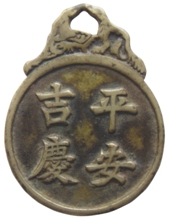
    Charm Inscription "Peace and Happiness"

    At the left is an old Chinese “hanging” charm with the inscription ping an ji qing (平安吉慶) which is a simple wish for “peace and happiness”.

    The Chinese characters are beautifully written and stand out prominently against the dark patina of an unadorned field.

    Adding to the “charm” of this piece is the loop at the top.  The loop is actually a dragon.  The dragon’s head, at the bottom of the loop, is looking back at its two hind legs and tail.


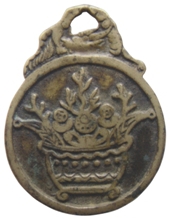
    Chinese "Treasure Bowl"

    A “treasure bowl” filled with riches is displayed on the reverse side of the charm.  These valuables are members of the “Eight Treasures” (八宝).

    In the very middle of the bowl is a round “flaming pearl” (火珠) with its flames extending upwards to the top of the rim.  The pearl is an ancient symbol of riches but also has the power to grant wishes and is a metaphor for perfection and enlightenment.  Chinese dragons are often depicted as “playing” with a flaming pearl.

    To the right and left of the pearl are two smaller round objects, with a square hole in the center, which represent traditional Chinese gold coins (金钱).

    Directly under each gold coin is a comma-shaped object representing a silver ingot (银锭).  Silver ingots were used as money particularly during the Yuan Dynasty (1271-1368).

    On the side of each gold coin is a branch-like object which is coral (珊瑚).  Coral symbolizes longevity, and red coral is considered especially auspicious.

    The two objects sticking out of the treasure bowl at the 3 o’clock and 9 o’clock positions are rhinoceros horns.  The rhinoceros horn (犀角) is a visual pun or rebus for “happiness” (喜) because both words share the same pronunciation xi.  A pair of rhino horns represents “double happiness” which is a traditional Chinese  symbol for a happy marriage.

    At the very bottom of the pile of treasures, and supporting the pearl and silver ingots, is the lotus.  The Chinese word for lotus (lian hua 莲花) has the same pronunciation as the word “continuous” (lian 连).  The hidden or implied meaning is that the treasures will continue to be produced endlessly.

    The treasure bowl itself is decorated with a string of seven “dots” which symbolize the seven-star “Big Dipper” constellation (北斗星).

    There are a number of stories associated with the Chinese treasure bowl (“wealth pot”, “basin of treasures”) which is usually portrayed as having the magical power to multiply whatever is placed inside of it.  Put a grain of rice in and the bowl will be filled with rice.  Place a gold coin in and the bowl will suddenly be filled with gold coins.

    One of the best known stories is of a fisherman named Shen Wan San (沈万三) who lived during the late Yuan and early Ming dynasties.  One day he saw a person who had caught a large number of frogs to eat.  Shen Wan San felt sorry for the frogs.  So he bought them and released them into a nearby pond.

    That night he was awakened by the loud croaking of the frogs.  He went to investigate and discovered a clay pot in the midst of the frogs.

    Shen Wan San took the pot home.  By chance, his wife accidentally dropped a silver object into the pot and immediately the pot was filled with silver.

    As it turned out, the pot was really a “treasure basin” which allowed Shen Wan San to become one of the richest men in Chinese history.

    But great wealth can also be a curse.

    When the first emperor of the Ming Dynasty, the Hongwu Emperor (洪武帝; Emperor Taizu 明太祖), began to build his capital at Nanjing in 1366, he “requested” Shen Wan San to donate a third of the cost.

    The newly constructed South Gate was named the “Gate of Gathering Treasure” (Ju bao Men 聚宝门).  The gate was so named because the emperor ordered that Shen Wan San’s treasure bowl be seized and buried underneath the gate to rectify a flooding problem that was causing it to collapse.

    It is believed that the emperor also wanted to demonstrate that no person would be permitted to challenge the empire in regard to wealth.

    The “Gate of Gathering Treasure” was subsequently renamed the “Zhonghua Gate” (中华门) in 1931 to commemorate the Revolution of 1911 (辛亥革命) and the founding of the Republic of China (Zhonghua Minguo 中华民国).

    This story is unusual in that it involves real historical figures and an actual historical site, thus giving some credence to the existence of a “treasure bowl”.

    Many of the other “treasure bowl” stories have a stronger moral content.  Honest and modest people are able to enjoy the bounties of the treasure bowl.  Dishonest and greedy people end up suffering.

    The stories of the Chinese “treasure bowl” have much in common with the Chinese legend of a “money tree” from which coins fall down when shaken.  For a further discussion, please visit “Chinese Money Trees” (摇钱树).

  • The Huainanzi and Vietnamese Coins

    The huainanzi (淮南子), variously translated as “The Masters of Huainan”, “The Huainan Philosophers” and “The Book of the Master of Huainan”, is an ancient Chinese philosophical work on the proper way for a monarch to govern.

    The huainanzi also records some of China’s most ancient myths and stories including “Nu Wa Repairs the Sky” (nu wa bu tian 女娲补天), “Hou Yi Shot the Suns” (hou yi she ri 后羿射日), “Chang’e Flies to the Moon” (chang e ben yue 嫦娥奔月), and “Yu the Great Tames the Flood” (xia yu zhi shui 夏禹治水).

    Liu An (刘安), the Prince of Huainan, was a grandson of Liu Bang (刘邦), the founder of the Han Dynasty, and also the uncle and adviser to Emperor Wu (武帝).  He, together with a gifted group of literary scholars known as the “Eight Immortals of Huainan” (淮南八仙), wrote this major treatise which he then presented to Emperor Wu in 139 BC.

    To be successful, according to the huainanzi, a ruler should embrace both Daoist and Confucian principles.  The monarch should adopt the practice of self-cultivation with the goal of attaining sagehood.  At the same time, he must actively engage in the mundane and practical activities of government administration.

    Vietnamese "Minh Mang Thong Bao" Coin
    Vietnamese “Minh Mang Thong Bao” Coin

    The huainanzi established the proper way for a king to rule and its influence spread to neighboring countries including Vietnam, also known as Annam.

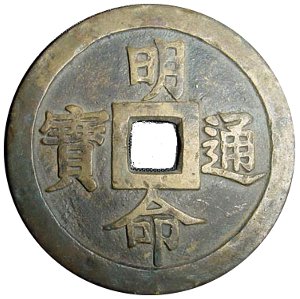
    The large Vietnamese presentation coin displayed here has the inscription Minh Mang Thong Bao (Chinese: ming ming tong bao 明命通宝) which was used on coins cast during the reign (1820-1840) of King Nguyen Thanh To of the Nguyen Dynasty.

    Because minh mang (明命) has the auspicious meaning of “intelligent decree” or “bright life” (明命), the inscription can also be found on Vietnamese charms and amulets.

    Vietnamese coin with inscription from the Huainanzi
    Vietnamese Coin with Inscription from the Huainanzi

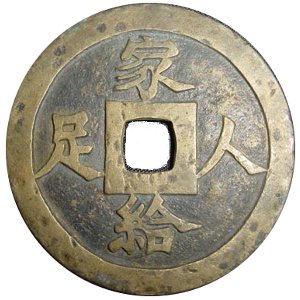
    The inscription on the reverse side is jia ji ren zu (家给人足).

    This phrase is taken directly from the chapter entitled “Fundamental Norm” <淮南子 · 本经训> of the huainanzi:

    衣食有余,家给人足

    yi shi you yu, jia ji ren zu

    “When clothing and food are plentiful, every family enjoys a rich life.”

    According the the huainanzi, an enlightened ruler should strive to ensure that the common people have the basic necessities.  In so doing, the people will live in contentment and the country can be at peace.

    This large Vietnamese cash coin has a diameter of 48 mm.

    Although no denomination is stated, these coins were valued at the equivalent of one hundred small cash coins.

    These large and well-made Minh Mang Thong Bao presentation coins are famous for their inscriptions based on the Chinese classics.  There are at least seventeen known varieties with a four-character inscription and twenty-three known varieties with an eight-character inscription.

  • Ancient Chinese Mirrors Donated To Shanghai Museum

    An outstanding private collection of ancient Chinese bronze mirrors owned by Lloyd Cotsen is being donated to the Shanghai Museum according to press releases issued in China and by The Huntington in San Marino, California.

    Lloyd Cotsen, a successful American entrepreneur and noted philanthropist, began collecting ancient Chinese mirrors in the 1950’s after being exposed to Chinese art as an undergraduate at Princeton University.  His collection of 95 pieces includes mirrors from the “Qijia Culture” (齐家文化 2100-1700 BC) as well as specimens produced during the Warring States Period, the Tang and later dynasties.

    The collection will be exhibited at The Huntington from November 2011 to May 2012, and then will be transferred to the Shanghai Museum in China for permanent display.

    Western Han Dynasty Inscribed Mirror
    Western Han Dynasty Inscribed Mirror

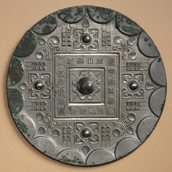
    At the left is a mirror from the Cotsen collection which is one of the earliest to include an inscription.  The inscription on this Western Han Dynasty (206 BC-24 AD) mirror reads:

    長貴福樂無事日有熹宜酒食常得君喜

    “May you enjoy noble status and blessings for a long time. May you have pleasure without incident. May you have brightness every day. May you have plentiful wine and food. And may you regularly obtain lordly delights.”

    The museum describes the piece as “quatrefoil, grass motifs, stars, and linked arc” incorporating cosmic symbols of space, time, earth and the heavens.

    Mirror from Warring States Period
    Mirror from Warring States Period

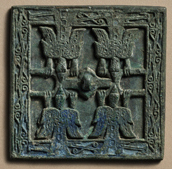
    This mirror was produced even earlier during the Warring States Period (475-221 BC).

    It is unusual in being layered or “tiered” and, unlike most mirrors, is square instead of round.

    In ancient Chinese cosmology, the earth was believed to be “square” while “the heavens” were seen to be “round”.

    The museum describes this as a “square double tier mirror with four opposed birds”.

    Tang Dynasty Mirror
    Tang Dynasty Mirror

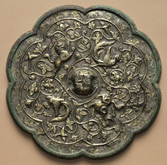
    The mirror at the left dates from the Tang Dynasty (618-907).

    According to the museum, it is an “eight-lobed mirror with vines, birds, and mythical animals”.

    The surface is covered with “hammerings” which are small pieces of soft metal placed over a carved form, tapped into shape with a hammer, and then attached to the mirror.

    The vines, birds and mythical animals on this mirror were all created in this manner.

    The mirror also exhibits “chasing” which is a technique for making intricate detail and texture on the surface of a mirror by using a hard stylus tapped with a hammer.

    Mr. Cotsen explained at the press conference in California that he decided to donate his collection of ancient Chinese mirrors to the Shanghai Museum because of its reputation and commitment to public education.

    Mr. Chen Kelun (陈克伦), the Deputy Director of the Shanghai Museum (上海博物馆副馆长), commented that the mirrors were exquisite.  He said that no data existed for some of them which means that they will be very valuable for research.

    Mr. Cotsen began his collecting in the 1950’s and acquired his first set of Chinese bronze mirrors at an auction in Hong Kong.  He did not know it at the time but the other key bidder was the Swedish government bidding on behalf of the King of Sweden.

  • Ancient Coins Discovered in Golden Horse River

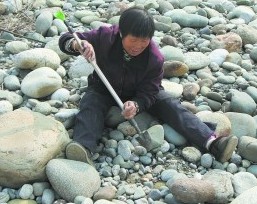
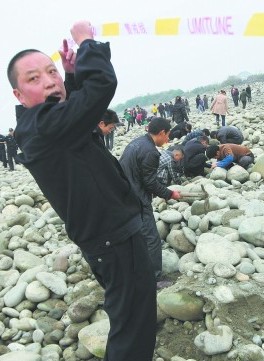
    More than 100 local villagers were seen busily overturning rocks in a small flood plain area of Sichuan Province’s “Golden Horse River” (金马河) once word spread that a large number of ancient Chinese coins had been discovered, according to a report by the Sichuan News Network (四川新闻网).

    Villager digging for coins
    Villager digging for coins

    Villagers of the Wenjiang District (温江区) of Chengdu City (成都市) arrived with shovels, hoes, sickles and any other digging implement they could find to turn over the cobblestones.

    Casual observers first thought the villagers were digging up edible “whip worms” (皮鞭虫) before they realized that there was real “treasure” buried there.

    Some of the treasure hunters came away with several kilograms of coins while others were only able to find 10 or 20 coins.

    The discovery is considered particularly unusual because, unlike most hoards, these bronze cash coins come from many different dynasties.

    Tang Dynasty "kai yuan tong bao" coin

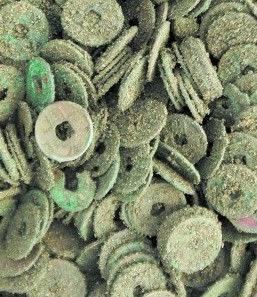
    The oldest coins are wu zhu (五铢) coins from the Han Dynasty (206 BC-220 AD) and huo quan (货泉) coins dating from Wang Mang’s Xin Dynasty (7-23 AD).

    The most recent coins were cast during the reign of the Qianlong Emperor (乾隆 1736-1795) and the Guangxu Emperor (光绪 1875-1908) of the Qing Dynasty.

    The coins thus span almost 2,000 years of Chinese history.

    The vast majority of coins, however, are from the Tang Dynasty (618-907).  Most have the inscription kai yuan tong bao (开元通宝) but some have the inscription qian yuan zhong bao (乾元重宝).

    Local police try to cordon off the area
    Local police try to cordon off the area

    The frantic activity attracted the notice of the authorities who immediately called in the police to prevent further “looting” and to protect the site.

    Experts from the local Bureau of Cultural Relics were also dispatched to carry out research.

    The Chengdu archaeologists determined that the coins were strewn over an area approximately 200 meters long and 100 meters wide.  The archaeologists themselves were able to dig up more than 5 kilograms of coins in a short period of time.

    While it still has not been determined how the ancient coins came to be scattered along the rocky bottom of the Golden Horse River, two of the archaeologists were willing to speculate.

    Coins from the Han to the Qing Dynasties spanning 2,000 years
    Coins from the Han to the Qing Dynasties spanning 2,000 years

    Mr. Liu Yumao (刘雨茂) said that throughout history, it has been the custom to place old coins into structures built for irrigation and water conservancy as a means to promote good fortune and to avoid disaster.  He said the coins may have been buried in such a structure that eroded and washed away over time.  The coins could then have been carried by the river current and deposited in this area.

    As to why the majority of coins are from the Tang Dynasty, Mr. Wang Zongxiong (王仲雄) said that in olden times heavy cargoes were transported by rivers and canals.  It is possible that during the Tang Dynasty a boat carrying coins may have sunk and the coins were hidden underwater until now.

    According to the cultural relics experts, it is not practical to try to excavate or even preserve the site because of the possibility of flood waters suddenly appearing.

    The authorities are encouraging the villagers not to continue to dig for coins or worms because of the danger.

    Although the coins are very old, they are still considered to be very common.

    Nevertheless, the villagers are asked to return all the coins to the authorities because, according to law, all cultural relics buried on land or found in the waters or seas within the territorial boundaries of China are considered to be the property of the state.

  • China’s Biggest Ancient Coin

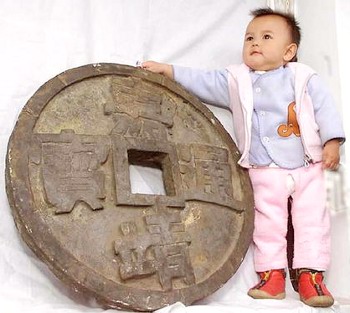
    The official New China News Agency (新华社) revealed in 1997 that Chinese archaeologists working in the southwestern province of Yunnan had unearthed a huge Ming Dynasty coin which was described as the largest and heaviest ancient Chinese coin ever found.

    China's Largest and Heaviest Ancient Coin
    China’s Largest and Heaviest Ancient Coin

    The coin was cast during the reign of Emperor Shi Zong (1522-1567) to commemorate the opening of a mint in dongchuanfu (东川府) which is now known as Huize County (会泽县).

    This commemorative coin (开炉钱) is now on display at the Huize County Lead and Zinc Mine Archives (会泽县的铅锌矿档案馆).

    The inscription on this giant bronze cash coin reads jia jing tong bao (嘉靖通宝).

    The coin has a diameter of 57.8 cm (22.8 in), a thickness of 3.7 cm (1.5 in) and a weight of 41.5 kg (91.5 lbs).

    An assay in 1990 revealed that the coin is primarily composed of 91% copper, 3% lead, 0.6% zinc and 0.6% aluminum.

    While the history of this region dates back more than 2,000 years, bronze cash coins did not circulate until very late.  Cowrie shells were still being used as a form of money even into the Ming Dynasty (1368-1644).  The economy relied to a great extent on barter.  The upper class used silver for their purchases.

    The casting of coins required approval from the imperial government.  It was not until the jia jing period (1522-1567) when large-scale copper mining and smelting were permitted in the area.  Yunnan’s rich mineral resources coupled with China’s mature casting technology were then used to produce these first bronze coins with the jia jing tong bao inscription.

    Following the reign of Emperor Shi Zong, coins continued to be cast at this mint for the succeeding Ming rulers.  These coins included Emperor Shen Zong’s wan li tong bao (万历通宝 1573-1620), Emperor Xi Zong’s tian qi tong bao (天启通宝 1621-1627), and Emperor Si Zong’s chong zhen tong bao (崇祯通宝 1628-1644).

    Coins of the Southern Ming, including the yong li tong bao (永历通宝 1646-1659) of Prince Yongming (永明王) and the xing chao tong bao (兴朝通宝 1648-1657) of Sun Kewang (孙可望), were also cast at this mint.

    With the establishment of the mint, and following the casting of the special commemorative coin, standard “cash coins” with the the same jia jing tong bao inscription were cast.  Additionally, a few larger denomination coins with the jia jing tong bao inscription were produced in values equivalent to 2, 3, 5 and 10 of the smaller “cash” coins.  All of these larger denomination coins are now rare.

    However, even the largest “Value 10” coin, with a diameter of 4.5 cm (1.8 in), pales in comparison with the special commemorative coin made to celebrate the first use of the furnace to cast bronze coins at the new mint.

  • Coffin Contains Coin Instead of Corpse

    An article in the Suqian Evening News (宿迁晚报) reported an unusual discovery.  Chinese archaeologists excavating a multiple tomb site in Suqian (宿迁), a city in northern Jiangsu Province (江苏), unearthed a coffin with no corpse.  The only thing inside the casket was a coin.

    Most of the tombs being excavated at the site date from the Han Dynasty (206 BC-220 AD).

    However, the tomb with the coin, designated the “No. 4 Tomb”, is from the much later Republican era (1912-).

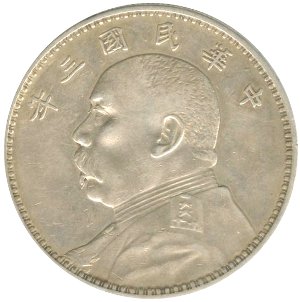
    Yuan Shikai "Silver Dollar"

    The archaeologists know the tomb is from the Republican period because the coin in the casket is a Yuan Shikai “silver dollar” (yin yuan 银元).  Yuan Shikai (袁世凯) was President of the Republic of China during the years 1912-1916 and coins from that era prominently display his portrait.

    The newspaper article did not include an image of the coin found in the casket but a typical example of a Yuan Shikai “silver dollar” is shown at the left.

    The archaeologists are a little puzzled as to why the casket contains just a coin but no corpse.

    They speculate that the tomb may be a “cenotaph” (衣冠冢) which is an “empty tomb” meant to be a memorial to a person whose remains may be elsewhere.  In lieu of a corpse, personal effects of the deceased are placed in the coffin instead.

    A village elder at the scene offered an alternative explanation.  He said Suqian has a local custom of reinterment.  Relatives of the deceased may have exhumed the body and reburied it in another place.