Month: February 2013

  • 700-Year-Old Coin Pit Discovered in Hunan Province

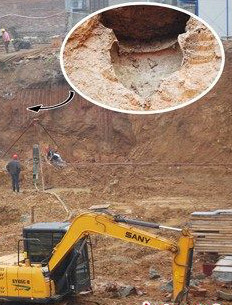
    Construction site in Hunan Province where Tang, Song and Yuan dynasty coins were unearthed
    Construction site in Hunan Province where Tang, Song and Yuan dynasty coins were unearthed

    On February 20, 2013 workers digging at a construction site in Chenzhou City (郴州市) located in Anren Prefecture (安仁县) in the southeastern part of Hunan Province (湖南省) unearthed a money pit dating back some 700 years according to Chinese newspaper reports.

    The money pit contained approximately 7.5 kg of coins from the late Song (960-1279) and early Yuan (1280-1368) dynasties.

    The construction site can be seen in the photo at the left.  The oval shows a close-up of the money pit and the arrow points to where the discovery was made.
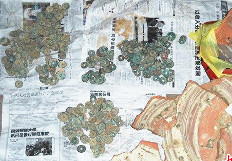
    Some of the coins discovered in the Hunan coin pit
    Some of the coins discovered in the Hunan coin pit

    According to the newspaper reports, most of the coins are from the late Song dynasty.  More than 20 types of Song dynasty coins were recovered including chong ning tong bao (崇宁通宝), chong ning zhong bao (崇宁重宝), zheng he tong bao (政和通宝), huang song tong bao (皇宋通宝), and xian ping zhong bao (咸平重宝).

    The reports also mention that Tang dynasty coins such as kai yuan tong bao (开元通宝) were also found in the pit.

    Some early Yuan Dynasty coins such as da de tong bao (大德通宝) were also discovered.
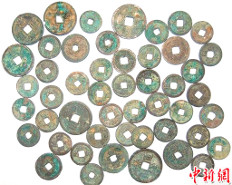
    Well-preserved small and large coins from the money pit
    Well-preserved small and large coins from the money pit

    On February 22nd, the China News Service dispatched a news team to Chenzhou City to cover the story.

    The video broadcast includes commentary in Chinese.  But even if you do not understand Chinese, you will see images of the construction site where the coin hoard was unearthed.  The video shows archaeologists cleaning and examining the coins.  There are also short interviews with Mr. Cai Ning (蔡宁) of the Anren Prefecture Cultural Relics Administrative Office (安仁县文物管理所) and Mr. Duan Bangqiong (段邦琼) of the Anren Prefecture Bureau of Culture, Broadcasting and the Press (安仁县文广新局).

    The print media, as well as the China News Service, mention that some of the coins in the cache are considered to be fairly scarce.  Among these are the jing yuan tong bao (景元通宝) and the chun hua tong bao (淳化通宝).

    Coins with the inscription jing yuan tong bao (景元通宝) are believed to have come from Annam (Vietnam) although it is still uncertain as to when these coins were actually cast.

    What would definitely be the greatest find from the money pit, however, would be chun hua tong bao (淳化通宝) and xian ping zhong bao (咸平重宝) coins.

    During the reign of Emperor Tai Zong of the Northern Song Dynasty, a large number of chun hua yuan bao (淳化元宝) coins were cast during the years 990-994.  As far as I have been able to determine, however, there are no historical records documenting a chun hua tong bao (淳化通宝) version of this coin and no authentic specimens are known to exist.

    Emperor Zhen Zong of the Northern Song issued coins with the inscription xian ping yuan bao (咸平元宝) during the years 998-1003.  However, I am not aware of any historical records of a xian ping zhong bao (咸平重宝) coin ever being cast during his reign.  This coin is not included in the major Chinese coin catalogs.

    Nevertheless, another major coin cache unearthed in 2010 in Shaanxi Province (陕西省) also claims to have discovered a xian ping zhong bao (咸平重宝) coin.

    Images of the chun hua tong bao (淳化通宝) and xian ping zhong bao (咸平重宝) coins reportedly recovered from the Hunan money pit have not yet been published.

    If the reports turn out to be true then this would certainly be considered a significant new discovery in Chinese numismatics.

  • Chinese Coins and Bank Logos

    Coins are one of the most easily recognized symbols of prosperity and good fortune and China, being one of the first countries in the world to use coins, has a monetary history going back more than 2,500 years.

    For this reason, ancient Chinese coin symbols have historically been popular for such non-currency purposes as fortune-telling, traditional Chinese medicine (TCM), the even the design of store signs and buildings.

    It is not surprising then that Chinese banks also like to use ancient Chinese coin symbols in the design of their logos.

    The People's Bank of China Logo
    The People’s Bank of China Logo

    The People’s Bank of China (PBC 中国人民银行) is China’s central bank responsible for monetary policy and the regulation of financial institutions.

    The bank logo, shown above, displays a simple geometric form on the left side.

    This red triangular design is actually based on a very ancient Chinese form of currency known as spade money (bubi 布币).

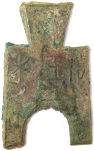
    Spade Money from Warring States Period
    Spade Money from Warring States Period

    An example of spade money used by the ancient State of Liang (400 BC – 300 BC) during the Warring States Period of the Zhou Dynasty is shown at the left.

    As can be seen, the logo design is actually composed of three of these “spade” coins arranged feet-to-feet.

    What is also interesting about the design is that it is in the shape of a “人”.  The interior “hole” of the logo has this same “人” shape.

    The “人” resembles the Chinese character ren (人) which means “man” or “person”.  Since there are two of these “人” the meaning is “people”. “People” (renmin 人民) is the key word in the bank’s name (The People’s Bank of China) and thus the logo, in an auspicious red color, is a very clever design combining China’s ancient money heritage with the name of the bank.

    Chinese Cash Coin
    Chinese Cash Coin

    When most people think of old Chinese coins they think of the traditional round bronze coin with a square hole in the middle popularly referred to as a “cash coin“.  Chinese cash coins were used for more than 2,000 years.

    This cultural icon is incorporated in the logo design of a number of major banks.

    Bank of China Logo
    Bank of China Logo

    The Bank of China (BOC 中国银行) is one of the big four state-owned commercial banks of China.

    The bank’s logo includes the archetypal cash coin.

    Instead of a simple square hole in the middle, however, the design uses a stylized version of the Chinese character zhong (中).  Zhong means “middle”, as in “middle kingdom”, and here represents the first character in the Chinese word for “China” (zhongguo 中国). This simple modification to the universally recognized cash coin symbol thus becomes the logo for the “Bank of China”.

    Industrial and Commercial Bank of China Logo
    Industrial and Commercial Bank of China Logo

    The Industrial and Commercial Bank of China (ICBC 中国工商银行) uses a similar theme.

    But in this case, the central hole of the cash coin is in the shape of the Chinese character “工”.

    The character gong (工) translates as “commercial” which is part of the bank’s name.  The character also resembles a capitalized “i” in English and thus represents the word “industrial”.  The “center hole” therefore expresses the essence of the bank’s name, the “Industrial and Commercial Bank of China”.

    China Construction Bank Logo
    China Construction Bank Logo

    The logo for the China Construction Bank (CCB 中国建设银行) uses not one but two Chinese cash coins.  The two coins are placed side-by-side with a slight overlap to give a three-dimensional effect.

    Also, a small piece has been removed from the circular design so that the coins look like two of the English letter “C”.  The two “C’s” stand for “China Construction”.  The two attached coins in the design can be seen as a “construction” which reinforces the name, “China Construction Bank”.

    Huaxia Bank Logo
    Huaxia Bank Logo

    The logo of the Hua Xia Bank (HXB 华夏银行) is another interesting variation of the Chinese cash coin theme.

    As seen here, the “coin” is actually the white space enclosed by an auspicious red border.  A gray square in the middle helps define the white space as the cash coin.

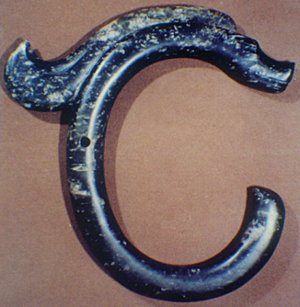
    5,000 Year Old Jade Dragon from Hongshan Culture
    5,000 Year Old Jade Dragon from Hongshan Culture

    The distinctive shape of this red border actually represents an ancient cultural artifact that was unearthed in 1971 at a site in Inner Mongolia.

    The object, shown at the left, is a jade carving of a dragon from the Hongshan Culture (hongshan wenhua 红山文化) and was created some 5,000 years ago during China’s Neolithic Period (New Stone Age).

    The dragon symbolizes the Chinese people and culture.

    This jade carving has the distinction of being the oldest representation of a dragon ever discovered.  As such, it is considered a national treasure and is now in the collection of the National Museum of China (中国国家博物馆).

    The logo of the Hua Xia Bank perhaps best represents the ancient Chinese money theme popular among Chinese banks.  Not only does it include the Chinese “cash coin” in its design but it also displays an easily recognized artifact representing China’s 5,000-year-long history.

  • Body Armor Made of Old Chinese Coins

    The Tlingit (特里吉特人) are one of the Native American people that live along the southern coastal region of Alaska and western Canada.

    They have long enjoyed a reputation for being skilled traders and competent warriors.  They have strikingly beautiful homes, carve large and imposing totem poles, and wear highly decorated ceremonial clothing made of bird feathers and animal pelts.

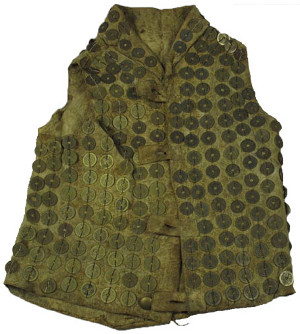
    Tlingit body armor covered with old Chinese coins
    Tlingit body armor covered with old Chinese coins

    One of the most fascinating cultural traits resulting from their particular set of circumstances is that Tlingit warriors have historically worn into battle body armor made of animal skins covered with old Chinese coins.

    The Tlingit believed that these old Chinese coins, made of bronze or brass and having a square hole in the middle, would provide protection from knives and bullets when fighting territorial wars against other tribes or the Russians.

    Some of these historic garbs, such as the one pictured above, are now in collections of such major museums as the American Museum of Natural History in New York.

    As can be seen, this moose-hide garment is covered with many old Chinese “cash” coins sewn on with sinew.

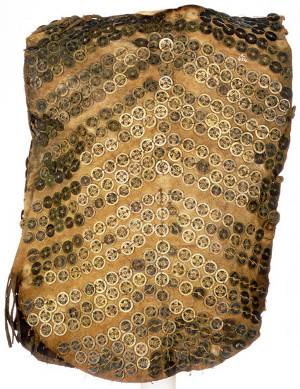
    Tlingit body armor with Chinese coins in chevron pattern
    Tlingit body armor with Chinese coins in chevron pattern

    Sometimes the coins would be in chevron patterns on the chest as shown on the garment at the left.

    Some warrior garments are completely covered with overlapping coins.

    The Tlingit believed that the coins would provide protection from bullets.  There is some anecdotal evidence that such body armor was in fact effective in a battle with the Russians in the year 1792.  According to Russian historical accounts, “bullets were useless against the Tlingit armor”.

    Of course, it may have been that the armor was more effective in terms of psychological warfare then in actually providing protection from bullets.  Russian smoothbore muskets at the time were notorious for being unreliable and inaccurate.

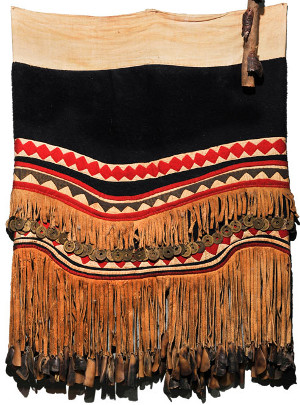
    Dancing cape with Chinese coins
    Dancing cape with Chinese coins

    Besides used as armor on warriors clothing, the ancient Chinese coins were also used as decorations on Tlingit ceremonial robes and masks.

    Chinese coins can be seen hanging from the top row fringe on the Gitxsan dancing cape shown at the left.  The coins made noise whenever the wearer moved.

    The Chinese coins were believed to symbolize wealth from a great power in a foreign land and as such enhanced the prestige of the owner by providing proof of his success in trade.

    The Tlingit body armor and ceremonial robes tended to use coins only from China’s Qing Dynasty (1644-1911).

    In particular, coins cast during the reigns of the Shunzhi Emperor (顺治帝 1643-1661), the Kangxi Emperor (康熙帝 1661-1722), and the Yongzheng Emperor (雍正帝 1722-1735) were preferred because these coins tended to be larger and heavier than coins cast during the time of the Xianfeng Emperor (咸丰帝 1850-1861) and later emperors.

    Most of the warrior garments in museum collections have coins with the inscription kangxi tongbao (康熙通宝) dating from the reign of the Kangxi Emperor.

    The coins used to make the warrior and ceremonial garments were obtained from maritime merchants who traded the coins for Tlingit animal skins which they then exchanged with the Chinese for tea, silk and porcelain.

    Old Chinese coins have historically been used for a number of purposes other than currency.  The Chinese used them as good luck charms, ground them up for use in traditional Chinese medicine, and used them to predict the future.  The Tlingit, an indigenous people living on another continent, discovered yet another use for these coins as body armor.

    For additional information on ancient Chinese coins, the Tlingit and their body armor, trade between the Russians and the Tlingit, and possible evidence of a controversial theory regarding worldwide exploration by early Chinese explorers, please see an article published by Discovery News and NBC News entitled “Ancient Chinese Coin Brought Good Luck in Yukon“.

    I am honored to have been interviewed for the news article because I had the rare opportunity to be the person the Canadian archaeologists contacted to identify the old Ming and Qing dynasty coins unearthed at the pre-gold rush site in the Yukon.