Month: March 2021

  • Coins Made of Turtle Shell Discovered at Famen Temple

    During renovation of the Famen Temple (Famensi 法门寺) in 1987, an underground “palace” was discovered under the foundation of the pagoda. This secret vault was found intact and had never been looted by grave robbers.

    Upon opening the vault, the archaeologists discovered remarkable treasures including the relic of a finger bone of the Buddha (释迦牟尼).

    Almost overlooked among the many priceless treasures was a set of thirteen coins.

    Shown in the image below are the 13 coins made of turtle shell (玳瑁币) which are the first in Chinese history to have been discovered made from this material.
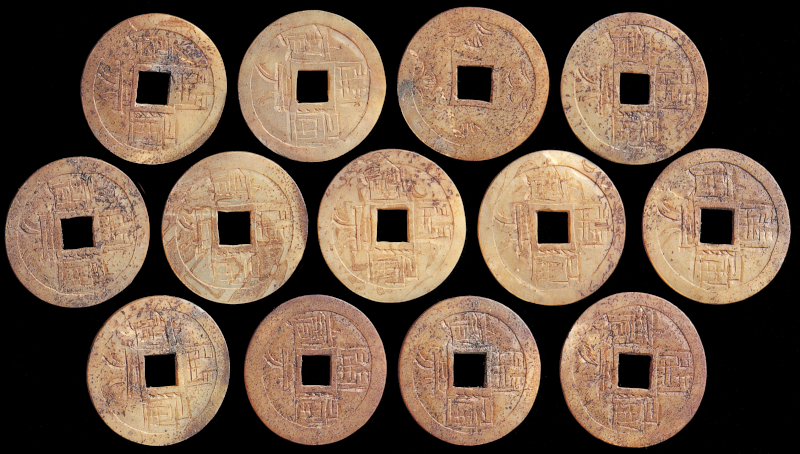
    World's first coins made of turtle shell were discovered during renovation of Famen Temple
    China’s first coins made of turtle shell were discovered during renovation of Famen Temple

    Famen Temple is situated about 75 miles (120 km) west of Xian (西安) in Shaanxi Province (陕西省). It is unclear as to when it was founded but historical records show that the temple had achieved consider size by the time of the Northern Wei dynasty (北魏 386-534 AD). The best historical evidence points to its founding during the middle to late Han dynasty.
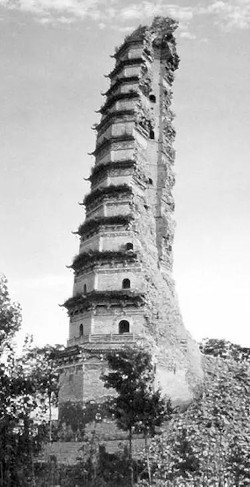
    Pagoda at Famen Temple collapsed after heavy rains in 1981
    Pagoda at Famen Temple collapsed after heavy rains in 1981

    In 1981, the thirteen-story octagonal brick pagoda at Famen Temple, which was built in 1609, partially collapsed due to heavy rains.

    During renovations in 1987, the foundation of the previous Tang dynasty (唐朝 618-907 AD) wooden pagoda was discovered underneath the foundation of the brick pagoda.

    Steps were discovered which led to a lower level.

    The archaeology team entered an underground palace by going down this 19-step staircase where they found a door.

    The archaeologists opened the door and proceeded along a long narrow path which was paved with a thick layer of coins. There were more than 27,000 coins.

    The coins dated from the Tang dynasty and included kaiyuan tongbao (开元通宝) and qianyuan zhongbao (乾元重宝) copper coins.

    Included among the priceless royal treasures in the underground palace were the thirteen coins made from the shell of the hawksbill sea turtle (玳瑁).
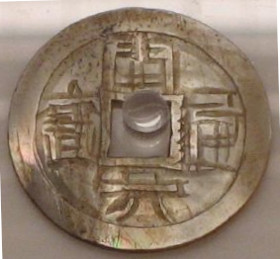
    "Kaiyuan Tongbao" coin made from Hawksbill Sea Turtle Shell
    “Kaiyuan Tongbao” coin made from hawksbill sea turtle shell

    These turtle shell coins are modeled after, and have the same inscription, as the copper kaiyuan tongbao coins.

    The turtle shell coins are 2.75 cm in diameter, 0.06 cm thick and weigh 24.8 grams.

    According to the Dharani Samuccaya Sutra (佛说陀罗尼集经):

    《佛说陀罗尼集经》中曰:“其七宝者:一金二银三珍珠四珊瑚五玳瑁六水晶七琉璃”.

    This tantra states that there are seven “treasures” or precious things: (1) gold, (2) silver, (3) pearl, (4) coral, (5) turtle shell, (6) crystal, (7) colored glaze.

    Coins of a precious material like turtle shell would have only been made to commemorate a very special occasion. In this case, they would have been made by order of an emperor to honor a sacred relic of the Buddha.

    There is no mention of coins made of turtle shell in any ancient Chinese historical text so this discovery came as a complete surprise to Chinese archaeologists and numismatists.

    As to why there are 13 coins, experts say that the number “13” is considered auspicious in Buddhism. This may be related to there being 13 sects in Chinese Mahayana. The number 13 is also reflected in Buddhist architecture as evidenced by the 13-story Famen Pagoda as well as the 13-floor Potala Palace (布达拉宫) in Tibet.

    These coins are the first turtle shell coins discovered in China and may also be the earliest coins made of turtle shell ever found in the world. The inscription on the coins date them to the Tang dynasty. Because there is no mention of turtle shell coins in Tang dynasty historical texts, little else is known of their origin.
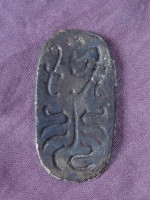
    Turtl shaped coin of the Han dynasty
    Turtle-shaped coin made of silver from the Han dynasty

    It should be noted that during the Han dynasty (汉朝) the Chinese did make coins in the shape of a turtle shell but these coins were made of silver and not turtle shell.

    In Buddhism, a pagoda is a burial chamber which stores a sarira (舍利子) which is a “relic” of the body remaining after cremation.

    Although the turtle shell coins were a significant find, the major discovery in the underground vault was the relic of the middle finger bone of the Buddha’s left hand. This did not come as a complete surprise, however, because historical documents clearly recorded that this “true relic” (灵骨) was kept at the Famen Temple.

    This sarira is the only finger bone of the Buddha known to exist.

    Many of the other treasures in the underground palace date to 874 AD which was when the chamber door was last closed. The underground palace remained hidden to the world for another 1,113 years.

    The underground palace contains a total of 2,499 treasures from the Tang dynasty including gems, jewelry, art pieces, gold and silver utensils, and numerous silk fabrics woven with gold thread. There is an embroidered dress of Wu Zetian (武則天) who reigned during the years 690-705 AD of the Tang dynasty and who was the only official female monarch in Chinese history.

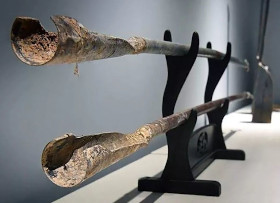
    Also found was a 1.96 meter long “stick” made of gold and silver. This “stick”, and a number of the finest celadon ceramics, are believed to have been gifts from Emperor Yizong (唐懿宗) who reigned during the years 859-873 AD of the Tang dynasty.

    The underground treasures, including the turtle shell coins, are now on display at the fully remodeled “Famen Temple Cultural Scenic Area” (法门寺文化景区).

  • Archaeological Blind Boxes and Ancient Chinese Coins

    Staff at Henan Museum digging for treasure in blind box
    Staff member at the Henan Museum using a ‘Luoyang shovel’ to dig for treasure in a blind box

    For several years, Chinese museums have been offering archaeological blind boxes (考古盲盒) in an effort to promote and popularize archaeology to the general public. These boxes are sold in museum gift shops and are especially popular with the younger generation.

    A blind box is a box in which a replica of an ancient cultural artifact is buried. The object is encased in soil or clay. To discover the artifact, one needs to carefully remove the clay in a manner similar to that of an archaeologist unearthing objects in the field.

    The outside of the box does not indicate what cultural artifact is “buried” inside. Much of the fun and excitement of these boxes is the surprise of discovery similar to what an archaeologist would experience.

    Archaeological blind boxes
    Blind boxes for sale at the Henan Museum

    To enhance the reality of the experience, the clay/soil in the box is sometimes the same as that in which the original artifact was found. Also, many blind boxes include a small brush and a digging tool.

    A very interesting video shows a Henan Museum staff member “excavating” treasure from a blind box.

    The blind boxes from the Henan Museum (河南博物院) in Zhengzhou (郑州) include a small chopstick-sized version of a digging tool known as a “Luoyang shovel” (洛阳铲) which is the traditional tool used in actual archaeological excavations.

    The Luoyang shovel, shown at the left, was invented in 1923 by a grave robber from Luoyang.

    Mr. Song Hua (宋华), the Director of the Cultural and Creative office (河南博物院文创办主任) of the museum, says that the blind boxes have been offered since 2019 and a brochure introducing items which may be “excavated” is included in each box.

    Mr. Song also says that the soil in the Henan Museum blind boxes is mixed with clay from the Mangshan Mountains (阳北邙山) in Luoyang which is where royal mausoleums from many dynasties have been unearthed.

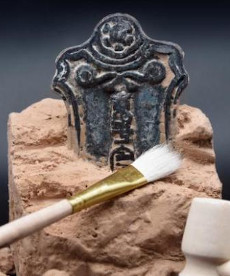
    Blind box treasure being unearthed
    Blind box “memorial tablet” being unearthed

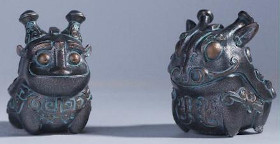
    There are a variety of archaeological blind boxes available including ones with replicas of ancient coins, silver ingots (元宝 sycee), seals (图章) of the 12 animals of the Chinese zodiac (生肖), and miniature bronze cooking vessels (gong ) from 3,500 years ago.

    Other boxes may include replicas of a tiger-shaped tally (虎符) issued to army generals in ancient times, a silver medal (银牌), a bronze mirror (铜鉴), jade ware (玉器) or a small bronze Buddha statue (铜佛).

    These blind boxes are extremely popular and can be difficult to buy because they are frequently sold out. Prices start at about $6.15 (40 yuan).

    Mr. Song mentions that 600 blind boxes were offered for sale online on December 8, 2020. Even though there was a limit of 3 boxes to a customer, the boxes sold out in 35 seconds. A total of 14,000 boxes were sold in that month alone.

    Other Chinese museums also offer blind boxes for sale.

    The Shaanxi History Museum (陕西历史博物馆) in Xi’an (西安), where the world renowned terracotta warriors (兵马俑) were discovered, offers blind boxes with a series of bronzeware from the Shang (商朝) and Zhou (周朝) dynasties.

    The Sanxingdui Museum (三星堆博物馆), where the ruins of an ancient Bronze Age culture are located, has blind boxes with replica dolls based on its collection of bronze face masks and figurines.

    Other museums which sell their own blind boxes are the National Museum of China (中国国家博物馆), the Palace Museum (故宫博物院), the Hebei Museum (河北博物院), the Suzhou Museum (苏州博物馆) and the Shanghai Museum (上海博物馆).

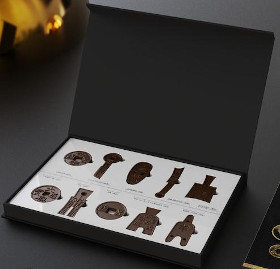
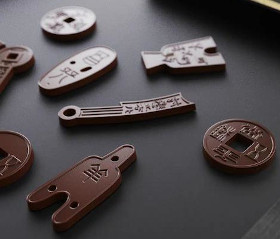
    Ancient Chinese coins made of chocolate
    Blind box with chocolate coins modeled after ancient coins in the collection of the Henan Museum

    For the Spring Festival (Chinese New Year 春节) in 2021, the Henan Museum offered a special archaeological blind box with replica ancient Chinese coins.

    Upon lifting the cover of this blind box, however, one realizes that the replica coins are not encased in clay or require any digging. The coins are already visible.

    These ancient coins are made of chocolate (古钱币巧克力) as can be seen in the photo.

    Ancient Chinese coins made of chocolate
    Chocolate coins from Henan Museum blind box

    Although made of chocolate, these are replicas of actual coins unearthed by archaeologists and now on display at the museum.

    There are 10 ‘coins’ in the box representing coinage from the Spring and Autumn period (春秋 770-476 BC), Warring States period (战国 475-221 BC), Western Han (西汉 202 BC – 8 AD), Xin dynasty (新莽 9-23), Northern Qi (北齐 550-577), and Northern Song (北宋 960-1127).

    To see specimens of the real coins upon which the chocolate coins are modeled, please see six character knife, gold inlaid knife, three hole spade, spade money, Wang Mang spade money, ant nose money, wuzhu coins, chang ping wu zhu, and Northern Song dynasty coins.

    If you enjoy learning about “edible” cultural relics, please also see Chinese Chess Mooncakes.

  • Bodhidharma Holding a Wu Zhu Coin

    Bodhidharma (菩提达摩) was a Buddhist monk who came to China from Central Asia or the Indian subcontinent during the 5th or 6th centuries. Little is known about him but he is regarded as the founder of Chan Buddhism () in China. Chan Buddhism eventually migrated to Japan where it further evolved into what is known as Zen.

    Bodhidarma is highly recognized and respected in Japan where he is referred to as Daruma. As part of this adoration, the Japanese created a very popular doll in his honor.

    These dolls are known as a daruma dolls. Daruma dolls are seen as symbols of perseverance, good luck and prosperity by the Japanese.

    Daruma dolls are ubiquitous in Japan. Some are even used as “coin banks” (“piggy banks“) in which to save coins.

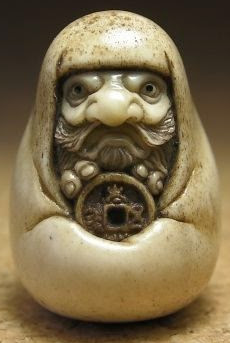
    Sculpture of Bodhidharma holding a wu zhu () coin
    Daruma doll showing Bodhidharma holding a tai he wu zhu (太和五铢) coin

    The daruma doll at the left is a most interesting and unusual example because Bodhidharma is shown holding a Chinese coin in his hands.

    Bodhidharma has a striking appearance. He was not of Chinese ancestry and is described in ancient texts as being wide-eyed, heavy bearded and ill-tempered. Some texts even refer to him as the “Blue-eyed Barbarian”.

    The Chinese coin he is holding is round with a square hole in the middle and is popularly known as a “cash coin”. Cash coins were used for more than 2,000 years in China and also became the model for the standard coinage of both Japan and Korea.

    What is remarkable is that the daruma doll’s coin is so accurately detailed that it can be readily identified.

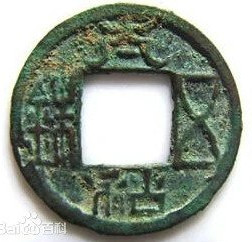
    "tai he wu zhu" coin
    Tai He Wu Zhu coin issued in 495 AD by Emperor Xiaowen of the Northern Wei dynasty

    This type of coin is known as a “wu zhu” (五铢) and the inscription reads tai he wu zhu (太和五铢). Taihe (太和) is the era name of Emperor Xiaowen and wu zhu is the monetary denomination “five zhu“.

    The tai he wu zhu coin was minted in 495 AD by Emperor Xiaowen (孝文帝 471-499) of the Northern Wei (北魏) in the capital city of Luoyang (洛阳).

    This was the first coin issued during the Northern Wei. The inscription is a mixture of seal script (篆书) and clerical script (隶书) which comprises the classic Wei stelae style (魏碑体).

    Tai he wu zhu coins tend to be fairly crudely made and vary in size and weight. Larger specimens are about 2.5 cm in diameter and weigh about 3 grams. Smaller specimens are about 2 cm and 2.3 grams.

    These coins circulated only in the areas around Luoyang and never became the currency for the Northern Wei as a whole. For this reason, tai he wu zhu coins are relatively scarce.

    It is important to note that Bodhidharma lived in the Luoyang area during the time that this coin circulated. Placing this specific coin in his hands is, therefore, historically accurate.

    As mentioned above, Bodhidharma is usually portrayed as being “wide-eyed”. This alludes to a story concerning his nine years of staring at a cave wall while meditating. The legend goes that one day he fell asleep. In order to prevent this from ever happening again, he cut off his eyelids.

    A Japanese legend states that after sitting and meditating in the cave for nine years his limbs atrophied. For this reason, daruma dolls do not have arms or legs. This particular daruma doll is a very rare exception. While it does not have arms or legs, it does have “hands” or, more accurately, a few fingers.

    The Chinese have the expression jian qian yan kai (见钱眼开) which translates as “one’s eyes grow round with delight at the sight of money”. The expression first appeared in the famous Ming dynasty (明朝 1368-1644) novel Jin Ping Mei (金瓶梅) which is translated into English as The Golden Lotus or The Plum in the Golden Vase.

    By a remarkable coincidence, there is a story dating from the Southern Song dynasty (南宋 1127-1279) that precisely illustrates this expression of a person going wide-eyed over the sight of a tai he wu zhu coin which is the same coin as in Bodhidharma’s hands.

    The story takes place in the city of Suzhou (苏州) and concerns an elderly businessman with the surname Chai () who literally loved money above everything else. He was extremely wealthy and was also extremely greedy and stingy.

    One day he was out walking when he saw a group of children playing with some coins in the street. Because he loved money so much, he fixed his eyes on the coins. His eyes lit up when he noticed that some of the coins were tai he wu zhu. Tai he wu zhu coins were very valuable at this time and were much loved by the people.

    Suddenly, one of the tai he wu zhu coins rolled under his feet. He quickly stepped on it to hide it from the children.

    The children walked over and asked for the coin but the old man said, “I didn’t take your money.” One of the children replied, “It’s under your foot.”

    The man quickly turned around and while his back was facing the children he picked up the coin. He then turned back around to face the children and said, “Look for yourselves, I don’t have any money under my foot.”

    A child then pointed to the man’s hands and said, “It’s in your hand!”

    The man spun around again and while his back was facing the children he put the coin in his mouth. He turned back to face the children and stretched out his hands to show there was no coin.

    A child said, “It’s in your mouth!”

    Knowing he had to hide the coin, he quickly swallowed it. He then opened his mouth wide so that the children could see there was no coin.

    The man returned home with the coin stuck in his throat. He kept trying to cough it out but it would not budge. In less than a day, his throat became swollen and he had difficulty breathing.

    His four sons wanted to call a doctor but the old man glared angrily at them and gestured with his hand to bring him a brush and ink. He then wrote, “For the sake of money, what would be the reason to spend money?”

    By the third day, the man was close to death. His four sons came to his bed to discuss the funeral. The eldest son said, “You have worked hard all you life and should therefore have a coffin made of cypress.” The father just glared at his eldest son and shook his head indicating disapproval.

    The Number 2 Son then said, “You have saved all your life and should have a coffin made of willow in order to save a lot of money.” The father again shook his head in disagreement.

    The Number 3 Son then said, “After your death, we could wrap your body in the old reed mat on your bed and bury you. Would this satisfy you?” The father again shook his head.

    The Number 4 Son was only 14 or 15 years of age but said, “After you die, we could chop your body into little pieces and fed the meat to your big yellow dog.”

    The man smiled and vigorously nodded his head approvingly. He picked up his brush and breathlessly wrote the last words of his life:

    After I die, chop me into pieces of meat and feed me to the dog.

    But, don’t let him eat the tai he wu zhu coin!

    The story serves as an example of a person being extremely wide-eyed in love with hoarding money and refusing to spend any of it even at the end of his life.

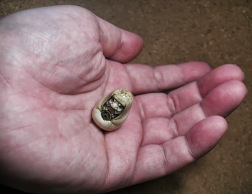
    This daruma doll is very small as can be seen in comparison to a hand
    The daruma doll is very small

    This daruma doll is carved from bone and has exquisite detail.

    It is quite small as can be seen in the photo at the left.

    Finally, we should not forget that Bodhidharma was a Buddhist monk who renounced the world, lived a very austere life in a cave, and spent a lifetime seeking true reality.

    Over the centuries, Daruma’s legacy in Japan has evolved to the point where dolls are made in his image to serve as good luck charms and coin banks.

    While the Japanese daruma dolls are very cute and symbolize perseverance, good luck and prosperity, the idea of associating the founder of Chan (Zen) Buddhism with something as secular and mundane as money is not consistent with his teachings.