Category: Chinese coins

  • Taiping Rebellion Coins Saved from Furnace

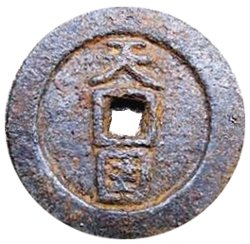
    Taiping Rebellion Iron Coin
    Taiping Rebellion Iron Coin

    A recent Chinese newspaper article describes how some valuable coins from a popular peasant uprising at the end of the Qing Dynasty were saved from being used as scrap iron for a backyard furnace during the Great Leap Forward campaign of 1958-1961.

    The article entitled “Grandfather Saved Iron Coins from the Taiping Rebellion” was published in the May 5, 2011 edition of the “Chutian City News” (楚天都市报).

    During the Great Leap Forward, Mao Zedong encouraged every commune and urban neighborhood to establish backyard steel furnaces in order to accelerate China’s economic development.

    Since the village discussed in the article did not have the necessary iron ore to feed the furnace, every household was required to provide a specific quantity of “scrap iron”.

    But the villagers also did not have “scrap iron” so they were forced to provide perfectly good iron utensils and tools in order to meet the requirement.

    The “grandfather”, who happened to be one of the technicians in charge of the local furnace, discovered that someone had provided a string of 10-20 iron coins from the Taiping Rebellion as “scrap iron” for the furnace.  He felt that it would be “a waste” to destroy the coins so he secretly hid them in his pocket and took them home.

    Over the years, the coins were gradually passed down to various family members.

    The Taiping Rebellion (1850-1864) was a civil war which began in southern China.  The leader Hong Xiuquan (洪秀全), who was convinced that he was the younger brother of Jesus, declared himself to be the “Heavenly King” (tian wang 天王) of “The Heavenly Kingdom of Great Peace” (taiping tianguo 太平天国).

    The rebellion would eventually spread through 15 provinces and include 30 million people before it was put down by government troops aided by French and British forces.
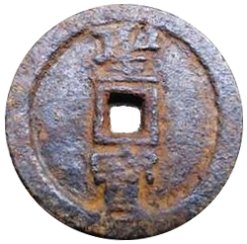
    Reverse side of Taiping Rebellion Iron Coin
    Reverse side of Taiping Rebellion Iron Coin

    Most Taiping Rebellion coins were cast in bronze with only a very small number made in iron or lead.  Gold and silver coins also exist but are extremely rare.

    The coins have some interesting characteristics.  For example, none of the coins bear a denomination.  Also, the character guo (国) in the inscription, which means “kingdom”, is written with a wang (王) character inside the “square box” (kou 口) instead of the standard yu (玉) character.

    The inscriptions on the coins can also vary.  Obverse inscriptions include tian guo (天国), taiping tianguo (太平天国) and tianguo shengbao (天国聖寶).  Reverse inscriptions can include shengbao (聖寶) and taiping (太平).

    The iron coin shown in the article and displayed here has the obverse inscription “Heavenly Kingdom” (tianguo 天国) and the reverse inscription “Holy Coin” (shengbao 聖寶).

    The coins have a diameter of 35 mm and weigh about 16.3 grams.

    The Great Leap Forward proved to be an economic disaster for China with the “backyard furnaces” being just one example.  Labor was diverted from the fields, the wood needed for the furnaces came from the doors and furniture of the peasants, the needed “scrap metal” consisted of perfectly good pots and pans, and the resulting pig iron was of such poor quality as to be useless.

  • China’s Largest Gold Coin

    China's Largest Gold Coin
    China’s Largest Gold Coin

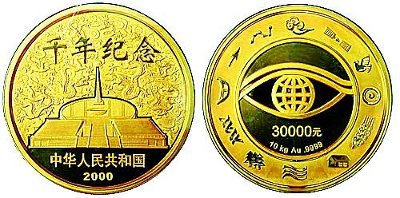
    China recently auctioned the largest gold coin the country has ever minted.  In the year 2000 when it was produced, it held the distinction of being the largest gold coin in the world.

    The coin sold for about $1.18 million (7.70 million yuan) at an auction conducted by China Guardian Auctions on May 14, 2011 in Beijing.

    The “2000 Millennium Commemorative Gold Coin” has a face value of 30,000 yuan. The coin weighs 10 kilograms (22 pounds) and is 99.99 percent pure gold.

    A total of 20 of these coins were minted with this coin being Number 17.

    World's Largest Gold Coin
    World’s Largest Gold Coin

    While it may have been the largest gold coin in the world in 2000, it pales in comparison to the current record holder.

    According to Guinness World Records, the largest gold coin in the world is now a coin minted by the Royal Canadian Mint in the year 2007.  The legal-tender “Maple Leaf” coin has a purity of 99.999 percent and a face value of CAN$1 million.  It weighs 100 kilograms (220 lbs).  The diameter is 50 cm (19.6 inches) and the thickness is 3 cm (1.1 inches).

    A total of 5 of these coins have been minted.

    One of these Canadian gold coins sold for $4.02 million at auction in June 2010 in Vienna, Austria.

  • Chinese Star Charm

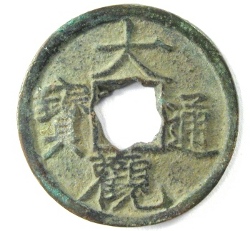
    Song Dynasty "Da Guan Tong Bao" coin with calligraphy by Emperor Hui Zong

    The “da guan tong bao” (大觀通寶) coin shown here was cast during the years 1107-1110 of the reign of Emperor Hui Zong of the Song Dynasty.  The coin is considered one of the most beautiful of all Chinese coins due to its exquisite calligraphy.  The Emperor himself did the calligraphy and his style has become known as “slender gold” script (shou jin shu 瘦金書).

    The “da” (大) in the inscription means “great” and “guan” (觀) means “to behold” or “to gaze upon”.

    Stars and star constellations were important to the ancient Chinese as sources of “light” and as symbols of deities and their residences.

    Guan” (觀) was also the word used for “gazing” at the stars and is found in such expressions as “guan tian wen” (觀天文) and “guan xing dou” (觀星斗) which mean to practice astronomy or astrology.

    Even more interesting, the word “guan” (觀) can mean a Daoist monastery.  Emperor Hui Zong was himself an ardent Daoist and openly promoted religious Daoism (Taoism) during his reign.

    So, it is not surprising that the ancient Chinese would want to create charms with “star” themes based on the “da guan tong bao” coin.

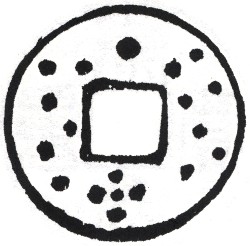
    Chinese Charm Displaying Stars and Star Constellations

    At the left is a rubbing of the reverse side of such a “star” charm.  The obverse side of the charm looks exactly like the “da guan tong bao” coin shown above.

    The large dot or “star” at the very top represents the North Star (bei ji xing 北極星).  The Chinese refer to this star as the “taiji” (太極) or “supreme ridgepole” and it was considered to be the central point from which the fabric of the heavens was suspended and around which all other heavenly bodies rotated.

    To the right of the square hole is a series of seven dots or “stars” representing the “Northern Bushel” (beidou 北斗), “Ladle” or “Big Dipper”.  The ancient Chinese saw this as the Emperor’s chariot which would rotate around the fixed North Star.

    There are six dots or “stars” at the left of the square hole.  If the dots were connected, the resulting line would resemble a “w” or “m” turned on its side.  The Chinese refer to this “six star” constellation as xian hou zuo (仙后座) which is known in the West as the “five star” constellation “Cassiopeia”.

    The “Big Dipper” and “Cassiopeia” are the two most prominent star patterns in the northern sky.  They are always on opposite sides of the North Star, as shown on this charm, and rotate around the polar star once each day.

    The Chinese call the five “star” cluster located below the square hole the tian qin xing zuo (天琴星座) which is known in the West as the constellation Lyra.  The star at the top of the constellation is the “Girl Weaver Star” (zhi nu xing 織女星) which is the star Vega.

    For more about the story of the “Weaver Girl”, and Chinese astronomy in general, please see Chinese Astronomy Coins.

  • “Battle of Jimo” Horse Coin

    Most ancient Chinese horse coins display only a horse with no rider.

    Horse coins displaying a horse with a rider are much scarcer and those originating from the Song Dynasty (960-1279 AD) are particularly rare.

    Old Chinese horse coin commemorating the "Battle of Jimo"
    “Battle of Jimo” Horse Coin

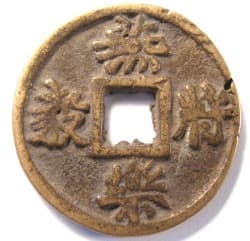
    The specimen at the left is a later version of one of these Song Dynasty horse coins with a rider.

    Instead of honoring the horse, though, these horse coins commemorate the famous generals and battles of ancient Chinese history.

    The inscription on the horse coin at the left is read in a clockwise order, beginning with the character at the top, as yan jiang yue yi (燕將樂毅).

    The inscription translates as “General Yue Yi of the State of Yan”.  (The name is sometimes translated as “General Le Yi of the State of Yan”.)

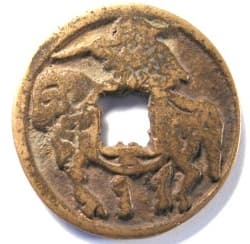
    Chinese horse coin depicting General Yue Yi of the State of Yan on horseback
    General Yue Yi with weapon on horseback

    As can be seen here, the reverse side of the horse coin shows a man holding a spear-like weapon and riding a horse.

    The rider is intended to be General Yue Yi who participated in the battle of Jimo which is one of the most famous battles of ancient China.

    Sima Qian (司马迁) (145 BC – 86 BC), the great historian of the Han Dynasty, wrote about the battle of Jimo in his monumental work “Records of the Grand Historian” (史记).

    Annotations by Tang Dynasty poet Du Mu (803-852 AD) to the famous Chinese military treatise “The Art of War” by Sun Tzu (Sunzi 孙子), written in the 6th Century BC during the Spring and Autumn Period (722 BC – 481 BC), included the Battle of Ji Mo to illustrate the successful application of the strategies by Sun Tzu.

    A brief narrative of the Battle of Jimo is as follows.

    In the year 284 BC, the state of Yan commenced a campaign to conquer the state of Qi.  General Yue Yi led the Yan army and within the short span of only six months had conquered seventy of Qi’s cities.

    In 283 BC, General Yue Yi attacked the city of Jimo.  The commanding officer of Jimo died in the battle and was replaced by General Tian Dan who would become a major figure in the Battle of Jimo.

    Having only 7,000 soldiers, General Tian Dan had to rely on superior tactics to inspire both his troops and the citizens to defend the city against the Yan army which was at least ten times as large.

    Failing to take the city by force, General Yue Yi soon realized that the only way to victory was to somehow win the hearts of the people of Jimo and convince them that to surrender would be better than to continue to resist.

    General Yue Yi therefore began a “benevolent” siege of the city which ended up lasting three years.  His army, for example, provided food and water to the residents of the city and even allowed them to till their fields outside the city walls.

    During this three year period, the king of Yan died and his son ascended to the throne.  The son, unlike his father, was not pleased that General Yue Yi was unable to conquer Jimo.

    Also, the new king harbored fears that General Yue Yi was interested in replacing him as king.

    General Tian Dan of Jimo was keenly aware of this situation and, to foment discontent, secretly sent spies to the capital of Yan to spread rumors that General Yue Yi did indeed want to be king.

    The rumors spread quickly and upon reaching the king’s ears only “confirmed” his suspicions.  The king immediately replaced General Yue Yi as head of the army and installed a new general who would prove to be much less competent.

    General Yue Yi, having lost his position, felt that the king would now try to eliminate any perceived threat to his power.  Fearing the king would try to assassinate him, General Yue Yi sought refuge in the state of Zhao.

    The new Yan army general abandoned the long siege and immediately commenced attacking the city.  But again, due to the competent leadership of General Tian Di, the troops and citizens defended themselves successfully despite being greatly outnumbered.

    To further strengthen his people’s resolve, General Tian Di sent spies into the camp of the Yan army to spread rumors that the people of the city would definitely surrender in fear if only the Yan soldiers were to “cut off the noses” of any captured Qi soldiers and also “dig up the graves of buried Qi ancestors”.

    The new Yan army general fell for these lies and ordered his soldiers to do these exact things.  As General Tian Di anticipated, these actions of savagery and desecration of the tombs so infuriated his troops and the residents of the city that they resolved to fight on at all costs.

    With the unconditional backing of his people, General Tian Di knew that this was the opportune time to take the offensive.  Knowing he did not have the number of troops to fight the enemy head on, he devised a very clever plan.

    He had his soldiers gather a thousand oxen.  He then had his men make the oxen look like “dragons” by tying daggers to their horns and lashing dried wood to their backs.

    At midnight, General Tian Di opened the city gates and had his men set fire to the wood on the backs of the oxen which then stampeded directly towards the Yan army camp.   In the darkness, the flaming oxen looked just like fiery dragons.  The enraged “dragons” killed many of the sleeping enemy troops and simultaneously set fire to the camp.  General Tian Di then ordered his five thousand soldiers to attack the much larger Yan army.

    His tactics not only succeeded in defeating the Yan army at the city of Jimo, but the tide was now turned, and General Tian Di was eventually able to free from Yan rule all seventy cities.

    Both General Tian Di, as well as the former Yan General Yue Yi, knew that the key to victory at Jimo depended on winning the hearts of the people.  Whichever side succeeded in this endeavor would win the battle.

    General Tian Di cleverly turned the enemy’s king against the competent leader of his own army.  And by devising a plan which enticed the Yan army into adopting tactics so despicable that the residents of Jimo vowed to defend the city to the very end, General Tian Di was able to turn an almost certain defeat into one of the great victories in Chinese history.


  • “Drilled Hole” Ban Liang Coins

    The ban liang coin was the official money of the state of Qin during the Warring States period.  When Qin Shi Huang conquered the various “warring states” and unified China for the first time in 221 BC, the ban liang became the official coinage of the empire.  The ban liang continued as the official currency even into the beginning of the Han Dynasty.

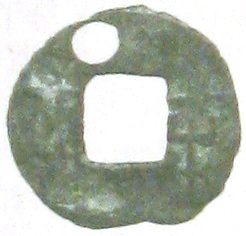
    An article in a Chinese numismatic publication introduces a newly discovered and never seen before variety of the Chinese ban liang coin.  In addition to the normal square hole in the center of the coin, these coins have an additional one or two holes drilled into them.

    Ban Liang Coin with Drilled Hole from State of Qin

    The Volume One 2010 edition of “China Numismatics” has an article entitled “Zhangjiachuan Prefecture Excavates ‘Drilled Hole’ Ban Liang“.

    The author explains that in the summer of 2006 he bought about 200 recently unearthed ban liang coins.  The coins were excavated in Zhangjiachuan prefecture of Gansu Province in northwest China.

    Among the coins purchased were a few of a variety that had neither been seen before or reported in the literature.

    As can be seen in the illustration*, these coins have one or two additional holes.

    The author states that these coins were cast in the state of Qin during the middle to late Warring States Period (475 BC – 221 BC).  The coins range in diameter of 23-33 mm and in weight of 1-8 grams.

    The coin shown here has the largest drilled hole but is actually the smallest and lightest of the coins with a diameter of 23 mm and a weight of only 1 gram.

    The additional holes are in various areas above or below the square hole.  Some have one large hole while others have two smaller holes.

    The author carefully examined each coin and determined that the holes, while not perfectly round, were definitely intentionally made by hand after the casting of the coin.  The holes are not the result of poor casting technique.  The holes were apparently drilled in the larger and thicker areas of each coin and placed so as to avoid damaging the Chinese character inscription.

    Unfortunately, the specifics as to where the coins were dug up is unknown so we do not know if the coins were buried in a pit or came from a tomb.  Knowing whether the coins came from a buried cache or from a grave could help provide an explanation as to the reason for the holes.

    The author speculates that the holes were not made so that the coins could be worn as an ornament or pendant because the off-center placement of the holes would not allow the coin to hang correctly.

    Since coins were a symbol of wealth, it is possible that they may have been burial objects.

    The author concludes that no matter what the ultimate purpose, the holes were intentionally handmade and not the result of inferior casting technique.

    As I discuss in detail at “Emergence of Chinese Charms“, ban liang coins began to appear with various marks and symbols at the beginning of the Western Han Dynasty (206 BC – 24 AD).  These symbols include “stars” (dots), “moons” (crescents), “suns” (circles), etc., and symbols on coins gradually became more and more complex until they finally developed into true charms and amulets.

    While the purpose of the additional holes on the newly discovered ban liang coins remain unknown, they may very well have been the precursor to the “stars” ,”moons” and “suns” that appeared on the later Han Dynasty coins.

    * Color added to black & white image to enhance features

  • Zhong Kui — “Peking Opera” Star and “Demon Slayer”

    Zhong Kui lived during the reign (712-756 AD) of Emperor Xuanzong of the Tang Dynasty.

    However, just at the moment he achieved the pinnacle of success which would guarantee him fame and fortune, he suffered such misfortune that he took his own life.

    Over the centuries, a mythical Zhong Kui evolved who, now immortal, protects others from evil and brings happiness and good fortune.

    Zhong Kui has also become one of Peking Opera’s most popular and beloved character roles.

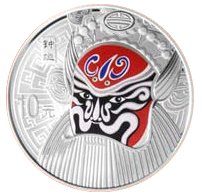
    On April 20th, China released a second series of gold and silver coins commemorating famous characters of the Peking Opera.  This set of coins, officially known as the Peking Opera Facial Makeup Series, includes a gold coin with a denomination of 100 yuan honoring Bao Zheng who was an official during the Northern Song Dynasty and a symbol of justice and integrity.  Two silver coins denominated at 10 yuan were also released.  One silver coin honors Dian Wei who was a military general under Cao Cao during the Han Dynasty.

    Zhong Kui as Peking Opera character

    The other silver coin, shown at the left, honors Zhong Kui who is a character in the ever popular Peking Opera “Zhong Kui Marries Off His Sister”.

    Zhong Kui was a gifted scholar who succeeded in passing the highest examination of the imperial examination system making him eligible for an important office which would ensure a life of wealth and honor.

    However, Zhong Kui was denied these rewards because he happened to be physically disfigured and was considered too ugly.

    Zhong Kui was so despondent that he committed suicide by bashing his head against a pillar.

    In China, history and myth frequently merge and this was the case with Zhong Kui.  The immortal Jade Emperor took pity on him and appointed him to be the protector of mortals and to be both judge and executioner in the fight against demons and evil spirits.

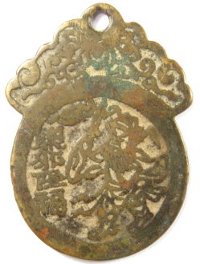
    Zhong Kui charm

    Pictures of Zhong Kui, in his mythical role as the “Demon Slayer” or “Demon Chaser”, have traditionally been hung on the walls of Chinese houses as a form of protection.

    For the same reason, Zhong Kui is also seen on old Chinese charms and amulets such as the one at the left.

    A robust and heavily-bearded Zhong Kui is seen here wielding his famous “Demon Slaying” sword.

    The projections extending from each side of his hat are actually “demon-seeking” devices which point at unseen and lurking dangers.

    Also, just above and to the left of his head is a bat.  The bat is often seen together with Zhong Kui as a symbol of “good fortune” and “happiness”.

    This is because the Chinese language facilitates the creation of puns and rebuses.

    In Chinese, the word for “bat” (fu) and the word for “happiness” (fu) have the same pronunciation.

    Also, if you observe closely, you will notice that the bat is actually flying upside-down.  The Chinese word for “upside-down” (dao) and the expression “have arrived” (dao) have the same pronunciation.

    Therefore, to say “the bat is upside-down” sounds exactly like saying “happiness has arrived”!

    Some of the same characteristics that identify this “mythical” Zhong Kui can also be found in his Peking Opera character.

    For example, the makeup of Zhong Kui on the Peking Opera coin includes a heavy beard.

    Moreover, the beard helps set off the face which, along with the ears that look like wings, gives the face the appearance of a bat.

    As already mentioned, the “bat” symbolizes the “happiness” he can bring to mortals.

    To further emphasize the “bat” and “happiness” rebus, an image of a bat flying downwards is actually painted on the forehead.

    As part of the makeup, Zhong Kui is given red cheeks to symbolize dignity.  The painted black and white lines on the face express uprightness and the mouth is shown smiling to express Zhong Kui’s amiability.

    The top of the head is painted red as a reminder that he died by beating his head against a pillar.

    However, at the very top of his head is an oval-shaped design which in reality is a very stylized version of the Chinese character shou meaning “longevity”.   In spite of his suicide, Zhong Kui became immortal.

    The Zhong Kui of the Tang Dynasty was denied the honor, wealth and happiness he had earned and he died in sorrow by his own hand.

    But the mythical Zhong Kui has become immortalized as a popular character in traditional Peking Opera.

    And, for many centuries, images of Zhong Kui have been hung in countless Chinese homes and carried as charms and amulets to provide protection from evil spirits and to bring “happiness” and “good fortune”.